
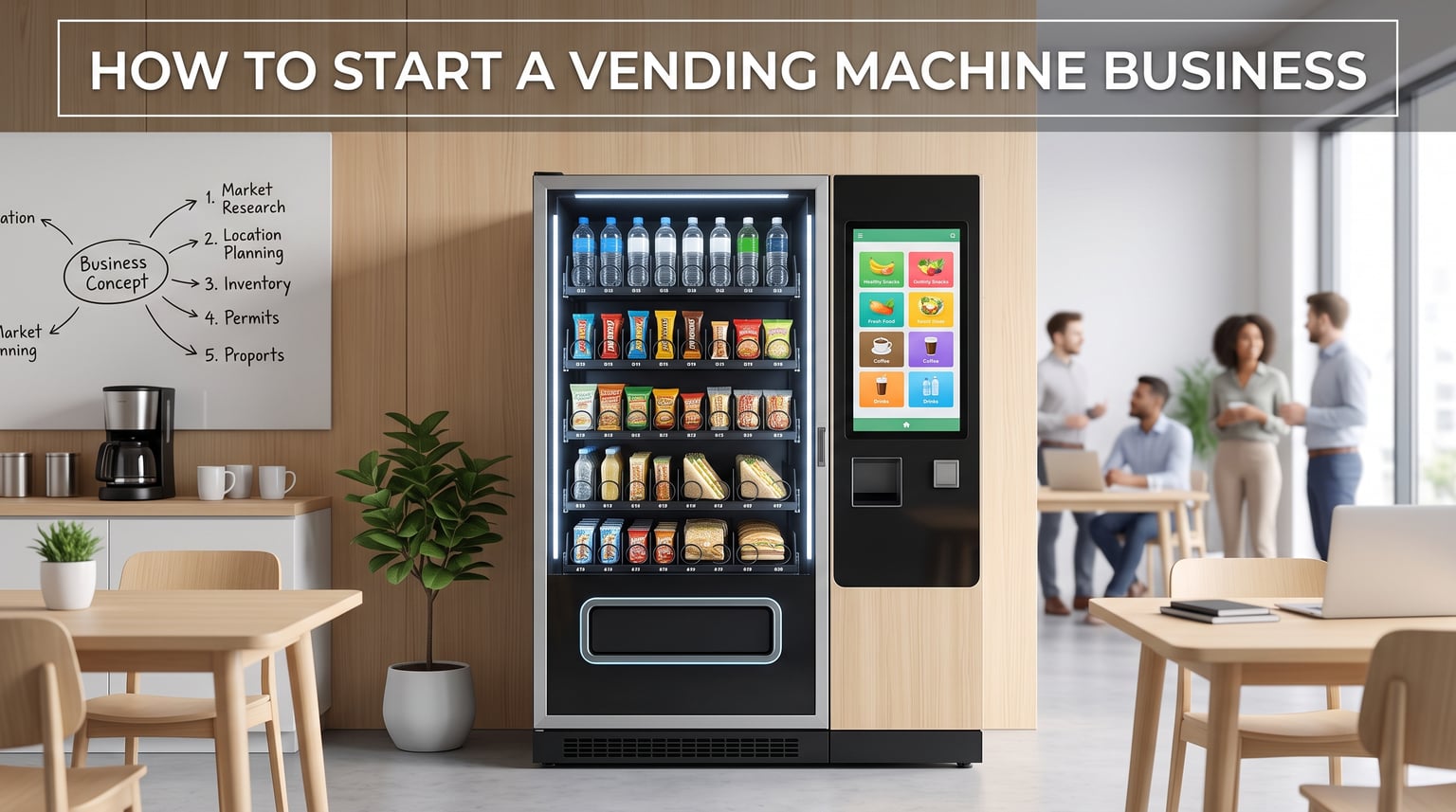
The vending machine industry generated $7.7 billion in revenue in 2025, according to IBISWorld, with approximately 2.59 million vending machines operating across the United States. The sector is projected to grow at a compound annual growth rate of 3.8% through 2033, driven by innovations in smart vending technology and the expansion of cashless payment systems. For entrepreneurs seeking a business with relatively low barrier to entry and scalable operations, understanding how to start a vending machine business represents a legitimate path to generating passive income streams.
This guide provides a comprehensive framework for launching and operating a vending machine enterprise. Industry operators and market analysts consistently identify three critical success factors: strategic location selection, disciplined financial management, and proactive operational systems. The following sections break down each component with specific cost benchmarks, profit formulas, and actionable tactics drawn from current market conditions and operator experiences documented across the industry.
What You’ll Learn in This Guide:
- How to select the right vending machine business model for your goals
- Detailed startup cost breakdowns by machine type
- Location scoring criteria used by successful operators
- Financing options including equipment loans, lease-to-own programs, and SBA loans
- Legal compliance checklist covering ADA, FDA labeling, and state permits
- Profit formula with worked examples showing net margin calculations
- Scaling strategies from side hustle to full-time operation
- Tax deductions and business entity structuring recommendations
Understanding the Vending Machine Business Model
A vending machine business operates on a straightforward premise: an operator places machines at third-party locations in exchange for a commission on sales or rental fee. The business model has evolved significantly from traditional coin-operated snack machines to encompass smart vending technology, micro markets, and cashless-first payment systems. Before investing capital, prospective operators should understand the distinct business models available and which align with their financial goals and operational capacity.
Traditional Vending Machine Operations
Traditional vending involves placing snack and beverage machines at locations with consistent foot traffic. Operators typically generate revenue through the markup between wholesale product costs and retail sale prices, plus any location commissions paid to property owners. According to VendSoft’s 2026 industry analysis, a typical vending machine generates $150 to $400 in monthly gross revenue, with net margins ranging from 25% to 35% after accounting for cost of goods sold, location commissions, and operational expenses.
The traditional model requires physical route management: operators drive to each location to restock products, collect cash, and perform basic maintenance. Route density significantly impacts profitability, as fuel and labor costs per sale decrease when machines are clustered geographically. New operators should target a minimum of five machines within a concentrated area to achieve viable economics, according to industry benchmarks.
Smart Vending and Micro Markets
Smart vending represents the fastest-growing segment of the industry. These machines incorporate telemetry systems that transmit sales data, inventory levels, and machine status remotely, enabling operators to optimize restocking routes and identify underperforming locations quickly. The initial investment for smart vending equipment ranges from $6,000 to $15,000 per machine, but operators report revenue increases of 30% or more compared to traditional machines due to improved product availability and cashless payment acceptance.
Micro markets take the smart vending concept further by creating unstaffed retail environments with multiple vending machines and open shelving. These setups, often found in office building break rooms, generate substantially higher per-square-foot revenue than traditional vending. According to 365 Retail Markets, operators installing micro market configurations in appropriate locations report monthly revenues reaching $22,000 or higher, though these installations require greater capital investment and more complex location agreements.
Specialty and Bulk Vending
Specialty vending encompasses machines dispensing non-food items including electronics accessories, personal care products, or unique merchandise. Bulk vending, characterized by machines dispensing gumballs, toys, or novelties for one to three cents per item, requires minimal capital to enter but generates lower per-machine revenue. These models suit operators seeking low-cost entry points or diversification strategies alongside higher-revenue snack and beverage operations.
Cashless Payment Systems and Their Impact
The shift to cashless payments has reshaped vending economics. Industry data from 2024 indicates that 75% of vending revenue is now generated through card readers and mobile payment systems. Machines equipped with cashless payment capability consistently outperform cash-only counterparts because they eliminate the constraint of customers lacking exact change and reduce cash collection risks.
Retrofitting existing machines with card readers costs $200 to $500 per machine, while new machines typically include cashless capability in their base configuration. Operators should factor card processing fees of 2% to 4% into their profit calculations. Despite these fees, the combination of higher sales volume and reduced cash handling costs typically produces net positive returns for cashless-enabled machines.
Startup Costs: A Detailed Breakdown
One of the most common questions prospective vending operators ask concerns startup costs. The answer varies significantly based on machine type, condition, and scale of operation. Understanding the full cost landscape prevents undercapitalization, which industry experts identify as a primary failure point for new vending businesses.
Machine Costs by Type and Condition
Used vending machines represent the lowest entry point, with prices ranging from $1,000 to $3,000 depending on age, condition, and features. Machines purchased at the lower end of this range frequently require immediate repairs or component replacements, adding $300 to $800 in additional costs. Operators should inspect used machines thoroughly before purchase, checking compressor function, coin mechanism accuracy, and bill validator calibration.
Refurbished machines offer a middle ground, typically priced between $2,500 and $4,500. Reputable refurbishment vendors warranty these machines for 90 days to one year, providing protection against early failures. The premium over budget used machines typically pays for itself through reduced repair downtime and longer service life.
New vending machines from manufacturers carry price tags of $3,000 to $6,000 for standard snack and beverage configurations. Refrigerated combo machines with both food and drink compartments range from $4,500 to $8,000. New equipment carries manufacturer warranties of one to three years and includes current-generation payment systems and telemetry capability.
Smart vending machines with integrated telemetry, touchscreens, and advanced inventory management represent the highest initial investment at $6,000 to $15,000 or more. While the upfront cost is substantially higher, operators benefit from remote monitoring capabilities that reduce route servicing time and enable data-driven inventory decisions.
Initial Inventory and Product Costs
Stocking a new machine requires $200 to $500 in initial inventory per machine, depending on machine capacity and product selection. Most snack machines hold 300 to 500 items, while beverage machines typically accommodate 200 to 400 units. Operators purchasing from wholesale distributors achieve cost margins of 40% to 60% off retail pricing, enabling healthy gross margins on each sale.
Product selection should align with location demographics. Machines placed near gyms or fitness centers typically perform well with protein bars, trail mix, and sports drinks at premium price points. Office environments favor traditional snacks, cold beverages, and healthier options. Analyzing competitor offerings at potential locations helps identify underserved product categories.
Location Costs and Commission Structures
Location commission rates typically range from 5% to 15% of gross sales, paid to the property owner in exchange for placing the machine on their premises. Prime high-traffic locations such as airports and hospitals command the highest commission rates, sometimes exceeding 20%, while smaller retail locations may accept lower percentages or flat monthly rental fees.
Some operators negotiate commission structures based on minimum monthly guarantees rather than percentage of sales. This approach protects operators during slow periods but requires accurate sales forecasting. A minimum guarantee of $50 to $100 per month per machine, regardless of sales volume, provides property owners with predictable income while giving operators upside potential during peak periods.
Additional Startup Expenses
Beyond machine and inventory costs, new operators should budget for business licensing, insurance, transportation, and tools. A general liability insurance policy for vending operations costs $500 to $1,200 annually, depending on coverage limits and location count. Vehicle expenses, whether through a dedicated service vehicle or mileage reimbursement from a personal car, represent an ongoing operational cost that significantly impacts profitability at small scales.
A basic tool kit for field service work costs $100 to $200, including screwdrivers, pliers, multimeter for electrical testing, and refrigeration diagnostic tools for refrigerated machines. Many minor repairs and adjustments can be performed on-site, reducing the need for service technician calls that typically cost $75 to $150 per visit.
Financing Options for Vending Machine Businesses
Capital constraints represent a significant barrier for many aspiring vending operators. Several financing pathways exist beyond personal savings, each with distinct advantages and qualification requirements. Understanding these options enables operators to select the approach best suited to their financial situation and growth objectives.
Equipment Financing and Lease-to-Own Programs
Equipment financing allows operators to purchase machines while spreading payments over 24 to 60 months. Interest rates typically range from 7% to 15% annual percentage rate, depending on credit score and down payment amount. The machines themselves serve as collateral, reducing down payment requirements compared to unsecured business loans. Most equipment financing agreements include provisions for early payoff without prepayment penalties.
Lease-to-own programs offered by vending machine distributors and independent financing companies provide an alternative where monthly payments ultimately lead to ownership. These programs often include maintenance and warranty services within the monthly payment, simplifying budget forecasting. However, total costs through lease-to-own programs typically exceed cash purchase prices by 15% to 30%.
Business Credit Cards and Lines of Credit
Business credit cards provide flexible financing for initial inventory purchases and unexpected repair costs. Rewards programs on business cards can offset operational expenses, with cash back or travel rewards valued at 1% to 3% of spending. Operators should distinguish between personal and business expenses for tax purposes and maintain separate business accounts from day one.
Establishing business credit through vendor relationships and equipment financing builds credit history that enables larger financing rounds as the business scales. Many operators start with personal credit and transition to business-only financing once they establish positive payment history and business revenue documentation.
SBA Loans and Traditional Business Financing
The Small Business Administration offers loan programs through certified lenders, including 7(a) loans up to $5 million and CDC/504 loans for real estate and equipment. SBA loans require more documentation and longer approval timelines than alternative financing sources but offer competitive interest rates and favorable terms. Operators with strong business plans and solid personal credit scores may qualify for SBA financing to fund larger scale operations from inception.
Buying an Existing Vending Route
Acquiring an existing vending route bypasses the startup phase, providing immediate cash flow, established locations, and proven product mixes. BizBuySell lists vending machine businesses with median asking prices around $135,000 for established operations. However, routes at various price points exist, with smaller operations of three to five machines sometimes available for $15,000 to $50,000.
Due diligence on route purchases should include verification of location contracts, equipment condition assessments, review of sales history documentation, and investigation of any pending disputes with location owners. Operators should physically visit each location and speak directly with property managers to confirm relationship status and satisfaction levels before completing acquisitions.
Location Selection: Finding Profitable Placement Opportunities
Industry veterans consistently identify location as the single most important factor in vending success. Even premium equipment in poor locations underperforms adequately equipped machines in high-traffic areas. Developing a systematic approach to location evaluation prevents costly placement mistakes and builds a foundation for profitable route density.
Location Scoring Criteria and Minimum Benchmarks
Successful operators evaluate locations using multi-factor scoring systems that weigh foot traffic volume, demographic fit, dwell time, competition proximity, and access hours. According to industry benchmarks, traditional vending machines require minimum daily foot traffic of 50 to 100 people to achieve viable economics, while smart machines with cashless capability need 150 or more daily visitors to justify their higher cost.
Dwell time matters significantly: locations where customers wait or linger, such as medical offices, auto repair waiting areas, and hotel lobbies, generate substantially higher per-visitor sales than locations where people walk past without stopping. Mike Hoffman of Vendingpreneurs, an industry operator with extensive experience, reports that an urgent care location with 80 patients per day and 90-minute average wait times generates $40 per day in energy drink sales alone.
Target Locations by Type
Office buildings and corporate campuses provide consistent weekday traffic and favorable demographics for premium-priced snacks and beverages. Manufacturing facilities, warehouses, and distribution centers with break rooms represent strong candidates, particularly those with shift workers who have limited access to external food options during work hours.
Healthcare facilities including hospitals, medical offices, and urgent care centers generate reliable traffic from patients, visitors, and staff. The captive audience effect of waiting rooms creates natural purchasing opportunities, and healthcare workers often purchase beverages and snacks during long shifts.
Educational institutions including colleges, universities, and high schools offer predictable traffic patterns aligned with class schedules. Vending in educational settings requires attention to nutritional standards that vary by institution type and state regulations.
Retail environments such as shopping centers, grocery stores, and convenience stores provide built-in foot traffic but may have existing vending arrangements or space constraints. Approaching retail locations with unique product offerings that complement rather than compete with existing options improves acceptance rates.
Placement Agreement Essentials
Securing machines requires a formal placement agreement that outlines terms including commission rates, minimum guarantees, contract duration, renewal provisions, and termination clauses. Operators should ensure agreements include exclusivity provisions preventing property owners from placing competing vending equipment in the same location during the contract term.
Contract durations typically run one to three years with automatic renewal provisions. Operators should negotiate termination rights that allow exit from underperforming locations without excessive penalties. Location owners should receive clear contact information and expect regular service visits, typically at least weekly for traditional machines and less frequently for smart machines with telemetry capabilities.
Negotiation Tactics and Approaches
Operators report that in-person visits to potential locations yield substantially better results than cold calling or email outreach. Industry discussions suggest a “Friday pop-in” approach, visiting potential locations on Friday afternoons when decision-makers are more available and receptive to brief conversations. Following up with formal proposals within 48 hours of initial contact capitalizes on positive impressions.
When negotiating commission structures, operators with limited credit history or startup experience may offer higher initial commission percentages that decrease as the location proves its performance over time. This approach reduces risk for location owners while preserving upside potential for operators when sales exceed expectations.
Business Formation and Legal Compliance
Establishing a vending machine business as a formal legal entity provides liability protection and tax benefits that outweigh the registration costs and administrative requirements. Compliance with federal, state, and local regulations prevents penalties and ensures smooth operations as the business scales.
Business Entity Formation: LLC and Beyond
Forming a Limited Liability Company separates personal assets from business liabilities, protecting personal savings and property if the business faces lawsuits or debt collection. LLC formation costs range from $100 to $500 depending on the state, with annual renewal fees of $50 to $800. Many entrepreneurs starting vending businesses operate as sole proprietors initially but form LLCs once they place their first machine and begin generating revenue.
The question of whether operators need an LLC for vending machine businesses frequently arises in industry discussions. While sole proprietors can operate vending routes, the liability exposure from machine placement on public and private property makes LLC formation advisable before placing the first machine. LLCs also enable business-only bank accounts and credit cards that simplify expense tracking and tax preparation.
Licenses, Permits, and Registrations
Vending machine operations require several licenses and permits that vary by state and locality. A general business license, often called a vendor’s license or business operations permit, is universally required. Most states require a seller’s permit for collecting and remitting sales tax on vending machine revenue. An Employer Identification Number from the IRS, obtained free through the IRS website, is required for LLCs and any business with employees.
Food vending machines containing perishable items require health department permits in most jurisdictions. Requirements vary significantly between states, with some requiring plan review and facility inspections before issuing food handler permits. Operators should consult their state vending association or the VendSoft 50-state vending law directory to understand jurisdiction-specific requirements before placing machines with food products.
ADA Compliance for Vending Machine Placement
The Americans with Disabilities Act establishes accessibility standards for vending machine placement. Machines must be reachable by users in wheelchairs, with controls positioned between 15 and 48 inches from the floor and floor clearance of at least 30 by 48 inches for approach. These requirements affect both the machines themselves and the locations where they are placed.
Operators should verify that proposed locations meet ADA access requirements before signing placement agreements. Property owners typically bear responsibility for accessible route compliance, but operators placing equipment in non-conforming spaces may face liability issues. Documentation of ADA compliance verification protects operators during any future accessibility-related inquiries.
FDA Calorie Labeling Requirements
The FDA requires calorie labeling on vending machine products in operations with 20 or more machines. This regulation, effective since 2018, mandates that operators display calorie information for each product at the point of selection. Machines with digital displays can often meet this requirement through programmable calorie labels, while traditional machines may require printed wrap labels or shelf talkers.
Operators with fewer than 20 machines are exempt from federal calorie labeling requirements but may face state or local regulations. California’s Proposition 65 and other state-specific requirements may apply depending on product selection and location. Consulting with a regulatory compliance specialist before launching operations prevents costly remediation efforts after growth expands the fleet beyond 20 machines.
Insurance Requirements
General liability insurance protects operators from claims arising from machine malfunctions, product liability, or injuries occurring near vending equipment. Minimum coverage of $1 million per occurrence and $2 million aggregate is typically required by location agreements, though some property owners require higher limits. Product liability coverage specifically addressing claims from consumed vending products is often included in general policies but should be verified.
Commercial auto insurance is required when using vehicles for route servicing. Coverage minimums depend on vehicle value and state requirements, with typical limits of $100,000 combined single limit or $50,000/$100,000/$50,000 split limits for bodily injury and property damage coverage.
Operational Systems and Day-to-Day Management
Successful vending operations depend on systematic processes that minimize wasted time and ensure consistent service quality. Building efficient operational systems from the start enables profitable scaling without proportional increases in labor costs.
Stocking Schedules and Restock Frequency
Establishing appropriate restocking frequencies requires balancing service visit costs against lost sales from empty machines. New operators should monitor machines closely during the first 30 days, tracking depletion rates by product to identify optimal service intervals. Most traditional machines require weekly servicing, while well-stocked smart machines in reliable locations may need service only every two weeks.
Route planning should cluster locations geographically to minimize drive time between stops. VendSoft recommends generating weekly picklists based on inventory data from route sheets or telemetry reports, ensuring service vehicles carry appropriate product assortments and quantities for each location visit.
Inventory Management and Product Mix Optimization
Effective inventory management balances product availability against spoilage and expiration costs. Vending machines experience spoilage primarily from products reaching expiration dates before sale, particularly in refrigerated units with limited product turnover. Tracking spoilage rates by product category helps identify underperforming items that should be replaced in the product mix.
Price adjustments based on sales velocity improve inventory turns. Products that sell out quickly may support price increases, while slow-moving items may perform better at reduced price points or should be discontinued entirely. Operators should review product mix quarterly, adjusting planograms based on sales data rather than gut feelings.
Pricing Strategy and Markups
Industry pricing benchmarks suggest markups of 2.5 to 3 times wholesale cost for beverages and 2 to 2.5 times for snacks. A beverage purchased wholesale for $0.50 should retail between $1.25 and $1.50, while snacks costing $0.40 wholesale typically sell for $1.00 to $1.25. Premium locations with captive audiences may support higher markups, while competitive locations may require lower pricing to maintain sales volume.
Cashless payment systems enable dynamic pricing strategies where operators adjust prices between cash and card transactions to absorb card processing fees. A common approach prices cash transactions at $1.25 and card transactions at $1.35, generating additional revenue that offsets the 3% card processing fee while remaining competitive with nearby retailers.
Vending Management Software and Telemetry
Vending management software platforms centralize route planning, inventory tracking, and cash reconciliation across machine fleets. Platforms like VendSoft, Nayax, and Cantec provide features including DEX file import for sales data analysis, automated service route optimization, and cash flow forecasting based on historical performance.
Telemetry-enabled machines transmit real-time data including inventory levels, sales transactions, and machine status alerts directly to management software dashboards. This capability transforms route servicing from scheduled guesswork into data-driven responses where trucks stock only what each location needs. Operators report telemetry integration reduces service time per location by 20% to 40% while improving product availability.
Cash Collection and Reconciliation
Regular cash collection maintains machine functionality and ensures operators receive earned revenue promptly. Weekly collection schedules work for most locations, though high-volume sites may require twice-weekly pickup to prevent bill stacking that leaves insufficient change for customers.
Cash reconciliation comparing collected amounts against expected sales based on DEX data identifies discrepancies that may indicate collection errors, theft, or machine malfunctions. Operators should establish procedures for investigating variances exceeding 5% and document all reconciliation findings for tax and insurance purposes.
Profitability Analysis: Understanding the Numbers
Prospective operators frequently ask whether vending machine businesses generate meaningful profit. The honest answer depends on multiple factors including machine count, location quality, operational efficiency, and cost control. Examining realistic profit scenarios with actual numbers helps entrepreneurs set appropriate expectations.
The Vending Machine Profit Formula
The fundamental vending profit formula subtracts cost of goods sold, location commissions, and operational expenses from gross revenue to determine net profit. A worked example from industry analysis demonstrates the calculation:
Gross Revenue: $1,000 monthly sales per machine
Cost of Goods Sold (50%): $500 in product costs at standard wholesale pricing
Location Commission (10%): $100 paid to property owner
Card Processing Fees (3%): $18 on cashless portion of sales
Fuel and Vehicle Costs: $20 allocated per machine for route servicing
Net Profit: $362 per machine per month (36.2% net margin)
This example assumes a well-performing machine in a quality location with efficient route density. Actual results vary significantly based on these factors.
Scaling Tiers and Revenue Projections
Industry benchmarks from VendSoft provide realistic scaling projections based on fleet size:
5 machines: $250 to $500 monthly net profit. This level functions as a viable side hustle generating supplementary income while requiring approximately 4 to 6 hours weekly for route servicing. Single-machine operators frequently report profits of $30 to $150 monthly, depending heavily on location quality.
10 machines: $500 to $1,200 monthly net profit. At this scale, vending becomes a meaningful income stream comparable to a part-time job, requiring 8 to 12 hours weekly. Operators typically achieve better pricing from suppliers through volume purchasing and improved route efficiency.
25 machines: $1,200 to $3,000 monthly net profit. This range represents full-time income territory for most operators, requiring 20 to 30 hours weekly. Fleet management becomes complex, typically requiring dedicated routing software and possibly part-time help for service runs.
50+ machines: $3,000 to $8,000+ monthly net profit. At this scale, operators transition from route servicers to logistics managers, delegating service tasks and focusing on growth, location acquisition, and financial management.
Key Performance Indicators to Track
Tracking specific metrics enables continuous improvement and identifies underperforming locations requiring intervention. Gross sales per machine per week reveals baseline performance trends. Gross margin percentage indicates pricing effectiveness and product cost management. Spoilage rate as a percentage of total inventory exposes potential product mix problems.
Service time per location helps optimize route planning and identify locations requiring excessive service attention. Commission percentage relative to gross sales shows location agreement terms and potential renegotiation opportunities. Understanding the complete profit picture for each machine guides both operational improvements and decisions about underperforming locations that may warrant removal.
Is Vending Machine Ownership Really Profitable?
Reddit discussions among vending operators reveal a consensus: vending machine businesses are profitable when properly managed, but the profit requires genuine effort rather than passive returns. Initial profits are modest, and operators should expect 12 to 24 months before seeing meaningful income. The comparison to “set it and forget it” passive income is misleading, according to experienced operators who emphasize the physical demands of route servicing.
Industry expert Mike Hoffman illustrates the growth potential: after purchasing an initial route generating $8,000 monthly, upgrading to smart micro-market configurations expanded revenue to $75,000 monthly. This trajectory required significant capital investment and operational expertise but demonstrates the scalability available to operators willing to continuously improve their business systems.
Tax Considerations and Business Deductions
Proper tax planning significantly impacts vending machine business profitability. Several deductions and depreciation strategies reduce taxable income, preserving more of earned revenue for reinvestment or personal use.
Section 179 Depreciation for Equipment
The IRS Section 179 deduction allows businesses to expense the full purchase price of qualifying equipment during the year of purchase rather than depreciating it over multiple years. For vending machines qualifying as personal property, this provides substantial front-loaded tax benefits. The Section 179 limit for 2026 is $1,160,000 with a $2,890,000 phase-out threshold.
Operators purchasing new or used vending equipment should work with tax professionals to determine whether Section 179 election makes sense for their situation. Businesses with limited taxable income may benefit more from standard depreciation spreads, while profitable operations in high tax brackets maximize savings through accelerated expensing.
Common Business Deductions
Trackable deductions for vending operators include vehicle mileage for route servicing, calculated using the IRS standard mileage rate or actual expenses including fuel, maintenance, and depreciation. Home office deductions apply if a dedicated business space exists within the primary residence. Business insurance premiums, licensing fees, and equipment maintenance costs are fully deductible business expenses.
Location commissions paid to property owners create deductible expenses, as do product costs and packaging materials. Bank fees and payment processing charges on business accounts reduce taxable income. Maintaining detailed records throughout the year simplifies tax preparation and maximizes legitimate deductions.
Sales Tax Collection and Remittance
Vending machine sales are subject to sales tax in most states, with rates ranging from approximately 4% to 10% depending on jurisdiction. Operators must collect applicable sales tax from customers at point of purchase and remit collected amounts to state revenue departments on scheduled intervals, typically monthly or quarterly.
Some states exempt certain food items from sales tax, particularly staple groceries, while taxing soft drinks and candy. Understanding state-specific exemptions affects both compliance obligations and product selection decisions. Multi-state operators face additional complexity requiring registration and compliance in each state where machines are placed.
Advantages and Disadvantages of Vending Machine Businesses
Objectively evaluating the vending machine business model requires acknowledging both genuine benefits and legitimate challenges. Prospective operators make better decisions when they understand what they are committing to rather than idealized expectations.
Key Benefits of Vending Operations
Passive income potential: Once established with quality locations and efficient systems, vending operations generate income with relatively limited ongoing time investment. Experienced operators report systems enabling semi-passive income where machines operate without daily attention.
Low barrier to entry: Starting with a single used machine requires as little as $1,500 to $3,000 in total startup capital, substantially less than most business opportunities. This accessibility enables entrepreneurs to test the business model without life-altering financial commitments.
Scalability: Growth does not require hiring employees or expanding physical facilities. Each additional machine generates incremental revenue with proportional cost increases that maintain profit margins. This linear scalability suits owner-operators who prefer incremental investment over dramatic leaps.
Schedule flexibility: Route servicing can accommodate other commitments, with many operators running vending routes alongside full-time employment. Service visits can be scheduled during evenings, weekends, or other convenient times.
Significant Challenges to Consider
Physical labor requirements: Vending is not truly passive income at startup or during scaling phases. Loading heavy product into machines, performing field repairs, and driving route miles requires physical effort and time investment that surprises many new operators.
Machine maintenance demands: Breakdowns occur unpredictably and require timely response to minimize lost sales. Used machines frequently experience compressor failures and component malfunctions within months of purchase, according to multiple operator reports. Warranties provide protection but still require administrative effort to pursue claims.
Location dependency: Revenue depends entirely on third-party property owners who can terminate agreements with limited notice. Location owners may also place competing machines or change building management, disrupting established relationships.
Thin margins at small scale: Single machines and small fleets generate modest profits that may not justify the time investment. Achieving meaningful income requires fleet growth that demands additional capital, which operators must generate from operations or external sources.
Competition pressures: The vending industry is highly fragmented, with operators competing for limited prime locations. Differentiation through product selection, pricing, and service quality becomes essential in markets with established competitors.
Frequently Asked Questions
How much does it cost to start a vending machine business in 2026?
Startup costs range from $1,500 to $3,000 for a single used machine with initial inventory, or $5,000 to $15,000 for a new smart vending setup. Total investment depends on machine type, condition, and fleet size. Traditional used machines cost $1,000-$3,000, new machines $3,000-$6,000, and smart vending equipment $6,000-$15,000.
How many vending machines do you need to make $100k per year?
Based on industry benchmarks of $150-$400 monthly gross revenue per machine with 25-35% net margins, generating $100,000 annual net profit requires approximately 25-40 machines depending on location quality and operational efficiency. Most operators achieve $3,000-$5,000 annual net profit per machine at scale, meaning 25 machines could generate $75,000-$125,000 before taxes.
Do I need an LLC to own vending machines?
While not legally required to start, forming an LLC is strongly recommended before placing your first machine. An LLC provides personal liability protection separating your business debts and legal risks from personal assets. Formation costs range from $100-$500 depending on the state, with annual renewal fees of $50-$800.
What permits and licenses are required for vending operations?
Requirements vary by state but typically include a general business license, seller’s permit for sales tax collection, health department permit for food machines, and Employer Identification Number. Locations may require ADA-accessible machine placement. Some states require food handler permits and health inspections before operation.
Is a vending machine business truly profitable in 2026?
Yes, vending machines generate $150-$400 monthly gross revenue per machine with net margins of 25-35% after accounting for product costs, commissions, and operational expenses. Realistic take-home profit ranges from $40-$120 per machine monthly. Profitability scales with fleet size and location quality. Initial years require reinvestment before meaningful distributions.
Where are the best locations for vending machines?
High-traffic areas with captive audiences generate best results: office buildings, hospitals, manufacturing facilities, schools, hotels, and apartment complexes. Ideal locations have 100+ daily foot traffic, extended operating hours, and demographics matching your product selection. Avoid locations with existing vending unless you offer superior products or competitive pricing.
Should I buy new or used vending machines for my first purchase?
For first-time operators, refurbished machines from reputable dealers offer the best balance of cost and reliability, typically $2,500-$4,500 with 90-day to one-year warranties. Used machines under $2,000 frequently require immediate repairs. New machines cost 2-3x more but include warranties and modern features. Smart machines cost $6,000-$15,000 but generate 30%+ higher revenue through telemetry and cashless payments.
How do vending machine commission payments work?
Location commissions typically range from 5%-15% of gross sales, paid monthly to property owners. Some agreements use minimum monthly guarantees instead of percentages. Prime high-traffic locations like airports command 20%+ commissions, while smaller retail locations may accept flat monthly fees of $50-$200.
Conclusion: Is Vending Machine Ownership Right for You?
The vending machine business offers genuine profit potential for operators willing to invest the required time and capital. The $7.7 billion industry grows steadily with 3.8% annual projections through 2033, supported by technological innovations in smart vending and expanding cashless payment adoption. Realistic profitability ranges from $40 to $120 monthly take-home profit per machine, scaling to meaningful full-time income with fleet sizes of 25 or more machines.
Success requires treating vending as a business rather than passive income, particularly during the initial years when operational systems are being developed and routes are being established. Location quality remains the primary determinant of success, exceeding the importance of machine features or product selection. Operators who approach the business with realistic expectations, adequate capital reserves, and commitment to consistent service build sustainable income streams over time.
The path to profitability follows a predictable trajectory: initial years focused on establishing locations and refining operations, middle period of scaling fleet size and optimizing systems, and mature operations generating semi-passive income with efficient route management. Entrepreneurs willing to commit to this timeline and put in the required physical work will find vending machine ownership a viable path toward financial independence through 2026.
Leave a Reply