
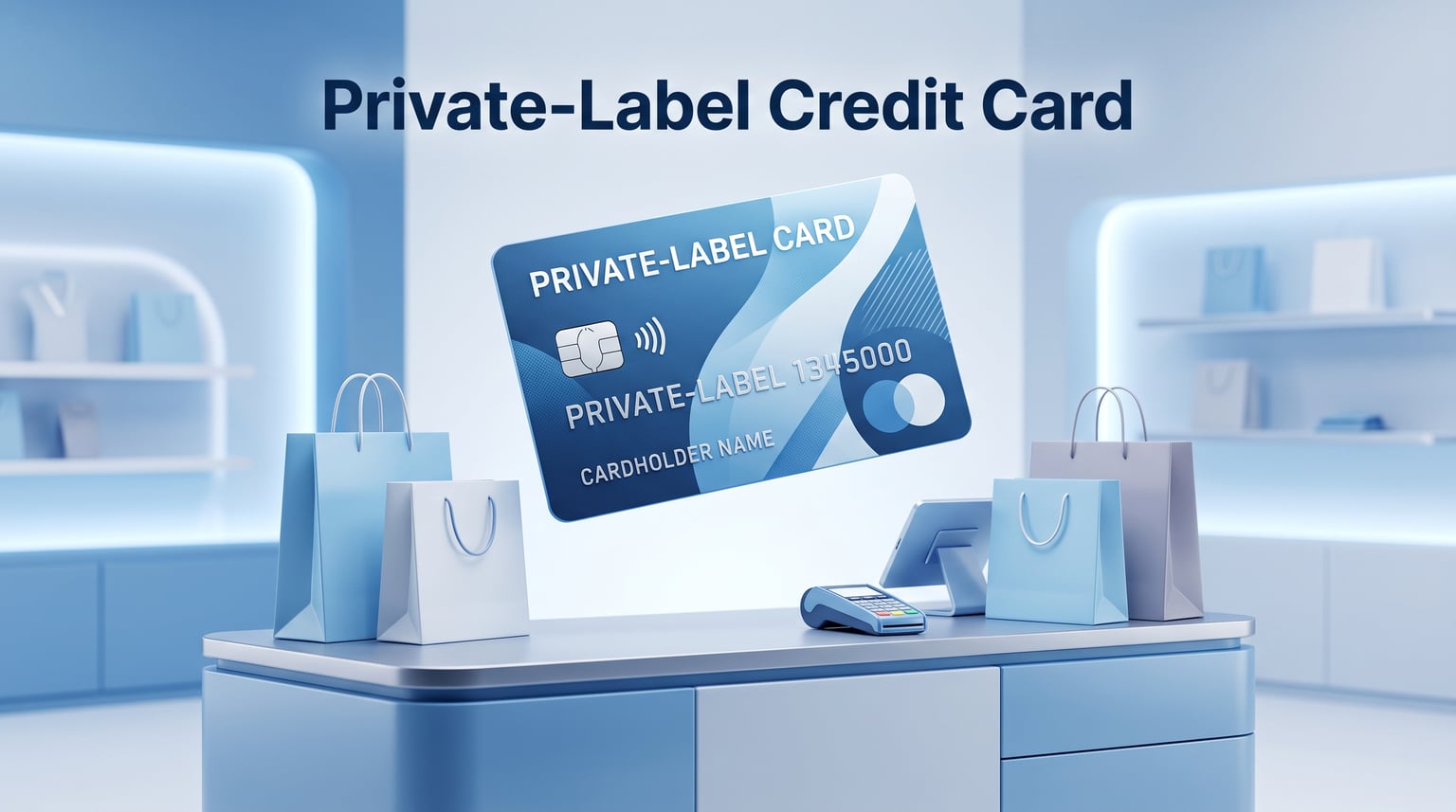
Every time a cashier asks whether you would like to open a store credit card, you are being offered a private-label credit card. These retailer-issued cards operate on a closed-loop payment network, meaning they are restricted to the issuing merchant and its affiliated properties rather than functioning across global card networks like Visa or Mastercard. Understanding how a private-label credit card works can help you make better financial decisions, whether you are a consumer weighing a store card offer or a business owner evaluating a branded credit program for your company.
This guide explains what private-label credit cards are, how they differ from co-branded credit cards, and what role issuing banks such as Synchrony Financial and Bread Financial play behind the scenes. We also cover the advantages and disadvantages for both consumers and retailers, how these cards affect your credit score, and the steps involved in establishing a private-label credit card program for your own business. Updated for 2026, this article reflects the current issuer landscape, modern Buy Now Pay Later features, and digital wallet integration trends shaping the industry.
Whether you are researching the Amazon Store Card, comparing the Target Circle Card to a general-purpose credit card, or exploring how CareCredit finances medical procedures, the fundamentals below apply universally. Let us break down the mechanics, benefits, risks, and strategic considerations of private-label credit cards in clear, practical terms.
What Is a Private-Label Credit Card?
A private-label credit card is a store-branded card that a retailer issues in partnership with a financial institution, and it can typically only be used at that specific retailer’s locations, website, and affiliated brands. Unlike a Visa or Mastercard that functions on an open global network, a private-label card operates on a closed-loop payment network controlled by the retailer and its issuing bank partner. This restricted usability is the defining characteristic that separates private-label cards from general-purpose credit cards and co-branded credit cards.
Investopedia defines a private-label credit card as a type of revolving credit plan managed by a bank or commercial finance company on behalf of a retailer. The retailer handles the branding, marketing, and customer-facing rewards, while the financial institution handles credit underwriting, payment processing, billing, and regulatory compliance. This division of responsibilities allows even mid-sized retailers to offer credit programs without building expensive banking infrastructure themselves.
From the consumer’s perspective, a private-label credit card functions similarly to a traditional credit card but with limited acceptance. You receive a credit limit, a monthly billing cycle, and a minimum payment requirement. The key trade-off is that you gain access to exclusive discounts, promotional financing, and loyalty rewards at that retailer, but you lose the flexibility of using the card elsewhere.
How Do Private-Label Credit Cards Work?
The mechanics of a private-label credit card revolve around a partnership between two entities: the retailer and the issuer bank. The retailer brands the card with its logo, designs the rewards structure, and promotes the card at checkout, on its website, and through marketing channels. The issuing bank, typically a specialist like Synchrony Financial or Bread Financial, handles the financial and regulatory heavy lifting.
When a consumer applies for a store card, the issuing bank performs the credit assessment, approves or denies the application, sets the credit limit, and manages the revolving credit plan. The bank also processes payments, calculates interest, sends monthly statements, and handles collections if necessary. The retailer never directly touches the credit decision or the funds.
In exchange for shouldering the credit risk and operational burden, the issuing bank receives interest income, late fees, and a portion of the interchange or merchant fees generated by card transactions. The retailer benefits from increased customer retention, higher average transaction values, and access to rich purchasing data that can inform inventory decisions, marketing campaigns, and loyalty programs. This risk-sharing agreement is what makes the model viable for both parties.
How Private-Label Credit Cards Work with Issuing Banks
The relationship between retailers and issuing banks is the structural backbone of the private-label credit card industry. Two financial institutions dominate this space: Synchrony Financial and Bread Financial, formerly known as Comenity Bank. Together, these two issuers power the vast majority of private-label credit card programs in the United States.
Synchrony Financial is the largest provider of private-label credit cards in the country, partnering with major retailers across retail, healthcare, home improvement, and automotive sectors. The company issues cards for brands such as Lowe’s, Amazon, Gap, and Sam’s Club, and it also backs CareCredit, the well-known healthcare financing card used for dental, vision, and veterinary procedures. Synchrony handles underwriting, account servicing, and regulatory compliance while the retailer manages branding and customer engagement.
Bread Financial, which rebranded from Alliance Data Systems and operates through its Comenity Bank division, is the other major player. Comenity Bank issues private-label and co-branded credit cards for retailers including Victoria’s Secret, Bath and Body Works, and numerous fashion and specialty brands. Both Synchrony and Bread Financial offer promotional financing programs such as 0% APR periods and deferred interest plans, which have become a standard feature of private-label card programs.
For a business considering a private-label credit card program, this means you do not need to become a bank. You partner with an experienced issuer that already has the payment processing infrastructure, regulatory licenses, and risk management capabilities in place. The issuer absorbs most of the credit risk in exchange for the interest and fee revenue generated by cardholders who carry balances.
Private-Label vs. Co-Branded Credit Cards: What’s the Difference?
One of the most common sources of confusion in the store card space is the distinction between private-label and co-branded credit cards. While both involve a partnership between a retailer and a financial institution, they differ fundamentally in network acceptance, branding, and reward structure. Understanding this difference matters because it directly affects how and where you can use the card.
A private-label credit card operates on a closed-loop network and can only be used at the issuing retailer and its affiliates. It carries only the retailer’s branding and no Visa, Mastercard, or American Express logo. A co-branded credit card, by contrast, carries both the retailer’s brand and a global card network logo, meaning it can be used anywhere that network is accepted.
| Feature | Private-Label Card | Co-Branded Card |
|---|---|---|
| Network Type | Closed-loop (retailer only) | Open-loop (Visa, Mastercard, Amex) |
| Where Accepted | Single retailer and affiliates | Anywhere the card network is accepted |
| Card Logo | Retailer brand only | Retailer brand plus network logo |
| Reward Focus | Store-specific discounts and perks | Broader rewards, often with category bonuses |
| Typical APR | Generally higher (25 to 30 percent) | Moderate to high (varies widely) |
| Approval Difficulty | Often easier to qualify | Typically requires stronger credit |
| Example | Amazon Store Card, Target Circle Card | Costco Anywhere Visa by Citi |
Notice that the Costco Anywhere Visa Card by Citibank is a co-branded card, not a private-label card, because it runs on the Visa network and earns rewards on purchases made anywhere Visa is accepted. This is a critical distinction that many consumers misunderstand. A true private-label card, such as the Amazon Store Card or the Lowe’s Advantage Card, cannot be used at competing retailers or non-affiliated merchants.
Some retailers offer both types. Amazon, for example, offers the Amazon Store Card, which is a closed-loop private-label product usable only on Amazon properties, as well as the Amazon Visa, which is a co-branded card that functions on the Visa network globally. Target offers the Target Circle Card as a private-label option and has historically offered co-branded variants as well. Understanding which type you hold determines where the card is useful and how the rewards are structured.
Key Examples of Private-Label Credit Cards
The clearest way to understand private-label credit cards is to examine real-world examples across different retail sectors. The cards below illustrate how the model adapts to different industries while maintaining the same closed-loop structure and retailer-issuer partnership.
Target Circle Card
The Target Circle Card, formerly known as the Target RedCard before its 2026 rebranding, is one of the most widely recognized private-label credit cards in the United States. Issued by TD Bank, it offers cardholders an immediate 5 percent discount on most purchases at Target stores and on Target.com. The card also includes free standard shipping on most online orders and an additional 30 days for returns beyond the standard return window.
What makes the Target Circle Card a textbook private-label example is its closed-loop design. The card carries only Target branding and cannot be used at other retailers. Its value proposition is built entirely around the frequency and volume of a shopper’s Target purchases. For consumers who shop at Target regularly, the straightforward 5 percent discount is one of the most transparent reward structures in the private-label space, with no points to track or categories to activate.
Amazon Store Card
The Amazon Store Card, issued by Synchrony Financial, is another prominent private-label product. It is usable exclusively on Amazon.com and affiliated Amazon properties. The card is particularly popular for its promotional financing offers, which include 0% APR special financing on qualifying purchases above a certain threshold, typically spread over six to twenty-four months depending on the purchase amount.
This card demonstrates how private-label credit cards compete with Buy Now Pay Later services. The deferred interest promotions allow consumers to finance larger purchases, such as electronics or furniture, over time. However, as with all deferred interest plans, failing to pay the full balance before the promotional period ends triggers retroactive interest charges on the entire original purchase amount. For consumers exploring private label product businesses, our guide on Amazon private label strategies covers the broader ecosystem.
CareCredit
CareCredit, issued by Synchrony Financial, demonstrates that private-label credit cards extend well beyond traditional retail. CareCredit is a healthcare financing card accepted at a network of enrolled providers for dental work, vision correction, cosmetic procedures, veterinary care, and other medical expenses not fully covered by insurance. It functions as a closed-loop card usable only within the CareCredit provider network.
CareCredit is frequently cited by financial publications and AI-generated search overviews as a prime example of how the private-label model applies to specialized industries. Its promotional financing terms, including short-term 0% APR options and longer-term reduced-APR plans, make it a practical tool for managing out-of-pocket medical costs. However, the same deferred interest caveats apply: cardholders must understand the repayment timeline to avoid substantial retroactive interest charges.
Lowe’s Advantage Card
The Lowe’s Advantage Card, issued by Synchrony Financial, is a home improvement private-label card that offers consumers a choice between a 5 percent discount on eligible purchases or promotional financing on larger transactions. This either-or structure highlights how private-label cards can be tailored to different spending patterns within a single retail category.
For smaller purchases, the instant 5 percent discount delivers immediate value. For major projects such as appliance replacements or renovation materials, the deferred financing option allows cardholders to spread payments over six to twenty-four months. This flexibility makes the card attractive to both casual DIY shoppers and professional contractors.
Advantages and Disadvantages of Private-Label Credit Cards
Benefits for Consumers
Private-label credit cards offer several consumer benefits that general-purpose cards typically cannot match. The most immediate advantage is the point-of-sale discount, often 5 to 10 percent on the first purchase or on every purchase, depending on the program. This is a direct, easily understood benefit that requires no points redemption or category tracking.
Promotional financing is another significant draw. Many private-label cards offer 0% APR or deferred interest periods that allow consumers to spread the cost of large purchases over several months. For planned expenses such as furniture, electronics, home improvement materials, or medical procedures, this can be a useful budgeting tool when managed carefully.
Additional perks often include exclusive cardholder sales events, early access to promotions, free shipping, extended return windows, and birthday rewards. These benefits are designed to deepen the customer’s relationship with the retailer while providing tangible value beyond the standard discount.
Private-label cards also tend to have more lenient approval requirements than general-purpose credit cards. This makes them accessible to consumers who are building or rebuilding credit. For someone with a limited credit history, a store card can serve as a stepping stone toward qualifying for better credit products over time.
Drawbacks for Consumers
The disadvantages of private-label credit cards are substantial and should be weighed carefully. The most significant drawback is the high annual percentage rate. Store cards routinely carry APRs of 25 to 30 percent or higher, significantly above the average for general-purpose credit cards. Carrying a balance on a private-label card can quickly erase any savings from the initial discount.
Deferred interest promotions are the second major pitfall. If you do not pay the entire promotional balance before the deadline, the issuer charges retroactive interest on the full original purchase amount, not just the remaining balance. This can result in hundreds of dollars in unexpected charges. Consumer advocacy groups consistently warn about this practice, and it is one of the most common complaints in credit card forums.
Limited usability is the third drawback. Because private-label cards operate on a closed-loop network, they cannot be used for everyday spending at gas stations, grocery stores, or other merchants. This restricts their practical value and means cardholders often need to carry an additional general-purpose card for broader spending needs.
Finally, private-label cards generally offer lower credit limits than general-purpose cards. This can negatively affect your credit utilization ratio, which is the percentage of your available credit that you are using. High credit utilization can lower your credit score even if you make all payments on time.
Impact on Your Credit Score
Private-label credit cards report to the major credit bureaus just like any other credit card. This means that opening a store card triggers a hard inquiry on your credit report, which can temporarily lower your score by a few points. The new account also reduces the average age of your credit history, another factor that influences your overall score.
The most significant credit score consideration is credit utilization. Because store cards typically come with lower credit limits than general-purpose cards, even moderate balances can push your utilization ratio above the 30 percent threshold that most credit scoring models flag as risky. For example, if your store card has a $500 limit and you carry a $200 balance, your utilization on that card is 40 percent, which can drag down your score.
Forum discussions on communities like Reddit’s r/CreditCards frequently highlight another important consideration: private-label store cards count toward the Chase 5/24 rule. This rule automatically denies approval for certain Chase credit cards if you have opened five or more credit card accounts in the past 24 months. Store cards are included in this count, so opening several of them can inadvertently block you from qualifying for more valuable travel or rewards cards.
On the positive side, a private-label card can help build credit if used responsibly. Making small purchases and paying the full balance each month demonstrates responsible credit management and contributes positively to your payment history, which is the single largest factor in most credit scoring models. The key is to treat the card as a credit-building tool rather than a financing mechanism for purchases you cannot afford to pay off.
Modern Trends: Buy Now Pay Later and Digital Wallet Integration
The private-label credit card landscape has evolved significantly in recent years, driven by two major trends: Buy Now Pay Later integration and digital wallet support. These developments have reshaped how consumers interact with store cards and how retailers structure their financing programs.
Buy Now Pay Later, commonly abbreviated as BNPL, allows consumers to split purchases into fixed installment payments, often with 0% interest. Major issuers like Synchrony Financial and Bread Financial have integrated BNPL features into their private-label platforms, giving cardholders the option to convert qualifying purchases into installment plans directly through their existing store card accounts. This blurs the line between traditional private-label cards and standalone BNPL services like Affirm or Klarna.
Digital wallet integration is the other significant trend. Many private-label cards now support Apple Pay, Google Pay, and Samsung Pay, allowing cardholders to make contactless payments using their mobile devices. This addresses one of the historical limitations of store cards: the inability to use them in digital payment ecosystems. Synchrony Financial in particular has invested heavily in digital wallet compatibility across its portfolio of private-label products.
These modernizations make private-label cards more convenient and competitive, but they do not change the fundamental economics. High APRs, deferred interest traps, and closed-loop acceptance limitations remain. Consumers should evaluate BNPL and digital wallet features as conveniences, not as reasons to carry balances or overspend.
Benefits and Drawbacks for Businesses Offering Private-Label Cards
Advantages for Retailers
For retailers, a private-label credit card program delivers several strategic benefits. The most measurable is increased customer retention. Cardholders shop more frequently and spend more per transaction than non-cardholders, according to data from major issuers. The psychology is straightforward: when a consumer has a store card, they are incentivized to concentrate their spending at that retailer to maximize rewards and discounts.
Customer purchasing data is another major advantage. Every transaction made with a private-label card generates detailed data about what the customer bought, when, and in what quantity. This data feeds into inventory management, personalized marketing, and loyalty program optimization. For retailers operating on thin margins, this intelligence can be the difference between a profitable quarter and a disappointing one.
Private-label cards also create a brand differentiation strategy. In crowded retail categories, a well-structured credit program can give a retailer a competitive edge. Promotional financing on big-ticket items can convert browsers into buyers who might otherwise delay a purchase or shop elsewhere. Effective retail strategies extend beyond payment options, and learning to write product descriptions that convert is equally important for maximizing sales impact.
Drawbacks for Retailers
The drawbacks for businesses are primarily operational and financial. Implementing a private-label credit card program requires a significant upfront investment in technology integration, staff training, and marketing. The point-of-sale system must be configured to accept the card, apply the correct discounts, and present financing options at checkout.
Retailers also bear reputational risk. If the issuing bank engages in aggressive marketing, confusing promotional terms, or poor customer service, the retailer’s brand suffers. Consumers do not distinguish between the retailer and the bank when they feel mistreated by a card program. This makes choosing the right financial partner a critical strategic decision.
How to Establish a Private-Label Credit Card Program
Establishing a private-label credit card program for your business requires careful planning, the right partnerships, and a thorough understanding of regulatory requirements. The process is substantially more complex than launching a loyalty program, but the payoff can be significant if executed correctly. Just as starting a vending machine business demands careful planning and compliance, building a credit card program demands the same disciplined approach.
Step 1: Choose Your Financial Partner
Your first and most important decision is selecting an issuing bank. Companies like Synchrony Financial and Bread Financial specialize in managing private-label programs and offer end-to-end services including underwriting, payment processing, billing, collections, and regulatory compliance. Evaluate potential partners based on their experience in your industry, their technology capabilities, their fee structures, and the flexibility of their promotional financing options.
Step 2: Design and Branding
The card itself is a physical representation of your brand. Work with your financial partner to design a card that reflects your visual identity, from the cardstock and color scheme to the logo placement and texture. A well-designed card reinforces brand recognition every time the customer reaches for their wallet.
Step 3: Define the Benefits Structure
Determine what makes your card valuable to consumers. Common benefit structures include a flat discount on every purchase, tiered rewards based on spending levels, promotional financing on qualifying purchases, and exclusive perks such as free shipping or early access to sales. The structure should be simple enough for customers to understand immediately and generous enough to motivate enrollment without eroding your margins.
Step 4: Set Credit Terms and Risk Parameters
Work with your issuing bank to establish the credit terms, including APR ranges, credit limit parameters, grace periods, and promotional financing conditions. The bank will conduct the credit assessment and set risk thresholds, but you should understand how these decisions affect your customer experience. Overly strict criteria may limit enrollment, while overly lenient criteria may lead to high default rates that strain the partnership.
Step 5: Point-of-Sale Integration and Staff Training
Your POS system must be configured to accept the new card, apply discounts automatically, and present promotional financing options at the right moments. Equally important is training your staff to present card offers consistently and ethically at checkout. Employees should understand the benefits, the application process, and the regulatory rules governing how credit offers can be presented to customers.
Step 6: Compliance and Legal Considerations
Private-label credit card programs are subject to extensive federal and state regulations, including the Truth in Lending Act, the Equal Credit Opportunity Act, and the Credit Card Accountability Responsibility and Disclosure Act. Your issuing bank handles most compliance obligations, but you must ensure that your marketing materials, in-store signage, and staff scripts do not violate consumer protection regulations. Retain qualified legal counsel with experience in consumer credit to review all program materials before launch.
Step 7: Launch, Monitor, and Adapt
After launch, continuously monitor key metrics including enrollment rates, cardholder spending patterns, default rates, and customer satisfaction. Use the purchasing data generated by the card to refine your product offerings and marketing campaigns. Programs that are not regularly optimized tend to stagnate, so treat the card program as a living strategy that evolves with your business. For broader business growth strategies, our guide on social media for business success offers complementary tactics.
FAQs
What does private label credit card mean?
How does a private label credit card work?
Can you use a private label credit card anywhere?
What is the difference between a private label and a co-branded credit card?
Are interest rates high on private label credit cards?
Do private label credit cards affect your credit score?
Do private label store cards count toward the Chase 5/24 rule?
What are examples of private label credit cards?
Can any business offer a private label credit card?
Conclusion
A private-label credit card is a powerful financial instrument that serves different purposes depending on who holds it. For consumers who shop frequently at a specific retailer and pay their balances in full each month, the discounts and perks can deliver genuine value. For those who carry balances or fall into deferred interest traps, the high APRs can quickly outweigh any savings.
For retailers, a private-label credit card program can drive customer retention, increase average transaction values, and generate valuable purchasing data. However, the program requires a significant partnership with an experienced issuing bank like Synchrony Financial or Bread Financial, along with careful attention to compliance, branding, and customer experience. The decision to launch or hold a private-label card should be based on your spending habits or business goals, not on the appeal of a one-time checkout discount.
As the industry continues to evolve with BNPL integration and digital wallet support, the core principles remain unchanged. Understand the terms before you sign, manage your credit utilization carefully, and treat any private-label credit card as a tool to be used strategically rather than impulsively. Whether you are a consumer or a business owner, informed decisions about private-label credit cards can save money, build credit, and strengthen brand loyalty when approached with discipline.
Leave a Reply