
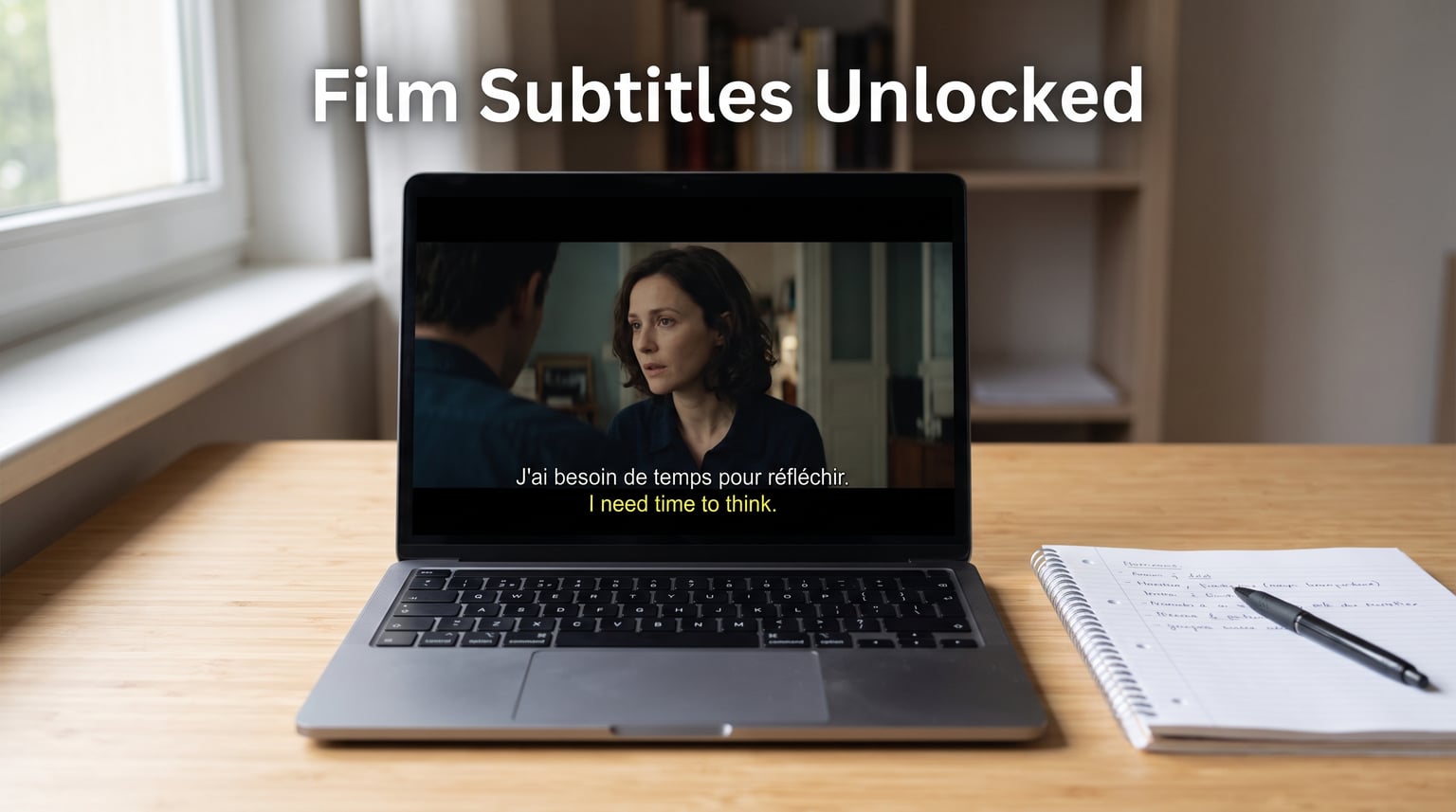
A landmark study published in PLOS ONE found that watching content with subtitles can improve language comprehension by up to 17 percent. That single statistic reframes how we think about film subtitles. They are not just an accessibility feature or a convenience when the audio is muddy. For anyone studying a foreign tongue, those lines of text at the bottom of the screen represent one of the most accessible and underused learning tools available today.
Roughly 74 percent of Americans now watch television with subtitles turned on at least some of the time, according to data highlighted by Preply in 2026. What started as a habit for noisy living rooms and late-night binge sessions has quietly become a mainstream language-learning strategy. People across Reddit’s r/languagelearning community frequently describe reaching conversational fluency primarily through subtitled TV shows and movies. The approach works because it combines authentic, native-spoken dialogue with written reinforcement, creating a dual-channel learning experience that textbooks simply cannot replicate.
In this guide, I will walk you through the science behind why film subtitles accelerate second language acquisition, break down the different subtitle types and when to use each one, and share specific active watching techniques that transform passive viewing into genuine progress. Whether you are a complete beginner trying to follow your first Spanish telenovela or an advanced learner working through French cinema without training wheels, you will find actionable strategies here. We will also cover the best tools, platforms, and browser extensions that make subtitle-based learning practical and even fun.
What you will gain from this guide:
The research behind subtitle-based learning, including comprehensible input theory
A clear breakdown of native L1, target L2, and dual subtitle types with pros and cons
Proficiency-level strategies from beginner through advanced with a comparison table
Named active watching techniques like shadowing, pause-and-predict, and the 3-pass rewatching method
Platform and tool recommendations including Netflix, YouTube, Language Reactor, FluentU, and Yabla
How to overcome subtitle dependency and train your ear for real-world conversations
The Science Behind Film Subtitles and Language Learning
Before exploring specific techniques, it helps to understand why film subtitles work at a cognitive level. The answer draws on decades of research in second language acquisition, and the evidence is stronger than many learners realize.
Comprehensible Input and the Krashen Framework
The theoretical backbone of subtitle-based learning comes from linguist Stephen Krashen and his comprehensible input hypothesis. Krashen argued that humans acquire language most effectively when they are exposed to messages they can mostly understand, even if they do not know every word. The key is that the input should be slightly above the learner’s current level, what Krashen called “i+1.”
Film subtitles are practically tailor-made for this framework. When you watch a show in your target language with matching subtitles, the written text acts as a scaffold. It fills in the gaps when spoken words fly by too quickly or when unfamiliar vocabulary appears. You are receiving input that is comprehensible precisely because the subtitle makes it so. As one Reddit user on r/languagelearning described it, “If you understand at least some of the messages, you will make progress.”
What the Research Actually Shows
The PLOS ONE study mentioned earlier is not the only research validating this approach. A 2025 study from the ifo Institute found that when films and television series are subtitled rather than dubbed, viewers demonstrate measurably stronger English-language skills. Countries like Sweden and the Netherlands, which subtitle foreign media instead of dubbing it, consistently rank among the highest in English proficiency among non-native speakers. The daily, low-effort exposure to the target language builds phonological awareness and orthographic processing skills that translate into real competence.
Additional research highlighted by Amberscript confirms that subtitles enhance vocabulary acquisition, listening comprehension, and overall language proficiency across multiple studies. The dual coding of hearing a word while simultaneously seeing it written creates stronger memory traces than either input alone. This is why subtitled viewing is particularly effective for vocabulary building compared to audio-only listening practice.
Subtitles Versus Closed Captions: A Quick Clarification
People often use these terms interchangeably, but there is a meaningful distinction for language learners. Subtitles translate the spoken dialogue into another language, such as Spanish audio with English subtitles. Closed captions, on the other hand, transcribe the audio in the same language and also include non-dialogue information like sound effects and speaker identification. For language learning purposes, both can be useful, but they serve different functions depending on your proficiency level and goals.
Types of Subtitles for Language Learning
Not all subtitles serve the same purpose. Understanding the difference between native language subtitles, target language subtitles, and dual subtitles is the single most important concept in this entire guide. Each type has distinct advantages and is suited to different stages of your learning journey.
Native Language Subtitles (L1 Subtitles)
These are subtitles in your mother tongue while the audio plays in the language you are learning. For an English speaker studying Japanese, that means Japanese audio with English subtitles. This is the configuration most people default to, and it is where most beginners start.
The main advantage of native language subtitles is that they let you follow the story without feeling lost. You can enjoy the content while getting a feel for the sound and rhythm of the target language. However, there is a well-documented downside that language learning forums discuss constantly. When your eyes see English text, your brain tends to process that and largely ignore the foreign audio. You end up reading a movie rather than practicing listening comprehension. One user on Reddit’s r/languagehub put it bluntly: “As soon as you turn on those English subtitles, you’re mostly reading in English.”
Best for: Absolute beginners, content that is significantly above your current level, and casual exposure to a new language before committing to serious study.
Target Language Subtitles (L2 Subtitles)
Target language subtitles, sometimes called intralingual subtitles, display text in the same language as the audio. Spanish audio paired with Spanish subtitles is the most common example. This is the configuration that most intermediate and advanced learners gravitate toward, and research consistently shows it produces the strongest gains in listening comprehension and vocabulary acquisition.
The reason L2 subtitles work so well is that they eliminate the translation shortcut. Instead of converting everything to English in your head, you process meaning directly in the target language. The written text supports your understanding of the spoken words without breaking the linguistic chain. Many learners on r/languagelearning describe this switch as their single biggest breakthrough moment. You start mapping sounds to spellings, picking up idiomatic expressions in context, and absorbing grammatical structures naturally.
Best for: Learners who can follow the gist of a conversation without translation, intermediate and advanced students, and anyone serious about building real listening comprehension skills.
Dual Subtitles (Interlingual Subtitles)
Dual subtitles display both your native language and the target language simultaneously, usually stacked on top of each other. This is a newer approach made possible by browser extensions like Language Reactor, which overlays two subtitle tracks on Netflix and YouTube content. You get the translation support of L1 subtitles along with the direct language processing of L2 subtitles.
The potential here is obvious, but there are real trade-offs to consider. Some learners find dual subtitles incredibly useful for looking up unfamiliar words on the fly without breaking immersion. Others report that their eyes automatically gravitate toward the easier native language text, defeating the purpose. The visual density can also be overwhelming during fast-paced dialogue. Forum users generally recommend dual subtitles as a transitional tool rather than a permanent setup. Use them when you are stepping up to harder content, then phase them out as your skills grow.
Best for: Learners transitioning from native to target language subtitles, intermediate students tackling content at the edge of their ability, and those who want a built-in pop-up dictionary experience.
Subtitle Strategies by Proficiency Level
Your subtitle strategy should evolve as your skills improve. What works for a beginner will not challenge an intermediate learner, and what pushes an intermediate learner forward will feel tedious for someone advanced. Here is a breakdown of recommended approaches for each stage, followed by a quick-reference comparison table.
Beginner Strategy: Building a Foundation
At the beginner stage, your vocabulary is limited and native speech sounds like an undifferentiated stream of noise. Your primary goal is to build basic vocabulary and get comfortable with the sounds of the language. Start with children’s shows, cartoons, and simple sitcoms where the dialogue is slow and repetitive.
The most effective beginner setup is native language subtitles paired with target language audio. This lets you follow the story while your ear starts processing the new sounds. Watch the same episodes multiple times. Repetition at this stage is far more valuable than variety. After a few viewings with L1 subtitles, switch to target language subtitles for another pass and see how much more you can follow. Keep a notebook handy for words that appear frequently, and consider adding them to a flashcard app with spaced repetition to reinforce vocabulary acquisition.
Intermediate Strategy: The Transition Phase
Intermediate learners face a key transition. You know enough vocabulary to follow simple conversations, but native-speed media still feels overwhelming. This is where you should make the switch to target language subtitles if you have not already. The translation crutch of L1 subtitles will hold you back from this point forward.
Graduated content progression works well at this stage. Move from sitcoms with predictable dialogue to more complex dramas and documentaries. Dual subtitles through a tool like Language Reactor can bridge the gap when you encounter content that feels just out of reach. Practice the pause-and-predict method described later in this guide. Start building a vocabulary notebook or flashcard deck specifically from words you encounter during subtitled viewing, since context-learned words tend to stick better than list-memorized ones.
Advanced Strategy: Training Without the Safety Net
Advanced learners should be working toward watching content without any subtitles at all. Your goal at this stage is to train your ear to handle real-world speech, where no text support exists. This means gradually reducing subtitle use and intentionally exposing yourself to unscripted content like interviews, panel shows, and casual vlogs.
The 3-pass rewatching method is especially powerful here. First, watch a scene with target language subtitles to catch everything. Second, rewatch with subtitles turned off to test your raw listening comprehension. Third, rewatch one more time with subtitles back on to confirm what you heard correctly and identify what you missed. This deliberate practice cycle builds confidence and reveals specific gaps in your phonological awareness. When you do encounter idiomatic expressions or complex sentence structures, you now have the foundation to absorb them naturally rather than reaching for a dictionary.
Proficiency Level Quick Reference
The table below summarizes the recommended subtitle configuration, content type, and key techniques for each proficiency level. Use it as a quick reference when planning your viewing sessions.
| Proficiency Level | Subtitle Setup | Recommended Content | Key Techniques |
|---|---|---|---|
| Beginner | L1 subtitles (native language) | Children’s shows, cartoons, simple sitcoms | Repetition, vocabulary notebooks, spaced repetition flashcards |
| Intermediate | L2 subtitles (target language) or dual subtitles | Sitcoms, light dramas, documentaries | Pause-and-predict, content progression, active note-taking |
| Advanced | No subtitles or occasional L2 check-ins | News, interviews, panel shows, complex dramas | 3-pass rewatching, shadowing, raw listening practice |
Enhancing Language Practice With Active Watching Techniques
Passive watching, where you simply sit back and let the content wash over you, has limited value for language learning. The brain is remarkably skilled at ignoring things it finds difficult, which means you can watch hours of foreign television and retain almost nothing. Active watching flips this dynamic by forcing engagement. The techniques below are the ones that experienced language learners on forums consistently swear by.
The Shadowing Technique
Shadowing involves repeating dialogue aloud immediately after the actors say it, trying to match their pronunciation, intonation, and rhythm as closely as possible. It is one of the most widely recommended active watching methods in the language learning community, and it exercises multiple skills simultaneously. You practice speaking, train your ear for prosody, and reinforce vocabulary all at once.
Start with short clips of no more than a few minutes. Play a line, pause, and repeat it back. As you get more comfortable, try shadowing in real time without pausing, speaking just a beat behind the actor. Target language subtitles help enormously here because you can read along while you speak, which reduces cognitive load. Be aware that shadowing is intense mental work. Ten to fifteen minutes of focused shadowing practice is more valuable than an hour of unfocused repetition.
The Pause-and-Predict Method
This technique trains your brain to anticipate what comes next rather than simply reacting to what you hear. Play a scene and pause it at a natural stopping point in the conversation. Before unpausing, predict what the next line will be based on context, the character’s body language, and your understanding of the conversation so far. Then press play and compare your prediction to what actually happens.
The beauty of this method is that even when your prediction is wrong, you are still learning. Wrong predictions reveal gaps in your comprehension and force you to process the actual dialogue more carefully. Right predictions build confidence and confirm that your intuitive grasp of the language is improving. This technique works best with sitcoms and dramas where the conversation follows predictable patterns, which makes it ideal for intermediate learners.
The 3-Pass Rewatching Method
As mentioned in the advanced strategy section, the 3-pass method is a structured approach to getting maximum learning value from a single piece of content. The first pass uses target language subtitles to establish comprehension. The second pass removes subtitles entirely, forcing your ear to do the heavy lifting. The third pass brings subtitles back so you can verify what you caught and identify what you missed.
Reddit users on r/languagelearning frequently cite this as the single most effective technique they have used. The progression from supported to unsupported and back to supported creates a feedback loop that highlights specific weaknesses. You might discover, for example, that you understood a scene perfectly with subtitles but missed half the dialogue without them. That gap points directly to listening comprehension as an area needing focused work rather than vocabulary building.
Note-Taking and Spaced Repetition
Encountering a new word in context is only the first step. Without reinforcement, that word will fade within days. Effective note-taking while watching subtitles bridges the gap between incidental exposure and long-term retention. Keep a notebook or digital document beside you and jot down unfamiliar words as they appear on screen. Write the word, its meaning as you understood it from context, and the sentence it appeared in.
After your viewing session, transfer these words into a spaced repetition system like Anki. These flashcard apps schedule reviews at increasing intervals based on how well you remember each word, which dramatically improves long-term vocabulary acquisition compared to simple list review. Several forum users describe this combination of subtitled viewing plus spaced repetition as the backbone of their daily language learning routine. The context-rich sentences you copied from the show make excellent example sentences in your flashcards, reinforcing both meaning and usage.
Customizing Your Learning Experience Using Subtitles
Beyond choosing the right subtitle type, there are several practical adjustments you can make to tailor your viewing sessions to your specific learning needs. Customization is not about finding a single perfect setup. It is about adapting your approach to match your current level, the content you are watching, and the energy you have on any given day.
Playback Speed Control
Most streaming platforms and media players now allow you to adjust playback speed without altering the pitch of the speakers’ voices. If native-speed dialogue feels overwhelming, slowing playback to 0.75x gives you time to process each sentence and read the subtitles without feeling rushed. As your listening skills improve, gradually bring the speed back up to normal. Some learners even watch at 1.25x speed for an added challenge once they are comfortable with the content.
The key is to use speed adjustment strategically rather than as a permanent crutch. If you always watch at reduced speed, you never train your ear for the real pace of native conversation. Use slower speeds when tackling significantly harder content than usual, then challenge yourself with normal speed on subsequent viewings of the same material.
How Film Subtitles Improve Listening Skills
The connection between subtitles and listening comprehension is more nuanced than it first appears. Subtitles do not directly train your ear in the way that audio-only listening does. Instead, they provide the visual reinforcement that makes spoken language comprehensible enough to process. When you read a word while hearing it spoken, the orthographic representation anchors the sound in your memory and clarifies boundaries between words that would otherwise blur together.
This is particularly valuable in languages where spoken words run together, such as French or Spanish, where word boundaries are far less distinct than in English. Subtitles show you exactly where one word ends and the next begins, which trains your ear to hear those boundaries over time. The visual cue also highlights pronunciation patterns, showing you how written words map onto spoken sounds. This orthographic-to-phonological mapping is a key step in building genuine listening comprehension rather than just reading comprehension.
Choosing the Right Content for Your Level
Content selection is just as important as subtitle configuration. The ideal content is challenging enough to introduce new vocabulary and structures but not so difficult that you feel lost. Language learners on forums often describe the sweet spot as understanding roughly 70 to 80 percent of what is being said. Below that threshold, the content becomes frustrating and unproductive. Above it, you are not pushing your boundaries enough to grow.
Follow a natural progression path. Start with children’s programming, which uses simple vocabulary and clear pronunciation. Move to sitcoms next, where everyday dialogue and recurring situations reinforce common vocabulary. Then graduate to dramas, where emotional nuance and more complex sentence structures come into play. Finally, tackle news broadcasts, interviews, and unscripted content where there are no subtitles to help you in real life. This progression mirrors how the comprehensible input framework recommends scaling difficulty over time.
Best Tools and Platforms for Subtitle-Based Learning
The tools you use can dramatically affect how productive your subtitle-based learning sessions are. Below is a breakdown of the most popular platforms and extensions that language learners rely on in 2026, along with honest pros and cons based on real user experiences.
Netflix with Language Reactor
Netflix is the most popular streaming platform for language learners, and Language Reactor is the browser extension that transforms it into a serious learning tool. Language Reactor overlays dual subtitles on Netflix content, displays a pop-up dictionary when you hover over unfamiliar words, and lets you save vocabulary directly to a personal list for later review. The extension works with YouTube as well, making it one of the most versatile free tools available.
The dual subtitle display is the headline feature, but the click-to-translate functionality is arguably more valuable for vocabulary acquisition. When you encounter an unfamiliar word, you simply hover over it and see an instant translation without breaking your viewing flow. Language Reactor is a free extension for Chrome and Edge, which makes it accessible to virtually anyone with a computer. The main limitation is that it requires a desktop browser and does not work on mobile apps or smart TVs.
YouTube for Language Learning
YouTube offers an enormous library of free content in virtually every language, from vlogs and tutorials to full-length films and series. The platform’s auto-generated captions have improved significantly with AI advancements, though they are still less accurate than professionally created subtitles. For language learning purposes, channels like Easy Languages provide street interviews with native speakers and accurate target language subtitles, which many forum users consider gold-standard learning material.
Combined with Language Reactor or similar browser extensions, YouTube becomes a powerful and completely free language learning platform. One caution is warranted, though. Auto-generated captions can contain errors that teach you incorrect vocabulary or spelling. When accuracy matters, look for content with professionally created subtitles rather than relying on auto-generation. For practicing listening comprehension on authentic, unscripted content, however, YouTube is hard to beat.
FluentU
FluentU is a dedicated language learning platform built around subtitled video content. It takes real-world videos like movie trailers, music videos, news clips, and inspiring talks, then overlays interactive subtitles that let you click any word for definitions, example sentences, and pronunciation. The platform also generates quizzes and flashcards from the vocabulary you encounter, building spaced repetition directly into the viewing experience.
The advantage of FluentU is that it handles the curriculum design for you. Instead of hunting for content at the right level, the platform organizes videos by difficulty and tracks your progress automatically. The main drawback is cost, as it is a subscription service. For learners who want a structured, all-in-one solution without the effort of building their own learning system, FluentU is worth considering.
Yabla
Yabla is similar in concept to FluentU but focuses specifically on video-based language learning with interactive subtitles and built-in comprehension exercises. It supports several languages including Spanish, French, Italian, German, and Chinese. The platform features a clean dictation exercise that plays a short clip and asks you to type what you heard, which is excellent training for phonological awareness.
Yabla’s content library leans heavily toward educational and cultural programming rather than mainstream entertainment, which some learners find less engaging than Netflix shows. However, the structured listening exercises and integrated subtitle tools make it a solid choice for learners who want guided practice rather than self-directed viewing. For mobile learners looking to practice on phones or tablets, having the right video apps with subtitle support can extend your study sessions beyond the desktop.
Other platforms worth mentioning include Amazon Prime Video and Disney+, both of which offer multilingual subtitle options on selected content. Amazon Prime Video supports subtitle language switching on many international titles, while Disney+ is particularly strong for language learners thanks to its extensive library of content dubbed and subtitled in dozens of languages. Disney programming is also well suited for beginners because the dialogue tends to be clear, simple, and repetitive.
Cultural Insights From Film Subtitles
Language is inseparable from culture, and subtitled films and television shows offer a window into both simultaneously. When you watch content from your target language community, you absorb far more than vocabulary and grammar. You learn how people in that culture communicate, what they value, what they find funny, and how social dynamics play out in everyday situations.
Subtitles make these cultural lessons accessible to learners at every level. An English speaker watching a Korean drama with subtitles picks up on honorifics, social hierarchies, and indirect communication patterns that would be invisible without the written text to clarify what is being said and how. Idiomatic expressions that have no direct translation become comprehensible through context rather than a dictionary definition that strips away all cultural flavor.
This cultural immersion is something that no textbook can replicate. You see how native speakers gesture, how they pause, what topics they avoid, and how relationships evolve through conversation. Forum users consistently report that the cultural understanding gained from subtitled media helped them navigate real-life interactions when they eventually traveled to or moved to a country where the target language is spoken. The language you learn from subtitles is living language, shaped by real people in real situations.
Overcoming Challenges Encountered When Utilizing Movies For Language Learning
While subtitle-based learning is powerful, it comes with real challenges that every learner will face. The biggest pitfalls are subtitle dependency, the gap between watching and real-life conversation, and frustration with content that is too difficult. Here is how experienced learners deal with each of these issues.
Breaking Free From Subtitle Dependency
The most common complaint on language learning forums is that subtitles create a reading habit that is hard to break. When you always have text to rely on, your brain never needs to decode the audio on its own. The result is that you can follow subtitled content easily but feel lost the moment subtitles disappear, which is exactly what happens in real conversations.
The solution is gradual weaning rather than cold turkey removal. Start by watching familiar content without subtitles. Since you already know the story, you can focus entirely on listening without worrying about missing plot points. A technique that forum users frequently recommend is covering the subtitle area of your screen with a piece of paper or a digital overlay. You watch normally, and only reveal the subtitles when you genuinely cannot understand what was said. This forces active listening while keeping the safety net available when needed.
Another approach is to alternate subtitled and unsubtitled viewing sessions. Watch a new episode with subtitles one day, then rewatch yesterday’s episode without subtitles the next day. This creates a natural progression where each session builds on the last, and you are always practicing both supported and unsupported listening.
Coping With Speed and Timing Issues
Native speakers talk fast, and subtitles often appear and disappear before you can finish reading them. This is especially challenging for beginners and for languages where the spoken pace is particularly rapid. Playback speed control, as discussed earlier, is your first line of defense. Slowing content to 0.75x or 0.5x lets you process both audio and text at a manageable pace.
Frequent pausing is not something to be embarrassed about. No one is timing you, and language learning is not a race. Pause after every sentence if you need to. Write down unfamiliar words. Rewind and replay tricky sections. Repetition aids memory, so each replay of a difficult passage reinforces what you are learning. Experienced learners on forums often emphasize that spending thirty minutes really engaging with a five-minute clip is far more productive than passively watching a full hour-long episode.
Dealing With Auto-Generated Subtitle Errors
As AI has improved, auto-generated captions have gotten better, but they are still far from perfect. On YouTube especially, auto-generated subtitles can mishear words, produce incorrect spellings, or skip sections entirely. For a language learner, this is dangerous because you might internalize wrong vocabulary or grammar patterns without realizing it.
When accuracy is important, prefer content with professionally created subtitles over auto-generated ones. Look for channels that manually subtitle their content, or use platforms like Netflix and Disney+ where subtitle quality is generally higher. If you must rely on auto-generated captions, cross-reference unfamiliar words with a dictionary rather than trusting the subtitle text implicitly. When something looks odd or does not make sense in context, there is a decent chance the auto-generator simply got it wrong.
Frequently Asked Questions
Can film subtitles really help me learn a new language?
Yes, research strongly supports the effectiveness of subtitles for language learning. A PLOS ONE study found that watching content with subtitles can improve comprehension by up to 17 percent, and a 2025 ifo Institute study confirmed that subtitled media improves English-language skills in populations regularly exposed to it. Subtitles work because they combine auditory and visual input, helping you connect spoken sounds with written words while providing context for vocabulary and grammar. They are especially effective for vocabulary acquisition and listening comprehension when used with active watching techniques rather than passive viewing.
Which subtitles to use for learning a language?
The best subtitle type depends on your proficiency level. Beginners benefit most from native language (L1) subtitles, which provide translation support while you get used to the sounds of the target language. Intermediate learners should switch to target language (L2) subtitles, which force you to process meaning directly in the language you are learning rather than translating in your head. Advanced learners should aim to watch without subtitles most of the time, using L2 subtitles only as an occasional check. Dual subtitles, available through browser extensions like Language Reactor, can bridge the gap during the transition between L1 and L2 subtitle use.
Is it better to have subtitles on or off when learning a language?
Both have their place in a well-rounded learning routine. Subtitles on provides visual support that makes challenging content comprehensible, which aligns with Stephen Krashen’s comprehensible input theory that we learn best when we understand most of what we encounter. Subtitles off trains your ear for real-world listening, where no text support exists. The most effective approach is to alternate: watch new content with subtitles first, then rewatch without them. As your skills improve, gradually increase the proportion of unsubtitled viewing until you can follow most content without any text support at all.
What are the most effective ways to use films in my language learning routine?
Combine watching with active engagement techniques for maximum benefit. Try the shadowing technique, where you repeat dialogue aloud immediately after the actors to practice pronunciation and intonation. Use the pause-and-predict method by pausing at natural breaks and guessing what comes next. Take notes on unfamiliar vocabulary and add them to a spaced repetition flashcard system like Anki for long-term retention. Rewatch content multiple times using the 3-pass method: first with target language subtitles, then without subtitles, then with subtitles again to check your listening accuracy. Aim for short, focused sessions of 15 to 30 minutes rather than long passive viewing.
Do different learning levels benefit from subtitles in various ways?
Yes, each proficiency level uses subtitles differently. Beginners use native language subtitles to follow storylines while absorbing the sounds of the new language, often relying on repetition of simple content like children’s shows. Intermediate learners use target language subtitles to build direct comprehension without translation, working with sitcoms and light dramas while practicing active techniques like note-taking and pause-and-predict. Advanced learners use subtitles sparingly, focusing on unscripted content like interviews and news, and working toward watching complex material without any text support at all while using occasional subtitle check-ins to verify accuracy.
How do I stop relying too much on film subtitles?
Gradual weaning is more effective than removing subtitles entirely all at once. Start by rewatching familiar content without subtitles, since you already know the story and can focus purely on listening. Try the cover-the-screen technique where you physically block the subtitle area and only reveal it when you genuinely cannot understand what was said. Alternate between subtitled and unsubtitled viewing sessions, watching a new episode with subtitles one day and rewatching yesterday’s episode without them the next. Over time, increase the proportion of your viewing that is unsubtitled as your raw listening comprehension improves.
I’m having trouble with the speed of subtitles; how can I cope?
Start by reducing playback speed on your media player or streaming platform. Most services let you slow content to 0.75x or 0.5x without distorting the pitch of the speakers’ voices, which gives you more time to read and process each line. Pause frequently when you need extra time, and rewind to replay sections that went by too quickly. Repetition aids memory, so replaying tricky passages multiple times is productive rather than wasteful. As your reading speed and listening comprehension improve naturally over weeks and months, gradually return playback to normal speed.
Conclusion
Film subtitles are far more than a viewing convenience. They are a research-backed language learning tool that bridges the gap between passive entertainment and active skill building. The evidence is clear: from the PLOS ONE study’s 17 percent comprehension improvement to the ifo Institute’s findings on subtitle exposure and language proficiency, the data consistently shows that combining written text with spoken audio accelerates second language acquisition in ways that neither input alone can achieve.
The practical takeaway is that your subtitle strategy should evolve as you grow. Start with native language subtitles as a beginner, transition to target language subtitles as an intermediate learner, and work toward subtitle-free viewing as you reach advanced proficiency. Along the way, use active watching techniques like shadowing, pause-and-predict, and the 3-pass rewatching method to squeeze maximum learning value from every viewing session. Combine this with note-taking and spaced repetition flashcards to lock in new vocabulary for the long term.
If you are someone who absorbs information best through audio, investing in a good pair of noise-cancelling earbuds for language practice can help you catch subtle pronunciation details during your viewing sessions. The key is consistency. Fifteen to thirty minutes of focused, active watching with subtitles every day will produce more progress than hours of passive viewing. Pick a show in your target language, configure your subtitles based on your current level, and start turning your next movie night into a genuine step forward in your language learning journey. Film subtitles are waiting to unlock a world of language for you, one scene at a time.
Leave a Reply