
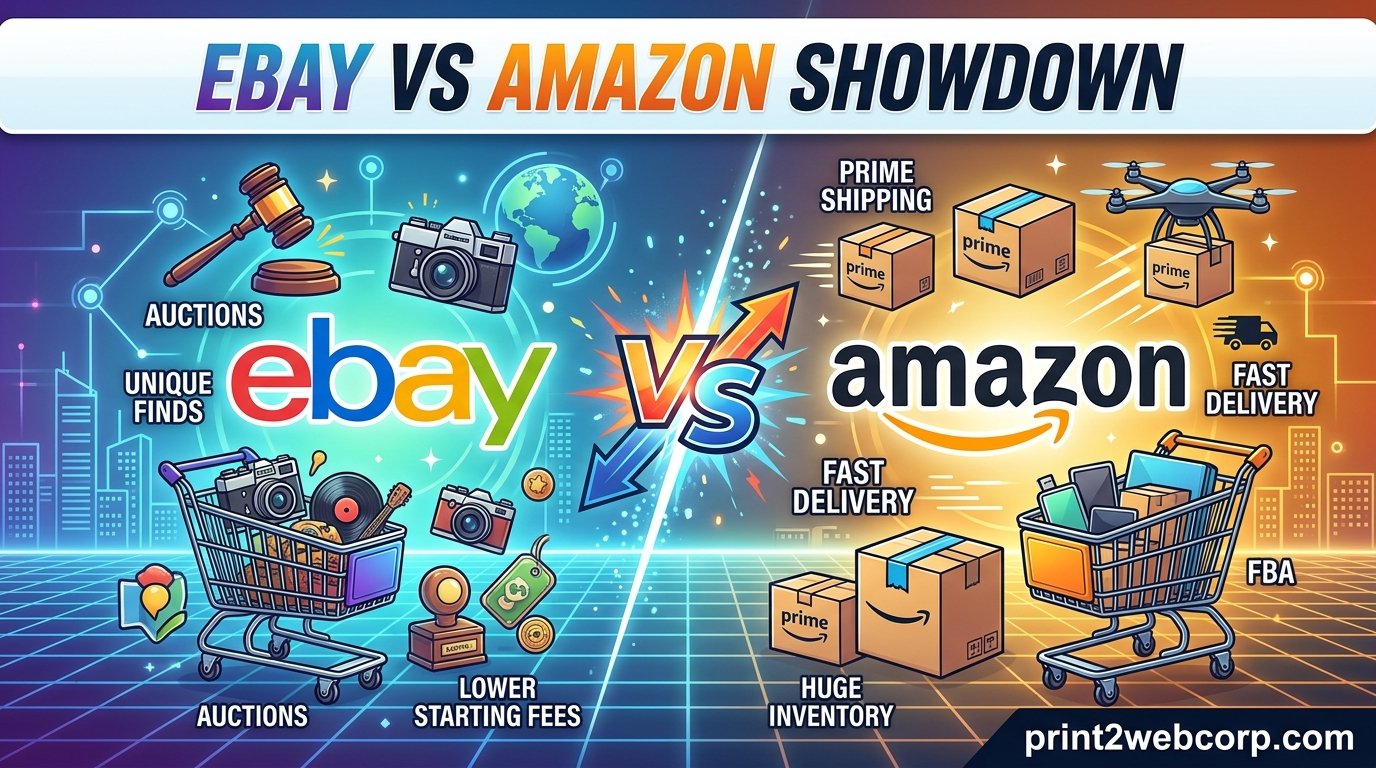
If you are standing at the crossroads of eBay vs Amazon, trying to figure out which platform deserves your inventory, your time, and your hard-earned capital, you are asking exactly the right question. Over 310 million active Amazon accounts and 134 million eBay buyers worldwide mean both platforms offer enormous earning potential for third-party sellers. But the path to profitability looks very different depending on which one you choose.
I have spent years analyzing seller data, reading through thousands of Reddit threads on r/FulfillmentByAmazon and r/eBaySellers, and tracking fee changes across both platforms. What I can tell you upfront is that there is no universal winner here. The right choice depends entirely on what you sell, how you source inventory, and whether you value control over scale.
Here is the quick verdict before we go deep. eBay is cheaper, more flexible, and gives you direct access to your customers. Amazon offers unmatched volume, consumer trust, and logistics infrastructure through FBA. Many successful resellers do not pick one over the other. They use a hybrid strategy, selling on both platforms to maximize reach while managing risk.
In this updated 2026 comparison, we will break down every angle that matters: current fee structures with real dollar examples, fulfillment options (including eBay’s newer logistics services), Buy Box mechanics, consumer trust data, product category fit, account setup difficulty, and tailored recommendations by seller type. By the end, you will know exactly where your products belong.
Quick Comparison: eBay vs Amazon at a Glance
Before diving into the details, here is a side-by-side snapshot of how the two platforms compare across the criteria that matter most to sellers in 2026.
| Criteria | eBay | Amazon |
|---|---|---|
| Active Users | 134 million active buyers worldwide | 310 million+ active accounts worldwide |
| Monthly Subscription | Free Starter Store; paid Store subscriptions from $4.95/month | $39.99/month for Professional Seller plan |
| Per-Item Fee (No Subscription) | 250 free listings per month, then $0.35 per listing | $0.99 per item sold (Individual plan) |
| Commission / Referral Fee | 12.7% to 15.3% final value fee (category dependent) | Typically 15% referral fee (ranges 6% to 45% by category) |
| Payment Processing | eBay Managed Payments (built in, no PayPal needed) | Handled through Amazon Seller Central |
| Fulfillment Options | Self-fulfillment, eBay International Shipping (EIS), Fulfillment by Orange Connex | Fulfilled by Amazon (FBA), Fulfilled by Merchant (FBM) |
| Listing Model | Unique seller listings with full customization | Shared product catalog pages (ASIN-based) |
| Pricing Competition | No direct listing competition; each listing is unique | Buy Box rotation among competing sellers |
| Prime Badge | Not available | Available through FBA enrollment |
| Best For | Collectibles, used goods, vintage, unique items, small sellers | New products, branded goods, high-volume sellers, retail arbitrage |
eBay vs Amazon: Understanding the Fundamentals
These two platforms may dominate the same ecommerce landscape, but they operate on fundamentally different business models. Understanding that structural difference is the foundation for every other comparison point that follows.
What is eBay and How Does it Work?
eBay launched in 1995 as an auction platform and has since grown into a global marketplace with 134 million active buyers across 190 markets. Unlike Amazon, eBay does not hold inventory or sell products itself. It functions purely as a facilitator, connecting independent sellers directly with buyers through a listing-based system.
Each seller creates their own unique listing with custom photos, descriptions, and pricing. Buyers can purchase through fixed-price “Buy It Now” listings or participate in auction-style bidding. This means you are never directly competing with another seller on the same listing page. Your product description, photos, and reputation are what differentiate you.
One major update that many outdated guides still get wrong: eBay no longer relies on PayPal as its primary payment system. Since completing its transition to eBay Managed Payments in 2022, all transactions flow through eBay’s own payment infrastructure. Buyers can still use PayPal, credit cards, Apple Pay, and Google Pay, but sellers receive payouts directly from eBay. This simplified the fee structure by combining payment processing into the final value fee rather than charging separate PayPal processing rates.
eBay also offers comprehensive seller tools through its Seller Hub dashboard, including detailed transaction and purchase history tracking. The platform provides 250 free listings per month with no monthly subscription required, making it genuinely accessible for new sellers testing the waters.
What is Amazon and Its Business Model?
Amazon started as an online bookstore in 1994 and has since become the largest ecommerce platform in the world, with over 310 million active customer accounts. Amazon operates as both a first-party retailer (purchasing and reselling products directly) and a third-party marketplace. In fact, third-party sellers now account for more than 60% of Amazon’s total sales volume.
The fundamental difference from eBay is Amazon’s catalog-based system. When multiple sellers offer the same product, they all share a single product detail page identified by an ASIN (Amazon Standard Identification Number). Sellers do not create unique listings. Instead, they add their offer to an existing product page and compete for visibility through pricing, fulfillment method, and seller metrics.
This shared-page model means the Buy Box determines who actually gets the sale. The Buy Box is the default “Add to Cart” option that the vast majority of buyers click without comparing sellers. Amazon uses an algorithm to rotate the Buy Box among eligible sellers based on price, shipping speed, seller rating, and fulfillment method. This creates intense pricing competition that simply does not exist on eBay.
Amazon Prime membership is another powerful differentiator. Over 200 million Prime members worldwide pay for fast, free shipping, and they overwhelmingly prefer Prime-eligible products. Sellers enrolled in Fulfillment by Amazon (FBA) automatically gain the Prime badge, which drives significantly higher conversion rates. Amazon also invests in building consumer trust at scale, with 65% of shoppers reporting they trust Amazon as a platform according to Jungle Scout consumer trend data.
The Showdown: eBay vs Amazon Seller Fees in 2026
Fee structure is where the eBay vs Amazon comparison gets concrete and where many sellers make their final decision. Let me break down exactly what each platform charges using current 2026 rates, then run through a real dollar-amount example so you can see the difference on an actual sale.
eBay Fee Structure
eBay’s fee system is refreshingly straightforward. There are three main components. First, insertion fees for listing your item. Most sellers get 250 free listings per month with a free Starter account, and additional listings cost $0.35 each. Paid Store subscriptions (starting at $4.95/month) unlock lower per-listing fees and final value fee discounts for higher-volume sellers.
Second, the final value fee is eBay’s commission on completed sales. This currently runs 12.7% to 15.3% depending on the product category, with most categories falling at 13.25%. The fee is calculated on the total sale amount including shipping costs. Third, eBay Managed Payments has absorbed what used to be separate PayPal processing fees, so there is no additional payment processing charge on top of the final value fee.
Amazon Fee Structure
Amazon’s fee system has more layers. The Professional Seller plan costs $39.99 per month and is required for sellers moving more than 40 units monthly. Below that threshold, the Individual plan charges $0.99 per item sold with no monthly subscription.
On top of the subscription, every sale incurs a referral fee that typically runs 15% of the sale price, though it ranges from 6% for personal computers to 45% for Amazon Device accessories. Media items (books, DVDs, video games) also carry a variable closing fee of $1.80 per item.
If you use FBA, add fulfillment fees for picking, packing, and shipping, plus monthly storage fees based on the cubic footage your inventory occupies. Amazon also introduced a low-inventory-level fee that penalizes sellers whose FBA inventory levels fall below historical demand, and Q4 storage fees increase significantly during peak holiday months. Amazon may also hold seller funds through its account level reserve policy, which can affect your cash flow depending on your account health and performance history.
Real Dollar Example: Selling a $25 Product
Let me make this tangible with a side-by-side calculation on a $25 product sale, which is the type of example that top-ranking competitors use to win featured snippets.
On eBay: The final value fee at 13.25% on a $25 sale comes to approximately $3.31. Add $0.30 for managed payment processing. That is roughly $3.70 total in fees, leaving you with $21.30 before product cost and shipping.
On Amazon (with FBA): The 15% referral fee on $25 is $3.75. Add the FBA fulfillment fee of roughly $3.06 for a standard-size item, plus a proportional share of monthly storage fees. At the Professional plan level, you also absorb $39.99 per month regardless of volume. Your total cost on this single sale comes to approximately $7.37 or more, leaving you with $17.63 before product cost.
That is nearly a $4 difference per sale. On 100 units per month, eBay saves you close to $400. Of course, Amazon may deliver significantly more volume through its larger customer base and Prime visibility, so the question is whether that volume compensates for the thinner margins.
Fulfillment Methods Face-Off
Fulfillment is one of the most important decisions you will make as a seller, and the two platforms take radically different approaches. The choice between hands-on control and outsourced logistics shapes everything from your daily workload to your profit margins.
eBay Fulfillment: Self-Shipping Plus New Options
Traditionally, eBay sellers handle all fulfillment themselves. You store your own inventory, print shipping labels, pack orders, and manage returns. This gives you complete control over costs, packaging quality, and customer communication. eBay also provides shipping label discounts through its integrated shipping dashboard.
However, the old claim that “Fulfillment by eBay doesn’t exist” is no longer accurate. eBay has launched eBay International Shipping (EIS), which handles international logistics by having sellers ship to a domestic eBay hub that then forwards packages globally. Additionally, Fulfillment by Orange Connex offers warehousing, picking, packing, and shipping services for eBay sellers, functioning similarly to FBA but on a smaller scale.
These options give eBay sellers more logistics support than ever before, though they still cannot match the scale and Prime-driven visibility of Amazon FBA. For most eBay sellers, self-fulfillment remains the default approach, especially for lower-volume operations and unique items that require careful handling.
Amazon FBA: The Logistics Powerhouse
Amazon’s Fulfilled by Amazon program is the gold standard for outsourced ecommerce logistics. You ship your inventory to Amazon warehouses, and Amazon handles storage, picking, packing, shipping, customer service, and returns. Products enrolled in FBA automatically receive the Prime badge, which dramatically increases conversion rates and Buy Box eligibility.
The trade-off is cost. FBA fulfillment fees, storage fees, and newer charges like the low-inventory-level fee can eat significantly into margins, especially for low-priced or slow-moving products. Q4 storage fee increases during October through December can surprise sellers who have not planned for the seasonal spike.
For sellers who want to maintain control, Amazon FBM (Fulfilled by Merchant) lets you handle your own shipping while still listing on Amazon. This is particularly viable for oversized items where FBA fees are prohibitive, or for sellers who already have efficient shipping operations.
eBay vs Amazon: Where Do You Earn More?
Profitability is the bottom line, and it depends on multiple factors working together. Let me break this into the key variables that determine your take-home earnings on each platform.
Fee Impact on Profit Margins
As the dollar example above showed, eBay’s total fee burden is typically 10% to 12% of the sale price, while Amazon’s combined fees (referral plus FBA) often consume 25% to 35% of a sale. This means that on a per-unit basis, eBay almost always delivers higher margins.
However, margins mean nothing without volume. Amazon’s 310 million users, Prime membership loyalty, and dominant search position often generate significantly more sales volume than eBay can for the same product. A seller making $5 profit per unit on eBay might make $2 per unit on Amazon but sell five times as many units.
Pricing Competition: Buy Box vs Unique Listings
Amazon’s shared-product-page model means you compete head-to-head with every other seller offering the same ASIN. The Buy Box algorithm rewards the lowest price, fastest shipping, and best seller metrics. This creates a race-to-the-bottom pricing dynamic, especially for commodity products where multiple sellers offer identical items.
Sellers on Amazon frequently use dynamic repricing tools that automatically adjust prices in real time based on competitor activity. While these tools help win the Buy Box, they can compress margins further as everyone fights for the same customer.
On eBay, every seller has their own unique listing. Even if ten people are selling the same smartphone, each listing stands alone with its own photos, description, and price. Buyers choose based on listing quality, seller reputation, and price, but there is no algorithmic Buy Box forcing you to undercut competitors by pennies.
Consumer Trust and Platform Safety
Consumer trust directly affects conversion rates. According to Jungle Scout consumer trends data cited by multiple competitors, approximately 65% of online shoppers trust Amazon, making it the most trusted online shopping platform. This trust translates into higher conversion rates, fewer abandoned carts, and more repeat purchases for Amazon sellers.
eBay also has strong trust signals, including its Money Back Guarantee and detailed seller ratings. However, buyer trust on eBay is more dependent on individual seller reputation. A new eBay seller with no feedback history will struggle to convert buyers until they build a positive rating track record.
Amazon’s A-to-z Guarantee gives buyers confidence that their purchases are protected regardless of the individual seller. While this benefits conversion rates, it also means Amazon heavily favors buyers in dispute resolution. Forum discussions on r/FulfillmentByAmazon and r/eBaySellers consistently report that Amazon’s return and claim policies can leave sellers vulnerable to return abuse and false claims.
eBay tends to be more seller-friendly in disputes when you follow their policies correctly. Many experienced sellers note that eBay will take the seller’s side if guidelines are properly followed and documentation is provided.
Product Category Fit: What Sells Best Where
Not every product performs equally on both platforms. Understanding category fit is one of the most practical ways to decide where to focus your selling efforts.
Products That Excel on eBay
eBay dominates in categories where uniqueness, condition variety, and niche expertise matter. Collectibles and vintage items are eBay’s strongest categories, attracting dedicated buyers willing to pay premium prices for rare finds. The auction-style listing format remains a powerful tool for items where market value is difficult to determine.
Used and refurbished goods are also eBay’s territory. Unlike Amazon, which is optimized for new products in retail packaging, eBay accommodates items in any condition with transparent grading systems. Automotive parts, electronics components, and fashion accessories all perform well on eBay.
The emerging recommerce trend, particularly among Gen Z shoppers, is driving renewed growth on eBay. Younger consumers increasingly value sustainability, secondhand goods, and unique finds over mass-produced items, which plays directly to eBay’s strengths.
Products That Excel on Amazon
Amazon is the clear leader for new, branded, and commodity products. Books, consumer electronics, kitchen appliances, home goods, and health products all perform exceptionally well on Amazon’s platform. The shared product page model works well when items are identical across sellers, and Prime shipping creates a massive conversion advantage.
Retail arbitrage and online arbitrage sellers gravitate toward Amazon because the catalog-based system makes it easy to list established products by UPC or EAN without creating custom listings. Wholesale sellers also prefer Amazon for its ability to move high volumes quickly through a single optimized product page.
Amazon also offers Amazon Brand Registry for sellers with registered trademarks, providing enhanced listing controls, brand protection tools, and access to A+ Content and Sponsored Brands advertising. This makes Amazon particularly attractive for private label sellers building their own brands.
However, Amazon restricts certain categories. Categories like groceries, health, beauty, and toys require category approval and sometimes additional documentation. For example, selling toys on Amazon requires special approval and compliance with specific performance standards, particularly during Q4.
Account Setup and Onboarding Difficulty
For new sellers, the barrier to entry matters. This is where eBay has a clear advantage. You can create an eBay seller account, list your first item, and start selling within hours. The free Starter account includes 250 free listings per month with no monthly fee, and the listing process is intuitive with step-by-step guidance for photos, pricing, and shipping.
Amazon’s onboarding is more rigorous. The Professional Seller registration requires business documentation, tax information, bank account verification, and a more extensive identity verification process. Category approvals add additional hurdles for certain product types. Amazon also enforces stricter initial performance metrics, and new accounts may face additional scrutiny during the first 30 to 90 days.
Forum data confirms this pattern. New eBay resellers report making their first sales within the first week, while Amazon sellers often take longer to get fully operational. However, Amazon sellers who push through the initial setup period often see higher volume once established.
Branding and Customer Relationship Control
How much control you have over your brand and customer relationships differs sharply between the two platforms. On eBay, every listing is yours. You control the photos, the description, the storefront branding, and crucially, direct communication with buyers. eBay allows you to include branded packaging, personalized thank-you notes, and follow-up marketing within policy guidelines. This direct line to customers helps build loyalty and repeat business.
Amazon restricts most direct customer communication. Buyers are identified only by name in Amazon’s messaging system, and sellers are prohibited from including marketing materials or directing customers to external channels. The customer relationship effectively belongs to Amazon, not the seller.
For brand builders, Amazon Brand Registry partially addresses this by giving registered trademark owners enhanced control over their product detail pages, brand stores, and advertising. But even with Brand Registry, the customer relationship remains mediated through Amazon’s platform.
If building a recognizable brand and maintaining direct customer relationships is part of your long-term strategy, eBay offers more flexibility. If you want maximum exposure with minimal customer management overhead, Amazon’s model may actually be preferable.
Seller’s Dilemma: Pros and Cons of Each Platform
Pros of Selling on Amazon
- Massive buyer base: Over 310 million active accounts provide unparalleled sales volume potential for most product categories.
- Prime badge advantage: FBA enrollment grants Prime eligibility, driving significantly higher conversion rates and customer loyalty.
- Outsourced logistics: FBA handles storage, shipping, returns, and customer service, freeing you to focus on sourcing and growth.
- Consumer trust: Approximately 65% of shoppers trust Amazon, leading to higher conversion rates and less buyer hesitation.
- Scalability: The catalog-based system and FBA infrastructure make it easier to scale from dozens to thousands of units efficiently.
Cons of Selling on Amazon
- Higher fee burden: Combined referral fees, FBA fees, storage fees, and the $39.99 monthly subscription can consume 25% to 35% of each sale.
- Intense Buy Box competition: The shared-page model forces price wars with other sellers offering identical products.
- Buyer-favoring policies: Amazon’s A-to-z Guarantee and return policies can leave sellers exposed to return abuse and false claims.
- Account suspension risk: Amazon can suspend accounts with little warning, and the appeal process is rigorous and stressful.
- No customer data access: Amazon restricts direct customer communication and prohibits external marketing, limiting brand-building opportunities.
The Advantages of Selling on eBay
- Lower overall fees: Final value fees of 12.7% to 15.3% with no monthly subscription required for the Starter plan keep more money in your pocket.
- Unique listings: No Buy Box competition means your listing is never buried under a cheaper competitor’s offer on the same page.
- Full listing control: Custom photos, descriptions, and branding options let you differentiate your products and build a recognizable seller identity.
- Seller-friendly dispute resolution: eBay is generally more balanced in resolving buyer-seller disputes when sellers follow policy guidelines.
- Ideal for used and unique items: Collectibles, vintage goods, refurbished electronics, and one-of-a-kind items perform far better on eBay than Amazon.
Potential Downsides of an eBay Store
- Lower overall traffic: With 134 million active buyers versus Amazon’s 310 million, the potential customer pool is smaller for most categories.
- Inconsistent sales volume: Many sellers report that eBay sales can fluctuate significantly compared to the steadier demand patterns on Amazon.
- Self-fulfillment burden: Without FBA-style logistics, you handle storage, packing, shipping, and returns yourself unless you opt into eBay International Shipping or Orange Connex.
- No Prime badge equivalent: eBay cannot match the conversion-boosting power of the Amazon Prime badge for fast-shipping-obsessed buyers.
- Reputation dependency: New sellers with no feedback history face an uphill battle building buyer trust from scratch.
For more context on Amazon’s return policies and what sellers need to know about original packaging requirements, our dedicated guide covers the essentials.
Which Platform Is Right For You? Recommendations by Seller Type
Different seller archetypes thrive on different platforms. Here is a breakdown of where each common seller type performs best.
New and Beginner Sellers
eBay is the clear winner for newcomers. The zero-cost entry, simple listing process, and forgiving learning curve make it ideal for testing products and building selling skills. You can start with items from around your house, learn the platform mechanics, and build feedback without financial risk. Many successful sellers recommend cutting your teeth on eBay for 30 to 90 days before tackling Amazon’s more complex ecosystem.
Retail Arbitrage and Online Arbitrage Sellers
Amazon is the stronger platform for arbitrage. Its catalog-based system lets you quickly list products by scanning barcodes, and FBA handles the logistics of high-volume flipping. The Buy Box competition is fierce, but the volume potential is unmatched. Amazon’s gating requirements for certain categories (like toys and grocery) can be a barrier, so verify category eligibility before sourcing.
Wholesale Sellers
Amazon is the natural home for wholesale selling. The ability to move high volumes through established product pages, combined with FBA logistics and Prime visibility, makes Amazon the efficient choice. Wholesale margins are typically thin, but Amazon’s volume can compensate. Consider using dynamic repricing tools to maintain Buy Box position without manually monitoring prices.
Collectibles and Used Goods Sellers
eBay is the undisputed champion for collectibles, vintage items, antiques, and used goods. The unique-listing model, auction format, and dedicated collector community make eBay the only viable choice for these categories. Amazon simply cannot accommodate the condition grading, provenance documentation, and niche audience that collectibles require.
Private Label and Brand Builders
Amazon is superior for private label sellers, particularly with Amazon Brand Registry. The ability to create exclusive product listings, run Sponsored Brands campaigns, and build an Amazon Storefront gives brand owners powerful tools. However, if direct customer relationships and external brand building are priorities, consider eBay or a standalone ecommerce site alongside your Amazon presence.
Hybrid Strategy: Selling on Both Amazon and eBay
Many experienced sellers do not choose between platforms. They use a hybrid multi-channel strategy to maximize reach while diversifying risk. This approach leverages each platform’s strengths while mitigating their individual weaknesses.
How Multi-Channel Selling Works
The typical hybrid approach uses eBay as a testing ground and Amazon as a scaling engine. Sellers list new or experimental products on eBay first, where setup is fast and costs are low. Once a product proves its demand and profitability, they move it to Amazon with FBA fulfillment for maximum volume. Products that perform well on both platforms can be listed on each simultaneously.
Multi-channel selling also protects against platform risk. If your Amazon account faces suspension or policy changes affect your listings, your eBay revenue provides a safety net. Conversely, if eBay sales dip, your Amazon volume maintains cash flow. Diversification across platforms is one of the smartest risk management strategies in ecommerce.
Tools for Managing Both Platforms
Selling on both platforms requires inventory synchronization to prevent overselling. Multi-channel inventory management tools like those integrating with Amazon Seller Central and eBay Seller Hub can sync stock levels and pricing across platforms in real time. Many sellers also use listing management software to create listings once and publish to both marketplaces with platform-specific adaptations.
The key to a successful hybrid strategy is understanding that each platform requires a different approach. The product, pricing, and listing strategy that works on Amazon may not translate directly to eBay, and vice versa. Tailor your approach to each platform’s unique dynamics while maintaining consistent inventory data.
eBay vs Amazon: Frequently Asked Questions
Is it better to buy off Amazon or eBay?
It depends on what you are buying. Amazon is better for new products, fast shipping, and branded goods, especially for Prime members. eBay is better for used items, collectibles, vintage goods, and products where you want to compare individual seller offerings rather than buy from a shared listing page.
What is the downside of eBay?
The main downsides of eBay are lower overall traffic compared to Amazon (134 million vs 310 million active users), inconsistent sales volume for some categories, the need to self-fulfill orders unless using eBay International Shipping or Orange Connex, and the lack of a Prime-style fast-shipping badge. New sellers also face the challenge of building feedback history from zero before buyers trust them.
Is it better to resell on eBay or Amazon?
For new branded products and retail arbitrage, Amazon typically generates higher volume through its larger buyer base and Prime visibility. For used goods, collectibles, vintage items, and unique products, eBay is the better choice due to its unique-listing model and dedicated niche buyer community. Many resellers use both platforms simultaneously.
How much does eBay take from a $10,000 sale?
eBay’s final value fee is 12.7% to 15.3% depending on the category. On a $10,000 sale, that means eBay takes between $1,270 and $1,530. At the most common rate of 13.25%, eBay would take approximately $1,325. There are no additional payment processing fees since eBay Managed Payments consolidated those charges into the final value fee.
Is it cheaper to sell on eBay or Amazon?
eBay is cheaper. eBay charges 12.7% to 15.3% final value fees with no required monthly subscription (free Starter plan includes 250 listings). Amazon charges a 15% referral fee plus $39.99 per month for the Professional plan, and FBA fees add further costs that typically bring total fees to 25% to 35% of each sale.
Can I sell on both Amazon and eBay at the same time?
Yes, absolutely. Multi-channel selling on both platforms is a common strategy that maximizes reach and diversifies risk. You need inventory management software to sync stock levels and prevent overselling across platforms. Many sellers use eBay for testing new products and Amazon for scaling proven winners.
Which is safer, Amazon or eBay?
For buyers, Amazon is generally considered safer due to its A-to-z Guarantee and approximately 65% consumer trust rating. For sellers, eBay is often considered safer because its dispute resolution tends to be more balanced, and the unique-listing model avoids the Buy Box price wars that erode Amazon seller margins. However, both platforms have robust buyer protection systems.
Do more people use Amazon or eBay?
More people use Amazon. Amazon has over 310 million active customer accounts compared to eBay’s 134 million active buyers. Amazon’s larger user base is one reason sellers accept its higher fees in exchange for greater sales volume potential.
Conclusion: Making Your eBay vs Amazon Decision in 2026
The eBay vs Amazon debate does not have a single correct answer, and anyone who tells you otherwise is oversimplifying. The right platform depends on what you sell, how you source inventory, your fulfillment preferences, and your long-term business goals.
If you sell collectibles, used goods, vintage items, or unique products, eBay is your best bet. Its lower fees, unique-listing model, seller-friendly dispute resolution, and dedicated niche buyer community give you the control and margins you need. If you are a new seller just starting out, eBay’s zero-cost entry and intuitive listing process make it the ideal training ground.
If you sell new branded products, run retail arbitrage, or want maximum sales volume, Amazon is the stronger choice. Its 310 million active users, Prime badge, FBA logistics infrastructure, and unmatched consumer trust make it the scaling engine of choice for high-volume sellers willing to accept thinner margins in exchange for greater reach.
And if you want the best of both worlds, a hybrid multi-channel strategy lets you leverage each platform’s strengths while protecting against the risks of relying on a single marketplace. Start where your products fit best, prove your model, then expand to the other platform to capture additional market share.
Whatever you decide, the most important step is to start selling. Both platforms reward sellers who understand their rules, optimize their listings, and consistently deliver quality products and service. Use the fee breakdowns, fulfillment comparisons, and seller-type recommendations in this guide to make your choice, then commit to executing your strategy with discipline. The 2026 ecommerce market is large enough for you to win on either platform, or both.
Leave a Reply