
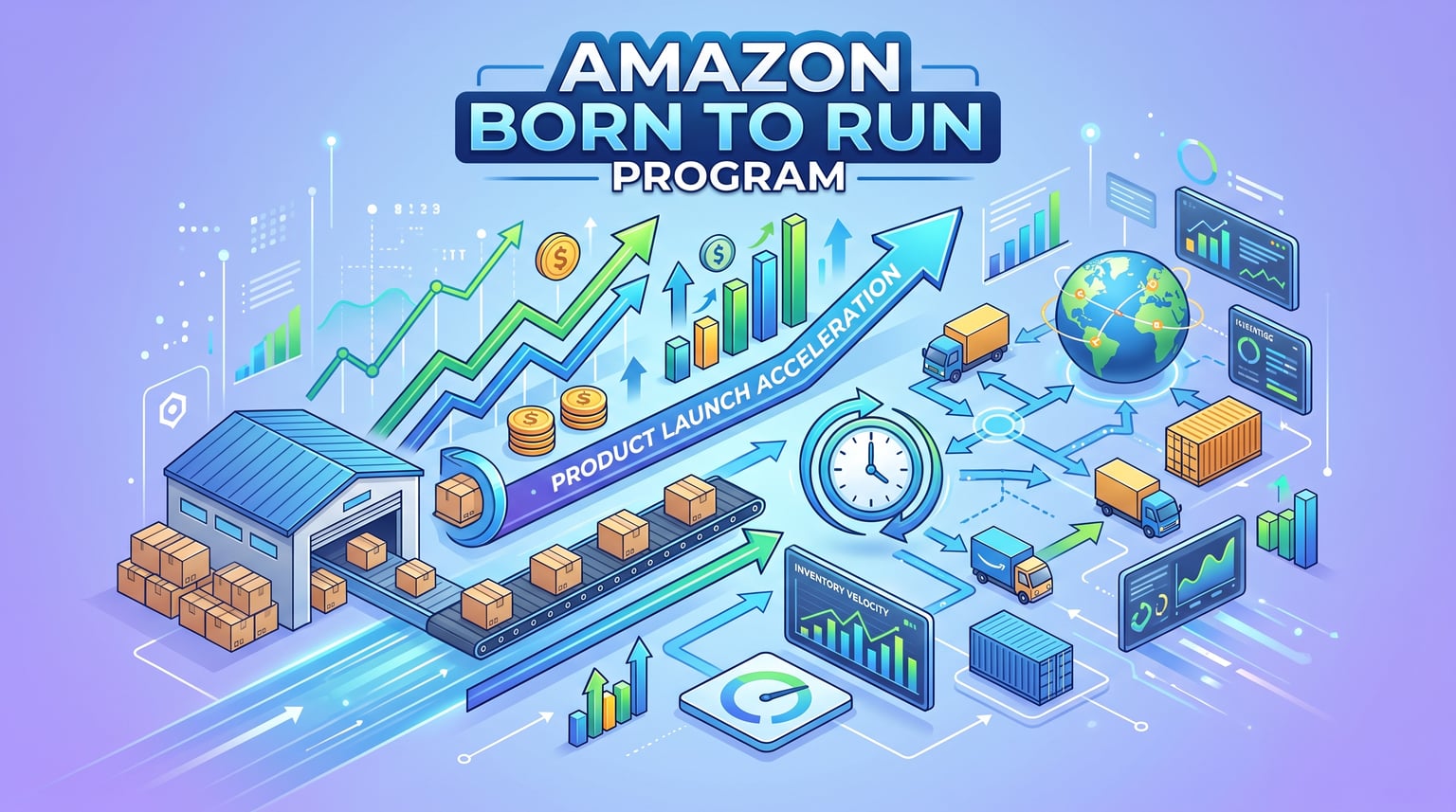
Launching a new product on Amazon often means waiting weeks or months for the platform’s algorithms to recognize demand and place meaningful purchase orders. For Amazon Vendor Central (1P) sellers, the Amazon Born to Run Program offers a way around that bottleneck by letting vendors request large upfront orders based on their own sales projections. But here is the catch most people miss: this is an invite-only program available exclusively to first-party vendors, not third-party FBA or FBM sellers. If you have ever wondered why some products seem to skyrocket overnight while yours crawls through the standard purchase order process, Born to Run might be the reason.
I have spent time digging into Amazon’s vendor ecosystem, and the confusion around Born to Run is widespread. Reddit users on r/VendorCentral regularly ask how to gain access, while others mistakenly believe any registered seller can enroll through Seller Central. That is simply not how it works. This guide breaks down exactly what the program is, who qualifies, how the 10-week sell-through period functions, what the penalty structure looks like, and whether it is worth the risk for your brand.
One quick clarification before we go further: this has nothing to do with the Christopher McDougall bestseller Born to Run or the Bruce Springsteen album. This is purely about Amazon’s Vendor Central ordering initiative. If you are a third-party seller exploring fulfillment options, you may want to read about Fulfillment by Amazon (FBA) or Fulfillment by Merchant (FBM) instead, since those are the programs designed for your seller type.
What You Will Learn:
What the Amazon Born to Run Program is and who can actually participate
How the 10-week sell-through period works, including the 20-day start window
Exact eligibility requirements, including dollar thresholds and product restrictions
The penalty structure: 10% shipping and handling for returns versus 25% retention fee
Best practices for forecasting, advertising, and listing optimization
Recent policy changes from 2026 that affect how vendors can use the program
What Is the Amazon Born to Run Program?
Born to Run is an invite-only program within Amazon Vendor Central that allows first-party (1P) vendors to request purchase orders for their products rather than waiting for Amazon to generate orders algorithmically. In plain terms, you tell Amazon how many units of an ASIN you expect to sell through within a 10-week window, and Amazon commits to buying that quantity upfront. This gives new or promotional ASINs immediate inventory depth on the platform, which can accelerate sales velocity and improve Best Sellers Rank (BSR) from day one.
The program exists because Amazon’s standard Vendor Central purchasing algorithm is conservative by design. It orders small quantities initially and ramps up only as sales data confirms demand. While that approach minimizes Amazon’s inventory risk, it creates a frustrating chicken-and-egg problem for vendors: you need inventory to generate sales, but you need sales data to receive purchase orders. Born to Run breaks that cycle by letting the vendor shoulder the inventory risk in exchange for accelerated market entry.
It is worth emphasizing the distinction between vendor types here. Born to Run is not available to third-party (3P) sellers who use Seller Central, including those enrolled in FBA or FBM. If you operate a 3P account, this program is not an option for you, regardless of how strong your sales history is. The program is managed entirely within Vendor Central, Amazon’s portal for first-party vendors where Amazon itself purchases and resells products.
How the 10-Week Sell-Through Period Works
The Mechanics: From Launch Buy Quantity to Final Accounting
When you submit a Born to Run request, you specify a Launch Buy Quantity, which is the number of units you project Amazon will sell through over a 10-week period. There is a cap: the total value of your Launch Buy Quantity cannot exceed $50,000. Once Amazon approves your submission, the clock starts ticking. However, there is a built-in buffer: the 10-week sell-through period does not begin immediately. Amazon allows a 20-day window after the product arrives at their fulfillment center before the clock officially starts, giving the listing time to go live and begin generating orders.
During those 10 weeks, Amazon tracks how many units sell through to customers. If your projections were accurate and the inventory sells through, you owe nothing extra. Amazon may even place additional purchase orders during the sell-through window if demand outpaces your initial projection. One vendor on Reddit reported using Born to Run to move several hundred thousand dollars worth of product over a three-to-four-month period, demonstrating that the program can scale well beyond the initial Launch Buy Quantity when products perform.
The critical question every vendor asks is what happens to unsold inventory. Amazon gives you two options when the sell-through period ends with remaining stock, and neither is free.
Penalty Option 1: Amazon Returns the Product
Amazon ships the unsold units back to you and charges a 10% shipping and handling fee on the cost of those returned goods. This means you recover your inventory but pay a penalty for the logistics of processing the return. For vendors who believe the product will sell through eventually with additional marketing or time, this option lets you take the units back and try again through standard purchase orders or other channels.
Penalty Option 2: Amazon Keeps the Product
Amazon retains the unsold inventory and charges a 25% retention fee on the cost of those goods. In this scenario, Amazon takes ownership of the remaining units and may liquidate them through warehouse deals or other clearance channels. You do not get the product back. This option makes sense if the cost of processing returns, restocking, and reshipping would exceed the 25% fee, or if the product has a short shelf life.
Neither option is painless, which is why accurate forecasting is the single most important factor in whether Born to Run works for your brand. Overestimate demand and you face either penalty. Underestimate, and you risk stockouts that damage your sales velocity and ranking.
Eligibility Requirements: Who Qualifies and What Products Are Accepted
Before you consider submitting a Born to Run request, you need to understand the program’s eligibility criteria. Several vendors on Reddit have reported frustration with denied submissions, so knowing the requirements upfront can save you time.
Account Requirements
First and foremost, you must have an active Amazon Vendor Central account in good standing. Born to Run is invite-only, meaning not every vendor sees the option in their dashboard. Access is granted at Amazon’s discretion, and the criteria for receiving an invitation are not publicly documented. Vendors who do not have Born to Run access typically rely on Direct Fulfillment (DF) codes as an alternative path to sell on Amazon, though it is a slower process.
Product Requirements
Your ASIN must meet specific criteria to be accepted into the program:
Minimum product cost of $5 per unit at wholesale pricing
Maximum Launch Buy Quantity value of $50,000 per submission
The ASIN must already be created and approved in your Vendor Central catalog (you cannot create a brand-new ASIN specifically for Born to Run)
Products cannot be classified as heavy, bulky, or dangerous goods (hazmat)
The product must pass Amazon’s internal profitability review, which evaluates Amazon’s expected margin on the item
That last point deserves attention. Multiple vendors have reported having their Born to Run submissions denied for “profitability” reasons even after lowering their wholesale costs. One vendor shared that they reduced their cost to $15.71 per unit, but the submission was still rejected. Amazon’s profitability thresholds are strict and not fully transparent, which makes it difficult to predict whether your ASIN will clear that bar before submitting.
Born to Run vs Standard Vendor Central Purchasing
To understand the value of Born to Run, it helps to contrast it with the standard Vendor Central purchase order process. Under normal operations, Amazon’s automated purchasing system analyzes your sales data, seasonal trends, and inventory levels to determine when and how much to order. For established ASINs with strong sales history, this system works reasonably well. Orders arrive predictably, and stockouts are rare.
The problem arises with new product launches and promotional ASINs. Since these items have no sales history, Amazon’s algorithm orders conservatively, often just a handful of units at a time. This slow ramp-up means your product may take weeks or months to build enough inventory depth to rank competitively in search results. Competitors with more stock capture the Buy Box more frequently, and your launch loses momentum. For sellers weighing their overall marketplace strategy, understanding how Amazon compares to other marketplaces can provide additional context for why inventory depth on Amazon matters so much.
Born to Run eliminates that cold-start problem. By committing to a large upfront order, you give Amazon enough inventory to fulfill orders aggressively from day one. According to Vendor Society data referenced by eComEngine, pilot tests showed that Born to Run ASINs attracted nearly double the sales volume of products launched through the standard process. That kind of head start can make a meaningful difference in long-term ranking and organic discoverability.
Benefits of the Amazon Born to Run Program
Accelerated Sales Velocity and BSR Improvement
The most immediate benefit is speed. When Amazon has deep inventory of your product, the listing appears more reliable to both the search algorithm and shoppers. Products with consistent availability tend to rank higher in search results and convert at better rates because customers are not deterred by out-of-stock warnings. This momentum feeds on itself: strong early sales improve your Best Sellers Rank, which drives more organic traffic, which generates more sales.
Stockout Prevention for Promotional ASINs
If you are running a major marketing campaign, a product launch, or a seasonal promotion, the last thing you want is for Amazon to run out of stock mid-campaign. Born to Run ensures adequate inventory is in place before you start driving traffic. This matters because stockouts not only lose immediate sales but can also reset your BSR progress and damage the product’s long-term organic performance.
No Advertising Spend Requirement
Historically, Born to Run required vendors to commit 10% of the Launch Buy Quantity value to Amazon advertising spend. Amazon has since abolished that requirement, which means you can now participate in the program without a mandatory ad commitment. That said, running Sponsored Products and Sponsored Brands campaigns during the sell-through period is strongly recommended to maximize your chances of moving inventory and avoiding penalties.
Stronger Relationship with Amazon
Vendors who successfully complete Born to Run cycles demonstrate to Amazon that they can forecast accurately and deliver products that sell. Over time, this builds trust with Amazon’s vendor management team, which can lead to better terms, larger standard purchase orders, and early access to new vendor programs. WAKE Commerce highlights this relationship-building aspect as one of the most underrated benefits of the program.
Risks and Drawbacks You Need to Weigh
The financial exposure is the most obvious risk. If your product does not sell through within the 10-week window, you are on the hook for either the 10% shipping and handling fee on returned goods or the 25% retention fee on inventory Amazon keeps. For a $50,000 Launch Buy Quantity where half the inventory remains unsold, the retention fee alone could cost you over $6,000. That is a significant hit, especially for smaller brands operating on thin margins.
Forecasting difficulty compounds this risk. New products have zero sales history, making it genuinely hard to project how many units will sell in 10 weeks. Even experienced vendors with strong market research sometimes get it wrong. Amazon Brand Analytics can help by providing search frequency data and competitor performance benchmarks, but it cannot predict consumer behavior with certainty. Vendors who are uncomfortable with this level of inventory risk may want to explore alternative Amazon selling methods that do not require the same upfront inventory commitment.
Another frustration vendors report is the opacity of Amazon’s profitability review. Submissions get denied for reasons that are not clearly communicated, and Seller Support often cannot provide specific feedback on what to change. This lack of transparency can waste weeks of preparation time if your ASIN is rejected after you have already built inventory and marketing plans around the Born to Run timeline.
How to Forecast Units for Your Born to Run Submission
Getting your Launch Buy Quantity right is the difference between a successful Born to Run cycle and an expensive penalty. Here is a framework for arriving at a defensible number.
Analyze Comparable Products
Use Amazon Brand Analytics to research similar products in your category. Look at search frequency rankings for relevant keywords and examine the performance of competitor ASINs that launched recently. If a comparable product from a similar brand sells roughly 300 units per week, projecting 2,000 to 3,000 units over a 10-week period is a reasonable starting point, adjusted for your brand’s relative market presence.
Factor in Seasonal Trends
If you are launching ahead of Black Friday, Prime Day, or holiday shopping seasons, demand during the 10-week window may be significantly higher than baseline averages. Review year-over-year category trends and account for promotional calendars. Conversely, if your sell-through period overlaps a historically slow period, be conservative with your projections.
Build in a Safety Margin
Many experienced vendors recommend submitting a Launch Buy Quantity that represents 70 to 80% of your optimistic forecast. This way, if demand slightly outpaces your projection, Amazon will place additional orders during the sell-through window to replenish. And if demand falls short, your exposure to penalties is limited. It is easier to request supplemental orders than to deal with unsold inventory.
Strategic Timing: When to Use Born to Run
Born to Run is not something you should use for every product launch. It is best reserved for high-stakes moments where inventory depth directly impacts your competitive positioning.
Launching a flagship product that you plan to support with significant advertising? Born to Run ensures stock availability so your ad spend does not go to waste on an out-of-stock listing. Preparing for Q4 holiday demand? Submit your Born to Run request 8 to 10 weeks before the seasonal peak so inventory is in place when traffic spikes. Promoting an ASIN through Amazon Vine or an influencer campaign? Having deep inventory prevents the ranking damage that comes from stockouts during a visibility push.
For routine restocking or incremental product updates, the standard Vendor Central purchase order process is usually sufficient. Reserve Born to Run for situations where speed and inventory certainty provide a genuine competitive edge.
How to Enroll: Step-by-Step for Vendor Central
If you have access to Born to Run, enrolling involves a specific navigation path within Vendor Central. Here is the actual process.
Log into Vendor Central and navigate to Orders > Vendor Initiated Orders > Born to Run. If you do not see this menu option, your account does not currently have program access.
Select your ASIN. The product must already exist in your Vendor Central catalog and have passed initial catalog approval. You cannot create a new ASIN specifically for a Born to Run submission.
Enter your Launch Buy Quantity. Specify the number of units you project will sell through in 10 weeks. The total value cannot exceed $50,000.
Submit for Amazon review. Amazon evaluates the submission for profitability, product eligibility (no dangerous goods, meets minimum cost threshold), and catalog compliance.
Monitor your submission status. You can check the status within the Vendor Initiated Orders section. If approved, Amazon generates a purchase order for the agreed quantity.
Ship the product to Amazon’s designated fulfillment center. The 20-day buffer begins once inventory is received, followed by the 10-week sell-through period.
Drive sales through advertising, listing optimization, and review generation during the sell-through window to maximize sell-through and avoid penalties.
If you are a third-party seller reading this and wondering where to apply, remember that this path does not exist in Seller Central. Vendors using Fulfillment by Merchant or Fulfillment by Amazon operate under an entirely different model where you set your own inventory levels without needing Amazon to place purchase orders.
Best Practices for Born to Run Success
Optimize Your Product Detail Page Before Launch
Your product detail page needs to be conversion-ready before the sell-through clock starts. Invest in professional product photography, write benefit-driven titles and bullet points, and ensure your A+ Content is live. Use the Amazon Search Terms Report to identify high-intent keywords and incorporate them naturally into your listing copy. A well-optimized page converts at a higher rate, which directly impacts how quickly your Born to Run inventory moves.
Run Sponsored Products Campaigns from Day One
Although the mandatory 10% ad spend requirement has been abolished, running Sponsored Products and Sponsored Brands campaigns during the sell-through period is strongly recommended. Paid advertising drives external traffic to your listing, accelerates sales velocity, and generates the early reviews that fuel organic ranking improvements. Budget aggressively during the first 4 to 6 weeks when momentum matters most.
Generate Reviews Quickly
Enroll your product in Amazon Vine to jumpstart review generation. Early reviews provide social proof that improves conversion rates, which in turn helps your Born to Run inventory sell through faster. Products with even a handful of detailed reviews convert significantly better than listings with zero social proof. Coordinate your Vine enrollment so that reviews begin appearing within the first few weeks of the sell-through window.
Monitor Sell-Through Progress Weekly
Track your inventory levels and sell-through rate closely throughout the 10-week period. If sales are lagging behind your projections, increase ad spend, adjust pricing, or run promotions to accelerate movement. If sales are exceeding projections, prepare for Amazon to place additional purchase orders and ensure you have supply chain capacity to fulfill them. Staying proactive gives you time to course-correct before the sell-through window closes.
Recent Policy Changes to Be Aware Of
In a policy update first surfaced through a July 2025 LinkedIn post by Ford Baker, Amazon changed how Born to Run interacts with its bulk buy system. Under the updated policy, vendors can no longer submit an ASIN to Born to Run if they previously rejected a bulk buy offer for that same ASIN. This change caught many vendors off guard and effectively closed the Born to Run door for products where a bulk buy was declined.
The lesson here is straightforward: Amazon can and does modify program terms with little notice. Vendors should stay connected to communities like the Vendor Society forum and industry newsletters to catch policy shifts early. What works today may not be available tomorrow, so treat program access as a privilege that requires ongoing attention.
FAQs
What is Amazon’s Born to Run program?
Born to Run is an invite-only program within Amazon Vendor Central that lets first-party (1P) vendors request upfront purchase orders for their products by telling Amazon how many units they expect to sell through in a 10-week period. It is not available to third-party (3P) sellers using Seller Central.
Can third-party sellers use Born to Run?
No. Born to Run is exclusively for Amazon Vendor Central accounts (first-party vendors). Third-party sellers using FBA or FBM through Seller Central cannot enroll. The program requires a Vendor Central account with invite-only access.
What happens if Born to Run products don’t sell?
If unsold inventory remains after the 10-week sell-through period, Amazon offers two options: return the product to you with a 10% shipping and handling fee, or retain the product and charge a 25% retention fee on the cost of the unsold goods.
How many units should I order for Amazon Born to Run?
Base your Launch Buy Quantity on sales projections for a 10-week period, using Amazon Brand Analytics data, comparable product performance, and seasonal trends. Many experienced vendors recommend submitting 70 to 80% of their optimistic forecast to limit penalty exposure while allowing room for Amazon to place supplemental orders.
Is Amazon Born to Run worth it?
Born to Run can be worth it for high-priority product launches and promotional campaigns where inventory depth provides a competitive advantage. Pilot tests showed Born to Run ASINs attracted nearly double the sales of standard launches. However, the penalty structure means vendors must be confident in their forecasting before committing.
Conclusion
The Amazon Born to Run Program gives Vendor Central sellers a powerful tool to bypass the slow ramp-up of standard purchase orders and get products in front of customers at full speed. For vendors launching a flagship product or preparing for a high-stakes seasonal push, the ability to secure deep inventory on day one can be the difference between a product that takes off and one that never gains traction.
But this program is not without real financial risk. The 10-week sell-through period, combined with the 10% returns fee and 25% retention fee, means inaccurate forecasting can quickly erase your margins. If you are confident in your product, have done your research with Amazon Brand Analytics, and have an advertising and review strategy ready to execute, Born to Run can accelerate your launch significantly. If you are uncertain about demand, the standard purchase order process may be the safer path.
Remember that program access is invite-only, limited to Vendor Central accounts, and subject to policy changes like the 2026 bulk buy restriction. Stay connected to vendor communities, keep your listings optimized, and treat each Born to Run submission as a strategic decision backed by data. With the right preparation, this program can be a genuine springboard for your product’s success on Amazon in 2026 and beyond.
Leave a Reply