
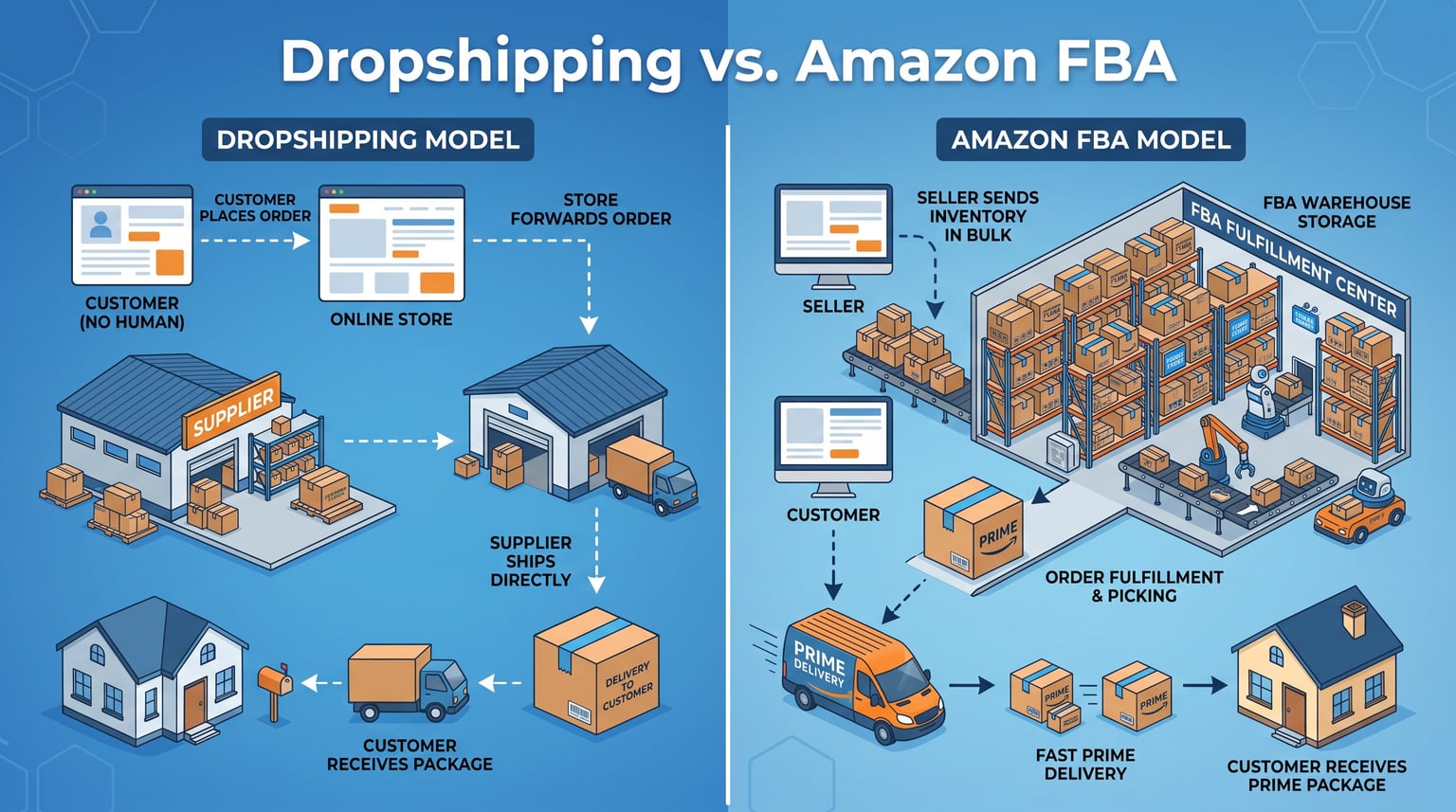
The single biggest difference in the Dropshipping vs. Amazon FBA debate comes down to one question: who owns the inventory? With Fulfillment by Amazon (FBA), you purchase products upfront, ship them in bulk to Amazon’s warehouses, and let Amazon handle storage, packing, shipping, and customer service. With dropshipping, you never touch the product at all. A third-party supplier ships directly to your customer only after they place an order.
That fundamental distinction drives every other difference between the two models, from startup capital requirements to profit margins to long-term scalability. In 2026, the gap between these two approaches has widened considerably. Amazon’s enforcement of its dropshipping policy is stricter than ever, FBA fee structures have shifted, and the data increasingly favors sellers who own their inventory. According to Jungle Scout’s most recent seller survey, roughly 57% of profitable Amazon sellers operate above 15% net margins, and most of them use FBA as their primary fulfillment method.
Here is the short version: if you have under $1,000 to start, dropshipping lets you test products and learn the basics of e-commerce without significant financial risk. If you have $5,000 or more to invest and you want a business you can scale, build into a brand, and eventually sell, Amazon FBA is the stronger choice for the vast majority of entrepreneurs in 2026. This guide breaks down exactly why, with real profit math, current fee schedules, and a clear decision framework so you can choose with confidence.
Dropshipping vs. Amazon FBA at a Glance
Before getting into the details, here is a quick side-by-side snapshot of how the two models compare across the metrics that matter most. Every top competitor in this space uses a comparison format like this, and for good reason: it lets you make a fast, informed decision.
- Startup capital: Dropshipping needs roughly $500 to start. Amazon FBA needs $5,000 or more for a private label launch.
- Net profit margins: Dropshipping typically nets 10 to 15 percent. FBA sellers commonly net 20 to 30 percent after fees.
- Inventory risk: Dropshipping carries almost zero inventory risk. FBA requires you to buy stock upfront, so unsold inventory is a real financial exposure.
- Shipping speed: Dropshipping orders often take 7 to 14 days. FBA orders arrive in 1 to 2 days thanks to Prime eligibility.
- Customer service: Dropshipping means you handle every return, refund, and complaint. FBA means Amazon handles returns and customer inquiries on your behalf.
- Scalability: Dropshipping is hard to scale beyond $2,000 to $3,000 per month due to supplier complexity. FBA scales far more easily because Amazon’s logistics network handles the volume.
- Brand building: Dropshipping offers limited branding potential since you do not control the product or packaging. FBA, especially private label FBA, lets you build a sellable brand asset.
- Time to first sale: Dropshipping can produce a first sale within days. FBA typically takes 4 to 8 weeks from product research to first sale.
- Prime eligibility: Dropshipping products are not Prime eligible. FBA products automatically qualify for Prime shipping, which over 200 million Prime members actively filter for.
- Buy Box access: FBA sellers win the Featured Offer (Buy Box) far more consistently than dropshippers because Amazon’s algorithm favors Prime-eligible listings.
If you are also evaluating other marketplaces beyond Amazon, our eBay vs Amazon comparison for sellers covers how those platforms differ in fees, audience, and fulfillment.
What Is Amazon FBA?
Amazon FBA stands for Fulfillment by Amazon. You source products from a manufacturer or wholesaler, ship them in bulk to Amazon fulfillment centers, and Amazon takes over from there. When a customer places an order, Amazon employees pick, pack, and ship the item. They also handle returns, refunds, and customer service inquiries through their own support channels.
The trade-off is that you pay Amazon a series of fees for this service. In 2026, those fees include referral fees ranging from 8 to 15 percent of the sale price, fulfillment fees between $3.65 and $7.00 per unit depending on size and weight, and monthly storage fees of $0.78 to $2.40 per cubic foot. There are also aged inventory surcharges that kick in at 181 days, escalate at 271 days, and hit their highest tier at 365 days, which means slow-moving products can quietly eat your margins if you are not tracking your Inventory Performance Index.
Despite the fees, FBA gives you access to Amazon’s single most powerful competitive advantage: Prime eligibility. Over 200 million Prime members worldwide filter their searches for Prime-eligible products, and FBA listings automatically qualify. This drives higher conversion rates, more Buy Box wins, and significantly more traffic than a non-Prime listing can generate. If you want to build a long-term, sellable e-commerce brand, you might also consider becoming an authorized reseller on Amazon as a complementary or alternative selling model.
What Is Dropshipping?
Dropshipping is a fulfillment model where you list products for sale but never purchase or store inventory yourself. When a customer places an order on your storefront or Amazon listing, you forward the order to a third-party supplier who ships the product directly to the customer. You profit from the difference between what the customer pays you and what you pay the supplier.
The appeal is obvious. Startup costs are minimal because you only buy a product after a customer has already paid you. You do not need warehouse space, packing materials, or a shipping operation. And because you are not locked into inventory, you can test dozens of products quickly to find what sells before committing real money.
The downside is equally significant. Profit margins are typically thin, often landing between 10 and 15 percent after supplier costs, platform fees, and advertising. Shipping times from overseas suppliers can stretch to two weeks or more, which makes it nearly impossible to compete with FBA’s one- to two-day Prime delivery. And because you never touch the product, you have no quality control. If a supplier ships the wrong item, ships late, or uses their own branded packaging instead of yours, you are the one who takes the hit in reviews and account health.
Side-by-Side Comparison: Dropshipping vs. Amazon FBA
Every comprehensive comparison of these two models needs a structured breakdown. Here is how dropshipping and Amazon FBA stack up across the ten categories that most directly affect your bottom line and day-to-day operations.
- Startup cost: Dropshipping wins. You can launch for around $500. FBA requires $5,000 or more for initial inventory, shipping, photography, and Amazon’s setup costs.
- Profit margins: FBA wins. FBA sellers typically net 20 to 30 percent. Dropshippers typically net 10 to 15 percent.
- Inventory risk: Dropshipping wins. You carry zero inventory. FBA requires you to commit capital to stock that may not sell.
- Shipping speed: FBA wins. Prime delivery is 1 to 2 days. Dropshipping is usually 7 to 14 days.
- Customer service responsibility: FBA wins. Amazon handles returns, refunds, and inquiries. Dropshippers manage every customer issue personally.
- Scalability: FBA wins. Amazon’s infrastructure scales effortlessly. Dropshipping hits operational bottlenecks around $2,000 to $3,000 per month.
- Brand building: FBA wins. Private label FBA lets you build a recognized, sellable brand. Dropshipping offers minimal branding control.
- Time to first sale: Dropshipping wins. You can list and sell within days. FBA takes weeks of prep before your first sale.
- Prime eligibility: FBA wins. Only FBA products automatically qualify for Prime shipping.
- Buy Box access: FBA wins. Amazon’s Featured Offer algorithm heavily favors Prime-eligible, FBA-fulfilled listings.
Dropshipping wins on low barriers to entry and speed. FBA wins on virtually every metric related to long-term profitability, scalability, and brand value. That pattern holds consistently across seller surveys, forum discussions, and real-world case studies.
Amazon FBA Fee Breakdown (2026 Rates)
Understanding Amazon’s fee structure is essential before committing capital to FBA. The platform charges three primary fee categories, and each one eats into your margin if you do not calculate it upfront. Many beginners underestimate these costs and end up with products that lose money on every sale.
Referral fees are Amazon’s commission on each sale. They range from 8 to 15 percent depending on the product category. Electronics tend to have the lowest referral fees, while jewelry and apparel carry some of the highest. On a $100 sale in a standard category with a 15 percent referral fee, Amazon takes $15 before any other fees apply.
Fulfillment fees cover picking, packing, and shipping each order. In 2026, these range from approximately $3.65 for small lightweight items to $7.00 or more for larger, heavier products. These fees are calculated based on dimensional weight, so bulky items cost significantly more to fulfill than compact ones.
Storage fees are charged monthly based on the volume of inventory stored in Amazon’s warehouses. Standard rates run from $0.78 to $2.40 per cubic foot, with higher rates during the peak Q4 holiday season. On top of base storage fees, Amazon charges aged inventory surcharges on products that sit unsold for extended periods. These surcharges begin at 181 days, increase at 271 days, and reach their maximum at 365 days. A product that sits in a warehouse for a year can rack up fees that exceed its original cost, which is why inventory turnover is so critical. For more on protecting your pricing strategy against margin pressure, see our guide to MAP pricing on Amazon.
The Real Profit Math: FBA vs. Dropshipping Examples
General statements about margins only go so far. Let us walk through specific dollar examples so you can see exactly how each model performs financially. These numbers are based on typical seller experiences and current 2026 fee structures.
Amazon FBA Profit Example ($5,000 Starting Budget)
Imagine you invest $5,000 to launch a private label product on Amazon FBA. You spend $2,500 on inventory (500 units at $5 each from a manufacturer), $500 on product photography and listing optimization, $500 on an initial PPC advertising campaign, $500 on shipping from the supplier to Amazon’s warehouse, and $1,000 as a cash buffer for fees and replenishment.
You price the product at $24.99. On each sale, Amazon takes a 15 percent referral fee ($3.75) and a fulfillment fee of approximately $4.20. Your cost of goods sold (COGS) is $5.00 per unit. That leaves you with a gross profit of roughly $12.04 per sale, which is a net margin of about 26 percent after Amazon’s fees. Once your inventory sells through and you reinvest the profits into reorder cycles, your cumulative revenue compounds quickly because the margin per unit is healthy enough to sustain growth.
Dropshipping Profit Example ($500 Starting Budget)
Now imagine you start dropshipping with $500. You spend $200 on a basic e-commerce store setup, $200 on initial ad spend, and keep $100 as a buffer. You source a product from a supplier at $12 per unit and sell it for $24.99. After platform payment processing fees, advertising costs, and supplier charges, your net profit per sale is approximately $3.25, which is a margin of about 13 percent.
That margin leaves very little room for error. A single return, a supplier shipping error, or a refund request can wipe out the profit from multiple sales. And because your advertising cost per acquisition often rises over time as competitors enter the same niche, margins tend to compress rather than expand.
Cumulative Profit Timeline: Month 1, 3, 6, and 12
Over a 12-month period, the difference becomes stark. A dropshipper starting with $500 might reach $1,500 to $2,000 in monthly revenue by Month 6, but thin margins and operational complexity typically cap growth around $2,500 to $3,000 per month unless they transition to owning inventory. An FBA seller starting with $5,000 might be slow in Month 1 as inventory ships and listings go live, but by Month 3 they are typically generating $3,000 to $5,000 in monthly revenue at healthier margins. By Month 12, a well-run FBA business can reach $10,000 to $20,000 in monthly revenue with net profits of 20 percent or more, and the business itself becomes a sellable asset.
Amazon Dropshipping Policy and Compliance
This is one of the most critical sections in this guide, and it is an area where many beginners get into serious trouble. Amazon does allow dropshipping, but only under specific conditions. Violating these conditions can result in account suspension, frozen funds, and a permanent ban from selling on the platform.
The core rule is the seller of record requirement. Amazon’s policy states that you must be the seller of record for every product you list. That means your name or your business name must appear on all packing slips, invoices, and packaging. Your supplier cannot ship products in their own branded packaging, include their own marketing materials, or list themselves as the seller anywhere the customer can see. If a customer receives a package from a supplier they have never heard of, you are in violation of Amazon’s dropshipping policy.
This is where many dropshippers run into problems. Most overseas suppliers ship in their own packaging with their own branding. To comply with Amazon’s policy, you need a prep center, which is an intermediary service that receives products from your supplier, inspects them, repackages them with your branding, and forwards them to the customer or to Amazon’s warehouse. Prep centers add cost to every order, which further compresses already thin dropshipping margins.
The second major risk is IP complaints. If you dropship branded products from a supplier and the brand owner files an intellectual property complaint with Amazon, your account can be suspended almost immediately. Amazon tends to side with brand owners by default, and even a single IP complaint can trigger a listing removal or account hold. Multiple dropshippers report receiving account suspensions within their first three months of selling due to IP complaints on products they believed they were authorized to sell. For guidance on protecting your seller reputation when issues arise, see our expert tips on navigating negative Amazon customer reviews.
The consequences of an account suspension are severe. Amazon may hold your funds for 90 days or longer, your listings disappear from the marketplace entirely, and reinstatement requires a detailed plan of action that Amazon may or may not accept. For most sellers, the risk of suspension makes long-term dropshipping on Amazon an unappealing proposition compared to FBA.
Can You Make $10,000 a Month?
This is one of the most searched questions on this topic, so let us break it down with actual math. Reaching $10,000 in monthly revenue means very different things depending on your profit margin.
If you are dropshipping at a 10 percent net margin, $10,000 in monthly revenue puts only $1,000 in your pocket. To earn $10,000 in actual profit through dropshipping, you would need to generate roughly $77,000 in monthly revenue at a 13 percent margin. That level of revenue requires significant advertising spend, a large product catalog, and a supplier network that can reliably fulfill hundreds of orders per day, which is extremely difficult to achieve without owning your inventory.
If you are selling on Amazon FBA at a 25 percent net margin, $10,000 in monthly revenue puts $2,500 in profit in your pocket. To earn $10,000 in actual profit, you would need approximately $40,000 in monthly revenue. That is a realistic target for an established FBA seller with a few well-optimized products, healthy reviews, and consistent PPC campaigns. Many FBA sellers in the Jungle Scout survey data report reaching this level within 12 to 18 months of launching their first product.
The takeaway: $10,000 a month in revenue is achievable in both models. But $10,000 a month in actual profit is far more realistic with FBA because the margins are roughly double what dropshipping offers.
Is Dropshipping Dead in 2026?
No, dropshipping is not dead. But it has evolved significantly, and the version of dropshipping that worked five years ago, listing cheap products from AliExpress with long shipping times and hoping for organic sales, is effectively over. Amazon’s policy enforcement, rising advertising costs, and customer expectations around shipping speed have made that approach unsustainable.
Dropshipping in 2026 still works in specific scenarios. It remains useful as a product validation tool, which means testing whether a product sells before you commit thousands of dollars to inventory. It can work with domestic suppliers who offer faster shipping and comply with Amazon’s seller of record requirements. And it can serve as a low-risk entry point for absolute beginners who need to learn the mechanics of e-commerce before graduating to FBA.
What no longer works is treating dropshipping as a long-term business model on Amazon. The combination of policy compliance costs, thin margins, supplier unreliability, and competition from FBA sellers with Prime shipping makes it nearly impossible to build a durable, scalable business through dropshipping alone. The dropshipping market is projected to continue growing globally, but on Amazon specifically, the model is best used as a stepping stone rather than a destination.
The Hybrid Model: Using Dropshipping as Product Validation
The smartest entrepreneurs do not treat dropshipping and FBA as an either-or choice. Instead, they use a hybrid approach that leverages the strengths of both models. The most effective version of this strategy works in two phases.
In phase one, you use dropshipping to validate product ideas. You identify products you think might sell well, list them on your own store or test them through small ad campaigns, and see if customers actually buy. Because you are not buying inventory, your financial risk is minimal. If a product flops, you have lost only your ad spend and time. This phase typically lasts a few weeks to a couple of months.
In phase two, once you have identified a product with proven demand, you transition it to Amazon FBA. You source the product directly from a manufacturer, ship it to Amazon’s warehouses, and launch it as a Prime-eligible listing. Now you benefit from faster shipping, higher conversion rates, Buy Box advantages, and significantly better margins. You also start building a brand around the product, which creates long-term equity.
This hybrid model gives you the low-risk testing environment of dropshipping and the profitability and scalability of FBA. It is the approach that experienced sellers on Reddit and e-commerce forums consistently recommend to beginners.
How to Choose: Decision Framework with Capital Thresholds
Based on everything above, here is a clear decision framework you can use right now to choose between dropshipping and Amazon FBA. The framework is built around your available capital, your experience level, and your long-term goals.
If you have less than $500 to invest: Dropshipping is your realistic option. Use it to learn e-commerce fundamentals, test products, and build initial sales skills. Do not expect significant profits. Treat this phase as education, not as a long-term business.
If you have $500 to $2,000: You can start dropshipping with a meaningful ad budget, or you can save for another few months to reach the FBA threshold. If your goal is to learn quickly, start dropshipping. If your goal is to build a real business, keep saving until you can launch FBA properly.
If you have $5,000 or more: Amazon FBA is the clear choice for most entrepreneurs. You have enough capital to source quality inventory, invest in professional listings, run initial PPC campaigns, and maintain a cash buffer. FBA offers higher margins, better scalability, Prime eligibility, and the ability to build a sellable brand.
If you are an experienced seller looking to scale: FBA is almost always the answer. Dropshipping becomes harder to manage at scale due to supplier coordination, quality control issues, and policy compliance overhead. FBA’s infrastructure handles volume effortlessly, and established FBA businesses can be sold for 2.5 to 4 times annual profit on marketplaces like Empire Flippers or Quiet Light.
Dropshipping vs. Amazon FBA: Frequently Asked Questions
Can I make $10,000 per month dropshipping?
Yes, but it requires roughly $77,000 in monthly revenue at a typical 13 percent dropshipping margin. That means you need to fulfill hundreds of orders daily, manage significant ad spend, and maintain a reliable supplier network. Most dropshippers plateau between $2,000 and $3,000 per month in revenue due to operational complexity. Earning $10,000 per month in actual profit is far more achievable with Amazon FBA, where a 25 percent margin means you need approximately $40,000 in monthly revenue.
How much does Amazon take from a $100 sale?
On a $100 sale, Amazon typically takes a referral fee of 8 to 15 percent depending on the product category, which is $8 to $15. If the product is fulfilled through FBA, Amazon also charges a fulfillment fee of approximately $3.65 to $7.00 depending on the size and weight of the item. That means Amazon takes between roughly $12 and $22 total from a $100 FBA sale, leaving you $78 to $88 before product costs and advertising.
Is $1000 enough to start dropshipping?
Yes, $1,000 is enough to start dropshipping. A typical dropshipping launch budget includes roughly $200 for store setup, $500 to $700 for initial advertising, and $100 to $200 as a buffer. However, $1,000 is not enough to start Amazon FBA, which typically requires $5,000 or more for inventory, shipping, photography, listing optimization, and an initial PPC campaign budget.
Which is more profitable, dropshipping vs Amazon FBA?
Amazon FBA is generally more profitable. FBA sellers typically net 20 to 30 percent margins after Amazon fees, while dropshippers typically net 10 to 15 percent after supplier and platform costs. Jungle Scout survey data shows that 57 percent of profitable Amazon sellers operate above 15 percent margins, and the majority use FBA as their primary fulfillment method.
Is dropshipping legal on Amazon?
Yes, dropshipping is legal on Amazon, but it must comply with Amazon’s dropshipping policy. You must be the seller of record, meaning your name or business must appear on all packing slips, invoices, and packaging. Your supplier cannot ship in their own branded packaging or include their own marketing materials. Violations can lead to account suspension, frozen funds, and permanent removal from the platform.
Can you do FBA and dropshipping at the same time?
Yes, and many experienced sellers recommend it. The most effective hybrid approach uses dropshipping as a product validation tool in the early stages, then transitions proven products to Amazon FBA for better margins, faster shipping, and Prime eligibility. This strategy combines the low-risk testing advantage of dropshipping with the profitability and scalability of FBA.
Is Amazon FBA still worth it in 2026?
Yes, Amazon FBA remains worth it in 2026 for sellers with adequate capital. Over 200 million Prime members actively filter for Prime-eligible products, FBA sellers win the Buy Box more consistently, and net margins of 20 to 30 percent are achievable with proper product research and fee management. The main risk is aged inventory surcharges on slow-moving stock, so product selection and inventory turnover are critical.
Conclusion: The Definitive Verdict
After comparing both models across startup costs, profit margins, shipping speed, scalability, brand building, policy compliance, and long-term business value, the verdict is clear. For the majority of entrepreneurs in 2026, Amazon FBA is the better business model. It offers roughly double the profit margins of dropshipping, automatic Prime eligibility, consistent Buy Box access, Amazon-handled customer service, and the ability to build a brand you can eventually sell for a significant multiple of annual profit.
Dropshipping still has a legitimate role. If you have under $1,000, it is the best way to learn e-commerce fundamentals without financial risk. If you are testing product ideas before committing to FBA inventory, dropshipping is an effective validation tool. And if you are working with domestic suppliers who can meet Amazon’s seller of record requirements, it can serve as a bridge to a full FBA business. But as a long-term, standalone model on Amazon, dropshipping struggles to compete with the margins, speed, and scalability that FBA provides.
If you have $5,000 or more and you are serious about building a real e-commerce business, start with Amazon FBA. If you have less than that, start with dropshipping, learn the fundamentals, validate products, and graduate to FBA as soon as your capital allows. Either way, the Dropshipping vs. Amazon FBA decision should be driven by your budget, your goals, and your timeline, not by hype. Choose the model that matches where you are today, and build toward the model that will get you where you want to be.
Leave a Reply