
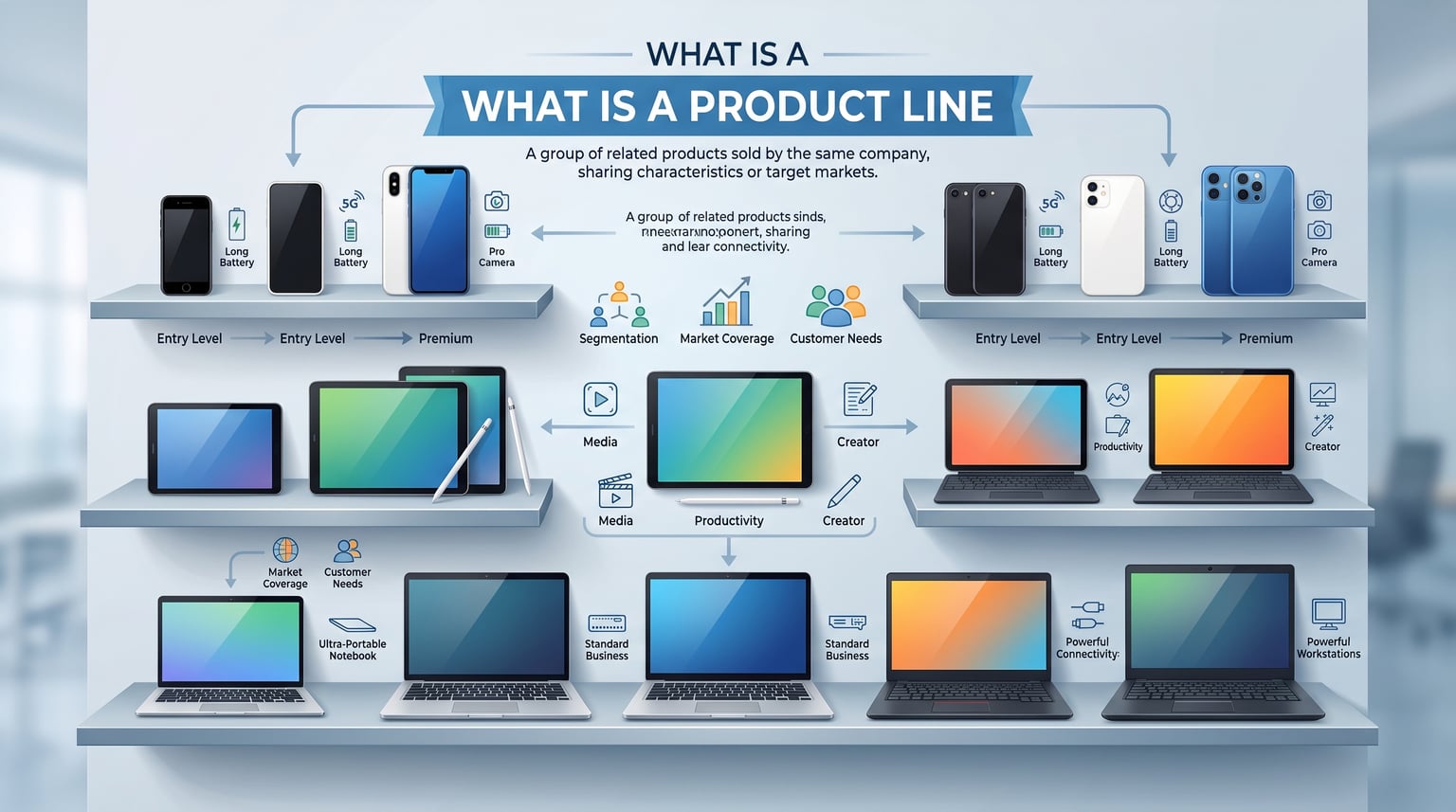
A product line is a group of related products that a company markets under a single brand name, targeting similar customer needs with variations in features, price points, or specifications. Businesses rely on this structure to serve multiple segments within a shared category without diluting brand equity or building separate identities from scratch.
Every time you browse a shelf or a digital catalog and notice variations of the same core offering, you are looking at a product line in action. From Apple’s iPhone range to Coca-Cola’s beverage portfolio, the strategy behind grouping related items shapes how companies grow, compete, and build lasting relationships with customers.
In this guide, we explore what a product line is, how it differs from related concepts like product mix and line extension, and why it matters for businesses of every size. Whether you run a small online store or manage strategy for an enterprise, understanding this framework can sharpen your competitive advantage in 2026.
What You Will Discover From Reading This
How leading brands structure their product offerings for growth
The difference between a product line, product mix, and product line extension
Real-world examples from Apple, Nike, Coca-Cola, Adobe, and Microsoft
The risks and disadvantages that come with expanding a product line
Practical methods for analyzing and managing your product portfolio
Key Takeaways
Definition: A product line is a curated set of related products sold under one brand, designed to serve a specific market segment with variations in features, quality, or price.
Strategic Purpose: Companies use product lines to diversify revenue, segment their audience, cross-sell, and strengthen brand loyalty.
Structure: Product line depth refers to the number of variants within a line, while product line width refers to how many distinct lines a company offers.
Risks: Over-expansion can lead to cannibalization, brand dilution, and operational complexity if not managed with disciplined analysis.
Examples: Apple iPhone, Nike footwear, Coca-Cola beverages, Adobe Creative Cloud, Google Workspace, and Microsoft 365 all demonstrate effective product line strategy.
What Is a Product Line?
A product line is a collection of related products that share a common brand identity, serve a similar purpose, and target overlapping customer segments. These products may differ in price, size, formulation, or feature set, but they all connect back to a unifying theme that customers recognize. For example, Apple’s iPhone line includes multiple models at different price tiers, yet every device carries the same design language and ecosystem promise.
Companies build product lines strategically rather than randomly. Each item within the line occupies a specific position in the market, addressing a particular need or budget level. This allows a business to capture a wider share of demand within its category without launching entirely separate brands. The result is a cohesive portfolio where every product reinforces the others.
Product lines also evolve over time. As technology advances, consumer preferences shift, and competitors introduce new offerings, companies adjust their lines by adding variants, retiring underperformers, or repositioning existing products. This continuous refinement keeps the brand relevant and competitive in a changing market.
The Role Of Product Lines in Business Growth
Product lines serve as engines for business expansion by allowing a company to address multiple customer segments within a single category. Rather than betting everything on one product, a well-structured line spreads risk across several offerings, each with its own demand pattern and profit profile. Here is how product lines contribute to growth:
Market Segmentation: A product line lets a company target different buyer personas within the same category. Apple, for instance, offers the iPhone SE for budget-conscious buyers and the iPhone Pro Max for premium users, all under one brand umbrella.
Economies of Scale: Producing multiple variants within a shared production and supply chain reduces per-unit costs. Shared components, packaging, and distribution channels make each additional product more efficient to manufacture and deliver.
Cross-Selling Opportunities: When customers trust one product in a line, they are more likely to purchase complementary items. A buyer who loves Nike running shoes may also pick up Nike apparel and accessories, increasing the lifetime value of that customer.
Brand Equity and Loyalty: A coherent product line reinforces brand recognition at every price point. Customers who start with an entry-level product can upgrade within the same brand as their needs and budgets grow, deepening their loyalty over time.
Revenue Diversification: Multiple products mean multiple revenue streams. If one variant underperforms due to seasonal demand or shifting trends, other products in the line can offset the shortfall, stabilizing overall revenue.
Through disciplined planning and customer research, businesses transform a product line from a simple catalog into a strategic asset. Each product serves a purpose within the larger portfolio, and together they create a resilient, growth-oriented business model.
Also Read: What is Dropshipping? Simplifying E-commerce Logistics
The Anatomy of a Successful Product Line
Not every product line succeeds. The ones that endure share certain structural qualities that set them apart from collections of loosely related items. Understanding these qualities gives businesses a framework for building and evaluating their own offerings.

Key Characteristics
Successful product lines share several defining traits that separate them from disorganized catalogs. These characteristics create the foundation for long-term growth and customer connection.
Strategic Cohesion: Every product in the line connects to a clear brand promise and category focus. Customers should instantly understand why these items belong together, whether through shared functionality, aesthetics, or target audience.
Market Responsiveness: Strong product lines adapt to changing customer preferences without losing their identity. Brands monitor feedback, track sales data, and adjust their offerings to stay relevant while maintaining their core value proposition.
Clear Differentiation: Each variant must justify its existence with a distinct benefit. If two products in the same line overlap too closely, they confuse customers and cannibalize each other’s sales rather than expanding the market.
Customer-Centric Design: The entire line should be built around real customer needs, not internal assumptions. Buyer personas, usage scenarios, and price sensitivity research should guide which products make the cut and how they are positioned.
Profitability Balance: A healthy product line mixes high-margin specialty items with volume-driving entry-level products. This balance keeps the line financially sustainable while still reaching a broad audience.
How Do They Contribute to Business Success?
The characteristics above translate directly into measurable business outcomes. When a product line is built on solid principles, it generates compounding benefits that go beyond what any single product could achieve alone.
Stronger Brand Recognition: A consistent, well-structured line makes the brand instantly recognizable across price points and use cases. This recognition builds trust and reduces the cost of acquiring new customers.
Efficient Resource Allocation: Shared R&D, marketing infrastructure, and distribution networks mean each new product costs less to launch than a standalone offering would. Economies of scale compound as the line grows.
Innovation Pipeline: Insights from one product in the line inform the development of others. Customer feedback, usage data, and technical improvements flow across the portfolio, accelerating the pace of innovation.
These advantages explain why companies invest so heavily in product line strategy. It is not simply about having more products to sell. It is about creating an interconnected system where each item strengthens the others, building a brand that customers return to again and again.
Product Line vs Product Mix
One of the most common points of confusion in product strategy is the distinction between a product line and a product mix. These terms are related but refer to different levels of a company’s portfolio architecture. Understanding the difference is essential for making informed strategic decisions.
A product line refers to a single category of related products within a brand. A product mix, also called a product assortment, is the complete set of all product lines a company offers. Think of the product mix as the umbrella that contains multiple product lines beneath it.
Scope: Product line = depth within one category. Product mix = breadth across all categories.
Example: Apple’s iPhone is a product line. Apple’s total product mix includes iPhone, iPad, Mac, Apple Watch, Apple TV, and services.
Strategic Focus: Product line strategy focuses on variants within a category. Product mix strategy focuses on how many categories the company competes in.
Risk Profile: A single product line carries category-specific risk. A diversified product mix spreads risk across multiple categories.
The table below summarizes the key distinctions for quick reference.
| Aspect | Product Line | Product Mix |
|---|---|---|
| Definition | A group of related products within one category | The total collection of all product lines a company offers |
| Scope | Narrow (single category) | Broad (multiple categories) |
| Example | Microsoft Surface laptops | Microsoft 365, Surface, Xbox, Azure, LinkedIn |
| Measured By | Depth (number of variants) | Width (number of lines), plus depth and length |
| Strategic Goal | Capture demand within a category | Cover multiple markets and reduce category risk |
Mastering both concepts allows business leaders to make smarter decisions about where to invest, when to expand, and how to structure their overall portfolio for maximum impact. For more on getting your offerings in front of the right audience, explore our guide on choosing the right e-commerce fulfillment strategy.
Different Types of Product Lines
Product lines can be classified in two complementary ways. The first approach categorizes them by the strategic role they play in a company’s portfolio. The second groups them by the type of goods or services they deliver. Both perspectives are useful for understanding how to structure and manage offerings effectively.

Strategic Types
Single Product Line: A company focuses on one category with multiple variants. This approach builds deep expertise and brand association. For example, Crocs built its early identity almost entirely around its foam clog line before expanding.
Multiple Product Lines: A company operates several lines across different categories. Procter & Gamble runs separate lines for laundry (Tide), dishwashing (Dawn), and personal care (Gillette), each with its own positioning.
Staple Product Lines: These are core offerings that generate consistent, year-round demand. Think of basic grocery items or everyday household products that customers repurchase regularly.
Seasonal Product Lines: These lines are tied to specific times of year, such as holiday collections, back-to-school items, or summer apparel. They create urgency and capitalize on predictable demand spikes.
Specialty Product Lines: These target niche audiences willing to make a special effort to purchase. Luxury watches, high-end audio equipment, and professional-grade tools fall into this category.
Category-Based Types
Consumer Goods: Products sold directly to end users for personal use. This includes convenience products (snacks, beverages), shopping products (electronics, clothing), and specialty products (luxury items).
Industrial Goods: Products built for business operations and manufacturing, including raw materials, machinery, and capital equipment. These lines target B2B buyers with technical specifications and volume pricing.
Digital and SaaS Product Lines: Software companies structure offerings around tiers and modules. Adobe Creative Cloud includes Photography, Single App, and All Apps plans. Microsoft 365 offers Personal, Family, and Business tiers. Google Workspace ranges from Business Starter to Enterprise.
Services: Intangible offerings grouped by expertise or function, such as financial advisory packages, healthcare service tiers, or consulting engagements.
Healthcare and Beauty Lines: Products ranging from pharmaceuticals to cosmetics, designed to enhance wellbeing and personal care.
Recognizing where your offerings fit within these classifications helps you apply the right strategy. A seasonal product line demands different planning than a staple line, and a SaaS product line requires different pricing logic than a consumer goods line.
Also Read: How to Freelance as a Student? – Insider Tips for Success
Product Line Depth and Width
Two fundamental metrics define the shape of a company’s product portfolio: depth and width. These terms describe how many variants exist within a line and how many distinct lines a company manages. Together, they paint a picture of a brand’s market coverage.
Product line depth refers to the number of variants within a single product line. A line with high depth offers many options, sizes, or formulations. For example, Coca-Cola’s beverage line includes Classic, Diet Coke, Coke Zero Sugar, Cherry Coke, Vanilla Coke, and various caffeine-free versions. This depth lets the brand serve customers with different taste and dietary preferences within the same category.
Product line width refers to the number of distinct product lines a company offers. A company with high width operates across many categories. Samsung, for instance, has product lines spanning smartphones, televisions, home appliances, semiconductors, and memory storage. Wide portfolios spread risk across categories but require more resources to manage effectively.
There is also the concept of product line length, which refers to the total number of items across all lines in the product mix. Managing length is a balancing act: too few products can leave market gaps, while too many can overwhelm customers and strain operations.
Product Line Extension
A product line extension is the addition of a new variant to an existing product line. Rather than creating an entirely new category, a company introduces a new flavor, size, feature set, or formulation within a line that already exists. This is one of the most common growth strategies because it leverages established brand equity to capture additional demand.
Line extensions generally fall into four categories:
New Flavors or Formulations: Coca-Cola adding Cherry Coke or Sprite Cranberry gives existing fans a reason to try something new without leaving the brand family.
New Sizes or Packaging: Offering a product in travel-size, family-size, or bulk formats captures different purchase occasions. Think of laundry detergent sold in single-use pods, standard bottles, and refill jugs.
Feature Enhancements: Adding upgraded features or technology to an existing line. The iPhone Pro and Pro Max models are feature-based extensions of the core iPhone line, targeting users who want advanced cameras and displays.
Price-Tier Extensions: Introducing a budget or premium version within the same line. Nike’s range spans entry-level running shoes under its core brand and premium editions under collaborations and limited releases.
It is important to distinguish a product line extension from a brand extension. A line extension stays within the same product category. A brand extension uses an established brand name to enter a different category entirely. For example, Apple creating a new iPhone model is a line extension. Apple launching Apple Music, a streaming service, is closer to a brand extension because it moves into a different category.
Product Line Stretching
Product line stretching is a specific strategy where a company extends its product line beyond its current positioning, either upward, downward, or in both directions. This allows a brand to reach new market segments without creating a separate brand identity.
Upward Stretching: A company adds a premium product above its current range. Toyota did this with the Lexus brand to capture luxury buyers, and many mid-range fashion labels introduce premium collections to elevate perceived value.
Downward Stretching: A company adds a budget-friendly product below its current range. This can open up volume but risks diluting the brand’s premium image if not handled carefully.
Two-Way Stretching: A company extends in both directions simultaneously, adding both entry-level and premium options. Samsung’s Galaxy smartphone line covers everything from budget A-series devices to flagship S-series and foldable models.
The opposite of stretching is product line pruning, which involves removing underperforming or redundant products from a line. Pruning streamlines the portfolio, reduces complexity, and frees resources for higher-potential offerings.
Disadvantages and Risks of Product Lines
While product lines offer significant advantages, they also carry real risks. Expanding a line without careful analysis can damage a brand more than it helps. Businesses must weigh these disadvantages before adding new products to their portfolio.
Cannibalization: When a new product in the line draws sales away from an existing product rather than attracting new customers, revenue simply shifts internally. This is one of the most discussed concerns among product managers, and it requires disciplined positioning to prevent.
Brand Dilution: Stretching a brand across too many price points or categories can weaken its identity. If a premium brand launches too many budget options, customers may stop associating it with quality.
Market Saturation: Adding too many variants can overwhelm customers with choice, leading to decision fatigue. Research shows that excessive options can actually reduce purchase rates rather than increase them.
Operational Complexity: Each new product adds demands on manufacturing, inventory management, marketing, and customer support. The cost of complexity can erode the efficiency gains that made the line attractive in the first place.
Increased Competitive Pressure: A broader line means more products competing for attention in more segments. Each variant faces its own competitive set, and maintaining market share across a wide line requires sustained investment.
Resource Strain: Small businesses in particular can overextend themselves by trying to support too many products with limited staff, capital, and marketing bandwidth. Focus often produces better results than breadth.
The key to mitigating these risks is disciplined product line analysis. Every addition or removal should be guided by data, customer feedback, and a clear understanding of how the change affects the entire portfolio.
What Is Involved in Managing a Product Line?
Product line management is the ongoing process of planning, developing, launching, and maintaining every item within a line. It requires coordination across teams and a clear strategic vision for how each product fits into the larger portfolio.

Here are the core stages of effective product line management:
Planning: This step involves analyzing market trends, conducting customer research, and laying out a roadmap for when and how to launch new products or variants. Planning also defines the strategic role each product will play within the line.
Development: This phase covers design, prototyping, manufacturing, testing, and refinement. Products must meet quality standards and align with the brand promise before they reach customers. Crafting compelling product descriptions that sell is essential during this phase to communicate each variant’s unique value.
Launching: A successful launch requires careful timing, promotional strategy, and the right distribution channels. Whether selling direct, through retail partners, or via e-commerce platforms, every channel decision affects how the product reaches its intended audience.
Lifecycle Management: Every product moves through introduction, growth, maturity, and decline. Effective management means knowing when to invest more in a growing product, when to maintain a mature one, and when to retire a declining one through product line pruning.
Product line management is not a one-time effort. It requires continuous monitoring, customer feedback, and willingness to adapt. The most successful brands treat their product lines as living portfolios that evolve alongside market conditions.
Product Line Analysis Methods
To manage a product line effectively, businesses need reliable methods for evaluating performance. Product line analysis provides the data-driven foundation for decisions about which products to keep, grow, or retire. Four analytical approaches are especially valuable.
Sales Analysis: Tracking revenue and unit sales for each product reveals which variants drive volume and which underperform. This analysis highlights trends over time and identifies products that may be candidates for pruning.
Market Share Analysis: Measuring each product’s share within its competitive set shows how well the line is positioned against rivals. Declining share may signal that a product needs refreshment or repositioning.
Profit Margin Analysis: Not all products contribute equally to the bottom line. Some generate high volume with thin margins, while others sell in smaller numbers but deliver strong profitability. Understanding this mix helps prioritize investment and promotional support.
Customer Feedback Analysis: Reviews, surveys, and direct feedback reveal how customers perceive each product. This qualitative data uncovers opportunities for improvement and signals when a product is losing relevance. Leveraging customer reviews for product improvement is a powerful way to keep a product line aligned with what buyers actually want.
By combining these four methods, businesses build a complete picture of product line health. Sales and profit data show financial performance, market share shows competitive standing, and customer feedback shows perception and satisfaction. Together, they guide confident decisions about the future of the portfolio.
Some Examples of Product Lines
The best way to understand product lines is to see them in action across different industries. The following examples show how both classic and modern brands use this strategy to serve diverse customer segments while building strong, recognizable identities.
Apple iPhone Series: Apple offers the iPhone SE, standard iPhone, iPhone Plus, iPhone Pro, and iPhone Pro Max, each targeting a different price point and feature set. This line captures everyone from budget-conscious first-time smartphone buyers to professionals who need cutting-edge camera and processing power.
Coca-Cola Beverage Varieties: The Coca-Cola Company’s product line includes Coca-Cola Classic, Diet Coke, Coke Zero Sugar, Cherry Coke, and Vanilla Coke, plus broader offerings under brands like Dasani, Powerade, and Minute Maid. This breadth covers sparkling beverages, water, sports drinks, and juices.
Nike Athletic Footwear: Nike’s footwear line spans running, basketball, soccer, training, and lifestyle categories. Each sub-line features specific technologies like Air, Zoom, and React cushioning, designed for distinct performance needs and style preferences.
Procter & Gamble Home Care: P&G manages separate product lines under brands like Tide for laundry, Dawn for dishwashing, and Swiffer for surface cleaning. Each line contains multiple variants formulated for different cleaning tasks and household needs.
Adobe Creative Cloud: Adobe structures its product line around tiers and individual applications. Customers can subscribe to a single app like Photoshop, the Photography plan, or the full All Apps suite. This flexibility serves everyone from hobbyist photographers to enterprise creative teams.
Google Workspace: Google offers Workspace plans ranging from Business Starter to Business Standard, Business Plus, and Enterprise. Each tier includes different storage capacities, meeting capabilities, and administrative controls, allowing companies to scale their subscription as they grow.
Microsoft 365: Microsoft 365 is structured as a product line with Personal, Family, Business Basic, Business Standard, and Enterprise plans. Each variant bundles different combinations of Word, Excel, PowerPoint, Teams, cloud storage, and security features to serve individual users, families, and organizations of all sizes.
These examples demonstrate that the product line strategy applies across physical goods, digital services, and software. Whether a company sells shoes or subscriptions, the underlying principle is the same: group related offerings under a unified brand to serve more customers within a shared category.
Also Read: How to Delete a Shopify Account & Cancel a Subscription?
FAQs
What are the elements of a product line?
The elements of a product line include individual products that are linked by shared function, target market, price range, or quality level. These elements work together under a single brand strategy to satisfy customer needs across a specific category, with each variant offering distinct features or benefits.
What is my product line?
Your product line is the group of related products your business offers that serve similar purposes, target the same market segment, or fall within the same price range. It represents the specific category your brand is known for and defines how customers identify your offerings.
Why is product line important?
A product line is important because it enables businesses to diversify revenue, serve multiple customer segments, and build brand loyalty. It allows companies to cross-sell, leverage economies of scale, and reduce risk by spreading demand across several products rather than relying on a single offering.
What is a full line of products?
A full line of products means offering a comprehensive range of items within one category to cover all major customer needs and price points. For example, a clothing brand with a full line would include tops, pants, dresses, outerwear, and accessories in multiple sizes, styles, and price tiers.
What is the difference between a product line and a product mix?
A product line is a group of related products within a single category, such as Apple’s iPhone models. A product mix is the complete set of all product lines a company offers across multiple categories, such as Apple’s total portfolio of iPhone, iPad, Mac, Apple Watch, and services. Product line measures depth within one category, while product mix measures breadth across categories.
What is a product line extension?
A product line extension is the addition of a new variant to an existing product line, such as a new flavor, size, feature set, or price tier. For example, Coca-Cola adding Coke Zero Sugar to its beverage line is a product line extension. It differs from a brand extension, which uses an established brand name to enter an entirely different product category.
What is product line stretching?
Product line stretching is a strategy where a company extends its product line beyond its current positioning. Upward stretching adds premium products above the current range, downward stretching adds budget-friendly options below it, and two-way stretching does both. Samsung uses two-way stretching with Galaxy phones ranging from budget A-series to flagship foldable models.
What is product line cannibalization?
Product line cannibalization occurs when a new product within a line takes sales away from an existing product rather than generating additional revenue. For example, if a company launches a new flavor that simply shifts customers from an existing flavor instead of attracting new buyers, total revenue may not grow. Careful positioning and market analysis help prevent cannibalization.
Also Read: How to Promote Your Shopify Store: Expert Tips & Strategies
Conclusion
Understanding what a product line is forms the foundation of smart business strategy. A well-structured line lets a company serve multiple customer segments, diversify revenue, and build a brand that customers trust across price points and use cases. From Apple and Nike to Adobe, Google, and Microsoft, the most recognizable names in business rely on this approach to grow sustainably.
But product lines are not without risks. Cannibalization, brand dilution, and operational complexity can erode the benefits if expansion happens without disciplined analysis. The companies that succeed are the ones that treat their product lines as living portfolios, continuously evaluated through sales data, market share tracking, profit analysis, and customer feedback.
Whether you are building your first product line or refining an existing one in 2026, the principles remain the same. Stay close to your customers, differentiate each variant clearly, and prune what no longer serves the portfolio. Do that, and your product line becomes more than a catalog. It becomes a growth engine for your brand.
Leave a Reply