
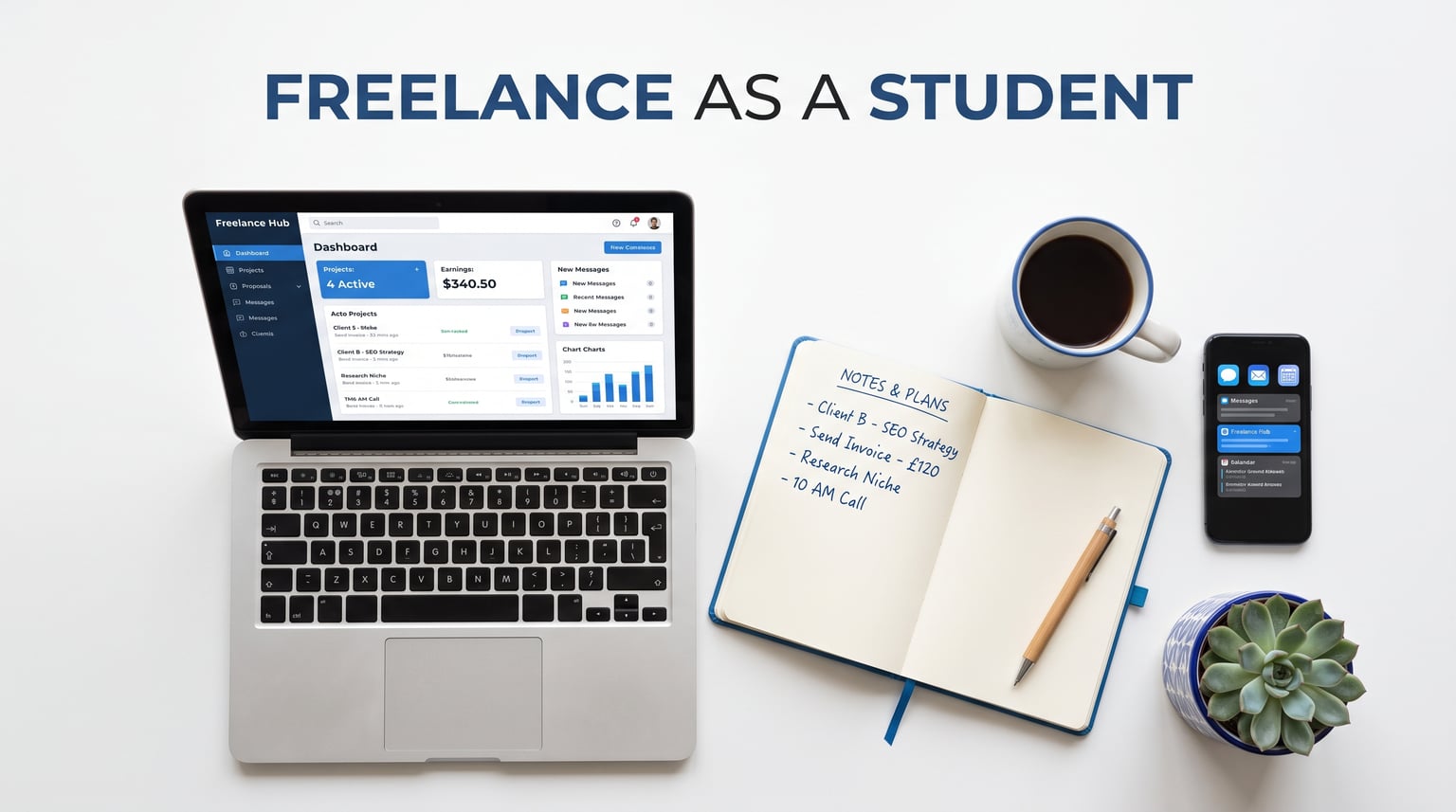
Learning how to freelance as a student opens the door to earning real money while building professional experience before you even graduate. To get started, identify a marketable skill you already have (writing, design, tutoring, coding, or social media), create a free profile on platforms like Upwork or Fiverr, assemble a small portfolio from class projects, and pitch your first few clients at entry-level rates. Most student freelancers earn between $15 and $50 per hour depending on their niche, and many reach their first $1,000 within two to three months of consistent effort.
I have spent years coaching college students through the exact steps covered in this guide. The strategies below are built from real conversations with student freelancers on Reddit, lessons from top-ranking career resources, and the latest 2026 freelance market data. Whether you have zero experience or already have a few gigs under your belt, this walkthrough will help you turn your skills into steady income without sacrificing your GPA.
This guide covers everything from choosing the right freelance jobs and setting rates, to handling taxes, using AI productivity tools, and landing that all-important first client. If freelancing feels like too much commitment alongside a heavy course load, you might also explore these side hustles that pay weekly for a lighter income option.
Why Freelance as a Student?
Making the decision to freelance as a student goes far beyond picking up a few extra dollars between classes. It is one of the few income strategies that simultaneously builds your bank account, your resume, and your professional network while you are still in school. According to recent freelance workforce data, over 70 million Americans participated in freelance work in 2026, and students represent one of the fastest-growing segments of that group.
When you freelance during college, every completed project becomes a portfolio piece you can show future employers. A marketing major who managed three real Instagram accounts for local businesses will always stand out against graduates whose only experience is a capstone project. Clients do not care whether you have a degree yet. They care about results, and that dynamic lets you build genuine work history years ahead of your peers.

Freelancing also teaches a set of life skills that classrooms simply cannot replicate. Negotiating project rates with clients, managing deadlines that overlap with midterm season, and handling the administrative side of self-employment all build a level of professional maturity that hiring managers notice immediately during job interviews.
Pros and Cons of Student Freelancing
Before jumping in, it helps to understand both the upside and the trade-offs of working for yourself while enrolled in classes. Here is an honest breakdown.
- Flexible income: You control how much you work and earn, scaling up during breaks and dialing back during exam weeks.
- Real-world experience: Every project adds to your portfolio and gives you concrete examples to discuss in job interviews.
- Skill development: You learn client communication, project management, invoicing, and negotiation on the job.
- Networking: Satisfied clients can become long-term references, mentors, or even full-time employers after graduation.
- Location independence: Most freelance work is remote, meaning you can earn money from your dorm room, the library, or back home during summer.
Those benefits are significant, but freelancing as a student is not without challenges. Being aware of the downsides helps you prepare for them rather than getting blindsided.
- Irregular income: Some months are busy and profitable; others are slow, especially around finals when you have less time to pitch clients.
- Time pressure: Balancing client deadlines with coursework requires disciplined scheduling, and slipping in either area has real consequences.
- Tax responsibilities: As an independent contractor, you are responsible for tracking and paying your own taxes, which trips up many first-time freelancers.
- Client acquisition effort: Finding and keeping clients takes consistent outreach, and rejection is part of the process especially early on.
- Burnout risk: Taking on too much work alongside a full course load can lead to exhaustion if you do not set boundaries.
Also Read: eBay vs Amazon Showdown – Which Dominates for Sellers?
Best Freelance Jobs for Students (With Realistic Rates)
Not every freelance job fits a student lifestyle. The best options are ones that allow flexible hours, can be done entirely online, and have enough entry-level demand that you can land your first gig without years of experience. Below are the most popular and accessible freelance categories for students, along with typical earning ranges based on current market data.

Content Writing and Blogging
Content writing is one of the most common entry points for student freelancers. Businesses constantly need blog posts, website copy, product descriptions, and email newsletters. If you can write clearly and research topics quickly, you can start earning almost immediately. Typical rates range from $15 to $40 per hour for beginners, with experienced freelance writers charging $50 to $100 or more per hour for specialized or technical content.
Most writers start on platforms like Upwork or ProBlogger, taking smaller jobs to build reviews and samples. Within a few months, many transition to direct client relationships that pay significantly better. If you enjoy a specific subject area, whether that is health, finance, or technology, specializing early helps you command higher rates from the start.
Graphic Design
Graphic design freelance work covers everything from logo creation and social media graphics to full brand identity packages. Students with an eye for visual design can start with free or low-cost tools like Canva and work their way up to professional software like Adobe Illustrator. Beginner designers typically earn $20 to $35 per hour, while those with strong portfolios can charge $50 to $75 per hour or more.
Platforms like Behance and Dribbble let you showcase visual work and attract clients organically. If design is part of your major, your coursework assignments can double as portfolio pieces. For students investing in this path, having the right equipment makes a real difference. Check out our guide to the best desktop computers for graphic design to make sure your hardware can handle design workloads.
Social Media Management
Small businesses increasingly need help managing their Instagram, TikTok, Facebook, and LinkedIn presence. If you already spend time on these platforms and understand how content trends work, social media management is a natural fit. Student freelancers in this space typically earn $18 to $40 per hour, or $300 to $1,000 per month per client on retainer arrangements.
The work involves creating post calendars, writing captions, designing graphics, engaging with followers, and sometimes running paid ad campaigns. Tools like Buffer and Hootsuite help you schedule content in advance, which is perfect for fitting the work around your class schedule. This is one of the easiest freelance jobs to start with no professional experience, since you can demonstrate your skills by showing your own well-managed social media accounts.
Virtual Assistant Services
Virtual assistant (VA) roles are ideal for students who are organized, detail-oriented, and comfortable handling administrative tasks. VAs help busy entrepreneurs with email management, calendar scheduling, data entry, booking travel, and basic research. Entry-level rates generally fall between $15 and $25 per hour, with experienced VAs charging $30 to $50 per hour.
What makes VA work especially student-friendly is that most tasks are asynchronous. You can respond to emails and organize spreadsheets late at night or between classes, as long as you meet agreed-upon deadlines. Many VAs also start with one or two clients and gradually expand as their availability increases.
Online Tutoring
If you excel in a particular subject, online tutoring lets you monetize that knowledge immediately. Popular areas include math, science, English as a second language, coding, and test preparation. Student tutors typically earn $18 to $45 per hour, depending on the subject and grade level being taught. Platforms like Wyzant, Preply, and Varsity Tutors make it easy to connect with students.
Tutoring offers the advantage of scheduled sessions, which means you know exactly when you are working and can plan your study time around it. It is also one of the few freelance categories where being a student yourself is actually an advantage, since parents often prefer tutors who are close in age to their children.
Web Development and Coding
For students studying computer science or self-taught programmers, web development is one of the highest-paying freelance categories available. Building websites, fixing bugs, creating landing pages, and developing WordPress plugins are in constant demand. Beginner freelance developers typically earn $25 to $50 per hour, and those with a few completed projects can charge $75 to $150 per hour or more.
You do not need to wait until graduation to start. Many successful student developers landed their first paid projects using skills learned in their first or second programming course. Building a few personal projects and contributing to open-source work can give you the portfolio pieces needed to win real client work.
Video Editing
Video content has exploded across YouTube, TikTok, and Instagram, creating strong demand for freelance video editors. Students who know how to cut footage, add transitions, sync audio, and create engaging short-form clips can earn $20 to $45 per hour as beginners. Editors working with established YouTubers or brands often charge $50 to $100 per hour.
Starting with a free tool like CapCut is perfectly fine for building initial skills. As you take on more complex projects, investing in professional editing software becomes worthwhile. For students serious about this path, we recommend reviewing our picks for the best laptops for Adobe Premiere Pro to handle demanding editing workflows smoothly.
Other Accessible Freelance Categories
- Transcription services: Converting audio to text for podcasts, interviews, and meetings. Rates typically range from $15 to $25 per audio hour for beginners.
- Data entry: Simple spreadsheet and database tasks that require attention to detail but minimal specialized skills. Usually pays $12 to $20 per hour.
- Translation: If you are fluent in two or more languages, translation work pays $20 to $50 per hour depending on language pair and subject complexity.
- Digital marketing: Managing PPC campaigns, SEO, and email marketing for small businesses. Rates range from $20 to $50 per hour for students.
- Voiceover work: Recording narration for videos, ads, and audiobooks. Beginners typically earn $20 to $40 per project depending on length.
Also Read: What is Dropshipping? Simplifying E-commerce Logistics
How to Start Freelancing as a Student With No Experience
The most common question I hear from students is whether they can start freelancing with zero professional experience. The answer is absolutely yes. Every working freelancer started with no clients and no portfolio at some point. What matters is having a clear, repeatable process to get from zero to your first paid project. Here is the step-by-step approach that works.
Step 1: Pick One Skill to Focus On
Resist the temptation to offer every service under the sun. Clients hire specialists, not generalists. Choose one skill you already have some foundation in, whether that comes from coursework, a hobby, or self-directed learning. If you write well in your essays, start with content writing. If you enjoy organizing information, consider virtual assistant work. If you spend hours on Instagram, explore social media management.
Spending even two weeks deepening your chosen skill before looking for clients gives you a meaningful advantage. Watch free tutorials on YouTube, complete a short online course, or practice with personal projects. You do not need to be an expert. You just need to be good enough to deliver value to someone who currently has no solution at all.
Step 2: Build a Starter Portfolio From What You Have
A portfolio does not require paid client work. What it needs is evidence that you can do the job. Here are practical ways to create portfolio pieces with zero professional experience:
- Use class projects: That research paper, marketing plan, or design assignment from last semester demonstrates real skills. Polish it up and include it.
- Create personal projects: Write sample blog posts about topics you enjoy. Design mock logos for imaginary brands. Build a simple website to showcase your coding skills.
- Offer free work to a local business: Approach one or two small businesses and offer to write a blog post, redesign their social media graphics, or clean up their website at no charge in exchange for a testimonial.
- Use portfolio platforms: Behance works great for visual work, Contently for writing, and GitHub for code. You can also build a simple Notion page or Google Sites portfolio for free.
Three to five solid samples is enough to start applying for paid gigs. Quality matters more than quantity. Choose pieces that show range and competence, and write a short description for each explaining the problem you solved and the approach you took.

Step 3: Set Up Your Freelance Platform Profiles
While eventually you may want to find clients directly, freelance marketplaces are the easiest starting point for beginners with no existing network. They handle payment processing, provide some protection against non-paying clients, and give you access to thousands of job postings. Set up a complete, professional profile on one or two platforms to begin.
Your profile should clearly state what you do, who you help, and what results you deliver. Use a professional headshot, write a headline that specifies your niche, and fill out every section the platform offers. Many students leave their profiles half-finished and then wonder why they get no responses. A complete profile signals professionalism and reliability.
Finding Your First Freelance Client
This is the step where most student freelancers get stuck. Finding that first client is genuinely the hardest part of the entire process, and it is completely normal to send dozens of proposals before landing a single project. On Reddit forums like r/freelance, experienced freelancers consistently say the same thing: most beginners give up after two or three weeks of no responses. The ones who succeed are simply the ones who keep going.
Write Proposals That Get Responses
A common mistake students make is sending generic, copy-paste proposals to every job posting. Clients can spot these instantly and ignore them. A strong proposal is short, specific, and shows you actually read the job description. Start by referencing something from their posting, briefly explain how you would approach the task, and link to one relevant portfolio piece.
Keep your proposal under 150 words. Clients are busy and skim through dozens of applications. Lead with what you can do for them, not your life story. Mention that you are a student only if it adds context, such as subject matter expertise for tutoring or writing in your field of study. Otherwise, focus entirely on the client’s needs and how you will meet them.
Leverage Your Existing Network
Before turning to online platforms, check connections you already have. Local businesses, family friends who run companies, campus organizations, and professors who consult on the side are all potential first clients. A warm introduction from someone you know is worth more than fifty cold proposals on Upwork.
University career centers and alumni networks are also underused resources. Many post freelance opportunities specifically targeted at students, and these jobs tend to have far less competition than public marketplace listings. Check whether your school has an internal job board or entrepreneurship center that connects students with local businesses seeking help.
Use LinkedIn for Cold Outreach
LinkedIn is a powerful client acquisition tool that most students completely ignore. Optimize your profile with a clear headline describing your freelance services, then start connecting with founders, marketing managers, and small business owners in industries related to your skill. Send personalized connection requests rather than the default message.
Once connected, do not immediately pitch. Engage with their posts, share relevant content, and build familiarity over a week or two. Then send a brief message offering a specific service that solves a problem you noticed in their business. This approach takes patience, but the clients you land through LinkedIn tend to pay better and stay longer than marketplace clients.
Best Freelance Platforms for Students in 2026
Choosing the right platform can make a significant difference in how quickly you land work and how much you earn. Each marketplace has its own fee structure, client base, and competitive dynamics. Here is a breakdown of the most popular platforms for student freelancers.
Upwork
Upwork is the largest freelance marketplace and offers the widest variety of job categories. It uses a connects system where you spend tokens to submit proposals. The platform charges a 10 percent service fee on all earnings. Competition is high, but the volume of jobs means there are always entry-level opportunities available. It is the best platform for students who want to build a long-term freelance profile with verified reviews.
Fiverr
Fiverr flips the traditional model by having freelancers create service listings (called gigs) that clients browse and purchase. You set your own prices starting at $5, though most successful sellers charge much more. Fiverr takes a 20 percent cut of each transaction. It works well for students offering packaged services like logo design, social media graphics, or short writing tasks, since the format handles the sales process for you.
Freelancer.com
Freelancer.com operates similarly to Upwork with a bidding system but tends to have lower average rates. It charges a 10 percent project fee (or a fixed $5 minimum). The platform is useful for getting started quickly, though the quality of clients and jobs varies widely. Many students use it as a secondary platform while building their primary presence on Upwork.
FlexJobs
FlexJobs is a subscription-based platform that screens all job postings for legitimacy, which means no scams and no lowball offers. Clients pay to post, so the quality of opportunities tends to be higher. The trade-off is that freelancers must also pay a subscription fee (around $15 to $60 per month depending on the plan). For students serious about finding quality remote work, the investment can pay off quickly.
PeoplePerHour and Toptal
PeoplePerHour is popular in the UK and Europe and offers a good middle ground between Upwork and Fiverr. Toptal, on the other hand, is an elite network that accepts only the top 3 percent of applicants and is not suitable for beginners. It is worth knowing about for the future, as Toptal freelancers earn some of the highest rates in the industry.
For students focused on creative freelance work, having capable hardware is just as important as choosing the right platform. If content creation is your niche, our roundup of the best desktop computers for content creation can help you invest wisely in your setup.
Setting Your Freelance Rates as a Student
Figuring out how much to charge is one of the most stressful parts of starting out. Charge too little and you undervalue your work. Charge too much and you may scare off potential clients before you have reviews to justify the price. The key is starting at a realistic entry-level rate and raising it systematically as your portfolio and reputation grow.
Current Market Rate Ranges
According to ZipRecruiter data, college student freelance jobs in the United States pay between $24 and $96 per hour on average, depending on skill level and category. For someone just starting out, a realistic entry-level rate falls between $15 and $25 per hour for most categories. Within three to six months of consistent work, most students can raise their rates to $30 to $50 per hour.
Here are practical starting rate benchmarks by category based on current market data:
- Content writing: Start at $15 to $25 per hour, or $0.05 to $0.10 per word for article work.
- Graphic design: Start at $20 to $30 per hour, or $50 to $150 per logo or design package.
- Social media management: Start at $18 to $30 per hour, or $300 to $600 per month per client.
- Virtual assistant: Start at $15 to $22 per hour.
- Web development: Start at $25 to $40 per hour, or $300 to $800 per simple website.
- Online tutoring: Start at $18 to $30 per hour depending on subject.
- Video editing: Start at $20 to $35 per hour, or $50 to $200 per video depending on complexity.
When and How to Raise Your Rates
A good rule of thumb is to increase your rates by 20 to 30 percent after every five completed projects with positive reviews. By the time you have ten to fifteen completed jobs and consistent five-star feedback, you have earned the credibility to charge market-rate prices. The clients who valued you at your entry-level rate will often accept the increase because they already trust your work.
Always raise rates for new clients first. Your existing clients signed on at a specific price, and suddenly charging them more can damage the relationship. When new clients ask about pricing, quote your updated rate confidently. If someone pushes back, that is normal. Simply explain what is included in your service and stand by the value you provide.

AI Tools Every Student Freelancer Should Use in 2026
One of the biggest changes in the freelance landscape over the past two years is the explosion of AI-powered tools. Student freelancers who use AI effectively can complete projects faster, produce higher-quality work, and compete with experienced freelancers who have not yet adapted. The goal is not to let AI do all the work, but to use it as an accelerator for research, drafting, and repetitive tasks.
Content Creation and Writing
AI writing assistants like ChatGPT and Claude have become standard tools for freelance writers, marketers, and virtual assistants. They help with brainstorming blog post ideas, generating outlines, drafting first versions of copy, and editing for clarity. A blog post that might take four hours from scratch can often be completed in two when you use AI for the initial research and structure phase.
The important word here is assist, not replace. Clients pay for your judgment, voice, and expertise, not for raw AI-generated text. The most successful student freelancers use AI to handle the tedious 60 percent of a project (research, outlining, formatting) and then spend their time on the 40 percent that requires human creativity and critical thinking.
Design and Visual Content
Canva has integrated AI features that make it easy to generate social media graphics, presentations, and marketing materials quickly. Its Magic Studio tools can resize designs across platforms, suggest color palettes, and even generate images from text descriptions. For student designers, this dramatically reduces the time spent on routine tasks like creating multiple format variations of the same design.
Social Media and Scheduling
Tools like Buffer and Hootsuite use AI to recommend optimal posting times, suggest caption improvements, and help manage multiple client accounts from one dashboard. If you offer social media management services, these platforms let you batch an entire month of content in a single afternoon, which is ideal for fitting freelance work around your academic schedule.
Transcription and Translation
AI transcription tools like Otter.ai and Rev can convert audio to text in a fraction of the time it takes to do manually. DeepL provides highly accurate translation between dozens of languages. If you offer transcription or translation freelance services, these tools let you handle higher volumes of work while maintaining quality. You still review and correct the output, but the time savings are substantial.
Productivity and Project Management
Beyond task-specific tools, AI-powered productivity apps help you manage the business side of freelancing. Notion AI can organize your client briefs and project notes. Tools like Clockify track your hours automatically. Grammarly uses AI to polish your client communications and proposals. Together, these tools let a single student freelancer operate with the efficiency of a small agency.
Balancing Freelance Work With Your Studies
The biggest concern students have about freelancing is whether it will hurt their grades. It absolutely can if you approach it without a system. But with the right strategies, freelancing can actually improve your academic performance by forcing you to develop stronger time management habits.
Treat Your Calendar as Your Command Center
Block out specific times for freelance work the same way you block out class times. Treat those blocks as non-negotiable appointments. Most successful student freelancers dedicate 8 to 15 hours per week to freelance work, usually split across evenings and weekends. During midterms and finals, they scale back to near zero and communicate proactively with clients about reduced availability.
Batch Your Work
Instead of spreading freelance tasks across every day, batch similar tasks together. Dedicate one block to client communication and proposals, another to actual project work, and a third to administrative tasks like invoicing and portfolio updates. This reduces the mental cost of context switching, which is one of the biggest drains on productivity when you are also studying.
Set Boundaries With Clients
Be transparent with clients about your availability from the very first conversation. Let them know you are a student and specify your working hours clearly. Most clients respect this honesty and appreciate knowing when to expect responses. Set up an auto-responder or status message for times when you are in class or studying so clients know when to expect a reply.
Watch for Burnout Signals
Trying to juggle a full course load, freelance clients, and a personal life is a recipe for burnout if you are not careful. Watch for warning signs like chronic fatigue, declining grades, procrastination on both academic and freelance work, and a growing sense of dread about your to-do list. If you notice these patterns, it is time to step back, reduce your client load, and recalibrate.
No amount of freelance income is worth sacrificing your degree or your mental health. The beauty of freelancing is that you control the volume. Scaling back during stressful academic periods is not a failure. It is smart business.
Managing Finances and Taxes as a Student Freelancer
Earning money is only useful if you manage it well. As a freelance student, you are essentially running a small business, which means you need systems for tracking income, handling taxes, and building financial stability. This is the area where most new freelancers get into trouble, but it is also where a little preparation goes a very long way.
Separate Your Business and Personal Money
Open a separate checking account specifically for freelance income and expenses. Every payment you receive goes into this account, and every business-related purchase comes out of it. This single step makes tax preparation infinitely easier and gives you a clear picture of whether your freelance work is actually profitable.
Track every transaction using a simple spreadsheet or a free tool like Wave. Record the date, amount, client, and purpose of each payment. This takes five minutes per week and saves you hours of scrambling at tax time.
Understanding Self-Employment Tax
As a freelancer, you are classified as an independent contractor, not an employee. This means no taxes are withheld from your payments. Instead, you are responsible for paying both the employer and employee portions of Medicare and Social Security, known as the self-employment tax. The current rate is 15.3 percent of your net freelance earnings.
In addition to self-employment tax, you also owe regular income tax on your freelance earnings. The exact amount depends on your total income for the year and your filing status. The combination can feel steep, which is why setting aside money from every payment is so important.
Key Tax Forms You Need to Know
- Form 1099-NEC: Clients who pay you $600 or more in a year are required to send you this form. It reports your total earnings from that client.
- Form 1099-K: Payment processors like PayPal and Stripe may send this if you receive payments above certain thresholds through their platforms.
- Schedule C (Form 1040): This is where you report your freelance income and expenses on your annual tax return. It calculates your net profit or loss.
- Form W-9: Clients may ask you to complete this before your first payment. It provides them with your tax identification information.
- Estimated quarterly taxes: If you expect to owe more than $1,000 in taxes for the year, you may need to make quarterly estimated tax payments to the IRS using Form 1040-ES.
Deductible Expenses That Save You Money
One of the advantages of being self-employed is the ability to deduct business expenses from your taxable income. Common deductions for student freelancers include:
- Software subscriptions: Adobe Creative Cloud, Canva Pro, Microsoft Office, project management tools, and AI tool subscriptions used for work.
- Equipment: Laptops, monitors, cameras, microphones, and other hardware used primarily for your freelance business.
- Home office deduction: If you have a dedicated workspace in your dorm or apartment, you may deduct a portion of your rent and utilities based on the square footage used for business.
- Education expenses: Courses, books, and training directly related to your freelance skill may be deductible. Form 1098-T reports tuition payments and may be relevant.
- Internet and phone: A percentage of your monthly internet and phone bill proportional to business use can be deducted.
- Student loan interest: Form 1098-E reports student loan interest paid, which may be deductible on your return.
Keep receipts for every business purchase throughout the year. Even small expenses add up and reduce your taxable income, which directly lowers your tax bill.
Build a Financial Buffer
Freelance income is inherently irregular. Some weeks you will have more work than you can handle; other weeks will be quiet. Get into the habit of setting aside 25 to 30 percent of every payment for taxes, and put an additional 10 percent into a savings buffer. Over time, this buffer grows into a financial safety net that covers you during slow periods or unexpected expenses.
It is also smart to maintain an emergency fund separate from your tax savings. Aim for at least one month of basic living expenses before you start counting on freelance income for necessities. This removes the pressure to take on low-quality clients just to pay rent.
Also Read: Side Hustles That Pay Weekly: 20 Fun & Easy Options
Building Your Freelance Reputation and Client Base
Long-term freelance success depends on reputation. Clients who trust you will hire you again, refer you to others, and agree to rate increases without hesitation. Building that reputation starts with your very first project and continues with every interaction you have.
Deliver More Than Expected
The single fastest way to build a freelance reputation is to consistently exceed client expectations. If you promise a blog post in five days, deliver it in three. If the client asks for three social media graphics, deliver four. These small overdeliveries cost you very little time but leave a lasting positive impression that turns one-time clients into repeat customers.
Communicate proactively throughout every project. Send a confirmation when you start working, provide a progress update midway through, and notify the client as soon as the work is complete. Clients fear being left in the dark, and consistent communication eliminates that fear entirely.
Collect and Showcase Reviews
After completing a project successfully, ask the client for a review or testimonial. Most happy clients are willing to write a few sentences but will not think to do it unless asked. Request specific feedback about what they appreciated, since detailed testimonials carry more weight than generic praise.
Feature these testimonials prominently on your portfolio website, your Upwork or Fiverr profile, and your LinkedIn page. Social proof is one of the most powerful conversion tools in freelancing. A profile with ten five-star reviews will win clients over someone with identical skills but no reviews, every single time.
Develop a Repeat Client Strategy
Acquiring a new client costs significantly more time and effort than retaining an existing one. After completing a project, follow up a week later to check whether the client needs any revisions or has additional work. Offer a small discount on their next project as an incentive to continue the relationship.
Over time, aim to have 60 to 70 percent of your income come from repeat clients. This reduces the constant pressure of finding new work and creates a more stable, predictable income stream. Many successful freelancers eventually stop marketing entirely because their repeat clients and referrals provide all the work they need.
Build a Personal Brand
Beyond platform profiles, investing in a personal brand accelerates your freelance career. Share your work and insights on LinkedIn, write about what you are learning, and position yourself as someone who understands your niche. A strong personal brand means clients start coming to you instead of you chasing them.
This is especially valuable for students because your personal brand grows alongside your skills. By the time you graduate, you could have two or three years of content, connections, and client relationships that most job seekers spend years trying to build from scratch. If you are considering other entrepreneurial paths beyond freelancing, our handyman business startup guide shows a similar step-by-step approach to launching a service business.
Also Read: Handyman Business Startup Guide: Kick-Start Your Dream!
Freelance as a Student: Frequently Asked Questions
Can I freelance as a student with no experience?
Yes, you can absolutely start freelancing with no professional experience. Build a starter portfolio using class projects, personal projects, or free work for local businesses. Join platforms like Upwork or Fiverr, and apply for entry-level gigs in your chosen skill area. Most student freelancers land their first paid project within two to four weeks of consistent pitching.
How much can a student freelancer earn?
Student freelancers typically earn between $15 and $50 per hour depending on their skill and category. According to ZipRecruiter, college student freelance jobs range from $24 to $96 per hour on average. Most students reach their first $1,000 within two to three months of consistent effort, with experienced student freelancers earning $1,000 to $3,000 or more per month.
What are the best freelance jobs for students?
The best freelance jobs for students offer flexible hours and remote work. Popular options include content writing ($15-$40/hr), graphic design ($20-$35/hr), social media management ($18-$40/hr), virtual assistant services ($15-$25/hr), online tutoring ($18-$45/hr), web development ($25-$50/hr), and video editing ($20-$45/hr). Choose a category that aligns with skills you already have.
Do student freelancers need to pay taxes?
Yes, freelance income is taxable. As an independent contractor, you are responsible for self-employment tax (15.3 percent) plus regular income tax on your earnings. Clients who pay you $600 or more in a year will send you Form 1099-NEC. You report income and expenses on Schedule C of your tax return, and you should set aside 25-30 percent of each payment for taxes.
How do I balance freelancing with my studies?
Block out specific times for freelance work in your calendar and treat them like class times. Most students dedicate 8 to 15 hours per week to freelancing. Scale back during midterms and finals by communicating proactively with clients. Batch similar tasks together to reduce context switching, and watch for burnout signs like declining grades or chronic fatigue.
Which freelance platform is best for beginner students?
Upwork and Fiverr are the best starting platforms for student freelancers. Upwork offers the widest variety of job categories and uses a proposal system. Fiverr lets you create service listings that clients browse and purchase. Both handle payment processing and provide review systems that help you build credibility. FlexJobs is another option for higher-quality listings but requires a subscription fee.
Conclusion
Choosing to freelance as a student is one of the highest-leverage decisions you can make during your college years. It generates income you control, builds a professional portfolio that sets you apart from other graduates, and develops real-world skills in communication, time management, and financial responsibility that no classroom can teach.
If you prioritize getting started quickly with an accessible skill like content writing or social media management, platforms like Upwork and Fiverr give you the fastest path to your first paid project. If you have technical skills like web development or graphic design, you can charge premium rates right from the start. And if your primary goal is financial stability with minimal client hunting, online tutoring or virtual assistant retainers offer the most predictable income.
The students who succeed are not the ones with the most natural talent. They are the ones who pick a skill, build a simple portfolio, send proposals consistently, and keep going past the inevitable early rejections. Start where you are, use the AI tools and strategies outlined in this guide, and your first $1,000 as a student freelancer is closer than you think.
Leave a Reply