
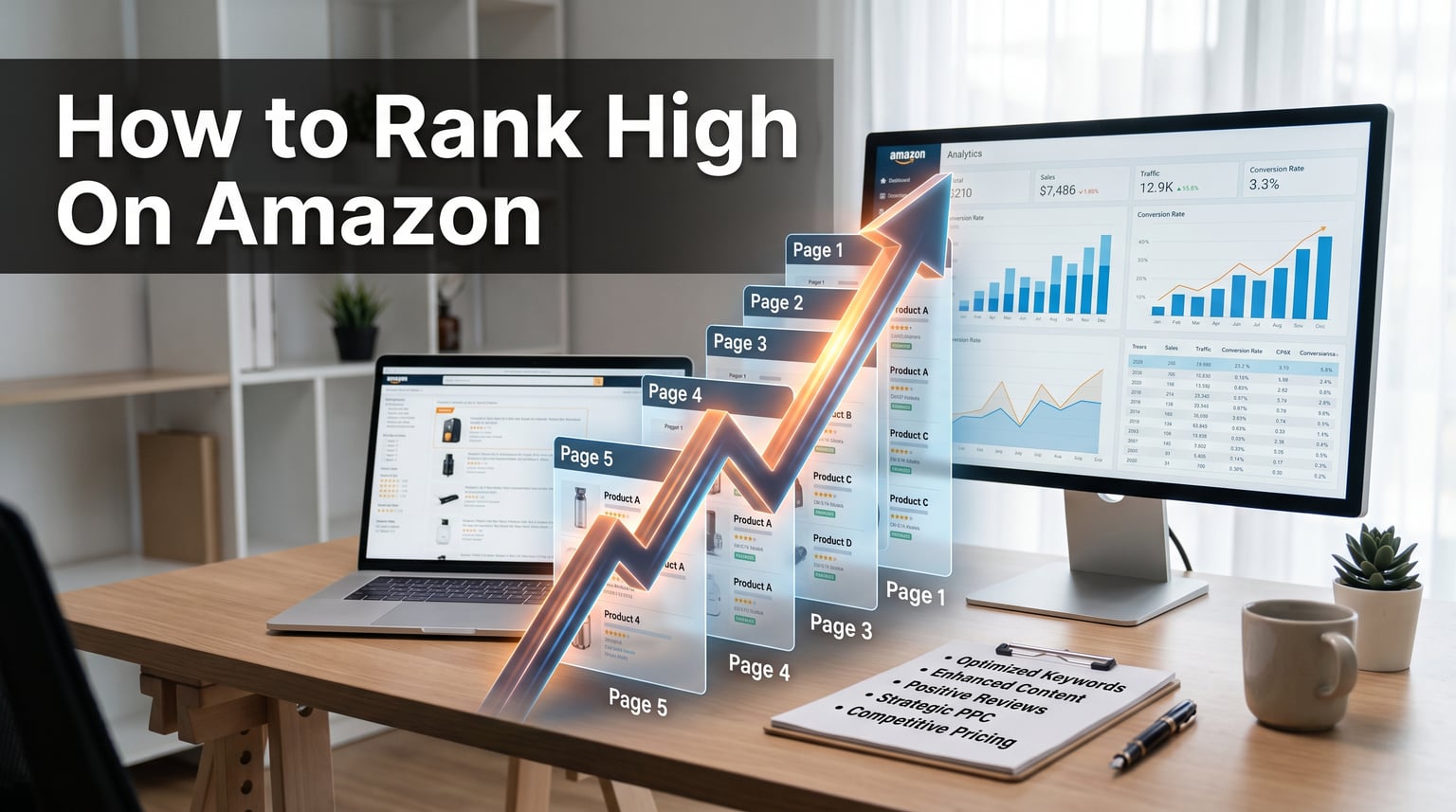
If you sell on Amazon, you already know the stakes. Roughly 80% of clicks on Amazon go to products listed on the first page of search results, and the first three listings capture about 60% of that traffic. When over half of all online product searches now start directly on Amazon rather than Google, your ability to rank high on Amazon can make or break your business. Yet many sellers treat ranking like a mystery rather than a system that can be studied, understood, and influenced.
The algorithm that governs Amazon’s search results has evolved significantly. What used to be called the A9 algorithm has transitioned into what industry experts now refer to as the A10 algorithm, adding new layers of behavioral signals, external traffic weighting, and seller authority metrics on top of the original sales-velocity-driven model. Sellers who still rely on outdated strategies from years past are leaving money on the table while competitors who understand the current system pull ahead. Whether you are launching your first product or trying to revive a stagnant listing, the fundamentals of Amazon SEO have shifted, and your playbook needs to shift with them.
In this guide, we break down exactly how Amazon’s ranking system works in 2026, covering the factors that matter most, the strategies that actually move the needle, and the common mistakes that quietly sabotage your position. From keyword-level sales velocity to backend search terms, PPC advertising, inventory management, and external traffic, you will find an actionable roadmap to climb the search results and stay there. If you are weighing Amazon against other platforms, our eBay vs Amazon comparison breaks down why Amazon’s market dominance makes ranking here especially valuable.
Understanding the Amazon A10 Algorithm: From A9 to the Current System
The first thing every seller needs to understand is that Amazon’s search algorithm is not the same creature it was a few years ago. The original A9 algorithm was built primarily around two pillars: text relevance (does your listing match the search query) and sales velocity (how well your product sells for that query). It was a relatively straightforward system where strong sales and good keywords could carry you to page one. But Amazon has since layered on new signals, creating what the seller community now calls the A10 algorithm.
The A10 evolution did not throw out the old rules. It added new ones on top. Amazon now tracks behavioral signals such as how long shoppers stay on your product page, whether they add your item to their cart, and whether they searched for your brand name directly. The algorithm also gives weight to external traffic, meaning shoppers who arrive at your listing from social media, blogs, or influencer links send a positive ranking signal. Seller authority, which includes factors like account health, fulfillment method, and overall performance history, also plays a growing role in determining where your product lands in search results.
What separates A10 from its predecessor is the emphasis on engagement quality, not just raw sales numbers. A product that gets thousands of clicks but has a terrible conversion rate will not hold a top position for long. Amazon’s ultimate goal is to show shoppers the products they are most likely to buy, so the algorithm rewards listings that demonstrate genuine purchase intent at every step of the funnel.
The 8 Key Ranking Factors That Determine Your Placement
If you want to rank high on Amazon, you need to know which factors the algorithm weighs and in what order of priority. Based on analysis of top-ranking products and insights from experienced sellers, here are the eight factors that matter most, ranked from highest to lowest impact.
1. Keyword-Level Sales Velocity
This is the single most important ranking factor, and many sellers misunderstand it. Your ranking is not based on total sales across all channels. Amazon tracks sales generated after a shopper searches for a specific keyword and then purchases your product. This is called keyword-level sales velocity, and it means that ranking for a high-value search term requires actual conversions from shoppers who typed that term into the search bar.
If you sell 500 units through external links or brand searches but zero from the keyword “stainless steel water bottle,” your ranking for that search term will not improve. This is why PPC campaigns targeted at specific keywords can be so effective for organic ranking, since they directly feed the keyword-level sales velocity that the algorithm rewards.
2. Conversion Rate and Unit Session Percentage
Your conversion rate measures the percentage of shoppers who view your listing and then buy. Amazon tracks this closely because a high conversion rate tells the algorithm that your product satisfies shopper intent. A related metric called unit session percentage goes a step further by measuring how many units are sold per session, which captures listings where customers buy multiple quantities at once.
Improving your conversion rate involves every element of your listing: compelling images, persuasive bullet points, competitive pricing, strong reviews, and clear product descriptions. Even small improvements in conversion rate can produce outsized ranking gains because Amazon interprets higher conversion as a signal that your product deserves more visibility.
3. Keyword Relevance and Indexing
Before you can rank for a keyword, Amazon has to index your listing for that keyword. Keyword indexing is the process by which Amazon’s system reads your listing content, including title, bullet points, description, and backend search terms, and determines which search queries your product is eligible to appear for. If you are not indexed for a keyword, you cannot rank for it, no matter how good your sales velocity is.
Keyword research is the foundation of this process. Tools like Helium 10 and Jungle Scout help sellers identify which search terms shoppers actually use, how much volume those terms get, and how difficult the competition is for each one. The most effective strategy is to target a mix of high-volume “strike zone” keywords and less competitive long-tail keywords where you can gain traction faster. For new sellers, understanding how to find products to sell on Amazon with the right keyword landscape built in is half the battle.
4. Customer Satisfaction Signals
Amazon measures customer satisfaction through star ratings, review volume, return rates, and customer service metrics. Products with a 4.2 or higher star rating generally outperform those with lower ratings, and a steady stream of recent reviews signals ongoing product relevance. Return rate is a hidden factor here. If shoppers frequently return your product, Amazon interprets that as a mismatch between expectation and reality, which can drag your ranking down.
Managing customer satisfaction requires both proactive and reactive strategies. Solicit reviews from happy customers using Amazon-compliant tools like the Request a Review button. Address negative feedback quickly and professionally. Keep product quality high to minimize returns. For a deeper look at building a review strategy that supports ranking, see our guide on Amazon reviews best practices.
5. Inventory Health and Stockout Prevention
Going out of stock is one of the fastest ways to destroy your ranking. Sellers on r/FulfillmentByAmazon consistently report that even a two-to-three-day stockout can cause rankings to drop significantly, sometimes taking weeks or months to recover. The algorithm interprets stockouts as a signal that your product cannot meet demand, so it pushes your listing down in favor of competitors who can fulfill consistently.
Smart inventory planning means maintaining buffer stock, using demand forecasting to anticipate spikes, and choosing a fulfillment method that minimizes the risk of running dry. Using Amazon FBA for your fulfillment strategy gives you a ranking advantage because it guarantees Prime shipping, signals reliability to Amazon, and reduces the operational burden of self-fulfillment.
6. Pricing Strategy and Buy Box Ownership
Price competitiveness directly affects both conversion rate and sales velocity. If your product is priced significantly higher than similar offerings without a clear value justification, shoppers will click away, your conversion rate drops, and your ranking follows. Winning the Buy Box is equally critical, since the vast majority of Amazon sales go through the Buy Box button rather than the individual listing page.
Buy Box ownership can be lost to hijackers, competing sellers on the same listing, or your own pricing errors. Maintaining competitive pricing, strong seller metrics, and healthy inventory levels all contribute to holding the Buy Box, which in turn feeds your keyword-level sales velocity and keeps your ranking stable.
7. Behavioral Signals
This is where the A10 algorithm diverges most clearly from its predecessor. Amazon now tracks micro-interactions on your listing page, including time spent on page, add-to-cart rate, and whether shoppers return to search results without purchasing (a negative signal). Brand searches, where a shopper types your brand name directly, are treated as a strong positive signal because they indicate established demand and brand recognition.
Optimizing for behavioral signals means creating a listing that holds attention. High-quality images, A+ Content, informative comparison charts, and a clear value proposition all keep shoppers engaged longer. The goal is to make every visitor interaction demonstrate intent and satisfaction.
8. Advertising Feedback Loop
Amazon PPC advertising does more than generate direct sales. It creates a feedback loop that boosts organic ranking. When a shopper clicks your Sponsored Products ad for a specific keyword and then purchases, that sale counts toward your keyword-level sales velocity for organic ranking. Over time, as your organic position improves for that keyword, you can reduce ad spend while maintaining the same traffic and sales levels.
This is why experienced sellers on Reddit recommend PPC as essential for new product launches but advise gradually transitioning to organic traffic as rankings stabilize. The key is to treat advertising as an investment in organic ranking, not just a direct sales channel.
Why Does Product Ranking Matter on Amazon?
The numbers tell the story. Approximately 80% of all Amazon clicks go to products on page one of search results. The first three organic listings alone capture roughly 60% of clicks. Products on page two and beyond see dramatically lower traffic, and most shoppers never scroll past the first page at all. When more than half of all online product searches in the United States start on Amazon, your search position directly determines how many potential customers even know your product exists.
Amazon accounts for nearly 38% of all US e-commerce sales, making it the dominant marketplace for online sellers. Ranking high on Amazon is not just about visibility. It is about accessing the largest concentrated pool of purchase-ready shoppers on the internet. A strong ranking compounds over time because higher visibility drives more sales, which improves sales velocity, which pushes your ranking even higher. This flywheel effect is why established sellers with top-ranked products can be extraordinarily difficult to displace.
The Buyer’s Journey and Click-Through Rate
When a shopper types a search term on Amazon, they are presented with a grid of results. The shopper’s eye typically moves from top to bottom and left to right, with the highest-placed listings receiving the most clicks. Your click-through rate, or the percentage of shoppers who click your listing after seeing it in search results, is heavily influenced by your position, your main image, and your title.
Once a shopper clicks through, the listing itself determines whether they convert. Every element of the page, from images to bullet points to reviews, plays a role in moving the shopper from browser to buyer. This is why listing optimization and ranking strategy are inseparable. You can drive all the traffic in the world to a poorly optimized listing, but if the conversion rate is low, Amazon will eventually demote your position.
Mobile optimization deserves special attention here. A growing majority of Amazon shoppers browse and buy on mobile devices. Vertical images, concise titles that do not get truncated on small screens, and scannable bullet points all improve the mobile shopping experience. Listings that are built for mobile tend to see higher click-through rates and conversion rates, which feeds back into better organic ranking.
Listing Optimization: The Complete Field-by-Field Playbook
Listing optimization is the process of making every element of your product page work together to maximize keyword relevance, click-through rate, and conversion rate. Each field in your Amazon listing serves a specific purpose, and understanding the rules and limits for each one is essential for sellers who want to rank high on Amazon.
Title Optimization
Your product title carries the most keyword weight of any field on your listing. Amazon allows up to 200 characters for most categories, and you should use as much of that space as possible while keeping the title readable. The ideal structure includes your brand name, the primary product descriptor, your most important keyword, key features or specifications, and relevant modifiers like size, color, or quantity.
Avoid keyword stuffing. A title that reads as a wall of search terms will hurt your click-through rate because shoppers will skim past it. Write for humans first, making sure the title clearly communicates what the product is and why it matters, while strategically placing your most valuable keywords near the beginning where they carry the most weight.
Bullet Points and Product Description
Amazon gives you five bullet points with up to 500 characters each. These should not be a feature dump. Each bullet should lead with a benefit, explain how a feature delivers that benefit, and include relevant keywords naturally. Think of bullets as your sales pitch. They are where shoppers decide whether your product solves their problem.
The product description field allows up to 2000 characters and gives you room to tell a fuller story about your product. Use this space to address common questions, explain use cases, and reinforce the value proposition. For brand-registered sellers, this is also where A+ Content replaces the plain text description with rich visual modules.
Backend Search Terms and Subject Matter Fields
Backend search terms are hidden keywords that shoppers never see but that Amazon uses for indexing. You get 500 bytes (approximately 500 characters) of space, and using it wisely can make the difference between ranking for a keyword and not being indexed at all. Focus on synonyms, alternative phrasings, Spanish-language terms if relevant, and long-tail keywords that do not fit naturally into your visible listing fields.
Do not repeat keywords that already appear in your title or bullet points, since Amazon does not give double credit. Do not use competitor brand names, as this violates Amazon’s terms of service. Subject matter fields, available to some categories, let you specify additional product attributes that help Amazon match your listing to relevant searches.
A+ Content for Brand-Registered Sellers
If you have Brand Registry, A+ Content lets you replace your text-only description with visual modules that include comparison charts, lifestyle images, and brand storytelling. Sellers who implement A+ Content consistently report higher conversion rates, sometimes by 5% to 15% or more. Premium A+ Content, available to top-performing brands, adds even more capabilities like video modules and interactive elements.
A+ Content also helps with behavioral signals because it keeps shoppers on your listing page longer. The richer the visual experience, the more time shoppers spend engaging with your product, which sends positive signals to the A10 algorithm.
Amazon PPC Advertising Strategy for Organic Ranking
Amazon PPC is not just a direct sales channel. It is one of the most powerful organic ranking tools available to sellers. The three main ad types each serve different strategic purposes. Sponsored Products ads target individual keywords and appear directly in search results, making them the primary tool for building keyword-level sales velocity. Sponsored Brands ads feature your brand logo and a custom headline, driving brand awareness and brand searches. Sponsored Display ads retarget shoppers who have viewed your product or similar products, helping capture demand at the consideration stage.
For new product launches, the typical strategy recommended by experienced sellers is to start with aggressive Sponsored Products campaigns targeting your most relevant keywords. The goal in the first few weeks is not profitability but sales velocity. You want to generate enough keyword-targeted sales to tell Amazon’s algorithm that your product is relevant and in demand for those search terms. Once your organic ranking begins to climb, you can gradually reduce bids and shift toward a profitable blend of organic and paid traffic.
The advertising feedback loop works because every PPC sale contributes to your organic sales history. Over time, as your organic position improves for a keyword, you earn free clicks and sales from shoppers who find you without ads. This is why sellers on r/AmazonSeller describe PPC as a temporary investment that pays dividends long after the campaigns end. The key is to track which keywords are generating both ad sales and organic ranking improvements, then double down on those terms.
External Traffic and Social Media as Ranking Signals
The A10 algorithm introduced a new appreciation for external traffic. When shoppers arrive at your Amazon listing from outside sources, whether that is an Instagram post, a YouTube review, a blog article, or a TikTok product search, Amazon interprets that as a strong demand signal. External traffic demonstrates that your product has real-world appeal beyond what Amazon’s internal search data would predict.
Building external traffic does not require a massive following. Even modest social media efforts, such as sharing product demos on TikTok or partnering with micro-influencers on Instagram, can generate a steady stream of off-platform visitors. Amazon Brand Stores and custom short links help you track which external sources are driving the most traffic and conversions, allowing you to refine your strategy over time.
One effective approach is to create content that naturally leads shoppers to search for your brand name on Amazon rather than clicking a direct link. Brand searches are one of the strongest behavioral signals in the A10 algorithm, so driving branded search activity through social media awareness can boost your ranking across multiple keywords simultaneously.
Amazon Best Sellers Rank and the Best Seller Badge
The Amazon Best Sellers Rank, commonly called BSR, is a numerical ranking that reflects how well a product is selling within its specific category compared to other products in that same category. A BSR of 1 means your product is the top seller in its category. BSR updates frequently, sometimes hourly, and is influenced by recent sales velocity more than historical totals.
As a general guideline, a BSR under 10,000 in a major category is considered a strong rank, while anything under 1,000 indicates exceptional sales performance. However, BSR varies dramatically by category. A BSR of 500 in a small niche category might represent fewer sales than a BSR of 5,000 in a massive category like Electronics or Home. Understanding your category’s BSR landscape helps you set realistic ranking goals and benchmark your progress against competitors.
The Best Seller Badge, marked by the orange number 1 badge on a listing, is awarded to the product with the highest sales volume in its specific sub-category. This badge is a powerful trust signal that can significantly increase click-through rate and conversion rate. Sellers who earn the badge often see a compounding effect where increased visibility drives more sales, which reinforces the badge position.
Steps To Shield Your Listing From Negative Feedback
Negative reviews are inevitable, but they do not have to derail your ranking. The key is to build a proactive system that minimizes negative feedback and maximizes positive reviews. Start by ensuring your product quality meets or exceeds the expectations set by your listing. Mismatched expectations are the most common cause of negative reviews, so your images, description, and bullet points should accurately represent what the customer will receive.
Active communication matters. Amazon shoppers expect quick responses to questions and concerns. Monitor your seller messages daily and respond within 24 hours whenever possible. Anticipate common issues by tracking the questions and complaints you receive most frequently, then update your listing content to address those concerns proactively. If customers consistently ask about sizing, add a size chart. If returns relate to compatibility, clarify compatible models in your bullets.
Solicit reviews from satisfied customers using Amazon’s built-in Request a Review button or compliant automated tools. The goal is to build a large base of authentic, positive reviews that dilute the impact of occasional negative feedback. Never manipulate reviews, buy fake reviews, or incentivize reviews in ways that violate Amazon’s terms of service. The short-term gain is never worth the risk of account suspension. For a comprehensive strategy on building trust through reviews, see our Amazon reviews best practices guide.
Inventory Management and Fulfillment Strategy
Inventory management is the most overlooked ranking factor, yet it has the power to wipe out months of progress overnight. When your product goes out of stock, Amazon removes it from search results, and your keyword-level sales velocity resets to zero. Even when you restock, the algorithm treats your listing as if it has no sales history for those keywords, meaning you essentially start the ranking climb from scratch.
Preventing stockouts requires demand forecasting based on historical sales data, seasonal trends, and promotional calendars. Maintain buffer inventory that covers at least two to four weeks of average sales, and reorder early enough to account for manufacturing lead times, shipping delays, and Amazon’s receiving processing time. Many sellers use inventory management software to automate reorder alerts and prevent human error.
Fulfillment method also affects ranking. Amazon FBA provides Prime shipping, which improves conversion rate and signals reliability to the algorithm. FBA listings often receive a ranking boost because Amazon trusts its own fulfillment network to deliver consistently. Sellers using FBA also benefit from simplified logistics and customer service, freeing time to focus on listing optimization and advertising. Learn more about building a strong Amazon FBA fulfillment strategy to protect your ranking momentum.
Common Mistakes That Hurt Your Amazon Ranking
Even experienced sellers fall into traps that quietly damage their ranking. Recognizing these mistakes is the first step to avoiding them. Here are the most common errors that hold sellers back from reaching page one.
Stocking out repeatedly. As discussed above, stockouts are ranking killers. Sellers who chronically under-order inventory never build sustained sales velocity, and their rankings bounce up and down without ever stabilizing. Treat inventory planning as a core ranking strategy, not an afterthought.
Choosing the wrong product from the start. If you enter a saturated niche with dominant competitors and no differentiation, ranking will be a grinding uphill battle regardless of how well you optimize. Product selection should account for demand, competition level, and your ability to offer something genuinely better or different.
Overloading product variations. Creating too many child variations on a single parent listing can dilute your keyword relevance and confuse shoppers. Keep variations focused on genuinely related options like size or color, and avoid creating variations that target fundamentally different search intents.
Relying on trends without a long-term plan. Trend-chasing can produce a short-term sales spike, but once the trend fades, your ranking collapses along with it. Build your strategy around products with sustained demand rather than flash-in-the-pan opportunities.
Ignoring image optimization. Your main image is the single biggest driver of click-through rate. Blurry, poorly lit, or cluttered images cause shoppers to scroll past your listing. Invest in professional photography, and make sure your main image follows Amazon’s requirements (pure white background, product filling 85% of the frame).
Neglecting ongoing SEO. Amazon’s search landscape evolves constantly. New competitors enter, keyword volume shifts, and algorithm updates change what matters. Sellers who optimize once and never revisit their listings will gradually lose ground. Use Brand Analytics and Search Query Performance (SQP) data to monitor how your listings perform and make incremental improvements over time.
How to Rank High On Amazon: Your Action Plan
Putting all of these factors together into a coherent strategy is what separates sellers who rank high on Amazon from those who stagnate. The process follows a predictable sequence, and understanding the order of operations helps you avoid wasted effort and focus on what moves the needle first.
Phase 1: Foundation (Before Launch)
Start with thorough keyword research to identify your primary target keywords, secondary keywords, and long-tail opportunities. Tools like Helium 10 Cerebro and Jungle Scout Keyword Scout are widely trusted by experienced sellers for this step. Build your listing with optimized titles, bullet points, description, backend search terms, and high-quality images. If you have Brand Registry, prepare A+ Content for launch day. Set up your FBA inventory with enough buffer stock to prevent early stockouts.
Phase 2: Launch and Momentum (Weeks 1 to 8)
Launch with aggressive PPC campaigns targeting your most relevant keywords. The goal is to generate keyword-level sales velocity quickly so Amazon’s algorithm begins associating your product with those search terms. Use Amazon’s Request a Review button to start building a review base. Monitor your Search Query Performance data in Brand Analytics to see which keywords are driving impressions and clicks, and adjust your campaigns accordingly.
Phase 3: Optimization and Growth (Ongoing)
As organic rankings improve, gradually reduce PPC spend on keywords where you are ranking organically on page one, and redirect that budget to new keyword targets. Continue soliciting reviews and managing customer feedback. Run A/B tests on your images, titles, and bullet points using Amazon’s Manage Your Experiments tool to incrementally improve conversion rate. Keep inventory healthy to prevent stockouts, and use Brand Analytics SQP data to identify new keyword opportunities and track your market share over time.
FAQs
What is a good rank on Amazon?
A good rank depends on your category, but generally a Best Sellers Rank under 10,000 in a major category indicates strong sales performance. A BSR under 1,000 is considered excellent. For organic search ranking, appearing on page one (the top 16 to 48 results depending on the query) for your primary keyword is the benchmark most sellers target.
How to rank higher in Amazon search results?
To rank higher in Amazon search results, focus on the top ranking factors in order of importance: keyword-level sales velocity, conversion rate, keyword relevance and indexing, customer satisfaction, inventory health, pricing and Buy Box ownership, behavioral signals, and the PPC advertising feedback loop. Optimize your listing content, run targeted PPC campaigns, maintain consistent inventory, and build authentic reviews.
How does the A10 algorithm differ from the A9 algorithm?
The A10 algorithm builds on the A9 foundation by adding greater weight to behavioral signals (time on page, add-to-cart rate), external traffic from social media and blogs, brand searches, and seller authority. A9 primarily rewarded sales velocity and text relevance. A10 rewards the same factors but adds engagement quality and off-platform demand signals on top.
How long does it take to rank on page one for a new product?
For most new products, reaching page one for a primary keyword takes 4 to 12 weeks of consistent effort, assuming proper listing optimization, aggressive PPC campaigns, and steady inventory. Highly competitive keywords can take 3 to 6 months or longer. Targeting less competitive long-tail keywords first can produce faster results and build momentum toward more competitive terms.
How does PPC advertising affect Amazon organic ranking?
PPC advertising affects organic ranking by generating keyword-level sales velocity. When a shopper clicks your Sponsored Products ad for a specific keyword and purchases, that sale signals to Amazon’s algorithm that your product is relevant for that search term. Over time, this improves your organic position, allowing you to reduce ad spend as organic traffic takes over.
What happens to my ranking if my product goes out of stock?
When your product goes out of stock, Amazon removes it from search results and your keyword-level sales velocity resets. Even a brief stockout of 2 to 3 days can cause significant ranking drops. After restocking, you essentially need to rebuild sales velocity from scratch, which can take weeks or months. Maintaining buffer inventory and using FBA fulfillment are the best ways to prevent stockout-related ranking losses.
Conclusion
Learning how to rank high on Amazon in 2026 requires a fundamentally different approach than it did even two years ago. The shift from A9 to A10, the growing importance of keyword-level sales velocity, the integration of PPC advertising as an organic ranking driver, and the emergence of behavioral signals and external traffic have all changed the rules. Sellers who adapt to this new reality will find that ranking is not a mystery but a system that rewards methodical effort and data-driven decisions.
If you are launching a new product, focus first on thorough keyword research, a fully optimized listing, and a PPC strategy designed to build keyword-level sales velocity. If you are trying to revive a stagnant listing, audit your conversion rate, inventory health, review profile, and ad performance to identify what is holding you back. And if you are managing an established product, use Brand Analytics and Search Query Performance data to find new growth opportunities and protect your position against rising competitors.
The sellers who consistently rank high on Amazon are not the ones with the biggest budgets or the most products. They are the ones who understand the algorithm, execute on every ranking factor systematically, and never stop optimizing. Start with the fundamentals, build momentum through targeted action, and let the ranking flywheel work in your favor. For additional support with your fulfillment strategy, explore how Amazon FBA can give you the ranking advantage you need to compete and win.
Leave a Reply