
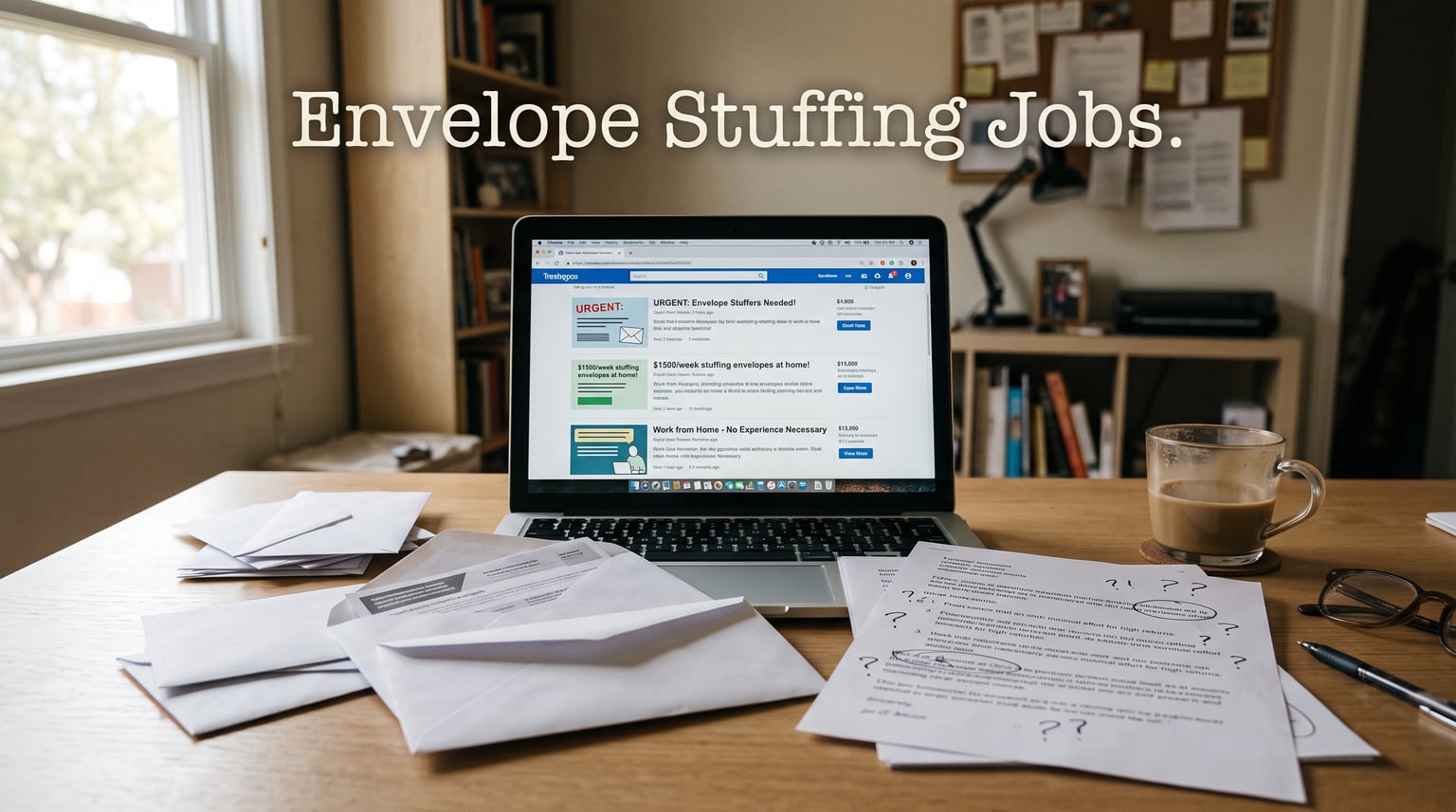
Scrolling through work-from-home job boards in 2026, you have probably spotted listings offering $50 an hour just for stuffing envelopes. These posts pop up everywhere — on social media feeds, job platforms, and direct messages from strangers. Every single one of them begs the same question: is this real? The honest answer is that almost all of them are not. Finding legitimate envelope-stuffing jobs from home without falling into a trap requires knowledge, patience, and a healthy amount of skepticism. Real opportunities exist in this space, but they are rare and heavily outnumbered by scams designed to steal your money or your personal information.
I have spent the last several months digging into this space, reading FTC complaints, interviewing people who fell victim to these schemes, and tracking how these scams have evolved in 2026. What I found surprised even me. The envelope-stuffing job market is not just full of lazy fraudsters posting the same boilerplate ads. Scammers have adapted. They now use WhatsApp for interviews, TikTok videos to recruit victims into course affiliate schemes, and even fake Amazon job listings to lure people in. Meanwhile, legitimate direct-mail operations do exist — they just look nothing like the ads you see on Craigslist.
In this guide, I break down everything you need to know: how these scams work, what legitimate work actually looks like, where to find real opportunities, what to do if you already paid a scammer, and how automation has made human envelope stuffing nearly obsolete. If you have ever been curious about mail stuffing jobs from home, direct mail work, or bulk mailing positions, this is the resource to read before you send anyone your money or personal information.
- How to identify every major scam variant operating in 2026
- Red flags that protect you from fraudulent job offers
- What legitimate envelope stuffing pays based on current market data
- Steps to take if you have already paid a scammer
- Platforms and companies that actually hire for this type of work
- Better alternatives that pay more with lower risk
What Is an Envelope-Stuffing Job, and Why Should You Be Cautious?
Envelope stuffing jobs involve placing printed materials — brochures, flyers, letters, or product samples — into envelopes, sealing them, and preparing them for mailing. In a legitimate setting, this work supports direct mail campaigns for small businesses, nonprofits, political campaigns, and print shops. Some organizations need seasonal help during mailing cycles, especially around holidays or fundraising periods.

The work itself is straightforward. You receive materials from an employer, insert them into envelopes according to specific instructions, seal the envelopes, and return them for shipping. Some roles also include addressing envelopes using provided mailing lists or verifying address accuracy before mailing. The tasks require no formal education, though basic attention to detail and the ability to follow instructions matters.
Here is why caution is essential. The Federal Trade Commission has warned consumers about envelope-stuffing schemes for decades. The Better Business Bureau lists this category among the most persistent work-from-home frauds on record. The U.S. Postal Inspection Service has also issued alerts about mail-related scams targeting people seeking home-based work. These warnings exist because for every legitimate opportunity, there are dozens of fraudulent listings designed to separate you from your money.
According to ZipRecruiter data, real envelope stuffing positions pay between $17 and $23 per hour, with annual earnings ranging from $36,000 to $45,500 depending on experience, location, and workload. These roles are typically handled by temp agencies, direct mail service companies, or nonprofit organizations during busy mailing seasons. If a listing promises substantially more than these figures for basic envelope work, that is a strong warning sign.
Envelope Stuffing Salary and Pay Rate Expectations
Before you invest time pursuing envelope stuffing as a side hustle or income source, understand what the market actually pays. ZipRecruiter reports current hourly rates between $17 and $23 across the United States. Indeed lists similar figures, with some seasonal or part-time positions paying slightly less and specialized direct mail roles paying more. Annual salaries typically fall between $36,000 and $45,500 for full-time workers.
Most legitimate positions pay on an hourly basis or through temp agencies like Robert Half or Kelly Services. Piece-rate pay — where you earn per envelope stuffed — does exist but is less common in 2026. If a listing claims you can earn thousands per week working part-time hours, that promise is a scam. Realistic expectations matter. Envelope stuffing is not a get-rich-quick scheme. It is entry-level administrative work with modest but honest pay.
Seasonal peaks during Q4 (holiday mailings, year-end fundraising letters, and political campaign mailers) can create temporary spikes in demand. Some nonprofits and small businesses need extra hands during these periods. If you are looking for temporary or seasonal envelope stuffing work, connect with local temp agencies or check with direct mail companies in your area. These channels offer the highest probability of finding genuine opportunities.
Common Scams Involving Envelope Stuffing Jobs
The envelope-stuffing scam is not a single scheme — it is a category of fraud that has mutated repeatedly since its earliest documented appearances. In 2026, scammers operate at least six distinct variants, each designed to exploit a different weakness in how people evaluate job offers. Understanding each type helps you recognize them before you lose money.
The Classic Upfront-Fee Scheme
The oldest and most common variant asks you to pay a fee before starting work. This fee is disguised as a cost for training materials, a starter kit, shipping supplies, or a processing deposit. The Federal Trade Commission specifically warns that legitimate employers never ask you to pay to get hired. Once you send the money — typically between $30 and $150 — the scammers disappear or send you worthless materials. Some will string you along with fake tasks before cutting off all contact.
Reddit threads on r/Scams from 2024 and 2025 consistently report victims paying $40 to $80 for kits that contained nothing but a stack of regular envelopes and a sheet of instructions downloaded from a free website. The Better Business Bureau receives hundreds of complaints annually about this specific scam pattern.
The Letter-Writing Scam
A newer variant that gained traction in 2026 recruits people through social media and freelance platforms. Instead of stuffing envelopes, scammers promise payment for writing letters to casinos or other businesses. The pitch sounds plausible — companies allegedly pay for handwritten promotional letters. Victims are told they need to purchase a $50 to $100 training package to access the letter templates and client list. After payment, there is no client list and no real work. This scam is essentially the upfront-fee scheme rebranded for a new audience.
The Course Affiliate Scam
On TikTok and Instagram, content creators promote envelope stuffing as an easy side income while quietly linking to paid courses. The scheme works in layers. A creator posts a video claiming they make hundreds per week stuffing envelopes. The video links to a landing page selling a $97 course that supposedly reveals secret companies hiring for this work. After purchase, the course contains generic advice freely available online and affiliate links to more expensive programs. The original creator earns a commission on your purchase. You do not get a job. You get recruited into selling the same course to other people.
The Pyramid or Multi-Level Marketing Wrapper
Some companies disguise envelope stuffing as a multi-level marketing opportunity. You are told you can earn money stuffing envelopes and also recruit others to do the same work. The real income comes from recruitment commissions, not from the actual envelope work. This structure meets the definition of a pyramid scheme. The Federal Trade Commission defines pyramid schemes as operations where money is generated primarily from recruiting new participants rather than from actual product sales or services rendered.
The Reshipping Scam
Some fraudulent employers recruit people to receive packages at home, open them, and ship the contents to new addresses. This is technically not envelope stuffing, but it often appears under similar work-from-home job listings. Victims become unwitting participants in fencing stolen goods. If law enforcement traces the packages, you could face criminal charges even if you claim you did not know the items were stolen. The U.S. Postal Inspection Service has prosecuted cases where reshipping workers received suspended sentences for their involvement.
The Impersonation Scam
Scammers now create fake job listings using the names of real companies. They might use Amazon branding, a local nonprofit you recognize, or the name of a well-known print shop. The application process happens entirely through free email addresses, WhatsApp, or Telegram. Real companies do not conduct job interviews on WhatsApp or ask for payment through gift cards or cryptocurrency. If a listing claims to be from a brand you know but asks for payment through unusual channels, it is fraudulent.
What to Do If You Paid a Scammer
If you already sent money to someone advertising envelope-stuffing jobs, take these steps immediately. Acting quickly improves your chances of recovering funds or preventing further damage.
- Contact your bank or credit card company: Report the transaction as fraudulent. Ask about a chargeback. If you paid by debit card, contact your bank immediately. If you paid by credit card, file a dispute with the issuer. Time limits apply, so do not delay.
- File a complaint with the FTC: Visit ReportFraud.ftc.gov or call 1-877-FTC-HELP. The FTC collects scam reports and uses the data to identify patterns and pursue enforcement actions. While the FTC does not resolve individual complaints, your report helps protect others.
- Report to the Better Business Bureau: File a scam report at bbb.org/scamtracker. The BBB maintains a public database that warns other consumers about fraudulent businesses and scam patterns.
- Contact the U.S. Postal Inspection Service: If the scam involved mail delivery or postage, report it to uspis.gov. The Postal Inspection Service investigates mail fraud and can sometimes intervene when packages or letters are involved.
- Change any passwords you shared: If the scammer obtained your email password, bank login, or social security number during the application process, change those credentials immediately and monitor your accounts for unauthorized activity.
- Place a fraud alert: Contact one of the three major credit bureaus (Equifax, Experian, or TransUnion) and request a free fraud alert on your credit report. This makes it harder for identity thieves to open accounts in your name.
Do not feel embarrassed if you paid a scammer. These operations are designed to appear legitimate. Victims include college students, retirees, stay-at-home parents, and people with disabilities who are looking for flexible income. The embarrassment stops people from reporting crimes, which allows scammers to continue operating. Reporting helps authorities track patterns and warn other consumers.
How Do You Find Legitimate Envelope-Stuffing Jobs From Home?
Finding legitimate envelope stuffing opportunities means looking in places where scammers rarely operate. Real employers post on established job boards, use temp agencies, and list openings on their own websites. They do not send random direct messages on Instagram.

Start your search on major job platforms that screen employers. Indeed, ZipRecruiter, Monster, and Glassdoor all list legitimate envelope stuffing and mailroom clerk positions. Filter for remote or work-from-home options. FlexJobs is particularly useful because every listing is hand-screened for legitimacy — a critical feature when you are navigating a category full of scams. Robert Half, Kelly Services, and other temp agencies regularly place workers in direct mail and administrative roles that include envelope stuffing tasks.
Upwork and Fiverr also list envelope stuffing and bulk mailing gigs. These platforms hold payments in escrow and offer dispute resolution, which provides more protection than dealing directly with an unknown employer. Axion Data is a specialized company that hires data entry and mailing support workers. Bold Business occasionally lists remote mailing support positions. Check these platforms directly rather than responding to unsolicited social media messages or classified ads.
Contact local print shops, political campaigns, and nonprofit organizations directly. Many small businesses need mailing support during campaign seasons or fundraising drives but do not post on large job boards. A polite email or phone call explaining your availability and skills can lead to genuine opportunities. State employment agencies also maintain listings for legitimate home-based work and can verify employer credentials.
Also Read: What is Dropshipping? Simplifying E-commerce Logistics
Legit vs Scam Envelope Stuffing Jobs
The table below summarizes the key differences between legitimate and fraudulent envelope stuffing job offers. Use it as a quick reference when evaluating any listing.
| Criterion | Legitimate Job | Scam |
|---|---|---|
| Payment to worker | Employer pays you. No fees required. | Asks you to pay for kits, training, or processing. |
| Hiring process | Application, interview, possibly background check. Professional communication through official channels. | No real interview. Communicates via WhatsApp, Telegram, or free email addresses. |
| Pay rate | $17-$23/hr or similar market-rate compensation. Clear about how pay is calculated. | Promises $50+/hr, thousands per week, or vague “unlimited earning potential.” |
| Company information | Physical address, phone number, business registration, BBB profile or similar verification. | No verifiable address, PO boxes only, or contact through social media DMs only. |
| Job description | Specific duties, hours, requirements, and terms clearly stated. | Vague descriptions, no details about who the mail goes to or what it contains. |
| Communication | Professional emails from company domain. Real phone support during business hours. | Poor grammar, generic email addresses, pressure to act immediately. |
| Payment method requested | Direct deposit, check, or PayPal. Never gift cards or cryptocurrency. | Requests payment via gift cards, wire transfer, cryptocurrency, or payment apps with no buyer protection. |
| BBB/FTC status | May have BBB accreditation or clean FTC record. | Multiple BBB complaints or FTC enforcement actions on record. |
This comparison table covers the most important distinctions. When evaluating any job offer, check as many of these criteria as possible. A single red flag does not guarantee a listing is fraudulent, but multiple red flags together almost always indicate a scam.
Evaluating Potential Jobs: Red Flags To Watch
A scam listing often triggers multiple warning signals at once. The more red flags you notice, the higher the probability the offer is fraudulent. Below are twelve indicators that should make you pause before proceeding with any envelope stuffing job application.

- Upfront fee requests: Any employer asking you to pay before starting work is not legitimate. Real employers pay you, not the other way around. Fees may be disguised as training, materials, or processing costs.
- Unrealistic pay promises: If the listing promises $50 per hour or thousands per week for basic envelope work, it is a scam. Realistic rates for this type of work fall between $17 and $23 per hour.
- WhatsApp or Telegram interviews: Legitimate companies conduct interviews through official email addresses or phone calls. Communication exclusively through WhatsApp, Telegram, or other messaging apps is a strong scam indicator.
- Poor grammar and spelling: Scam listings frequently contain spelling errors, awkward phrasing, or inconsistent formatting. Professional employers proofread their job postings.
- Pressure tactics: Scammers create artificial urgency (“Only 3 positions left!” or “Act within 24 hours!”). Real employers do not pressure you to accept a job immediately.
- Unsolicited job offers: If you received a message out of the blue offering envelope stuffing work, treat it with extreme skepticism. Legitimate employers do not cold-message strangers on social media with job offers.
- Free email addresses for business contact: A real company uses an official domain email (for example, [email protected]). Gmail, Yahoo, or Hotmail addresses for hiring communications are a major red flag.
- No verifiable company information: If you cannot find a physical address, phone number, BBB profile, business registration, or website for the employer, walk away.
- Payment through unusual channels: Requests for payment via gift cards, wire transfers, cryptocurrency, or payment apps like Cash App or Venmo without buyer protection are scam indicators.
- Vague job descriptions: If the listing does not clearly explain what you will be doing, who you will be working for, or how the business operates, that is intentional. Scammers avoid specifics because there are no real details to provide.
- Requests for sensitive personal information early: No legitimate employer needs your social security number, bank account details, or copy of your driver’s license during the initial application stage.
- No formal application process: Real jobs have structured applications, possibly followed by interviews and reference checks. If you can “start working” within minutes of expressing interest, something is wrong.
When you notice three or more of these signals together, the odds of fraud approach certainty. Trust your instincts. If something feels off about a job listing, it probably is. Walking away from a suspicious opportunity costs nothing. Walking into a scam can cost you money, personal data, and time.
Weighing the Company’s Physical Contact Information
A legitimate business has a physical presence. Check whether the employer provides a verifiable street address, not just a P.O. box. Use Google Maps to look up the address. If the building is a residential home, a vacant lot, or a UPS store, that is a warning sign. A real mailing company operates from a commercial space.
Call the phone number if one is provided. Ask to speak with someone about the job. If you reach a voicemail with no option to speak to a human, or if the number is disconnected, do not proceed. The Better Business Bureau website lets you look up businesses by name and location to see if complaints have been filed. A company with a clean BBB record and an A+ rating is far more trustworthy than one with no online presence at all.
Interpreting Online Reviews and Feedback
Before engaging with any employer, search for reviews on Glassdoor, Trustpilot, and the Better Business Bureau. Look for patterns rather than isolated complaints. A single negative review among dozens of positive ones is normal. Multiple reviews mentioning the same problem — especially non-payment, sudden communication cuts, or demands for upfront fees — confirms a pattern of fraudulent or abusive behavior.
Reddit communities like r/Scams and r/WorkFromHome contain thousands of real experiences from people who have applied to or been scammed by envelope-stuffing job listings. Searching these communities for the company name can save you from making a costly mistake. Users in 2026 continue to post warnings about active scams on these platforms.
Automation and Why Machines Replaced Humans
Understanding why legitimate envelope stuffing work is so rare requires a look at the technology behind it. Modern inserter machines can process more than 1,300 envelopes per hour with near-zero error rates. A single machine replaces what would have required a small team of workers stuffing envelopes by hand. These machines handle folding, inserting, sealing, and in some cases addressing and sorting — all at speeds no human worker can match.
Large corporations, political campaigns, and major nonprofits almost exclusively use automated equipment for bulk mail operations. The remaining human-based envelope stuffing work exists primarily in small-scale operations: local print shops handling specialty mailings, small nonprofits with limited budgets, political candidates running grassroots campaigns, and seasonal temp work during peak mailing periods. This limited demand is precisely why scam listings claiming to offer “unlimited positions” are so obviously fraudulent. The real market cannot absorb thousands of home-based workers.
Steps Employers Take Toward Ensuring Fair Practices
Legitimate employers in the direct mail and administrative staffing space follow specific practices that protect both the company and its workers. Understanding these practices helps you distinguish real employers from scammers.
- Written contracts or offer letters: Real employers provide documentation outlining your role, pay rate, hours, and terms. Verbal agreements with no paperwork are not standard employment practice.
- Proper classification: Legitimate employers classify workers correctly as employees or independent contractors and handle tax documentation (W-2 or 1099) accordingly. Misclassification is common among scam operations.
- Clear payment schedules: Real employers pay on a predictable schedule — weekly, bi-weekly, or monthly. If pay terms are vague or keep shifting, that is a warning sign.
- Transparent business structure: Legitimate companies are registered with state business authorities and carry appropriate insurance. Ask for their EIN or business registration number if you need verification.
- Professional onboarding: Real employers invest time in training or providing clear instructions. If your “training” consists of a poorly written PDF you had to pay for, that is not onboarding — that is a scam.
Reputable staffing agencies like FlexJobs maintain A+ ratings with the Better Business Bureau specifically because they enforce these standards on behalf of job seekers. When you work through a verified platform, you gain the benefit of their screening process. When you apply directly to an unknown employer found on a social media ad, you have no such protection.
Alternatives to Envelope Stuffing Jobs From Home
If your goal is flexible income from home, envelope stuffing is one of the riskiest paths available. The alternatives below offer higher pay, better job security, and far fewer scams. Each of these roles is actively hiring in 2026 and does not require you to pay upfront fees.

- Virtual Assistant: Virtual assistants handle administrative tasks for businesses and executives. Duties include email management, scheduling, data entry, customer support, and basic research. Pay ranges from $20 to $35 per hour on platforms like Upwork and Fiverr. Specialized VAs with skills in project management or bookkeeping can earn significantly more.
- Freelance Writing: Content writing, copywriting, and technical writing are consistently among the highest-paying work-from-home roles. Entry-level writers earn $20 to $40 per hour on Upwork and Freelancer. Specialized niches like healthcare, finance, or SaaS writing pay $50 to $100 per hour for experienced writers.
- Data Entry Clerk: Data entry involves transferring information from physical documents or one digital format into another. Pay ranges from $15 to $25 per hour. Platforms like Axion Data, Clickworker, and SigTrack hire remote data entry workers. This role shares the repetitive nature of envelope stuffing but with better pay and no scam risk when using established platforms.
- Transcriptionist: Transcriptionists convert audio recordings into written text. Medical and legal transcription pay the most, with rates between $20 and $40 per hour. General transcription on Rev or TranscribeMe pays $15 to $20 per hour. No degree is required, though certifications improve earning potential.
- Online Tutor: If you have expertise in a subject area, online tutoring pays $20 to $60 per hour depending on the subject and platform. VIPKid, Chegg, and Wyzant connect tutors with students. Some platforms require a bachelor’s degree, while others accept proficiency without formal credentials.
- Calligrapher and Handwriting Services: Contrary to what scam letter-writing ads claim, real calligraphers and handwriting service providers earn money through legitimate platforms like Etsy and Fiverr. Clients pay for wedding invitations, custom address work, and personalized notes. Rates range from $5 to $20 per envelope depending on complexity. This is a genuine skill-based service, not a pyramid scheme disguised as envelope work.
- Graphic Designer: Graphic designers create visual content for businesses using tools like Canva, Adobe Creative Suite, or Figma. Entry-level designers earn $25 to $50 per hour on Upwork and Fiverr. If you already use design software or want to learn, this path leads to significantly more income than envelope stuffing with far better long-term prospects.
- Intake Specialist: Intake specialists collect and process client information for law firms, healthcare providers, and insurance companies. This role often involves reviewing documents, entering data, and verifying information — work that is similar in nature to envelope processing but pays $18 to $30 per hour through established employers.
All of these alternatives share a common advantage: they are listed on platforms that verify employers and protect workers. When you use Upwork, Fiverr, FlexJobs, or major job boards, you have access to dispute resolution, verified payment systems, and employer reviews. Envelope-stuffing scams do not exist on these platforms because the scam structure requires direct payment from you to the scammer — a step the platform would block.
Also Read: eBay vs Amazon Showdown – Which Dominates for Sellers?
E-commerce models like dropshipping offer another path to flexible income without the scam risks of envelope stuffing. If you are interested in building an online store, read our guide on What is Dropshipping? Simplifying E-commerce Logistics. Selling products on marketplaces like Amazon or eBay can also provide flexible income. Our eBay vs Amazon comparison helps you choose the right platform for your goals. Some people prefer building their own brand through Shopify. If you decide to launch an e-commerce business, our guide on how to manage your Shopify account can help you get started on the right foot.
FAQs
Can you really get paid to stuff envelopes at home?
Yes, but legitimate opportunities are rare. Real envelope stuffing jobs pay between $17 and $23 per hour and are typically found through temp agencies, direct mail companies, or nonprofit organizations during seasonal mailing periods. The overwhelming majority of online listings for this work are scams asking for upfront fees.
How much money can you make stuffing envelopes?
According to ZipRecruiter, legitimate envelope stuffing positions pay $17-$23 per hour, with annual salaries ranging from $36,000 to $45,500. Seasonal or temporary positions may pay slightly less. Any listing promising substantially more for basic envelope work is almost certainly a scam.
How do envelope-stuffing scams work?
Scammers post fake job listings asking you to pay upfront for training materials, starter kits, or processing fees. Once you pay — typically $30 to $150 — you either receive worthless materials or no response at all. Modern variants use WhatsApp for interviews, TikTok videos promoting paid courses, or fake letters to casinos. The FTC and BBB have documented these patterns for decades.
Is envelope stuffing a legit side hustle?
Envelope stuffing is not a practical side hustle for most people. Legitimate opportunities are rare, pay modest hourly wages, and are usually seasonal. The risk of encountering scams is extremely high. For side income, alternatives like virtual assistance, freelance writing, or data entry on verified platforms like Upwork or FlexJobs offer better pay with far less risk.
What to do if you paid for an envelope stuffing scam?
If you already paid a scammer, contact your bank or credit card company immediately to request a chargeback. File a complaint with the FTC at ReportFraud.ftc.gov or 1-877-FTC-HELP. Report the scam to the Better Business Bureau at bbb.org/scamtracker. If mail was involved, contact the U.S. Postal Inspection Service at uspis.gov. Change any passwords you shared and place a fraud alert on your credit report if you shared sensitive information.
Are there any legit companies that hire for envelope stuffing?
Yes, but they rarely advertise on social media or job classifieds. Legitimate employers include direct mail service companies, temp agencies like Robert Half and Kelly Services, nonprofit organizations during fundraising seasons, and political campaign mailing operations. Axion Data hires remote data and mailing support workers. Check ZipRecruiter, Indeed, and FlexJobs for current listings rather than responding to unsolicited ads.
Is envelope stuffing worth the effort?
For most people, no. The pay for legitimate work is modest, opportunities are seasonal and scarce, and the scam risk is high. If you need flexible income from home, data entry, virtual assistance, transcription, or freelance writing offer better pay, more consistent availability, and far fewer fraudulent listings. Spend your time on platforms that verify employers rather than chasing envelope-stuffing opportunities on social media.
How do I avoid envelope stuffing job scams?
Follow these rules: never pay money to get a job, avoid employers who communicate only through WhatsApp or Telegram, verify the company’s physical address and BBB rating, skip listings promising unrealistic pay, use established job boards like FlexJobs or Indeed, and research every employer on Glassdoor and Trustpilot before applying. If a listing triggers three or more red flags, walk away. The FTC, BBB, and USPS all maintain scam warning resources you can consult for current threats.
Conclusion
Envelope stuffing jobs from home occupy a strange space in the work-from-home landscape. Real positions exist, but they are seasonal, scarce, and rarely advertised on the platforms where most people search for work. The far larger presence belongs to scammers who have turned this category into a persistent fraud ecosystem. In 2026, these scams have evolved to use WhatsApp interviews, TikTok course affiliate schemes, and impersonation tactics that fool even cautious job seekers.
If you are serious about finding legitimate work from home, focus on platforms that screen employers: FlexJobs, Indeed, ZipRecruiter, Upwork, and verified temp agencies. The pay you will earn there — whether in virtual assistance, data entry, writing, or transcription — will exceed what envelope stuffing offers with a fraction of the risk. If you have already paid a scammer, take action immediately. Contact your bank, file a report with the FTC, and notify the BBB. The faster you act, the better your chances of recovering your money.
Also Read: How to Delete a Shopify Account and Cancel a Subscription?
Leave a Reply