
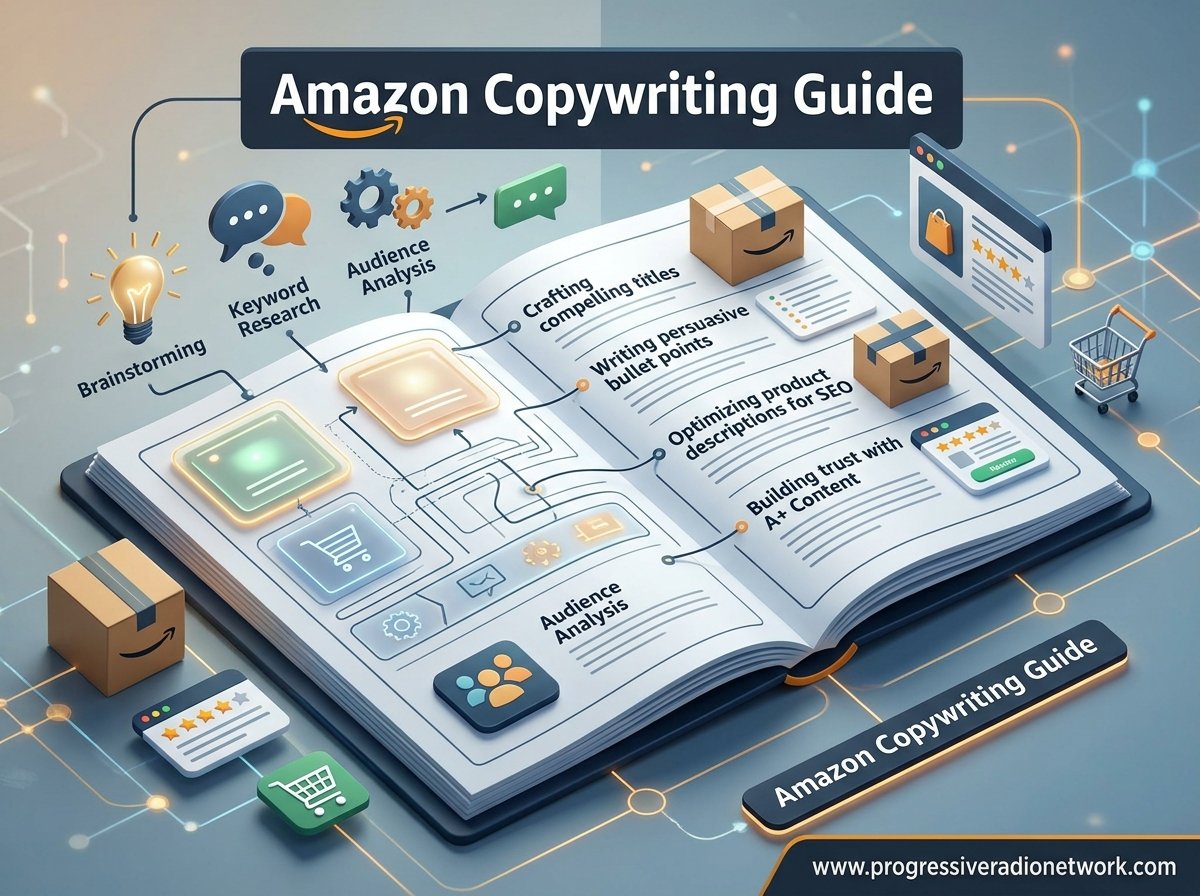
Amazon copywriting is the difference between a product that dominates search results and one that vanishes into the catalog’s depths. Every word on your listing, from the title to the final bullet point, feeds Amazon’s A10 algorithm and shapes a shopper’s decision to click “Add to Cart.” Yet most sellers treat their listing copy as an afterthought, wondering why their conversion rate sits below the 1-2% category average while competitors capture the Buy Box and Best Sellers Rank momentum.
I have spent years analyzing what separates high-converting Amazon listings from underperforming ones. The pattern is remarkably consistent. Top-performing sellers understand that Amazon listing optimization is not about stuffing keywords into every available field. It is about strategically combining buyer intent keywords, benefit-driven bullet points, compelling product descriptions, and A+ content into a unified message that speaks directly to the shopper’s needs.
This guide covers everything you need to master Amazon copywriting in 2026. Whether you are launching your first Amazon Private Label product or optimizing an established catalog, you will find actionable frameworks for keyword research, title formulas, bullet point structures, A+ content design, A/B testing, and the growing role of AI copywriting tools. By the end, you will have a repeatable system for writing listings that rank higher, convert better, and withstand algorithm changes.
What You Will Learn:
The core components of Amazon copywriting and how the A10 algorithm evaluates them
A proven product title formula with good versus bad examples
How to structure bullet points that sell benefits, not just features
Keyword research strategies using Reverse ASIN and buyer intent classification
How AI tools like ChatGPT and Claude can accelerate your copywriting workflow
A+ content design principles, A/B testing methodology, and mobile optimization
What Is Amazon Copywriting?
Amazon copywriting refers to the strategic writing and optimization of all text elements on an Amazon product listing. This includes the product title, bullet points, product description, A+ content modules, backend search terms, and even image captions. Each element serves a dual purpose: helping Amazon’s search algorithm understand and rank your product, and persuading human shoppers to choose your product over competitors.
Think of your listing as a sales page with two audiences. The first is the A10 algorithm, Amazon’s ranking system that determines which products appear for a given search query. The A10 algorithm analyzes your title, bullets, and backend keywords to decide if your product matches a shopper’s search. It also weighs conversion rate and sales velocity, meaning copy that converts poorly will eventually lose ranking regardless of keyword density.
The second audience is the shopper. Real people read your title to confirm relevance, scan bullet points for the information they care about most, and review the product description to overcome remaining objections. Effective Amazon copywriting bridges both audiences by weaving relevant keywords into natural, benefit-focused language that reads smoothly and compels action. When you are selling on Amazon through any fulfillment method, this skill directly impacts your bottom line.
Why Amazon Copywriting Matters More Than Ever in 2026
The competitive gap on Amazon has widened significantly. Categories that once had a few hundred sellers now host thousands, and the difference between page one and page two search results often comes down to listing quality. Sellers who invest in professional copywriting consistently outperform those who copy manufacturer descriptions or rely on generic templates.
Several developments make 2026 a turning point. Voice search through Alexa and mobile devices now influences how shoppers phrase queries, favoring conversational, natural-language copy over keyword-stuffed text. AI recommendation systems are increasingly summarizing listing content for shoppers, which means clear, well-structured copy gets surfaced more often. And Amazon’s continued refinement of the A10 algorithm places heavier emphasis on conversion signals, making every word on your listing a factor in your search ranking.
Consider the data. The average Amazon conversion rate across most categories sits between 1% and 2%. Sellers with optimized, benefit-driven copy routinely achieve 3-5% or higher. That difference compounds rapidly. A listing converting at 4% generates double the sales from the same traffic as one converting at 2%, which in turn signals higher relevance to the A10 algorithm and drives even more organic traffic. Strong copy creates a positive feedback loop that weak copy cannot replicate.
Understanding Your Buyer: Persona Research for Amazon Listings
Before writing a single word, you need to know exactly who you are writing for. Amazon copywriting fails most often not because of poor grammar or missing keywords, but because the writer never understood the buyer’s actual motivation. A shopper searching for a standing desk mat is not looking for “ergonomic floor surface.” They want relief from foot fatigue during long work hours. The copy must speak to that pain.
Building a buyer persona for Amazon listings requires answering specific questions. What age range and income level does your typical buyer fall into? What problem are they trying to solve when they search for your product? What objections might prevent them from buying? What alternatives have they already tried? If you are selling a travel backpack, your buyer might be a weekend adventurer who values durability and organization over luxury materials. Every word choice should reflect that understanding.
Customer reviews, both yours and your competitors’, are a goldmine for persona research. Scan one-star reviews for recurring complaints your product solves. Read five-star reviews to identify the language buyers use when describing what they love. Quote their phrasing directly in your bullet points. When your copy mirrors the words shoppers already use internally, it builds immediate trust and reduces purchase friction. This approach works whether you sell through Amazon FBA or fulfill orders yourself.
Amazon Keyword Research: Finding Buyer Intent Search Terms
Keyword research forms the foundation of every successful Amazon listing. Without the right keywords, even the most beautifully written copy will never appear in front of shoppers. The goal is to identify the exact search terms your target customers type into Amazon’s search bar, then strategically incorporate those terms into your title, bullet points, and backend search terms.
Not all keywords carry equal value. Buyer intent keywords, the terms shoppers use when they are ready to purchase, deserve priority over informational queries. Someone searching “what is a cast iron skillet” is researching. Someone searching “12 inch pre-seasoned cast iron skillet with lid” is buying. Your listing should target commercial and transactional intent keywords first, capturing shoppers who have moved past research and are ready to add to cart.
Reverse ASIN research is one of the most effective methods for building your keyword list. Tools like Helium 10 Cerebro allow you to enter a competitor’s ASIN and see every keyword their product ranks for organically. This reveals which terms Amazon’s algorithm already associates with products in your category. Cross-reference multiple top-ranking competitors to identify high-volume keywords that appear consistently across listings.
Once you have your keyword list, organize it by priority. Your primary keyword, the single most relevant and highest-volume search term, belongs in your title’s first few words. Secondary keywords distribute across bullet points and the product description. Long-tail keywords, longer phrases with lower competition but strong purchase intent, work well in backend search terms. Aim for natural integration. Keyword stuffing, the practice of cramming unrelated terms into your listing, can trigger suppression and hurt your conversion rate.
The Product Title Formula: How to Write Amazon Titles That Convert
Your product title is the single most important piece of copy on your entire listing. It is the first thing shoppers see in search results, the primary factor the A10 algorithm uses for indexing, and the main text Alexa reads during voice searches. A weak title undermines every other optimization effort.
Amazon allows up to 200 bytes (approximately 200 characters) for most product titles, though some categories enforce tighter limits. The most effective titles follow a proven structure: Brand Name + Primary Keyword + Key Feature + Secondary Keyword + Material or Size + Color or Variant. This formula satisfies the algorithm with relevant keywords while giving shoppers the information they need to make a quick decision.
Consider the difference. A weak title reads: “Water Bottle Blue.” A strong title reads: “HydraFlow Insulated Stainless Steel Water Bottle, 32 oz, Keeps Drinks Cold for 24 Hours, Leak-Proof, Powder Blue.” The second version includes the brand, primary keyword, material, capacity, a benefit, a feature, and the color variant. It tells both the algorithm and the shopper exactly what the product is and why it matters.
Avoid common title mistakes. Do not use promotional language like “Best Seller” or “#1 Rated” unless Amazon has officially awarded that designation. Do not repeat keywords unnaturally. Do not include price, quantity, or shipping information, as Amazon restricts these in titles. And never use all capital letters for the entire title, which hurts readability and can trigger listing suppression.
Bullet Points That Sell: Structure and Best Practices
Bullet points, also called “About This Item,” are where most shoppers make their final purchase decision. Amazon allows five bullet points per listing, and each can contain up to 500 characters, though the first 200-250 characters matter most because that is what displays before the “See more” cutoff on mobile devices.
The most effective bullet structure follows a consistent pattern. Start each bullet with a clear, capitalized benefit statement that acts as a headline. Follow with supporting details that explain the feature and its real-world value. This format lets shoppers scan quickly while still accessing depth when they need it.
Here is a proven five-bullet framework. Bullet one should lead with your unique selling proposition, the single benefit that differentiates your product from every competitor. Bullet two addresses the primary problem your product solves. Bullet three highlights a secondary benefit or use case. Bullet four covers technical specifications like dimensions, materials, or compatibility. Bullet five reinforces trust with warranty, guarantee, or social proof information.
The biggest mistake sellers make is listing features without translating them into benefits. “Made with 304 stainless steel” is a feature. “Rust-proof 304 stainless steel that lasts a lifetime, even with daily use” is a benefit-driven feature. Always connect what the product is to why the shopper should care. Use the word “you” to speak directly to the reader and make the copy feel conversational rather than clinical.
Product Descriptions and A+ Content: Building Your Brand Story
The product description section is your opportunity to go beyond the quick-scan format of titles and bullets and tell a fuller story. For sellers with Amazon Brand Registry, this section can be upgraded to A+ content, also known as Enhanced Brand Content. A+ content replaces plain text with rich modules that combine images, comparison charts, brand storytelling, and formatted text.
A+ content significantly impacts conversion rates. Amazon reports that A+ content can increase sales by 3-10% on average. The visual nature of A+ modules lets you showcase lifestyle imagery, highlight key features with infographics, and address common buyer questions before they become objections. Comparison charts are particularly effective because they position your product against alternatives in a controlled, favorable format.
Effective A+ content follows design principles that mirror good copywriting. Start with a hero image and brand story module that creates emotional connection. Follow with feature highlight modules that use consistent iconography and concise text. Include a comparison chart that lists your product alongside generic alternatives, using your actual strengths as the comparison criteria. End with a frequently asked questions module that preemptively addresses the objections visible in competitor negative reviews.
Maintain visual consistency across all A+ modules. Use the same color palette, typography, and image style throughout. Inconsistent design signals an unprofessional brand and undermines trust. If you lack design resources, Amazon provides pre-built A+ templates within Seller Central that offer a clean, structured starting point you can customize with your own text and images.
Writing Backend Keywords and Search Terms
Backend keywords, found in the search terms field within Seller Central, are invisible to shoppers but critical for indexing. Amazon gives you 250 bytes for generic keywords, and every byte counts. This field captures the long-tail keywords and synonyms that do not fit naturally into your visible listing copy.
Follow a few rules to maximize backend keyword effectiveness. Never repeat keywords that already appear in your title or bullet points, since Amazon already indexes those. Avoid subjective terms like “best” or “cheap.” Skip brand names other than your own. Use spaces rather than commas to separate terms, as Amazon’s algorithm parses individual words regardless of punctuation. Prioritize single words and short phrases that combine into multiple possible search queries.
Backend keywords also help you capture misspellings and alternative phrasings without cluttering your visible copy. If shoppers commonly search for your product using a regional term or informal name, the backend field is where it belongs. Review and update these terms quarterly based on performance data from your keyword research tools.
How AI Tools Are Transforming Amazon Copywriting
AI copywriting tools have fundamentally changed how sellers approach listing creation. ChatGPT, Claude, and Grammarly now play roles in everything from initial brainstorming to final proofreading. Used strategically, these tools can reduce listing creation time by half while improving output quality. Used carelessly, they produce generic, detectably artificial copy that harms conversion rates.
ChatGPT for Amazon Listings
ChatGPT excels at generating first drafts quickly. Feed it your keyword list, product specifications, and target buyer persona, and it can produce title variations, bullet point drafts, and description outlines in seconds. The key is in the prompt quality. Instead of asking “write Amazon bullets for a water bottle,” provide detailed context: “Write five Amazon bullet points for a 32oz insulated stainless steel water bottle targeting outdoor enthusiasts. Include the keywords ‘leak-proof,’ ‘cold for 24 hours,’ and ‘BPA-free.’ Lead each bullet with a capitalized benefit statement.”
Always treat ChatGPT output as a rough draft. Edit every sentence for accuracy, brand voice, and Amazon guideline compliance. AI models sometimes hallucinate features or make claims that are not true of your actual product. Verify every factual statement before publishing.
Claude AI for Deeper Product Analysis
Claude AI is particularly strong at analyzing competitor listings and extracting patterns. Paste the top five competitor listings into Claude and ask it to identify common keyword usage, bullet point structure, and benefit framing. Claude can also review customer reviews across your category and summarize the most frequently mentioned pain points, giving you a data-driven foundation for your own copy.
Use Claude for sentiment analysis of your existing listing copy. Ask it to review your current bullets and identify areas where the tone is too clinical, where benefits are undersold, or where keyword placement feels forced. This second-pass review often catches issues that the original writer overlooked.
Grammarly for Final Polish
Grammarly serves as your final quality check. Run every listing through Grammarly before publishing to catch grammar errors, awkward phrasing, and readability issues. Set Grammarly to your target audience reading level, generally grade 6-8 for consumer products on Amazon, to confirm your copy is accessible to the broadest possible audience.
The consensus among experienced copywriters is clear. AI tools accelerate the drafting and analysis phases, but human judgment remains essential for the final edit. The tension between keyword optimization and readability, which forum discussions consistently identify as the top challenge for Amazon sellers, requires human judgment to resolve. No AI tool understands your buyer persona, brand voice, or competitive positioning the way you do after thorough research.
Product Image Strategy: The Visual Side of Copywriting
While technically not text, product images are inseparable from copywriting. Your images and text must work together as a unified sales message. A compelling title gets the click, but the main image earns it. Strong bullet points build desire, but infographic images reinforce those claims visually. The interaction between words and visuals determines your overall conversion rate.
Amazon requires a main image with a pure white background and the product filling at least 85% of the frame. Minimum resolution should be 1,600 pixels on the longest side to enable zoom functionality. Beyond the main image, aim for at least six additional images plus one video. Include lifestyle images showing the product in use, infographic images highlighting key features with text overlays, and comparison images that position your product against alternatives.
Infographic images deserve special attention. These are images with text annotations that call out specific features, dimensions, or benefits. They function as visual bullet points, delivering information to shoppers who skim rather than read. Keep text concise, use readable fonts at small sizes, and maintain consistent branding across all infographics. Mobile shoppers, who now account for the majority of Amazon traffic, depend heavily on images because reading long text on a phone screen is cumbersome.
Selling Solutions: Emotional Storytelling in Amazon Copy
Shoppers do not buy products. They buy better versions of themselves. The most effective Amazon copywriting connects product features to emotional outcomes. A skincare listing should not just say “contains hyaluronic acid.” It should paint the picture of waking up to visibly smoother, more radiant skin that makes you feel confident walking into any room.
This principle, often called selling the cure rather than the prevention, reframes your product as the solution to an immediate problem. Instead of warning shoppers about what happens if they do not buy, show them what their life looks like when they do. A travel backpack listing should not focus on “avoiding disorganized trips.” It should evoke the feeling of striding through an airport with everything perfectly organized, ready for adventure.
Emotional storytelling works because purchasing decisions are largely emotional, not logical. Shoppers justify with logic but buy with feeling. Your bullet points and product description should acknowledge the emotional driver behind the purchase and validate it. If someone is buying a luxury candle, they are not buying wax and a wick. They are buying an hour of calm after a stressful day. Write accordingly.
Calls to Action and Creating Meaningful Urgency
Your call to action, or CTA, is the final push that converts a browser into a buyer. On Amazon, the primary CTA is the “Add to Cart” and “Buy Now” button, which Amazon controls. But you can reinforce urgency and action within your listing copy through strategic language that motivates the shopper to act now rather than later.
Effective urgency is honest and specific. Phrases like “limited stock at this price” work only if true. Amazon prohibits false scarcity claims, and violations can result in listing suppression. Instead, create urgency through benefit framing. “Start your mornings pain-free” implies immediate value from acting now. “Join thousands of satisfied customers” leverages social proof to reduce purchase anxiety.
Place subtle CTAs throughout your listing, not just at the end. The final bullet point can end with a soft CTA like “Order yours today and experience the difference.” A+ content modules can include buttons or visual cues that direct attention to the purchase area. The goal is to maintain purchase momentum from the moment a shopper clicks your listing to the moment they complete checkout.
A/B Testing and Continuous Improvement
Even the most carefully crafted listing is a hypothesis until tested against real shoppers. Amazon’s Manage Your Experiments tool, available to Brand Registry sellers, lets you run controlled A/B tests on your title, bullet points, product description, and A+ content. The tool splits traffic between two versions and reports which generates higher conversion over a four to ten week testing period.
A/B testing follows a simple principle: change one element at a time, test it against the current version, and let data decide. If you change your title, your bullets, and your main image simultaneously, you will never know which change drove the results. Test your title first, since it has the largest impact on both click-through rate and conversion. Then test bullet point order, then individual bullet copy.
Run each experiment for the full recommended duration, even if one version appears to be winning early. Short testing windows produce unreliable results due to normal sales fluctuations. Amazon’s tool will tell you when statistical significance has been reached. Once a clear winner emerges, apply it permanently and begin the next experiment. This continuous improvement cycle is how top sellers maintain their competitive edge over time.
Many sellers skip A/B testing because their current listing performs acceptably. This is a mistake. Even a 0.5% conversion rate improvement compounds into significant revenue over a year. The sellers dominating their categories are not necessarily smarter. They are simply more disciplined about testing and iterating.
Conversational Copy and Voice Search Optimization
Voice search is reshaping how Amazon listings need to be written. When a shopper asks Alexa for a product recommendation, the algorithm selects based on natural-language matching and conversion data. Keyword-stuffed, robotic copy performs poorly in this environment because it does not match how people actually speak.
Conversational copy reads the way a knowledgeable friend might describe a product. Instead of “Premium Stainless Steel Insulated Tumbler 20oz Double Wall Vacuum,” conversational copy might read “a 20-ounce insulated tumbler that keeps your coffee hot for hours.” Both contain the same keywords, but the second version mirrors natural speech patterns and performs better with voice search and AI recommendation systems.
To optimize for conversational search, write your bullets and description using complete sentences and natural phrasing. Include question-based keywords that match how shoppers phrase voice queries, such as “best gift for” or “how to.” Read your listing copy aloud. If it sounds unnatural when spoken, revise it until it flows like conversation.
Amazon Copywriting Best Practices: A Quick Checklist
Use this checklist as a final review before publishing any Amazon listing. Each item addresses a specific factor that impacts either search ranking or conversion rate.
Title: Under 200 bytes, leads with primary keyword, includes brand, key features, and variant info
Bullet points: Five bullets, each leading with a capitalized benefit, most important information in the first 200 characters
Keywords: Primary keyword in title, secondary keywords in bullets, long-tail terms in backend search terms field
A+ content: Brand story module, feature highlights with infographics, comparison chart, FAQ module
Images: White-background main image at 1,600px+, six supporting images including lifestyle and infographic shots, one video
Tone: Conversational, benefits-first, written at a grade 6-8 reading level
Compliance: No promotional claims, no price references in title, no unverified superlatives
Mobile: Test how the listing displays on a phone screen, where most shoppers will see it
This checklist is especially relevant if you are scaling an Amazon FBA business or comparing strategies like eBay vs Amazon. No matter your selling model, copy quality is the common denominator that determines how well your products perform.
What Does an Amazon Copywriter Do?
An Amazon copywriter specializes in writing and optimizing product listings specifically for Amazon’s marketplace. Unlike general copywriters who might write website copy, email campaigns, or ad creative, Amazon copywriters focus exclusively on the elements that drive Amazon search ranking and conversion. Their work directly affects a product’s Best Sellers Rank, organic traffic, and sales velocity.
Day-to-day responsibilities typically include conducting keyword research using tools like Helium 10, writing product titles and bullet points optimized for the A10 algorithm, creating A+ content for Brand Registry clients, and running A/B tests through Manage Your Experiments. Many Amazon copywriters also analyze competitor listings, review customer feedback for copy improvement opportunities, and ensure listings comply with Amazon’s constantly evolving style guidelines.
The freelance market for Amazon copywriting is active and growing. Platforms like Upwork and Fiverr host thousands of Amazon copywriting gigs, and many sellers hire dedicated copywriters for ongoing listing optimization. Experienced copywriters who can demonstrate measurable conversion improvements command premium rates. Whether you are considering hiring a copywriter or becoming one, understanding the full scope of listing optimization, from keyword research through A/B testing, is what separates professionals from hobbyists.
FAQs
Can copywriting improve my sales on Amazon?
Yes. Optimized listing copy directly impacts both traffic and conversion rate. Better keyword placement improves your search ranking through the A10 algorithm, while benefit-driven bullet points and descriptions persuade more shoppers to purchase. Sellers who invest in professional copywriting typically see conversion rate improvements of 1-3 percentage points, which translates to significant revenue gains over time.
What does an Amazon copywriter do?
An Amazon copywriter writes and optimizes product titles, bullet points, descriptions, A+ content, and backend search terms. They conduct keyword research using tools like Helium 10, analyze competitor listings, ensure compliance with Amazon guidelines, and run A/B tests through Manage Your Experiments to continuously improve conversion rates.
Can you make $10,000 a month with copywriting?
Yes, experienced Amazon copywriters can earn $10,000 or more per month, particularly those who serve multiple FBA sellers or agencies on retainer. Freelance rates typically range from $50 to $300 per listing depending on complexity, and copywriters who manage ongoing optimization for a portfolio of clients can build substantial recurring income. Reaching this level requires demonstrated results and a strong client base built over time.
Does Amazon hire copywriters directly?
Amazon employs in-house copywriters and content specialists for various teams, including Amazon Fresh, Amazon Basics, and brand store design. However, the vast majority of Amazon copywriting work is done by freelancers and agencies serving third-party sellers. Job postings for Amazon’s internal copywriting roles appear on Amazon’s careers page and typically require several years of professional copywriting experience.
How often should I update my Amazon listing copy?
Review your listing copy quarterly and run A/B tests whenever conversion rates decline or a competitor launches a superior listing. Amazon’s Manage Your Experiments tool makes continuous testing straightforward. Avoid frequent full rewrites, as they reset your keyword indexing. Instead, test individual elements like title variations or bullet point reordering to find incremental improvements.
Should I use AI tools like ChatGPT for my Amazon listings?
AI tools like ChatGPT and Claude can accelerate drafting and competitor analysis, but human editing remains essential. AI-generated copy often lacks the specific product knowledge, brand voice, and emotional nuance needed to convert shoppers. Use AI for first drafts, research, and proofreading, then refine every sentence with your own product expertise and customer insights before publishing.
What is the biggest mistake in Amazon copywriting?
The most common mistake is keyword stuffing, or cramming unrelated search terms into titles and bullet points at the expense of readability. Keyword stuffing can trigger listing suppression and drives shoppers away because the copy becomes unreadable. Always prioritize natural, benefit-driven language and place keywords strategically where they fit without forcing.
Conclusion
Mastering Amazon copywriting is not a one-time task but a continuous discipline that directly determines how visible and persuasive your products are on the world’s largest marketplace. The framework is straightforward but requires execution. Research your buyer, identify buyer intent keywords, write titles and bullets that lead with benefits, leverage A+ content for brand storytelling, test relentlessly through Manage Your Experiments, and use AI tools to accelerate without sacrificing the human touch.
If you want immediate results, start with your best-selling product. Rewrite the title using the formula in this guide, restructure your bullet points to lead with benefit headlines, and set up your first A/B test. Small improvements in copy quality compound into significant revenue growth over time. Whether you are building an Amazon aggregator portfolio or optimizing a single product, the principles of effective Amazon copywriting remain the same: know your buyer, write with purpose, and let data guide your improvements.
Start applying these strategies to your Amazon listings today and watch your conversion rate, search ranking, and sales velocity improve throughout 2026 and beyond.
Leave a Reply