
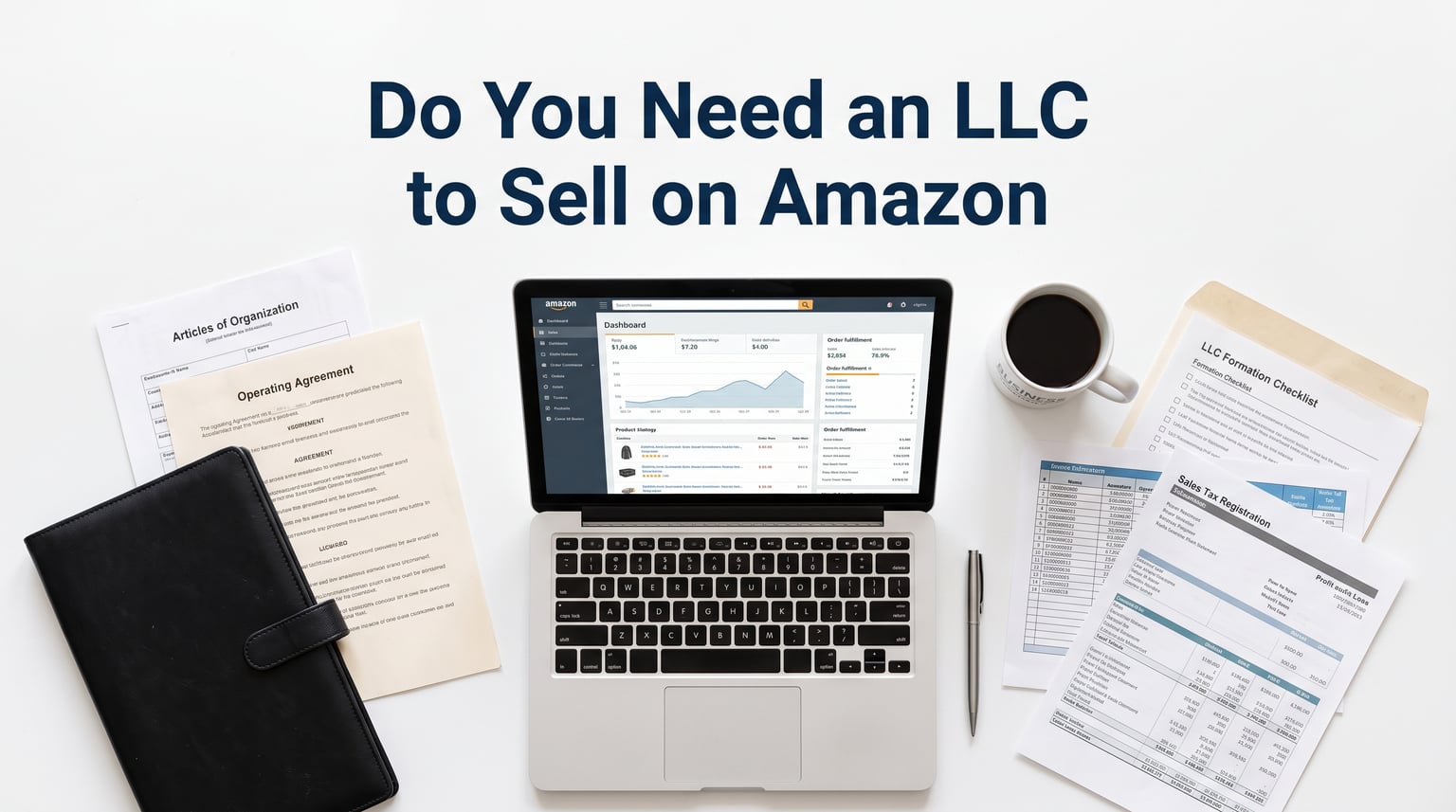
The short answer is no, you do not need an LLC to sell on Amazon. Amazon does not require any specific business structure to open a seller account, and you can register as an individual using your personal information. However, forming an LLC to sell on Amazon is strongly recommended once your store starts generating consistent revenue, because it shields your personal assets from product liability claims, simplifies tax filing, and makes your brand look more credible to suppliers and customers alike.
Every month, thousands of new sellers set up shop on Amazon Seller Central, and nearly all of them hit the same fork in the road: should I stay a sole proprietor or form a limited liability company? I have helped enough Amazon FBA sellers work through this exact decision to know that the right answer depends on what you sell, how much revenue you generate, and how much personal risk you are willing to accept. This guide walks through the real trade-offs so you can make an informed choice for your own store in 2026.
Whether you are doing retail arbitrage on weekends or building a private label brand with global suppliers, the business entity you choose touches everything from lawsuit exposure to self-employment tax. I will cover Amazon’s minimum requirements, break down how an LLC works, compare it head-to-head with a sole proprietorship, lay out a step-by-step formation process, and flag the exact revenue milestones that signal it is time to make the switch. By the end, you will have a clear, confident plan for your Amazon business.
Here is what this guide covers:
- Amazon’s Actual Requirements – What the platform really asks for at registration.
- LLC Fundamentals – How a limited liability company functions and why it differs from a sole proprietorship.
- LLC vs Sole Proprietorship – A side-by-side comparison for Amazon sellers.
- When to Form an LLC – Specific revenue milestones and product risk triggers.
- Formation Steps – A complete walkthrough from picking a state to opening a business bank account.
- Tax Implications – Pass-through taxation, S-Corp elections, and self-employment tax basics.
- Ongoing Compliance – Annual reports, sales tax permits, and keeping your liability shield intact.
Understanding Amazon Selling Basics
Before diving into business entities, it helps to understand exactly what Amazon requires from a new seller. The registration process through Amazon Seller Central is designed to be accessible to individuals and registered companies alike. You provide your legal name, a government-issued ID, a valid credit card, a phone number, and bank account details for deposits. Amazon also runs a tax interview during sign-up to collect your taxpayer information, whether that is a Social Security Number or an Employer Identification Number (EIN).
Amazon offers two selling plans. The Individual plan charges a per-item fee on each sale and works well for someone testing the waters with a handful of products. The Professional plan carries a monthly subscription fee but removes the per-item charge and unlocks advertising tools, bulk listing capabilities, and eligibility for programs like Fulfillment by Amazon (FBA). Neither plan requires you to be an LLC or any other type of registered business entity.
Once your account is active, you list products, set competitive prices, manage inventory, and fulfill orders. You can ship items yourself using a carrier of your choice, or you can send inventory to Amazon’s warehouses and let the platform handle storage, packing, and shipping through FBA. All of this is available to you whether you operate as a sole proprietor, an LLC, or another business structure entirely.
Does Amazon Require an LLC to Sell?
No, Amazon does not require sellers to form an LLC or any other type of registered business entity. Amazon’s own seller registration guide confirms that you can sell as an individual without being incorporated. The platform cares about identity verification, valid payment methods, and accurate tax information, not your legal business structure.
That said, selling without an LLC means you are operating as a sole proprietor by default. Your personal name goes on the seller account, your personal Social Security Number handles the tax interview, and there is no legal separation between your business finances and your personal assets. For someone selling a few used books, that is perfectly fine. For a seller scaling toward thousands of dollars in monthly revenue, it introduces real risk.
The decision to form an LLC to sell on Amazon is ultimately about risk management, not platform compliance. Amazon will never block your registration for lacking one, but the longer you sell, the more exposure you accumulate from product defects, customer disputes, intellectual property claims, and tax obligations.
Related Reading: Review on Amazon: Uncover Your Own Feedback!
Deep Dive into LLC
A Limited Liability Company, or LLC, is a business structure that blends elements of a partnership with the liability protection of a corporation. When you form an LLC, you create a separate legal entity that exists independently from you as an owner (called a “member”). This entity can own property, sign contracts, open bank accounts, and be sued in its own name.
The LLC has become the go-to structure for small business owners and e-commerce entrepreneurs because it is simpler to maintain than a corporation while still delivering the asset protection that a sole proprietorship lacks. In the context of Amazon selling, this means your LLC can hold your seller account, process customer payments, and absorb liability from a defective product claim without putting your personal savings, home, or vehicle at risk.

How Does an LLC Work?
An LLC works by drawing a legal boundary between the business and its owners. If a customer files a product liability lawsuit against your Amazon store, that lawsuit targets the LLC, not you personally. Your personal bank accounts, retirement savings, and other assets remain protected as long as the LLC is properly maintained and you have not personally guaranteed the specific debt in question.
To keep this liability shield intact, you need to treat the LLC as a genuine separate entity. That means using a dedicated business bank account, signing contracts in the name of the LLC rather than your personal name, and avoiding commingling of personal and business funds. Courts can “pierce the corporate veil” if it appears the LLC is just an alter ego for the owner, which would eliminate the liability protection.
For tax purposes, a single-member LLC is treated as a “disregarded entity” by default, meaning the IRS ignores the LLC and taxes all business income on your personal return via Schedule C. However, you can elect S-Corporation taxation once your profits are high enough to make the savings worthwhile. This flexibility is one of the biggest reasons Amazon sellers gravitate toward the LLC structure.
Why Choosing an LLC Over Sole Proprietorship Could Be Beneficial
A sole proprietorship is the default business structure when you start selling without filing any formation paperwork. There is no separation between you and the business, which means every dollar of business debt, every lawsuit, and every vendor dispute can reach your personal assets directly. For someone testing Amazon selling with low risk and low volume, that exposure may be acceptable.
The moment you start importing products, selling in high-risk categories like supplements or electronics, or generating enough revenue that a single lawsuit would be financially devastating, the sole proprietorship model breaks down. An LLC to sell on Amazon gives you the same pass-through tax treatment as a sole proprietorship while adding a critical layer of personal liability protection that the sole proprietorship simply cannot offer.
Beyond legal protection, an LLC also signals professionalism. Wholesale suppliers, branding partners, and lenders all prefer working with a registered business entity over an individual. When you can list an LLC name and EIN on applications, you gain access to wholesale accounts, business credit cards, and lines of credit that a sole proprietor may struggle to obtain.
Do You Need an LLC to Sell on Amazon?
You do not need an LLC to sell on Amazon. Amazon allows individuals to register and sell as sole proprietors without any formal business structure. However, most experienced sellers recommend forming an LLC to protect your personal assets from product liability claims, simplify tax filing, and improve credibility with suppliers and customers. The right time to make that decision depends on your revenue, product category, and growth plans.
This is the featured snippet answer to the question, and it aligns with what Amazon’s own registration guide, Helium 10, Bizee, and other authoritative sources all confirm. The platform does not gatekeep based on entity type. The real conversation is about whether remaining a sole proprietor exposes you to more risk than you can responsibly carry as your Amazon business scales.
Role of LLC in Protecting Your Amazon Business
The primary function of an LLC is asset protection. When a customer claims a product you sold caused injury or property damage, they can file a product liability lawsuit. Without an LLC, that lawsuit names you personally, meaning a judgment could be satisfied against your house, your savings, and your future earnings. The financial consequences can be devastating.
With an LLC in place, the lawsuit targets the business entity. Only the assets owned by the LLC are at risk, not your personal property. This is why sellers in high-risk categories like supplements, electronics, children’s products, cosmetics, and fitness equipment almost always form an LLC before launching. The cost of formation is trivial compared to the cost of a single liability claim.
An LLC also protects you in less dramatic scenarios. If a supplier ships defective inventory, a freight forwarder files a disputed charge, or a competitor files an intellectual property complaint, the LLC structure keeps these business disputes contained within the business rather than spilling into your personal financial life.
LLC vs Sole Proprietorship for Amazon Sellers
To make this decision concrete, here is a head-to-head comparison across the categories that matter most to Amazon sellers. Both structures allow pass-through taxation, but they diverge sharply on liability, credibility, and long-term scalability.
- Liability Protection: A sole proprietorship offers zero separation between personal and business assets. An LLC creates a legal barrier that keeps your home, savings, and personal property out of reach in a business lawsuit.
- Tax Treatment: Both structures default to pass-through taxation, meaning business income flows to your personal tax return. However, an LLC gives you the option to elect S-Corporation taxation, which can reduce self-employment tax once profits exceed roughly $60,000 to $80,000 annually.
- Formation Cost: A sole proprietorship costs nothing to start. An LLC requires a state filing fee that ranges from roughly $40 to $500 depending on the state, plus potential registered agent fees.
- Ongoing Compliance: Sole proprietors have minimal paperwork. LLCs may need to file annual reports, pay franchise taxes, and maintain a registered agent, though the administrative burden is still lighter than a corporation.
- Credibility and Access to Capital: Suppliers, wholesale distributors, banks, and Amazon Brand Registry all prefer or require a registered business entity. An LLC opens doors that a sole proprietorship keeps closed.
- Amazon Brand Registry: To enroll in Brand Registry and unlock enhanced listing tools and brand protection, you need an active registered trademark. An LLC name and EIN make it straightforward to file that trademark under your business.
When Should You Form an LLC for Amazon Selling?
Timing matters. Forming an LLC on day one is not always necessary, and waiting too long can expose you to unnecessary risk. The sweet spot is somewhere in between, and experienced sellers generally point to specific triggers that signal it is time to make the move.
Revenue Milestones
A common guideline is to form an LLC once your Amazon store generates consistent monthly profit in the $3,000 to $5,000 range, or once annual revenue crosses $50,000. At that level, the cost of LLC formation and maintenance is easily justified by the tax savings, asset protection, and professional benefits it delivers.
Below those thresholds, a sole proprietorship may be perfectly adequate while you validate your product and market. Just keep in mind that even a small store can face a large liability claim if a product causes injury, so the revenue guideline is about financial efficiency, not absolute safety.
High-Risk Product Categories
Some product categories carry inherent liability risk regardless of revenue volume. If you sell supplements, electronics, children’s toys, cosmetics, fitness equipment, or kitchen products, you should strongly consider forming an LLC before your first sale. A single product liability claim in these categories can easily exceed the cost of formation by a factor of a hundred or more.
Growth and Scaling Triggers
If you plan to add partners, hire employees, apply for business loans, pursue Amazon Brand Registry, or eventually sell your Amazon business, an LLC becomes essential. Investors and buyers want to acquire a clean, transferable business entity, not a personal sole proprietorship tangled with your individual tax filings.
Setting Up an LLC for Your Amazon Store
If you have decided that forming an LLC to sell on Amazon makes sense for your situation, the process is straightforward but requires attention to detail. Each step builds on the previous one, and skipping a step can create headaches when you try to open a bank account, apply for wholesale accounts, or file taxes.

Step 1: Choose Your State
The first decision is where to form your LLC. Most sellers form in their home state because it is the simplest and avoids the need to register as a “foreign LLC” in multiple states. However, some sellers choose states like Wyoming, Delaware, or Nevada for their business-friendly tax laws and low filing fees.
If you form in a state where you do not live, you may still need to register as a foreign LLC in your home state if you have a physical presence there, which can double your paperwork and costs. For most new Amazon sellers, forming in the home state is the pragmatic choice.
Step 2: Name Your LLC and Check Domain Availability
Your LLC name must be unique within your state and include a designator like “LLC” or “L.L.C.” Beyond legal compliance, this name becomes your brand identity, so choose something that aligns with your Amazon store and leaves room to grow. Once you have a name, check whether the matching web domain is available so you can build a consistent online presence.
Step 3: Appoint a Registered Agent
Every LLC needs a registered agent, which is a person or service designated to receive legal and tax documents on behalf of the business. You can serve as your own registered agent if you have a physical address in the state of formation, but many sellers hire a professional registered agent service for privacy and reliability.
Step 4: Create an Operating Agreement
An operating agreement is an internal document that defines ownership percentages, profit distribution, management roles, and what happens if a member leaves the business. Some states do not require one, but having one strengthens your liability protection by demonstrating that the LLC is a genuine, well-governed business entity rather than a personal alter ego.
Step 5: File Articles of Organization with the Secretary of State
This is the official formation step. You submit Articles of Organization (sometimes called a Certificate of Formation) to the Secretary of State in your chosen state, along with the required filing fee. Processing times vary from a few business days to several weeks depending on the state and whether you pay for expedited service.
Step 6: Obtain an EIN from the IRS
Once your LLC is approved, apply for an Employer Identification Number (EIN) from the IRS. This is a nine-digit number that functions like a Social Security Number for your business. The application is free and takes minutes through the IRS website. You will use this EIN to open a business bank account, file taxes, and update your Amazon Seller Central tax information.
Step 7: Open a Business Bank Account
This step is critical and often overlooked. Open a dedicated business checking account using your LLC name and EIN, then route all Amazon payouts and business expenses through it. Commingling personal and business funds is the fastest way to lose your liability protection, so keep the finances completely separate from day one.
Step 8: Secure Necessary Licenses and Permits
Depending on your state, product category, and business activities, you may need a general business license, a sales tax permit, or category-specific permits. Research the requirements in your state and locality to stay compliant. Amazon itself does not require most of these, but your state and local government do.
Once these eight steps are complete, you can update your Amazon Seller Central account to reflect your new business entity. Provide your LLC name, EIN, and updated banking details so that deposits, tax reporting, and account verification all align with your new structure.
Related Reading: Kindle Unlimited: Dive into Limitless Reading Pleasure!
Advantages of Having an LLC to Sell on Amazon
Once your LLC is in place, the benefits compound across legal, financial, and operational dimensions of your Amazon business. Here is a detailed look at what changes when you move from sole proprietorship to a registered business entity.
- Personal Asset Protection: This is the headline benefit. If a customer is injured by a product you sold or a supplier files a dispute, the LLC absorbs the liability. Your home, car, personal bank accounts, and retirement savings stay out of reach.
- Tax Flexibility and Savings: An LLC defaults to pass-through taxation but gives you the option to elect S-Corporation status. That election can significantly reduce self-employment tax once your profits are high enough to justify the added payroll administration.
- Cleaner Financial Organization: A dedicated business bank account and EIN make bookkeeping dramatically simpler. At tax time, your Schedule C or partnership return is clean and defensible because personal and business transactions never overlap.
- Enhanced Credibility: Suppliers, wholesale distributors, banks, and branding partners all prefer to work with a registered business. An LLC name on applications signals that you are a serious operator, not a hobbyist.
- Access to Business Credit and Loans: Once your LLC has a track record, you can apply for business credit cards, lines of credit, and small business loans. Lenders evaluate the LLC’s financials rather than relying solely on your personal credit.
- Amazon Brand Registry Eligibility: An LLC makes it straightforward to register and hold a trademark, which is the prerequisite for Amazon Brand Registry. Brand Registry unlocks A+ content, enhanced brand protection, and advanced advertising tools.
- Retirement Plan Options: LLC members can set up a SEP-IRA or Solo 401(k) with contribution limits far higher than a standard IRA, allowing you to shelter significant income from taxes while building long-term wealth.
- Future-Proofing and Exit Strategy: If you ever want to add a partner, bring on investors, or sell your Amazon business, an LLC makes the transaction clean. Buyers acquire the entity with its established history rather than restructuring from scratch.
Tax Implications of an LLC for Amazon Sellers
Taxes are where the LLC structure really earns its keep for Amazon sellers. By default, a single-member LLC is taxed as a “disregarded entity,” meaning all business income and expenses flow through to your personal tax return on Schedule C. This is identical to how a sole proprietorship is taxed, so forming an LLC does not increase your tax burden.
The advantage is flexibility. Once your LLC is profitable enough, you can elect S-Corporation taxation by filing Form 2553 with the IRS. Under S-Corp taxation, you pay yourself a reasonable salary subject to payroll taxes, and the remaining profit passes through as distributions that are not subject to self-employment tax. The threshold where this election starts to make financial sense is typically around $60,000 to $80,000 in annual net profit.
Sales tax is a separate consideration. Thanks to the marketplace facilitator rules in most U.S. states, Amazon is responsible for collecting and remitting sales tax on behalf of third-party sellers for transactions processed through the platform. However, if you sell through your own website, other marketplaces, or maintain inventory in a state, you may trigger economic nexus and need a sales tax permit in that state.
Always consult a licensed tax professional or CPA who understands e-commerce before making entity elections or handling multi-state tax questions. The rules change frequently, and the right strategy depends on your specific revenue, expenses, and growth trajectory.
Ongoing Compliance for Your Amazon LLC
Forming an LLC is not a one-time event. To keep your liability protection intact, you need to maintain the entity properly over time. The requirements vary by state, but most involve annual or biennial reporting and a nominal fee.
Annual Reports and Franchise Taxes
Many states require LLCs to file an annual report and pay a franchise tax or annual registration fee. These costs range from minimal amounts in states like Wyoming to several hundred dollars in states like California. Missing these filings can result in your LLC being administratively dissolved, which eliminates your liability protection.
Maintaining the Corporate Veil
To preserve your liability shield, keep personal and business finances completely separate. Use your business bank account for all Amazon-related income and expenses, sign contracts in the name of the LLC, and document major business decisions. If a court determines you have been treating the LLC as a personal piggy bank, it can pierce the corporate veil and hold you personally liable.
Business Licenses and Sales Tax Permits
Depending on your state and product category, you may need to maintain a general business license, a resale certificate, or category-specific permits. Review these requirements annually because states update their rules, and your growth into new product categories can trigger new obligations.
Other Business Entity Types to Consider
An LLC is the most popular choice for Amazon sellers, but it is not the only option. Depending on your revenue, growth plans, and tax strategy, you might also consider a corporation. Understanding the alternatives helps you make an informed decision rather than defaulting to the most common path.
S-Corporation
An S-Corporation is not a separate entity type but rather a tax election that an LLC or a C-Corporation can make. It allows profits to pass through to owners while potentially reducing self-employment tax. Many successful Amazon sellers start as an LLC and elect S-Corp taxation once their profits justify the added payroll administration.
C-Corporation
A C-Corporation is a separate taxable entity, meaning the business pays corporate income tax and shareholders pay tax on distributions. This double taxation makes C-Corps less attractive for small Amazon sellers, but they can make sense if you plan to raise outside investment or eventually go public.
Related Reading: Does Taco Bell Accept Apple Pay? Find Out Now!
Frequently Asked Questions About Forming an LLC for Amazon
Should I set up an LLC to sell on Amazon?
You are not legally required to set up an LLC to sell on Amazon, but it is strongly recommended once your store generates consistent revenue or you sell in high-risk product categories like supplements, electronics, or children’s products. An LLC protects your personal assets from business liabilities and offers tax flexibility that a sole proprietorship cannot match.
Can I sell on Amazon without an LLC?
Yes, you can sell on Amazon without an LLC. Amazon allows individuals to register as sole proprietors using their personal information and Social Security Number. However, operating without an LLC means your personal assets are exposed to business liabilities, so most experienced sellers recommend forming one as revenue grows.
What are the main benefits of having an LLC for selling on Amazon?
The main benefits include personal liability protection, pass-through taxation with the option to elect S-Corp status, cleaner financial organization through a dedicated business bank account, enhanced credibility with suppliers and lenders, eligibility for Amazon Brand Registry through trademark ownership, and a cleaner path to selling or transferring the business in the future.
Does having an LLC affect my taxes as an Amazon seller?
An LLC defaults to pass-through taxation, meaning business income flows to your personal tax return on Schedule C, which is the same as a sole proprietorship. The advantage is that an LLC can elect S-Corporation taxation, which can reduce self-employment tax once annual net profit exceeds roughly $60,000 to $80,000. Consult a tax professional before making this election.
How much does it cost to set up an LLC for selling on Amazon?
The cost to form an LLC ranges from approximately $40 to $500 depending on the state, plus potential registered agent fees of $50 to $300 per year. Some states also charge annual report fees or franchise taxes. Budget between $100 and $800 total for formation and first-year compliance.
Do I need an LLC to sell on Amazon FBA?
No, you do not need an LLC to use Fulfillment by Amazon (FBA). Amazon FBA is a fulfillment service available to any seller regardless of business structure. However, because FBA involves storing inventory in multiple states, an LLC is especially recommended to manage the increased legal and tax complexity that comes with scaling.
Can I switch my Amazon seller account from sole proprietor to LLC later?
Yes, you can update your existing Amazon Seller Central account to reflect a new LLC. You will need to provide your LLC name, EIN, updated bank account details, and complete a new tax interview. Amazon allows business entity changes, but make sure your address and banking information are consistent across all fields to avoid account verification delays.
Conclusion
You do not need an LLC to sell on Amazon, but the longer you sell and the more you grow, the stronger the case for forming one becomes. If you are just testing a few products with low risk and minimal revenue, a sole proprietorship may serve you fine for now. If you are selling in high-risk categories, scaling past $50,000 in annual revenue, or planning to build a brand you might eventually sell, an LLC to sell on Amazon is one of the smartest investments you can make in your business.
The liability protection alone justifies the cost for most serious sellers. Add in the tax flexibility, cleaner bookkeeping, supplier credibility, and path to Amazon Brand Registry, and the LLC becomes the foundation that supports every other piece of your growth strategy. The formation process takes a few hours and a modest filing fee, but the protection and professional benefits last for the lifetime of your business.
If you are ready to take the next step, start by choosing your state, picking a name, and working through the eight steps outlined above. If the paperwork feels overwhelming, formation services like ZenBusiness, LegalZoom, or Bizee can handle the filing for a reasonable fee. Whatever path you choose, make the decision deliberately based on your revenue, product risk, and long-term goals for your Amazon store in 2026 and beyond.
Leave a Reply