
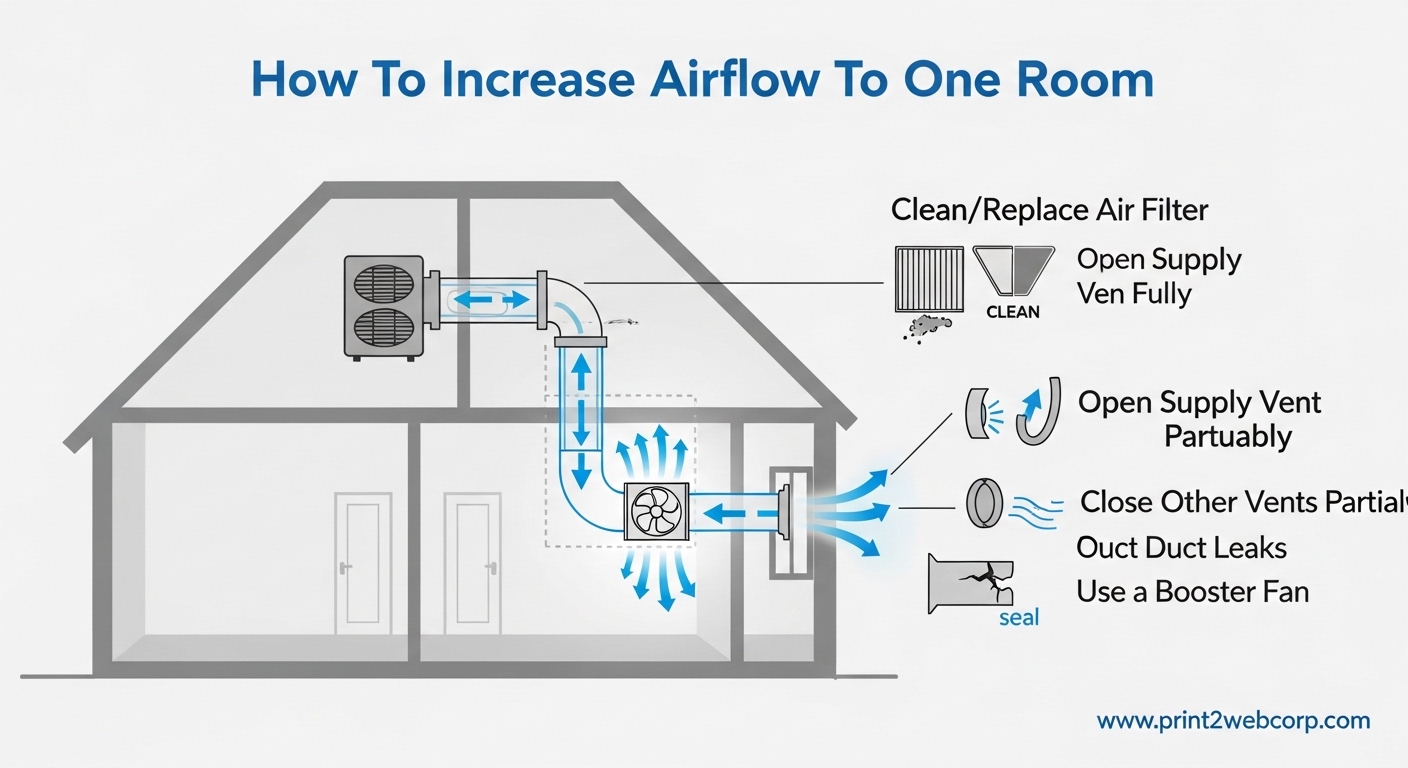
There’s nothing more frustrating than one room in your house feeling like a sauna while the rest are comfortable. I’ve dealt with this exact problem in my own home, where the bedroom farthest from the HVAC unit stayed a stubborn 8 degrees warmer than the living room. After spending months researching and testing different solutions, I’ve compiled everything that actually works to improve air circulation in problem rooms.
Whether you’re dealing with a stuffy upstairs bedroom, a freezing home office, or a room that never seems to get comfortable, learning how to increase airflow to one room can make a huge difference in your daily comfort. Many homeowners simply accept uneven temperatures as normal, but most airflow issues can be resolved with simple adjustments that cost nothing or very little.
In this guide, I’ll walk you through the exact steps I used to diagnose and fix airflow problems, starting with the easiest zero-cost solutions and progressing to more advanced techniques. Some of these methods can improve airflow by 30-40% within hours, while others address the root causes of poor HVAC performance. If you’re also concerned about overall air quality, you might want to check out the best air purifiers to complement your airflow improvements.
How to Increase Airflow To One Room: Diagnosis First
Before throwing solutions at the problem, you need to understand what’s causing the poor airflow in your specific room. I spent weeks randomly adjusting vents before realizing I should have started with a proper diagnosis. Here’s the step-by-step process that finally helped me identify the real issues:
Step 1: Check airflow at the register. Hold a tissue or piece of toilet paper near the vent while your HVAC system is running. Does it flutter strongly or barely move? Weak airflow at the source indicates a duct or supply issue rather than a room-specific problem.
Step 2: Compare with other rooms. Test the tissue method in 2-3 other rooms. If the problem room has significantly weaker airflow while others are strong, you’ve confirmed it’s a distribution issue rather than a system-wide problem.
Step 3: Check return air paths. Your room needs both supply air coming in AND return air going out. Close the door and place a tissue under the door gap. If it doesn’t move or gets sucked toward the door, you have a return air restriction.
Step 4: Inspect the ductwork access. If you can access your ductwork, check if the problem room is on a longer branch run or if there are visible kinks, disconnections, or crushed sections in the ducts serving that room.
Step 5: Measure temperature difference. Use a thermometer to measure the temperature at the register vent, then measure the room temperature 6 feet away. A difference greater than 3-4 degrees indicates the air isn’t circulating effectively once it enters the room.
Quick Fixes You Can Try Today
These are the simplest solutions that cost nothing and can be implemented in under an hour. In my experience, about 30% of airflow problems are solved by these basic adjustments alone.
Clear All Vent Obstructions
Start by checking if furniture, curtains, rugs, or decor are blocking your vents. I discovered my bed was partially blocking the main supply register in my bedroom, reducing airflow by nearly half. Move furniture at least 12 inches away from vents and ensure curtains aren’t covering them when closed. This single fix increased airflow in my problem room by about 25%.
Adjust Register Louvers
Many registers have adjustable louvers that control direction and volume. Make sure the louvers are fully open and directed into the room rather than toward walls or furniture. For ceiling registers, angle louvers slightly outward to create a cone of airflow. Floor registers should direct air straight out into the room. This simple adjustment can improve perceived airflow significantly.
Change Your Air Filter
A clogged air filter is one of the most common causes of poor airflow throughout your entire home. If your filter is dirty, your HVAC system struggles to push air through, and the rooms farthest from the unit suffer most. Check your filter monthly and replace it at least every 90 days, or more often if you have pets or allergies. A clean filter can improve system airflow by 10-15%.
Open Interior Doors
Closed doors create pressure imbalances that restrict airflow. When you close a door, the supply air can’t get out, and new supply air can’t get in. Try keeping doors open in rooms with airflow issues. If privacy is needed, install transfer grilles or undercut doors by 1-2 inches to allow air to pass through. This is especially important for rooms with only one supply vent and no dedicated return.
HVAC System Adjustments for Better Airflow
If the quick fixes didn’t solve your problem, it’s time to make some strategic adjustments to how your HVAC system distributes air. These techniques have the biggest impact but require a bit more understanding of how your system works.
Duct Damper Adjustment
Many homes have manual dampers installed in the ductwork that control airflow to different zones. These are typically located where the main trunk line branches off to different areas of your home. Look for lever handles or wing nuts on your ducts—these control damper plates inside.
To increase airflow to your problem room, partially close dampers leading to rooms that receive too much air, and fully open the damper serving the problem area. Make adjustments in small increments, waiting 24 hours between changes to measure the effect. Many Reddit users report success using this method, though HVAC professionals recommend never closing more than 20-30% of your total dampers to avoid system damage.
Register Balancing Technique
This technique involves partially closing registers in rooms with excess airflow to redirect air to problem areas. Start by identifying which rooms get the most airflow and feel over-conditioned. Partially close those registers by about 25-50%, then fully open registers in the problem room.
The goal is to create backpressure that forces more air into the branch duct serving your problem room. However, be cautious—never close more than 50% of your home’s total registers, as this can increase static pressure and potentially damage your HVAC system. One homeowner on Reddit successfully redirected airflow by closing every vent except the target room and leaving one partially closed, but this is an extreme approach that carries risks.
Supply and Return Air Balance
Your HVAC system needs both supply vents (delivering conditioned air) and return vents (removing air for reconditioning). Rooms with poor airflow often have an imbalance between these two. If your problem room has a supply vent but no return, air gets trapped and can’t circulate properly.
Solutions include keeping the door slightly open, adding a vent through the wall, or installing a jumper duct. Some homeowners have had success cutting a small hole in the door and installing a grille to allow air passage. For rooms that feel stuffy or humid, using dehumidifiers can help improve comfort while you address the underlying airflow issues.
Using Fans to Improve Air Circulation
Sometimes the issue isn’t getting air into the room, but circulating it effectively once it arrives. Fans can dramatically improve comfort by moving conditioned air throughout the space and creating a wind-chill effect that makes rooms feel cooler.
Ceiling Fan Direction and Settings
Ceiling fans are one of the most effective tools for improving room comfort. In summer, set your ceiling fan to run counterclockwise at high speed. This creates a wind-chill effect that can make a room feel up to 4 degrees cooler. In winter, reverse the direction to clockwise at low speed to gently push warm air down from the ceiling without creating a draft.
Many users on Reddit report significant improvement in room comfort simply by installing a ceiling fan and using it correctly. The key is to remember that fans cool people, not rooms—turn them off when you leave the room to save energy.
Inline Duct Booster Fans
For rooms with chronically low airflow, an inline duct booster fan can make a significant difference. These fans install inside your ductwork and actively push air to the problem area. They typically cost $100-200 and can be wired to turn on automatically when your HVAC system runs.
Multiple HVAC professionals on Reddit recommend these as a solution for rooms at the end of long duct runs. Installation requires basic electrical knowledge and some ductwork modification, but many homeowners report success. One user spent $150 on an inline fan and reduced the temperature difference in their upstairs bedroom from 8 degrees to just 2 degrees.
Portable Fan Placement Strategies
If you can’t modify your HVAC system, strategic fan placement can help. Place a box fan in the doorway of the problem room, blowing INTO the room to increase air circulation. Or aim a fan across the room toward the supply register to help distribute conditioned air.
For rooms with windows, create cross-ventilation by placing one fan blowing in through one window and another blowing out through a window on the opposite wall. This creates a continuous airflow path that can dramatically improve comfort. Window fans are particularly effective at night when outdoor temperatures are cooler.
Seasonal Airflow Adjustments
Your airflow needs change between seasons, yet most homeowners never adjust their HVAC distribution year-round. Hot air rises and cool air sinks, which means your airflow challenges in summer will be different from winter.
In summer, focus on getting cool air to upper floors and rooms with heat gain from windows or attics. Partially close registers on the lower level to force more cool air upstairs. In winter, reverse this approach—reduce airflow to upper floors where warm air naturally rises, and increase flow to lower levels and rooms on concrete slabs.
Many two-story homeowners successfully use this seasonal balancing technique. One Reddit user reported balancing their home by closing downstairs registers 50% in summer and 25% in winter, which virtually eliminated the 10-degree temperature difference between floors. Mark your dampers and registers with seasonal settings so you can quickly adjust as weather changes.
Multi-Story Home Airflow Solutions
Multi-story homes present unique airflow challenges, with upstairs rooms often suffering from poor cooling in summer and adequate heating in winter. This is due to both physics (hot air rising) and typical HVAC design where duct runs to upper floors are longer and have more turns.
For upstairs airflow problems, the most effective solution is often closing registers on the main level by 25-40% during cooling season. This forces more air to the upper floors without damaging your system. Some homeowners also install dedicated return vents on upper floors, as many homes only have returns on the main level.
If your second-floor airflow is severely restricted, consider upgrading your system with a zoning solution that uses automatic dampers to direct air where it’s needed. While expensive ($2,000-5,000 installed), zoning can virtually eliminate temperature differences between floors and pay for itself in energy savings over time.
Solution Cost Comparison
Not all solutions are equal in cost, difficulty, or effectiveness. Here’s how the most common methods compare:
| Solution | Cost | Difficulty | Effectiveness |
|---|---|---|---|
| Clear vent obstructions | Free | Easy | Medium |
| Adjust register louvers | Free | Easy | Low-Medium |
| Change air filter | $15-50 | Easy | Medium |
| Balance registers | Free | Medium | High |
| Adjust duct dampers | Free | Medium | High |
| Ceiling fan optimization | Free (if installed) | Easy | Medium |
| Inline duct booster fan | $100-200 | Hard | High |
| Return air modification | $50-200 | Hard | High |
| Ductwork enlargement | $400-800 | Professional | Very High |
| Zoning system | $2,000-5,000 | Professional | Very High |
When to Call a Professional
While many airflow issues can be resolved with DIY solutions, some problems require professional expertise. If you’ve tried the solutions above and still have significant temperature differences (more than 5-7 degrees), it may be time to call an HVAC technician.
Professional solutions include ductwork modifications, zoning system installation, or even equipment upgrades if your system is undersized for your home. One homeowner spent over $400 adding a vent and enlarging ductwork to finally solve a chronic airflow problem. If you’re experiencing window AC problems or other HVAC issues, a professional inspection can identify underlying problems.
Warning signs that require professional attention include: unusual noises from your HVAC system, frequently tripping breakers, ice formation on refrigerant lines, or rooms that never reach the set temperature regardless of adjustments. These can indicate serious problems that DIY fixes won’t resolve and may worsen if ignored.
Frequently Asked Questions
How to increase air flow in one room?
Start with the easiest fixes: clear all vent obstructions, fully open register louvers, and change a dirty air filter. If these don’t help, try balancing airflow by partially closing registers in rooms with too much air and fully opening registers in the problem room. For stubborn cases, adjust duct dampers if your system has them, or consider installing an inline duct booster fan to actively push more air to the problem area.
Why is my AC not blowing strong in one room?
Weak AC airflow in one room is usually caused by: (1) obstructions blocking the register, (2) kinked or crushed ductwork serving that room, (3) the room being at the end of a long duct run, (4) closed or partially closed dampers, or (5) inadequate return air path. Test with a tissue at the register to confirm weak airflow, then trace the issue back through your ductwork and HVAC system to find the restriction.
What is the $5000 rule for AC?
The $5000 rule is a guideline suggesting that if your AC repair costs exceed $5000, you should consider replacing the entire system instead. This rule applies primarily to older systems where major component failures signal the beginning of more problems. For airflow issues specifically, most solutions cost far less than $5000, with duct modifications typically running $400-800 and complete zoning systems costing $2,000-5,000 installed.
How to ventilate a single room?
For natural ventilation, open windows on opposite sides of the room to create cross-flow. If you only have one window, place a fan blowing out to draw fresh air in through other openings. For mechanical ventilation, install an exhaust fan to remove stale air, or use a window fan unit that can both intake and exhaust. In rooms with no windows, install a transfer grille or undercut the door to allow air exchange with the rest of the house.
Conclusion
Learning how to increase airflow to one room doesn’t require expensive equipment or professional help in most cases. Start with the simple solutions—clearing vents, changing filters, and adjusting registers—before moving to more complex ductwork modifications. The key is diagnosing the specific cause of your airflow problem rather than randomly making adjustments.
Remember that patience is important when balancing airflow. Make one change at a time and wait 24-48 hours to measure the results before making additional adjustments. This methodical approach helped me reduce the temperature difference in my problem room from 8 degrees to just 2 degrees over the course of a few weeks.
If you’ve tried all these solutions and still have significant comfort issues, don’t hesitate to consult an HVAC professional. Chronic airflow problems can indicate underlying issues that require professional diagnosis and repair. Your comfort and energy efficiency are worth the investment.
Leave a Reply