
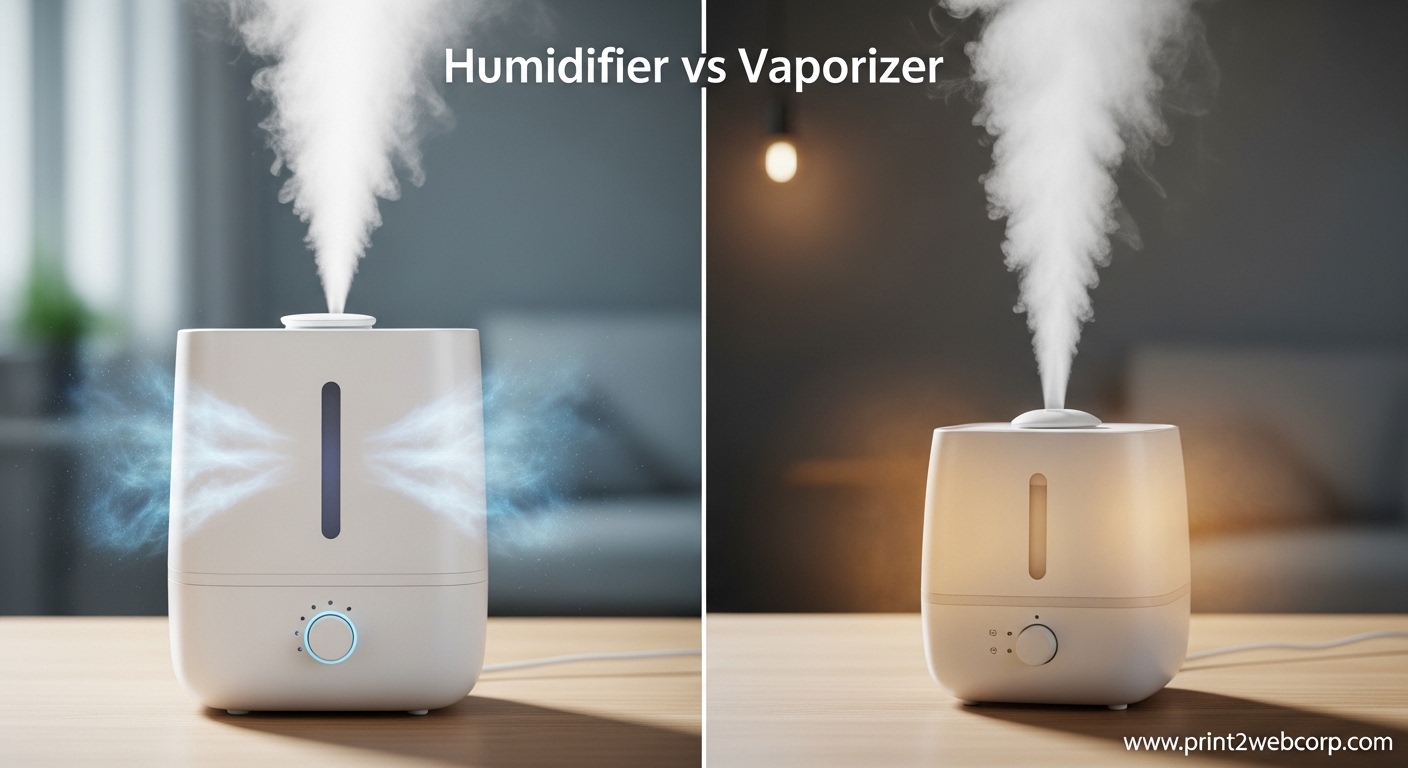
When dry air strikes your home, you’re faced with a common dilemma: humidifier vs vaporizer, which one should you choose? Both devices add moisture to indoor air, but they work in fundamentally different ways that can affect your health, safety, and comfort. The main difference comes down to temperature—humidifiers create cool mist using ultrasonic vibrations or fans, while vaporizers boil water to produce hot steam.
This distinction matters more than you might think. The American Academy of Pediatrics recommends cool-mist humidifiers for children due to burn risks from steam vaporizers. However, vaporizers have their advantages too, including faster humidity increases and the ability to use medicated inhalants. Understanding these differences helps you make the right choice for your specific situation, whether you’re battling congestion, soothing a baby with croup, or managing allergies year-round.
In this comprehensive guide, I’ll break down exactly how each device works, compare their pros and cons, and help you decide which one deserves a spot in your home based on your needs, safety concerns, and maintenance preferences.
What is a Humidifier?
A humidifier is a device designed to increase moisture levels in indoor air by dispersing water droplets or vapor without using heat. These machines are specifically engineered to add humidity to your living space while keeping the output cool to the touch, making them popular for year-round use in bedrooms, nurseries, and living areas.
Humidifiers work through several different technologies, with the most common being ultrasonic, evaporative, and impeller systems. Ultrasonic humidifiers use high-frequency vibrations to break water into tiny micro-fine mist particles that are then released into the air silently. Evaporative models rely on a fan to blow air through a wet wick or filter, allowing natural evaporation to add moisture. Impeller humidifiers use a rotating disc to fling water at a diffuser, breaking it into cool droplets that enter your room’s air.
The cool mist output makes humidifiers versatile and safe for use around children and pets. You’ll find them particularly helpful during dry winter months when heating systems strip moisture from indoor air, causing dry skin, irritated sinuses, and static electricity. Many modern humidifiers also come with built-in hygrometers to monitor humidity levels, automatic shut-off features when water runs low, and adjustable mist settings to customize output based on room size and current humidity.
Most humidifiers require regular maintenance to prevent mold and bacteria growth in the water tank or on wet components. This typically means emptying and drying the tank daily, with more thorough cleaning every few days using white vinegar or hydrogen peroxide to remove mineral buildup and biological contaminants.
What is a Vaporizer?
A vaporizer is a moisture-adding device that heats water until it boils and releases pure steam into your room’s air. Unlike cool-mist humidifiers, vaporizers rely on a heating element to bring water to its boiling point, creating hot steam that humidifies and slightly warms your space simultaneously. The steam emerges from the unit and mixes with room air, raising humidity levels quickly and effectively.
The heating mechanism is what sets vaporizers apart. Inside the unit, an electrical heating element submerged in the water tank brings the water to a rolling boil. As the water vaporizes, it exits through a steam outlet or vent, releasing warm moisture into your room. Because the water reaches boiling temperatures, this process effectively kills bacteria and other microorganisms that might be present in the water, resulting in steam that’s essentially sterile when released.
Vaporizers have been popular for decades, especially during cold and flu season, because they can be used with medicated inhalants like Vicks VapoSteam or similar products. These additives release soothing vapors when heated, which can help ease congestion, coughing, and respiratory discomfort. Many parents and caregivers swear by vaporizers for croup in children, as the warm steam can help relax airways and reduce the characteristic barking cough.
The heating process does have drawbacks. Vaporizers consume more electricity than cool-mist humidifiers because they’re essentially running a small kettle continuously. The hot steam also presents a burn risk, especially for curious children or pets who might knock over the unit or touch the steam outlet. Additionally, the boiling water can leave mineral deposits on the heating element over time, requiring periodic cleaning with vinegar or descaling solutions to maintain efficiency.
Humidifier vs Vaporizer: Key Differences at a Glance
To help you quickly compare these devices, here’s a breakdown of the main differences between humidifiers and vaporizers across the factors that matter most for your decision.
| Feature | Humidifier | Vaporizer |
|---|---|---|
| Output Temperature | Cool mist (room temperature) | Hot steam (heated) |
| Working Mechanism | Ultrasonic vibrations, fan, or rotating disc | Heating element boils water |
| Child Safety | Safer (no burn risk) | Burn hazard from hot steam and water |
| Electricity Use | Lower (no heating element) | Higher (continuous boiling) |
| Noise Level | Silent (ultrasonic) to moderate (fan models) | Generally quiet (bubbling sounds only) |
| Medicated Inhalants | Usually not compatible | Compatible with Vicks and similar products |
| Bacteria in Output | Possible if not cleaned regularly | Killed by boiling process |
| Humidity Speed | Gradual increase | Faster humidity boost |
| Room Warming | None | Slight warming effect |
| Mineral Deposits | White dust from ultrasonic models | Buildup on heating element |
| Best Climate | Year-round use | Cold weather or illness |
| Initial Cost | $20-$150 depending on type | $15-$60 typically |
Humidifier vs Vaporizer: Which is Better for Cold and Flu?
When illness strikes your household, choosing between a humidifier and vaporizer can affect how comfortable you feel during recovery. Both devices help ease cold and flu symptoms by adding moisture to dry indoor air, which keeps nasal passages and throat tissues hydrated. However, they work differently and offer distinct advantages depending on your specific symptoms.
For congestion relief, many users find vaporizers have the edge. The warm steam helps loosen mucus and can provide soothing relief for stuffed sinuses and chest congestion. The heat from the steam also creates a comforting environment that can ease the body aches that often accompany viral illnesses. If you’re dealing with a nagging cough, the warm moisture can calm irritated airways and reduce coughing frequency, especially at night when symptoms often worsen due to dry air from heating systems.
Vaporizers also offer the unique advantage of compatibility with medicated inhalants like Vicks VapoSteam or similar products. When added to the water, these releases menthol and eucalyptus vapors that can provide additional congestion relief and make breathing easier. Many parents specifically choose vaporizers when their children have croup, as the warm steam combined with medicated additives can significantly reduce the severity of coughing episodes.
However, humidifiers shouldn’t be discounted for illness recovery. Cool-mist humidifiers are often recommended by doctors because they’re safer, especially for children who might accidentally touch a hot vaporizer. The cool moisture can still effectively hydrate dry nasal passages and soothe sore throats. Ultrasonic humidifiers run silently, which is a significant benefit when you’re trying to rest while sick. If you’re running a fever, you might prefer the cool mist over the additional warmth from a steam vaporizer.
For sore throat specifically, both devices can help by keeping throat tissues moist and reducing irritation. The choice often comes down to personal preference—some people find warm steam more soothing, while others prefer cool mist when their throat feels inflamed. If you’re congested but also feverish, a humidifier might be more comfortable. If congestion is your primary symptom without fever, the warm steam from a vaporizer could provide more relief.
Real user experiences from parent forums consistently show that vaporizers are the go-to choice during active illness, especially for respiratory issues like bronchitis, croup, and severe congestion. However, for general maintenance during cold season or when recovering from mild illnesses, humidifiers offer a safer and more energy-efficient option.
Humidifier vs Vaporizer: Which is Better for Allergies and Asthma?
The relationship between humidity and respiratory conditions like allergies and asthma is complex. Both devices can help or hinder depending on how you use them. The key factor is maintaining optimal humidity levels—ideally between 30% and 50%. Below this range, air is too dry and irritates respiratory passages. Above 50%, you create an environment where dust mites, mold, and other allergens thrive.
For allergy sufferers, humidifiers often get the nod for several reasons. First, they don’t heat the air, which means they don’t create the warm, damp conditions that dust mites love. Cool-mist operation also prevents the growth of mold and bacteria in the unit itself—provided you clean it regularly. Many people with allergies prefer ultrasonic humidifiers because they’re silent and don’t have filters that can trap allergens if not changed frequently. However, if you use tap water in an ultrasonic humidifier, you might notice white dust settling on surfaces, which is actually mineral content from the water that can irritate allergies.
Vaporizers have a mixed reputation for allergies. On one hand, boiling water kills bacteria and mold spores that might be present in tap water, so the steam released is essentially sterile. This can be beneficial if you’re sensitive to microbial allergens. On the other hand, the warm, moist environment created by steam vaporizers can encourage dust mite populations in your bedding, carpets, and upholstery. If you struggle with dust mite allergies, you might need to be more vigilant about controlling overall humidity when using a vaporizer.
For asthma management, both devices can be helpful during dry weather or winter months when heating systems make indoor air parched. Dry air can trigger asthma symptoms by irritating airways, so adding moisture often provides relief. However, the American Academy of Allergy, Asthma & Immunology warns that too much humidity can worsen asthma by creating conditions for mold growth and dust mites. The key is monitoring your humidity with a hygrometer and keeping it in that 30-50% sweet spot regardless of which device you choose.
Some asthma sufferers prefer vaporizers when they have respiratory infections because the warm steam can help loosen mucus and ease breathing. Others find that the heat actually triggers bronchospasms and do better with cool mist. If you have asthma, pay attention to how your body responds to different temperature humidity—personal experience is your best guide.
Regardless of which device you choose for allergies or asthma, cleaning becomes even more critical. Both humidifiers and vaporizers can become breeding grounds for mold and bacteria if neglected, and these contaminants will be dispersed into your air where they can trigger respiratory symptoms. Empty tanks daily, clean units thoroughly every three days with white vinegar or hydrogen peroxide, and dry all components completely before storage.
Safety Considerations: Children, Pets, and Placement
When it comes to safety, humidifiers have a clear advantage over vaporizers—especially in homes with children and pets. This is why the American Academy of Pediatrics explicitly recommends cool-mist humidifiers for use in children’s rooms rather than warm steam vaporizers. The reasoning is straightforward: hot steam and boiling water pose serious burn risks that don’t exist with cool-mist devices.
Consider a typical scenario: a curious toddler pulls themselves up by grabbing a vaporizer’s cord, tipping over the unit. The hot water inside can cause severe burns, and the steam outlet remains hot enough to injure even after the unit is unplugged. Even without tipping over, a child might touch the steam vent out of curiosity, resulting in burns to sensitive skin. Pets face similar risks—a cat might knock a vaporizer off a nightstand, or a dog could investigate the steam output too closely.
Cool-mist humidifiers eliminate these burn hazards entirely. The water in the tank remains at room temperature, and the mist output is cool to the touch. If a child knocks over an ultrasonic or evaporative humidifier, the worst consequence is typically just water on the floor rather than a burn injury. This safety advantage is why pediatricians consistently recommend humidifiers for babies and young children, especially in nurseries where infants spend unsupervised time sleeping.
Beyond burn risks, both devices come with other safety considerations worth noting. All humidifying devices can encourage mold and bacteria growth if not cleaned properly, and these microorganisms become airborne when the unit runs. This is why daily emptying and regular cleaning are non-negotiable, especially in homes with family members who have compromised immune systems or respiratory conditions.
Placement matters for both safety and effectiveness. Position either device at least four feet away from beds and furniture to prevent moisture from accumulating on surfaces, which can damage wood finishes and create conditions for mold growth. Keep units on flat, stable surfaces where they’re unlikely to be tipped over. Avoid placing them on the floor where they can be easily knocked over by children or pets. Never place either device near curtains, bedding, or other flammable materials, and always keep them away from electronics that could be damaged by moisture.
If you have indoor plants, you might notice they respond differently to each device type. Tropical plants often appreciate the extra moisture from either device, but the warm steam from vaporizers can create localized humidity that might affect plants differently than cool mist. Some plant enthusiasts prefer cool-mist humidifiers to avoid accidentally creating microclimates that are too warm and damp for certain plant species.
For homes with hard water, both devices will show mineral buildup over time, but this manifests differently. Vaporizers develop scale on the heating element that can affect efficiency and requires periodic descaling. Ultrasonic humidifiers disperse minerals into the air as white dust that settles on surfaces and can be inhaled. Using distilled water in either device eliminates mineral issues but adds ongoing cost.
Cleaning and Maintenance Guide
Proper maintenance is the most overlooked aspect of owning either a humidifier or vaporizer, yet it’s absolutely critical for preventing the dispersal of mold, bacteria, and mineral contaminants into your air. Both devices can become serious health hazards if neglected, but with regular care, they can provide years of safe, effective humidity control.
Daily maintenance should become part of your routine, especially during months of heavy use. Every day, empty any remaining water from the tank and allow it to air dry completely. Stagnant water is a breeding ground for microorganisms, and even a few hours can allow bacterial colonies to establish themselves. If you’re using a vaporizer, pay special attention to the heating chamber where water accumulates—this area must be emptied daily to prevent mineral deposits that can reduce efficiency and harbor bacteria.
Every three days, perform a more thorough cleaning. For humidifiers, disassemble all removable parts and wash them with hot water and mild dish soap. Use a soft brush to scrub away any slime or mineral deposits, paying special attention to corners, crevices, and the base of the water tank. For stubborn mineral buildup, soak components in white vinegar for 15-20 minutes before scrubbing. Rinse thoroughly and allow everything to air dry completely before reassembling.
Vaporizers require slightly different cleaning due to the heating element. After daily emptying, weekly descaling is typically sufficient. Fill the tank with equal parts white vinegar and water, then run the unit until about half the liquid has evaporated. The vinegar will dissolve mineral deposits on the heating element and interior surfaces. Let it sit for another 15 minutes to penetrate stubborn scale, then empty and rinse thoroughly. If you notice vinegar odor lingering, run a cycle with plain water to flush the system.
For both devices, disinfect weekly during periods of heavy use or daily if anyone in your household is sick. After cleaning with soap and water, wipe all surfaces with a solution of one teaspoon of bleach per gallon of water, or use hydrogen peroxide as a safer alternative. Rinse thoroughly to remove any disinfectant residue before using the device again. Never mix bleach with vinegar—this creates dangerous chlorine gas.
Filter maintenance applies specifically to evaporative humidifiers and some vaporizer models. Replace filters according to the manufacturer’s schedule, typically every 1-3 months depending on water hardness and usage. A dirty filter not only reduces efficiency but can also trap and then redistribute contaminants into your air. Some filters are washable and reusable—follow the manufacturer’s instructions for cleaning and drying filter elements.
Storage matters too. When you stop using your humidifier or vaporizer for the season, clean it thoroughly as described above, then allow all components to dry completely for at least 24 hours. Store in a cool, dry place with the tank cap removed to prevent moisture from being trapped inside. Before using again after storage, repeat the full cleaning process to remove any dust or contaminants that accumulated during storage.
Hard water accelerates maintenance needs for both device types. If you notice excessive mineral deposits, white dust from humidifiers, or frequent scaling in vaporizers, consider switching to distilled water. While this adds ongoing expense, it dramatically reduces cleaning frequency and prevents mineral contaminants from being dispersed into your air. Many users find the trade-off worthwhile, especially for units used in bedrooms or nurseries where air quality is paramount.
Cost and Energy Consumption Comparison
Price differences between humidifiers and vaporizers extend beyond the initial purchase price to include ongoing operating costs like electricity, replacement filters, and water treatment products. Understanding these long-term costs helps you make an informed decision that fits your budget and usage patterns.
Initial purchase price generally favors vaporizers, which typically cost $15-60 for basic models. Humidifiers show more price variation depending on technology—ultrasonic models range from $20-150, while evaporative units with fans typically cost $30-100. The price difference reflects complexity: vaporizers are essentially simple boiling chambers with heating elements, while humidifiers incorporate more sophisticated technology like ultrasonic discs, fans, filters, or impeller mechanisms.
Electricity consumption tells a different story. Vaporizers continuously heat water to boiling, which requires significant energy. Most vaporizers draw 300-500 watts while running, comparable to running a few incandescent light bulbs. Over a month of nightly use, this can add $10-20 to your electric bill depending on local rates. Humidifiers use considerably less power—ultrasonic models typically draw only 25-40 watts, while evaporative units with fans use around 50-100 watts. Over the same month of use, a humidifier might add only $2-5 to your electricity costs.
The energy advantage clearly goes to humidifiers, especially ultrasonic models that are essentially silent and sip electricity. If you plan to run your device for many hours each day or throughout entire seasons, these electricity differences add up. A vaporizer used nightly for six months might cost $60-120 in electricity alone, while an ultrasonic humidifier used the same amount might cost only $12-30.
Filter costs apply to some humidifier models but not vaporizers. Evaporative humidifiers require regular filter replacements every 1-3 months, with filters costing $10-25 each. Over a year, this adds $40-150 to your operating costs depending on how hard your water is and how frequently you replace filters. Ultrasonic humidifiers and vaporizers don’t use filters, eliminating this ongoing expense entirely.
Water quality affects costs differently for each device. Vaporizers tolerate tap water well because minerals remain in the tank as scale rather than being dispersed into the air. However, hard water accelerates scaling and requires more frequent descaling, which means using more vinegar or commercial descaling solutions. Humidifiers—especially ultrasonic models—disperse minerals into the air as white dust if you use tap water. This white dust can damage furniture and electronics while potentially irritating lungs. Many humidifier users find they must use distilled water, which costs approximately $1 per gallon. At typical usage rates of 1-3 gallons per day, this adds $30-90 monthly to operating costs.
Lifespan also factors into long-term value. Vaporizers have simpler construction with fewer moving parts, often lasting 5-10 years with proper maintenance. The main failure point is the heating element, which can burn out after several years but is sometimes replaceable. Humidifiers have more components that can fail—ultrasonic discs degrade, fan motors wear out, and electronic controls malfunction. Typical humidifier lifespan is 3-7 years, with evaporative models often on the lower end due to fan motor wear and filter-related issues.
When calculating total cost of ownership, consider your specific usage patterns. If you only need occasional moisture relief during colds or especially dry winter weeks, a vaporizer’s lower purchase price might make sense despite higher operating costs. If you plan to run a device continuously for months at a time, a humidifier’s higher upfront price might be offset by lower electricity consumption over its lifespan, especially if you choose an ultrasonic model without ongoing filter costs.
Frequently Asked Questions
Do you use a vaporizer or humidifier for congestion?
Both devices can help relieve congestion, but vaporizers often have the edge due to warm steam that loosens mucus effectively. The heat from steam vaporizers can relax airways and make breathing easier when you’re stuffed up. However, if congestion is accompanied by fever, you might prefer the cool mist from a humidifier. For children, doctors recommend cool-mist humidifiers due to safety concerns about hot steam.
Is a humidifier good for bronchitis?
Yes, humidifiers can help manage bronchitis symptoms by adding moisture to dry air that irritates bronchial tubes. The extra humidity keeps mucus thinner and easier to cough up, while soothing inflamed airways. Most respiratory specialists recommend cool-mist humidifiers for bronchitis because they’re safer and effective without the burn risk of steam vaporizers. Maintain indoor humidity between 30-50% for optimal relief—higher humidity can encourage mold growth that might worsen respiratory symptoms.
What kind of humidifier is best for RSV?
For RSV (Respiratory Syncytial Virus) in infants and children, pediatricians consistently recommend cool-mist humidifiers rather than warm steam vaporizers. The cool moisture helps ease breathing without any burn risk to your child. Position the humidifier near the crib but safely out of reach, and aim the mist so it doesn’t blow directly on the baby’s face. Combined with other treatments like nasal saline drops and bulb suctioning, a cool-mist humidifier can make breathing more comfortable for babies struggling with RSV symptoms.
Does a humidifier help with a sore throat?
Yes, humidifiers help soothe sore throats by keeping throat tissues moist and reducing irritation caused by dry air. The added moisture prevents the throat from becoming parched, especially during sleep when mouth breathing dries tissues further. Cool-mist humidifiers are generally preferred for sore throats because they’re safer and often more comfortable on inflamed tissues. For maximum relief, combine humidifier use with warm saltwater gargles and staying hydrated. If your sore throat persists beyond a week or is accompanied by high fever, consult a healthcare provider.
Can I use Vicks in a humidifier?
Only vaporizers are designed to work with medicated inhalants like Vicks VapoSteam. Adding Vicks or similar products to a cool-mist humidifier can damage the unit and clog components—most manufacturers explicitly warn against it. If you want the benefits of medicated vapors, choose a vaporizer specifically designed for use with inhalants. Alternatively, you can use a Vicks plug-in diffuser alongside a regular humidifier to get both cool moisture and mentholated vapors without damaging your humidifier.
Conclusion
When deciding between a humidifier vs vaporizer, the choice ultimately comes down to your specific needs, household composition, and priorities. For families with young children or pets, the safety advantages of cool-mist humidifiers make them the clear winner—no burn risks, lower electricity costs, and year-round versatility. The American Academy of Pediatrics recommends cool-mist humidifiers for children, and that guidance from medical experts carries significant weight.
If you’re primarily looking for relief during cold and flu season, especially for congestion and coughing, vaporizers offer advantages that many users find worthwhile. The warm steam provides comforting relief, works faster to increase humidity, and can be used with medicated inhalants for enhanced symptom relief. Many adults specifically choose vaporizers for their own rooms while using cool-mist humidifiers in children’s spaces—a compromise that gives them the benefits of both technologies.
For year-round humidity control, especially in dry climates or during winter months when heating systems parch indoor air, humidifiers are generally the better investment. Their lower operating costs, safer operation, and versatility make them suitable for continuous use in bedrooms, living areas, and home offices. Ultrasonic models in particular offer near-silent operation that won’t disturb sleep, while evaporative units provide self-regulating humidity that automatically adjusts output based on current conditions.
Your decision should also factor in maintenance preferences. If you’re diligent about regular cleaning and don’t mind descaling heating elements, vaporizers offer reliable performance with fewer moving parts to fail. If you prefer simpler maintenance without worrying about mineral buildup on heating elements, or if you want to avoid the ongoing cost of distilled water, a cool-mist humidifier might be more practical for your lifestyle.
Whichever device you choose, remember that both humidifiers and vaporizers require commitment to proper maintenance. Daily emptying, regular cleaning, and attention to humidity levels are essential for safe operation. Consider purchasing a hygrometer to monitor indoor humidity regardless of which device you select—keeping levels between 30% and 50% maximizes benefits while minimizing risks from mold, dust mites, and other humidity-related problems.
The humidifier vs vaporizer debate doesn’t have a single winner for everyone. By understanding the key differences in how they work, their safety profiles, operating costs, and maintenance requirements, you can choose the device that best fits your household’s needs. Many families ultimately find that owning both types—a vaporizer for illness relief and a humidifier for everyday use—gives them the flexibility to address whatever situations arise throughout the year.
Leave a Reply