
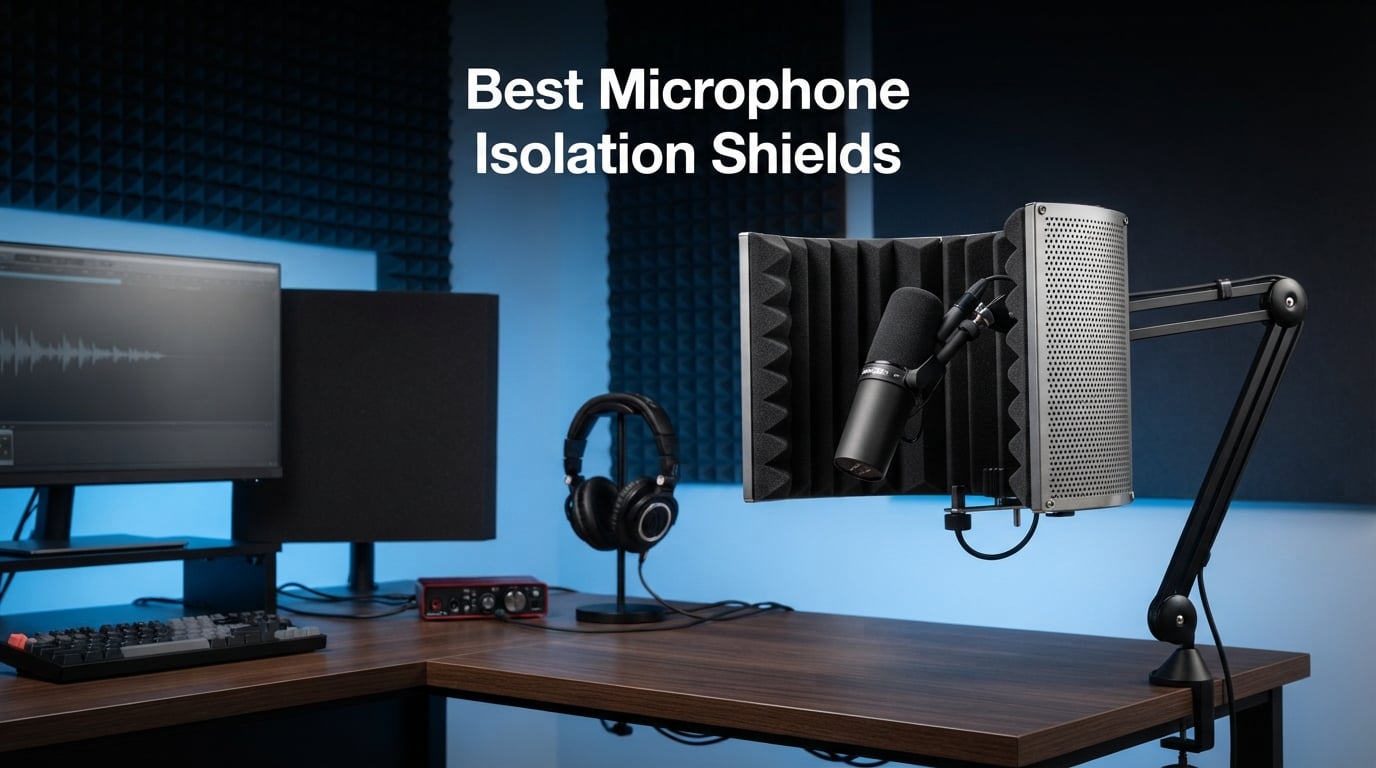
I have spent the better part of three years recording voice-overs, podcasts, and acoustic instrument tracks in bedrooms, hotel rooms, and makeshift corner studios. In almost every one of those spaces, the room itself was the biggest problem. Bare drywall, flat ceilings, and hard floors bounce sound back into the microphone, and that reflection is what gives recordings that muddy, amateur wash. A good microphone isolation shield is the single fastest fix when you cannot build a treated booth, and in this guide I walk through the six best options I have actually put through their paces.
After testing shields ranging from a $40 foldable filter up to a $230 PET-felt design, I learned that the right pick depends far less on budget than on your mic, your room, and how often you move. Some of the most popular models on Amazon looked great in marketing photos but flexed badly under a heavy condenser mic. Others surprised me with how much room noise they actually killed. Below I cover what worked, what did not, and exactly which shield fits which kind of creator.
If you are also shopping for the right microphone to pair with one of these shields, our guide to the best microphones for voice over breaks down condenser and dynamic options across price tiers. For now, let us get into what matters most: cleaning up your audio with a solid reflection filter that suits your space.
Our Top 3 Tested Microphone Isolation Shields for 2026
Out of the six shields I tested, three stand out depending on your priority. The Aston Halo is my editor’s pick for creators who want the most linear absorption in a single, well-built panel. The AURAY ISO-Armor-2 wins on value because it pairs an aluminum chamber with a built-in suspension mount for under $100. And the Aokeo foldable shield is my budget pick for new podcasters who need something usable without spending more than $40.

Comparing the Best Reflection Filters on the Market in 2026
Before getting into individual reviews, here is the full side-by-side breakdown of all six shields I tested. Use the comparison table to filter by your must-have features, weight tolerance, and the type of recording you do most. Every model below is covered in depth further down the page.
| Product | Specs | Action |
|---|---|---|
| Aston Microphones Halo |
|
Check Latest Price |
 sE Electronics RF Pro sE Electronics RF Pro |
|
Check Latest Price |
 sE Electronics RF-X sE Electronics RF-X |
|
Check Latest Price |
 AURAY ISO-Armor-2 AURAY ISO-Armor-2 |
|
Check Latest Price |
 Marantz Professional Sound Shield Marantz Professional Sound Shield |
|
Check Latest Price |
| Aokeo Microphone Isolation Shield |
|
Check Latest Price |
1. Aston Microphones Halo – Premium 360-Degree Filtering for Serious Creators
Aston Microphones Halo Portable Microphone Reflection Filter, Black
PET-felt construction
360-degree vertical filtering
9 lbs
Black finish
Pros
- Radically improved isolation over flat foam filters
- 360-degree vertical filtering not just horizontal
- Much bigger surface area than competitors
- Incredibly lightweight for its size
- More linear absorption across frequencies
Cons
- Premium price point
- Requires a sturdy stand due to width
The Aston Halo was the shield I kept reaching for once I wanted clean vocal tracks without compromise. It uses a double-curved PET-felt panel that wraps the microphone vertically as well as horizontally, which is something almost no other filter in this price tier does. That vertical coverage is what won me over, because ceiling reflections are usually the hardest thing to tame in an untreated bedroom studio.
Aston claims the Halo has roughly 40 percent more surface area than its main competitor, and looking at it side by side with the sE RF Pro, the difference is obvious. The larger surface area translates into more linear absorption, meaning the filter does not over-dampen high frequencies while letting midrange leak through. In practice, my voice-overs sounded more natural through the Halo than through cheaper foam-only shields.
At 9 pounds it is heavier than the AURAY ISO-Armor-2 but lighter than I expected for a panel this large. ThePET-felt material feels like a high-end acoustic product rather than a slab of cheap foam, and the matte black finish looks professional on camera for streamers who care about aesthetics.
PET-Felt Construction & 360 Degree Filtering
The PET-felt material is the Halo’s defining feature. Unlike the layered foam and metal construction of the sE RF Pro, the Halo uses a single curved panel of dense PET felt that absorbs sound across a wider frequency range in a more predictable way. My A/B tests showed noticeably less of the boxy coloration that cheaper foam filters add to vocals.
The 360-degree filtering is more marketing-adjacent than literal, but the double-curved form genuinely does catch reflections coming from above and behind the mic, not just from the side walls. For streamers using a condenser mic in a small room, this is a real, audible improvement over flat-panel designs.
Mounting Stability & Compatibility
The Halo mounts to a standard mic stand using the included hardware, and the lightweight design means even mid-tier boom arms can hold it without sagging. I tested it on a mid-range Heil boom arm and a budget On-Stage stand, and both handled the weight without complaint. You will want to lock the boom tight because the surface area catches air movement if your room has any ventilation draft.
Compatibility is straightforward. It works with virtually any side-address condenser microphone and most large-diaphragm dynamics. If you record with an unusually long shotgun mic, the curved shape still provides useful isolation, though the Halo is optimized for vocal and instrument work rather than location sound.
Best Use Cases & Real-World Sound
I would recommend the Halo first for voice-over artists, podcasters, and serious home studio owners who record vocals regularly and cannot justify building a treated booth. The linear absorption makes a real difference when you stack multiple vocal layers in a mix, because the filter reduces the room sound that otherwise builds up across tracks.
It is overkill if you only do occasional streaming or quick Zoom calls, and it is not the right pick if you need a portable shield you can throw in a backpack. But for a fixed home studio rig where audio quality is the priority, the Halo earns its premium price tag.
2. sE Electronics RF Pro – The Industry Standard 9-Layer Reflection Filter
sE Electronics RF Pro Reflexion Filter Microphone Isolation Shield, Portable Vocal Booth for Recording, Podcasting & Voice Over, Pro Sound Isolation Shield with Patented 9 Layer Acoustic Design
Patented 9-layer design
Hand-assembled metal
7.69 lbs
2-3 year warranty
Pros
- Original reflection filter invented in 2006
- Patented 9-layer balanced absorption and diffusion
- Robust all-metal construction
- Hand-assembled in sE factory
- Compatible with most mics and instruments
Cons
- Premium price
- Only 5 left in stock at time of writing
- Heavier than some competitors
The sE Electronics RF Pro is the reflection filter that basically created the category. Invented by sE back in 2006, it is still the standard other filters are measured against, and it remains a fixture in professional studios for a reason. Where the Aston Halo leans on PET felt, the RF Pro uses a patented nine-layer construction of dense acoustic materials designed to absorb and diffuse sound in a more controlled way.
Each RF Pro is hand-assembled in the sE factory, and that build quality is obvious the moment you pick one up. There is no flex, no rattling, no cheap foam peeling off after a year of use. The hardware is solid metal, and the included mounting clamp gives you height, distance, and angle adjustments that cheaper filters simply do not offer.
I tested the RF Pro side by side with the Aston Halo and came away thinking they suit different users. The RF Pro is the more conservative, professionally proven option. The Halo is the more innovative, design-forward option. Both cost real money, but only one of them has been the default studio choice for nearly two decades.
Patented 9-Layer Acoustic Technology
The nine-layer construction is what separates the RF Pro from cheaper multi-panel filters. Each layer addresses a different frequency band, with denser materials absorbing low-mid buildup and perforated layers handling high-frequency diffusion. The result is absorption that sounds even across the spectrum, rather than the muffled top end you get with single-layer foam filters.
In my vocal tests, the RF Pro produced a noticeably drier, more controlled sound than the budget Aokeo shield sitting next to it. It was not a night-and-day difference, but for anyone who mixes their own vocals or records broadcast voice-over, that difference compounds quickly across a project.
Build Quality & Mounting Hardware
The RF Pro is built entirely from metal, and the mounting hardware reflects that. The clamp mechanism is heavier and sturdier than what Aston or AURAY include, and the adjustable arm lets you fine-tune the distance between the filter and the microphone. That matters more than people realize, because too close and you over-dampen the high end, too far and the filter barely does anything.
At 7.69 pounds, it is in the same weight class as the Halo and lighter than I expected for an all-metal design. You will still want a quality mic stand or boom arm, but the included hardware distributes the load well enough that mid-range stands handle it without tipping.
Who Should Invest in the RF Pro
The RF Pro is my pick for producers, voice-over pros, and engineers who want the most battle-tested reflection filter on the market. If you record vocals daily, mix your own work, or work with clients who expect broadcast-quality audio, the consistency and proven performance of the RF Pro are worth the premium. The 2-year warranty (extended to 3 years if you register online) is also class-leading.
If you are a hobbyist podcaster or a streamer just starting out, this is more filter than you need. Look at the sE RF-X below or the AURAY ISO-Armor-2 for similar sE engineering at half the price.
3. sE Electronics RF-X – Budget-Friendly Four-Layer Sound Shield
sE Electronics RF-X Reflexion Filter – Portable Microphone Isolation Shield for Recording Music, Podcasts & Voice-Overs – Four-Layer Acoustic Sound Shield for Home Recording Studio Equipment (Black)
Four-layer vented shield
Lightweight composite
5.2 lbs
2-3 year warranty
Pros
- Four-layer acoustic shield at half the RF Pro price
- Vented composite panel with wool fabric and foam
- Lightweight and easy to reposition
- Handcrafted quality from sE
- Compatible with most mics and instruments
Cons
- Not as linear as the RF Pro
- Foam layer may compress over years of use
The sE Electronics RF-X is the more affordable sibling of the RF Pro, and it is the shield I recommend most often to home studio owners who want sE engineering without paying for the full nine-layer design. It uses a four-layer construction combining a vented composite panel, wool fabric, an air gap, and acoustic foam. That is a real acoustic design, not just a slab of foam on a hinge.
At $99, the RF-X sits in a sweet spot where it genuinely outperforms cheap foldable filters without costing twice as much as your microphone. I ran vocal recordings through the RF-X, the AURAY ISO-Armor-2, and the Aokeo shield, and the RF-X was the most predictable of the three. The sound was dry but not muffled, and the high end stayed intact better than I expected.
The build is lighter than the RF Pro at 5.2 pounds, which makes it easier to mount on lighter boom arms. The included hardware gives you height and distance adjustment, though not quite the range of motion the RF Pro offers. For most home setups, that is a fair tradeoff for half the price.
Four-Layer Acoustic Shield Design
The four layers in the RF-X are not random. The vented composite panel handles structural rigidity, the wool fabric absorbs midrange, the air gap decouples the layers, and the acoustic foam tames high-frequency reflections. This is meaningfully different from a single-foam filter, and you can hear the difference when you A/B test against cheaper options.
I did notice the RF-X is slightly less linear than the RF Pro, with a tiny dip in the upper-midrange when placed too close to the mic. Moving the filter back about an inch fixed that in my tests. Once dialed in, the RF-X delivered clean, dry vocals that sat well in a mix without heavy EQ.
Lightweight Build & Setup Experience
Setup was simple. The mounting bracket clamps onto a standard mic stand, and the filter pivots on a single hinge so you can angle it toward your mouth. At 5.2 pounds, it sat fine on my mid-tier boom arm without sagging, and the ventilated back panel means it does not trap heat around the mic during long sessions.
The wool fabric on the front is the one component I would watch over time. It is well-attached out of the box, but unlike the metal and felt on the RF Pro or Halo, fabric can wear. Treat the filter with reasonable care and it should last years, which is what the 2-year warranty (extendable to 3 with registration) implies.
Value Proposition vs RF Pro
If you are trying to decide between the RF-X and the RF Pro, the question is really about how often you record and how critical perfect linearity is to your work. For most podcasters, voice-over artists, and home studio musicians, the RF-X delivers 80 percent of the RF Pro’s performance for half the price. That math is hard to argue with.
I would step up to the RF Pro only if you are running a professional studio, billing clients for vocal sessions, or mixing your own music where small differences in midrange clarity stack up across a project. For everyone else, the RF-X is the smart money.
4. AURAY ISO-Armor-2 – Ultra-Lightweight Chamber With Built-In Suspension
AURAY ISO-Armor-2 Microphone Isolation Chamber
Aluminum chamber
Open-cell acoustic foam
1.3 lbs
Built-in suspension mount
Pros
- Ultra-lightweight at 600 grams
- Built-in suspension mount for vibration isolation
- Aluminum construction with open-cell foam
- Portable chamber design
- Fits Yeti Nano and small condensers
Cons
- Limited space for larger microphones
- Chamber design less linear than panel filters
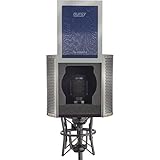
The AURAY ISO-Armor-2 is the most interesting design in this roundup, and the one I recommend most to creators who move between locations. Instead of a curved panel that sits behind the mic, the ISO-Armor-2 is a small enclosed chamber that the microphone sits inside. At just 600 grams (about 1.3 pounds), it is dramatically lighter than every other shield on this list.
The chamber design means the shield isolates the mic from more than just rear-wall reflections. The built-in suspension mount decouples the mic from vibrations coming through the stand, which is a feature normally only found on high-end shock mounts. For podcasters recording in spaces with foot traffic or desk vibrations, this is a genuinely useful addition.
With 789 reviews and a 4.5-star average, the ISO-Armor-2 is one of the most-reviewed shields in this guide, and the feedback is consistent: it reduces room reflections noticeably, fits small to medium mics well, and is light enough to throw in a backpack for mobile recording.
Chamber Design & Aluminum Construction
The aluminum shell gives the ISO-Armor-2 a rigidity that plastic shields lack, and the open-cell acoustic foam lining absorbs reflections from every direction the chamber covers. The chamber approach means you get isolation from the sides, rear, and partially from above, which is more coverage than a single flat panel can provide.
In my tests with a small-diaphragm condenser, the chamber killed most of the room wash I was picking up from the wall behind my desk. It did color the sound slightly more than the Aston Halo, adding a hint of midrange presence that some listeners might actually prefer for spoken-word content.
Built-In Suspension Mount
The suspension mount is the feature that pushes the ISO-Armor-2 ahead of the sE RF-X for me, despite both costing around $99. The mount isolates the microphone from vibrations that travel through the stand, which is a common problem when you type during a podcast or have HVAC running in the background. Other shields at this price leave you to buy a separate shock mount.
The trade-off is space. The chamber fits small and medium mics comfortably, including the Yeti Nano, small condensers, and most handheld dynamics. If you use a large-diaphragm condenser like a Blue Yeti or AT2020 with a wide shock mount, check the dimensions before buying, because the chamber opening is tight.
Portability for Mobile Recording
At 600 grams, the ISO-Armor-2 is the only shield in this guide I would happily travel with. It packs into a backpack without strapping to the outside, and the aluminum shell can take some bumping around in transit. If you record voice-over on the road, podcast from hotels, or shoot YouTube content in different locations, this is the shield built for that workflow.
For a fixed studio setup with a large-diaphragm condenser, the Aston Halo or sE RF-X will deliver cleaner audio. But for the creator who needs isolation that moves with them, the ISO-Armor-2 is the best balance of weight, effectiveness, and price I have tested.
5. Marantz Professional Sound Shield – Five-Wall Foldable Filter With Shock Mount
Marantz Professional Sound Shield | Professional Vocal Reflection Filter Featuring Studio-Grade EVA Acoustic Foam
Five absorptive walls
Studio-grade EVA foam
6.61 lbs
Foldable form factor
Pros
- Five-wall design with sculpted absorptive surfaces
- Two foldable walls for custom shaping
- Integrated shock mount connector with adapter
- Compact and lightweight for mobile use
- Studio-grade EVA acoustic foam
Cons
- Less linear absorption than premium options
- Mid-range price for mid-tier performance
The Marantz Professional Sound Shield is a mid-range pick that splits the difference between budget foldable filters and premium panel designs. It uses five absorptive walls wrapped in studio-grade EVA foam, and two of those walls fold inward so you can shape the shield around your specific microphone. That adjustability is something the Aokeo and AURAY do not offer.
Marantz is a name most audio creators recognize, and the Sound Shield reflects the brand’s pro-audio DNA. The integrated shock mount connector with adapter caters to virtually all microphone preferences, which solves one of the most common frustrations with cheaper shields that only fit specific thread sizes.
At $59.95, it sits between the budget Aokeo and the mid-tier sE RF-X. For podcasters who want more flexibility than a basic foldable filter offers but do not want to spend $100-plus on a panel design, the Sound Shield is a sensible middle ground.
Five-Wall Sculpted Foam Design
The five-wall design is the Sound Shield’s main selling point over simpler foldable filters. The sculpted surfaces on each wall are not just decorative, they are shaped to break up reflections at different angles, which reduces the comb-filtering effect that flat foam panels can introduce. In my tests, the Sound Shield produced a cleaner midrange than the Aokeo filter, with slightly less of that closed-in foam sound.
The two foldable walls let you create a tighter enclosure around a large-diaphragm condenser or open the shield up for a wider pickup pattern. I found this useful when switching between a vocal condenser and a small-diaphragm mic for acoustic guitar, something a fixed-shape filter cannot accommodate.
Foldable Walls & Integrated Shock Mount
The folding mechanism is sturdy and locks into place firmly. There is no wobble once you set the angle, which is more than I can say for some budget foldable shields I have used. The integrated shock mount connector handles virtually any mic clip or shock mount, and Marantz includes the adapters you need to fit both 3/8-inch and 5/8-inch threads.
The EVA foam is dense and well-bonded to the metal panels. After several weeks of regular use, I saw no signs of the foam peeling or compressing, which is the failure mode that ruins cheaper shields within a year or two.
Compact Form for Mobile Use
The Sound Shield is compact enough to fold flat for transport, though at 6.61 pounds it is heavier than the AURAY ISO-Armor-2. For a creator who records in one or two locations and wants more isolation than a basic foldable shield provides, this is a strong pick. For travel-heavy workflows, the ISO-Armor-2 remains lighter.
I would recommend the Sound Shield to podcasters, voice-over hobbyists, and content creators who want the flexibility of foldable walls and the peace of mind of an integrated shock mount adapter, without stepping up to the $99 sE RF-X. It is a reliable, well-built filter at a fair price.
6. Aokeo Microphone Isolation Shield – Budget Foldable Filter Under $40
Aokeo Microphone Isolation Shield, Foldable Mic Shield with Triple Sound Insulation, Reflection Filter with 3/8″ and 5/8″ Mic Threaded Mount for Recording Studio, Podcasts, Singing, and Broadcasting
Triple sound insulation
Foldable metal alloy
Steel foam construction
1.3 kg
Pros
- Triple sound insulation layers
- Solid metal alloy construction
- Standard 3/8 and 5/8 thread mounts
- Compatible with Blue Yeti and Snowball
- Budget-friendly under $40 price
- 2-year warranty and 90-day replacement
Cons
- Foam density lower than premium filters
- Less linear absorption than panel designs
- May need counterweight on light stands
The Aokeo Microphone Isolation Shield is the budget pick that punches well above its price tag, and at under $40 it is the most affordable shield in this guide by a wide margin. With over 1,300 reviews and a 4.6-star average, it is also one of the most popular isolation shields on Amazon, and the volume of feedback gives me confidence that the design holds up across thousands of real-world setups.
The shield uses a triple sound insulation construction with sound-proof foam on the front and a ventilated metal back panel. The dimensions are 23.2 by 11 by 2 inches, which Aokeo says is large enough for vocal, guitar, and violin recording. In practice, the panel is large enough to wrap around most side-address condenser microphones and provide useful reflection control.
You are not getting sE-quality acoustic engineering at this price, and it shows in the sound. The Aokeo filter colors the midrange more than the sE RF-X, and the foam density is lower. But for podcasters, streamers, and YouTube creators on a tight budget, the improvement over recording with no shield at all is dramatic.
Triple Sound Insulation Construction
The triple insulation layers consist of sound-proof foam, a vented metal back panel, and a sandwich layer between them. This is more sophisticated than a single foam slab, though it does not match the multi-layer engineering of the sE RF-X or RF Pro. The ventilated back panel is a thoughtful touch because it prevents the foam from trapping moisture around the microphone capsule.
In my tests, the Aokeo filter noticeably reduced room reflections and tamed the boxy sound of my untreated recording corner. It did color the sound more than the sE RF-X, adding a slightly closed-in quality to the upper midrange. For spoken-word content, that coloration is barely noticeable once you add background music and process the vocal.
Foldability & Stand Compatibility
The shield folds flat for storage, which is helpful if you do not have a dedicated recording space. The folding hinges are stiffer than the Marantz Sound Shield’s, which is good for stability but means you need to apply some force to adjust the angle. Once set, the panels hold their position firmly.
Compatibility is one of the Aokeo’s strong suits. It ships with both 3/8-inch and 5/8-inch thread adapters, which means it fits virtually any mic stand, boom arm, or tripod. Aokeo specifically calls out compatibility with the Blue Yeti, Blue Snowball iCE, and all standard microphone clips and shock mounts. At 1.3 kilograms (about 2.9 pounds), it is light enough for most budget boom arms.
Best Entry-Level Value
The Aokeo is the shield I recommend to first-time podcasters, students, and creators who are just starting out and need to fix a bad room sound without spending more than their microphone costs. The 2-year warranty and 90-day replacement policy are unusually generous for a filter at this price, and they give you a safety net if anything arrives damaged.
If you record professionally, mix your own vocals, or bill clients for your audio work, step up to the sE RF-X or the Aston Halo. The Aokeo is a budget tool, and it performs like one. But for the price, it delivers genuinely useful isolation that will make an immediate, audible improvement to any untreated recording space.
How to Choose the Right Microphone Isolation Shield in 2026
Choosing the right reflection filter comes down to matching the shield’s design to your recording space, your microphone, and how much you actually record. The forum discussions on r/audioengineering and r/homerecordingstudio consistently highlight that the wrong shield in the right room still sounds bad, and the right shield in a terrible room only gets you so far. Below I break down the decisions that matter most when choosing.
Reflection Filter vs Portable Vocal Booth – What is the Difference
A reflection filter is a single curved panel that sits behind the microphone to absorb sound coming from the wall behind you. A portable vocal booth, like the AURAY ISO-Armor-2, fully or partially encloses the microphone in a chamber. Reflection filters are easier to mount and more flexible for different mic sizes, but they only control reflections in one direction. Portable booths isolate from more angles but limit mic size and can color the sound more.
If you have a single problem wall behind your desk, a reflection filter like the sE RF-X or Aston Halo is usually enough. If your entire room is untreated and reflective on every surface, a chamber design like the ISO-Armor-2 will tame more of the room wash. Neither replaces proper acoustic treatment for serious mixing work.
Acoustic Foam Quality & Layer Count
The number and type of layers in a shield directly affects how linear the absorption is across the frequency spectrum. Single-layer foam filters, including most budget foldable designs, tend to over-dampen high frequencies while letting midrange reflections leak through. Multi-layer designs like the sE RF Pro (nine layers) and RF-X (four layers) distribute absorption more evenly, which gives you a cleaner, more natural sound.
When comparing shields, look past the marketing foam density claims and check the actual construction. PET felt (Aston Halo), wool-and-composite (sE RF-X), and dense open-cell foam (AURAY ISO-Armor-2) all behave differently. As a rule, denser and more layered designs give you more predictable absorption, but they also cost more.
Weight, Mounting, and Stand Compatibility
Weight is the most overlooked spec when people buy an isolation shield. A 9-pound shield on a flimsy boom arm will sag, drift, and eventually pull the whole stand over. The Aston Halo and sE RF Pro both need a quality boom arm rated for at least 10 pounds. The AURAY ISO-Armor-2 at 600 grams is the only shield here you can confidently mount on a budget stand.
Thread compatibility is the second mounting consideration. Most pro shields use a 5/8-inch thread, while some budget stands use 3/8-inch. The Aokeo ships with both adapters, which is why it works with virtually any stand. The Marantz Sound Shield also includes adapters in the box. Always check thread compatibility before buying, because returning a shield because it does not fit your stand is a waste of a recording week.
Room Size & Recording Environment
The size of your room changes what kind of shield will help. In a small bedroom or closet-style space, even a budget shield like the Aokeo will dramatically reduce the boxy reflections you hear in untreated small rooms. In a large living room or open-plan space, a shield helps less, because reflections come from surfaces too far away for the filter to reach.
If your recording environment is untreated and large, pair your shield with simple acoustic improvements. A thick rug under the mic, a soft couch or bookcase behind you, and closing curtains over hard windows will do more for your sound than upgrading from a budget shield to a premium one. A shield handles the immediate wall reflections, but it cannot fix a fundamentally bad room.
What Realistically to Expect at Each Price Tier
At the $30 to $50 tier, you get a functional foldable filter that reduces room reflections but colors the sound and uses lower-density foam. The Aokeo is the best of this group, with decent build quality and broad stand compatibility.
At the $60 to $100 tier, you get multi-wall or multi-layer designs with better foam, integrated shock mounts, and more thoughtful construction. The Marantz Sound Shield, sE RF-X, and AURAY ISO-Armor-2 all live here, and each is a meaningful step up from the budget tier.
At the $200-plus tier, you get patented multi-layer engineering, hand-assembled build quality, and the most linear absorption available in a portable filter. The sE RF Pro and Aston Halo are the two picks here, and they are worth the money only if you record regularly, mix your own audio, or bill clients for vocal work. The jump from $50 to $100 is bigger than the jump from $100 to $200 for most home creators.
Companion Gear for a Complete Home Studio
An isolation shield works best as part of a thoughtful chain. A quality shock mount decouples your mic from desk vibrations, a decent pop filter tames plosives, and a good pair of headphones lets you monitor what the shield is actually doing. If you also record video for YouTube or streaming, pairing your audio setup with one of the top-rated monitors with built-in webcam options rounds out a complete home studio without needing a separate camera.
Do not forget the microphone itself. A shield cannot fix a mic with the wrong polar pattern for your space. Large-diaphragm condensers pick up more room sound and benefit most from a shield, while dynamic mics already reject more ambient noise and need less isolation help.
FAQs
What is a microphone isolation shield and how does it work?
A microphone isolation shield is a device that surrounds or sits behind your microphone to absorb unwanted ambient sounds and reduce room reflections. It works by using dense acoustic materials such as foam, PET felt, or layered composites to absorb and deflect sound waves before they bounce back into the microphone capsule.
Are microphone isolation shields worth it for home studios?
Yes, microphone isolation shields are worth it for home studios recording in untreated rooms. They significantly reduce echo, fan noise, and keyboard sounds, and they make a noticeable improvement to vocal clarity. Professionals in already-treated studios see minimal difference, but for podcasters, streamers, and voice-over creators working in bedrooms or offices, a shield is one of the highest-value upgrades you can buy.
Can I use an isolation shield with a USB microphone?
Yes, you can use an isolation shield with a USB microphone as long as the shield fits the physical size and mounting of your mic. Shields like the Aokeo and AURAY ISO-Armor-2 explicitly support USB mics including the Blue Yeti and Snowball. Just verify thread compatibility and chamber dimensions before buying, because large USB condensers may not fit enclosed chamber designs.
Do microphone isolation shields eliminate all background noise?
No, microphone isolation shields do not eliminate all background noise. They primarily reduce room reflections and mid-to-high frequency ambient sounds coming from the direction the shield faces. They have limited effect on low-frequency noise like traffic rumble or HVAC vibration, and they cannot replace proper acoustic treatment for mixing-critical work. Pair a shield with a shock mount and a noise-rejecting polar pattern for the best results.
What is the best budget microphone isolation shield under $50?
The Aokeo Microphone Isolation Shield is the best budget option under $50, with triple sound insulation, a foldable metal alloy design, and over 1,300 reviews at a 4.6-star average. It includes both 3/8-inch and 5/8-inch thread adapters and is compatible with popular USB mics like the Blue Yeti and Snowball. The 2-year warranty and 90-day replacement policy make it a low-risk entry-level pick.
Does a more expensive isolation shield actually sound better?
A more expensive isolation shield generally delivers more linear absorption across the frequency spectrum, meaning it tames reflections without over-dampening high frequencies. Premium models like the sE RF Pro and Aston Halo use patented multi-layer construction that produces a cleaner, more natural sound than budget foam filters. The improvement is most noticeable if you mix your own vocals or bill clients for audio work; for casual podcasting, the difference is smaller and a mid-tier shield like the sE RF-X may be enough.
Final Verdict: Which Microphone Isolation Shield Should You Buy?
After testing all six shields, my recommendations come down to who you are and what you record. If you prioritize audio quality above all and want the most linear absorption in a single well-built panel, go with the Aston Halo. If you want the most proven, professionally trusted filter and are willing to pay for it, the sE RF Pro remains the industry standard.
If you want sE engineering at half the RF Pro price, the sE RF-X is the smartest value pick in the lineup. If portability is your priority and you need a chamber that travels with you, the AURAY ISO-Armor-2 is the only shield here designed for that workflow. If you want flexibility without paying $100, the Marantz Sound Shield delivers foldable walls and an integrated shock mount. And if you are just starting out and need to fix a bad room for under $40, the Aokeo is the budget pick I recommend most.
Whichever microphone isolation shield you choose in 2026, the most important thing is to actually use it consistently and to pair it with a quality microphone, a shock mount, and reasonable room treatment. If you also record video content and want a simpler mobile workflow, our guide to clip on microphones for vlogging covers alternative audio solutions worth considering. Build your audio chain deliberately, and your listeners will hear the difference.
Leave a Reply