
Selling on Amazon in 2026 means competing against millions of listings, many of which offer nearly identical products at similar price points. Amazon Product Promotions give sellers a powerful way to break through that noise, capture shopper attention, and convert casual browsers into loyal customers. Whether you are launching a new ASIN, clearing aging inventory, or preparing for a major shopping event like Prime Day, understanding how to structure and time your promotions can make or break your quarterly revenue.
The promotional landscape on Amazon has shifted significantly over the past two years. Amazon introduced updated promotion policies in 2025, including new minimum purchase requirements for percentage-off deals and revised fee structures for Amazon Coupons. Sellers who stay on top of these changes gain a measurable advantage over competitors still using outdated tactics from 2023 and early 2024. This guide walks you through every major promotion type, current platform requirements, and the external marketing strategies that amplify your results.
What You Will Learn in This Guide
- The three core Amazon seller promotions: percentage-off, BOGO, and social media promo codes
- How Amazon Coupons, Lightning Deals, and Best Deals differ in cost and visibility
- Integrating Sponsored Products and Amazon Ads with your promotional calendar
- Email and social media tactics that drive external traffic to your listings
- Current Amazon rules, fee updates, and customer metrics that affect promotion eligibility
Understanding Amazon Product Promotions
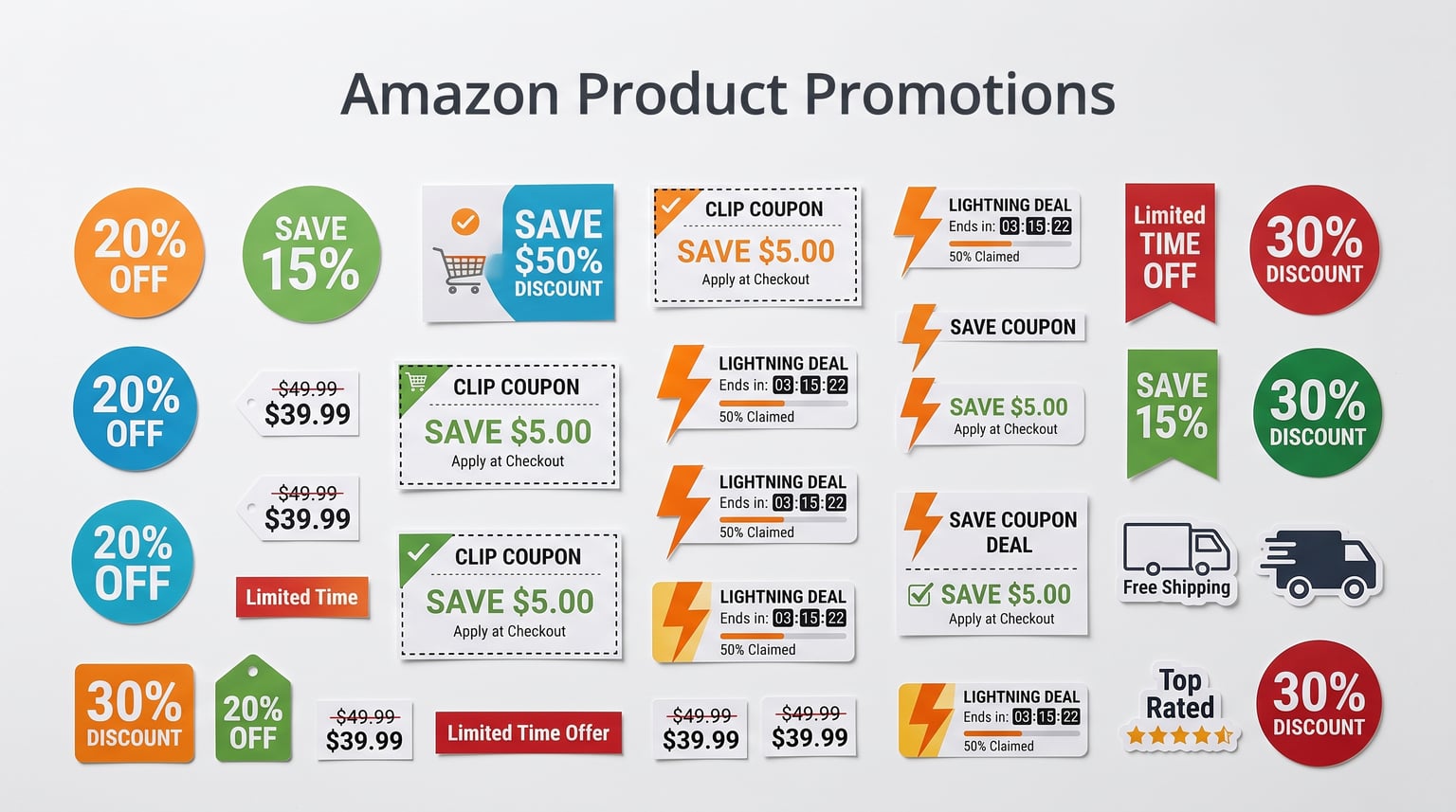
Amazon Product Promotions are structured discount offers that sellers create through Amazon Seller Central to incentivize purchases. Unlike simple price reductions, promotions appear with visible badges, countdown timers, or coupon clip widgets that catch a shopper’s eye during product searches and detail page visits. This visual distinction matters enormously because Amazon shoppers typically scan results in seconds before clicking.
Amazon currently offers three primary seller promotion categories: percentage-off promotions, buy one get one free (BOGO) deals, and custom social media promo codes. Each type serves a distinct strategic purpose, from driving volume on bundled products to generating off-Amazon traffic through influencer partnerships. Choosing the right format depends on your margins, inventory depth, and whether you are targeting new customers or rewarding repeat buyers.

Key Aspects of Amazon Product Promotions
Each promotion type available through Amazon Seller Central comes with specific configuration requirements and buyer-facing display features. Percentage-off promotions let you discount a product by a set percentage when a customer meets certain conditions, such as purchasing a minimum quantity. As of September 2025, Amazon updated this format to require a minimum two-unit purchase for percentage-off promotions, meaning sellers can no longer offer single-unit percentage discounts through this tool.
BOGO Amazon promotions work differently, offering a free or discounted item when a customer buys a qualifying product at full price. This format is particularly effective for consumable goods, accessories, and any product line where customers naturally purchase multiples. Social media promo codes function as claim codes that you distribute outside Amazon, letting you track which external channels drive the most conversions.
Benefits of Promoting Your Amazon Product Promotions
Running structured promotions on Amazon delivers measurable advantages beyond a simple revenue bump. Here are the core benefits sellers experience when they execute promotions strategically:
- Higher Conversion Rates: Promotional badges and coupon widgets increase click-through and purchase rates by signaling savings to price-sensitive shoppers.
- Improved Search Ranking: The Amazon algorithm rewards products that generate sales velocity, and promotions accelerate that velocity during critical periods.
- Inventory Clearance: Aging stock and seasonal items move faster when discounted, reducing long-term FBA storage fees and freeing up capital.
- New Customer Acquisition: A reduced-price offer lowers the perceived risk for first-time buyers, encouraging them to try your brand and return at full price later.
- Review Generation: More purchases mean more opportunities for verified reviews, which compound your ranking and trust advantages over time.
Role of SEO in Amazon Product Visibility
Before any promotion can succeed, shoppers need to find your product listing. Amazon SEO is the foundation that determines whether your promoted items appear on the first page of search results or get buried three pages deep. This means optimizing your product titles, backend keywords, bullet points, and descriptions with the exact search terms your target customers type into the Amazon search bar.
When your listings rank organically, every promotion you run performs better because the traffic is already qualified. Sellers who understand this connection between SEO and promotions see significantly higher returns on their discount investments. For sellers looking to refine their keyword strategy, the Amazon Search Terms Report provides actionable data on which queries drive clicks and conversions, helping you align your promotions with actual search demand.
Beyond keywords, modern Amazon SEO also factors in A+ Content quality, image completeness, and review velocity. Listings with rich A+ Content modules tend to convert promoted traffic at higher rates because shoppers can make informed decisions quickly. If your listing lacks these elements, even a steep discount may underperform compared to a well-optimized competitor running a smaller promotion.
Strategies for Enhancing Your Amazon Product Promotions Visibility
Creating a promotion is only half the equation. To get meaningful results, you need strategies that put your discounted offers in front of the right shoppers at the right moments. The most successful Amazon sellers in 2026 combine organic SEO with paid advertising and multi-channel marketing to build a promotion ecosystem that drives consistent traffic from every direction.
Building Strong Foundations: The Power of SEO Optimization
SEO optimization remains the single most effective way to amplify your Amazon promotions without spending additional ad budget. When your listing already ranks well organically, promotional badges appear more frequently in search results, drawing the eye toward your product over competitors. The optimization process starts with keyword research to identify high-volume, relevant search terms that match buyer intent.
From there, you need to weave those keywords naturally into your product title, bullet points, product description, and backend search terms field. High-quality images with infographics and lifestyle shots also play a role, since Amazon’s algorithm factors in click-through rates and conversion rates when determining ranking positions. A listing with compelling visuals and keyword-rich copy will consistently outperform a barebones listing, even when both run identical promotions.
Many experienced sellers now treat SEO as an ongoing process rather than a one-time setup. Regularly reviewing your search term reports, testing new keyword combinations, and updating A+ Content based on customer feedback questions keeps your listing competitive. This continuous optimization approach means your promotions always land on listings that are primed to convert traffic into sales.
Multi-Channel Marketing: Gateway to New Opportunities
Multi-channel marketing extends your promotional reach well beyond Amazon’s own platform. Social media promo codes are designed specifically for this purpose, letting you generate claim codes that shoppers redeem on Amazon after discovering your product on external channels. This creates a trackable link between your off-Amazon marketing efforts and actual sales performance.
Platforms like Instagram, TikTok, and Facebook offer powerful ways to showcase your promoted products through both organic content and paid advertising. Short-form video content in particular has become one of the most effective ways to drive external traffic to Amazon listings. Sellers who build even a modest social media following can direct that audience toward their Amazon promotions, generating sales that also boost their organic ranking on the platform itself.
For sellers ready to expand their approach, our comprehensive social media marketing guide covers platform-specific strategies for building an audience that converts. The key insight from successful sellers is that Amazon rewards external traffic through its Brand Referral Bonus program, which offers sellers a credit for qualifying sales generated from off-Amazon sources.
Amazon Product Promotions: Maximizing Your Advertising Avenues
Paid advertising on Amazon has become inseparable from effective promotion strategy. Sponsored Products campaigns, Amazon Ads, and promotional tools like Lightning Deals and Amazon Coupons work best when they are coordinated rather than treated as separate initiatives. Reddit sellers consistently report that combining PPC campaigns with active promotions delivers better return on investment than running either tactic alone.
Sponsored Products and Amazon Ads Integration
Sponsored Products campaigns put your listings at the top of relevant search results and on competitor detail pages through cost-per-click advertising. When you run a promotion simultaneously, the combination of a Sponsored Products placement with a visible discount badge creates a compelling offer that converts at significantly higher rates than advertising alone. Amazon even displays promotional messaging within Sponsored Products ad creative when an active deal is running.
The most effective approach is to increase your ad bids on products with active promotions, since the improved conversion rate justifies the higher cost per click. Long-tail keyword targeting tends to perform better than broad match campaigns when paired with promotions, because shoppers searching for specific terms are closer to a purchase decision. Monitor your Advertising Cost of Sales closely during promotional periods and adjust bids based on real-time performance data.
Amazon Coupons: Fee Structure and Setup
Amazon Coupons function as clickable discount widgets that appear on search results pages and product detail pages, making them one of the most visible promotional tools available to sellers. Unlike percentage-off promotions, coupons can be applied to single-unit purchases, which makes them ideal for products where the updated two-unit minimum for percentage-off deals does not fit your strategy. Each redeemed coupon costs the seller a flat fee, which changed in 2025 alongside broader promotion policy updates.
Coupons work particularly well for new product launches, since the visible green coupon badge draws attention even when a listing has limited review history. They also integrate with Sponsored Brands video campaigns, giving your products multiple touchpoints with potential buyers. When setting up a coupon, pay close attention to the budget cap, since popular coupons can exhaust their budget quickly and disappear from search results mid-campaign.
Email Marketing: Established Yet Effective
Email marketing remains one of the highest-return channels for promoting Amazon products, particularly for sellers who have built their own customer lists through brand websites or previous ecommerce ventures. A well-timed email blast announcing a limited-time promotion can drive a concentrated burst of sales that pushes your product up the organic ranking ladder. The key is segmenting your audience so that each email speaks directly to the recipient’s demonstrated interests.
- Personalization: Segmenting by past purchase behavior and browsing history lifts open and click rates significantly compared to generic blasts.
- Trackability: Using social media promo codes in emails lets you attribute sales directly to specific campaigns and messages.
- Cost Efficiency: Email campaigns cost a fraction of paid advertising while reaching an audience that has already expressed interest in your brand.
Sharing Listings on Social Media: An Informal Boost
Social media promotion works differently from paid Amazon Ads because it relies on building genuine connections with followers rather than bidding on keywords. When you share a promotional listing on Instagram, TikTok, or Facebook, the informal, conversational nature of these platforms lets you present your product in a lifestyle context that Amazon’s detail page cannot replicate. User-generated content and customer photos shared on social channels often drive more engagement than polished brand assets.
- Shareability: Engaging product content gets reshared by followers, extending your reach organically without additional spend.
- Engagement: Responding to comments and questions builds a community around your brand that returns for future product launches.
- Buzz Building: Behind-the-scenes content and sneak peeks of upcoming promotions create anticipation that converts into day-one sales.
These external channels work best when combined rather than used in isolation. A coordinated promotion might start with an email announcement, followed by social media posts featuring customer testimonials, and conclude with a Sponsored Products push on Amazon itself. This multi-touch approach ensures shoppers encounter your promotion at multiple points in their buying journey.
Maximize ROI With Effective Inventory Management
Promotions only generate profit when you have sufficient inventory to meet the demand they create. Stocking out during a Lightning Deal or coupon campaign not only costs you immediate sales but can also damage your listing’s search ranking and trigger Amazon’s inventory performance metrics penalties. Effective inventory management is the backbone that supports every promotional strategy discussed in this guide.

Balancing stock levels means forecasting demand based on historical sales data, seasonal trends, and the expected lift from your planned promotions. Overstocking ties up capital and incurs long-term FBA storage fees, while understocking means missed opportunities and frustrated customers. The most successful sellers maintain a buffer inventory of at least 30 to 45 days of expected promotional demand.
Understanding the Time-Bound Impact of Lightning Deals
Lightning Deals are short-term promotional offers that run for a limited number of hours, typically featuring a deep discount and a countdown timer that creates urgency. These deals appear on Amazon’s Deals page, one of the most visited sections of the marketplace, giving your product exposure to shoppers actively hunting for bargains. The psychological pressure of a ticking timer drives rapid purchase decisions that can clear weeks of normal inventory in a single afternoon.
Best Deals offer a different proposition, running for up to two weeks with a discounted price and a Best Deal badge on your product detail page. While less intense than Lightning Deals, Best Deals provide sustained visibility that can introduce your product to thousands of new shoppers over the promotion period. Sellers on Reddit frequently debate which format delivers better ROI, with the consensus favoring Lightning Deals for quick ranking pushes and Best Deals for steady volume during slower sales periods.
Importance of Having a Personalized Website for Your Products
A branded website serves as the central hub for your off-Amazon promotional efforts, giving you a platform you fully control for content, email capture, and customer engagement. While your Amazon listing handles transactional conversions, your website builds the brand narrative that makes shoppers choose your product over cheaper alternatives. This is especially important when running social media promo codes, since you need a destination to send traffic before directing shoppers to Amazon.
Amazon’s Brand Referral Bonus program makes this strategy even more financially attractive by crediting sellers a percentage of sales that originate from external sources. When you combine a well-designed website with active social media promotion and email marketing, you create a funnel that drives qualified traffic to your Amazon listings while earning referral credits that offset your promotional costs.
Amazon Product Promotions: Supportive Metrics & Regulations Surrounding It
Amazon operates a data-driven marketplace where every promotion, review, and customer interaction feeds into performance metrics that determine your seller health. Understanding these metrics and the platform’s evolving rules is essential for maintaining promotion eligibility and avoiding account penalties that can sideline your business.
Decoding Customer Metrics on Amazon and Its Impact
Amazon Seller Central provides a detailed dashboard of customer metrics that reveal how shoppers interact with your products and promotions. The Account Health dashboard tracks order defect rates, cancellation rates, and late shipment rates, all of which must stay below Amazon’s thresholds to maintain promotion eligibility. A healthy account with strong metrics gets approved for Lightning Deals and coupon placements more readily than an account with performance warnings.
Review velocity and average star rating also play a significant role in promotion success. Products with higher ratings convert promotional traffic at better rates, and Amazon’s algorithm favors well-reviewed products when assigning organic placement boosts after a promotion ends. For sellers focused on building this social proof, effective Amazon review management strategies can complement promotional efforts by ensuring that the surge of orders generated by a deal translates into verified reviews.
Abiding by Rules Set by Amazon
Amazon updated its promotion policies in September 2025 with several changes that sellers must understand to remain compliant. Percentage-off promotions now require a minimum two-unit purchase, meaning single-unit percentage discounts are no longer available through this promotion type. This change pushes sellers toward Amazon Coupons and promotional tools for single-unit discounts, shifting the cost structure of running promotions across the platform.
Beyond the percentage-off change, Amazon continues to enforce strict rules around pricing conduct, review solicitation, and customer communication. Sellers cannot offer discounts in exchange for positive reviews, cannot direct customers away from Amazon for purchases, and must maintain accurate product listings that match the items actually shipped. Violations can result in suppressed listings, suspended promotion privileges, or full account suspension.
Promotion timing rules also matter. Amazon limits how frequently a product can participate in Lightning Deals and sets minimum discount thresholds for deals to qualify. Virtual bundles, which let brand-registered sellers create multi-product offers without physical bundling, have their own set of promotion rules. Staying current with Amazon Seller Central announcements and the help documentation for each promotion type is the best way to avoid surprises that could derail a planned campaign.
Frequently Asked Questions
What promotions does Amazon have?
Amazon offers three main seller promotion types: percentage-off promotions (now requiring a minimum two-unit purchase as of September 2025), buy one get one free (BOGO) deals, and custom social media promo codes. Additionally, sellers can use Amazon Coupons, Lightning Deals, Best Deals, Prime Exclusive Discounts, and Sponsored Products advertising to promote their products.
Can you pay Amazon to promote your product?
Yes, sellers can pay Amazon to promote products through Sponsored Products, Sponsored Brands, and Sponsored Display ads on a cost-per-click basis. Amazon also offers paid placement options like Lightning Deals and Best Deals, which charge a flat fee per deal run. These paid promotional tools appear prominently in search results and on the Amazon Deals page.
How do Lightning Deals differ from Best Deals on Amazon?
Lightning Deals are short-term offers lasting several hours with a countdown timer and deep discount, creating urgency for quick sales. Best Deals run for up to two weeks at a discounted price with a Best Deal badge, providing sustained visibility. Lightning Deals work best for rapid ranking pushes, while Best Deals are better for steady volume over extended periods.
How can SEO optimization improve product visibility?
SEO optimization improves product visibility by helping your listing rank higher in Amazon search results through strategic keyword placement in titles, bullet points, descriptions, and backend search terms. Listings that rank organically perform significantly better when promotions are active, because the promotional badge appears more frequently in search results and the existing traffic is already qualified to convert.
What are the Amazon promotion changes in 2025?
In September 2025, Amazon updated percentage-off promotions to require a minimum two-unit purchase, eliminating single-unit percentage discounts through this promotion type. Amazon also revised coupon fee structures and adjusted Lightning Deal requirements. Sellers should review Amazon Seller Central announcements regularly to stay current with policy changes that affect promotion eligibility and costs.
Can I advertise my Amazon products on Instagram?
Yes, you can advertise Amazon products on Instagram through both organic posts and paid advertising. Using Amazon social media promo codes lets you track which Instagram content drives sales back to your Amazon listings. Instagram shopping features and link stickers in Stories make it easy to direct followers straight to your product detail pages.
Conclusion
Mastering Amazon Product Promotions in 2026 requires understanding how each promotional tool works, when to deploy it, and how to support it with SEO, advertising, and multi-channel marketing. The sellers who consistently outperform their competitors are the ones who treat promotions as part of an integrated strategy rather than isolated discounts. Percentage-off deals, BOGO offers, Amazon Coupons, Lightning Deals, and social media promo codes each serve distinct purposes, and choosing the right combination for your product and season makes all the difference.
Recent platform changes, particularly the September 2025 update requiring minimum two-unit purchases for percentage-off promotions, make it more important than ever to stay informed. Sellers who adapt quickly to policy shifts maintain a competitive edge while those relying on outdated tactics see diminishing returns. Pair your promotions with strong SEO foundations, targeted Sponsored Products campaigns, and active social media promotion to create a traffic engine that drives sustainable sales growth.
Start by auditing your current listings for SEO readiness, then choose one promotion type that aligns with your next sales goal. Whether that is clearing inventory before a seasonal transition, launching a new product, or capturing market share during Prime Day, the strategies in this guide give you a proven framework for success on Amazon.
Leave a Reply