
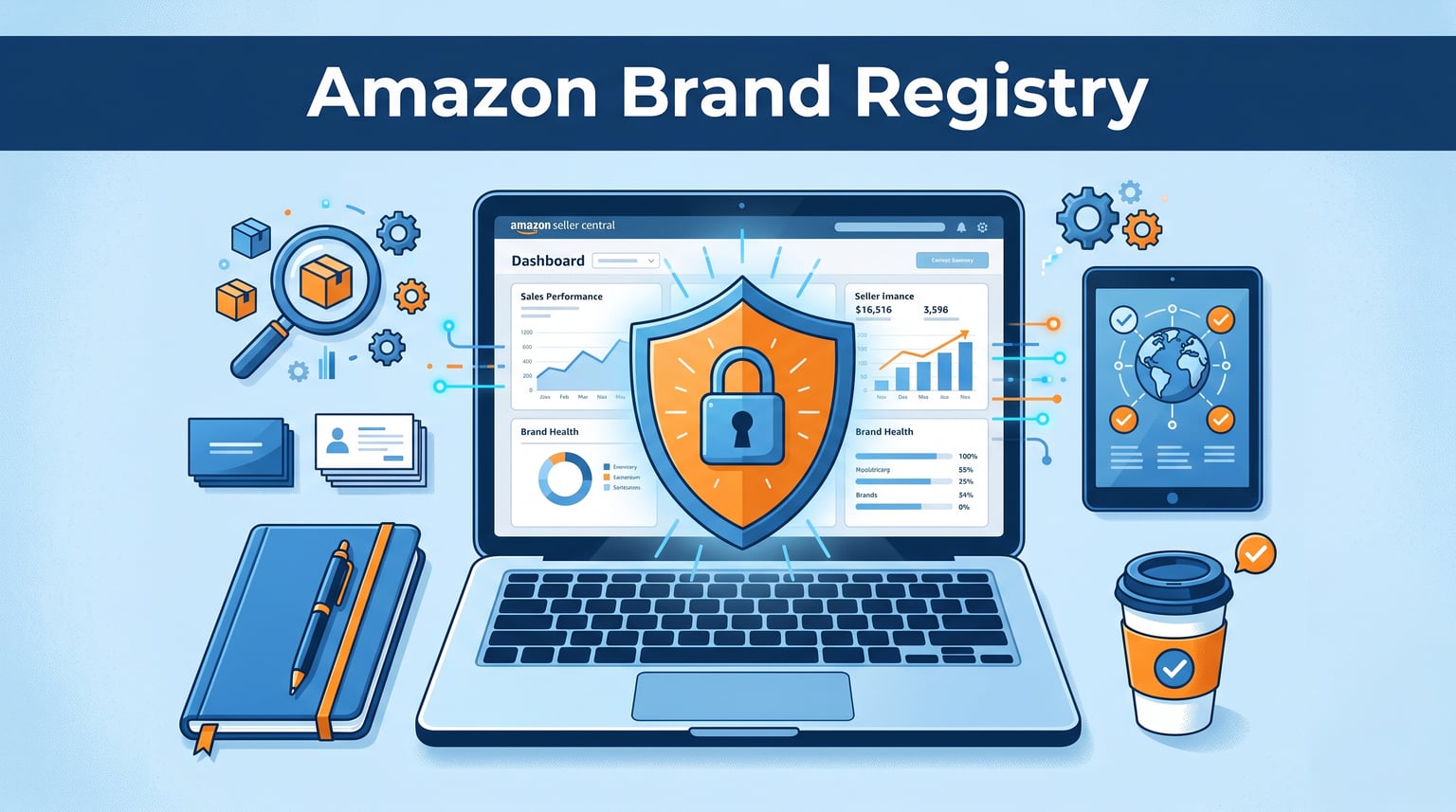
Counterfeit listings, unauthorized sellers, and brand representation issues cost Amazon sellers significant revenue every year. The Amazon Brand Registry is the platform’s official program designed to give trademark owners direct control over how their products appear, are protected, and are marketed across Amazon’s marketplace. For any serious private-label seller or brand owner, enrollment in this program represents one of the most impactful steps you can take to secure your intellectual property and unlock advanced selling tools.
Amazon Brand Registry is a free program that helps you protect and grow your brand, even if you do not currently sell in the Amazon store. The program provides a suite of proprietary tools for brand protection, enhanced content creation, advertising access, and customer insight analytics that are simply unavailable to unregistered sellers. In 2026, with counterfeit activity on Amazon continuing to challenge legitimate sellers, Brand Registry enrollment has shifted from an optional advantage to a competitive necessity.
This guide covers everything you need to know about the program: what it is, how it works, eligibility requirements, the step-by-step enrollment process, every major tool you gain access to, how it compares to Amazon Brand Approval, common rejection reasons, and what to do immediately after approval. Whether you are preparing to file a trademark or already hold a registered mark and want to maximize your Brand Registry benefits, this resource walks you through the full process.
What this guide covers:
What Amazon Brand Registry is and how the program functions
Complete eligibility criteria and trademark requirements
Step-by-step enrollment process walkthrough
Detailed breakdown of every Brand Registry tool and benefit
Amazon Brand Registry vs Amazon Brand Approval comparison
IP Accelerator program for pending trademarks
Common application rejection reasons and how to avoid them
Post-approval next steps to maximize your enrollment
What Is Amazon Brand Registry?
Amazon Brand Registry is a free enrollment program that provides brand owners with enhanced control over their product listings, advanced tools for intellectual property protection, and access to marketing features that are not available to standard Amazon seller accounts. The program is operated through a dedicated Brand Registry portal that is separate from Seller Central, though the two systems are linked once your enrollment is approved.
A critical point that many sellers misunderstand is that you do not need to sell on Amazon to enroll. Brand Registry is available to any rights owner with an active registered trademark, regardless of whether they currently list products on the platform. This makes it a powerful tool for brand protection alone, even before you begin selling. Once enrolled, your trademark data is integrated into Amazon’s systems, enabling proactive detection and removal of infringing listings.
The program operates across all of Amazon’s marketplaces globally. A single enrollment gives you brand protection and tool access in every Amazon store where your trademark is registered, rather than requiring separate applications for each region. This global reach is one of the most significant advantages for international brand owners managing products across multiple countries.
How Amazon Brand Registry Works: The Mechanics
Understanding the underlying mechanics of Brand Registry helps clarify why enrollment is so effective at brand protection. The program functions through a combination of trademark verification, automated detection systems, and manual enforcement tools that work together across Amazon’s entire marketplace infrastructure.

Trademark Verification and Enrollment
The foundation of Brand Registry is trademark verification. When you submit an application, Amazon cross-references your trademark registration number against official government trademark databases such as the USPTO in the United States, the EUIPO in Europe, and equivalent registries in other supported countries. This verification step confirms that you are the legitimate rights owner for the brand name you are claiming.
Amazon requires that your trademark be either a text-based wordmark or a text-plus-image mark that includes words, letters, or numbers. Purely design or image marks without textual elements are not eligible for Brand Registry enrollment. This requirement exists because Amazon’s matching systems rely on text-based brand name data to identify and protect your listings across the platform.
Automated Proactive Brand Protection
Once enrolled, Amazon uses the information you provided during registration to power its automated brand protection systems. These systems continuously scan listings across the marketplace, comparing product data, images, and listing content against your registered brand information. When the system detects a potential match that suggests infringement or misuse, it can take action automatically without requiring you to file a manual report.
This proactive approach means that many infringing listings are removed before they ever generate sales or harm your brand. The automated protections work around the clock across all Amazon marketplaces where your trademark is registered, providing coverage that would be impossible to replicate through manual monitoring alone.
Manual Enforcement and Reporting
For situations where automated protections do not catch an issue, Brand Registry provides a Report a Violation tool that lets you search for and report infringing content directly. You can search by keyword, image, or ASIN to identify potential violations, then submit a report through the Brand Registry portal. Amazon’s dedicated Brand Registry support team reviews these reports and takes enforcement action, which can include listing removal, seller account suspension, or escalation to Amazon’s Counterfeit Crimes Unit for legal prosecution.
The reporting workflow is designed to be efficient, allowing brand owners to submit multiple reports in bulk and track the status of each case through the Brand Registry dashboard. This structured enforcement system gives rights owners a direct channel to Amazon that is significantly more responsive than standard seller support.
For deeper insights into how customer feedback connects to brand health, see our guide on leveraging Amazon Reviews to strengthen your listing strategy after enrollment.
Benefits of Amazon Brand Registry
Brand Registry enrollment unlocks a comprehensive suite of benefits that span brand protection, content creation, advertising, analytics, and customer engagement. Each tool is designed to give enrolled brand owners a measurable advantage over unregistered sellers on the platform.
Enhanced Brand Protection and IP Enforcement
The primary benefit of Brand Registry is intellectual property protection. Enrolled brands have access to automated proactive protections that scan and remove potentially infringing listings before they gain traction. When infringers do slip through, the Report a Violation tool provides a direct escalation path to Amazon’s enforcement team. This combination of automated and manual enforcement significantly reduces the presence of counterfeits, unauthorized sellers, and listing hijackers on your product pages.
Complete Listing Control
Without Brand Registry, any seller listed on your product’s detail page can edit the title, description, images, and other listing content. This creates constant problems with unauthorized changes that can misrepresent your brand or degrade conversion rates. Brand Registry gives you authoritative control over product listings associated with your brand name, ensuring that information is accurate and presented exactly as you intend.
A+ Content and Enhanced Brand Content
A+ Content replaces the standard product description with a rich, visually engaging module that can include comparison charts, brand stories, high-quality lifestyle images, and detailed feature breakdowns. This content format has been shown to increase conversion rates significantly by giving shoppers a more complete understanding of the product. A+ Content is available exclusively to Brand Registry-enrolled sellers and represents one of the most immediate and tangible benefits of enrollment.
Sponsored Brands and Sponsored Display Advertising
Brand Registry is a prerequisite for creating Sponsored Brands campaigns and Sponsored Display ad campaigns on Amazon. Sponsored Brands ads appear at the top of search results and feature your brand logo, a custom headline, and a selection of products. Sponsored Display ads retarget shoppers who have viewed your products but not purchased. Together, these advertising formats give brand-registered sellers significantly more reach and targeting precision than the standard Sponsored Products ads available to all sellers.
Amazon Stores
Amazon Stores is a free self-service tool that lets Brand Registry-enrolled sellers build a dedicated, multi-page storefront on Amazon. Your Store can include custom layouts, video content, product collections, and brand storytelling elements. Stores serve as a destination that you can drive traffic to through Sponsored Brands campaigns, social media, and external marketing channels, giving you a controlled brand environment within the Amazon ecosystem.
Brand Analytics
Brand Analytics provides enrolled sellers with proprietary data that Amazon does not share with unregistered accounts. This includes the Amazon Search Terms Report, which shows the actual search terms shoppers use on Amazon along with click and conversion share data. Brand Analytics also includes repeat purchase behavior, demographic insights, and item comparison data. To learn how to act on this data, see our detailed guide on the Amazon Search Terms Report and how it connects to your overall listing optimization strategy.
Amazon Vine Program
Amazon Vine is an invitation-only program that connects brand-registered sellers with a curated community of reviewers. When you enroll a product in Vine, Amazon sends units to trusted reviewers who then publish honest, detailed feedback. This program is one of the most effective ways to generate early reviews for new product launches, which directly impacts search ranking and conversion rates. Brand Registry enrollment is required to participate.
Manage Your Experiments
This tool lets you run A/B tests on your product listings, comparing different titles, product images, and A+ Content variations against each other. Amazon splits traffic between the variations and provides statistical data on which version performs better. Manage Your Experiments removes guesswork from listing optimization and helps you make data-driven decisions that improve click-through and conversion rates over time.
Project Zero
Project Zero is an invite-only program available to Brand Registry-enrolled sellers that combines Amazon’s automated protections with self-service counterfeit removal. Once enrolled in Project Zero, brand owners can remove counterfeit listings themselves without waiting for Amazon to process a report. The program also includes product serialization through the Transparency program, which uses unique codes on each unit to authenticate products before they reach customers.
Transparency Program
The Transparency program applies unique alphanumeric codes to individual product units, enabling Amazon to verify authenticity at every fulfillment center before items ship to customers. If a unit does not have a valid Transparency code, Amazon prevents it from being shipped. This program provides the highest level of counterfeit protection available on the platform and is available to Brand Registry-enrolled sellers.
Amazon Brand Registry vs Amazon Brand Approval
One of the most common points of confusion among Amazon sellers is the difference between Amazon Brand Registry and Amazon Brand Approval. These are two distinct processes with different requirements, different outcomes, and different levels of access. Understanding the distinction is critical for choosing the right path for your business.
Amazon Brand Registry
Brand Registry is the full enrollment program that requires an active registered trademark with a government intellectual property office. It provides the complete suite of tools and protections described above, including A+ Content, Sponsored Brands advertising, Amazon Stores, Brand Analytics, Amazon Vine, and the full brand protection toolkit. Enrollment is global once approved, and there is no fee from Amazon to participate.
Amazon Brand Approval
Amazon Brand Approval is a separate process that grants sellers approval to list products in certain restricted categories or to sell specific brands on Amazon. It does not require a registered trademark and does not provide access to Brand Registry tools. Brand Approval is about authorization to sell, not about brand ownership or intellectual property protection.
The key distinction is that Brand Approval answers the question “Am I allowed to sell this?” while Brand Registry answers the question “Am I the owner of this brand with full control over how it is represented?” A seller can have Brand Approval to list products in a gated category without having Brand Registry for any trademark. Conversely, a brand owner can have Brand Registry for their trademark without needing Brand Approval, since they own the brand they are selling.
If your goal is to unlock enhanced content, advertising, analytics, and brand protection tools, you need Brand Registry with a registered trademark. If your goal is simply to sell in a restricted category or list an existing brand’s products, Brand Approval may be sufficient. For most private-label sellers building their own brand, Brand Registry is the path that delivers long-term value.
Eligibility Criteria and Requirements
Amazon Brand Registry enrollment is available to trademark owners who meet specific criteria. The requirements are straightforward but strict, and applications that do not meet every criterion will be rejected. Understanding the full requirements before you begin the application process saves time and prevents unnecessary rejections.
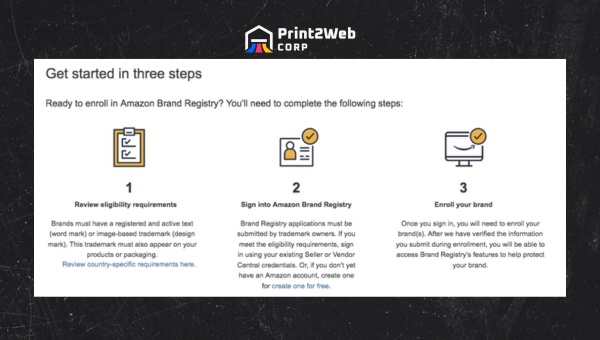
Active Registered Trademark
The most critical requirement is an active registered trademark issued by a government intellectual property office in one of the countries supported by Brand Registry. The trademark must be either a text-based wordmark or a text-plus-image mark containing words, letters, or numbers. Amazon does not accept design-only marks, service marks without registration, or trademarks that are still pending without registration status.
In the United States, this means your trademark must have progressed beyond “pending” status to “registered” status with the USPTO. Intent-to-use applications and pending applications are not accepted for standard Brand Registry enrollment. However, Amazon’s IP Accelerator program, discussed below, provides an alternative pathway for sellers with pending trademarks.
Trademark Type Clarification
Amazon accepts two types of trademarks for Brand Registry: standard character marks, also called wordmarks, and image-based marks that contain text. A standard character mark protects the brand name itself in any font or styling. An image-based mark, also called a stylized or design mark, protects a specific logo design that includes readable text. If you have a design mark, the text within the logo must clearly correspond to the brand name on your product packaging.
Brand Name on Products and Packaging
The brand name on your products and packaging must match the registered trademark exactly. If your trademark is registered as “MountainGear” but your packaging reads “Mountain Gear Outfitters,” Amazon may reject your application due to the mismatch. This requirement catches many applicants off guard, so verify that your packaging, labeling, and trademark all use the identical brand name before applying.
Identity and Ownership Verification
You must verify that you are either the trademark owner or an authorized agent with permission to manage the brand on Amazon. Amazon will request contact information and may reach out to the trademark owner or their attorney to confirm authorization. If you are applying as an authorized agent, you need documentation proving that the trademark owner has granted you permission to manage the brand on Amazon.
Amazon Seller or Vendor Account
You need an active Amazon account, either a Seller Central account or a Vendor Central account, to access the Brand Registry portal. This account is used to log in to the Brand Registry platform where you submit and manage your application. If you do not yet sell on Amazon, you can still create a Seller Central account for the purpose of Brand Registry enrollment.
Product and Packaging Images
Amazon requires clear images showing your brand name or logo as it appears on your actual products and packaging. The images must show the brand name permanently affixed to the product or its packaging, not digitally added or printed on a label that appears temporary. Low-quality, blurry, or poorly lit images are a leading cause of application rejection, so invest in professional-quality photographs that clearly show the brand name on physical products.
Step-by-Step Enrollment Process
The Brand Registry enrollment process is structured into clear stages. Following each step carefully and providing complete, accurate information minimizes processing time and reduces the likelihood of rejection. Here is the complete walkthrough.
Step 1: Confirm Your Trademark Is Registered
Before starting the application, verify that your trademark has full registered status with the appropriate government office. Check the status in the USPTO database (or your country’s equivalent) and confirm the registration is active, not abandoned or expired. The trademark registration number you provide must match what appears in the official database.
Step 2: Access the Brand Registry Portal
Navigate to brandregistry.amazon.com and sign in using your Amazon Seller Central or Vendor Central credentials. If you do not have an Amazon seller account, you will need to create one first. Once signed in, click the “Enroll a New Brand” button to begin the application.
Step 3: Enter Your Brand Information
Provide your registered brand name exactly as it appears in your trademark registration. Select the trademark office where your trademark is registered, enter your registration number, and upload an image of your trademark if it is an image-based mark. Amazon will automatically pull trademark data from the government database to verify your information.
Step 4: Select Your Product Categories
Choose the product categories that apply to your brand. Amazon uses this information to scope where your brand protection and listing control apply. You can select multiple categories if your brand sells across different product types.
Step 5: Upload Product and Packaging Images
Submit clear photographs showing your brand name or logo on your products and packaging. Take photos in good lighting with the brand name clearly visible and readable. Include images of the product itself, the packaging, and any labeling that displays the brand name. The more documentation you provide, the smoother the review process.
Step 6: Submit and Wait for Review
Review all information for accuracy and submit your application. Amazon’s Brand Registry team reviews applications and typically provides a decision within a few business days to two weeks, depending on current processing volumes. You can check your application status through the Brand Registry portal at any time during this period.
Step 7: Complete Post-Approval Setup
Once approved, you gain immediate access to all Brand Registry tools through Seller Central and the Brand Registry portal. Take time to complete the initial setup process, which includes configuring your brand profile, setting up A+ Content modules, creating your Amazon Store, and familiarizing yourself with the Report a Violation tool.
The IP Accelerator Program
Amazon’s IP Accelerator program solves a significant problem for sellers: the lengthy trademark registration process. In the United States, obtaining a registered trademark from the USPTO can take anywhere from 8 to 14 months, and Brand Registry normally requires a fully registered trademark. IP Accelerator bridges this gap by allowing sellers with pending trademark applications to access Brand Registry benefits while their registration is still processing.
Through IP Accelerator, you work with a participating law firm from Amazon’s network to file your trademark application. Once the firm confirms that your application has been filed and meets Amazon’s criteria, you can submit your Brand Registry application using the pending trademark. This means you can access A+ Content, Sponsored Brands, Brand Analytics, and brand protection tools months before your trademark is fully registered.
The program does not change trademark law or guarantee registration approval. If your trademark application is ultimately denied by the USPTO, your Brand Registry enrollment may be revoked. IP Accelerator simply provides earlier access to Brand Registry tools by accepting the pending application as a proxy for registration. The legal fees for filing through an IP Accelerator law firm typically range from several hundred to around one thousand dollars, depending on the firm and the complexity of the application.
Common Application Rejection Reasons
Many Brand Registry applications are rejected on the first submission, often due to avoidable errors. Understanding the most common rejection reasons helps you prepare a complete application that is likely to be approved on the first attempt.
Trademark Mismatch with Brand Name
The leading cause of rejection is a mismatch between the registered trademark name and the brand name shown on product packaging. If your trademark reads “SummitTrail” but your packaging says “Summit Trail Co.,” the application will likely be denied. The solution is to ensure exact consistency across your trademark registration, product packaging, and Brand Registry application. If the names cannot be reconciled, you may need to update your packaging or file an additional trademark that matches.
Pending Trademark Without IP Accelerator
Submitting a trademark application number when the trademark is still in pending status will result in rejection. Standard Brand Registry requires a fully registered trademark. If you only have a pending application, you must go through the IP Accelerator program to enroll before registration is complete.
Low-Quality or Insufficient Product Images
Amazon requires clear, high-resolution images showing the brand name permanently displayed on the product or packaging. Photos that are blurry, poorly lit, show a digitally added logo, or depict the brand name on a temporary label will be rejected. Invest in professional product photography and include multiple angles showing the brand name on physical items.
Design-Only Trademark Without Text
If your registered trademark is a purely visual design without any text, letters, or numbers, it is not eligible for Brand Registry. Amazon’s system relies on text-based brand matching, so a logo without readable text does not qualify. The solution is to file a separate standard character mark or a combined text-and-design mark that includes the brand name in readable form.
Inadequate Proof of Authorization
If you are applying as an agent rather than the trademark owner, you must provide documentation proving authorization. Applications without clear authorization letters or contracts between the agent and trademark owner will be rejected. Ensure that your authorization documentation explicitly grants permission to manage the brand on Amazon.
Post-Approval: Next Steps After Enrollment
Receiving Brand Registry approval is just the beginning. To maximize the value of your enrollment, take these immediate next steps in the days and weeks following approval.
Set Up A+ Content on Your Top Listings
Prioritize your highest-traffic and highest-converting product listings for A+ Content creation. Start with comparison modules that cross-sell related products in your catalog, then add brand story modules that communicate your brand’s unique value proposition. A+ Content can take several days to build properly, so allocate time for design and copywriting.
Build Your Amazon Store
Create a dedicated Amazon Store that showcases your full product lineup. Organize your store with clear category pages, a homepage with brand messaging, and product collection pages that make navigation intuitive. Once your store is live, use Sponsored Brands campaigns to drive traffic directly to your store pages.
Launch Sponsored Brands Campaigns
With Brand Registry active, you can now create Sponsored Brands ad campaigns that appear at the top of Amazon search results. Start with keyword-targeted campaigns using your most important search terms, and consider product collection ads that showcase multiple products in a single placement.
Review Brand Analytics Data
Dive into Brand Analytics to understand how shoppers are finding your products. The Search Terms Report reveals which keywords drive the most clicks and conversions in your category. Use this data to refine your listing titles, backend keywords, and advertising strategy. Combining Brand Analytics with your advertising dashboard gives you a complete picture of your Amazon performance.
Enroll New Products in Amazon Vine
If you have recently launched products or have listings with fewer than 30 reviews, enroll them in Amazon Vine to generate authentic early reviews. Vine reviews build social proof that improves conversion rates and search visibility, making this one of the highest-ROI activities available after Brand Registry approval.
Run Listing Experiments
Use Manage Your Experiments to test different titles, main images, and A+ Content variations. Run one experiment at a time per listing, let it gather sufficient data, and implement the winning version before testing the next element. This iterative approach produces steady conversion rate improvements over time.
For sellers looking toward long-term growth or eventual acquisition, note that Brand Registry enrollment is often a prerequisite for interest from Amazon aggregator solutions that acquire successful brand-registered businesses.
FAQs
What is Amazon Brand Registry?
Amazon Brand Registry is a free program that gives trademark owners enhanced control over their product listings, access to advanced marketing and analytics tools, and intellectual property protection across all Amazon marketplaces where their trademark is registered.
Does Amazon Brand Registry cost anything?
No, Amazon Brand Registry is completely free to enroll in and use. The only costs involved are the fees associated with obtaining your government-registered trademark, which typically range from several hundred to around one thousand dollars depending on your country and whether you use an attorney.
How to access Amazon Brand Registry?
To access Amazon Brand Registry, go to brandregistry.amazon.com and sign in with your Amazon Seller Central or Vendor Central account credentials. Once enrolled, you can manage all Brand Registry tools through both the Brand Registry portal and your Seller Central dashboard.
Do I need a trademark for Amazon Brand Registry?
Yes, an active registered trademark is the primary requirement for Amazon Brand Registry enrollment. The trademark must be a text-based wordmark or a text-plus-image mark registered with a government intellectual property office in a supported country. Pending trademarks are only accepted through the IP Accelerator program.
What is the difference between Brand Registry and Brand Approval?
Amazon Brand Registry requires a registered trademark and provides full brand protection tools, A+ Content, advertising access, and analytics. Amazon Brand Approval is a separate authorization process that allows sellers to list products in restricted categories or sell certain brands, does not require a trademark, and does not provide Brand Registry tools.
Can you sell a product on Amazon without a trademark?
Yes, you can sell products on Amazon without a trademark, but you will not have access to Brand Registry tools and protections. Without enrollment, other sellers can edit your listings, you cannot run Sponsored Brands ads, and you have no access to A+ Content, Brand Analytics, or Amazon Vine.
How long does Amazon Brand Registry approval take?
Once you submit a complete application with all required documentation, Amazon typically reviews and processes Brand Registry applications within a few business days to two weeks. Incomplete applications or those requiring additional verification may take longer.
Can international sellers apply for Amazon Brand Registry?
Yes, international sellers can apply as long as they have an active registered trademark in at least one of the countries supported by the Brand Registry program. A single enrollment provides brand protection and tool access across all Amazon marketplaces where your trademark is registered.
Do I need multiple trademarks for different products?
No, if your products fall under a single brand name covered by one trademark, that is sufficient for Brand Registry enrollment. You only need multiple trademarks if you operate under different brand names that each require separate Brand Registry protection.
What happens if my Brand Registry application is rejected?
If your application is rejected, Amazon will provide a reason. Common causes include trademark name mismatches, pending trademark status, low-quality images, or insufficient proof of authorization. Fix the identified issue and resubmit your application through the Brand Registry portal.
Is Amazon Brand Registry worth it?
For any brand owner selling on Amazon or planning to sell, Brand Registry is highly valuable. The program is free, provides tools that directly increase conversion rates and sales, and offers intellectual property protection that is essential for maintaining brand integrity on a marketplace where counterfeit activity is common.
Can I get Brand Registry with a pending trademark application?
Standard Brand Registry requires a fully registered trademark, but the Amazon IP Accelerator program allows sellers with pending trademark applications to access Brand Registry benefits. You work with a participating law firm to file the trademark, then use the pending application to enroll while the registration processes.
Conclusion
Amazon Brand Registry is an essential enrollment for any serious brand owner on the platform. The program is free, provides a comprehensive suite of marketing and analytics tools, and delivers intellectual property protection that directly impacts your ability to maintain brand integrity and drive sales. From A+ Content and Sponsored Brands advertising to Brand Analytics, Amazon Vine, and the full brand protection toolkit, the value of enrollment far exceeds the time investment required to complete the application process.
If you already hold a registered trademark, begin your enrollment today at brandregistry.amazon.com. Confirm that your brand name matches across your trademark registration and product packaging, gather clear product and packaging images, and follow the step-by-step process outlined in this guide. If your trademark is still pending, explore the IP Accelerator program to access Brand Registry benefits while your registration processes.
Once enrolled, prioritize setting up A+ Content on your top listings, building your Amazon Store, launching Sponsored Brands campaigns, and reviewing Brand Analytics data to refine your strategy. Brand Registry is not a one-time setup but an ongoing advantage that compounds as you leverage each tool to its full potential. In 2026, with competition on Amazon continuing to intensify, the sellers who succeed are those who take full advantage of every tool the platform makes available to enrolled brand owners.
Leave a Reply