
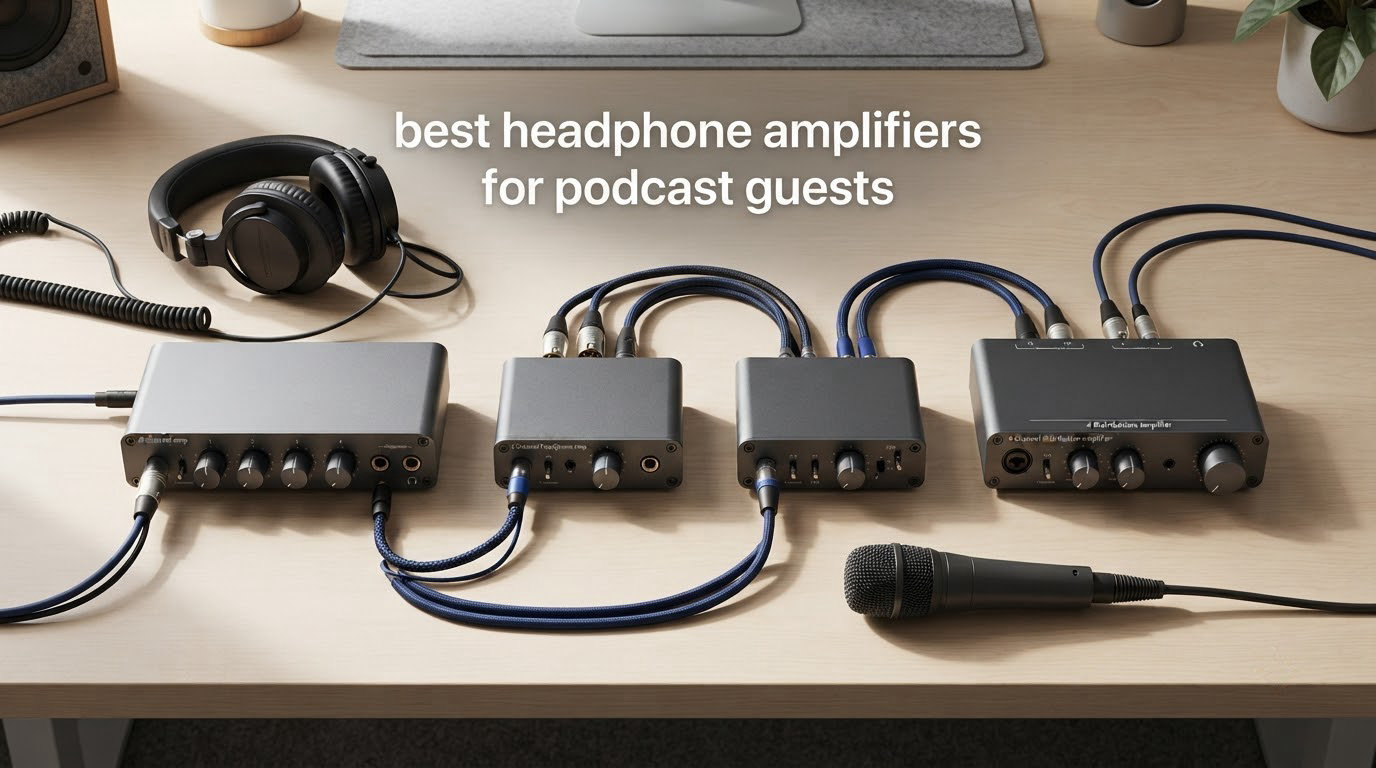
The moment a second person sits down at your podcast table, you find out how many headphone jacks your interface actually has. One. Maybe two. The recording is fine, but now your guest is sitting there with a laptop lid propped against a boom arm, straining to hear the playback monitor at a level that lets them follow the conversation without leaking sound into your microphones.
A multi-channel headphone amplifier is the small box that solves this. It takes one line-level feed from your interface or mixer and splits it into two, four, five or eight headphone outputs, each with its own volume knob. That last detail matters more than most buyers expect: with a passive splitter, one person turning their volume down turns everyone else’s down too, and the person with the least sensitive ears dictates the level for the whole table.
We ran eight of these boxes through the same routine for this guide: one source feeding multiple pairs of closed-back headphones, level changes on every channel, and a check of what each one does with the impedance range podcasters actually use. We deliberately looked for the two failure modes that show up in owner reviews of budget units, a shared signal path that alters the tone, and hiss that becomes obvious in a silent room between sentences. All picks below carry their real owner rating and review count so you can see how much long-term feedback sits behind each one.
Last updated in 2026, and if you are still narrowing the field, our picks for the best desktop headphone amplifiers and best portable headphone amplifiers cover the single-listener side of the category in more depth. Everything here is built for the multi-person question.
Our Top 3 Headphone Amplifiers for a Podcast Table

Mackie HM-4
- Four independent level controls
- Drives 1/4 inch or 1/8 inch sources
- 8 ounce metal chassis

These three cover the situations most podcasters are actually in. The Mackie HM-4 is the one we would put behind a four-person table because the level pots feel like studio gear and there is enough gain for the high-impedance headphones owners keep asking about. The Pyle PHA40 is the cheapest way to get four pairs running, and it has the largest owner base in this group. The FIFINE N6 sits between them with a metal chassis that takes daily moving around better than plastic.
Comparing 8 Headphone Amplifiers Side by Side in 2026
| Product | Specs | Action |
|---|---|---|
| Mackie HM-4 |
|
Check Latest Price |
| Pyle PHA40 |
|
Check Latest Price |
 FIFINE N6 FIFINE N6 |
|
Check Latest Price |
 LZSIG 4-Channel Headphone Amp LZSIG 4-Channel Headphone Amp |
|
Check Latest Price |
 Fosi Audio PH05 Fosi Audio PH05 |
|
Check Latest Price |
 Bolanle PH400 Bolanle PH400 |
|
Check Latest Price |
 Behringer HA8000 V2 Behringer HA8000 V2 |
|
Check Latest Price |
 STABCL 8-Channel Headphone Amp STABCL 8-Channel Headphone Amp |
|
Check Latest Price |
One column worth reading twice is the input. Seven of these eight take a single stereo feed and do nothing else, which is exactly what you want when your interface is already handling the mic preamps. Only the Behringer HA8000 V2 adds a per-channel direct input, and that one changes what it is useful for.
1. Mackie HM-4 – Editor’s Choice for Four-Person Monitoring
Mackie HM-4 Headphone Amplifier (4-Channel), Compact Splitter, Black
Four independent outputs
1/4 inch or 1/8 inch source input
8 ounce metal chassis
2.3 x 4.3 x 2 inch
Pros
- One real level control per listener
- Enough gain for high-impedance studio headphones
- 8 ounce metal chassis that mounts anywhere
- Low noise at normal listening levels
Cons
- No stereo or mono switch
- Only a power indicator LED rather than an illuminated switch
The HM-4 is the box we ended up leaving on the studio desk. Every one of the four outputs has its own level control, so a guest can turn themselves down without touching anyone else’s setting, and the pots have the weighted feel you would expect from a Mackie product rather than the scratchy micro pots found on the cheapest units.
It also runs quietly. Owners consistently report low noise and no hum or crackle at normal listening levels, and several mention a measurable improvement in clarity and bass weight compared with an interface headphone output on its own. For a podcast that is the whole argument: the monitoring feed is the thing a guest reacts to, and a clean feed reads as a more professional show.
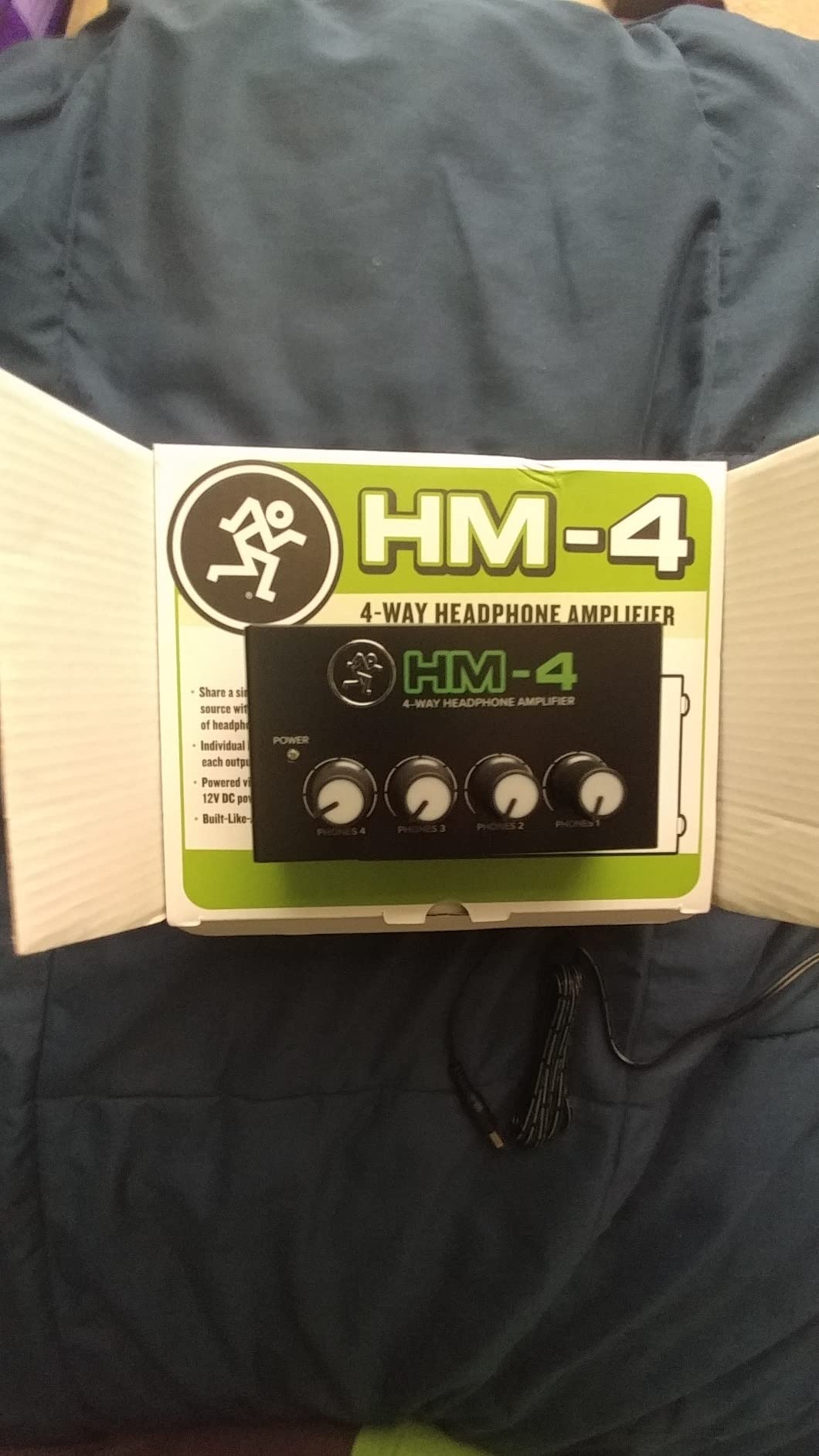
Four Real Level Controls, Not One Shared Pot
Independent volume is the feature that separates an amplifier from a splitter, and the HM-4 implements it properly with one attenuator per channel. Plug your interface output into the 1/4 inch input on the back, run a 1/4 inch TRS cable from each front output to a pair of headphones, and each person sets their own level.
That matters even more with guests than with hosts. A first-time guest on a four-person roundtable has no idea what a normal level is for the show, and being handed a knob that changes everyone else is the fastest way to make them self-conscious about asking for more volume.
Gain Headroom for 250-Ohm Studio Headphones
The HM-4 has enough gain to drive high-impedance studio headphones such as the AKG Q701 and Beyerdynamic DT770 class models, which is where budget distribution boxes usually fall short. Those cans need far more voltage than a typical 32 ohm studio pair, and a weak amp either runs quiet or introduces distortion trying to reach a usable level.
If your show runs 250 ohm or 300 ohm headphones, this is the main reason to spend above the entry tier. For 32 ohm and 38 ohm closed-backs, the extra headroom is simply spare capacity you may never touch.
Desk, Rack or Stand Mounting
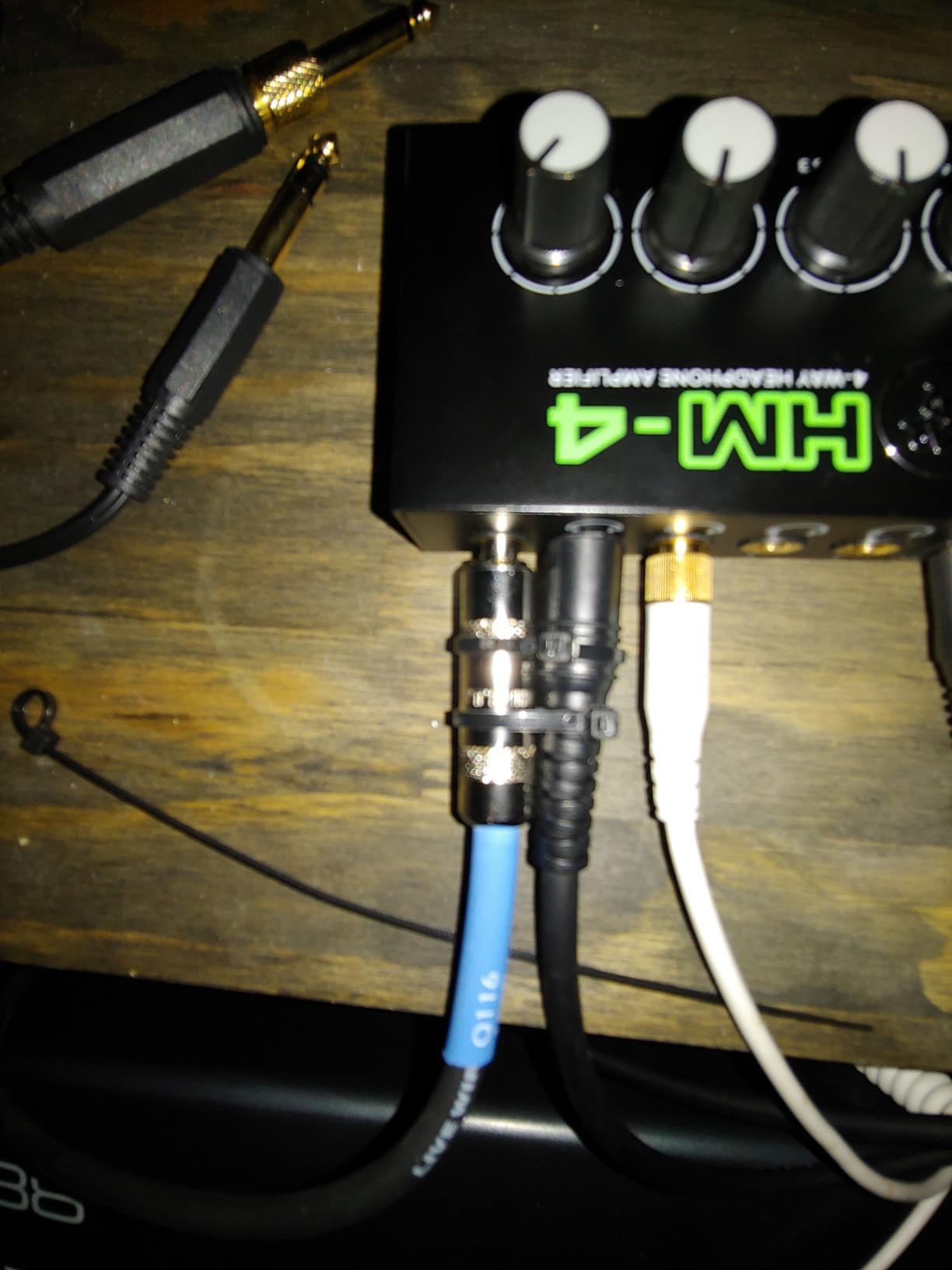
At 8 ounces and 2.3 by 4.3 by 2 inches, the HM-4 can be velcro-mounted to a desk edge, a rack rail or a stand, which keeps the headphone cables off the floor of a small studio. Metal construction means it survives being dropped in a bag between a session and an interview.
Power is corded electric and operation is plug and play with no power supply games, so there is no balancing ritual to explain to a guest who arrives early and starts poking at things.
Where the HM-4 Falls Short
There is no stereo or mono switch and no bass tone shaping, which some owners building a permanent broadcast-style control room will miss. The power control is a small indicator LED rather than a lit switch, so it is easy to leave running overnight.
A small number of buyers received a box that failed to power on, and owners report occasional hum when it sits directly beside noisy gear or power bricks. Keep a short distance between the HM-4 and your interface power supply and the problem usually disappears.
2. Pyle PHA40 – Budget Pick for a Four-Person Table
4-Channel Portable Stereo Headphone Amplifier – Professional Multi Channel Mini Earphone Splitter Amp w/ 4 ¼” Balanced TRS Headphones Output Jack and 1/4″ TRS Audio Input For Sound Mixer – Pyle PHA40 BLACK
Four 1/4 inch TRS outputs
1/4 inch TRS input
Independent rotary volume
4.07 x 1.18 x 2.24 inch
Pros
- Powers four headphone pairs from one stereo source
- Independent volume knob for each listener
- Ultra-low noise design for the price tier
- Compact housing that travels well
Cons
- Plastic housing feels cheap beside metal options
- 1/4 inch jacks only so 3.5 mm earbuds need adapters
- Single input cannot blend two sources
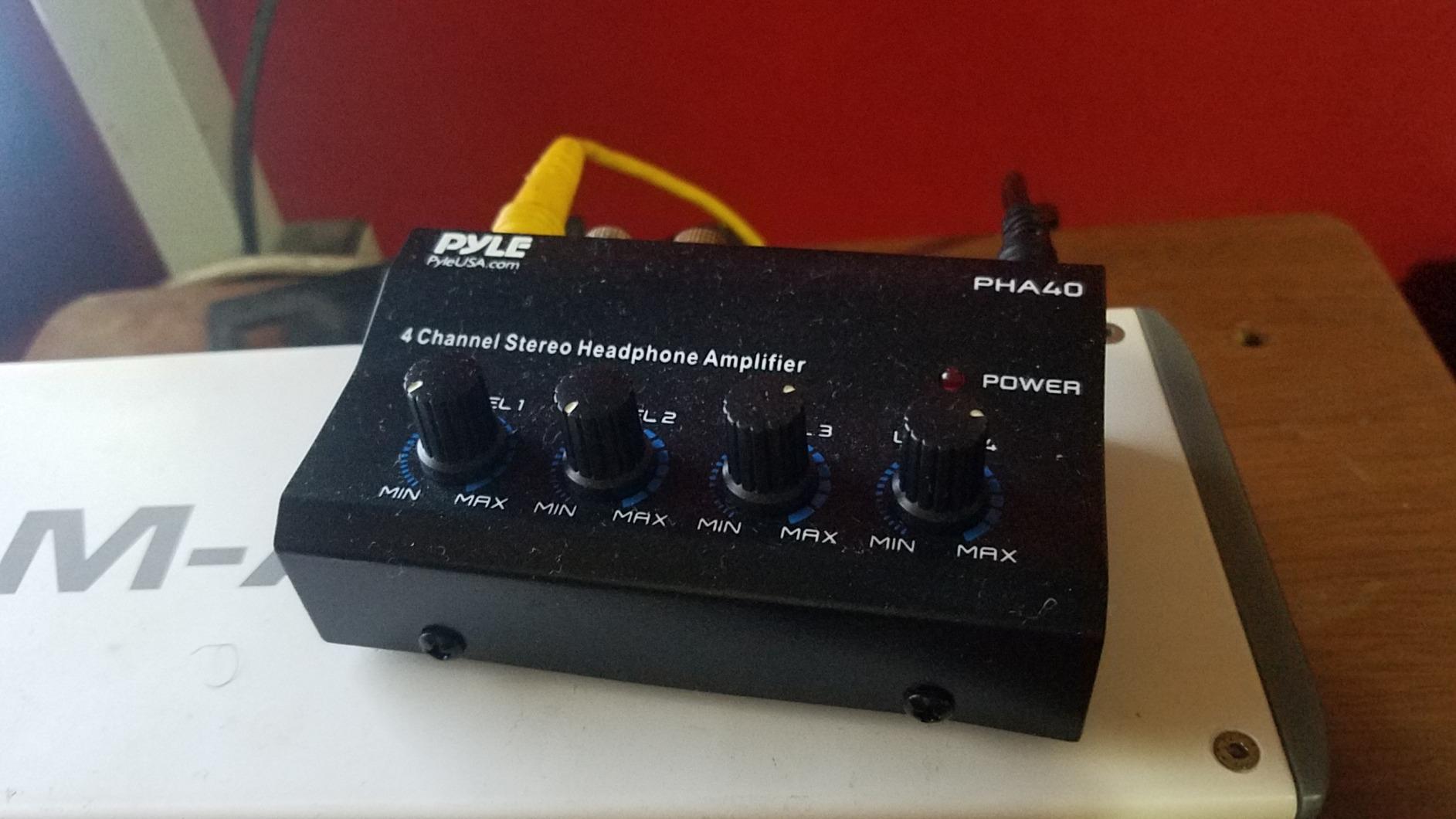
The PHA40 is the most widely reviewed unit in this roundup at more than 2700 owner ratings, and that volume of feedback is part of why we included it. It does the core job: one stereo source into four headphone outputs, each with its own rotary level control, in a housing small enough to sit behind a microphone stand.
It is used far more for tracking sessions and rehearsals than for polished interviews, which tells you where the value sits. If you need four people to hear the same playback feed and none of them are making critical mix judgements, this is the cheapest way to do it.
Four Listeners on a Very Compact Footprint
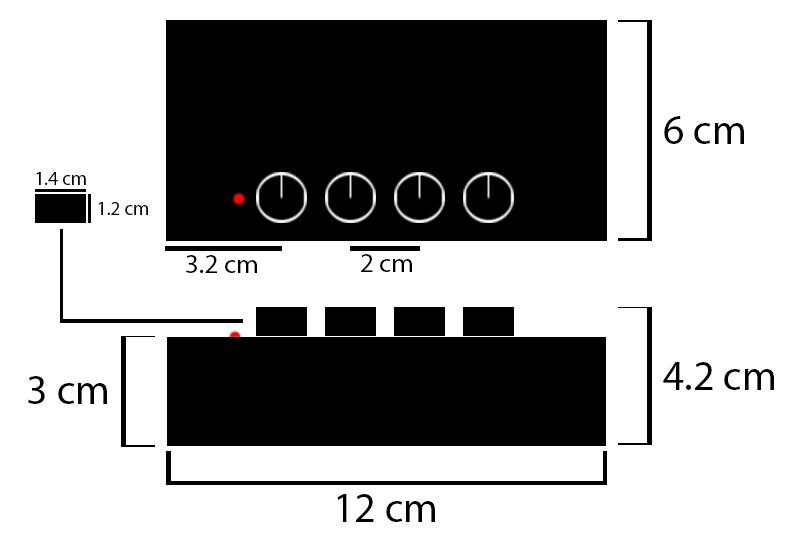
The enclosure measures 4.07 by 1.18 by 2.24 inches, which makes it one of the more compact four-channel boxes in this roundup. That size matters in the guest table scenario, where the amplifier competes for the same surface as two mic stands, two boom arms and a notebook.
Owners like it for exactly that reason. It gets carried between the home desk and a mobile rig without needing its own bag, which is more than can be said for a rack chassis.
1/4 Inch Jacks Only Means Adapter Juggling
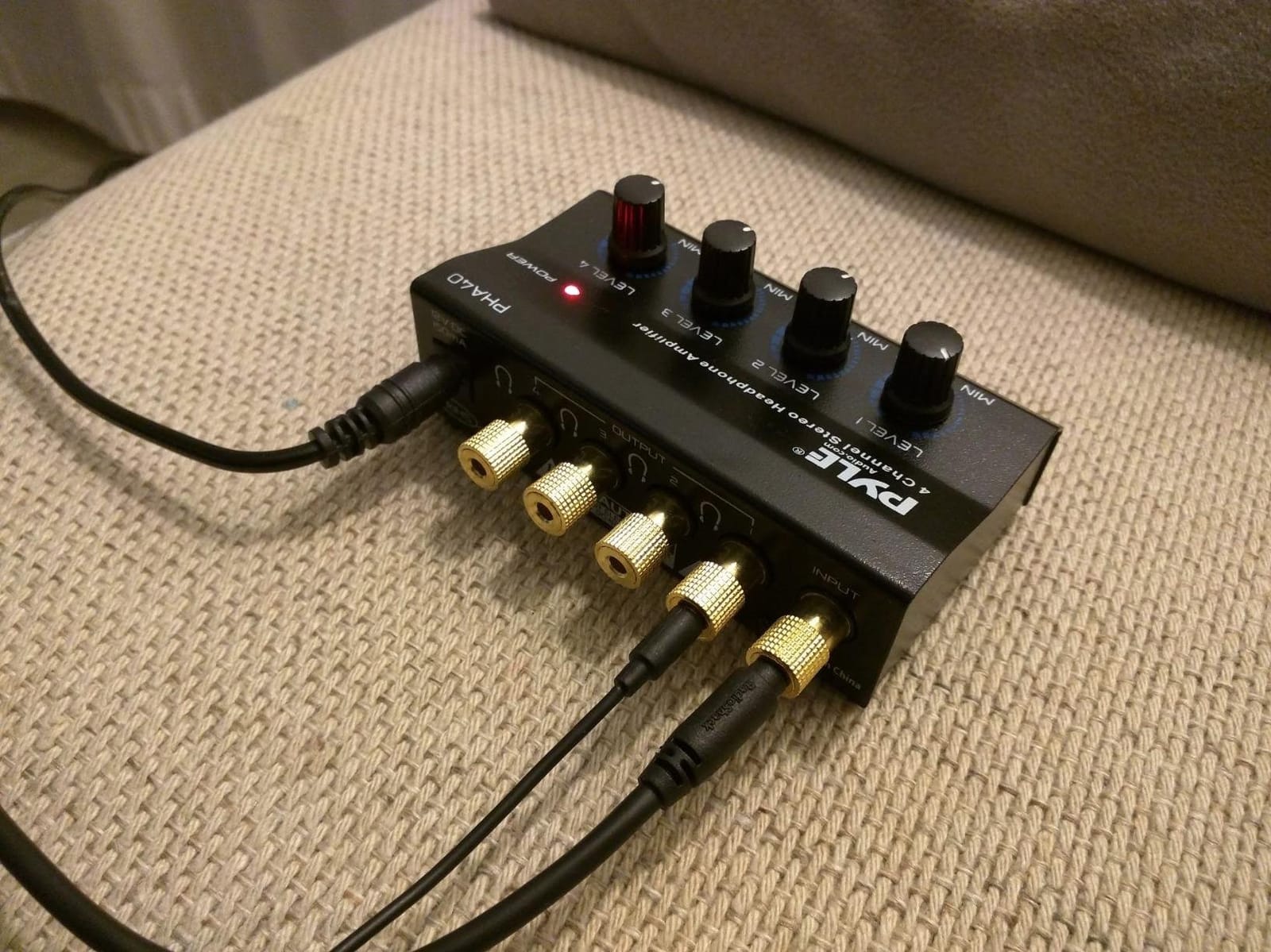
All four outputs are 1/4 inch TRS and the single source input is 1/4 inch TRS as well. If a guest arrives with 3.5 mm earbuds or a pair of on-ear headphones wired with a 3.5 mm plug, you need adapters at the table, and that is a failure point nobody wants in the middle of a conversation.
The upside is that 1/4 inch TRS is the standard for studio headphones, so if you own four pairs of closed-back monitoring cans you can wire the whole table without a single adapter.
The Plastic Housing Trade-Off
The enclosure material is plastic, and it is the first thing owners mention when they compare it to a metal alternative. It does not crack or distort, but it flexes slightly if you press on the top panel, and the knobs feel lighter in the hand.
Rated warranty coverage is one year. For a box that lives on a shelf between interviews, that is unremarkable but also unremarkable to claim.
Best Suited to Rehearsal and Tracking Rooms
Because there is a single stereo input and no onboard mixing, the PHA40 cannot blend a second source. If your show needs playback music running under a conversation, you need that blend upstream in your interface or mixer.
Reviewers do raise occasional noise complaints on a minority of boxes, and the seven percent one-star share in the ratings reflects the usual mix of DOA and dead-channel reports. Test all four outputs before your first recording session rather than during it.
3. FIFINE N6 – Best Value Metal Four-Channel Amp
FIFINE N6 4 Channels Metal Stereo Headphone Amplifier for Audio Mixer
One 1/4 inch TRS input
Four 1/4 inch TRS outputs
Independent volume per channel
12V DC adapter included
Pros
- Solid metal chassis with tight smooth knobs
- Four independent volume controls from one stereo feed
- Reports of no signal loss or crackle on all four channels
- 12V DC adapter with power-on indicator included
Cons
- TRS and TS cables are not included
- 1/4 inch jacks only so 3.5 mm needs adapters
- Single input means no onboard mixing
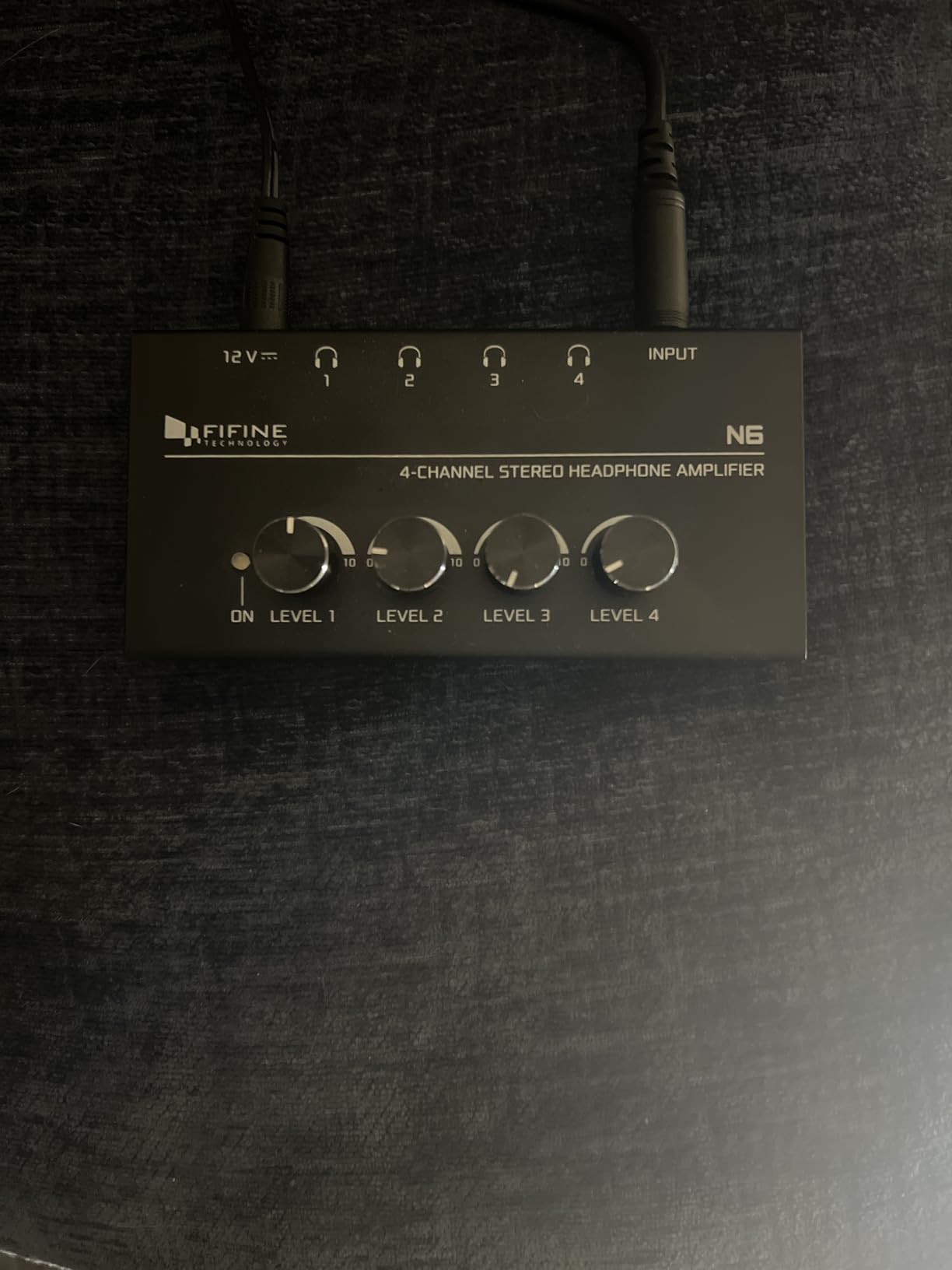
The N6 answers the most common complaint about budget four-channel boxes, which is that they feel like they will not survive being moved. The chassis is solid metal with tight connections and smooth knobs, and at nearly 2000 owner ratings it has a long enough track record to be worth trusting in a working studio.
Sonically it sits alongside the Mackie in the group for a podcast feed, with an ultra-low noise design and minimal distortion at high volume. The practical difference from the PHA40 is build quality, and the practical difference from the Mackie is the absence of any documented gain advantage for high-impedance headphones.
A Metal Chassis at a Budget Price
Owners single out the metal construction and the quality of the volume pots as the reasons they prefer it to plastic-bodied alternatives. The knobs are smooth through their travel rather than scratchy, which means a guest adjusting their level mid-sentence is not going to produce a burst of crackle.
That single detail has more effect on how a first-time guest experiences the session than any specification on the box. A host who fidgets with a stiff potentiator sends a signal that you are about to record.
Cables Are Not in the Box
This is the caveat owners mention most, and it is worth planning for. TRS and TS cables are not supplied, so you need one 1/4 inch TRS male-to-male cable for the source and four more for the outputs.
Run stereo operation with 1/4 inch TRS cables and mono operation with 1/4 inch TS, which is the standard wiring the unit expects. A 12V DC power adapter with a power-on indicator light is included.
Clean Output Across All Four Channels
Users report no signal loss or crackle even with all four outputs connected, and the rating distribution sits heavily positive with 73 percent five-star. For a monitoring feed rather than a mix judgement, that is exactly what you want.
It is also compact enough for stage and studio bags, so the same box works for a rehearsal room and a recording session without a different rig.
Where It Fits in a Podcast Room
Choose the N6 when you want four channels, a chassis that handles being moved, and clean monitoring, but you are running 32 or 38 ohm headphones and do not need 250 ohm headroom. If you are running heavier cans, the Mackie HM-4 is the safer bet.
The single input is the hard limit. Blending a guest call, music bed and your own playback all happens upstream, so pair it with a mixer or interface that already handles that.
4. LZSIG 4-Channel Amp – Best for Mixed Jack Sizes at the Guest Table
LZSIG Headphone Amplifier with Bass Boost, 1‑IN Multi‑OUT, 12V, 4 Channel
One stereo input and four outputs
Accepts 3.5 mm and 6.35 mm
Bass boost and mono switch
4.13 x 2.95 x 0.98 inch
Pros
- Works with 3.5 mm and 6.35 mm headphones without adapters
- Bass boost and stereo or mono switches per channel
- Five ROHM low-noise op amps inside
- Metal chassis with a 4.13 inch footprint
Cons
- Some owners hear a slightly brighter split than a direct out
- Included cable is short
- Mono button feels loose and can partially invert phase
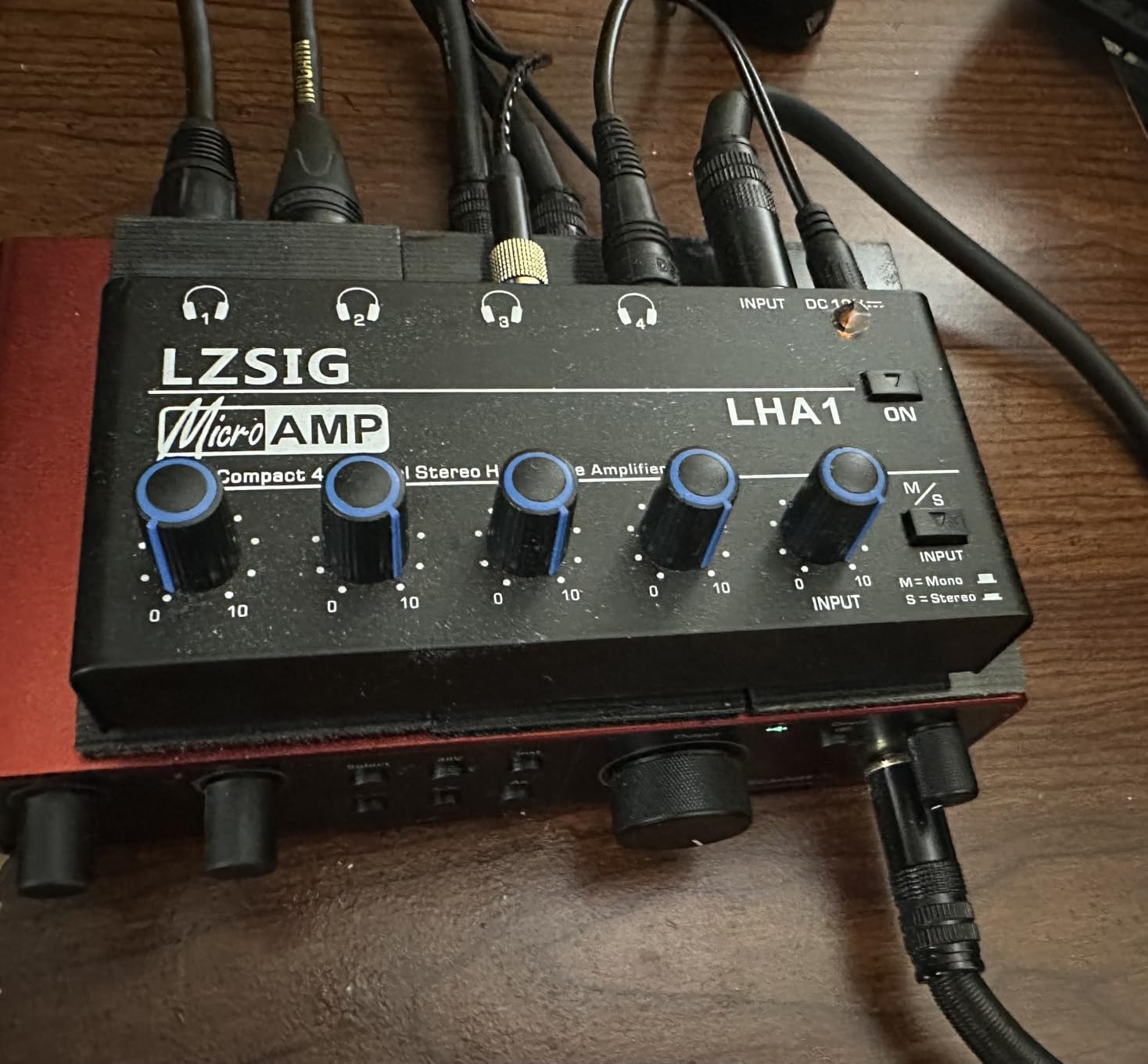
Most four-channel boxes in this guide take 1/4 inch plugs, which means an adapter ring on the table for anyone who turns up with consumer headphones. This LZSIG unit accepts both 3.5 mm and 6.35 mm headphones without adapters, and in a room where the participants do not all own identical studio gear, that removes a recurring annoyance.
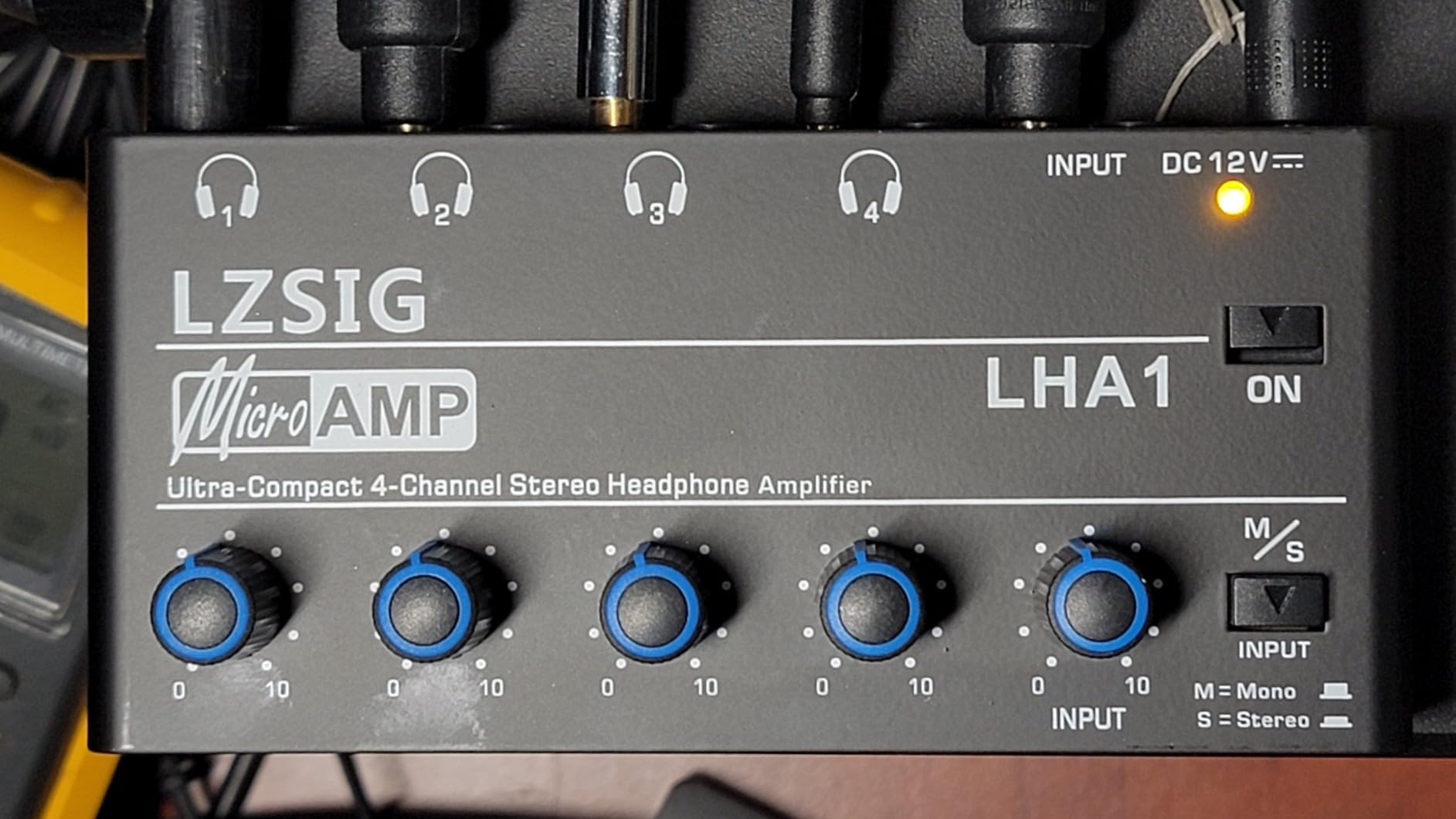
It is also the only four-channel unit here with per-channel tone and mode switching, which gives you two tools that are genuinely useful for voice: a bass boost that lifts the 400 to 600 Hz and 3000 to 7200 Hz bands, and a stereo to mono switch for checking how a conversation translates.
Both 3.5 mm and 6.35 mm Without Adapters
The supported impedance is 32 to 100 ohm by rating, with users reporting that they drive 250 ohm models successfully. Both jack types are present on every channel, so you can hand a guest whatever they brought and still give them a working level.
Inside there are five ROHM low-noise op amps and an anti-crosstalk circuit design on each channel. That last part matters when four people are talking at once, because channel bleed between outputs would be audible in a shared room.
Bass Boost and Mono Switching for Voice Work
Voice is a narrow band of frequencies, and a headphone that sounds flat on music can sound thin on speech. The per-channel bass boost switch is there to compensate for exactly that, and because it is per channel you can compensate for a guest with different hearing rather than changing the feed for everybody.
The stereo and mono mode switch is compatible with 1/4 inch and 1/8 inch TS and TRS plugs, so a mono source is handled correctly instead of collapsing to one ear.
Why Some Owners Hear a Slightly Brighter Split
This is the substantive criticism in the reviews and it is worth stating plainly. Owners using it for monitoring report the split signal as less warm and slightly brighter than a direct headphone output, which is why engineers tend to keep it for guest monitoring rather than final mix decisions.
Other reported gripes are that the included cable is short, and that the mono button feels loose and can partially invert phase in mono mode. For a monitoring box feeding guests, none of that changes the usefulness, but if you are mixing on it you should know.
Six and Eight Channel Versions Exist
The same family also comes in six-channel and eight-channel versions, which matters if your roundtable is growing. At 12 ounces and 4.13 by 2.95 by 0.98 inches, the four-channel unit still fits a small desk, so you are not forced to jump straight to a larger box to add one person.
Power is 12V, and the metal chassis with heavy-duty knobs is the part owners consistently praise as feeling more substantial than the price suggests.
5. Fosi Audio PH05 – Five Outputs for Larger Guest Tables
Fosi Audio PH05 5-Channel Headphone Splitter Amplifier, Mini Headphones Amp for Music Studio, Audio Sharing, Podcast Monitor, Supports 16-300 Ohm High Impedance IEM with 12V Power Adapter
One in and five out
Up to 310 mW per channel at 32 ohm
16 to 300 ohm range
24-month warranty
Pros
- Five independent outputs plus a master volume and one-touch mute
- Rated for 16 to 300 ohm loads including in-ear monitors
- 105 dB signal to noise and 0.001 percent THD
- 24-month warranty is the longest here
Cons
- Newer listing with a smaller pool of owner reviews
- Single input so multiple sources need an upstream mixer
- Needs the bundled 12V adapter rather than USB bus power
The PH05 is the point at which a podcast table outgrows four channels. Five independent outputs with a large-diameter master volume and a one-touch mute is a control layout designed for handing control to a host and passing it to guests, rather than four identical pots and a guessing game.
It is also the first unit in this guide with a published impedance range that covers in-ear monitors as well as high-impedance studio headphones, running from 16 to 300 ohm. That means you do not have to keep two different amplifier boxes for the person on IEMs and the person on 250 ohm cans.
Five Channels Plus a Master Level and Mute
Each channel has an independent level knob, and there is a separate master volume above them. The master control is the useful part for a live taping session: you set the ceiling once, hand each guest their own channel knob, and nobody can accidentally push the whole room into your microphones.
The one-touch mute is a small thing that saves a real problem. A guest who is not supposed to hear the playback feed yet can be muted without unplugging anything, which avoids the loud pop that comes from pulling a connector under load.
Rated From 16 to 300 Ohm
Up to 310 mW per channel into 32 ohms is a meaningful amount of power for a distribution box this size. Combined with the 16 to 300 ohm range, it means a table can mix a pair of in-ear monitors, a 32 ohm closed-back and a 250 ohm studio headphone without any of them being the weak link.
That flexibility is the reason to choose this over a four-channel unit, not raw loudness. The moment one person on the panel has in-ears, a 32 ohm-only budget box forces everyone else to share its compromise.
Measured Figures Worth Comparing
The published figures are strong for the class: signal-to-noise ratio up to 105 dB, total harmonic distortion as low as 0.001 percent, and a noise floor as low as 25 microvolts. Those are the numbers to check first when a room is quiet enough that a monitoring hiss becomes audible between sentences.
For a podcast, that is not an audiophile concern. A guest who can hear amplifier noise starts talking more quietly, which is a worse outcome than any amount of high-frequency extension.
A Newer Listing With Fewer Owners
At 141 owner ratings this is the thinnest review base in the roundup, and it is the main reason it does not carry our top badge despite a 4.6 rating. The one-star share is the lowest of any pick here at one percent, but a small pool is a small pool.
It also needs the bundled 12V power adapter, so it is not USB bus powered, and the single input means multiple sources still need an upstream mixer. Weight is 1.1 pounds on an all-aluminium alloy chassis with anti-slip foot pads, and the warranty runs 24 months.
6. Bolanle PH400 – Eight Jacks From Four Amplifier Channels
Bolanle PH400 4-Channel Headphone Amplifier 8-Output 3.5mm 6.35mm 250Ω
4 x 3.5 mm plus 4 x 6.35 mm jacks
Rated to 250 ohm
Mono and stereo toggle
5.75 x 3.11 x 0.98 inch
Pros
- Eight jacks from four channels in both 3.5 mm and 6.35 mm
- Rated to 250 ohm with plenty of gain headroom
- Mono and stereo toggle for sound checks
- Metal housing at 5.75 inches wide
Cons
- Noticeable hiss and a faint whine at higher gain
- Crosstalk when gain pots are mismatched
- LED knob colour cycles drift out of sync
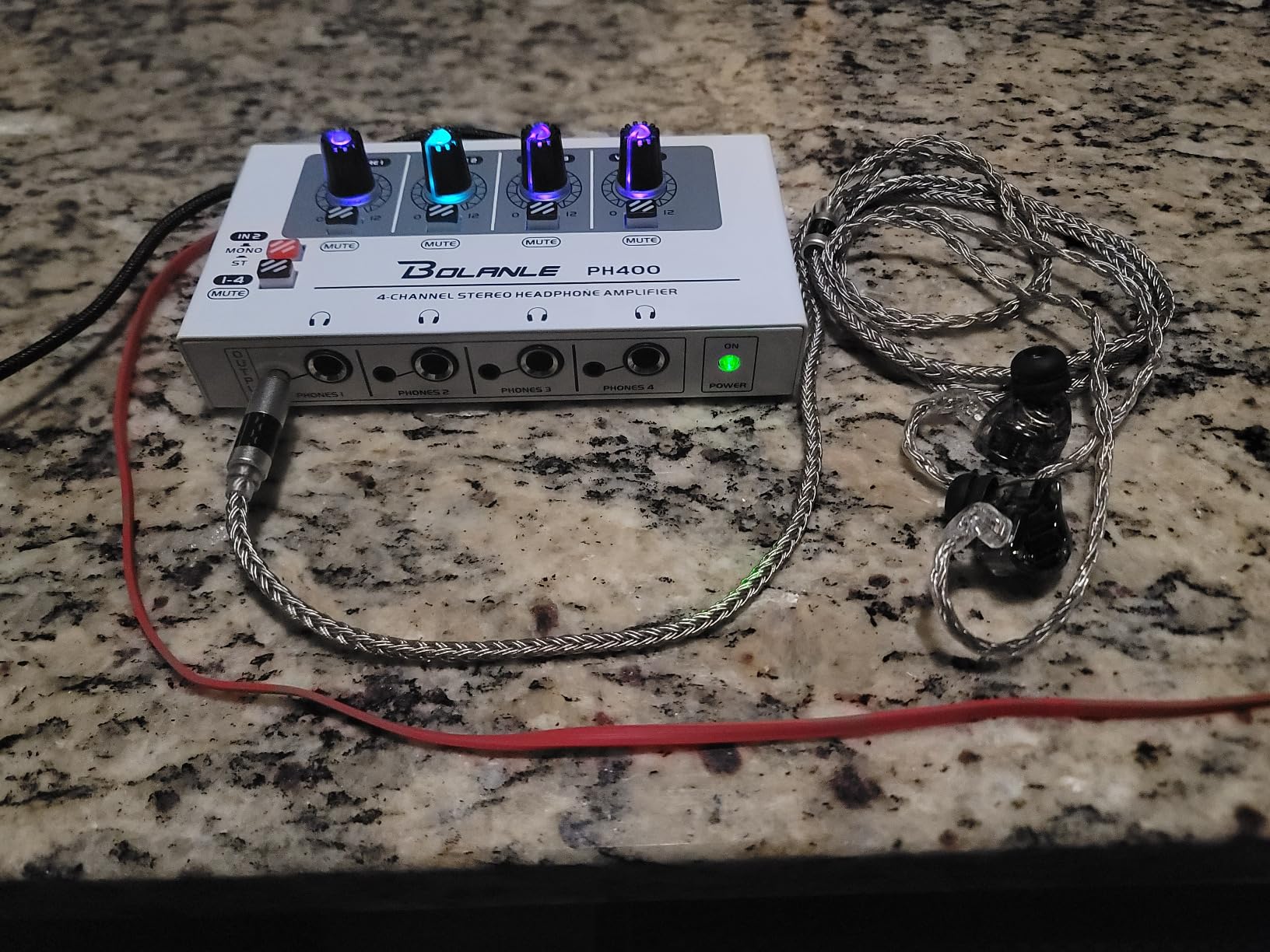
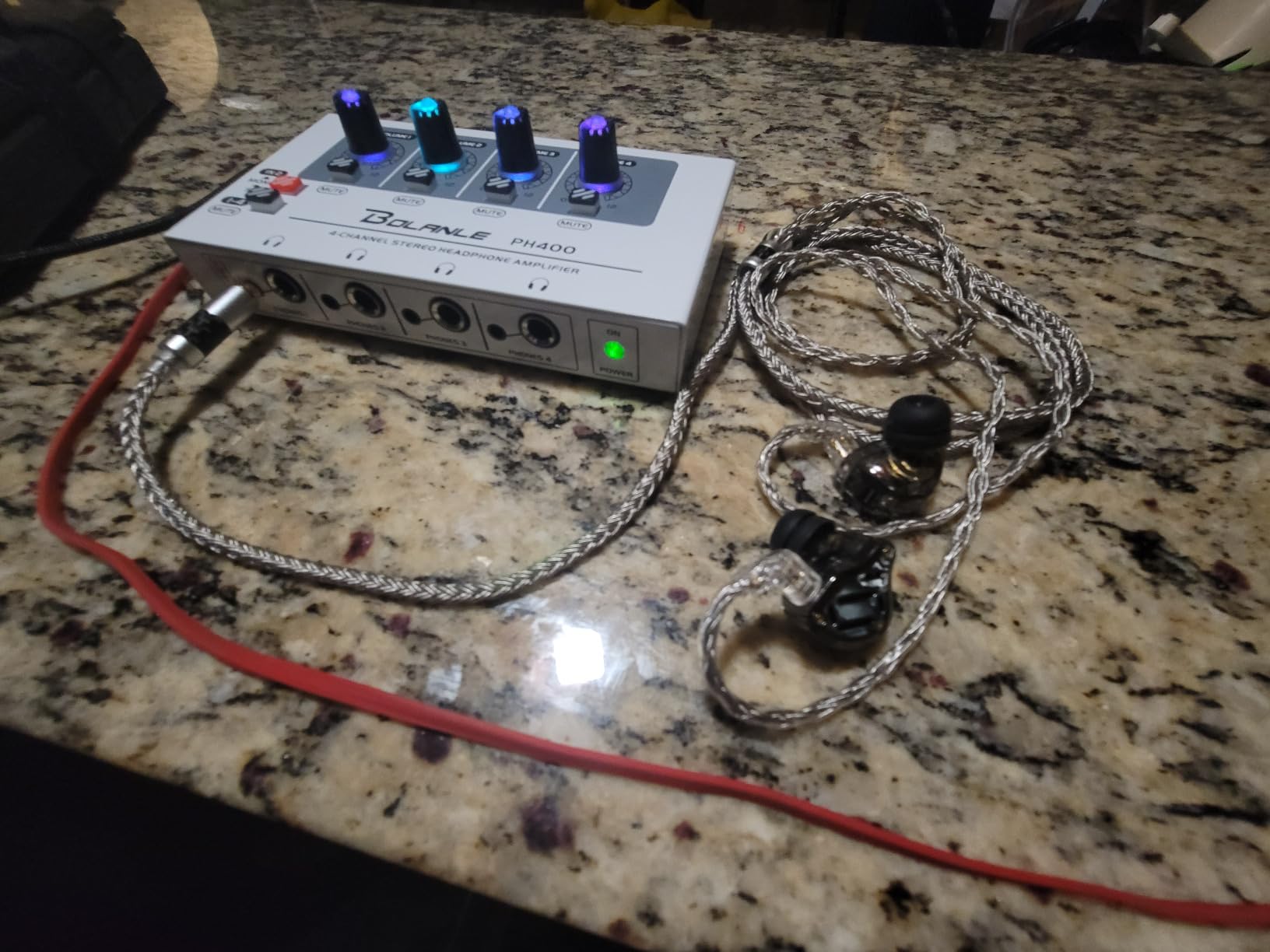
This one is unusual in how it counts outputs. Four amplifier channels are exposed as eight physical jacks, four 3.5 mm and four 6.35 mm, with no interference between them. That gives you a full four-person table where a guest with 3.5 mm earbuds and a host with 1/4 inch studio headphones both plug in directly.
Owners report more gain and cleaner output than several competing four-channel boxes, and a few describe it as a better-sounding alternative to the Fosi PH04 at a similar level. Rated to 250 ohm, it is listed as driving professional monitoring headphones such as the Audio-Technica ATH-M50x and Sony MDR-7506.
Both Jack Types on the Same Box
Frequency response is 20 Hz to 20,000 Hz and sensitivity is 100 dB, and the unit is rated to 250 ohm. The housing is metal at 5.75 by 3.11 by 0.98 inches and 12.32 ounces, powered from a DC 5V/3A input, with the charger and a user manual in the box.
The two 3.5 mm and two 1/4 inch pairs mean a four-person panel can be wired without buying a single adapter, which is the whole argument for this design. Where it differs from the LZSIG is that the extra jacks here do not add channels, they duplicate the four that exist.
Hiss and Whine Appear at Higher Gain
The recurring criticism in the reviews is noise. Hiss and a faint high-pitched whine appear at higher gain settings on some builds, and channel-to-channel crosstalk shows up depending on how the gain pots are set relative to each other.
That is manageable with a plan. Set the gain pots to matching positions and treat them as trim, not as a per-person volume control, then use your interface or the source level for the actual balance. Mismatched pots are what cause the crosstalk.
The LED Knobs Are Decoration
The 7-colour breathing LED volume knob gives visual level and status feedback, which is genuinely useful on a dim stage. In a quiet recording room it adds nothing, and owners note that the independent colour cycles drift out of sync, which reads as a fault even when the audio is fine.
The mono and stereo toggle for live sound checks, in-ear monitoring and critical listening is the more functional feature, and worth using before you record rather than after.
Who Should Skip It
At 84 owner ratings this has the second-smallest feedback base here, and the noise criticism is specific enough to be worth hearing before you buy. If your show is a quiet conversation in a treated room, the Mackie HM-4 or the FIFINE N6 are quieter and better documented.
Pick this one when jack variety is your actual problem, or when in-ear monitors and over-ears have to share the same box.
7. Behringer HA8000 V2 – Eight Channels for a Permanent Install
Behringer HA8000 V2 8-Channel High-Power Headphone Mixing and Distribution Amplifier | For Professional Stage and Studio Applications
Eight discrete amplifier channels
Up to 16 headphone pairs
Per-channel 8-digit LED meters
19 inch rack-mount chassis
Pros
- Eight channels feeding up to sixteen headphone pairs
- High-power sections drive loads down to 8 ohms
- Per-channel 8-digit LED level meters
- Per-channel direct inputs allow separate mixes per listener
Cons
- Main bus inputs do not override a channel direct input
- 5.3 pound rack chassis is bulky for a desktop
- No headphones or cables included
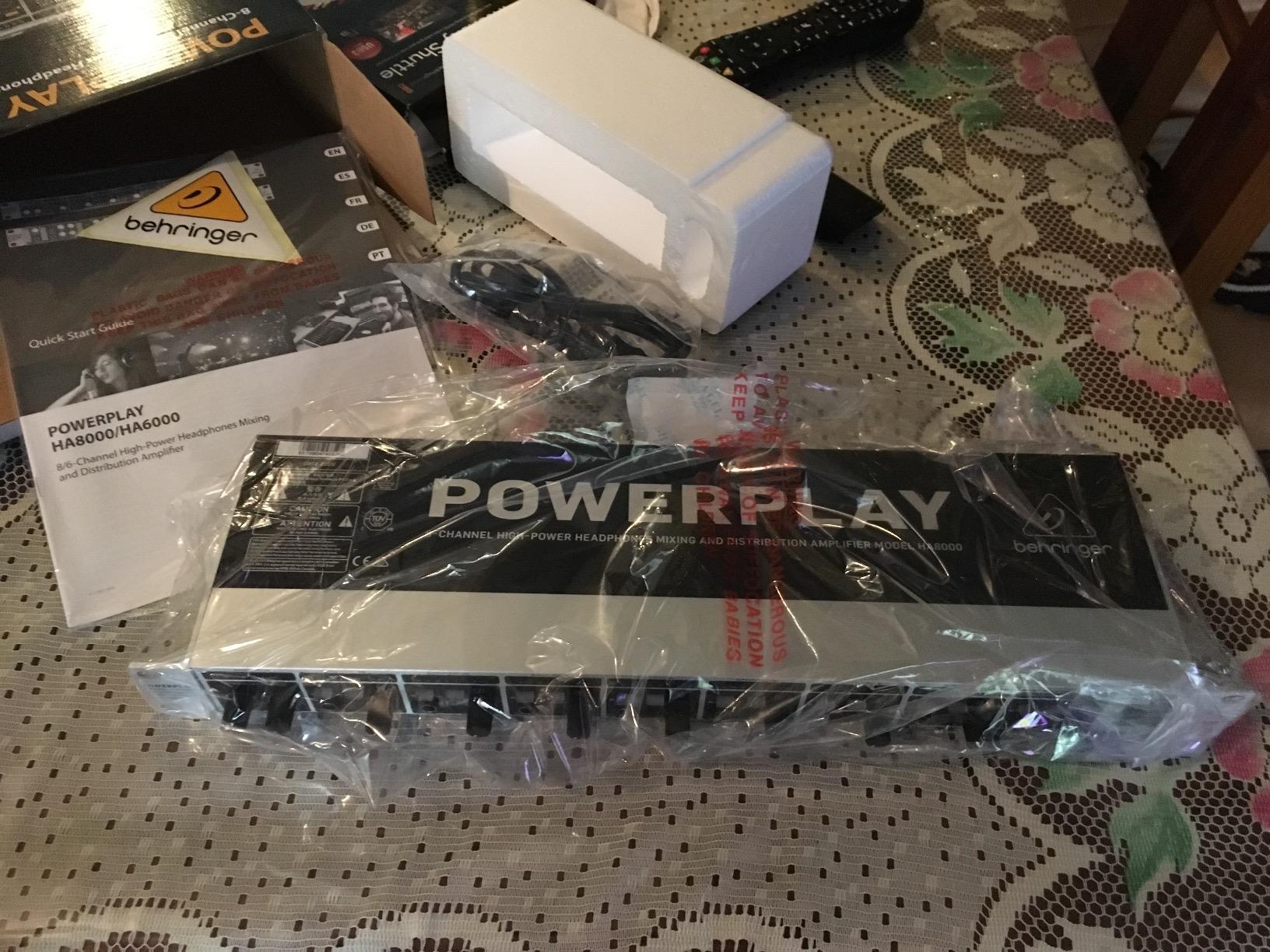
The HA8000 V2 is the only genuinely rackable unit in this guide, and it is a different class of device from the four-channel desktop boxes. Eight discrete high-power amplifier sections drive loads down to 8 ohms, which means in-ear monitors, closed-backs and open-backs can share the same distribution without anyone being starved.
It is built for rooms where monitoring is permanent: churches, rehearsal spaces, broadcast booths and studios. For a two-person show on a desk, it is enormously more than the job requires.
Eight Channels Feeding Up to Sixteen Headphone Pairs
There are eight front phones outputs and eight rear-panel 1/4 inch phones outputs, so one channel can feed two people. That doubling is what makes it useful for a panel or a live taping where you have a host plus a production team all needing a feed.
Audio input is 1/4 inch TRS and the included components are the HA8000 with its power cable. No headphones and no cables are supplied, so budget for a set of TRS leads whatever you decide.
Per-Channel Meters and Direct Inputs
Each channel has an 8-digit LED output level meter, which means you can see a guest who has quietly turned their monitor up without unmuting their microphone or asking you. On a shared table that visibility is worth more than any tone control.
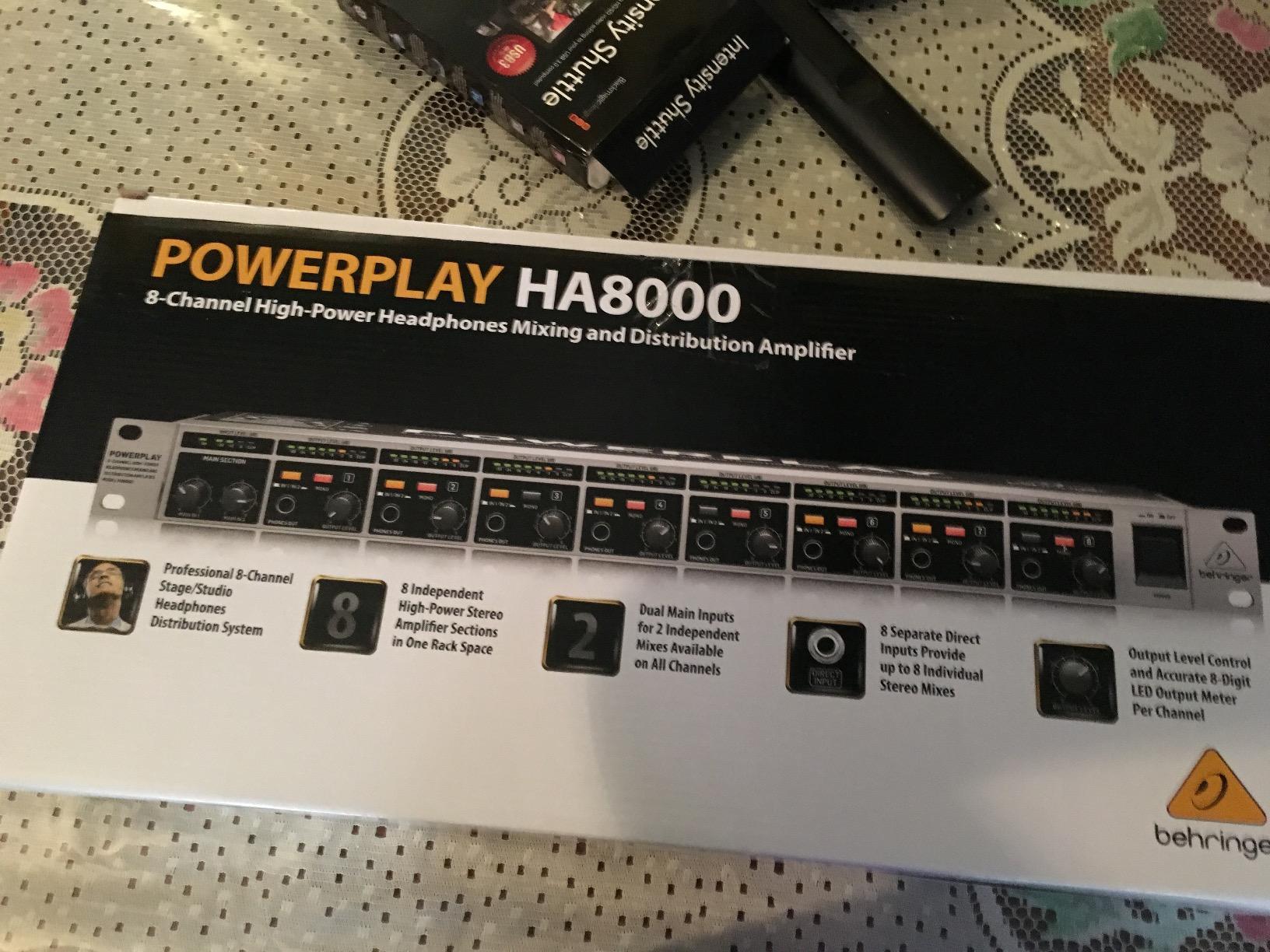
Each channel also has a direct 1/4 inch input for adding an additional source, plus a Main In 1 and Main In 2 select and a stereo/mono or dual-mono switch. With those direct inputs active you can effectively run eight separate monitor mixes, one per person, which is a real mix-minus capability no other pick here offers.
The Main Input Learning Curve
The single most repeated complaint is that the main bus inputs are only audible on channels that do not have their own direct input. If a channel has something plugged into its direct input, that input wins and the main feed disappears from that channel.
This surprises first-time users every time. Plan your patching before the session: decide which channels are fed from the main bus and which need their own source, and do not expect a channel to blend both.
Not a Desktop Unit
At 5.3 pounds in a 19-inch rack chassis, it needs a rack space or a shelf and real cable management behind the desk. Warranty handling runs through the Music Group rather than a straightforward return path, which is worth considering if you are putting a whole room on it.
The rating distribution is among the strongest here, 80 percent five-star and 14 percent four-star. The people who buy it for a monitoring distribution hub tend to keep it.
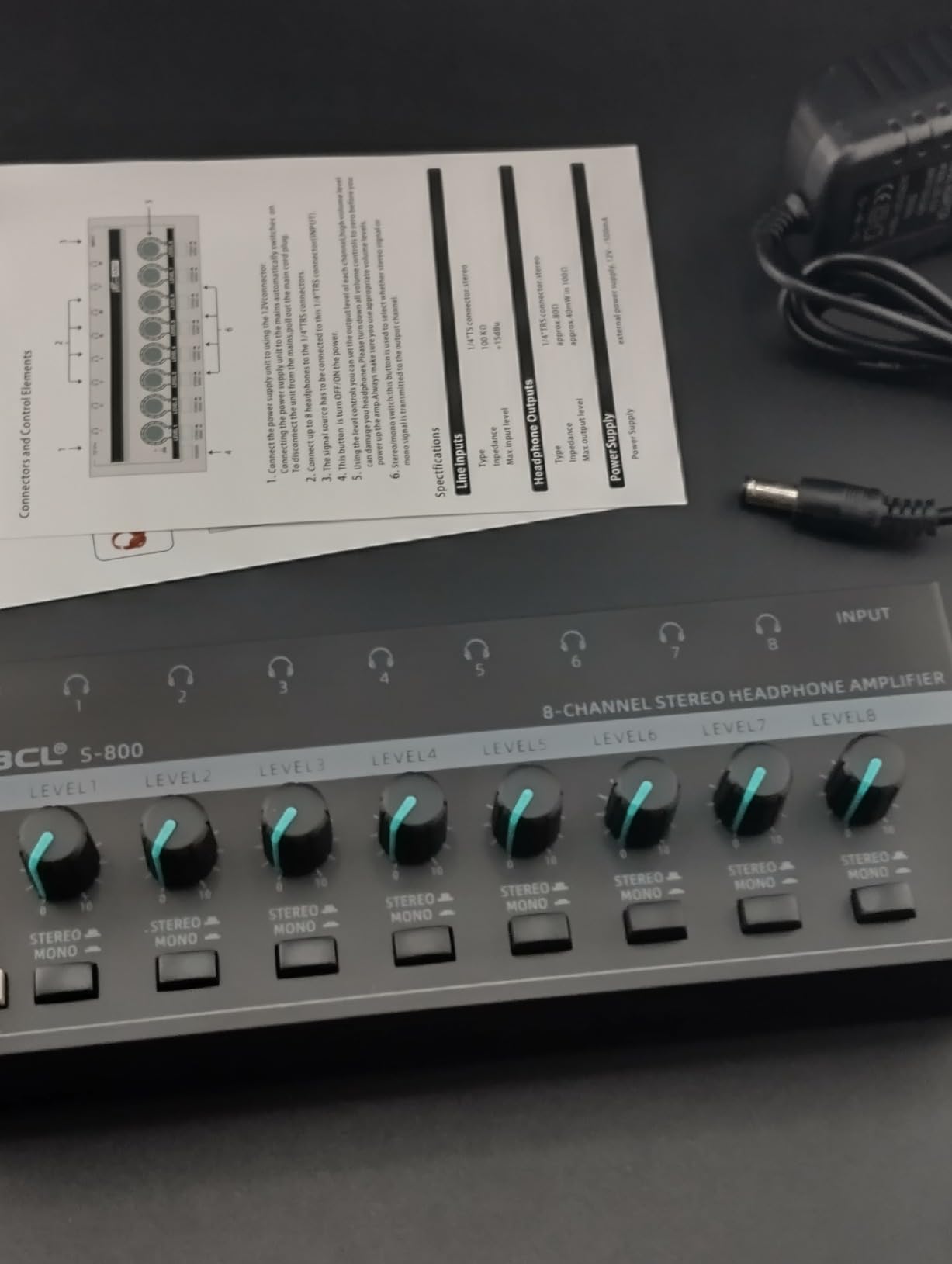
8. STABCL 8-Channel Headphone Amp – Adapters Supplied
STABCL Headphone Amplifier 8 Channel, Stereo Headphone Amp with 9 Pcs 6.35mm to 3.5mm Jack, Metal Portable Studio Headphone Amp Splitter, Headphone Mixer with Mono and Stereo for Recording Studios
8 channels, 1 in and 8 out
Mono and stereo switch
Nine 1/4 inch to 3.5 mm adapters
CNC aluminium unibody
Pros
- Eight independent amplified channels in a CNC aluminium body
- Nine 1/4 inch to 3.5 mm adapters supplied in the box
- Mono and stereo switch can upmix a mono source
- Owners report no hum squeal or hiss in the signal
Cons
- Loud pop in the headphones when a channel is plugged in
- Bundled adapters misbehave with three-ring headset plugs
- Only one input jack on the unit
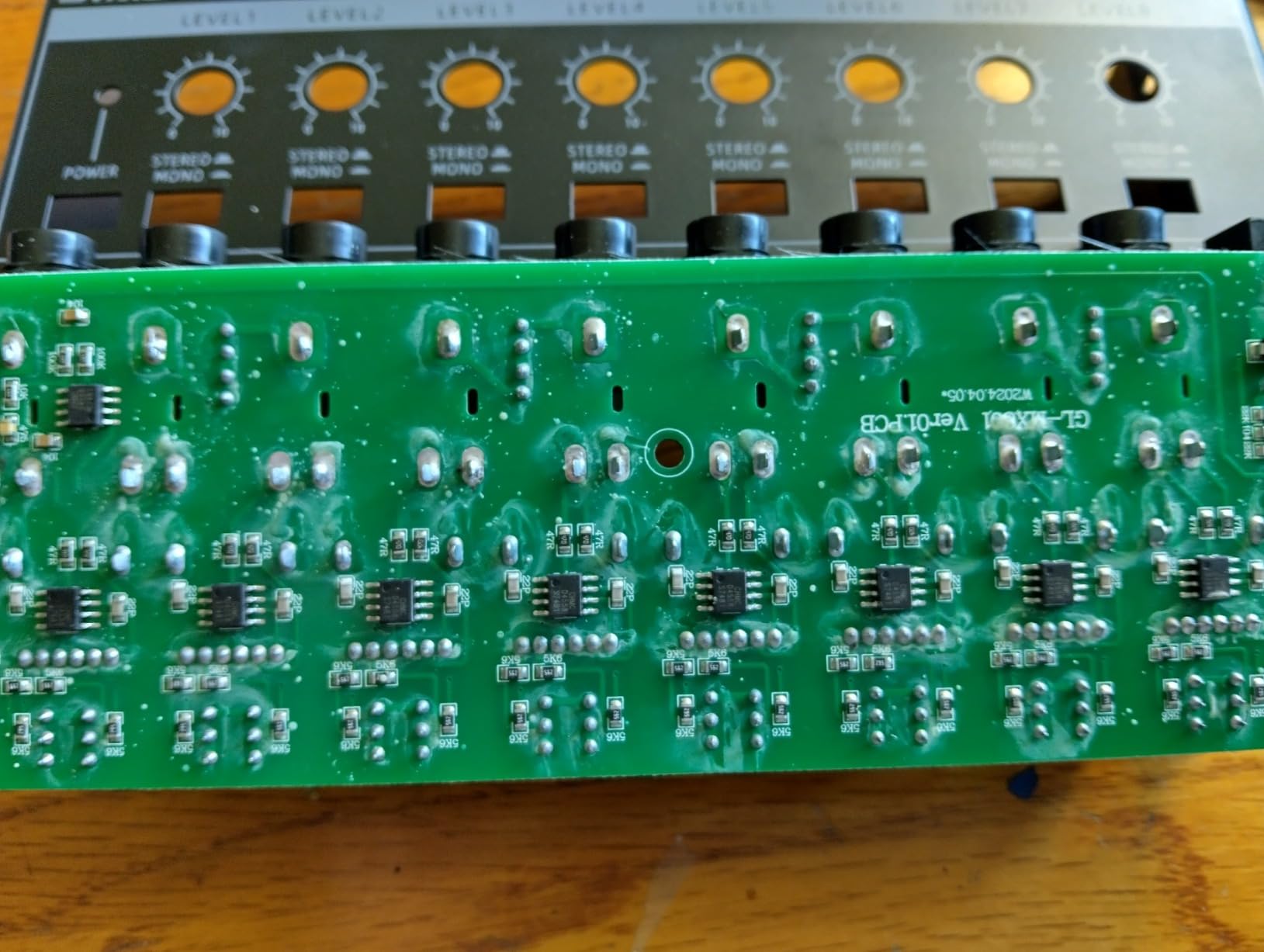
The STABCL unit covers a full eight-person roundtable from a single interface output, with eight high-power stereo amplifier channels and an individual volume control on each. The body is a CNC-machined aluminium alloy unibody at 1.43 pounds, and it is powered by an included 12V AC adapter with a front-mounted power button.
It is also the most generously packed box in this guide on accessories, with nine pieces of 6.35 mm to 3.5 mm adapters in the box. That saves you the adapter shopping that otherwise happens the night before a roundtable.
Eight Channels in a Machined Aluminium Body
One audio input distributes to eight audio outputs, each independently adjustable. The unit is compatible with 1/4 inch and 1/8 inch TS and TRS plugs, with 1/8 inch devices needing a conversion plug, and it doubles as a distributor to powered speakers and subwoofers as well as headphones.
Owners single out the signal path as the strength here, reporting no hum, squeal or hiss unlike several cheaper eight-way splitters. There is an intelligent noise reduction chip and a mono and stereo mode switch whose stereo setting can simulate stereo from a mono source.
Nine Adapters in the Box
Most four-channel units in this roundup ship without any cabling at all, so the nine included adapters are a real saving on a full table. The 1/4 inch to 3.5 mm pieces are the ones you will use for guests with consumer headphones.
Package dimensions are 11.54 by 5.39 by 2.64 inches, and six-channel and eight-channel variants of the same family exist if you want a different count.
The Plug-In Pop Owners Mention
There is a loud pop in the headphones when a channel is plugged in, even with that channel volume at zero. This is the most common complaint, and the fix is simply to plug channels in before the session starts rather than swapping headphones live.
A noticeable volume jump when toggling between mono and stereo is also reported, so set the mode once and leave it there during a conversation.
Three-Ring Headset Plugs Are a Problem
The bundled 3.5 mm adapters do not work correctly with three-ring TRRS headset connectors and can phase-invert one channel, which is a real trap for anyone using a headset with an integrated boom mic. Test an adapter with your actual headset before the roundtable.
A couple of knobs have a slight wobble, and with an 11 percent one-star share this is the weakest rating distribution in the group. It is also the least hi-fi tuned of these picks, so use it for monitoring distribution rather than for critical listening decisions.
How to Choose a Headphone Amplifier for Podcast Guests
The amplifier is the last box in the chain, not the first. Work through these questions in order and the right class of device falls out on its own, which is faster than comparing specifications on a product grid.
Do You Actually Need an Amp?
Start here, because the honest answer is often no. If your audio interface already has two headphone outputs, one for you and one for your guest, you can cover a two-person show today with no purchase at all. A single passive splitter is the accepted answer for two people on a recorder with one jack.
You need an amplifier when a passive splitter will not do the job: more than two people, a guest who wants their own level, high-impedance headphones the interface cannot drive cleanly, or a signal chain where turning one person down should not turn everyone down. Over-buying gear you do not need is the fastest way to lose a room’s trust.
How Many Outputs Do You Need?
Map headcount to the minimum output count. Two people at the table means two outputs, and your interface probably already covers that. A three or four person roundtable needs four channels, which is where the budget four-channel boxes live. Five to eight people means you are looking at five to eight channels, and the eight-channel units or a second four-channel box are the sensible options.
Count everyone who needs to hear the feed, not just everyone with a microphone. A producer at the back of the room listening for levels is an output too, and on a taping session that is often the person who notices a problem first.
Independent Versus Shared Volume Control
This is the distinction that matters most for guests and is the reason to prefer an amplifier over a splitter. A passive splitter gives every connected pair the same signal at the same level, and the only control is the single knob on the source.
An amplifier gives each output its own attenuator, so a guest can find their level without touching anyone else. In a room with people of different ages, different hearing and different headphone sensitivities, that is the difference between a comfortable session and a guest quietly struggling.
Headphone Impedance and How Much Gain You Need
Impedance is measured in ohms and it determines how hard your amplifier has to work. Most portable and consumer headphones sit between 16 and 38 ohm, which any of these boxes will drive easily. Studio models in the 250 and 300 ohm class, including the DT770 and HD 280 Pro families, need far more voltage, and a weak box either plays quietly or distorts trying to reach a usable level.
Match the amp to the heaviest pair you plan to plug in. The Mackie HM-4 and the Fosi PH05 both have documented headroom for 250 ohm studio headphones, the Bolanle PH400 is rated to 250 ohm, and the LZSIG is rated 32 to 100 ohm with owners reporting 250 ohm results.
Planar magnetic headphones sit outside all of these ranges and deserve their own check before you commit.
Mix-Minus So a Guest Does Not Hear Themselves Twice
The most common guest complaint is hearing their own voice in their headphones with a delay. It reads as an echo, it makes people talk quieter, and it sounds unprofessional on the recording if a guest lifts their voice to talk over it.
The fix is a mix-minus, also called a cue mix, where each person hears the full program feed but with their own microphone removed. Two ways to do it: build it in your mixer or interface with a bus per guest, or use the per-channel direct inputs on a unit like the Behringer HA8000 V2 to give each person their own mix. Most of the small desktop distribution boxes cannot do this, because they have a single input and no per-output source selection.
Jack Sizes and Guest Table Logistics
Studio headphones use 1/4 inch TRS plugs, consumer headphones and earbuds use 3.5 mm, and phone-style headsets use three-ring TRRS. A guest table needs to handle all three without a scavenger hunt for adapters ten minutes before recording.
Five of our eight picks take 1/4 inch plugs only, so plan a small adapter kit: at least four 1/4 inch to 3.5 mm adapters and one that handles TRRS headsets properly. Cable length matters more than most people expect, since a guest table places the listener a metre or more from the amp, and cable runs should be long enough to reach without a guest unplugging something to move their chair.
Splitter Versus Amp Versus Podcast Mixer
A passive splitter is a cable with no electronics, cheap, and correct for two people who will accept the same volume. A multi-channel amplifier adds independent level control and enough power for demanding headphones, and is the right call from three people upward or whenever the feed feeds a microphone in the room.
A podcast mixer with built-in multi-out, such as the Zoom PodTrak P4 or the RØDECaster series, handles microphone preamps, recording and monitoring in one device, and forum consensus repeatedly points at that as the all-in-one answer rather than stacking a separate amp. Choose that route when you are building the rig from scratch, and choose an amplifier when the recorder or interface is already right and only the headphone outputs are short.
Silencing Hum and Ground Loops
Budget multi-out amps attract one complaint more than any other, a hum or buzz in the monitoring feed. Almost all of it is physical rather than electronic. Keep the amplifier away from laptop power bricks, phone chargers and dimmer switches, and run the source cable separately from power cables.
Check whether the hum is actually coming from the source by unplugging the input and listening. A laptop headphone output feeding a cheap amp is a common source of high-pitched whine, and replacing the source with a proper interface output fixes it more often than replacing the amplifier does.
Frequently Asked Questions
Are headphone amplifiers worth it for podcasting?
Only when your interface or recorder cannot already do the job. If you have two headphone outputs, you do not need an amplifier for a two-person show. You do need one when a third person sits down, when a guest wants their own volume level, or when you run 250 ohm studio headphones that a quiet interface output struggles to drive.
How many headphone outputs do I need for podcasting?
Count everyone who needs to hear the monitoring feed. Two people need two outputs, which most interfaces already provide. A three or four person roundtable needs four independent channels. A panel or live taping with five to eight people needs five to eight, which means a five-channel unit, an eight-channel box, or two four-channel boxes.
What is the difference between a headphone splitter and a headphone amplifier?
A splitter is a passive cable that sends one signal to two or more pairs of headphones with no electronics and no volume control of its own, so everyone hears the same level. An amplifier buffers the signal, adds gain, and gives every output its own volume control, so each person can set their own level without changing anyone else.
Can podcast guests have their own volume control?
Yes, as long as you use an amplifier with one volume control per output rather than a passive splitter. That is the single most useful feature for a guest table, because a first-time guest has no reference for a normal level and can find their own without disturbing the hosts.
How do I stop a guest hearing their own voice in their headphones?
Build a mix-minus, also called a cue mix, so each person hears the program feed with their own microphone removed. Small distribution boxes have one input and cannot do this, so use your mixer or interface with a bus per guest, or a unit with a per-channel direct input that can carry a separate mix for each listener.
Which Headphone Amplifier Fits Your Guest Table
If you are running a two-person show, check your interface first and buy nothing until you confirm it is short of outputs. If you need four channels, the Mackie HM-4 is the pick we would put behind the table for its level pots, low noise and 250 ohm headroom, and the Pyle PHA40 is the cheaper way to get the same four-way split.
For a metal chassis at a mid entry level, the FIFINE N6 is the better long-term buy than plastic. For a roundtable where people bring their own headphones, the LZSIG 4-Channel Amp saves the adapter scramble because it takes 3.5 mm and 6.35 mm plugs, and the Fosi Audio PH05 covers five voices with a master level and a mute for live taping.
For a permanent room with five to eight listeners, the Behringer HA8000 V2 is the only rackable option and the only one here with per-channel direct inputs for separate monitor mixes, while the STABCL 8-Channel Headphone Amp covers an eight-person roundtable from a desktop and supplies nine adapters. If you want the sound of a single-output desk amp instead, our guides to the best desktop headphone amplifiers and best tube headphone amplifiers cover that side of the desk.
Whichever you choose, test every output with the headphones you will actually use before you record, and keep a small adapter kit with the setup. The best headphone amplifiers for podcast guests are the ones that need no explanation on the day.
Leave a Reply