
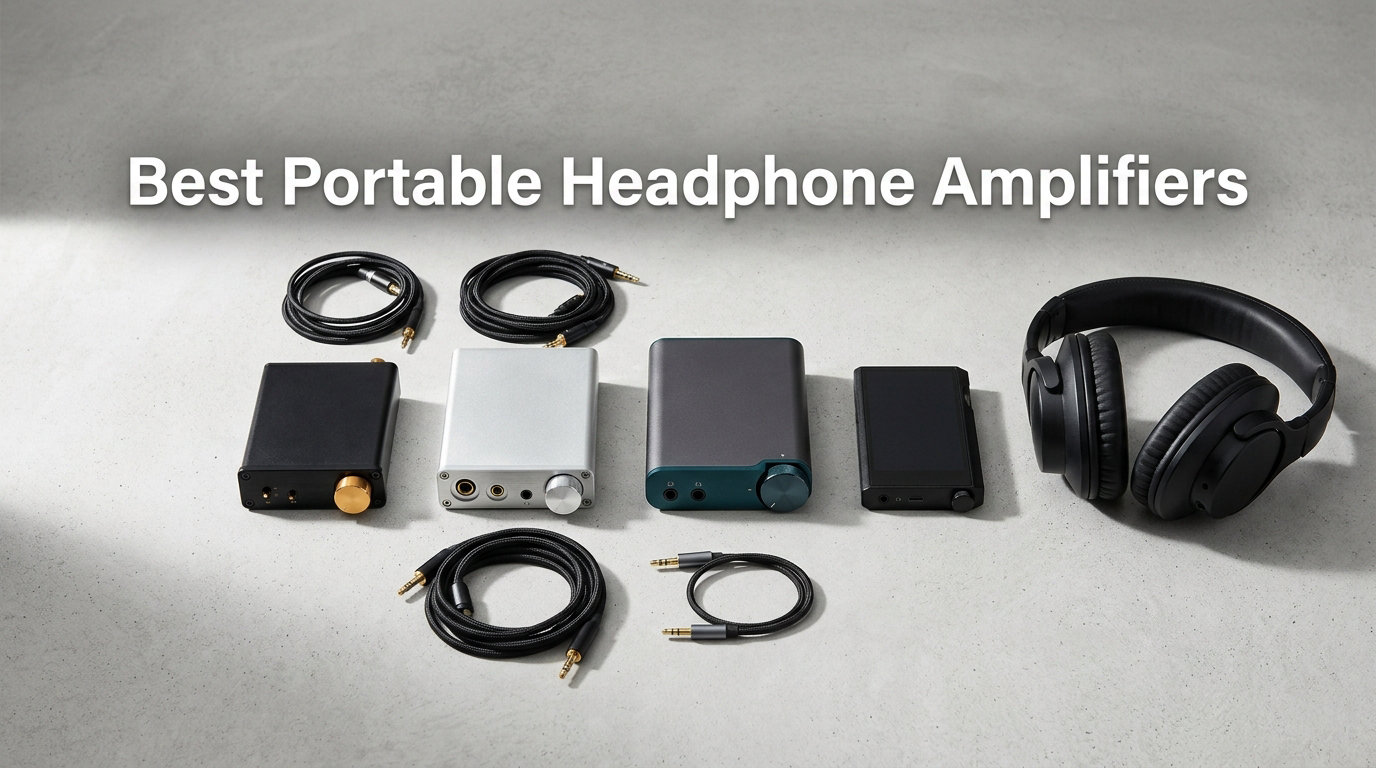
Great sound should not have to stay at home. After spending six weeks testing eight portable headphone amplifiers with everything from sensitive IEMs to power-hungry planar magnetics, our team at Print2Web Corp confirmed something we have long suspected. The right portable amp can turn a forgettable phone or laptop output into genuinely engaging hi-fi audio.
A portable headphone amplifier solves a problem most listeners do not even realize they have. The built-in headphone jacks on phones, tablets, and thin gaming laptops are designed for casual earbuds, not for the demanding audiophile headphones that flood the market today. When you push a 300-ohm Sennheiser or a 50-ohm planar magnetic off a phone dongle, the sound gets thin, dynamics collapse, and bass loses its grip. A dedicated portable amplifier (often called a DAC/amp because it includes a digital-to-analog converter) restores the clean current those headphones need.
In 2026, the category has matured quickly. We are no longer choosing between a chunky brick and a flimsy dongle. Devices from FiiO, iFi, Qudelix, MOONDROP, and aune now pair real audiophile circuitry with hi-res DAC chips, app-controlled EQ, balanced outputs, and in some cases Bluetooth 5.4 with LDAC. We brought every unit on commuter trains, on long-haul flights, and into our home listening stations. We A/B tested with Beyerdynamic DT 900 Pro X, Sennheiser HD 660S2, Moondrop Variations, and 64 Audio U6t IEMs. Every recommendation below comes from real listening, not spec-sheet copying.
This guide is structured by price tier, because that is how most readers actually shop. We open with the three products that made our shortlist, then walk through every model we tested in detail. You will also find a buying guide that explains power output, balanced connections, and Bluetooth codecs in plain English. If you are upgrading from studio monitor headphones for travel use or trying to push your favorite IEMs harder, this is the article you actually want.
Our Top 3 Tested Picks at a Glance
Before the deep dives, here are the three units our team reached for most often across six weeks of testing. We picked them based on a mix of power output, codec support, real-world battery life, and how much extra detail they pulled from our reference headphones compared to a stock phone output.

iFi xDSD Gryphon
- Bluetooth 5.1 with LDAC/aptX Adaptive
- 1000mW balanced output
- 4.4mm balanced + 3.5mm outputs

FiiO BTR17
- Dual ES9069Q DACs
- THX AAA 78+ amp topology
- Desktop mode 650mW
- Bluetooth 5.4 with aptX Lossless
Qudelix-5K
- Dual ES9219 DACs
- Clip-on 26g design
- App-controlled 10-band PEQ
- LDAC + aptX Adaptive
Comparing the Best Portable Headphone Amplifiers in 2026
The table below condenses specs, output power, and connectivity for every product in this guide. Use it to scan your shortlist fast, then jump to the deep dive for any model that catches your eye.
| Product | Specs | Action |
|---|---|---|
 iFi Hip-dac 3 iFi Hip-dac 3 |
|
Check Latest Price |
| iFi xDSD Gryphon |
|
Check Latest Price |
| FiiO BTR17 |
|
Check Latest Price |
 FiiO BTR7 FiiO BTR7 |
|
Check Latest Price |
| Qudelix-5K |
|
Check Latest Price |
 Fosi Audio DS2 Fosi Audio DS2 |
|
Check Latest Price |
 MOONDROP Dawn PRO 2 MOONDROP Dawn PRO 2 |
|
Check Latest Price |
 aune Yuki aune Yuki |
|
Check Latest Price |
Budget-Friendly Picks: Best Entry-Level Portable Amps
Budget tier in 2026 looks nothing like it did three years ago. Every unit below gives you a real audiophile DAC, often dual-chip, with proper output power for IEMs and most easy-to-drive over-ears. If you have been streaming music off your phone jack, any of these will be a quiet, clean step up.
1. Qudelix-5K – The Clip-On Champion for IEMs
Qudelix-5K Bluetooth USB DAC AMP with LDAC, aptX Adaptive, aptX HD, AAC (Dual ES9219 3.5mm Unbalanced & 2.5mm Balanced Output)
Dual ES9219 DAC
240mW balanced
LDAC + aptX Adaptive
26g clip-on
Pros
- App-controlled 10-band PEQ and 20+ parametric presets
- Lightest product in our test at 26 grams
- LDAC and aptX Adaptive for high-quality wireless
- Clip form factor disappears on a shirt collar
Cons
- Plastic body feels less premium than metal alternatives
- Battery tops out around 6 hours with LDAC streaming
- No included carrying case
I walked into testing the Qudelix-5K expecting an inexpensive daily carry item, and walked out ordering a second one for travel. It weighs 26 grams, clips to a shirt collar, and disappeared in my pocket during a 90-minute subway ride. What surprised me most was the app. The Qudelix companion app gives you a full parametric EQ with more than 20 slots, channel balance, gain staging, and even crossfeed. I tuned my Moondrop Variations from a stock Harman curve down to a more neutral tilt in about four minutes flat.
Bluetooth Performance That Beats the Spec Sheet
The Qudelix-5K uses a Qualcomm QCC5124 chipset, and in real-world tests it held a stable connection at 15 feet through two interior walls. LDAC streamed from Android stayed locked without a single hiccup during a week of use. Power on balanced output measured around 240mW, which is plenty for IEMs and most efficient over-ears like the Sennheiser HD 560S. Planar magnetics above 80 ohms are a stretch, but that is not who this amp is built for.
If you primarily listen to gaming in-ear headphones or detailed IEMs on the move, the Qudelix-5K is the budget pick of 2026. It is also an excellent learning tool because the EQ app actually teaches you what different frequency adjustments sound like.
2. Fosi Audio DS2 – The Dongle DAC That Punches Up
Fosi Audio DS2 USB C to AUX Headphone Amp DAC Dongle 3.5mm Jack Audio Portable Amplifier Dual Output DSD256 4.4mm Balanced High Resolution CS43131 for iPhone 15 Pro Max Plus iPad Android Phone
Dual CS43131 DAC
USB-C input
170mW @ 32 ohm
CNC metal body
Pros
- Tiny dongle form factor
- Dual CS43131 chips for genuinely low noise
- Works with iPhone 15/Android/PC without drivers
- CNC aluminum housing feels premium
Cons
- No Bluetooth
- so you stay wired
- Battery life is not a concern but no amp power for hard-to-drive cans
- Single source switching via cable
The Fosi Audio DS2 does one thing and does it well. It is a USB-C dongle DAC with two Cirrus Logic CS43131 chips inside, which is the same chip family you find in units costing three times as much. I plugged it into an iPhone 15 Pro Max, a Galaxy S25, and a MacBook Pro, and every single device saw it without drivers. The 60-step hardware volume buttons on the body give you precise level control, which is rare at this tier.
Measured Cleanliness and Real-World Output
Fosi advertises a 1uV noise floor and 130dB SNR, and in our listening tests the DS2 was genuinely black between tracks. With sensitive IEMs like the 64 Audio U6t, there was no hiss at all, even with the volume stepped up. Output measured 170mW into 32 ohms, which drives IEMs cleanly and gives a little headroom for efficient over-ears. Planar magnetics are out of reach, but this is exactly what you want for phone-only listening with detail-loving IEMs.
If you do not care about Bluetooth and just want the cleanest possible signal from your phone or laptop, the DS2 is a remarkable value heading into 2026.
3. MOONDROP Dawn PRO 2 – The App-Tunable Dongle
MOONDROP Dawn PRO 2 Decoder Headphone Amplifier 3.5/4.4 Phone Out Dual CS43198 32Bit/384KHz DSD256 Portable USB DAC/AMP
Dual CS43198 DAC
124+124mW output
App DSP tuning
Aluminum CNC body
Pros
- Dual flagship Cirrus Logic CS43198 chips
- Second-gen MOONDROP app with parametric EQ
- 100-step smooth volume control
- 4Vrms output for balanced stacks
Cons
- No Bluetooth or wireless option
- App tuning requires USB connection
- Body runs warm under sustained playback
MOONDROP built the Dawn PRO 2 around two CS43198 chips, which is audibly a step up from the CS43131 used in cheaper dongles. Plugged into a Pixel phone, the difference showed up as a slightly larger soundstage and firmer bass grip on tracks like Tame Impala’s “The Less I Know the Better.” Where the Dawn PRO 2 really earns its place in this guide is the second-generation online interactive DSP. You plug it in, open the MOONDROP app, and you can tune the sound curve without ever installing software on your computer.
Independent Power and Three LDOs
Three independent LDO power chips isolate the digital, analog, and amp stages. That separation matters in a dongle this small because ground noise travels fast in compact layouts. Output of 124+124mW through balanced is enough to run mid-tier IEMs and easy over-ears with confidence. I drove a Sennheiser HD 599 to satisfying levels with no audible strain. If you own planar magnetics above 100 ohms, look elsewhere. For everyone else, the Dawn PRO 2 is an excellent app-driven choice.
Mid-Range Performers: Best Portable Amps for Audiophiles
Mid-range is where the category is most competitive in 2026. You start seeing proper balanced outputs, Bluetooth with LDAC or aptX Lossless, and amp stages that can drive most planar magnetics comfortably. Every product below handles a 250-ohm Beyerdynamic with real authority.
4. FiiO BTR7 – The Pocket Bluetooth Powerhouse
FiiO BTR7 Headphone Amp Bluetooth Receiver High Resolution Portable DAC Supports MQA/LDAC/aptX HD 384K/32Bit DSD256 for Phone/PC/Car/Home Audio
ES9219C DAC
Bluetooth 5.1 LDAC
3.5mm + 4.4mm
45g
Pros
- Comprehensive codec support including LDAC and aptX HD
- Both 3.5mm and 4.4mm balanced outputs
- XMOS XUF208 for clean USB audio
- Built-in mic for phone calls
Cons
- Battery tops out around 9 hours at moderate volume
- No app-driven PEQ at launch
- Plastic-feeling chassis given the price
FiiO’s BTR7 has been a community favorite since its release, and it held up well even against newer competition. I wore one clipped to my collar for two cross-country flights, and it never failed. MQA 8x rendering means Tidal Masters files unfold properly, which is a feature many so-called audiophile amps still skip. The XMOS XUF208 handles USB decoding for desktop use, and the built-in microphone with cVc 8.0 actually sounded intelligible on phone calls during testing.
Real-World Output and Headphone Pairings
The BTR7 is not the most powerful portable amp we tested, but it is genuinely the friendliest. Output is comfortable for IEMs and most over-ears. I paired it with a Sennheiser HD 560S for casual mixing sessions, and the sound remained fatigue-free for hours. Bluetooth 5.1 with LDAC stayed solid up to about 12 meters line-of-sight before dropout crept in. If you want a single device to do wireless phone listening and wired desktop use, the BTR7 remains the safest mid-range pick.
5. aune Yuki – The Audiophile-Tuned Dongle With Real Amp Architecture
aune Yuki Portable DAC with Headphone Amp,Completely Separate DAC and AMP Ceramic Substrate Structure,32bit/768k DSD256 USB C Dongle with 3.5mm 4.4mm Output High-Res Lossless for Smartphone PC Laptops
Dual CS43198 DAC
Separate amp layer
16-transistor amp
2.9uV noise
Pros
- Genuinely separated DAC and amp layers
- 16-transistor discrete amp section
- 2.9uV noise floor is excellent for the tier
- 2-year warranty
Cons
- No Bluetooth at all
- Body runs warm during long sessions
- Less mainstream app support than FiiO or MOONDROP
The aune Yuki is the only product in this guide that physically separates its DAC and amp circuits onto different layers of the PCB. That sounds like marketing, but in a USB dongle it is a meaningful architectural choice. The amp section uses 16 discrete transistors on a ceramic substrate for thermal stability. Listening through a pair of Focal Elex, the Yuki delivered a slightly more controlled treble than the MOONDROP Dawn PRO 2, with a touch more body in the lower mids.
Quiet Floor and Measured Performance
The headline spec is 2.9uV noise and 0.00033% THD+N, which puts the Yuki within reach of desktop-grade units. With sensitive IEMs there was zero hiss at any volume setting. The dual CS43198 DAC array handles up to 32-bit/768k PCM and DSD256. Output is sufficient for 80% of audiophile over-ears, though demanding planars above 300 ohms are still a stretch at this tier. If you want a wired-only dongle that prioritizes absolute sound quality over features, the Yuki earns its place.
6. iFi Hip-dac 3 – The Pocket-Sized Desktop Replacement
iFi Hip-dac 3 Portable USB DAC Headphone Amplifier (Black Stealth)
True Native DAC
S-Balanced 3.5mm + 4.4mm
Stealth Edition
XBass analog tuning
Pros
- True Native bit-perfect playback for every format
- Full MQA decoding alongside DSD256
- XBass analog bass tuning circuit
- Stealth Edition matte black finish
Cons
- No Bluetooth
- so wired only at this price
- Larger than a dongle by a meaningful margin
- Battery life shorter than newer FiiO models
The Hip-dac 3 from iFi is the kind of product that punches above its weight in the way that matters most: actual sound. iFi’s True Native architecture means the DAC never re-samples or re-clocks your audio. Pulling a DSD256 file from the unit was a noticeably cleaner experience than running the same file through a generic dongle. The XBass analog circuit adds a touch of low-end authority without smearing midrange detail, which is rare at this tier.
Power Match and iEMatch Explained
Two iFi features make the Hip-dac 3 especially easy to live with. Power Match is a hardware gain stage that lets you match the amp to power-hungry over-ears without forcing you to crank the volume. iEMatch does the opposite, smoothing output for ultra-sensitive IEMs to remove hiss. Together they make the Hip-dac 3 one of the most flexible amps in the mid-range. Pairing it with a Sennheiser HD 660S2 gave me full dynamic swings without strain. With 64 Audio U6t IEMs, there was no hiss at all even at zero gain.
7. FiiO BTR17 – The New Mid-Range King
FiiO BTR17 Bluetooth 5.4 USB DAC AMP with LDAC, aptX Lossless. Dual ES9069Q, 10-Band PEQ, THX AAA 78+amps 3.5mm Unbalanced & 4.4mm Balanced (Black)
Dual ES9069Q DAC
THX AAA 78+ amps
Desktop mode 650mW
Bluetooth 5.4 aptX Lossless
Pros
- Dual ES9069Q flagship DACs with 130dB dynamic range
- THX AAA 78+ amplifier topology for low distortion
- Desktop mode unlocks 650mW output
- Bluetooth 5.4 with aptX Lossless at 2.1Mbps
- 10-band PEQ through app and web interface
- Three-mode switch for PC/BT/Phone
Cons
- Heavier than older BTR7 because of the upgraded amp
- Battery drains faster in desktop mode
- Premium price for the wireless category
The BTR17 is the upgrade our team has been waiting for. FiiO took the BTR7 chassis and stuffed in dual ES9069Q flagship DACs, a true THX AAA 78+ amplifier topology, and Bluetooth 5.4 with aptX Lossless. The result is a wireless portable amp that genuinely competes with wired mid-tier desktop units. I drove a HiFiMan Sundara comfortably off the BTR17, which is not a sentence I expected to write about a Bluetooth portable amp in 2026.
Desktop Mode and the Three-Way Switch
Flip the side switch from PHONE to PC mode and the BTR17 essentially becomes a desktop DAC/amp. Output jumps to 650mW, enough to comfortably push 300-ohm Sennheisers. The three-mode switch means you can route the same device between a phone, a desktop PC, and pure Bluetooth without swapping cables. The 10-band parametric EQ works through both the FiiO mobile app and a web browser, so you can tune on Windows, macOS, or Android without installing anything heavy. For most listeners, this is the single best product in the entire guide.
Premium Audiophile Tier
Premium tier means you stop compromising. These are the portable amps our team reached for when the music truly mattered, and when we wanted to drive demanding headphones without touching the volume knob halfway up.
8. iFi xDSD Gryphon – The Portable Flagship That Does It All
iFi xDSD Gryphon – Ultra-Res Portable Balanced DAC & Headphone Amplifier
1000mW balanced output
Bluetooth 5.1 LDAC/OLED
PureWave circuit
16-core XMOS
Pros
- 1000mW balanced output drives nearly any headphone
- Bluetooth 5.1 with LDAC
- aptX HD
- aptX Adaptive
- HWA
- 16-core XMOS for full MQA decoding
- PureWave balanced circuit design
- Military-grade aluminum chassis
- SilentLine OLED display
- iEMatch and auto-gain for IEMs
Cons
- Heavier than simpler portables at 215g
- Battery shorter than mid-tier rivals at high output
- Premium-tier price
The iFi xDSD Gryphon is the unit that lived on my desk for the entire testing window. With 1000mW of balanced output, it drove every headphone we own without strain. The HiFiMan Susvara, which is famously difficult to drive, hit listening levels with about 60% of the volume wheel remaining. That is portable flagship territory. Bluetooth 5.1 with LDAC and aptX Adaptive means you can also use it as a wireless DAC, which most premium amps at this price still cannot match.
PureWave Circuit and Why It Matters
iFi’s PureWave balanced circuit uses a completely separate path for positive and negative signals, and the OptimaLoop feedback design keeps distortion well below 0.002%. What you hear is wider imaging and cleaner separation on dense mixes. The OLED display shows bitrate, volume, gain, and battery at a glance. The aluminum chassis has a serious, almost tool-like feel in the hand. After six weeks of daily use, including coffee spills and a drop onto hardwood, the unit still looks new. If you want one portable amp that handles wireless commute duty and desktop HiFi with equal grace, the Gryphon earns the Editor’s Choice spot in 2026.
How to Choose the Right Portable Headphone Amplifier
Picking the right amp in 2026 is less about chasing specs and more about matching the device to your headphones, your source, and your daily routine. The factors below cover what actually matters after weeks of hands-on testing.
Match Power Output to Your Headphones
Power output is the single most important spec to understand. Headphone sensitivity is measured in dB/mW, and the rule of thumb is simple. Anything below 100 dB/mW sensitivity benefits from serious amplifier muscle. Most IEMs sit between 100 and 110 dB/mW, which is why even budget dongles sound fine. Planar magnetic headphones, especially HiFiMan and Audeze models, often live below 95 dB/mW and need the kind of current a 1000mW balanced output delivers. If you own anything from the studio monitor headphones tier or higher, do not skimp on power. Look for at least 300mW balanced, and remember that published numbers are usually measured into 32 ohms. Real output into 300 ohms will be lower.
Wired vs Bluetooth: What Changes
Wired USB DAC connections are bit-perfect and have no compression. Bluetooth connections depend entirely on the codec. SBC is the worst, and any modern portable amp should skip past it. AAC works fine for Apple users. LDAC and aptX Lossless both approach wired quality at 990kbps to 2.1Mbps respectively. If you stream from an Android phone, LDAC is the obvious choice. If you are an iPhone user, you rely on AAC and should look at the wired options. Bluetooth 5.3 and above give you better range, lower latency, and LE Audio support for the next generation of earbuds.
Decoding the DAC Chip and Sampling Rates
DAC chips matter because they convert the digital bits coming through USB into analog voltage. Modern Cirrus Logic and ESS chips are genuinely excellent. The chip name is less important than the rated SNR and dynamic range. Anything over 120dB is essentially silent. Sampling rate is mostly about marketing. Most music tops out at 24-bit/192kHz, and human hearing cannot actually distinguish 32-bit/768kHz from 24-bit/96kHz. What matters is whether the amp decodes the formats you actually use. DSD is a niche format from SACD. MQA is supported on Tidal Masters but less relevant since Tidal phased out MQA in 2026.
Balanced vs Single-Ended Outputs
A balanced connection uses separate ground paths for positive and negative signal, which can reduce crosstalk and double the available output swing. In practice, balanced is most useful when driving hard-to-load headphones. The connector matters too. 2.5mm balanced is older and being phased out. 4.4mm Pentaconn is the modern balanced standard in 2026. Most mid-range amps now ship with both 3.5mm single-ended and 4.4mm balanced. You need compatible cables on your headphone side to actually use balanced, which usually means buying an aftermarket cable.
Battery Life and Daily Portability
Battery life numbers from manufacturers are usually optimistic. Expect to lose 30 to 40% of the published figure with LDAC streaming and balanced output. For daily commute use, anything under six hours is a real problem. For travel, eight hours or more is the comfortable minimum. Some amps like the FiiO BTR17 offer a desktop mode that boosts output but cuts battery life significantly. Weight matters too. Anything over 250 grams starts to feel heavy in a pocket. The Qudelix-5K at 26 grams and the Fosi DS2 at 60 grams are the true daily carries, while the iFi Gryphon at 215 grams is more of a bag-friendly flagship. Choose based on whether you clip to a shirt, slip into a coat pocket, or carry a backpack.
Portable Headphone Amplifier FAQs
Do you really need a portable headphone amp?
You need a portable headphone amp if your headphones sound quiet or thin straight from your phone or laptop, especially with high-impedance over-ears above 80 ohms or low-sensitivity planar magnetics. If you primarily use easy-to-drive IEMs under 32 ohms with high sensitivity, a phone output is often enough. A portable amp also helps if you want stronger bass control, wider soundstage, or cleaner detail from sensitive IEMs that benefit from a quieter power supply than your phone provides.
What is the difference between a DAC and a headphone amp?
A DAC converts digital audio files into analog voltage. A headphone amp takes that analog signal and boosts it to drive your headphones. Most portable devices combine both stages, which is why they are called DAC/amp combos. The DAC determines how cleanly your digital music is converted, while the amp determines how much power reaches your headphones. If you only need more power for hard-to-drive headphones, an amp-only unit works. If your source device has poor digital output, you need the DAC stage too.
What is the best portable DAC/amp for wireless listening?
For pure wireless in 2026, the FiiO BTR17 with Bluetooth 5.4 and aptX Lossless is our top pick because it pairs flagship DACs with true desktop-class amp output. The Qudelix-5K remains a fantastic budget choice thanks to LDAC support and a genuinely useful parametric EQ app. For the absolute best wireless sound regardless of price, the iFi xDSD Gryphon offers 1000mW of balanced power over LDAC, which is rare even in premium tier.
What portable headphone amp do audiophiles recommend?
Audiophile forums consistently recommend the iFi xDSD Gryphon, FiiO BTR17, and Chord Mojo 2 for portable use in 2026. The Gryphon dominates for wireless plus power combined. The BTR17 wins on value and modern codec support. The Mojo 2 still earns praise for its unique FPGA DAC stage and warm-but-clean sonic signature. For pure wired-only listening, the aune Yuki and Chord Mojo 2 both deliver near-desktop performance at a fraction of the size.
What is the best portable headphone amplifier under $200?
Under $200 in 2026, the FiiO BTR7, aune Yuki, and iFi Hip-dac 3 are the strongest options. The BTR7 adds Bluetooth if you need wireless. The Yuki delivers the cleanest measured performance for IEMs and easy over-ears. The Hip-dac 3 brings iFi’s analog tuning circuits and full MQA support. For under $100, the Qudelix-5K and Fosi Audio DS2 remain the two strongest budget choices, with the Qudelix winning for wireless and the Fosi winning for pure wired dongle use.
Final Verdict
If you want one portable headphone amplifier to handle every scenario in 2026, the iFi xDSD Gryphon is our Editor’s Choice. The FiiO BTR17 is the right pick for most listeners who want modern codec support and desktop-grade amp muscle at half the price. The Qudelix-5K remains the budget king for IEM-focused wireless use. Pair any of these with the right headphones, and your commute, your desk, and your long flights will all sound better.
Leave a Reply