
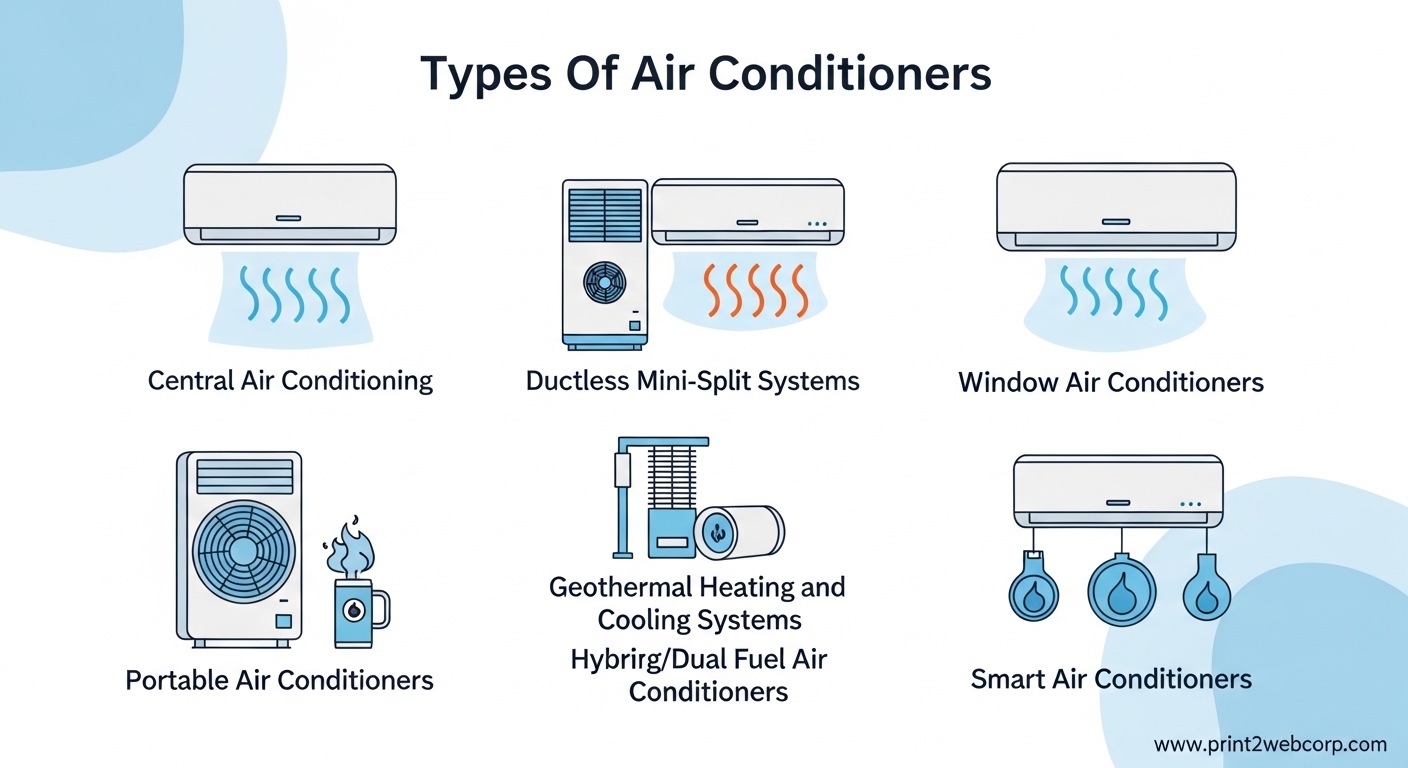
When summer temperatures soar and humidity makes being outdoors unbearable, having the right cooling system becomes essential for home comfort. But with so many options available, choosing between the different types of air conditioners can feel overwhelming without proper guidance.
Understanding the various types of air conditioners helps you make an informed decision based on your home’s layout, climate, budget, and cooling needs. From whole-house systems to portable units you can wheel from room to room, each AC type serves specific purposes and comes with distinct advantages.
In this comprehensive guide, I’ll walk you through every major type of air conditioning system available in 2026, explaining how each works, who they’re best for, and what you need to know before making an investment in home cooling.
Quick Reference: Types of Air Conditioners at a Glance
| AC Type | Best For | Cost Range | Key Pros | Key Cons |
|---|---|---|---|---|
| Central Air | Whole homes with existing ductwork | $3,000 – $7,000+ | Cools entire home evenly, quiet operation, adds home value | Expensive installation, requires ductwork, higher operating costs |
| Ductless Mini-Split | Homes without ducts, zoned cooling needs | $2,000 – $5,000 per zone | Energy efficient, no ductwork needed, zone control | Higher upfront cost, visible indoor units, professional install required |
| Window AC | Single rooms, apartments, budget-conscious | $150 – $800 | Affordable, easy installation, good for renters | Blocks window, noisy, only cools one room |
| Portable AC | Renters, temporary cooling, spot cooling | $250 – $900 | No installation needed, portable, good for rentals | Less efficient, noisy, takes floor space, requires venting |
| Through-The-Wall | Rooms without suitable windows, permanent installation | $400 – $1,200 | Permanent solution, doesn’t block windows | Requires wall sleeve, professional install, permanent |
| Smart AC | Tech-savvy homeowners, energy-conscious users | $300 – $1,500+ | WiFi control, scheduling, energy monitoring | Higher cost, depends on WiFi, learning curve |
| Geothermal | Eco-conscious homeowners, new construction | $15,000 – $25,000+ | Most efficient, eco-friendly, lower operating costs | Very expensive install, requires land, not suitable for all properties |
| Evaporative Cooler | Dry climates only, outdoor cooling | $200 – $800 | Very low operating cost, eco-friendly, adds humidity | Only works in dry climates, less cooling power, uses water |
| Hybrid/Dual-Fuel | Areas with variable seasons, energy-conscious | $5,000 – $10,000+ | Year-round comfort, optimizes energy use, lower heating costs | Complex system, expensive, professional maintenance needed |
Central Air Conditioner
Central air conditioning represents the gold standard for whole-home cooling in the United States. These systems use a network of ducts hidden behind walls and ceilings to distribute cooled air throughout every room in your house simultaneously.
A central AC system consists of two main components: an outdoor condenser unit that houses the compressor and condenser coils, and an indoor evaporator coil typically located inside your furnace or air handler. The system circulates refrigerant between these units, absorbing heat from indoor air and releasing it outside.
What makes central air so popular is its ability to maintain consistent temperatures across your entire home. You set your thermostat once, and the system automatically maintains your desired temperature throughout the day, cooling multiple rooms evenly without you needing to move or adjust anything.
How Central Air Conditioning Works
The process begins when warm air from your home is pulled through return ducts and passed over the cold evaporator coil. Heat from the air transfers to the refrigerant flowing through the coil, cooling the air which is then pushed back through supply ducts into your living spaces.
The heated refrigerant travels to the outdoor condenser unit where the compressor pressurizes it, releasing the absorbed heat into the outside air. This continuous cycle keeps your home comfortable while removing humidity from indoor air.
Best For
Central air conditioning works best for homes that already have ductwork installed or for new construction where ducts can be easily added. It’s ideal for homeowners who want whole-house cooling without visible equipment in each room.
If you live in a hot, humid climate and need consistent cooling throughout your entire home during summer months, central air is typically the most effective solution. It’s also excellent for multi-story homes where cooling each floor individually would be impractical.
Pros of Central Air Conditioning
- Cools entire home evenly and consistently
- Quietest operation with noisy components outside
- Adds to home resale value
- Can integrate with existing HVAC systems
- Improves indoor air quality when paired with good filtration
- Can be controlled with programmable or smart thermostats
- Most aesthetically pleasing (minimal visible equipment)
Cons of Central Air Conditioning
- Highest upfront installation cost ($3,000-$7,000+)
- Requires existing ductwork or expensive duct installation
- Higher operating costs than room-specific solutions
- Requires professional installation and maintenance
- Not suitable for homes without attic/crawlspace for ducts
- All-or-nothing cooling (wastes energy cooling empty rooms)
- Ductwork can develop leaks reducing efficiency
Ductless Mini-Split Air Conditioner
Ductless mini-split systems have revolutionized home cooling, offering an efficient alternative for homes without existing ductwork. As the name suggests, these systems don’t require ducts instead delivering cooled air directly into individual rooms or zones.
A mini-split system consists of an outdoor compressor/condenser unit connected to one or more indoor air-handling units via small refrigerant lines. Each indoor unit can be controlled independently, allowing for customized zoned cooling throughout your home.
These systems have gained tremendous popularity in Europe and Asia for decades, and they’re now becoming increasingly common in the United States as homeowners recognize their efficiency benefits and flexibility.
How Mini-Split Systems Work
Like central air, mini-splits use refrigerant to transfer heat from indoors to outdoors. The difference is that instead of distributing cooled air through ducts, each indoor unit blows conditioned air directly into its zone.
The outdoor unit can connect to up to four or more indoor units, depending on system capacity. Each indoor unit has its own thermostat, allowing different rooms to be set to different temperatures or turned off entirely when not in use.
Best For
Mini-split systems are perfect for older homes without existing ductwork where installing ducts would be expensive or impractical. They’re also ideal for home additions, sunrooms, converted garages, or any space where extending existing ductwork doesn’t make sense.
If you want zoned cooling where different family members can control temperatures in their own spaces, mini-splits offer unmatched flexibility. They’re also excellent for homes with open floor plans where traditional ducted systems struggle to distribute air evenly.
Pros of Ductless Mini-Splits
- No ductwork required (saves installation costs)
- Highly energy efficient (no duct losses)
- Zoned control for different rooms
- Quiet operation
- Compact indoor units
- Heating options available (heat pump models)
- Easy to add zones later
- Longer lifespan than central air (20+ years)
Cons of Ductless Mini-Splits
- Higher upfront cost than window/portable units
- Visible indoor units on walls
- Professional installation required
- Multiple indoor units can be expensive
- Requires careful placement for optimal airflow
- Regular filter cleaning needed
- Outdoor unit still required
Window Air Conditioner
Window air conditioners represent one of the most affordable and accessible cooling solutions available. These self-contained units install directly in a window, pulling warm air from the room, cooling it, and expelling heat outside through the back of the unit.
Window ACs have been cooling American homes for generations, and they remain incredibly popular today thanks to their simplicity, low cost, and effectiveness at cooling single rooms. Modern units are more energy efficient and quieter than older models, with many featuring advanced controls and remote operation.
For apartment dwellers, renters, and homeowners on a budget, window air conditioners offer an ideal balance of performance and affordability. They’re particularly effective in bedrooms, home offices, and small apartments where cooling a single space is sufficient.
How Window Air Conditioners Work
Window AC units contain all components in a single box: evaporator coils, condenser coils, compressor, expansion valve, and fan. The unit sits in your window with the front inside your room and the back exposed to outdoor air.
Indoor air is drawn across the cold evaporator coils where heat and moisture are removed. The cooled air is blown back into the room, while the absorbed heat is carried by refrigerant to the condenser coils on the outdoor side of the unit and released outside.
Best For
Window air conditioners excel at cooling single rooms up to about 650 square feet, depending on unit capacity. They’re ideal for renters who can’t install permanent systems, apartments without central air, or supplementing inadequate central air in particularly warm rooms.
If you need affordable cooling for a bedroom, home office, or small apartment and don’t mind giving up a window, a window AC provides excellent value. They’re also great for seasonal use in spaces that don’t need year-round climate control.
Pros of Window Air Conditioners
- Very affordable upfront ($150-$800)
- Easy DIY installation
- Perfect for renters (removable)
- Effective for single-room cooling
- No permanent changes to home
- Wide range of sizes available
- Can be removed and stored in winter
Cons of Window Air Conditioners
- Blocks window and natural light
- Noisy operation (compressor indoors)
- Only cools one room
- Requires properly sized window
- Can be security risk if not properly secured
- Less energy efficient than central/mini-split
- May require support bracket for heavy units
If you’re experiencing issues with your window AC, such as water leakage inside your home, check out our guide on window air conditioner troubleshooting for common problems and solutions.
Portable Air Conditioner
Portable air conditioners offer the ultimate flexibility for temporary or spot cooling needs. These freestanding units can be moved from room to room on wheels, requiring only a window for venting the hot exhaust air outside.
Portable ACs are essentially window air conditioners that aren’t fixed in place. They pull warm room air in, cool it, and exhaust hot air through a hose that hangs out a window or sliding door. This mobility makes them popular among renters and anyone who needs cooling flexibility.
While portable units are less efficient than window ACs and typically noisier, their versatility makes them invaluable for certain situations. They’re particularly useful in homes with windows that can’t accommodate window units or when you only need cooling occasionally.
How Portable Air Conditioners Work
Portable ACs work on the same principle as window units but with a key difference in how they handle exhaust. Room air is cooled and blown back into the space, while hot air from the condenser is vented outside through an exhaust hose.
Most portable ACs are single-hose units that use indoor air to cool the condenser and vent it outside. This creates slight negative pressure that can draw warm air in from adjacent rooms or outdoors. Dual-hose models are more efficient, using separate intakes and exhausts.
Best For
Portable air conditioners are ideal for renters who can’t install window units, homeowners with windows that won’t accommodate traditional ACs, and anyone who needs cooling in different rooms at different times.
They’re also perfect for supplemental cooling in rooms where your central AC struggles, for seasonal use in spaces like garages or workshops, or as temporary cooling during heat waves. If you move frequently or want cooling you can take with you, portables are unmatched.
Pros of Portable Air Conditioners
- Completely portable with wheels
- No permanent installation
- Works with any window type
- Great for renters
- Can be stored when not in use
- No heavy lifting required
- Can cool different rooms as needed
Cons of Portable Air Conditioners
- Less efficient than window units
- Typically noisier than other AC types
- Takes up floor space
- Requires window venting kit
- Higher operating costs
- Single-hose models create negative pressure
- Limited cooling capacity (usually under 500 sq ft)
Through-The-Wall Air Conditioner
Through-the-wall air conditioners, also called wall sleeve air conditioners, offer a permanent cooling solution that doesn’t require window space. These units install through an exterior wall in a metal sleeve, similar to what you’d find in hotel rooms.
Like window ACs, through-the-wall units are self-contained systems with all components in a single cabinet. However, they’re designed for permanent installation and typically offer higher capacity and more durability than window units.
These units are excellent for rooms without suitable windows for AC installation or where preserving window space is important. They’re commonly found in apartments, condos, and additions where central air isn’t available.
How Through-The-Wall ACs Work
Through-the-wall units operate on identical principles to window air conditioners. The main difference is the installation method: instead of sitting in a window, the unit slides into a wall sleeve that’s permanently installed through your exterior wall.
This sleeve provides structural support and weatherproofing while allowing the unit to be removed for service or replacement. The rear of the unit extends outside to exhaust heat, while the front grille remains indoors.
Best For
Through-the-wall air conditioners are ideal for rooms with windows that don’t accommodate traditional window ACs, such as casement or awning windows. They’re perfect for preserving window views and natural light while still getting effective cooling.
If you own your home and want a more permanent and aesthetically pleasing solution than a window unit, or if you’re replacing an existing through-the-wall system, these units offer excellent single-room cooling with a professional appearance.
Pros of Through-The-Wall Air Conditioners
- Doesn’t block windows
- More permanent and secure than window units
- Higher capacity than most window ACs
- Better seals against outdoor air
- Can be replaced without disturbing wall
- More aesthetically pleasing
- Typically more durable than window units
Cons of Through-The-Wall Air Conditioners
- Requires wall sleeve installation
- Professional installation recommended
- Permanent hole in exterior wall
- More expensive than window units
- Limited to specific wall sleeve sizes
- Cannot be easily moved
- Exterior portion exposed to weather
Smart Air Conditioner
Smart air conditioners represent the intersection of cooling technology and home automation. These WiFi-enabled units can be controlled remotely via smartphone apps, voice assistants, or automated schedules, offering unprecedented convenience and energy management.
Smart ACs come in various forms including window units, portable units, and mini-split systems with smart capabilities built in. Even traditional ACs can be made “smart” by adding smart thermostats or smart AC controllers.
The real advantage of smart air conditioning lies in the ability to optimize cooling based on your schedule, preferences, and even real-time electricity rates. You can start cooling your home before you arrive, adjust temperatures from anywhere, and monitor energy usage to reduce costs.
How Smart Air Conditioners Work
Smart air conditioners incorporate WiFi connectivity and sophisticated control systems that communicate with your home network and mobile devices. Through dedicated apps, you can adjust temperature, fan speed, modes, and schedules from anywhere.
Many smart ACs feature learning algorithms that adapt to your preferences and schedule, automatically adjusting settings for optimal comfort and efficiency. Integration with voice assistants like Alexa and Google Assistant enables hands-free control and automation routines.
Best For
Smart air conditioners are perfect for tech-savvy homeowners who want maximum control over their cooling system. They’re ideal for people with irregular schedules who want to avoid cooling empty homes.
If you’re interested in reducing energy costs through smart scheduling, want the convenience of controlling your AC from your phone, or enjoy automating your home with other smart devices, a smart AC system offers features traditional units can’t match.
Pros of Smart Air Conditioners
- Remote control via smartphone
- Voice assistant compatibility
- Automated scheduling
- Energy usage monitoring
- Optimization algorithms
- Can reduce energy costs
- Integration with smart home ecosystems
- Temperature and humidity alerts
Cons of Smart Air Conditioners
- Higher cost than standard units
- Dependent on WiFi connection
- Potential privacy concerns
- Learning curve for features
- App quality varies by manufacturer
- Software updates required
- May require smart home hub
Geothermal Air Conditioner
Geothermal air conditioning systems represent the pinnacle of cooling efficiency, harnessing the earth’s consistent underground temperature to provide incredibly efficient home cooling. Also called ground-source heat pumps, these systems are the most energy-efficient cooling technology available.
While geothermal systems require significant upfront investment, they offer unmatched efficiency and lower operating costs over their lifetime. The stable temperature underground (typically 45-65°F depending on location) provides a consistent heat exchange medium that’s far more efficient than exchanging heat with fluctuating outdoor air.
These systems are increasingly popular among eco-conscious homeowners and those building new homes with long-term sustainability in mind. Federal and state tax incentives can also offset the higher installation costs.
How Geothermal Systems Work
Geothermal systems circulate water or refrigerant through underground loops buried in your yard. In cooling mode, the system extracts heat from your home and transfers it into the ground, which remains much cooler than outdoor air in summer.
The underground loops can be installed vertically in deep boreholes or horizontally in trenches, depending on your property size and soil conditions. The indoor heat pump unit concentrates the temperature difference to provide effective cooling.
Best For
Geothermal systems are ideal for new construction where the ground loops can be easily installed, or for homeowners replacing existing systems who plan to stay in their homes long enough to recoup the investment through energy savings.
If you’re committed to sustainability, want the lowest possible operating costs, live on a property suitable for ground loop installation, and plan to stay in your home for 10+ years, geothermal offers the best long-term value of any cooling system.
Pros of Geothermal Systems
- Highest efficiency of any AC type (400-600% efficient)
- Lowest operating costs
- Longest lifespan (25+ years for indoor unit, 50+ for loops)
- Quietest operation
- Environmentally friendly
- Provides heating as well
- Minimal maintenance required
- Eligible for tax credits
Cons of Geothermal Systems
- Highest upfront cost ($15,000-$25,000+)
- Requires suitable yard for ground loops
- Not suitable for all properties
- Complex installation requires professionals
- Long payback period (7-12 years)
- Difficult to repair if loops have issues
- Not practical for existing small lots
Evaporative Cooler (Swamp Cooler)
Evaporative coolers, commonly known as swamp coolers, use a completely different cooling principle than traditional air conditioners. Instead of using refrigerants and compressors, they cool air through the natural process of water evaporation.
These systems are incredibly simple and inexpensive to operate, using only water, a fan, and porous cooling pads. As hot dry air passes through the wet pads, water evaporates, lowering the air temperature and adding humidity to the dry air.
Swamp coolers are highly effective in specific climates and situations, offering an eco-friendly and budget-friendly alternative to traditional AC. However, their effectiveness is entirely dependent on climate conditions.
How Evaporative Coolers Work
Evaporative coolers pull hot outdoor air through wet cooling pads. As the air passes through the pads, water evaporates into the air, absorbing heat and lowering the air temperature by 15-40°F depending on conditions.
The cooled, humidified air is then blown into your home, pushing warmer air out through open windows or vents. This continuous air exchange creates a cooling breeze throughout your space while freshening indoor air.
Best For
Evaporative coolers are only effective in dry climates where humidity levels are low. They work best in desert regions and areas with hot, dry summers where traditional AC might be overkill or too expensive to operate.
If you live in the western United States or other dry regions and want an affordable, eco-friendly cooling solution that also adds beneficial humidity to dry indoor air, an evaporative cooler can be an excellent choice. They’re also great for outdoor cooling of patios and garages in dry climates.
Pros of Evaporative Coolers
- Very low operating costs (75% less than traditional AC)
- Eco-friendly (no refrigerants)
- Adds humidity to dry air
- Brings fresh outdoor air inside
- Simple and inexpensive to maintain
- Easy installation
- No compressor means quieter operation
- Effective for outdoor spaces
Cons of Evaporative Coolers
- Only works in dry climates
- Less effective in humid weather
- Lower cooling capacity than traditional AC
- Uses water continuously
- Requires regular maintenance
- Can increase indoor humidity too much
- Requires window/vent opening
- Not suitable for all climates
Hybrid/Dual-Fuel Air Conditioner
Hybrid or dual-fuel systems combine an electric heat pump with a gas furnace, automatically switching between the two depending on outdoor temperatures to optimize efficiency and comfort. While more complex than single-fuel systems, they offer exceptional efficiency for year-round climate control.
In cooling mode, these systems work like any other heat pump, removing heat from your home and releasing it outside. In heating mode, they use the heat pump when temperatures are mild (more efficient) and switch to gas heat when temperatures drop below the heat pump’s efficient operating range.
These systems are becoming increasingly popular as homeowners seek to reduce energy costs while maintaining comfort throughout all seasons. They’re particularly valuable in regions with variable seasonal temperatures.
How Hybrid Systems Work
Hybrid systems use a smart thermostat that monitors outdoor temperatures and automatically selects the most efficient heating source. When temperatures are above freezing, the electric heat pump provides both heating and cooling very efficiently.
When temperatures drop below the heat pump’s efficient operating point (typically around 35-40°F), the system switches to the gas furnace for heating. This automatic switching ensures you’re always using the most cost-effective fuel source for current conditions.
Best For
Hybrid systems are ideal for climates with distinct seasons where temperatures vary significantly throughout the year. They’re perfect for homeowners who want year-round comfort with maximum efficiency and don’t mind the complexity of a dual-fuel system.
If you live in an area with cold winters and hot summers, want to reduce your overall energy costs, and are replacing both your furnace and air conditioner, a hybrid system offers excellent long-term value.
Pros of Hybrid Systems
- Optimizes energy use automatically
- Lower overall energy costs
- Year-round comfort (heating and cooling)
- Reduces strain on either system
- Environmentally friendly
- Can extend equipment lifespan
- Future-proofs against energy price changes
Cons of Hybrid Systems
- Higher upfront cost
- Complex system requiring professional installation
- Requires gas line if adding furnace
- More maintenance required
- Not suitable for all climates
- Requires compatible smart thermostat
- Professional repairs more expensive
How to Choose the Right One Types Of Air Conditioners in 2026?
Choosing the right type of air conditioner requires evaluating multiple factors specific to your situation. By considering these key elements, you can narrow down your options and select the system that will serve you best for years to come.
Consider Your Home and Installation
Start by assessing your home’s existing infrastructure. Do you have ductwork? If so, central air might be your most cost-effective option. If not, ductless mini-splits or room units may be more practical.
Consider whether you own or rent your home. Renters typically need portable or window solutions that can be removed without permanent changes. Homeowners can invest in permanent systems that add property value.
Think about your space constraints. Through-the-wall units require wall sleeves, window units block windows, and portable units take floor space. Central AC requires outdoor space for the condenser unit.
Climate and Cooling Needs
Your local climate significantly impacts which AC type will work best. In humid regions, traditional air conditioners that remove moisture work best. In dry climates, evaporative coolers can be incredibly effective and economical.
Consider how you use your home. Do you need whole-house cooling or just spot cooling for specific rooms? If you spend most of your time in one or two rooms, cooling those spaces with window units or mini-splits may be more efficient than cooling the entire house.
Budget Considerations
Your budget should include both upfront costs and ongoing operating expenses. While window units are cheap to buy, they cost more to operate than central systems. Geothermal systems are expensive to install but offer the lowest operating costs.
Consider also the cost of AC surge protection to safeguard your investment from electrical damage, which is particularly important for expensive systems like central air, mini-splits, and geothermal.
Efficiency and Environmental Impact
If energy efficiency is a priority, look for systems with high SEER (Seasonal Energy Efficiency Ratio) ratings. Higher SEER numbers indicate more efficient operation. Energy Star certified units meet strict efficiency guidelines.
For the most eco-conscious choice, geothermal systems offer the lowest environmental impact. Mini-splits also provide excellent efficiency, especially for zoned cooling where you’re not conditioning unused spaces.
Maintenance and Lifespan
Different AC types have varying maintenance requirements. Window and portable units need regular filter cleaning and may need professional servicing every few years. Central systems and mini-splits require annual professional maintenance.
Consider expected lifespan as well. Central air conditioners typically last 15-20 years, while window units may last 8-12 years. Geothermal systems can last 25+ years for the indoor unit and 50+ years for ground loops.
Frequently Asked Questions
What are the four types of air conditioners?
The four main types of air conditioners are central air conditioning systems (for whole-home cooling), window air conditioners (for single rooms), ductless mini-split systems (for homes without ductwork), and portable air conditioners (for temporary or spot cooling). These four categories cover the majority of residential cooling needs in the United States.
What are six types of air conditioning systems?
Six common types of air conditioning systems include: 1) Central Air Conditioner, 2) Ductless Mini-Split, 3) Window Air Conditioner, 4) Portable Air Conditioner, 5) Through-The-Wall Air Conditioner, and 6) Geothermal Air Conditioner. Additional types include smart ACs, evaporative coolers (swamp coolers), and hybrid/dual-fuel systems that combine different technologies for optimal efficiency.
What is the $5000 rule for AC?
The $5000 rule for air conditioning refers to a guideline suggesting that if the cost of repairing an AC unit exceeds $5000, it may be more cost-effective to replace the unit entirely rather than repair it, especially for older systems. This rule of thumb helps homeowners decide between expensive repairs on aging equipment versus investing in a new, more efficient system that will provide reliable cooling for years to come.
What is the best type of air conditioner to use?
The best type of air conditioner depends on your specific needs. Central air conditioning is ideal for whole-home cooling with existing ductwork. Ductless mini-splits work best for homes without ducts or for zoned cooling. Window units are cost-effective for single rooms, while portable ACs offer flexibility for renters or temporary cooling. For maximum efficiency, geothermal systems are unmatched but require significant upfront investment. Consider your home’s layout, climate, budget, and cooling requirements when choosing.
Conclusion
Understanding the different types of air conditioners available in 2026 empowers you to make the right choice for your home, budget, and lifestyle. From whole-house central systems to flexible portable units, there’s a cooling solution designed for every situation.
Remember that the best AC type isn’t necessarily the most powerful or expensive option—it’s the one that matches your specific needs. Consider your home’s layout, your local climate, your budget for both purchase and operation, and how you use each space in your home.
Professional installation quality matters more than brand choice for most system types. Whether you choose central air, a mini-split system, or a simple window unit, proper sizing and installation will determine your satisfaction and the system’s longevity.
For more information on air conditioning solutions, check out our collection of more air conditioning articles covering everything from maintenance tips to product reviews.
Stay cool and comfortable this summer by choosing the right air conditioner for your needs. Your perfect cooling solution is out there—you just need to identify which type of air conditioner fits your life best.
Leave a Reply