
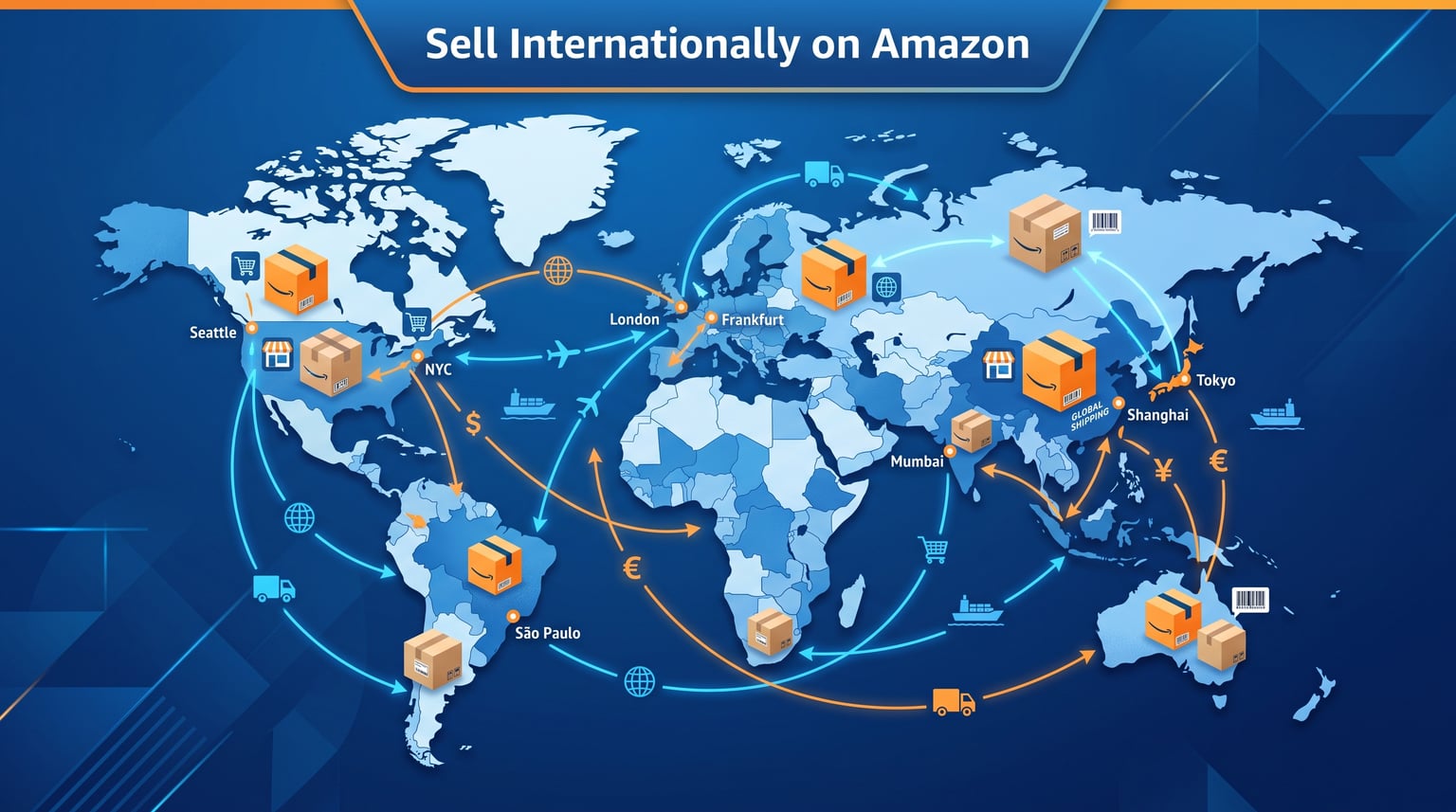
Amazon Global Selling is a program that lets you list and sell products across more than 20 international Amazon marketplaces spanning 200-plus countries and regions, giving you access to over 300 million active customers worldwide. If you have ever wanted to sell internationally on Amazon, the process is far more structured today than it was even two years ago, thanks to unified seller accounts, the Build International Listings tool, and an expanding menu of fulfillment options designed specifically for cross-border commerce.
I have spent years watching sellers struggle with the same questions: Do I need separate accounts for every country? How do I handle VAT in Germany? What is the difference between Pan-European FBA and the European Fulfillment Network? The confusion is understandable because Amazon’s international infrastructure has layers. This guide breaks down every layer so you can make confident decisions about where to sell, how to fulfill orders, and what it all costs.
Whether you are a US-based seller looking at Canada and Mexico, a domestic seller eyeing European expansion, or an international entrepreneur trying to reach American buyers, the fundamentals covered here apply to your situation. I will walk you through marketplace selection, account setup, listing creation, fulfillment programs, fee structures, tax compliance, and the common pitfalls that trip up first-time international sellers.
What you will find inside:
A complete list of all 20-plus Amazon global marketplaces organized by region
How unified seller accounts work and which countries they cover
The Build International Listings tool explained step by step
Every FBA international fulfillment option compared, including FBA Exports, Pan-EU, EFN, and NARF
Detailed fee breakdowns with specific percentages so you can calculate margins
Tax, compliance, and regulatory requirements by region
How to Sell Internationally on Amazon: The Complete 2026 Roadmap
The path to selling internationally on Amazon follows a logical sequence: pick your target marketplaces, register the right seller account, create localized product listings, choose a fulfillment method, understand your fees, and maintain compliance with local regulations. Each step builds on the previous one, and skipping ahead is where most sellers create problems for themselves down the road.
Amazon currently operates more than 20 distinct marketplaces across the Americas, Europe, Asia-Pacific, and the Middle East. These marketplaces collectively serve over 300 million customers. The scale is enormous, but that also means competition varies wildly from one region to the next. A product category that is saturated in the United States might have almost no competition in Japan or Brazil, which is why marketplace research is the foundation of everything that follows.
Step-by-Step Guide on How to Sell Internationally on Amazon
Here is the sequence I recommend for any seller planning international expansion. Each step corresponds to a section later in this guide, so treat this as your roadmap.
Step 1: Research target marketplaces using Best Sellers Rank data, Buy Box competition analysis, and demand indicators for your product category in each region.
Step 2: Register or link your seller account through Amazon Seller Central, taking advantage of unified accounts where available to reduce paperwork.
Step 3: Verify product eligibility using Amazon’s Compliance Reference tool and checking restricted product lists for each destination marketplace.
Step 4: Create localized listings using the Build International Listings tool to sync product information, pricing, and inventory across connected marketplaces.
Step 5: Choose your fulfillment strategy from FBA Exports, Pan-European FBA, the European Fulfillment Network, North American Remote Fulfillment, or Merchant Fulfilled Network.
Step 6: Set up payment and currency conversion using Amazon Currency Converter for Sellers, Amazon Seller Wallet, or a multi-currency business account.
Step 7: Register for taxes including VAT in Europe, GST in Australia, and any applicable customs or import duty arrangements.
Step 8: Launch and monitor using the Sell Globally dashboard in Seller Central to track performance across all connected marketplaces.
Understanding the Global Marketplace: All Amazon Marketplaces by Region
Amazon operates distinct storefronts in countries around the world, and each one functions as a separate marketplace with its own customer base, language, currency, fee structure, and competition level. Knowing which marketplaces exist, where they are located, and what language they operate in helps you make informed decisions about where your products will perform best. If you are also evaluating other platforms for global selling, our eBay vs Amazon comparison breaks down the differences between these two e-commerce giants.
Below is the full list of Amazon’s global marketplaces organized by geographic region. This list reflects the current marketplace count and includes newer additions such as Amazon Belgium and Amazon Ireland.
Americas Region
United States (Amazon.com) – English – The largest Amazon marketplace with the highest traffic volume
Canada (Amazon.ca) – English and French
Mexico (Amazon.com.mx) – Spanish
Brazil (Amazon.com.br) – Portuguese
Europe Region
United Kingdom (Amazon.co.uk) – English
Germany (Amazon.de) – German
France (Amazon.fr) – French
Italy (Amazon.it) – Italian
Spain (Amazon.es) – Spanish
Netherlands (Amazon.nl) – Dutch
Sweden (Amazon.se) – Swedish
Poland (Amazon.pl) – Polish
Belgium (Amazon.com.be) – Dutch and French
Ireland (Amazon.ie) – English
Asia-Pacific Region
Japan (Amazon.co.jp) – Japanese
Australia (Amazon.com.au) – English
India (Amazon.in) – English and Hindi
Singapore (Amazon.sg) – English
Middle East Region
United Arab Emirates (Amazon.ae) – Arabic and English
Saudi Arabia (Amazon.sa) – Arabic and English
Egypt (Amazon.eg) – Arabic and English
Turkey (Amazon.com.tr) – Turkish
Forum discussions on r/AmazonSeller consistently highlight a common recommendation: start with English-speaking marketplaces first. The United States, United Kingdom, Canada, and Australia share a language, which dramatically reduces the learning curve for listing translation, customer service, and keyword research. Once you have proven your product in those markets, expanding into Germany, France, or Japan becomes a more manageable next step.
Product Eligibility and Amazon Policies
Every Amazon marketplace maintains its own list of restricted and prohibited products, and what is perfectly legal to sell in the United States might be banned or heavily regulated in Germany, Japan, or the UAE. Before listing any product internationally, you need to check eligibility for each specific destination marketplace. Assuming your product is approved everywhere because it is approved at home is one of the fastest ways to get a listing suspended or an account flagged.
Amazon provides a Compliance Reference tool inside Seller Central that lets you look up product compliance requirements by marketplace and product category. This tool shows you what documentation, certifications, or labels your product needs for each country. For example, electronics sold in the EU need CE marking, while products sold in Japan may require PSC marks depending on the category. The Compliance Reference tool is free to use and should be your first stop before expanding into any new marketplace.
Beyond product restrictions, Amazon also runs IP Alert, a system that notifies you when a product you are trying to list may infringe on an existing patent, trademark, or copyright in a particular marketplace. Intellectual property protections differ by country, so a product that has no IP issues in the US could trigger an alert in the UK or Germany. Taking these warnings seriously protects both your account standing and your wallet from potential legal action.
Starting Your Journey as an International Seller on Amazon
Getting started with international selling means understanding how Amazon structures its accounts across regions. This is an area where the platform has evolved significantly, and much of the older advice floating around forums and blogs is now outdated. Let me walk you through how account setup actually works in 2026.
Setting Up Your Seller Account: Unified Accounts Explained
The single most important thing to understand about international seller accounts is Amazon’s Unified Account system. A Unified Account lets you manage sales across multiple marketplaces within a geographic region from a single login. This eliminates the need to create and juggle separate accounts for every country where you want to sell.
Here is how the regional groupings work. A North American Unified Account covers the United States, Canada, and Mexico. When you register for a seller account in any one of these three marketplaces, you automatically get access to all three through a single Seller Central dashboard. Similarly, a European Unified Account covers the UK, Germany, France, Italy, Spain, Netherlands, Sweden, Poland, Belgium, and Ireland. Register in one European marketplace and you can sell across all of them.
The Asia-Pacific region works slightly differently. Japan, Australia, India, and Singapore each require their own separate seller accounts, though Amazon has been working toward greater integration. The Middle East marketplaces (UAE, Saudi Arabia, Egypt) operate under their own regional structure. If you already sell in North America and want to expand to Europe, you use a process called account linking or account merging within Seller Central to connect your accounts and manage them from a unified dashboard.
Registration requirements vary by region. For North American accounts, you typically need a government-issued ID, a credit card, a bank account, tax information, and a phone number. European accounts require similar documentation plus a KYC (Know Your Customer) verification process, which may ask for additional documents such as a utility bill or company registration paperwork. Middle East and Asia-Pacific accounts have their own document requirements, so check the registration page for your target marketplace before starting.
Listing Products for International Marketplaces with the BIL Tool
The Build International Listings tool, commonly called BIL, is Amazon’s primary tool for creating and managing product listings across international marketplaces. It is the single most important tool for any cross-border seller, and it is available for free inside Seller Central under the Inventory section.
Here is what the BIL tool actually does. When you have an established listing in a source marketplace, such as Amazon.com in the United States, BIL automatically creates corresponding listings in connected target marketplaces, such as Amazon.ca in Canada and Amazon.com.mx in Mexico. It copies your product title, description, images, and bullet points, then applies a translation if the target marketplace operates in a different language. You can also set pricing rules that automatically adjust your selling price in each destination marketplace based on your source price plus a markup for additional costs like shipping, taxes, or currency conversion.
The tool supports both individual listing creation and bulk upload through Inventory File Templates. For sellers with large catalogs, the bulk upload approach saves significant time. You download a spreadsheet template, fill in the required fields for each product, and upload it to create listings across multiple marketplaces simultaneously. BIL also includes automated price synchronization, which means if you change your price in the source marketplace, the tool can update prices across all connected marketplaces based on the pricing rules you defined.
One important detail: while BIL handles listing creation and pricing synchronization, it does not translate images or product packaging. If your product images contain text in English, buyers in Japan or Germany will see English text on those images. For best results, plan to create market-specific images for non-English marketplaces. You can also use the Amazon Search Terms Report to identify the most effective keywords for each local marketplace, since search behavior differs significantly by region.
Shipping Items Internationally: Every Fulfillment Option Compared
Fulfillment is where most international sellers either succeed or fail. The method you choose affects your delivery speed, customer satisfaction, Buy Box eligibility, Amazon Prime status, and overall costs. Amazon offers five distinct fulfillment programs for international selling, each designed for a specific cross-border scenario.
Fulfillment by Amazon (FBA)
The standard FBA program works the same way internationally as it does domestically. You ship inventory to an Amazon fulfillment center in the target marketplace’s country, and Amazon handles storage, packing, shipping, customer service, and returns. This gives you Amazon Prime eligibility and the Buy Box advantage in that marketplace. The trade-off is that you must send inventory across borders before making sales, which requires upfront capital and demand forecasting.
FBA Exports
FBA Exports lets you sell products from your home-country inventory to customers in other countries without sending inventory to those countries in advance. When a customer in another nation places an order, Amazon ships the product internationally from your domestic fulfillment center. This is the lowest-risk way to test international demand because you do not need to commit inventory to a foreign marketplace. The downside is longer delivery times and higher per-unit shipping costs compared to local FBA.
European Fulfillment Network (EFN)
EFN is specifically for sellers operating within the European Unified Account. It allows you to store inventory in one European country and fulfill orders across all European marketplaces from that single inventory pool. For example, you could store products in a German fulfillment center and serve customers in the UK, France, Italy, Spain, and other EU nations. EFN simplifies inventory management because you maintain stock in one location rather than distributing it across multiple countries. Cross-border EFN fees apply, which are higher than domestic FBA fees but eliminate the need for multiple inventory shipments.
Pan-European FBA
Pan-European FBA takes European fulfillment a step further. Instead of keeping all inventory in one country, Amazon distributes your products across fulfillment centers in multiple European nations based on demand predictions. This means faster delivery for customers and lower shipping costs per unit. To qualify, you must be registered for VAT in each country where Amazon stores your inventory, which currently includes Germany, France, Italy, Spain, Poland, and the Czech Republic. The VAT registration requirements are the main barrier to entry, but the delivery speed and cost savings make Pan-EU attractive for established European sellers.
North American Remote Fulfillment (NARF)
NARF is the North American equivalent of cross-border fulfillment within a unified region. It lets US-based sellers fulfill orders to customers in Canada and Mexico using inventory stored in US fulfillment centers. You do not need to send inventory to Canadian or Mexican warehouses, which dramatically lowers the barrier to expanding into those two markets. NARF is often the first international step for US sellers because it requires no additional inventory commitment beyond what they already have domestically. Products fulfilled through NARF can qualify for Prime in Canada and Mexico, giving you a competitive advantage over locally-fulfilled listings.
Fulfillment by Merchant (FBM)
FBM, also called the Merchant Fulfilled Network, means you handle storage, packing, shipping, customer service, and returns yourself. For international orders, this requires reliable shipping carriers capable of cross-border delivery and the ability to provide customer service in the buyer’s language. Most experienced sellers recommend FBM for international selling only when FBA is not available for your product category or when your margins cannot absorb FBA fees. Forum data from r/FulfillmentByAmazon consistently shows that FBA is strongly preferred for international orders because of the Prime eligibility and reduced operational burden.
Dealing with Finances while Selling Internationally On Amazon
Managing International Selling Fees: The Complete Breakdown
Understanding your fee structure is what separates profitable international sellers from those who lose money without realizing it. International selling involves multiple fee layers that do not exist in domestic selling, and they can add up quickly if you are not pricing your products with full cost awareness.
Selling plan fees: The Individual plan charges $0.99 per item sold with no monthly subscription. The Professional plan costs $39.99 per month and waives the per-item fee. For international selling, you need a Professional plan to access the Build International Listings tool and most advanced selling features.
Referral fees: Amazon charges a referral fee on every item sold, calculated as a percentage of the total selling price (including shipping but excluding taxes). Referral fees range from 8% to 15% depending on the product category. Electronics typically carry an 8% referral fee, while clothing and accessories can be 15% or higher. The referral fee percentage is generally consistent across marketplaces, but always verify for your specific category in each destination store.
FBA fees: When using Fulfillment Amazon, you pay fulfillment fees that cover picking, packing, and shipping. These fees are based on product size tier and weight. For international fulfillment through EFN or cross-border programs, additional cross-border fees apply on top of standard FBA fees. Storage fees are charged monthly based on the volume your inventory occupies in Amazon’s fulfillment centers, and these increase during the fourth quarter peak season.
Customs duties and import taxes: When shipping products across international borders, customs duties and import taxes may apply. For FBA orders, Amazon often collects an Import Fees Deposit from the customer at checkout and handles customs clearance on your behalf. For FBM orders, you or your carrier must handle customs documentation and duty payments. Import duty rates vary by country and product classification, so research the Harmonized System (HS) code for your product in each target nation.
Currency conversion costs: If your sales proceeds are in a foreign currency, converting them to your home currency incurs a fee. Amazon Currency Converter for Sellers charges a spread on the exchange rate, typically around 1.5% above the mid-market rate. Third-party multi-currency accounts like Wise Business often offer better exchange rates, which can save meaningful money for high-volume sellers.
Understanding Payment Options
Getting paid for international sales involves receiving funds in currencies that may differ from your home currency. Amazon offers two built-in payment tools, and you can also use external multi-currency accounts. The right choice depends on your sales volume, the countries you sell in, and how much currency conversion you want to manage.
Amazon Currency Converter for Sellers (ACCS) is the default payment method for international sellers. When a customer pays in euros, pounds, or yen, Amazon converts the proceeds to your home currency and deposits the funds directly into your local bank account. ACCS is convenient because everything happens automatically within Seller Central. The downside is the built-in conversion spread, which is typically higher than what you would pay with a dedicated currency conversion service.
Amazon Seller Wallet is a newer tool that lets you hold balances in multiple currencies before converting and withdrawing. This gives you more control over when currency conversion happens, so you can wait for favorable exchange rates rather than converting immediately on every sale. Seller Wallet is particularly useful for sellers operating across multiple European marketplaces who receive payments in several currencies.
For sellers processing significant international volume, a multi-currency business account through a service like Wise Business or Payoneer can reduce currency conversion costs. These accounts give you local bank details in multiple countries, so Amazon can pay you in the local currency without any conversion. You then convert funds strategically when rates are favorable. Forum discussions consistently highlight currency conversion as a hidden profit killer for international sellers, so this is worth optimizing as your volume grows.
What is Amazon Global Selling (AGS)?
Amazon Global Selling, or AGS, is the umbrella program that encompasses everything discussed in this guide. It provides the infrastructure, tools, and support systems that make cross-border selling possible across Amazon’s marketplace network. When you list a product on an international marketplace using the BIL tool, fulfill it through FBA, and receive payment through the Currency Converter, you are using the AGS ecosystem.
The program is designed to remove as much friction as possible from cross-border commerce. Before AGS, selling on Amazon in another country meant registering a new account, figuring out unfamiliar tax systems, sorting out international shipping logistics, and managing customer service in a foreign language independently. AGS centralizes these functions within the Sell Globally dashboard in Seller Central, giving you a single command center for monitoring performance across all your connected marketplaces.
AGS also includes a support component. Amazon assigns account managers to help sellers through the expansion process, and many forum participants on r/AmazonSeller report positive experiences with these managers during their first months of international selling. The account managers can help with marketplace selection, listing setup, fulfillment strategy, and troubleshooting issues specific to each region.
Advantages of Selling Internationally on Amazon With Amazon Global Selling
The benefits of expanding beyond your domestic marketplace extend well beyond simple revenue growth. Here are the core advantages that make AGS worth the effort for qualifying sellers.
Access to 300 million-plus customers: Your products become visible to Amazon’s full global customer base across 200-plus countries and regions, dramatically increasing your total addressable market.
Diversified revenue streams: Selling in multiple marketplaces means that seasonal dips, policy changes, or increased competition in one region do not wipe out your entire business. Revenue from other regions can cushion the impact.
Reduced competition in some marketplaces: A product with heavy competition in the United States might face minimal competition in Japan, Brazil, or the Middle East. International expansion lets you find underserved markets for products that are struggling domestically.
Amazon Prime eligibility across regions: Fulfilled inventory qualifies for Prime in each destination marketplace, giving you the Prime badge and its associated conversion rate advantages with local customers.
Centralized management: Unified accounts, the BIL tool, and the Sell Globally dashboard let you manage listings, pricing, inventory, and performance metrics across all marketplaces from a single interface.
Local language customer support: When using FBA, Amazon handles customer service and returns in the buyer’s local language, removing a major operational burden from you.
Growth pathway: For sellers looking to scale their Amazon business beyond domestic limits, international expansion and eventually Amazon aggregator solutions represent two of the most common growth pathways available. Successful international sellers become more attractive acquisition targets.
Crucial Factors of Selling Internationally On Amazon
Understanding Taxes, Regulations, And Compliance
Tax compliance is the area where international sellers face the most complexity and the highest risk of costly mistakes. Each country has its own tax framework, and failing to register or collect the right taxes can result in fines, frozen funds, or account suspension. Let me break down the major tax categories you need to understand.
Value Added Tax (VAT) in Europe: If you store inventory in any EU country or the UK, you generally must register for VAT in that country. This applies whether you use FBA, Pan-European FBA, or EFN. VAT rates vary by nation, ranging from around 19% in Germany to 25% in Sweden. You must collect VAT on sales, file periodic VAT returns, and remit the collected amounts to each country’s tax authority. The UK has its own VAT system post-Brexit, with a current standard rate of 20%. Amazon can handle VAT calculation and collection on your behalf through services like VAT Calculation Service, but registration remains your responsibility.
Goods and Services Tax (GST): Australia applies a 10% GST on imported goods, and Amazon collects this at checkout for low-value goods. India has a more complex GST structure with multiple tiers. Check the specific GST requirements for any Asia-Pacific marketplace you plan to enter.
Customs duties and import restrictions: Beyond taxes, each country maintains customs duties on imported goods and restrictions on certain product types. Products might need specific certifications, labeling in the local language, or compliance with local safety standards. For example, electronics sold in the EU require CE marking and may need compliance with the WEEE directive for electronic waste. Japan has its own Electrical Appliance and Material Safety Law (PSE mark) requirements. The Compliance Reference tool in Seller Central is your best resource for identifying what your product needs in each destination marketplace.
Product standards differences: Physical product standards vary by country in ways that are not always obvious. Electrical products designed for 110V systems (North America) may not work in 220V regions (Europe, most of Asia). Plug shapes differ between the US, UK, EU, and Australia. Children’s products have different testing requirements in each region. Food and cosmetic products face some of the strictest regulations, with ingredient restrictions that vary widely. Research these differences before sending inventory abroad.
Know Your Customer (KYC) verification: European accounts require KYC verification, which involves submitting identity documents, proof of address, and business registration documents. This is a one-time process but can take several weeks if your documentation is incomplete. Prepare these documents before beginning European registration to avoid delays.
Managing Language Support Across Marketplaces
Language barriers affect three areas of international selling: product listings, customer service, and keyword optimization. Amazon provides tools for each, but the quality and extent of support varies by marketplace.
For listings, the BIL tool provides automatic translation between connected marketplaces. The quality of these translations has improved over the years, but it is still machine translation. For best results, have a native speaker review and refine the translated listing content, especially for product titles and bullet points, which directly affect search ranking and conversion rates. Keyword research should also be conducted in the local language, since direct translations of English keywords often miss what local buyers actually type into the search bar.
For customer service, sellers using FBA get Amazon-managed support in the local language at no additional cost. Amazon handles buyer messages, returns, and complaints in German, French, Italian, Japanese, or any other marketplace language. Sellers using FBM must handle customer service themselves, which means either being proficient in the buyer’s language or hiring bilingual support. This is another reason why FBA is the recommended fulfillment method for international expansion.
Product Selection Tips for International Markets
Not every product that sells well domestically will succeed internationally. Market demand, competition levels, shipping costs, and regulatory barriers all differ across borders. Here are the key factors to evaluate when selecting products for international expansion.
Best Sellers Rank (BSR) analysis: Before entering a new marketplace, research the BSR of products similar to yours in that destination store. A high BSR (meaning strong sales) with few competing sellers signals opportunity. A low BSR with dozens of well-established competitors suggests you will struggle to gain traction. Tools like Jungle Scout, Helium 10, and SellerAssistant can provide BSR data across international marketplaces.
Buy Box competition: Check how many sellers are competing for the Buy Box on similar products. If established sellers with strong feedback ratings and FBA inventory already dominate the Buy Box, a new entrant will have difficulty winning sales. Look for product categories where the Buy Box winner has weak metrics or where FBA inventory is limited.
Size and weight considerations: International shipping costs scale with product size and weight. Bulky or heavy products may have shipping costs that make the product uncompetitive in the destination marketplace. Small, lightweight products are ideal for international expansion because shipping costs remain manageable and margins stay healthy.
When to Start Selling Globally: Readiness Indicators
Timing matters in international expansion. Expanding too early can stretch your resources thin and divert attention from a growing domestic operation. Expanding too late means ceding market share to competitors who moved first. Here are the signals that indicate you are ready.
Domestic stability: Your home marketplace sales are consistent and growing, and you have excess capacity in terms of capital, time, and inventory management bandwidth to dedicate to international expansion.
Product-market fit at home: Your product has proven demand, healthy review ratings, and a stable Buy Box position domestically. International expansion amplifies what already works, it does not fix what is broken.
Capital availability: You have enough working capital to fund initial international inventory shipments, VAT registration costs, and potential slow-selling periods while the new marketplace gains traction.
Compliance readiness: You have verified that your product meets the regulatory and compliance requirements of the target marketplace through the Compliance Reference tool.
Operational maturity: Your supply chain, listing optimization, and customer service processes are well-established domestically, so you can replicate them internationally without starting from scratch.
Risks of Selling Internationally on Amazon
International expansion carries real risks that every seller should weigh before jumping in. Understanding these risks does not mean you should avoid international selling, but it does mean you should plan for them.
Capital risk: Sending inventory to a foreign fulfillment center requires upfront investment with no guarantee of sales. If demand does not materialize, you face long-term storage fees, removal fees, or disposal costs for unsold inventory in a country where returning it to your home base may not be economical.
Compliance and account risk: Policy violations in a foreign marketplace can trigger account suspensions that affect your entire seller account, including domestic operations. Different countries have different rules, and ignorance is not a defense. A product recall, safety complaint, or intellectual property claim in an unfamiliar jurisdiction can be expensive and time-consuming to resolve.
Currency risk: Exchange rate fluctuations can erode margins between the time you price a product and the time you receive payment. If your home currency strengthens against the destination currency, your effective revenue per sale drops.
Operational complexity: Managing inventory across multiple countries, tracking VAT deadlines in different jurisdictions, and monitoring performance metrics across marketplaces adds operational overhead. This is manageable at scale but can overwhelm small sellers who try to expand too quickly.
Frequently Asked Questions
Is selling internationally on Amazon profitable?
Yes, selling internationally on Amazon can be highly profitable when you price your products with full awareness of referral fees, FBA fees, cross-border shipping costs, customs duties, and currency conversion spreads. The key is choosing marketplaces where demand for your product is strong and competition is manageable. Many sellers find that international marketplaces have lower advertising costs and less competition than the US marketplace, which can produce higher net margins per unit.
Can I sell worldwide on Amazon?
You can sell on any of Amazon’s 20-plus global marketplaces across the Americas, Europe, Asia-Pacific, and the Middle East. Unified accounts let you manage multiple marketplaces within a region from a single login, so a North American Unified Account covers the US, Canada, and Mexico, while a European Unified Account covers the UK, Germany, France, Italy, Spain, Netherlands, Sweden, Poland, Belgium, and Ireland. You can reach customers in 200-plus countries and regions through the Amazon Global Selling program.
Can I sell on all of Amazon’s global marketplaces from one account?
Not from a single account. Amazon uses a Unified Account system that groups marketplaces by region. A North American Unified Account covers the US, Canada, and Mexico. A European Unified Account covers the UK, Germany, France, Italy, Spain, Netherlands, Sweden, Poland, Belgium, and Ireland. You need separate accounts for Asia-Pacific marketplaces (Japan, Australia, India, Singapore) and Middle East marketplaces (UAE, Saudi Arabia, Egypt). However, you can link these accounts within Seller Central to manage them from a unified dashboard.
How much does Amazon take from a $100 sale?
Amazon typically takes a referral fee of 8% to 15% of the selling price depending on the product category, plus FBA fees if you use Fulfillment by Amazon. On a $100 sale, the referral fee alone ranges from $8 to $15. FBA pick-and-pack fees add approximately $3 to $5 or more depending on product size and weight. Storage fees, cross-border fees, and currency conversion costs apply on top of these. For international orders, the total Amazon cut can reach 25% to 35% of the sale price.
Do I need to pay taxes in each country when selling internationally?
Yes, in most cases. If you store inventory in a country, you generally must register for and remit VAT (in Europe) or GST (in Australia, India, and Singapore). Each country sets its own tax rates and registration thresholds. The UK charges 20% VAT, Germany charges 19%, and rates vary across other EU nations. Amazon can calculate and collect VAT on your behalf through its VAT Calculation Service, but registration and filing remain your responsibility. Always consult a tax advisor familiar with cross-border e-commerce for your specific situation.
What are the risks of global selling on Amazon?
The main risks are capital tied up in foreign inventory that may not sell, compliance violations that could suspend your account, currency exchange losses, and the operational complexity of managing multiple marketplaces. You can mitigate these risks by starting with low-risk options like NARF or FBA Exports, researching demand with BSR data before committing inventory, and using the Compliance Reference tool to verify product eligibility in each marketplace.
Which country is best to sell on Amazon?
The best country depends on your product, language capabilities, and logistics. Most sellers start with English-speaking markets: the US for its massive customer base, the UK for European entry, Canada and Mexico through NARF for low-risk expansion, and Australia for Asia-Pacific entry. Germany is the largest non-English marketplace and offers strong demand, but it requires German-language listings and VAT registration. Start with markets where demand is high and barriers to entry are low, then expand from there.
How does language support work when selling internationally?
Amazon provides automatic listing translation through the Build International Listings tool and offers local-language customer service when you use FBA. For FBM orders, you handle customer messages yourself, so you need proficiency in the buyer’s language or bilingual support staff. For best results, have a native speaker review your translated listings and conduct keyword research in the local language rather than relying on direct translations of English keywords.
Conclusion
Selling internationally on Amazon in 2026 is more accessible than it has ever been, but accessibility does not mean it is easy. The Unified Account system eliminates the paperwork nightmare of separate accounts for every country. The Build International Listings tool automates the listing creation process across connected marketplaces. Fulfillment programs like NARF, FBA Exports, EFN, and Pan-European FBA give you graduated options ranging from low-risk testing to full-scale multi-country distribution. These tools did not exist or were far less capable when much of the older advice about Amazon international selling was written.
If you take away one principle from this guide, let it be this: start small and expand based on evidence. Use NARF or FBA Exports to test demand in Canada and Mexico before committing inventory to European fulfillment centers. Let the Compliance Reference tool and BSR data guide your marketplace selection rather than guessing. Price your products with full awareness of every fee layer, not just the referral fee. And get your tax registrations right from the start, because cleaning up compliance issues retroactively is far more painful than doing it correctly the first time.
International expansion is not the right move for every seller, but for those with proven products, adequate capital, and the willingness to learn each marketplace’s quirks, it represents one of the most reliable growth strategies available on Amazon today. Take the first step by opening the Sell Globally dashboard in Seller Central and exploring which marketplaces are available to you. The global customer base is waiting.
Leave a Reply