
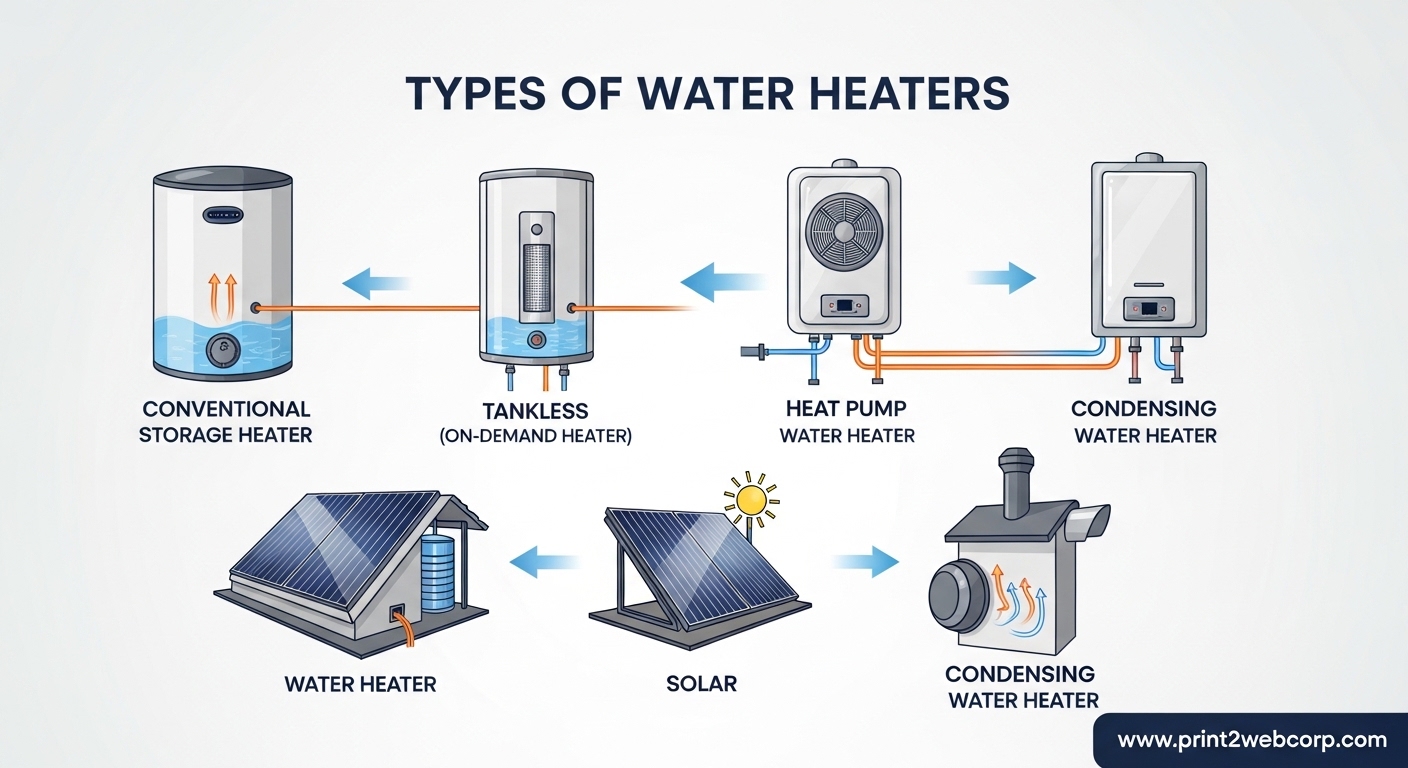
Choosing the right water heater is one of the most important decisions you’ll make for your home comfort and energy bills. Water heating accounts for about 18% of household energy use, so understanding the different types of water heaters can save you hundreds of dollars annually. The main types of water heaters include storage tank models, tankless on-demand units, heat pump hybrid systems, solar-powered heaters, point-of-use heaters, and high-efficiency condensing models. Each type has distinct advantages depending on your household size, climate, fuel availability, and budget. I’ve researched every major water heater type to help you make an informed decision that matches your specific needs.
Understanding types of water heaters starts with recognizing that no single option works best for everyone. A large family in a cold climate has different needs than a single person in a warm region. The right choice balances upfront costs, long-term energy savings, available space, and your home’s existing infrastructure. Let me walk you through each type so you can see which one aligns with your situation.
Types of Water Heaters
The six main types of water heaters available for residential use each serve different purposes and user situations. Storage tank water heaters remain the most common choice in American homes, storing 20-80 gallons of hot water in an insulated tank. Tankless water heaters heat water on demand as it flows through the unit, eliminating standby energy loss. Heat pump water heaters use electricity to move heat from the air or ground to heat water, making them extremely energy efficient. Solar water heaters harness energy from the sun through rooftop collectors, offering renewable heating with significant long-term savings. Point-of-use water heaters provide instant hot water for specific fixtures like sinks or distant bathrooms. Condensing water heaters capture waste heat from exhaust gases to boost efficiency in gas-powered systems. Understanding these types of water heaters helps you narrow down your options based on your specific requirements.
Storage Tank Water Heaters
Storage tank water heaters, also called conventional water heaters, have been the standard in residential applications for decades. These units feature an insulated tank that holds heated water ready for use, with capacities typically ranging from 20 to 80 gallons. Cold water enters the bottom of the tank and gets heated by either electric heating elements or a gas burner located at the bottom. The heated water rises to the top of the tank, where it’s drawn out when you turn on a hot water tap.
The first hour rating (FHR) is the key metric for tank heaters, indicating how much hot water the unit can supply during peak usage. A typical 50-gallon gas tank heater might deliver 80 gallons in the first hour before running cold. This makes them well-suited for households with predictable usage patterns and simultaneous hot water demands. Recovery rate determines how quickly the tank reheats after depleting its hot water supply, with gas models recovering faster than electric.
Tank heaters suffer from standby heat loss, where energy is wasted keeping water hot even when not in use. Modern models have improved insulation to minimize this loss, but it remains an inherent inefficiency compared to tankless designs. Despite this drawback, tank water heaters remain popular due to lower upfront costs, simple installation, and ability to deliver high flow rates for multiple fixtures simultaneously.
Pros of Storage Tank Water Heaters:
- Lower initial purchase cost compared to most alternatives
- Simple, proven technology with easy maintenance
- Can deliver hot water to multiple fixtures simultaneously
- Widely available parts and qualified technicians
- No minimum flow rate requirements
Cons of Storage Tank Water Heaters:
- Standby heat loss wastes energy continuously
- Limited supply means you can run out of hot water
- Requires significant floor space for installation
- Shorter lifespan (8-12 years on average) than some alternatives
- Higher operating costs due to inefficiency
Tankless (On-Demand) Water Heaters
Tankless water heaters, also called on-demand or instantaneous water heaters, heat water directly without using a storage tank. When a hot water tap is turned on, cold water travels through a pipe into the unit where either a gas burner or electric element heats it instantly. This means you never run out of hot water as long as the unit is properly sized for your demand. Tankless models can be 24-34% more energy efficient than conventional storage tank heaters for homes that use less than 41 gallons of hot water daily.
Flow rate measured in gallons per minute (GPM) is the critical specification for tankless units. A typical whole-house tankless heater might deliver 7-10 GPM, enough to run a shower (2.5 GPM) and a dishwasher (1.5 GPM) simultaneously. However, adding a washing machine could overwhelm the unit. Electric tankless models typically have lower flow rates than gas models, often requiring multiple units for whole-home applications.
Tankless water heaters eliminate standby heat loss entirely, contributing significantly to their energy efficiency. They also have a longer lifespan of 20+ years compared to 8-12 years for tank models. However, they require higher upfront costs and may need electrical or gas line upgrades during installation. The continuous flow means they can’t supply multiple high-flow fixtures simultaneously without potential temperature drops.
Pros of Tankless Water Heaters:
- Virtually endless hot water supply when properly sized
- Significantly more energy efficient than tank models
- Compact design saves floor space and can be wall-mounted
- Longer lifespan with proper maintenance
- No standby heat loss reduces operating costs
Cons of Tankless Water Heaters:
- Higher upfront purchase and installation costs
- Limited flow rate means simultaneous high demand can cause issues
- May require gas line or electrical system upgrades
- More complex maintenance and repair requirements
- Cold water sandwich effect between hot water uses
Heat Pump (Hybrid) Water Heaters
Heat pump water heaters, also called hybrid water heaters, use electricity to move heat from one place to another instead of generating heat directly. Like a refrigerator in reverse, they pull heat from the surrounding air and transfer it to water in a storage tank. This makes them 2-3 times more energy efficient than conventional electric resistance water heaters. Heat pump water heaters can reduce water heating costs by up to 70% in appropriate climates.
These units have a minimum operating temperature, typically around 40-50°F, below which they switch to conventional electric heating elements. This makes them less efficient in very cold climates or unheated spaces like garages. However, in moderate climates, they can extract significant heat from ambient air even in winter. Many models offer different operating modes including efficiency, hybrid, electric, and vacation settings to optimize performance based on conditions.
Heat pump water heaters dehumidify the surrounding air as a byproduct of their operation, which can be beneficial in humid climates but problematic in already dry conditions. They require adequate clearance around the unit for proper air circulation and may produce operational noise similar to a refrigerator. While energy savings are substantial, the upfront cost is higher than conventional electric tanks, though federal tax credits often offset this difference.
Pros of Heat Pump Water Heaters:
- Exceptional energy efficiency reduces operating costs significantly
- Can dehumidify surrounding air as added benefit
- Multiple operating modes adapt to different conditions
- Lower carbon footprint than electric resistance models
- Eligible for federal and state tax credits and rebates
Cons of Heat Pump Water Heaters:
- Higher upfront purchase cost than conventional models
- Reduced efficiency in cold climates or unheated spaces
- Requires adequate clearance for air circulation
- Can produce operational noise during operation
- Larger physical footprint than some alternatives
Solar Water Heaters
Solar water heating systems use energy from the sun to heat water for your home, offering one of the most environmentally friendly options available. These systems typically consist of solar collectors (often installed on the roof), a storage tank, and sometimes a backup heating system for cloudy days. Active solar systems use pumps to circulate water or heat-transfer fluid, while passive systems rely on natural convection. Solar water heaters can reduce water heating bills by 50-80% depending on your climate and system size.
The two main types of solar collectors are flat-plate collectors and evacuated-tube collectors. Flat-plate collectors are glazed, insulated boxes with dark absorber plates, while evacuated-tube collectors feature rows of glass tubes with vacuum insulation that makes them more efficient in cold climates. Solar systems can be direct (circulating household water through collectors) or indirect (circulating heat-transfer fluid to avoid freezing in cold weather).
Solar water heaters offer substantial long-term savings and environmental benefits but require significant upfront investment. Performance depends heavily on your location, with optimal results in sunny climates. Most systems include a backup heating element for periods of insufficient solar gain, ensuring hot water is always available. These systems typically last 20+ years with minimal maintenance, making them a worthwhile investment for homeowners planning to stay in their homes long-term.
Pros of Solar Water Heaters:
- Minimal operating costs after initial installation
- Renewable energy source reduces carbon footprint
- Long system lifespan with low maintenance requirements
- Available tax credits and incentives offset installation costs
- Immune to utility rate increases for heating portion
Cons of Solar Water Heaters:
- Highest upfront installation cost of all water heater types
- Performance depends heavily on climate and weather conditions
- Requires sufficient roof space and proper orientation
- May need backup system for cloudy periods or high demand
- Complex installation requiring specialized contractors
Point-of-Use Water Heaters
Point-of-use water heaters are small units designed to provide hot water for specific fixtures rather than whole-home applications. These compact heaters are typically installed under sinks or near remote fixtures to eliminate the wait for hot water from the main water heater. They come in both tank and tankless versions, with capacities usually ranging from 2 to 20 gallons for tank models. Point-of-use units are ideal for additions, remodels, or locations far from the main water heater where running a dedicated line would be expensive.
Electric point-of-use heaters are most common, as they’re simple to install and don’t require venting. Gas versions are available but more complex to install and vent properly. These units can be wired directly to the fixture they serve, eliminating the need to run hot water lines from distant locations. They’re particularly useful for bathroom additions, outdoor kitchens, workshop sinks, or any location where occasional hot water is needed without installing or expanding a whole-home system.
While point-of-use heaters solve specific problems, they’re not designed to replace whole-home water heating. Using multiple point-of-use units throughout a home would be inefficient compared to a single properly sized central heater. However, they excel in targeted applications where their convenience and efficiency outweigh the limitations of their small capacity.
Pros of Point-of-Use Water Heaters:
- Instant hot water eliminates waiting for distant units
- Compact size fits under sinks or in tight spaces
- Simple installation often doesn’t require major plumbing work
- Eliminates water waste from running taps to get hot water
- Ideal for additions or remote fixtures
Cons of Point-of-Use Water Heaters:
- Limited capacity can’t serve multiple fixtures simultaneously
- Not suitable as primary whole-home water heating solution
- Higher per-gallon operating costs than larger units
- Multiple units needed for whole-home coverage
- Requires dedicated electrical circuit for each unit
Condensing Water Heaters
Condensing water heaters represent the most efficient type of gas water heater available, capturing waste heat from exhaust gases that would otherwise be vented outside. These units use a secondary heat exchanger to extract additional heat from the combustion byproducts before they exit the unit, pushing thermal efficiency above 90% compared to 60-70% for conventional non-condensing models. This technology allows condensing heaters to deliver more hot water using less fuel.
The combustion process in condensing heaters produces water vapor as a byproduct, which condenses in the secondary heat exchanger. This condensate is acidic and must be properly drained and neutralized, requiring special installation considerations. Condensing units typically use PVC venting instead of metal venting required for conventional gas heaters, simplifying installation in some cases but adding complexity in others.
While condensing water heaters have higher upfront costs than standard gas models, the energy savings can offset this difference in 5-10 years depending on fuel costs and usage patterns. These units are particularly valuable in high-use households or areas with expensive natural gas or propane. They’re available in both storage tank and tankless configurations, allowing you to choose the design that best fits your needs while maximizing efficiency.
Pros of Condensing Water Heaters:
- Highest efficiency among gas water heaters
- Lower fuel costs reduce long-term operating expenses
- Can use PVC venting for easier installation in some cases
- Higher hot water output for same fuel input
- Reduced greenhouse gas emissions compared to conventional gas
Cons of Condensing Water Heaters:
- Higher upfront purchase cost than standard gas models
- Requires condensate drain and neutralization system
- More complex installation may require specialized contractors
- Larger and heavier than conventional units
- Efficiency advantage less significant in low-use households
Electric vs Gas vs Propane Water Heaters
Beyond the technology type, the fuel source powering your water heater significantly impacts performance, cost, and suitability. Electric water heaters are the most common type in many areas due to simple installation and availability. They have lower upfront costs and no venting requirements, making installation straightforward. However, electricity is typically more expensive per BTU than gas or propane, resulting in higher operating costs. Electric models also heat water more slowly than gas counterparts, with slower recovery rates.
Natural gas water heaters offer lower operating costs in areas where natural gas is available. Gas units heat water faster with higher recovery rates, making them better for high-demand households. Installation is more complex, requiring gas line connections and proper venting to outdoors. Gas models also produce combustion byproducts and require regular maintenance to ensure safe operation. In areas where natural gas is available, gas water heaters typically offer the best balance of upfront cost and operating efficiency.
Propane water heaters function similarly to natural gas models but use liquid propane stored in tanks. They’re common in rural areas without natural gas service. Propane contains more energy per gallon than natural gas, but fuel costs vary significantly by region and market conditions. Installation requires propane tank placement, gas line connections, and proper venting. Propane heaters offer excellent performance where natural gas isn’t available but come with the added consideration of fuel delivery and tank maintenance.
When comparing fuel types, consider availability in your area, current and projected fuel costs, installation requirements, and your household’s hot water demand patterns. Electric models may be the only viable option in some multi-family buildings, while propane might be necessary in rural settings. Natural gas often offers the best economics where available, but regional price variations can shift this calculus.
How to Choose the Right Water Heater for Your Home 2026?
Selecting from the different types of water heaters requires evaluating several factors specific to your situation. Start by calculating your household’s hot water needs by listing all hot water fixtures and estimating simultaneous usage. A family of four with teenagers might need 70-80 gallons of storage capacity or a high-flow tankless unit, while a single person might manage with 30-40 gallons. Consider both your current household size and any anticipated changes in the coming years.
Your climate plays a significant role in water heater selection. Cold climates reduce heat pump efficiency and may limit solar viability, while warm climates make these options more attractive. Homes in northern regions often benefit from gas or propane models that perform reliably regardless of outdoor temperatures. Southern climates provide ideal conditions for heat pump and solar systems that can deliver substantial energy savings. Consider installing your water heater in a conditioned space in cold climates to maintain efficiency.
Available fuel types in your home often narrow your options. If your home already has natural gas service, a gas water heater typically offers the best economics. Electric-only homes might benefit from heat pump technology or electric tankless models. Propane provides gas performance in areas without natural gas service. Solar systems work anywhere but require sufficient sunlight exposure. Your home’s electrical capacity should also be evaluated, especially when considering electric tankless models that may require service upgrades.
Space constraints can eliminate some options. Tankless and point-of-use units save floor space but require wall mounting. Large tank models need significant floor space and often occupy utility closets or basements. Heat pump water heaters require clearance around the unit for air circulation. Consider available space before committing to a particular type. Also factor in installation complexity and whether your home’s infrastructure can accommodate the chosen system without major renovations.
Budget considerations include both upfront costs and long-term operating expenses. Tank water heaters have the lowest upfront cost but higher operating costs. Tankless and heat pump models cost more initially but save money over time through improved efficiency. Solar systems have the highest upfront cost but minimal operating costs. Factor in available tax credits, rebates, and incentives that can significantly offset the initial investment. Calculate the payback period for higher-efficiency options to determine if they make financial sense for your situation.
Finally, consider your household’s lifestyle and usage patterns. If hot water demand is spread evenly throughout the day, a tank model works well. If you have periods of very high demand followed by extended periods of low use, tankless or larger tank models might be better. For environmentally conscious homeowners, heat pump and solar options offer reduced carbon footprints. Evaluate maintenance requirements and your willingness to perform or pay for regular servicing, as different types have different maintenance needs.
Frequently Asked Questions
What type of hot water heater is best?
The best water heater type depends on your specific needs. Tank water heaters offer the lowest upfront cost and work well for households with predictable usage patterns. Tankless models provide endless hot water and better energy efficiency for homes using less than 41 gallons daily. Heat pump hybrids offer exceptional efficiency for electric homes in moderate climates. Solar systems provide long-term savings in sunny locations. Consider your climate, fuel availability, household size, and budget when choosing.
Which is better conventional or tankless water heaters?
Conventional tank water heaters are better for households with high simultaneous hot water demands, lower upfront budgets, or limited electrical/gas capacity for upgrades. Tankless water heaters are superior for homes wanting endless hot water, better energy efficiency, longer lifespan, and space savings. Tankless models cost more upfront but can save 24-34% on energy costs. Choose conventional if you need high flow to multiple fixtures simultaneously, or tankless if you want efficiency and never run out of hot water.
What are the 4 types of hot water systems?
The four main types of hot water systems are storage tank water heaters (most common, store heated water), tankless or on-demand water heaters (heat water as needed), heat pump or hybrid water heaters (move heat from air to water), and solar water heaters (use sun energy). Each type offers distinct advantages in efficiency, cost, and suitability for different household situations and climates.
What are two types of hot water unit heaters?
The two primary categories of hot water unit heaters are storage tank heaters and tankless (on-demand) heaters. Storage tank heaters maintain a reservoir of heated water ready for immediate use, while tankless heaters heat water instantly as it flows through the unit. These represent the fundamental difference between storing heated water versus creating it on demand.
Why do plumbers not recommend tankless water heaters?
Plumbers sometimes caution against tankless water heaters due to several factors: higher upfront costs, potential need for electrical or gas line upgrades, limited flow rate that can cause temperature drops during high demand, more complex maintenance, and performance issues with very cold incoming water. Additionally, the savings don’t always justify the investment for all households, particularly those with high simultaneous hot water needs or low daily usage where efficiency gains are minimal.
What is the most reliable type of water heater?
Storage tank water heaters, particularly gas models, are generally considered the most reliable water heater type due to their simple, proven technology with fewer components that can fail. They have been used for decades with predictable performance and straightforward maintenance. Heat pump and solar water heaters have more components and technology that can require attention. However, reliability varies significantly by brand, model quality, proper installation, and regular maintenance regardless of type.
Conclusion
Choosing from the many types of water heaters available doesn’t have to be overwhelming when you understand how each option aligns with your specific situation. The right water heater provides reliable hot water for your household while minimizing energy waste and operating costs. Take time to evaluate your hot water usage patterns, available fuel types, climate, and budget before making a decision. Investing in the appropriate water heater type pays dividends in comfort, savings, and reliability for years to come. Consult with a qualified plumber or installer to assess your specific situation and get professional recommendations tailored to your home’s unique characteristics.
Leave a Reply