
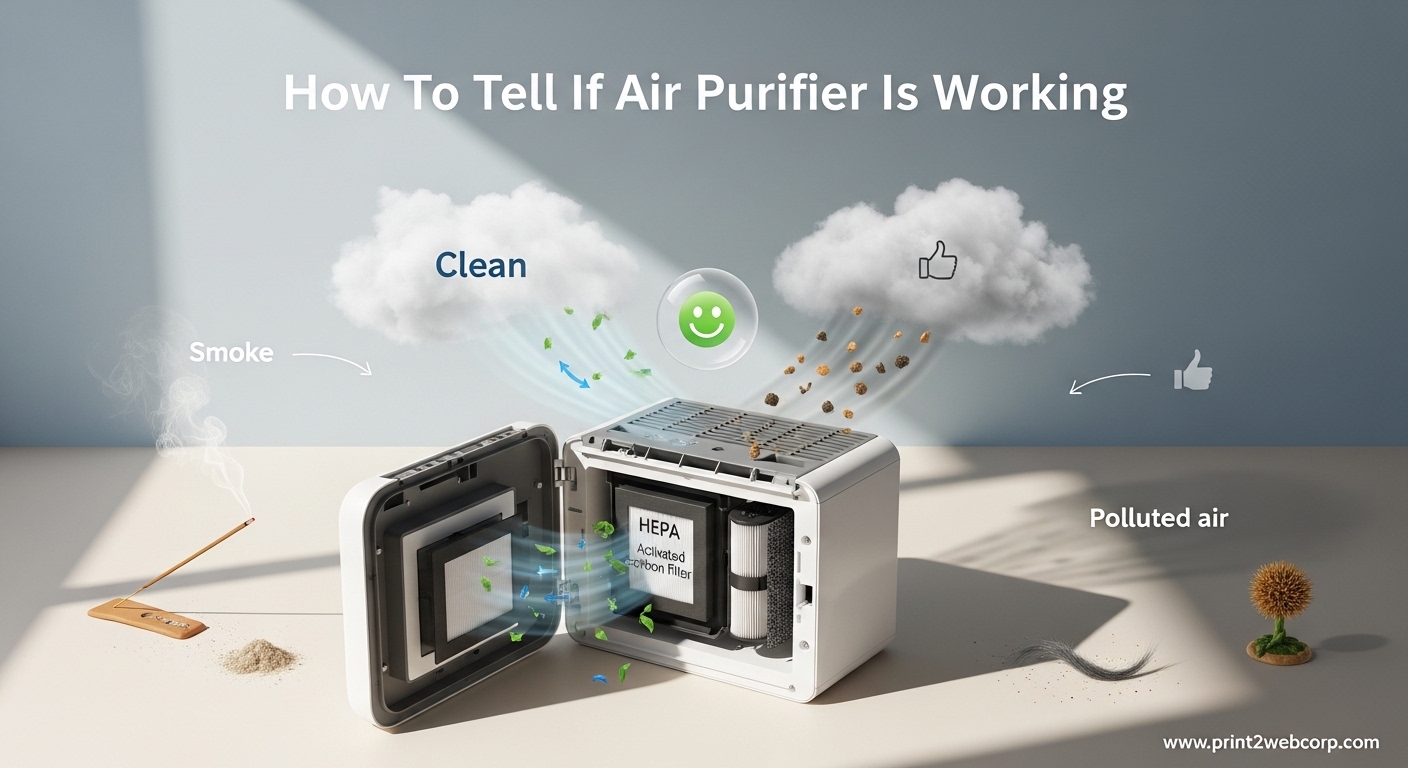
Air quality is invisible, which makes it surprisingly difficult to know if your air purifier is actually doing its job. I’ve spoken with dozens of air purifier owners who run their units for months, unsure whether they’re breathing cleaner air or just paying for electricity to spin a fan. The challenge is real – unlike a vacuum cleaner where you can see the dust being collected, an air purifier’s work happens silently and invisibly.
Learning how to tell if air purifier is working matters for your health and your wallet. A properly functioning air purifier can reduce allergy symptoms, eliminate odors, and remove harmful particles from your home. But a malfunctioning or poorly placed unit might be giving you a false sense of security while your indoor air quality remains unchanged. Let me walk you through the reliable ways to verify your air purifier is actually cleaning your air.
In this guide, I’ll share quick checks you can do in under five minutes, affordable testing methods used by air quality enthusiasts, and realistic timelines for when you should expect to see results. These verification techniques come from real user experiences and air quality testing standards, not manufacturer marketing claims.
Quick Visual Indicators Your Air Purifier Is Working
The fastest way to check if your air purifier is functioning is to look at the built-in indicators. Most modern air purifiers include some form of visual feedback that shows the unit is powered on and actively filtering air. A steady, illuminated light usually means the purifier is operating normally, while blinking or colored lights often indicate filter status or air quality readings.
Check your air purifier’s indicator light first. This seems obvious, but many users overlook the simplest verification method. If the power light is solid and not blinking, your unit is receiving electricity and the fan should be running. Some models use color-coded lights to show real-time air quality – blue typically indicates good air quality, yellow means moderate, and red signals poor air quality that needs cleaning.
Listen to the fan operation. A working air purifier should produce consistent airflow sound. If your unit is completely silent but supposed to be running, the fan may have failed or the unit might be in standby mode. Conversely, unusually loud noises or rattling suggest a mechanical problem that could reduce effectiveness.
Inspect the filter condition if your model allows easy access. A visibly dirty, gray, or dusty filter actually indicates your purifier has been capturing particles – it’s working. A brand-new looking filter after months of use might signal that air isn’t passing through it properly. However, don’t expect dramatic visible changes in filter appearance, as the most harmful particles are too small to see clearly.
Feel for airflow at the exhaust vent. Place your hand about 6-12 inches from where clean air exits the unit. You should feel steady, consistent air movement. Weak or intermittent airflow suggests a clogged filter, failing fan, or blocked intake vent. This simple test takes seconds and reveals whether air is actually circulating through the filtration system.
How to Test Air Purifier Airflow
Airflow testing is the most reliable physical verification method you can perform without special equipment. The paper tissue test is a simple technique used by air quality professionals and enthusiasts alike. Take a lightweight tissue or single-ply toilet paper and hold it about 2-3 inches from the air purifier’s exhaust vent while the unit is running on a medium or high setting.
The tissue should be pulled toward the vent and flutter consistently as air flows out. If the tissue barely moves or falls away from the vent, your airflow is insufficient. This indicates either a clogged filter, a failing fan motor, or obstructed intake vents that are preventing proper air circulation. Compare the tissue movement across different fan speeds – higher speeds should produce stronger airflow that pulls the tissue more firmly toward the vent.
Test airflow at multiple points along the exhaust vent if your purifier has a wide output area. Some models distribute air across a panel rather than a single vent. Weak spots in airflow could indicate internal blockages or uneven filter loading, where one section of the filter is more clogged than others.
Measure the distance that effective airflow reaches. While not a precise test, noticing how far from the unit you can feel air movement gives you insight into coverage area. Most air purifiers are designed to clean air in a specific room size based on their Clean Air Delivery Rate (CADR). If airflow barely extends 2-3 feet from the unit, it may be undersized for your space or struggling with a restricted filter.
Compare current airflow to when the unit was new. If you’ve owned your purifier for several months or years, reduced airflow compared to its initial performance indicates filter loading or component wear. Most filters gradually lose efficiency as they fill with particles, which is normal but eventually requires replacement. A dramatic drop in airflow over a short period suggests a specific problem that needs troubleshooting.
Using Air Quality Monitors to Verify Performance
Air quality monitors provide objective data about whether your purifier is reducing airborne particles. PM2.5 readings are the gold standard for measuring air purifier effectiveness because these fine particles are exactly what HEPA filters are designed to capture. PM2.5 refers to particulate matter smaller than 2.5 micrometers – particles so small they’re invisible to the naked eye but harmful when inhaled.
The most reliable test method is the before-and-after comparison. First, measure your room’s baseline PM2.5 reading with the air purifier turned off for at least 30 minutes. Note this number, then turn on your purifier and watch how the PM2.5 level changes over the next 1-2 hours. A working air purifier should noticeably reduce the PM2.5 reading, typically by 30-50% or more depending on the initial air quality and the purifier’s capacity.
You don’t need expensive professional equipment to perform this test. Affordable air quality monitors in the $40-100 range work well for home verification. Models like the Ikea Vindstyrka ($40), Temtop M10, and various generic PM2.5 monitors provide accurate enough readings for home testing. These devices have become popular among air quality enthusiasts because they make the invisible visible – you can actually see the difference your purifier makes.
Built-in air quality sensors on some purifier models offer convenience but aren’t always reliable. Many users report that these sensors fluctuate between just two values or fail to respond to actual air quality changes. Standalone monitors typically provide more consistent readings because they’re placed separately from the purifier, measuring the room’s air rather than the air immediately exiting the unit.
Understanding PM2.5 readings helps you interpret the data. Readings below 12 mcg/m³ indicate excellent air quality, 12-35 is good, 35-55 is moderate, and above 55 is unhealthy. If your purifier is working, you should see readings move toward the lower end of this scale during operation. The most telling sign is watching the number drop consistently after turning on the purifier – this visual confirmation provides concrete evidence of effectiveness.
Physical Signs Your Air Purifier Is Making a Difference
Beyond measurements and tests, your environment provides clues about air purifier performance. Reduced dust accumulation on surfaces is one of the most noticeable long-term indicators. After 4-6 weeks of consistent use, you should see less dust settling on furniture, electronics, and windowsills. Many users report dusting half as often once their purifier is working effectively. The difference becomes most apparent when you compare dust buildup before and after installing the unit.
Filter dust accumulation provides visual proof of particle capture. While a brand-new white filter won’t show immediate changes, after 6-12 months of use, a working filter will develop visible gray discoloration and particle buildup. This visible accumulation proves the filter is capturing particles from your air. The timeline varies based on your home’s air quality – homes with pets, smokers, or high pollution areas will show faster filter loading.
Odor reduction is another clear performance indicator. Air purifiers with activated carbon filters should effectively neutralize smells from cooking, pets, smoke, or musty areas. Within 1-2 weeks of use, you should notice lingering odors disappearing more quickly after their source is removed. A purifier that’s working well will clear cooking smells within an hour or two, whereas before, those odors might have persisted overnight.
Allergy and asthma symptom improvements often provide the most convincing evidence for health-conscious users. Within 2-4 weeks of consistent operation, many people report reduced morning congestion, fewer allergy flare-ups, and easier breathing. While individual results vary based on specific allergens and sensitivities, noticeable symptom improvement indicates the purifier is successfully removing irritants from your air. Keep a simple symptom journal to track changes objectively.
How Long to See Effects of an Air Purifier
The timeline for seeing results varies based on what you’re measuring and your home’s specific conditions. Immediate effects are limited to airflow, sound, and indicator lights – you can verify these within minutes of turning on the unit. The paper tissue test works instantly, and listening to consistent fan operation provides immediate confirmation that the unit is powered and functioning.
Short-term effects become noticeable within 1-2 weeks. Odor reduction is typically the first improvement you’ll experience, as activated carbon filters work quickly on gaseous pollutants. PM2.5 readings should show measurable improvement within hours of operation, and you’ll see consistent reductions whenever the purifier runs. Some users with dust sensitivities report slight improvement in morning congestion during this period.
Medium-term effects emerge after 4-6 weeks of consistent use. Reduced dust accumulation on surfaces becomes apparent during this timeframe. Many users notice they’re dusting less frequently and that surfaces stay cleaner longer. Allergy sufferers often report meaningful symptom reduction by week 4-6, assuming the purifier is appropriately sized for their space and running consistently.
Long-term effects take 6-12 months to become fully visible. This is when filter dust buildup becomes clearly apparent, providing tangible proof that particles are being removed from your air. Chronic allergy issues often show the most improvement during this period, as consistent air quality reduction allows respiratory systems to recover and heal. The cumulative effect of months of clean air creates the most dramatic health improvements.
Several factors affect how quickly you’ll see results. Room size relative to the purifier’s capacity matters significantly – an undersized unit will struggle to show improvement. Initial air quality plays a role too; heavily polluted spaces take longer to clean. Consistency of operation is crucial – running the purifier intermittently dramatically extends the timeline. Most air quality enthusiasts recommend 24/7 operation for the best results, typically on medium fan speed rather than turbo or low settings.
Troubleshooting When Your Air Purifier Isn’t Working Properly
A clogged or dirty filter is the most common reason air purifiers stop working effectively. HEPA filters gradually fill with particles over 6-12 months of use, restricting airflow and reducing efficiency. If your filter is visibly gray or has been in use longer than the manufacturer’s recommended replacement interval, replace it immediately. Many users report dramatic performance restoration simply by changing an overdue filter. Check your manual for specific replacement timing, but don’t exceed 12 months regardless of appearance.
Undersized purifiers struggle to show results because they’re trying to clean more air than their capacity allows. Every air purifier has a recommended room size based on its CADR rating and air changes per hour (ACH) capability. If your room exceeds this size, the unit will run continuously without ever achieving full air cleaning cycles. Measure your room’s square footage and compare it to your purifier’s specifications. For large rooms or open floor plans, you may need multiple units or a higher-capacity model.
Poor placement can block airflow and reduce effectiveness significantly. Air purifiers need clearance around intake and exhaust vents to function properly. Avoid placing units against walls, under furniture, or in corners where air circulation is restricted. Position the purifier at least 12-18 inches from any surface, ideally in a central location away from obstacles. Many users unknowingly block vents by placing purifiers behind sofas or under tables, dramatically reducing their effectiveness.
Fan speed settings affect both performance and noise levels. Running your purifier on the lowest setting may provide inadequate air changes for effective cleaning. Conversely, maximum turbo settings are often too loud for continuous use. Most users find medium speed (typically labeled 2 or 3 out of 5) provides the best balance of effectiveness and livability. If you only run your purifier on low, try increasing the speed and monitor whether air quality measurements improve.
Filter replacement reminders sometimes need manual reset after changing filters. Many models continue showing “replace filter” warnings until explicitly reset through the control panel or app. Check your manual for the reset procedure, which usually involves holding a specific button combination for 3-5 seconds. A constantly blinking replacement indicator doesn’t necessarily mean the new filter isn’t working – it may simply need the reset procedure.
Brand-specific quirks affect certain models. Levoit purifiers sometimes require a filter reset that involves unplugging for 30 seconds after replacement. Dyson units occasionally need app recalibration if sensors seem stuck. Coway models have a unique ionizer setting that can be toggled independently. If you’re experiencing issues specific to your brand, check the manufacturer’s troubleshooting guide or user forums for known issues and solutions.
What Air Purifiers Can and Cannot Filter
Understanding what your air purifier is designed to capture helps set realistic expectations about performance. HEPA filters excel at removing particulate matter including dust, pollen, pet dander, mold spores, and some bacteria. True HEPA or H13-grade filters capture 99.97% of particles as small as 0.3 microns. If your concern is allergies, asthma triggers, or general dust reduction, a HEPA-based purifier should effectively address these issues.
Activated carbon filters target gaseous pollutants and odors that HEPA filters cannot catch. These include volatile organic compounds (VOCs) from cleaning products and building materials, cooking odors, pet smells, and smoke. Carbon filters work through adsorption, trapping gas molecules in a porous structure. However, carbon has limited capacity and saturates over time – typically needing replacement every 3-6 months rather than the 6-12 month HEPA timeline.
The question of whether air purifiers filter microplastics has incomplete research. Some evidence suggests HEPA filters can capture microplastic fibers, which are physically larger than many particles HEPA is rated to catch. However, microplastics research is emerging, and no air purifier is specifically tested or certified for microplastic removal. If microplastics are a primary concern, focus on source reduction and HEPA filtration as a precautionary measure.
Air purifiers cannot remove all indoor air pollutants. Gases like carbon monoxide and radon require specialized detection and mitigation, not filtration. Some viruses are too small for HEPA capture unless the unit includes additional technology like UV-C light. Very fine VOCs may pass through standard carbon filters. Understanding these limitations helps you evaluate whether your purifier is performing as designed rather than expecting it to address every possible air quality issue.
Frequently Asked Questions
How do I test if my air purifier is working?
The most reliable test is using a PM2.5 air quality monitor. Measure your room’s baseline reading with the purifier off for 30 minutes, then turn it on and watch the PM2.5 level drop over 1-2 hours. A working purifier should reduce readings by 30-50% or more. Without a monitor, use the paper tissue test at the exhaust vent – the tissue should flutter consistently as air flows out.
Do air purifiers filter microplastics?
Research on microplastic filtration is incomplete. HEPA filters may capture some microplastic fibers since they’re physically larger than the 0.3-micron particles HEPA is rated to catch. However, no air purifier is specifically tested or certified for microplastic removal. If microplastics concern you, HEPA filtration provides some protection alongside source reduction strategies.
Would an air purifier help my COPD?
Air purifiers can benefit COPD patients by removing irritants that trigger symptoms. HEPA filtration reduces airborne particles like dust, pollen, and smoke that can worsen breathing difficulties. However, air purifiers are supplementary – they don’t treat COPD itself or replace medications. Consult your healthcare provider about using an air purifier as part of your COPD management plan.
Can a dirty air filter cause a sore throat?
Yes, a dirty air filter can contribute to sore throat symptoms. Clogged filters restrict airflow and may allow particles to pass through that would otherwise be captured. Worse, severely dirty filters can become breeding grounds for mold and bacteria, releasing these irritants back into your air. Replace filters on schedule – every 6-12 months for HEPA filters, every 3-6 months for carbon filters.
How long until I see effects of an air purifier?
Timeline varies by effect type. Odor reduction happens within 1-2 weeks. PM2.5 readings improve within hours of operation. Dust reduction becomes noticeable after 4-6 weeks. Allergy symptom relief typically appears after 2-4 weeks of consistent use. Filter dust buildup becomes visible after 6-12 months. Run your purifier 24/7 on medium speed for the fastest results.
Conclusion
Knowing how to tell if air purifier is working comes down to combining multiple verification methods rather than relying on a single indicator. The paper tissue test confirms airflow, PM2.5 monitors provide objective data, and physical changes in your environment offer real-world proof. When all these indicators align – strong airflow, falling PM2.5 readings, reduced dust, and improved symptoms – you can be confident your purifier is doing its job.
Remember that seeing results takes time. While airflow and PM2.5 readings provide immediate feedback, meaningful environmental changes like dust reduction and symptom relief typically require 4-6 weeks of consistent operation. Filter dust buildup takes 6-12 months to become clearly visible. Patience and consistent operation are key to experiencing the full benefits of air purification.
If you’ve tried these verification methods and suspect your current purifier isn’t performing adequately, it might be time for an upgrade. Check out our guide to the best air purifiers for clean air to find models with proven performance. For more information on maintaining optimal home air quality, explore more air purifier guides and reviews on our site.
Breathe easier knowing you can verify your air purifier is actually working. The invisible nature of air quality makes verification challenging, but with these testing methods and realistic timeline expectations, you can have confidence in your home’s air purification system.
Leave a Reply