
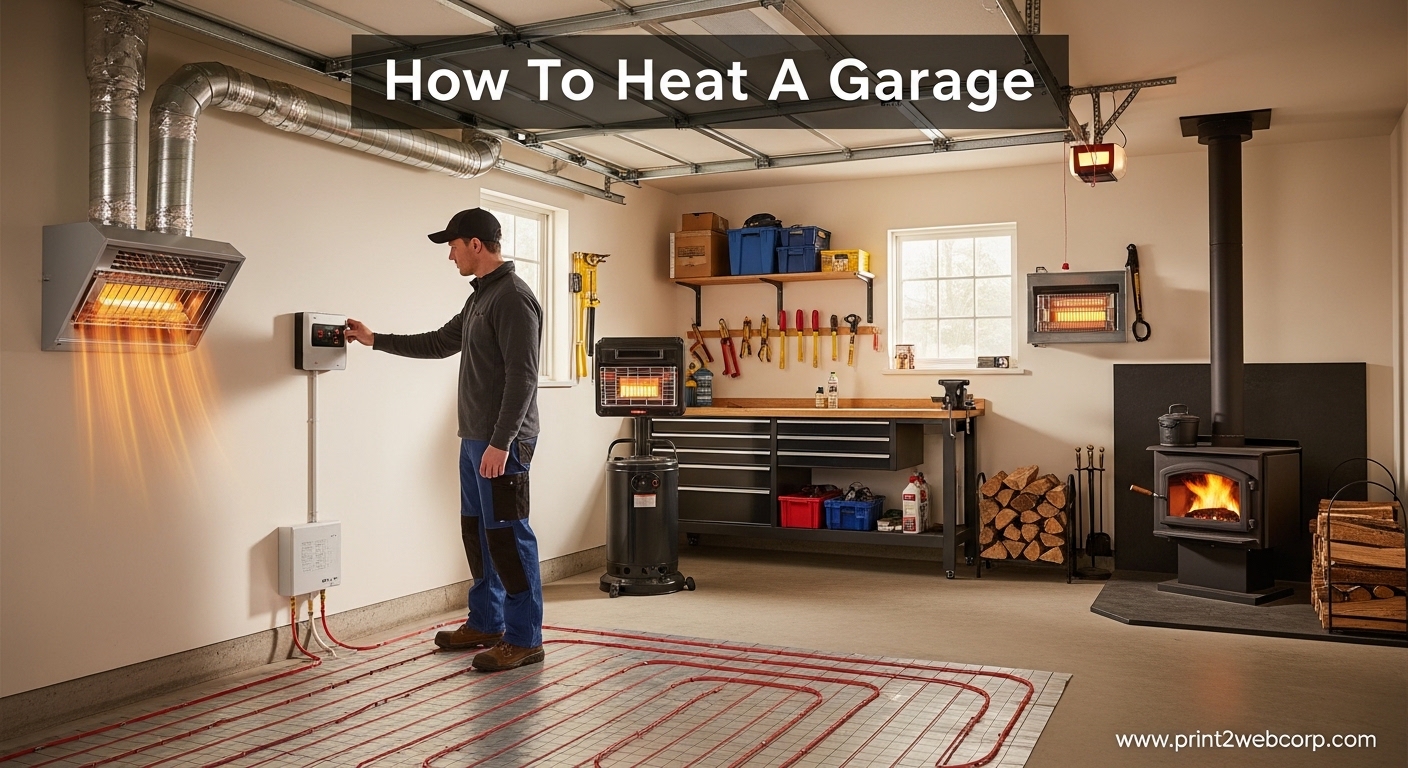
Learning how to heat a garage can transform your cold storage space into a year-round workshop, home gym, or comfortable hobby area. I’ve spent years researching garage heating solutions, and I’ll share what actually works based on real user experiences and heating fundamentals.
A heated garage protects your vehicles from extreme temperature swings, prevents moisture damage to stored items, and makes working on projects comfortable during winter months. The approach you choose depends on your garage size, insulation level, climate zone, and how often you use the space.
This guide covers everything from calculating your heating needs to comparing all available heating methods, along with real costs and safety considerations you won’t find in manufacturer brochures.
How Much Heat Does Your Garage Need?
Before choosing a heating method, you need to understand your garage’s heating requirements. This comes down to BTU (British Thermal Units) output – the measure of heating power. Get this wrong, and you’ll either waste money on oversized equipment or shiver with an underpowered heater.
The BTU requirement depends on three factors: garage size, insulation level, and your climate zone. A well-insulated two-car garage in moderate climates needs significantly less heat than a poorly insulated workshop in Minnesota.
BTU Calculator By Garage Size and Climate
| Garage Size | Moderate Climate (BTU) | Cold Climate (BTU) | Severe Cold (BTU) |
|---|---|---|---|
| 1 Car (12×20 ft) | 5,000 – 10,000 | 10,000 – 15,000 | 15,000 – 20,000 |
| 2 Car (20×24 ft) | 10,000 – 20,000 | 20,000 – 30,000 | 30,000 – 45,000 |
| 3 Car (30×30 ft) | 20,000 – 30,000 | 30,000 – 45,000 | 45,000 – 60,000 |
These figures assume standard ceiling height (8-9 feet). Add 25% more BTU for vaulted ceilings. If your garage has zero insulation, double these numbers. The formula heating professionals use: Volume (cubic feet) x Temperature Rise x 0.133 = Required BTU.
Your target temperature depends on usage. For car storage, 45-50°F prevents cold starts and protects fluids. For workshops, 60-65°F keeps materials stable and hands comfortable. Home gyms typically need 65-70°F for comfortable exercise.
Step 1: Insulate Your Garage First
I can’t stress this enough: insulation is the foundation of effective garage heating. Reddit users from woodworking and home improvement communities unanimously agree – adding heat to an uninsulated garage is like trying to fill a bucket with holes. You’ll spend exponentially more on heating bills without getting meaningful results.
Insulation works by slowing heat transfer through your garage walls, ceiling, and door. In winter, it keeps heated air inside. In summer, it blocks exterior heat. The measurement for insulation effectiveness is R-value – higher numbers mean better resistance to heat flow.
For garage walls, aim for R-13 to R-19 depending on your climate zone. Fiberglass batt insulation is the most accessible DIY option, costing about $0.50-1.00 per square foot. Spray foam provides superior air sealing but costs $2-4 per square foot and requires professional installation.
Ceiling and Roof Insulation
Heat rises, making ceiling insulation your highest priority. An uninsulated ceiling can account for 25% of heat loss. For garages with living space above, install R-30 to R-38 fiberglass batts between ceiling joists. For detached garages with exposed rafters, you can use blown-in cellulose or foam board between rafters.
If your garage has a flat roof with no attic space, rigid foam insulation boards installed on the interior ceiling can achieve R-15 to R-20. This requires covering with drywall or plywood for fire code compliance in most jurisdictions.
Garage Door Insulation
The garage door is typically the weakest link in thermal performance. A standard uninsulated steel door has an R-value of less than 1. Garage door insulation kits, which include foam panels designed to fit between door sections, can increase this to R-6 or higher for $100-200.
For serious heating projects, consider replacing your door with an insulated model (R-12 to R-16). While this costs $800-2,000 installed, the energy savings in cold climates can offset the investment within 3-5 years. Many users report dramatic temperature differences after this single upgrade.
Window Insulation
If your garage has windows, they’re major heat loss points. Window insulation film kits ($20-40) create an air barrier that reduces heat loss by up to 70%. For garages you don’t need natural light in, covering windows entirely with foam board provides the highest R-value.
Step 2: Seal Gaps and Drafts
After insulation, air sealing is your most impactful step. As one Reddit user noted: “Sealing any gaps and cracks with caulk or spray foam will help make the space feel more comfortable and will help retain any heated air.” This step alone can make a 5-10°F temperature difference.
Start with the garage door bottom seal. Over time, rubber weatherstripping cracks and compresses, creating gaps. Replacement bottom seals cost $20-50 and install with basic tools. For older doors, consider a threshold seal that mounts to the floor, creating a complete barrier.
Check around windows and door frames for gaps where caulking has failed. Use exterior-grade silicone caulk for gaps under 1/4 inch. For larger gaps around pipes, wires, or framing, expanding spray foam creates an airtight seal. One user reported: “I sealed every penetration point and my heating requirements dropped by 30%.”
Don’t forget the transition between your garage and your home (if attached). This area often lacks proper sealing, allowing heated air to escape into your house. Weatherstripping kits for interior access doors cost under $20 and install in minutes.
How To Heat A Garage: 7 Proven Methods
Now that your garage is insulated and sealed, let’s compare heating methods. Each has strengths and weaknesses depending on your situation. I’ll cover real operating costs, installation complexity, and which users each method serves best.
1. Electric Space Heaters
Portable electric space heaters are the entry-level solution for garage heating. They plug into standard 120V outlets, require no installation, and cost $50-200 for decent units. However, they’re limited to 1,500 watts (5,120 BTU), which is insufficient for most two-car garages in cold climates.
The main advantage is portability and low upfront cost. They work well for small one-car garages or spot heating near a workbench. Operating costs are high – at $0.15/kWh, running a 1,500W heater for 8 hours costs about $1.80 daily, or $54 monthly.
Reddit users consistently report disappointment with space heaters for anything beyond small spaces. As one noted: “The space heater plan is not a good one, too much risk.” The risks include fire hazards if placed near materials, and circuit overloading if running on the same circuit as power tools.
Best for: Small one-car garages, occasional use, spot heating near workbenches. Not recommended for daily heating of larger spaces.
2. Electric Wall and Ceiling Mounted Heaters
Hardwired electric heaters provide 5,000-10,000 BTU from a 240V circuit. Popular brands like Fahrenheat and Cadet offer units with built-in thermostats and fans for heat distribution. Installation requires electrical work but provides permanent, reliable heat.
These units cost $200-400 plus electrical installation ($200-500 depending on complexity). They mount out of the way, freeing up floor and workspace. The 240V connection provides significantly more heat than portable units – enough for a well-insulated two-car garage in moderate climates.
Operating costs remain high compared to gas options. A 5,000W unit running 8 hours daily costs about $6 per day, or $180 monthly at typical electric rates. However, maintenance is minimal – no combustion, no venting, and no fuel storage.
Best for: Insulated two-car garages in moderate climates, users who prioritize simplicity and low maintenance, locations where gas isn’t available.
3. Propane and Natural Gas Heaters
Gas heaters deliver the lowest operating cost per BTU, making them popular for daily heating needs. Propane units like Mr. Heater’s “Big Maxx” series provide 50,000-80,000 BTU, enough for large uninsulated garages. Natural gas versions offer the same output without fuel tank management.
Unit costs range from $300-800 for the heater, plus $500-1,500 for professional installation. Venting is required for indoor use – these heaters mount on the wall or ceiling and exhaust through a sidewall or roof vent. The venting requirement increases installation complexity but ensures safety.
Operating costs are significantly lower than electric. At typical propane rates ($2.50/gallon), a 50,000 BTU heater running 8 hours costs about $3.50 daily, or $105 monthly. Natural gas is even cheaper where available. One Reddit user reported: “A hanging gas garage furnace is the way to go. They vent out through a sidewall and are fairly cost efficient to run.”
Condensation is a common complaint with gas heaters. Combustion produces water vapor, which can increase garage humidity. This isn’t a problem for occasional use but requires ventilation strategies for daily heating.
Best for: Large garages, daily use, very cold climates, users with access to natural gas. Not ideal for spaces with poor ventilation.
4. Mini-Split Heat Pumps
Mini-split systems are increasingly popular for garage heating, and experienced users consistently recommend them. These ductless heat pumps provide both heating and cooling, with exceptional efficiency. A typical unit provides 12,000-24,000 BTU using a fraction of the electricity of resistance heaters.
Installation costs are significant – expect $3,000-6,000 for equipment and professional installation. However, operating costs are dramatically lower than electric resistance heat. Many users report 50-70% savings compared to electric space heaters. As one Reddit user explained: “An air source heat pump (ASHP) would work great for you! Virtually everywhere in the USA it is cheaper to heat with a modern, efficient, mini-split heat pump.”
Mini-splits maintain consistent temperatures rather than the on-off cycling of forced air. They’re quiet, provide air conditioning in summer, and add value to your property. The main drawback is upfront cost and the need for professional installation.
Performance does decline in extreme cold – most mini-slops lose efficiency below 20°F. However, modern cold-climate models maintain output down to -13°F or lower. For severe cold climates, consider a backup heating source.
Best for: Year-round garage use, attached garages, energy-conscious users, situations where cooling is also desired.
5. Forced-Air Garage Furnaces
Dedicated gas furnaces designed for garages provide powerful heat with professional-grade reliability. These units mount overhead (saving floor space) and deliver 45,000-125,000 BTU through ductwork or direct blowers. Brands like Modine and Reznor are commercial favorites.
Installation costs range from $2,000-4,000 including the furnace, venting, and electrical. These units require gas lines, 120V power, and exhaust venting. They’re typically installed by HVAC professionals and include proper thermostatic controls.
Forced-air furnaces heat spaces quickly and evenly. The overhead mounting distributes heat effectively, and the powerful fans eliminate cold spots. Operating costs are comparable to other gas heaters – lowest among all options after the initial investment.
One Reddit user summed up the sentiment: “Get a real permanent forced air heater, or a mini split. The space heater plan is not a good one, too much risk.” The “risk” refers to the fire hazards and inadequate heating of portable solutions compared to properly installed permanent systems.
Best for: Large garages, commercial workshops, primary workspaces, users wanting maximum reliability and heating power.
6. Radiant Floor Heating
Radiant floor heating provides luxurious comfort by warming the floor surface, which then radiates heat upward. Electric systems use cables or mats installed under tile, concrete, or laminate flooring. Hydronic systems pump hot water through tubing in a concrete slab.
Electric systems cost $8-12 per square foot for materials plus installation. For a typical two-car garage (400 sq ft), budget $3,200-4,800 plus flooring costs. Hydronic systems are more expensive initially ($10-15/sq ft) but offer lower operating costs.
The advantage of radiant heating is exceptional comfort. There’s no fan noise, no dust circulation, and heat is evenly distributed from the floor up. Your feet stay warm while working, and tools don’t become ice-cold to the touch.
However, radiant floors are best for new construction or major renovations. Retrofitting existing slabs is expensive and disruptive. Response time is slower than forced-air systems – the floor takes time to heat up and cool down, making radiant less ideal for sporadic use.
Best for: New garage construction, major renovations, users prioritizing comfort over quick heating, attached garages with continuous use.
7. Infrared Heaters
Infrared heaters work differently than forced-air systems – they heat objects directly rather than the air. Think of how the sun warms you on a cold day. This makes infrared particularly effective for spot heating work areas without heating the entire garage volume.
Portable infrared heaters cost $150-400 and provide 5,000-15,000 BTU. Overhead-mounted units provide higher output but require professional installation. Fuel options include propane, natural gas, and electric.
The advantage is targeted heat where you need it. If you work at a bench in one corner, an infrared heater can keep you comfortable without heating the entire garage. This saves energy compared to whole-space heating.
Infrared heaters don’t heat air, so they’re less affected by drafts or garage doors opening briefly. They’re silent (no fans) and don’t circulate dust. However, they only heat what’s in their line of sight – objects behind the heater remain cold.
Best for: Spot heating work areas, poorly insulated spaces, users who don’t need whole-garage heating, supplemental heat alongside other systems.
Garage Heating Cost Comparison
| Heating Method | Installation Cost | Monthly Operating Cost* | Best For |
|---|---|---|---|
| Electric Space Heater | $50-200 | $50-180 | Small garages, occasional use |
| Electric Wall/Ceiling | $400-900 | $100-180 | Insulated 2-car, moderate climates |
| Propane Heater | $800-2,300 | $60-150 | Large garages, daily use |
| Mini-Split Heat Pump | $3,000-6,000 | $30-90 | Year-round use, energy efficiency |
| Forced-Air Furnace | $2,000-4,000 | $40-100 | Large workshops, reliability |
| Radiant Floor | $3,200-6,000+ | $30-80 | New construction, comfort priority |
| Infrared Heater | $150-600 | $40-120 | Spot heating, poorly insulated |
*Based on 8 hours daily use, moderate climate (20-30°F winter lows), 400-500 sq ft garage. Your actual costs will vary based on local energy rates, insulation quality, and usage patterns.
Safety Considerations for Garage Heating
Heating a garage introduces specific safety concerns that don’t exist in home heating. Garages often contain flammable materials, vehicles, and chemicals. Proper ventilation and safety equipment are non-negotiable, especially with combustion heaters.
Ventilation Requirements
Any combustion heater (propane, natural gas, kerosene) requires adequate ventilation. Burning fuel consumes oxygen and produces carbon monoxide (CO) – an odorless, deadly gas. Without proper ventilation, CO can accumulate to lethal levels within minutes.
Ventilated gas heaters exhaust combustion gases outside through dedicated vent pipes. Never use an unvented heater designed for outdoor use in an enclosed garage. Reddit horror stories consistently involve improper ventilation – don’t become one.
Even with properly vented heaters, garage ventilation is important for air quality. Vehicles running in attached garages, paints and chemicals, and general garage activities produce fumes. A basic ventilation strategy includes a small exhaust fan that runs when the heater operates.
Carbon Monoxide Detection
Install a CO detector in your garage if you use any combustion heating. Place it near the heater but not directly above it (heat rising can trigger false alarms). For attached garages, install a second detector in the adjacent living space, as CO can migrate into your home.
CO detectors cost $20-50 and provide essential protection. Test them monthly and replace batteries annually (or get units with sealed 10-year batteries). If your CO alarm sounds, evacuate immediately and call emergency services – don’t assume it’s a false alarm.
Electrical Safety
Electric heaters draw significant current. A 5,000W heater at 240V draws about 21 amps – nearly the capacity of a 25-amp circuit. Ensure your electrical service can handle the load. Many garages have minimal electrical service, requiring an upgrade from the main panel.
Never plug high-wattage heaters into extension cords – the voltage drop causes overheating and fire hazards. Hardwired units should be installed by qualified electricians following local codes. GFCI protection is recommended for garage circuits.
Fire Safety
Keep flammable materials away from all heaters. This includes cardboard, paint thinners, gasoline, oily rags, and paper products. Maintain at least 3 feet of clearance around portable heaters, more if the manufacturer specifies it.
Never leave portable heaters unattended. If you leave the garage, turn off the heater. For permanent heaters, install a thermostat with a high-temperature limit switch that shuts off the unit if overheating occurs.
A fire extinguisher rated for electrical and flammable liquid fires (ABC-rated) should be visible and accessible in your heated garage. Mount it near the exit, not near the heater – you want to grab it on your way out, not approach a fire.
Attached vs Detached Garage Considerations
Your garage’s relationship to your home affects heating strategy. Attached garages share walls with your living space, gaining some passive heat but also presenting CO migration risks. Detached garages stand alone, losing heat more quickly but offering more heating flexibility.
For attached garages, prioritize safety. CO detectors in both garage and adjacent living space are mandatory. Ensure the door between garage and home has proper weatherstripping and a functional self-closing mechanism. Some building codes require fire-rated doors for this access point.
Detached garages can use less expensive venting solutions since CO migration to living spaces isn’t a concern. However, they typically have poorer insulation and more air leakage. Plan for 25-50% more heating capacity for detached versus attached garages of the same size.
Frequently Asked Questions
What is the most efficient way to heat a garage?
Mini-split heat pumps offer the best efficiency for most situations. They deliver 2-3 units of heat per unit of electricity consumed, compared to 1:1 for resistance heaters. While upfront costs are higher ($3,000-6,000 installed), operating costs are 50-70% lower than electric space heaters. For garages with access to natural gas, forced-air furnaces provide the lowest operating cost per BTU.
Are propane heaters safe in garages?
Propane heaters are safe in garages ONLY if they’re designed and rated for indoor use and properly vented to the outside. Never use outdoor-rated propane heaters (like those meant for construction sites) in enclosed spaces – they produce dangerous carbon monoxide. All combustion heaters require adequate ventilation and working carbon monoxide detectors. Follow manufacturer clearance requirements from flammable materials.
How cold is too cold for a garage?
Below freezing (32°F) poses risks for stored items and vehicles. Water-based liquids freeze, batteries lose efficiency, and tools can develop condensation rust. For vehicle storage, maintain at least 45°F to protect fluids and batteries. Workshops need 60-65°F for comfort and material stability. Below 40°F, many adhesives, paints, and finishes fail to cure properly. Extreme cold below 0°F can damage power tool batteries and crack stored fluids.
Is a heated garage bad for cars?
No, a heated garage benefits vehicles by preventing cold starts, reducing battery strain, and protecting fluids from extreme temperature cycling. The ideal temperature range for car storage is 45-55°F – warm enough to protect fluids and batteries, not so warm that it encourages condensation. Avoid rapid temperature changes – don’t heat the garage to 70°F then open the door to sub-zero weather, as this can cause condensation on vehicle surfaces.
What is the best garage temperature in winter?
The ideal temperature depends on usage. For car storage only, 45-50°F prevents cold weather damage without excessive energy use. Workshops perform best at 60-65°F, keeping hands comfortable and materials stable. Home gyms typically need 65-70°F for exercise comfort. Above 70°F is rarely necessary and wastes energy. Smart thermostats can lower temperatures when the space isn’t in use, saving money while maintaining minimum safe temperatures.
Conclusion
Learning how to heat a garage effectively starts with insulation and air sealing – these steps reduce your heating requirements by 30-50% and should never be skipped. Once your garage is properly prepared, choose a heating method based on your usage patterns, climate, and budget.
For occasional use and small garages, electric wall-mounted heaters provide adequate heat at reasonable cost. Daily users in cold climates should consider forced-air gas furnaces or mini-split heat pumps for the lowest long-term operating costs. The most satisfied users invest in permanent solutions rather than struggling with inadequate portable heaters.
Remember that safety is non-negotiable. Proper ventilation, CO detectors, and fire safety equipment are essential expenses, not optional add-ons. Your heated garage should be comfortable AND safe.
The right heating solution transforms your garage from a cold storage space into a year-round workshop, gym, or hobby area. Calculate your BTU needs, compare options for your situation, and invest in a system that matches how you actually use the space. You’ll wonder why you tolerated the cold for so long.
Leave a Reply