
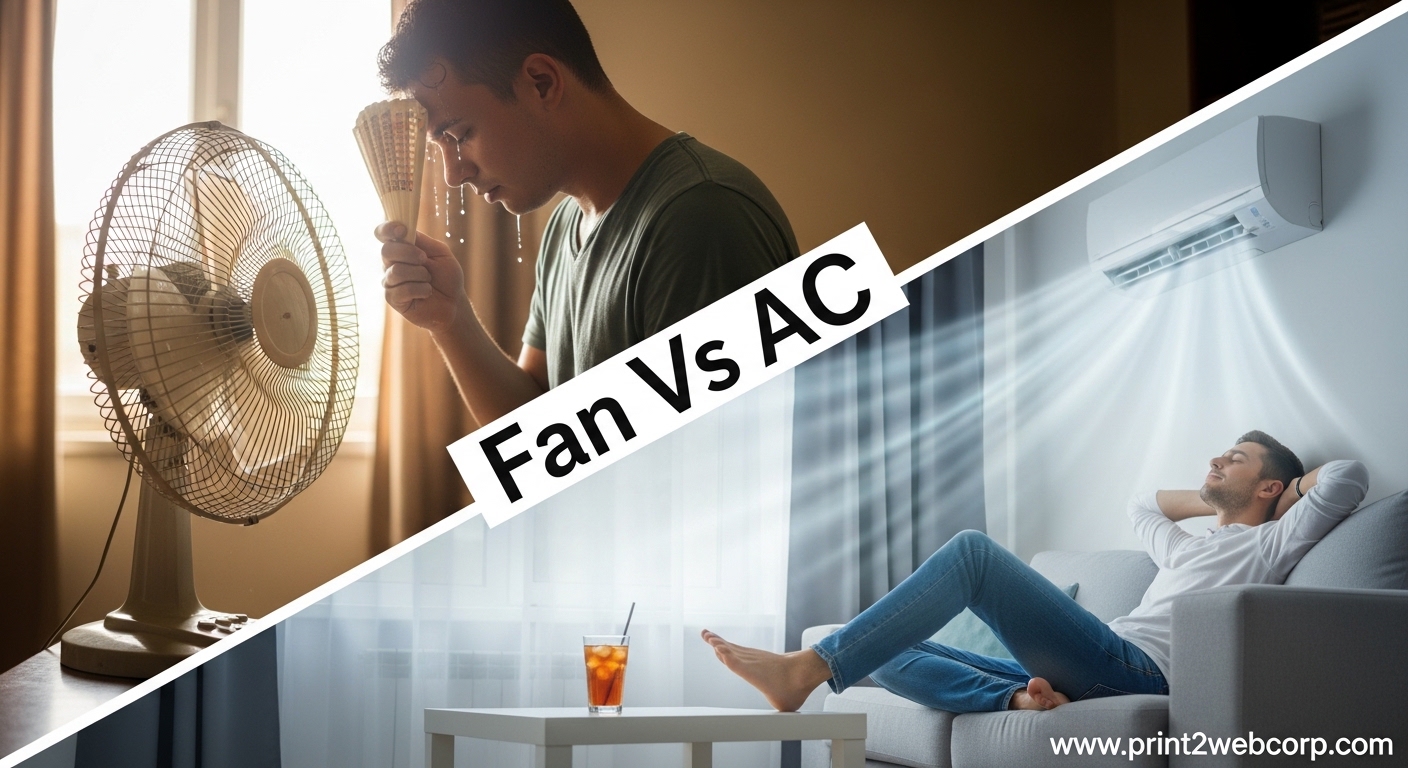
Every summer, millions of homeowners face the same cooling dilemma. Do you save money with a fan or invest in air conditioning for true comfort? The answer isn’t as simple as comparing price tags.
This Fan Vs AC comparison matters more than you might realize. The average American household spends $400-600 annually on cooling, and choosing the wrong option for your situation can cost you hundreds of dollars and leave you sweltering through heat waves.
I’ve spent years analyzing cooling solutions and testing real-world scenarios. Let me break down exactly when each option makes sense, how much you’ll actually spend, and the critical factors most people overlook before making this decision.
How Fans and ACs Actually Cool You
Fans and air conditioners work in fundamentally different ways. Understanding this distinction is crucial because it explains why fans struggle in certain conditions while ACs excel.
A fan doesn’t cool the air at all. It creates a wind-chill effect by moving air across your skin, which accelerates evaporation of moisture and makes you feel cooler. Your body temperature stays the same, but you perceive up to 8°F of cooling through increased evaporation.
An air conditioner actively removes heat from indoor air through the refrigeration cycle. It pulls warm air across refrigerant-filled coils, absorbs the heat energy, and releases it outside while dumping moisture through condensation. This process lowers the actual room temperature, not just your perception of it.
The key difference? Fans cool people, not rooms. ACs cool both people and spaces. This explains why leaving a fan on in an empty room wastes electricity while running AC can actually cool down your home for later.
Energy Consumption & Cost Comparison
The energy difference between these options is staggering. A typical ceiling fan uses 15-75 watts per hour. A box fan might use 100 watts at maximum speed. Compare this to a window AC unit consuming 500-1,500 watts, or a central air system drawing 3,000-5,000 watts when running.
Let’s break down the math. Running a ceiling fan 24 hours a day for a month costs approximately $1.50-4.50 depending on your electricity rates. Running a window AC for just 8 hours daily costs $30-90 monthly. Central air can cost $150-400 per month depending on efficiency and usage patterns.
So how many fans equal one AC? In pure wattage terms, you could run 30-50 ceiling fans for the energy consumption of a central air system. In practical terms, 3-4 well-placed fans can create a cooling effect similar to mild AC settings in moderate conditions.
The real-world savings depend on your climate. Users in dry western states report saving $50-150 monthly by using fans instead of AC. In humid southeastern states, fans simply can’t replace AC during summer months, though using them together can reduce AC runtime by 20-30%.
Temperature & Humidity Effectiveness
Temperature tells only half the story. Humidity determines whether fans can actually keep you comfortable. The 95°F threshold exists because above this temperature, fans merely move hot air around your body without providing meaningful cooling relief.
When humidity exceeds 60%, fans become significantly less effective. Your sweat can’t evaporate properly in saturated air, eliminating the wind-chill effect that makes fans work. This is why humid 85°F feels more oppressive than dry 95°F, and why fans fail in muggy conditions even at moderate temperatures.
AC units remove 5-15 gallons of water daily depending on humidity levels. This dehumidification makes air feel cooler at the same temperature and prevents that sticky, oppressive feeling. In humid climates, this moisture removal is arguably more important than temperature reduction.
Dry climates tell a different story. In Arizona, New Mexico, or Nevada, nighttime temperatures often drop into the 70s even after 100°F days. Strategic window opening combined with whole-house fans can completely eliminate AC needs for many households during shoulder seasons.
Pros and Cons Side-by-Side
Fans offer compelling advantages for budget-conscious consumers. The purchase price ranges from $20-150 compared to $300-1,500 for window units or $5,000-15,000 for central AC installation. Fans require no professional installation, minimal maintenance (occasional cleaning), and can be moved room-to-room as needed.
However, fans have clear limitations. They don’t reduce humidity, can’t cool below ambient temperature, and become ineffective above 95°F or in high humidity. Some users also report that fans circulate dust and allergens, potentially triggering allergies or respiratory issues.
AC units provide true cooling regardless of outdoor conditions. Modern systems maintain precise temperature control, significantly reduce humidity, filter air to reduce allergens, and can cool entire homes evenly. For those with health conditions requiring temperature stability, AC isn’t optional—it’s medical equipment.
The drawbacks involve cost and complexity. Beyond high purchase prices, AC units require professional installation, regular maintenance, and consume substantial electricity. They also dry out air significantly, potentially causing sinus irritation, dry skin, and respiratory discomfort for some users.
Health & Sleep Considerations
The health impacts of cooling options affect different people differently. AC’s dehumidification effect creates excellent conditions for mold prevention but can cause sinus problems, dry throat, and irritated eyes. Many users report increased congestion after sleeping in AC-cooled rooms, particularly at lower temperature settings.
Fans circulate existing air along with whatever it contains—dust, pollen, pet dander, and other allergens. For allergy sufferers, this can trigger symptoms during sleep. However, fans don’t dry out sinuses or skin, making them preferable for those sensitive to dry air conditions.
Sleep quality research suggests slight advantages for each option depending on conditions. AC maintains consistent temperature throughout the night, preventing sleep disruption from temperature swings. Fans provide white noise that some find soothing, but they don’t prevent heat-related sleep disruption during temperature spikes.
Special populations need special consideration. Infants, elderly individuals, and those with chronic health conditions often require precise temperature control that only AC can provide. However, the dry air from AC can exacerbate certain respiratory conditions, creating a complex trade-off that requires medical guidance in some cases.
Installation & Maintenance Costs
The true cost of ownership extends far beyond the purchase price. A quality ceiling fan costs $100-300 with DIY installation taking most homeowners 1-2 hours. Box and tower fans require no installation at all—just plug them in and position them strategically.
Window AC units range from $300-800 plus potential installation costs if you need mounting brackets or electrical work. These units require annual cleaning of filters and coils, plus professional servicing every 2-3 years to maintain efficiency. Most last 10-15 years with proper maintenance.
Central air represents a major investment. $5,000-15,000 covers installation depending on home size and system efficiency. Annual maintenance runs $100-300 for professional inspections, and repairs can cost hundreds to thousands depending on components. However, central systems typically last 15-20 years and can increase home resale value.
Many users overlook the hidden costs. AC units often require electrical panel upgrades, structural modifications for installation, and increase homeowner insurance premiums in some areas. Fans have virtually no hidden costs beyond occasional cleaning and the rare blade replacement.
If you’re experiencing issues with your AC, you might find yourself troubleshooting your air conditioner for common problems like water leaks. These maintenance tasks add to the total cost of ownership over time.
Environmental Impact Comparison
The environmental footprint of cooling choices extends beyond electricity consumption. AC units contain refrigerants that are potent greenhouse gases if released. Modern units use more environmentally friendly refrigerants than older models, but manufacturing and disposal impacts remain significant.
Fans have minimal environmental impact beyond their electricity use. With no refrigerants, simpler manufacturing processes, and longer lifespans, fans represent the more sustainable cooling option when they can adequately meet cooling needs.
However, the full picture requires nuanced consideration. In extremely hot climates, fans simply can’t provide adequate cooling, making AC unavoidable for health and safety reasons. In these cases, choosing the most efficient AC unit possible and using fans to reduce runtime minimizes environmental impact while maintaining necessary cooling.
The electricity source matters too. In regions with renewable-heavy grids, AC’s environmental impact decreases significantly. In coal-dependent regions, the carbon footprint of AC usage increases substantially, making fans the more environmentally responsible choice whenever practical.
Combination Strategy: Using Both Together
Smart homeowners don’t choose between fans and AC—they use both strategically. Running ceiling fans while operating AC allows you to raise the thermostat setting by 4°F without sacrificing comfort. This simple strategy reduces AC energy consumption by 20-30% while maintaining the same perceived cooling level.
The optimal combination approach varies by room. In bedrooms, ceiling fans circulate cooled air from AC vents, maintaining consistent temperatures throughout the night. In living areas, portable fans direct cooled air to occupied zones rather than wasting energy cooling empty spaces.
Timing matters too. Run ceiling fans during the coolest parts of day to maximize their effectiveness. Use AC during peak heat hours when fans can’t keep up, then switch to fans during evening hours as temperatures naturally drop. This hybrid approach minimizes energy use while maintaining comfort throughout the day.
Room-by-room optimization offers additional savings. Cool only occupied rooms with AC while using fans to circulate air into adjacent spaces. Close doors to unoccupied rooms to concentrate cooling where needed. This zone cooling strategy can reduce AC costs by 40% compared to cooling the entire home equally.
Decision Framework: 7 Factors to Consider
Your local climate determines more about this decision than any other factor. Dry climates under 95°F allow fans to handle most cooling needs. Humid climates above 85°F typically require AC for comfort. Coastal areas with moderate temperatures might need neither for significant portions of the year.
Budget considerations include both upfront costs and ongoing expenses. If you can afford $500-2,000 upfront and $50-200 monthly, AC provides superior comfort. If you need to keep monthly expenses under $20 and can’t afford major purchases, fans offer adequate cooling in many conditions.
Room size and layout affect cooling effectiveness. Small, well-ventilated rooms under 150 square feet often cool adequately with fans. Large open spaces, multiple rooms, or multi-story homes typically require AC for effective temperature management throughout the space.
Health needs shouldn’t be compromised. If you have asthma, allergies, or respiratory conditions, the air filtration and humidity control from AC may be medically necessary. Conversely, if dry air exacerbates your condition, fans might be the healthier option despite less effective cooling.
Usage patterns determine ROI considerations. If you’re home during the hottest parts of day and need consistent temperatures, AC justifies its cost. If you’re away during peak heat and only need evening cooling, fans might provide adequate relief at a fraction of the cost.
Environmental priorities might sway your decision. If minimizing carbon footprint is important, fans clearly win when they can adequately meet your cooling needs. If AC is necessary in your climate, choosing the most efficient unit and using fans to reduce runtime minimizes environmental impact.
Installation constraints often make the decision for you. If you’re renting or can’t modify your home, portable fans might be your only option. If you own your home and can install permanent equipment, AC becomes feasible despite the higher upfront cost.
Frequently Asked Questions
Is it better to use a fan or AC?
Neither is universally better—it depends on your climate, budget, and health needs. Fans cost 99% less to operate and work well in dry climates under 95°F. AC provides true cooling and humidity control essential in hot, humid regions or for those with health conditions requiring temperature stability. Many homeowners use both strategically: fans for mild days and AC during heat waves, with fans helping distribute cooled air efficiently.
How many fans are equal to 1 AC?
In pure energy terms, you could run 30-50 ceiling fans for the same electricity as one central air conditioner. However, this doesn’t mean fans can replace AC’s cooling power. Fans create wind-chill effects that make you feel 4-8°F cooler, but they can’t lower room temperature or reduce humidity. In moderate conditions, 2-3 well-placed fans can provide comfort similar to mild AC settings. Above 95°F or in high humidity, no number of fans can match AC’s actual cooling capability.
Is it cheaper to run a fan all day or AC for a few hours?
Running a fan 24 hours costs approximately $1.50-4.50 per month, while running AC for just 8 hours daily costs $30-150 monthly depending on unit size and efficiency. Even running AC for only 2-3 hours typically costs more than operating a fan continuously for a full day. The fan-all-day approach saves money in temperatures under 95°F with moderate humidity. However, in extreme heat or high humidity, those few hours of AC provide necessary cooling that fans simply can’t deliver regardless of runtime.
Can I use a fan when it’s over 95°F outside?
Above 95°F, fans provide minimal cooling benefit because they merely move hot air across your skin without meaningful evaporation. The Environmental Protection Agency specifically warns that fans may not prevent heat-related illness when temperatures exceed the high 90s. In these conditions, fans can actually increase dehydration risks by accelerating sweat loss without providing corresponding cooling relief. When temperatures exceed 95°F, AC or other actual cooling methods become necessary for safety, not just comfort.
Which option is better for allergies?
AC units generally outperform fans for allergy sufferers because they filter airborne particles while cooling and reducing humidity that promotes mold and dust mite growth. Modern AC units with HEPA filters can remove pollen, pet dander, and other allergens from circulated air. Fans simply recirculate existing air along with all allergens it contains, potentially worsening symptoms. However, poorly maintained AC units can harbor mold in ductwork or coils, potentially exacerbating allergies. Regular filter changes and professional cleaning maximize AC’s allergy benefits.
Final Verdict
Fan Vs AC comes down to matching your cooling method to your specific situation. In dry climates under 95°F, fans provide adequate cooling at 1% of the operating cost. In humid regions or during heat waves, AC becomes essential for both comfort and safety regardless of cost considerations.
The smartest approach for most households? Start with quality fans positioned strategically in your most-used spaces. Add AC only when and where necessary: window units for particularly problematic rooms, or central air if your climate consistently exceeds 95°F with high humidity during summer months.
Use both together strategically to maximize efficiency. Run ceiling fans while operating AC to raise thermostat settings without sacrificing comfort. Use fans during mild periods and AC during peak heat. This combination approach typically saves 20-40% compared to AC-only cooling while maintaining comfort throughout even the hottest summers.
Your decision should balance budget, climate, health needs, and environmental priorities rather than following generic recommendations. The households that save the most money and stay most comfortable are those that thoughtfully match their cooling strategy to their specific situation rather than defaulting to either extreme.
Leave a Reply