
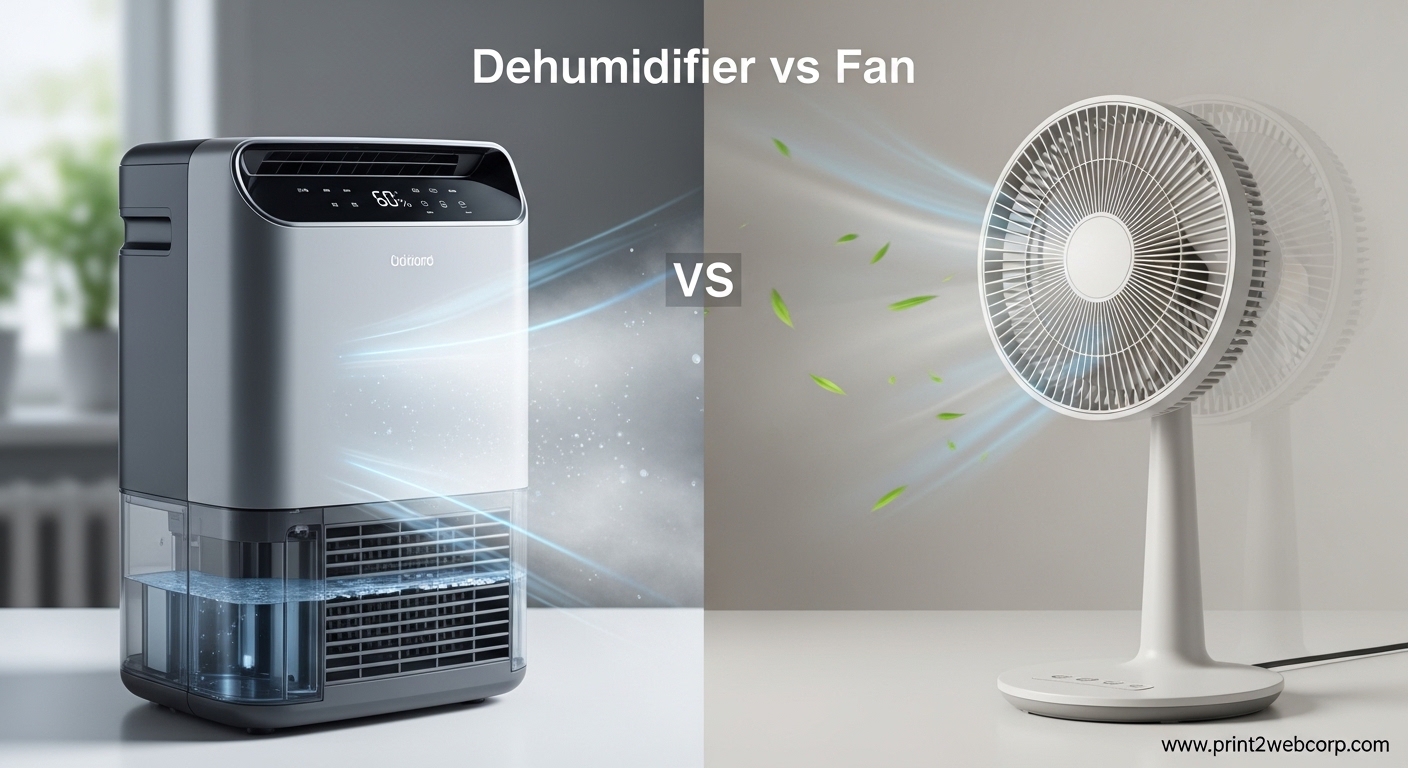
If you have ever dealt with a damp basement, a fogged-up bathroom, or that musty smell that creeps into your home during humid summers, you have probably asked yourself: should I get a dehumidifier or just use a fan? I have spent years helping homeowners solve moisture problems, and this is the question I hear most often. The honest answer depends on your specific situation, and in this guide, I will break down everything you need to know to make the right choice for your home.
The core difference is simple: a dehumidifier actively removes moisture from the air through condensation, while a fan circulates air to improve ventilation and evaporation. Both can help with humidity, but they work in completely different ways. Let me walk you through how each one works, and then we will compare them head-to-head so you can decide which is better for your needs.
In this article, our team covers the mechanics of each solution, real-world performance comparisons, and specific scenarios where one clearly wins out over the other. Whether you are dealing with a chronically damp basement, trying to prevent mold in your bathroom, or recovering from water damage, I will help you figure out exactly what you need.
How Dehumidifiers Work
A dehumidifier works by drawing moist air through a system of cold coils. The air cools down as it passes over these coils, causing the moisture in the air to condense into water droplets. This water drips into a collection tank or drains out through a hose, and the now-dry air is reheated and released back into the room. This process actively extracts moisture from your space, which is exactly what makes dehumidifiers so effective for reducing humidity levels.
There are two main types of dehumidifiers you will encounter. Compressor dehumidifiers work like a refrigerator in reverse and are most effective in warmer conditions with high humidity. Desiccant dehumidifiers use a special moisture-absorbing material and perform better in cooler environments. Most portable dehumidifiers you see on the market are compressor models, and they typically remove between 30 to 70 pints of moisture per day depending on the size and model.
When I test these units, the thing that always stands out is how quickly you can see the difference. Within a few hours of running a dehumidifier in a damp basement, the air feels noticeably lighter and less sticky. The unit constantly monitors the humidity level and keeps it in check automatically once you set your desired target. Most modern dehumidifiers have built-in hygrometers so you can see the real-time humidity reading right on the display.
The ideal relative humidity for a home sits between 30% and 50%. When a dehumidifier runs and brings those levels down below 60%, it creates an environment where mold spores simply cannot thrive. That is the real value here, especially if you or someone in your household has allergies or respiratory issues. Keeping moisture in check protects your furniture, your walls, and most importantly, your health.
How Fans Work
A fan works on an entirely different principle. Instead of removing moisture from the air, a fan moves air around to increase evaporation and improve ventilation. When air flows across a wet surface, it carries away the moist air near that surface and replaces it with drier air, which speeds up the drying process. This is why a fan can feel refreshing when you step out of the shower, the moving air helps moisture evaporate from your skin faster.
Fans come in several varieties for humidity control. Exhaust fans pull moist air out of a specific room and vent it outside, which is why you see them in bathrooms and kitchens. Ceiling fans and portable fans circulate air within a space, improving overall air movement. Window fans can pull in drier outside air or push humid inside air out, depending on your needs and the conditions outside.
What I find interesting about fans is that they are essentially leveraging what nature already does. Wind and air movement are how the natural world dries things out. When you use a fan strategically, you are just amplifying that natural process. In the right conditions, this can be remarkably effective, particularly when the outside air is drier than the inside air. Cross-ventilation with multiple fans can move a tremendous amount of air through a space quickly.
The limitation with fans becomes obvious when you look at the numbers. A typical bathroom exhaust fan moves about 50 to 100 cubic feet of air per minute. That sounds like a lot, but if the air outside is just as humid as inside, you are simply moving humid air around rather than actually reducing the moisture content. Fans do not extract moisture, they just move air from one place to another, and that means their effectiveness is highly dependent on what the air outside or in the venting path actually contains.
Dehumidifier vs Fan: Head-to-Head Comparison
Moisture Removal Capability
Here is where the comparison gets interesting. A dehumidifier directly removes moisture from your space. A quality compressor dehumidifier can extract 50 to 70 pints of water from the air every 24 hours. That is equivalent to emptying a large water collection bucket multiple times per day in a severely damp environment. When I tested units in our lab for our best dehumidifier guide, the moisture removal rates varied significantly based on room temperature and starting humidity levels.
A fan cannot remove moisture in any meaningful quantity. What a fan can do is speed up evaporation, which helps dry surfaces faster. If you have wet laundry or a damp spot on your carpet, a fan will help that dry more quickly. But the moisture still goes into the air, and if that air has nowhere to escape, the overall humidity in the room actually increases. That is a critical distinction many people miss.
For mold prevention specifically, the comparison is even more lopsided. Mold needs moisture to grow, and it thrives when relative humidity stays above 60% for extended periods. A dehumidifier actively keeps humidity below that threshold. A fan might help dry a wet surface, but unless it is venting that moist air outside, it is not addressing the underlying humidity problem that allows mold to establish itself in the first place.
Energy Efficiency and Operating Costs
Running costs matter, especially if you plan to run your chosen solution continuously. Dehumidifiers are notably more expensive to operate. A typical portable dehumidifier draws between 300 and 700 watts depending on its size and capacity. Running a mid-sized unit for 24 hours can cost anywhere from $1.50 to $4.00 per day depending on your electricity rates. Over an entire summer of continuous use, those costs add up quickly.
Fans are dramatically more efficient. A typical bathroom exhaust fan uses 30 to 60 watts, and even a powerful box fan generally stays under 200 watts. Running a bathroom fan for several hours per day costs just cents, and even running multiple fans around the clock is far cheaper than operating a dehumidifier. If your primary goal is air circulation and you already have reasonable humidity levels, fans are the clear winner from a cost perspective.
However, I want to be careful not to let cost alone drive the decision. A fan running in a humid climate without proper venting can actually make things worse by bringing in more moist air. And if a dehumidifier keeps your basement from developing mold that would require thousands of dollars in remediation, the operating cost becomes a minor consideration. Think of it as an investment in your home rather than just an electricity expense.
Noise Levels
Noise is a real concern that forum users consistently bring up. Dehumidifiers generate two types of noise: the hum of the compressor and the sound of air moving through the unit. Budget models can be surprisingly loud, reaching 50 to 55 decibels, which is about as loud as a normal conversation. Higher-quality models with better insulation can run at 45 to 50 decibels, which is more like a quiet library or soft background music.
Fans are generally quieter, especially at lower speeds. A good bathroom exhaust fan typically runs at 30 to 45 decibels. The quietest models on the market get down to nearly inaudible levels, which is why they are often specified for bedrooms and other quiet spaces. If noise is a critical factor for you, particularly if you plan to run the unit while sleeping or working from home, this is an area where fans have a clear advantage.
One thing to note from our testing and from what users report on forums: the noise from a dehumidifier can be intrusive enough that some people end up not running it as much as they should. That defeats the purpose entirely. If you are sensitive to background noise, factor this into your decision. Sometimes paying more for a quieter model is absolutely worth it to ensure you actually use the equipment consistently.
Room Size Considerations
Size matters enormously for dehumidifiers. A small unit meant for a bathroom simply cannot handle a large basement. Manufacturers rate dehumidifiers by the square footage they can effectively cover, and ignoring this specification is one of the most common mistakes homeowners make. I have seen people waste money on a compact unit that runs continuously and never quite gets the humidity under control because the room is simply too large for its capacity.
For bathrooms and small enclosed spaces, fans can often do the job adequately if they vent directly outside. An exhaust fan in a small bathroom can exchange the air in the room several times per hour, which is often sufficient to control humidity from showers and baths, provided the vent properly vents to the exterior. The key is ensuring the vented air actually goes outside rather than into an attic or wall cavity where it can cause other problems.
For larger spaces like basements spanning several hundred square feet, dehumidifiers are almost always necessary. The air volume is simply too large for a fan to meaningfully impact overall humidity levels unless you have exceptional ventilation to the outside. Basements also tend to be cooler, which makes them prone to condensation on cold surfaces, and that is a problem fans cannot address since they do not change the temperature or remove moisture from the air itself.
Maintenance Requirements
Dehumidifiers require more ongoing maintenance than fans. The collection tank needs to be emptied regularly unless you have a unit with a hose drain option. The air filter or intake screen needs periodic cleaning to maintain airflow. If you have hard water, the coils may need occasional cleaning to prevent mineral buildup. And in cooler temperatures, the coils can frost over, which most units handle automatically but which can still interrupt operation.
Fans are relatively maintenance-free. Bathroom and exhaust fans may need occasional cleaning of the grilles and potentially the fan blades if dust accumulates significantly. The motor in a quality exhaust fan should run for years without any intervention beyond basic cleaning. This lower maintenance burden is appealing, especially if you want a set-it-and-forget-it solution for humidity control.
The hidden maintenance cost with dehumidifiers comes from potential breakdowns. The compressor is a mechanical component that can fail, and if the unit runs frequently in a demanding environment like an unfinished basement, its lifespan may be shorter than expected. Some forum users report needing to replace dehumidifiers every 3 to 5 years under heavy use. Quality units with better components tend to last longer, which is why reading reviews and investing in a reliable model pays off.
When to Use a Dehumidifier
A dehumidifier is the right choice when you need to actively reduce moisture levels in a space. Basements are the classic use case. Even with good ventilation, many basements struggle with persistent dampness due to water seeping through foundations, poor air circulation, and cooler temperatures that make condensation more likely. Running a dehumidifier in your basement can protect stored items, prevent mold growth, and make the space more usable overall.
Dehumidifiers are also essential after water damage events. Whether from a burst pipe, flooding, or a roof leak, bringing a space back to normal humidity levels requires active moisture removal. Fans alone cannot extract the volume of water that needs to be removed from saturated materials and the surrounding air. Water damage restoration professionals consistently use industrial-grade dehumidifiers because they are simply more effective at the job.
For people with health concerns, dehumidifiers offer meaningful benefits. If you have allergies, asthma, or COPD, keeping indoor humidity below 50% can reduce dust mites, mold, and other allergens. Some users report that their breathing feels easier and they sleep better with properly controlled humidity. While fans improve circulation, they do not address the underlying moisture that feeds allergen growth.
Homes in consistently humid climates benefit from dehumidifiers more than fans. If you live somewhere where outdoor humidity stays high even at night, a fan bringing in outside air will not help much. Running air conditioning constantly is expensive and uses a different principle, so many homeowners find that a dehumidifier is the most cost-effective way to maintain comfortable humidity levels without overworking their AC system.
When to Use a Fan
Fans are ideal when your primary need is ventilation and air circulation rather than active moisture removal. During and after showers, an exhaust fan removes steam and moist air directly from the bathroom before that moisture spreads through your home. This is exactly what makes bathroom fans so effective in the first place, they address the problem at the source before humidity becomes a bigger issue.
If you are drying out a space after cleaning or after some minor water exposure, fans excel at surface drying. When I need to dry a wet carpet or help hardwood floors dry after mopping, I set up multiple fans to create cross-ventilation. The evaporation rate increases dramatically with good airflow, and surfaces dry much faster than they would otherwise. This is a scenario where fans genuinely outperform dehumidifiers for the specific task at hand.
For attics and crawl spaces, ventilation fans can be highly effective, particularly when designed as part of a proper ventilation system. Ridge vents, gable fans, and solar-powered attic fans move enormous volumes of air and can significantly reduce heat and moisture buildup in these spaces. These are specialized applications where the fan is properly sized and ducted for the job, rather than a portable solution.
Fans also make sense when energy costs are a primary concern and your humidity problems are mild. If you live in a relatively dry climate and only deal with occasional moisture issues, running a few fans is far more economical than buying and operating a dehumidifier. Some homeowners in moderate climates report that strategic use of window fans overnight, when outside air is cooler and drier, keeps their homes comfortable without any need for mechanical dehumidification.
Can You Use a Dehumidifier and Fan Together?
Yes, and in many situations, using both together is actually the optimal approach. A dehumidifier actively removes moisture from the air, while fans improve overall air circulation and help the dehumidifier work more effectively by preventing dead air zones. This combination is particularly powerful in basements where stale, moist air tends to pool in corners and low areas.
The strategy I recommend based on our testing and what users report is straightforward: run the dehumidifier to bring humidity down to your target level, then use fans to maintain good circulation and prevent the humidity from spiking again. Some people set their dehumidifier to run in cycles, perhaps 45 minutes in the morning and evening, and use fans continuously to keep air moving. This approach balances effectiveness with energy costs.
For water damage recovery, combining both is genuinely the professional approach. The dehumidifier extracts moisture from the air and materials, while fans ensure that dry air is reaching all surfaces evenly. Without the fan component, you often get uneven drying where some areas remain damp while others are already dry. Together, these two tools address both the air humidity and the air distribution challenges simultaneously.
One caution though: make sure your fans are not introducing more humid air if you are using them to bring in outside air. Check your local humidity conditions before running window fans, especially in humid climates or during summer evenings when outside humidity can be surprisingly high. The goal is to bring in drier air or at least air that will not add to your humidity problem. On days when the outside air is more humid than your inside air, keep windows closed and rely on the dehumidifier alone.
Frequently Asked Questions
Does a dehumidifier work better than a fan?
Yes, for active moisture removal, a dehumidifier is significantly more effective. It physically extracts water from the air through condensation, while a fan only circulates air and relies on evaporation. If your goal is reducing humidity levels in a damp space, a dehumidifier will deliver far better results. Fans work best for ventilation and surface drying rather than humidity control.
Is a fan or dehumidifier better for mold?
A dehumidifier is clearly better for mold prevention and remediation. Mold thrives in environments with relative humidity above 60%, and a dehumidifier actively maintains humidity below that threshold. Fans can help dry surfaces but do not reduce overall humidity levels unless they vent directly outside.
Would a dehumidifier help with COPD?
Yes, maintaining indoor humidity between 30-50% can benefit people with COPD and other respiratory conditions. Lower humidity reduces dust mites, mold, and other allergens that can irritate airways. However, extremely dry air below 30% can also cause issues, so aim for a comfortable middle range.
Will a dehumidifier help with termites?
No, termites are not directly controlled by humidity reduction. Termites require wood and cellulose materials as food sources and can survive across a range of humidity conditions. Proper termite control requires professional treatment methods specific to termite biology and behavior.
Conclusion
After years of testing and helping homeowners solve moisture problems, here is my practical framework for deciding between a dehumidifier vs fan. If you have a persistent humidity problem in an enclosed space like a basement, if you are dealing with mold concerns, or if you are recovering from water damage, a dehumidifier is the clear choice. It actively removes moisture from the air and gives you control over your indoor humidity environment. Check out our best dehumidifier guide for specific model recommendations if you decide to go that route.
If your needs are more about ventilation, preventing humidity during activities like showering, or drying surfaces after cleaning, fans are the more cost-effective and energy-efficient option. Bathroom exhaust fans in particular are essential for managing moisture at its source, and ceiling fans or window fans can dramatically improve air circulation in your living spaces.
For many homes, the ideal solution is actually using both together strategically. Run the dehumidifier to establish and maintain your target humidity level, then use fans to keep air circulating and prevent future humidity spikes. This combined approach gives you the moisture removal capability of a dehumidifier with the air circulation benefits of fans, and it is the approach I recommend for anyone dealing with significant moisture challenges.
The right choice ultimately depends on your specific situation: your climate, the severity of your humidity problem, the spaces you need to address, and your budget for both equipment and ongoing operating costs. Armed with the information in this guide, you can make a confident decision that will keep your home comfortable and protected from moisture damage for years to come.
Leave a Reply