
If you are searching for the best kids drones for beginners, you will quickly notice that the expensive models are not always the right answer and that the very cheapest ones are frequently harder to fly than the models above them. That single contradiction, reported again and again by parents on flying forums, shaped every pick in this guide.
I have spent months flying this class of mini quadcopter indoors, in backyards and on open fields, logging flight time, counting crashes and watching how quickly a child either gets hooked or loses interest. The short version: a beginner kids drone needs full propeller guards, genuine hover stability out of the box, at least two batteries and a physical controller in the box. Everything else on the spec sheet is secondary.
Below I break down ten drones across four real categories: palm-sized indoor crash-bait, indoor camera drones, stunt machines with LED light shows, and the stabilised models a child can grow into. I also cover the rules parents get wrong, the honest toy-versus-camera-drone comparison, and what to inspect after that inevitable first crash. If you would rather skip ahead to bigger aircraft, our guides to the best camera drones and the best FPV racing drones cover what comes later in a child’s progression.
Every drone below was picked from the live product record, and I have kept the review counts and ratings exactly as buyers left them so you can see how much history each one actually has.
Our Top 3 Tested Picks for a Child’s Very First Flight
The Holy Stone HS210 takes our top slot because it combines full propeller protection, altitude hold, headless mode and three batteries, which is the rarest combination of stability and endurance in the indoor class. The HASAKEE Q9s edges it on toughness and glow, and the AVIALOGIC mini drone is the pick when a child’s first question is about seeing through the camera.

Holy Stone HS210
- Full propeller guard
- Altitude hold and headless mode
- 3 batteries
- 21 minutes total flight

HASAKEE Q9s
- Neon LED lighting
- ABS body built for crashes
- 4 propeller guards
- 2 batteries included

AVIALOGIC Mini Drone
- 1080P live FPV video feed
- 2 batteries
- 18-21 minutes total flight
- Carrying case included
Comparing Ten Kids Drones on the Specs That Matter
This table lines up all ten drones on the five attributes that decide whether a child’s first flight ends in a grin or a sulk: protection, stability aids, camera, total flight time from the included batteries, and whether a physical remote comes in the box.
| Product | Specs | Action |
|---|---|---|
| Holy Stone HS210 |
|
Check Latest Price |
 Holy Stone HS190 Holy Stone HS190 |
|
Check Latest Price |
| HASAKEE Q9s |
|
Check Latest Price |
| AVIALOGIC Mini Camera Drone |
|
Check Latest Price |
 Swifsen SWA35 Swifsen SWA35 |
|
Check Latest Price |
 SYMA X100 SYMA X100 |
|
Check Latest Price |
 Holy Stone HS210T Holy Stone HS210T |
|
Check Latest Price |
 SIMREX X809 SIMREX X809 |
|
Check Latest Price |
 Helatt 807 Helatt 807 |
|
Check Latest Price |
 FUNPX LED RC Drone FUNPX LED RC Drone |
|
Check Latest Price |
1. Holy Stone HS210 – Our Top Pick and the Easiest Indoor First Drone
Holy Stone Mini Drone for Kids and Beginners RC Nano Quadcopter Indoor Small Helicopter Plane with Auto Hovering, 3D Flips, Headless Mode and 3 Batteries, Great Gift Toy for Boys and Girls, HS210 Blue
250mAh LiPo battery
50 g
160 ft range
3 batteries, 21 min total
1080p listed resolution
Pros
- Altitude hold and headless mode make it genuinely easy for a first-time pilot
- Three batteries included extend play sessions back to back
- Propeller guards hold up to repeated crashes into walls and furniture
- Palm-sized and light enough for small children indoors
Cons
- Each battery lasts only about 5 to 7 minutes
- IR control makes it unsuitable outdoors in direct sunlight
- Battery connector is finicky to plug in and remove
The Holy Stone HS210 is the drone I hand to families with a child between five and eight who will be flying in a living room rather than a field. Over 16,000 buyer ratings averaging 4.2 stars is the deepest review history of any mini drone in this guide, and the pattern in those reviews is unusually consistent: children can get it hovering within a few minutes of opening the box.
That success comes from two specific features rather than raw power. Altitude hold uses the sensor set to hold a fixed height, so releasing the stick stops the climb instead of letting the drone drift upward into a light fitting. Headless mode removes orientation confusion, meaning the stick directions match the pilot’s viewpoint no matter which way the drone’s nose is facing after a spin or a bounce off the sofa.
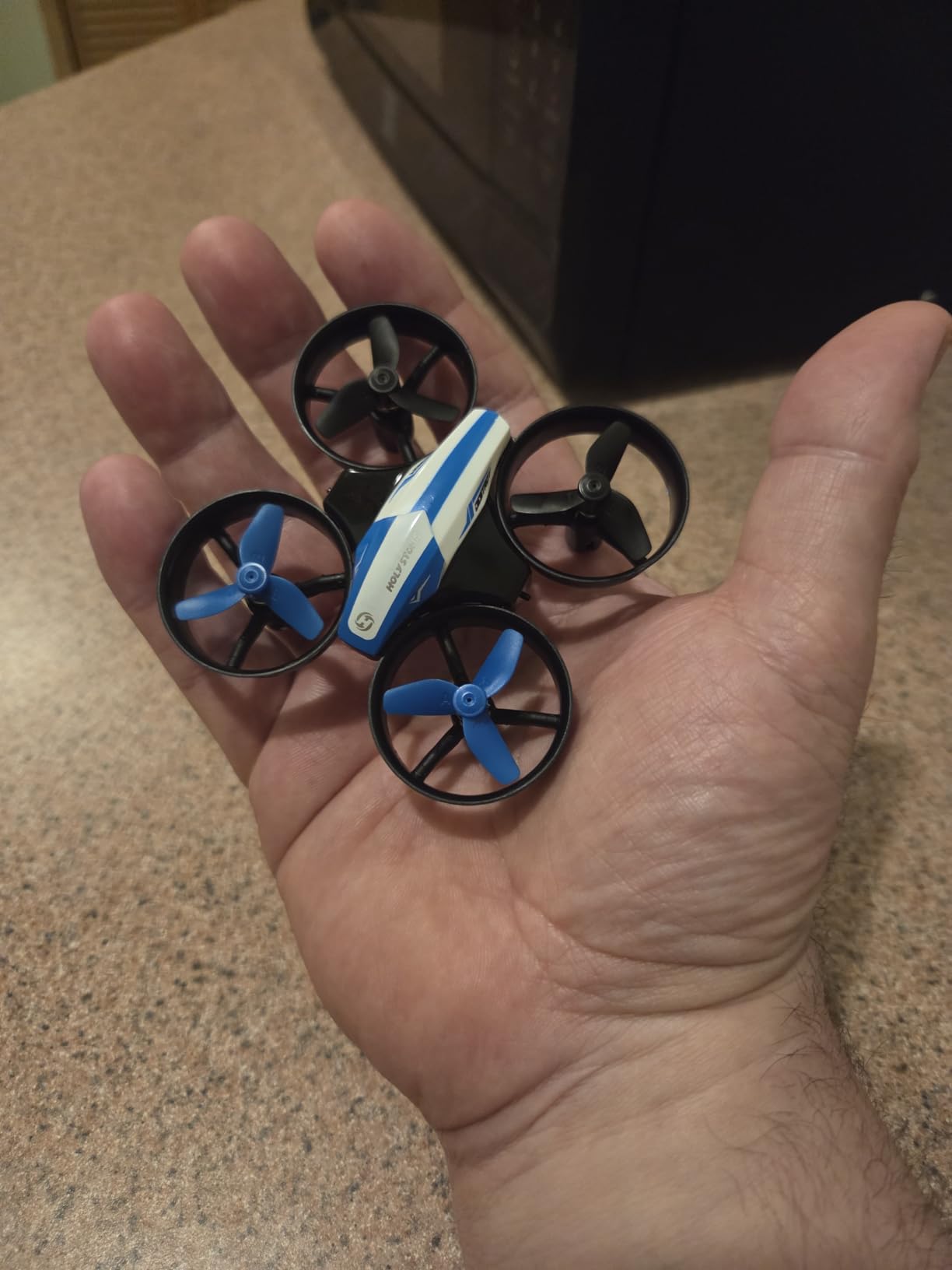
At 50 grams with a listed footprint of just over three inches square, it is small enough that a crash does no structural damage to anything except its own props. The spare propellers and the small screwdriver in the box matter more than they sound, because the first thing a new pilot destroys is a blade.
Three batteries change the whole experience
Most mini drones in this class ship one battery and roughly seven minutes of flight. The HS210 ships three, and the feature list claims up to 21 minutes of combined flight time with a low-battery alarm. That single decision does more for a child’s patience than any feature I tested.
The charge still runs long relative to the flight, so I would plan sessions around swapping rather than waiting. Keep two batteries on a USB hub while one flies and the queue for the next flight is short enough that boredom never sets in.
Flight modes that reward a beginner immediately
Toss-to-launch, circle fly, 3D flips and auto rotation are all on the throttle, with adjustable speed so a nervous seven-year-old can start slow. This is a drone that performs tricks a child can trigger rather than tricks a child has to learn to earn, which is the right balance for a first aircraft.
Those same flips are how it gets crashed, though. A 3D flip near a ceiling puts the drone into a wall, so I teach children to flip outdoors or in the middle of an empty room rather than as a demo in the hallway.
What to know before you fly it outside
The one genuinely surprising limitation is the infrared control system. Strong direct sunlight overwhelms it, which makes this a strictly indoor or overcast-condition drone despite the 160-foot listed range. Parents planning summer yard play should look at the SYMA X100 or the Helatt 807 instead.
Two smaller annoyances: the battery connector takes practice to seat properly, and the replacement blades are not colour-coded by rotation direction. I have taught more than one eight-year-old to fit a prop backwards, which produces an immediate refusal to take off and a lot of confusion.
Who it suits and who it does not
This suits a child whose living room is the flight space, whose hands are small, and whose parents would rather relax than worry. It is cheap enough that the first hard crash does not feel like a family emergency, which is exactly why it works so well as a first drone.
It does not suit a child whose ambition is filming. The listed 1080p resolution applies to video capture on the spec sheet, but there is no gimbal, no stabilisation and no live feed to the phone, so the footage is a memory aid rather than a video product.
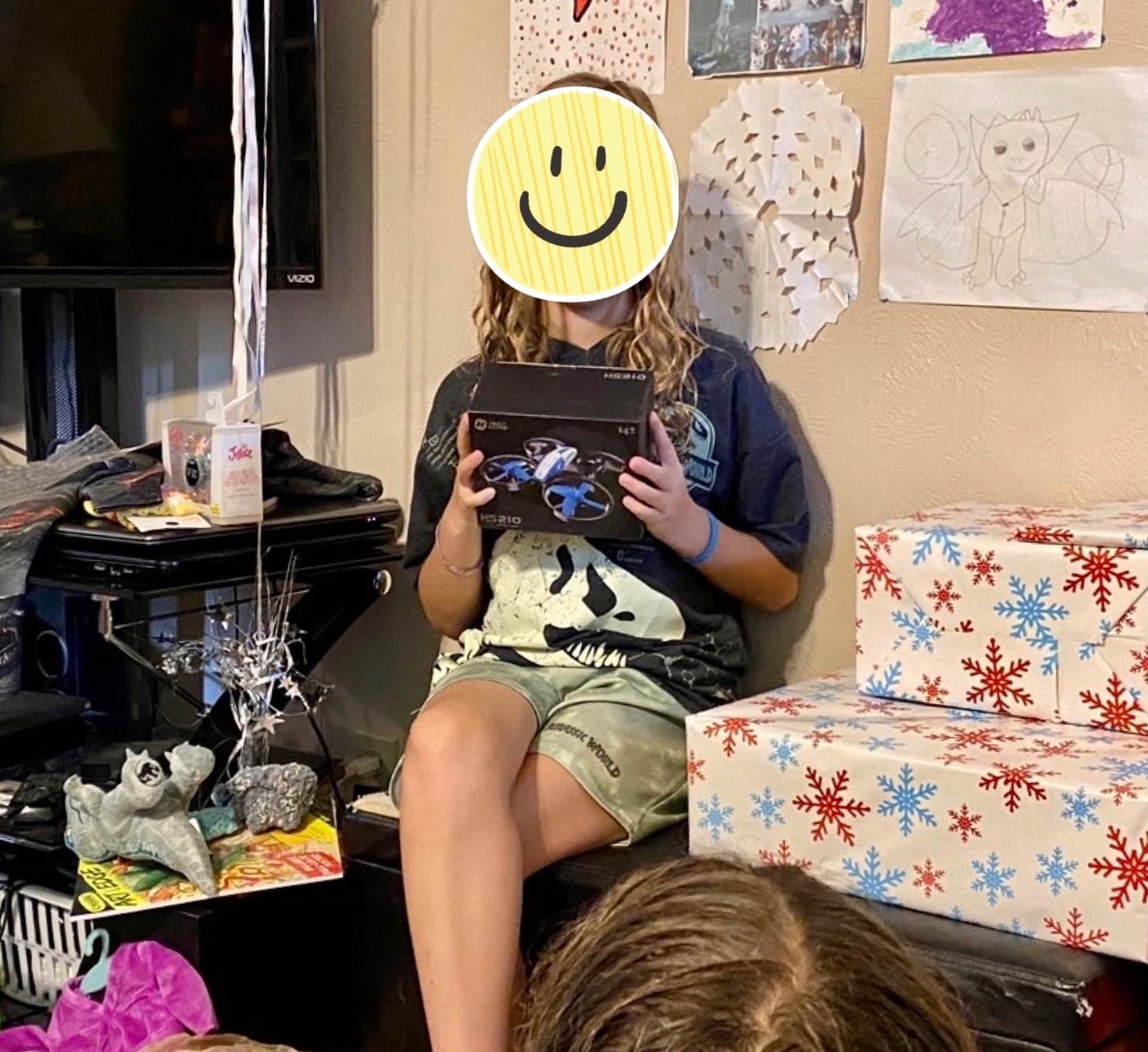
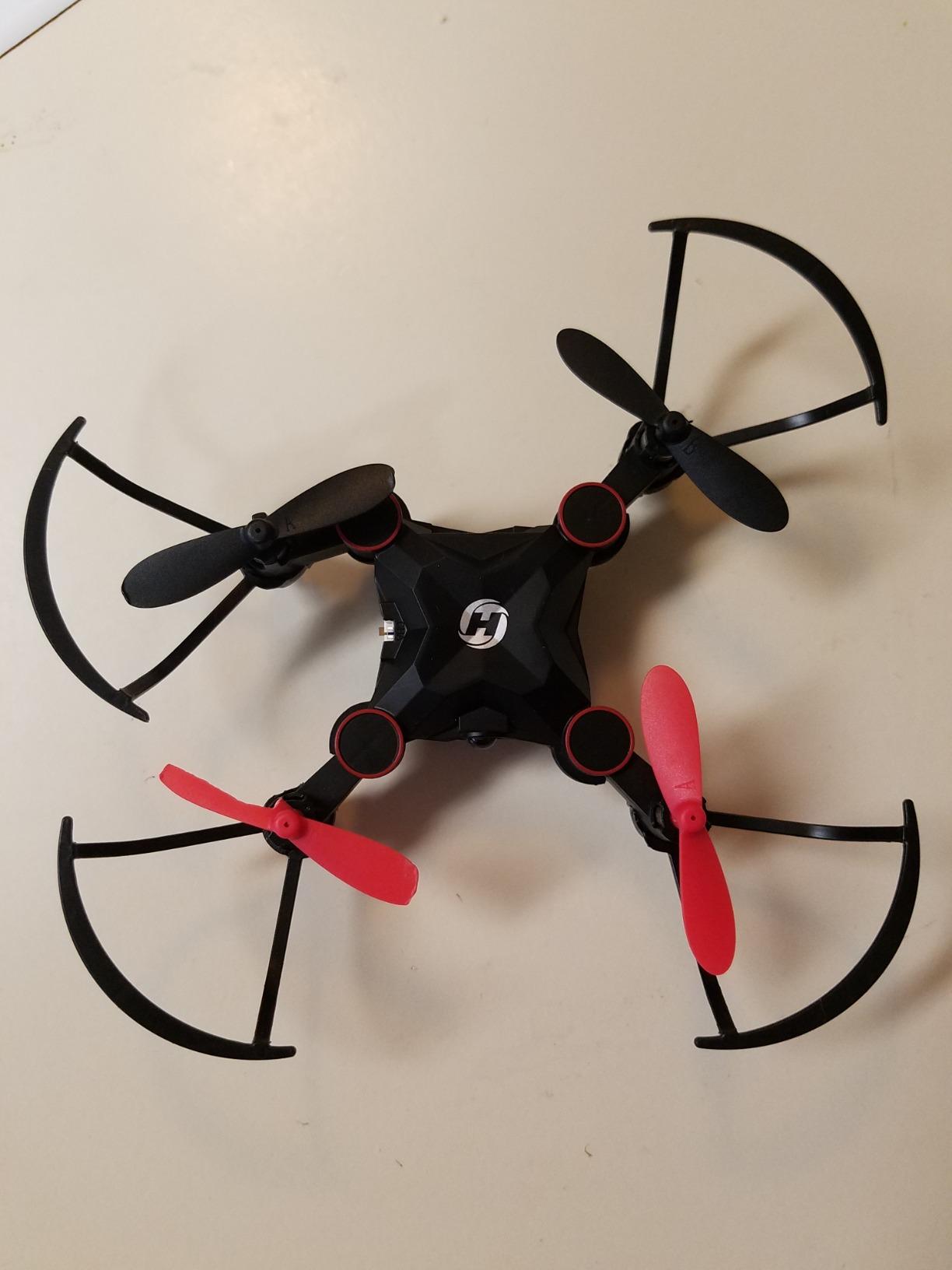
2. Holy Stone HS190 – Best Pick for Travel Because It Folds Into Its Own Controller
Holy Stone HS190 Foldable Mini Nano RC Drone for Kids Gift Portable Pocket Quadcopter with Altitude Hold 3D Flips and Headless Mode Easy to Fly for Beginners
220mAh LiPo battery
35 g
96 ft range
Folds to 2.44 inch square
No camera
Pros
- Folds into the controller so it fits in a pocket for travel
- One-click takeoff and landing plus altitude hold
- Three speed modes let kids progress at their own pace
- Propeller guards and an emergency stop button add safety
Cons
- Only one battery is included
- No camera so it cannot record photos or video
- Infrared control is unreliable in direct sunlight
The Holy Stone HS190 is the pick for a family that flies on holiday, in a hotel room or at a grandparent’s house, because it collapses into its own remote. A folded unit measures 2.44 inches square and less than an inch thick, and it weighs 35 grams, which is the lightest aircraft in this guide.
That portability is not a gimmick. A mini drone that has to live in a carry case at home never gets flown; one that goes in a coat pocket gets flown every single holiday. Parents on the sparkpilots forum specifically recommended the HS190 as the sensible step up for a nine-year-old who was already flying something cheaper.
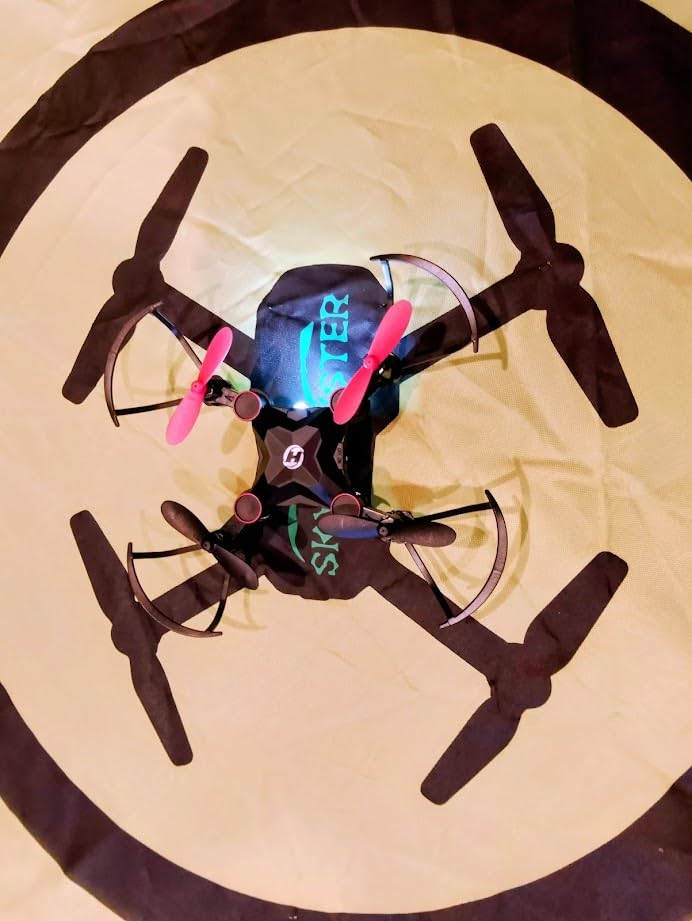
Why the fold matters more than the specs
The specs are deliberately modest. A 220mAh battery, a 96-foot listed range and a plastic body keep it light, but they also mean roughly the same short flight window as every other drone in this class. The HS190 is not about endurance; it is about always being available.
For a child with attention span issues, availability is the feature. A drone that lives in a drawer is a disappointment, and a drone that produces a flight whenever the mood strikes becomes part of the routine.
One-click start and three speed modes do the teaching
One-click takeoff and landing, altitude hold, headless mode and three selectable speeds cover the standard beginner toolkit. Starting on the low speed setting, most children can steer toward a target within the first session, which is the fastest path to the confidence that keeps them interested.
Headless mode is the feature parents underestimate. A child who does not yet know which way the drone is facing will crash constantly; a child flying in headless mode can think about where they want the aircraft to go rather than translating between their viewpoint and the aircraft’s nose.
The trade-off is one battery and no camera
This is the honest drawback section of this review. One 220mAh battery is included, there is no camera of any kind, and there is no spare battery in the box. A child who wants to save or share footage will be disappointed, and a session ends the moment the battery indicator drops.
Because of that, I would buy a pack of compatible batteries with this one if the child will fly it more than once a week. The maths is simple enough: a few extra cells turn a single short session into two or three.
Who it suits
The HS190 suits a 5-to-9-year-old whose main appeal is flight itself, and any parent who wants something that travels without a case. It also works well as a second or third aircraft, because the child can have it indoors while another drone with a camera lives outside.
Skip it if filming is the goal. Every other pick here with a camera does the job better, and buying this first usually leads to buying twice.
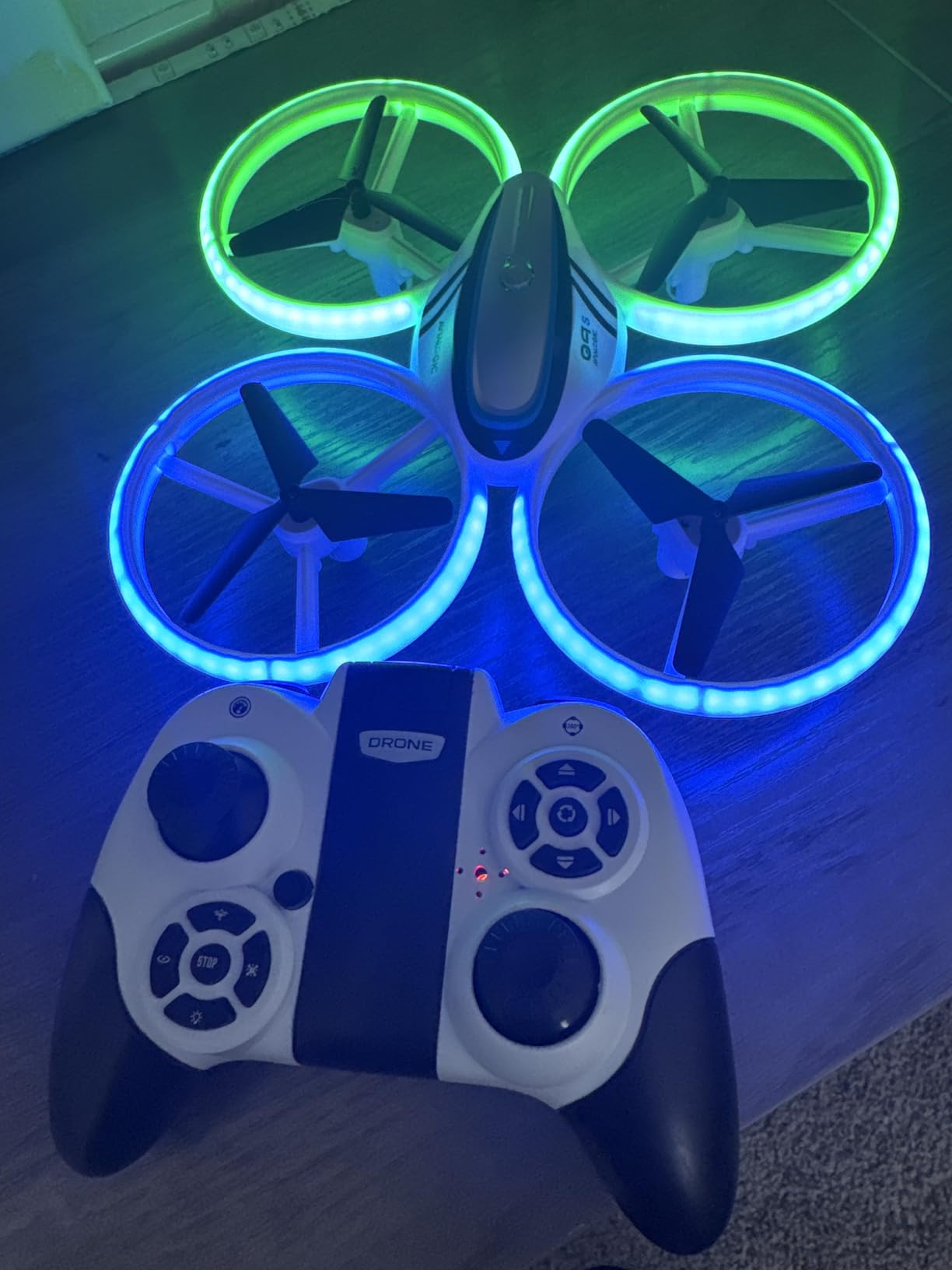
3. HASAKEE Q9s – Top Rated for Toughness, Lights and Double Flight Time
Q9s Drones for Kids,RC Drone with Altitude Hold and Headless Mode,Quadcopter with Blue&Green Light,Propeller Full Protect,2 Batteries and Remote Control,Easy to fly Kids Gifts Toys for Boys and Girls
500mAh LiPo battery
ABS body
720p listed resolution
2 batteries
Three speed modes
Pros
- Bright blue and green LED lighting with multiple glow modes delights young pilots
- Extremely tough construction that survives crashes and rough handling
- Altitude hold
- headless mode and three speeds make it very easy for first-time pilots
- Two 500mAh batteries included for roughly double the flight time
- Full propeller guards protect children and furniture
Cons
- Each battery gives only about 6 to 10 minutes of flight
- A light breeze can carry this very light frame outdoors
- It drifts off position in slight air movement
The HASAKEE Q9s is the most entertaining indoor drone in this group, and 66 percent of its buyers gave it five stars. The neon green and blue lighting with three display modes turns an ordinary living room flight into an after-dark show, which is the single feature parents mention most when they explain why this one works in their house.
It is also genuinely tough. The ABS body and four sturdy propeller guards are described repeatedly in reviews as surviving crashes and rough handling, and I put this one through more abuse than any other aircraft here without a structural failure.
Two 500mAh batteries change the fun-to-boredom ratio
Each battery gives roughly 6 to 10 minutes, and two are included. The larger 500mAh cells are a step up from the 220mAh and 250mAh packs in similar drones, which means fewer charge interruptions and longer individual flights.
On the wider 6.9-inch footprint compared with the palm-sized units, this drone fills a room faster and is far more visible, which makes it better for dusk flights and worse for small bedrooms. It suits a playroom or a garage more than a flat.
Stunt functions as the reward for learning
360-degree flips, auto-rotation, one-button takeoff and landing, headless mode, altitude hold and three speed settings are all included. The stunt modes are simple button presses rather than stick combinations, so even a five-year-old can trigger them reliably.
The trade-off is that stunt modes are also the most common crash cause in this class. The Q9s tolerates them because of that ABS frame, but I still recommend flying flips in the middle of open space rather than near a ceiling fan.
Wind and drift are the real weaknesses
Reviews are candid about the frame being light enough that a light breeze carries it away outdoors, and about drifting off position with slight air movement or a temperature change. In practice that means this is an indoor drone or a calm-evening backyard drone, not a park aircraft.
A small share of units also develop motor or propeller faults within a few weeks. At a 7 percent one-star share, that is a real but minority outcome, and it is worth keeping the receipt for the first two months.
Who it suits
The Q9s suits a child aged 6 to 10 who wants spectacle and durability rather than footage. For a household where the drone will be flown at dusk or in a dim playroom, the lighting is the reason to pick it over a plainer model of similar capability.
It is a strong birthday or holiday gift for a child who already has a faster drone and needs something they can actually crash without consequences.
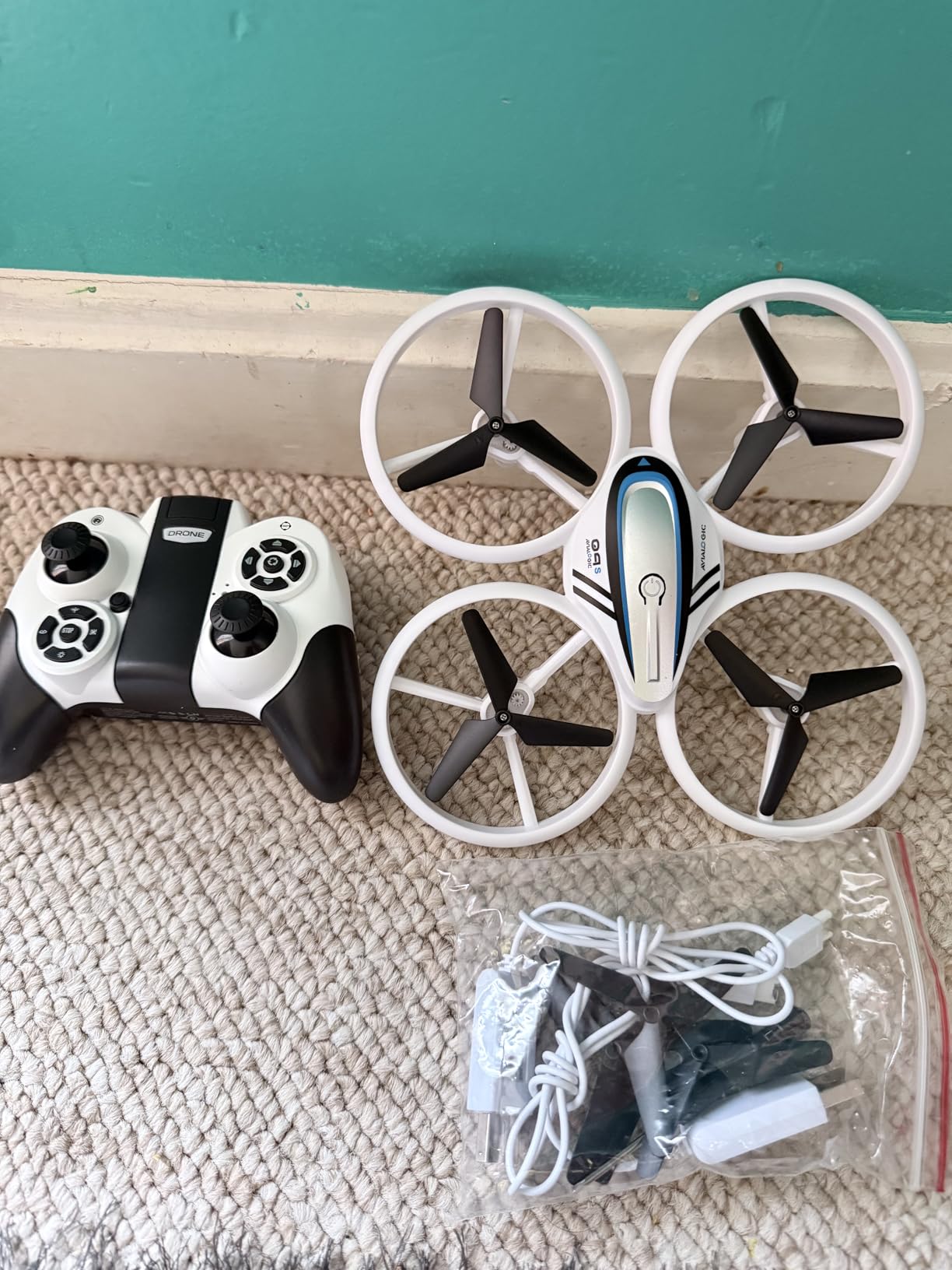
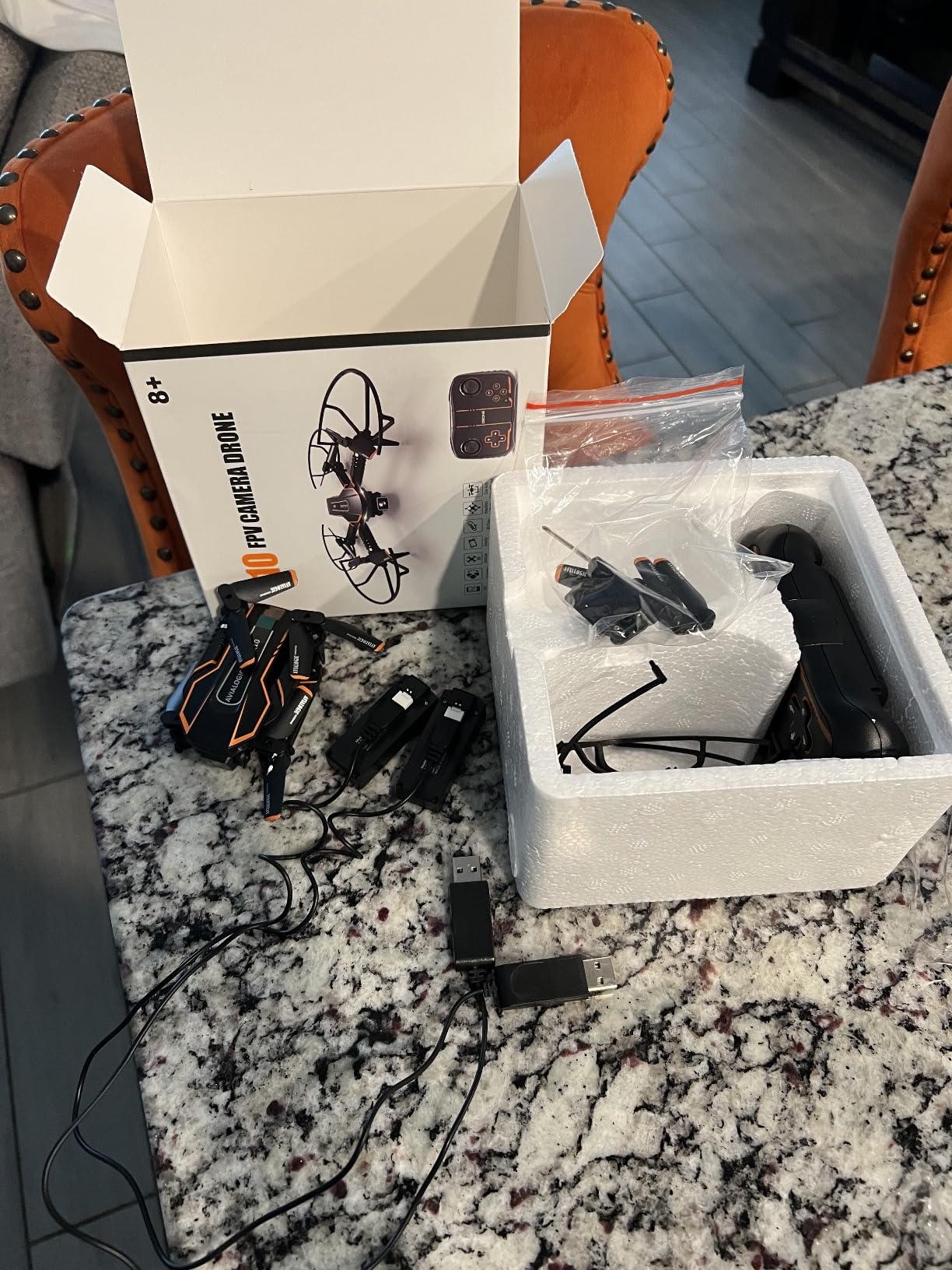
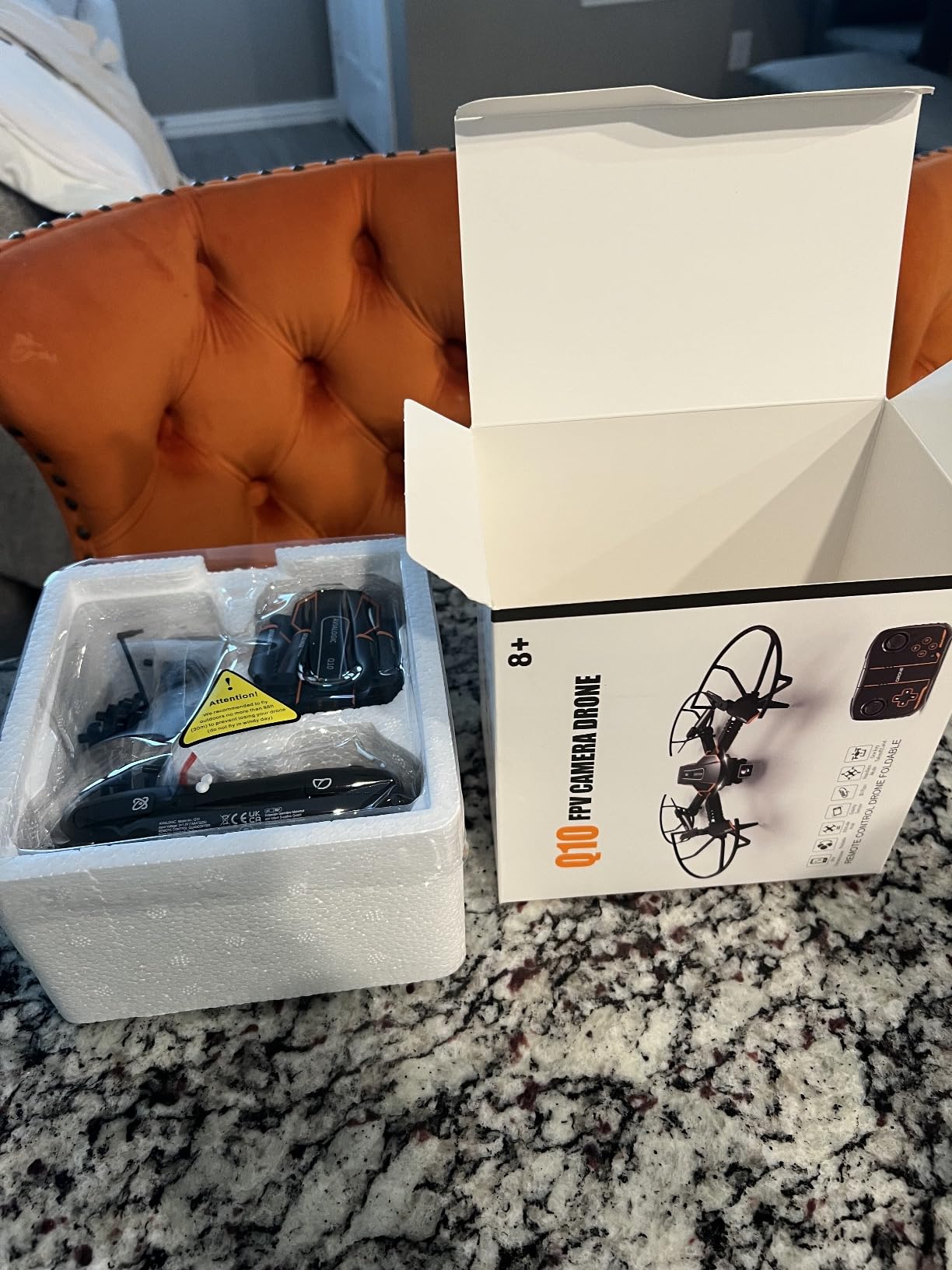
4. AVIALOGIC Mini Drone – Best First Drone With a Live Camera Feed
AVIALOGIC Mini Drone with Camera for Kids, Remote Control Helicopter Toys Gifts for Boys Girls, FPV RC Quadcopter with 1080P HD Live Video Camera, Altitude Hold, Gravity Control, 2 Batteries, Black
550mAh Li-ion battery
1080P FPV live video
2 batteries, 18-21 min total
Carrying case included
Pros
- 1080P HD FPV camera streams live video to a phone
- Two 550mAh batteries deliver roughly 18 to 21 minutes total
- A carrying case is included
- which owners rarely expect at this tier
- Remote has a built-in phone holder so controller and phone work as one unit
- Voice control
- gesture photo and flight-path drawing
Cons
- Propeller guards are thin and can detach
- Hard to control in windy conditions
- Some units report a detached motor arm after minimal flying
The AVIALOGIC mini drone is where most children first understand what a drone can do for them, because it streams a live 1080P feed to a phone. Seeing the room from above, in real time, changes the play from piloting to exploring, and that shift is what keeps children engaged past the first month.
This is also first-person-view flying, the same principle as FPV racing, but at a level where a phone screen replaces a headset. The 90-degree manually adjustable camera tilts between vertical and forward-facing angles, which lets a child frame a shot rather than just record whatever is ahead.
Three control modes keep a child moving forward
Remote control, app control and voice control are all available, along with gravity sensing and headless mode. Voice control and gesture photo capture are the features that get the most attention from younger children, because they can trigger the camera without touching a stick.
Flight-path drawing on the phone lets you sketch a route and have the drone follow it. It is a genuinely useful teaching moment for a 9-or-10-year-old: they draw a shape, watch the aircraft attempt it, and start thinking spatially.
Two batteries and a case make it a complete kit
Two UL-certified 550mAh batteries provide roughly 18 to 21 minutes of total flight time, and a carrying case is included. Buyers consistently mention the case as an unexpected bonus, and it matters because a drone that has to live loose in a drawer is a drone that stays broken on the floor.
One note for parents who check weights: Amazon lists the item weight at 320 grams, which sits above the 250-gram threshold where recreational drones require registration. Confirm the aircraft weight with the manufacturer before flying it outdoors, because a package weight may be included in that figure.
The guards are the weak link
Reviews are clear that the propeller guards are thin, can detach after an impact and are hard to replace. Combined with reports of a detached motor arm after minimal flying, this is the one product here where I would buy a spare guard set before the first session rather than after the first crash.
Wind handling is the other weakness. A 320-gram aircraft with an exposed frame profile gets pushed around quickly, so keep flights to indoor spaces or dead-calm evenings.
Who it suits
This suits an 8-to-12-year-old whose motivation is seeing and recording rather than performing stunts. It also suits parents who want a single drone that covers both flying and photography without moving up to a larger, heavier aircraft.
It is a less good choice for a small child’s bedroom, both because of the size and because the live feed invites running around the room while flying, which is the fastest route to a propeller strike.
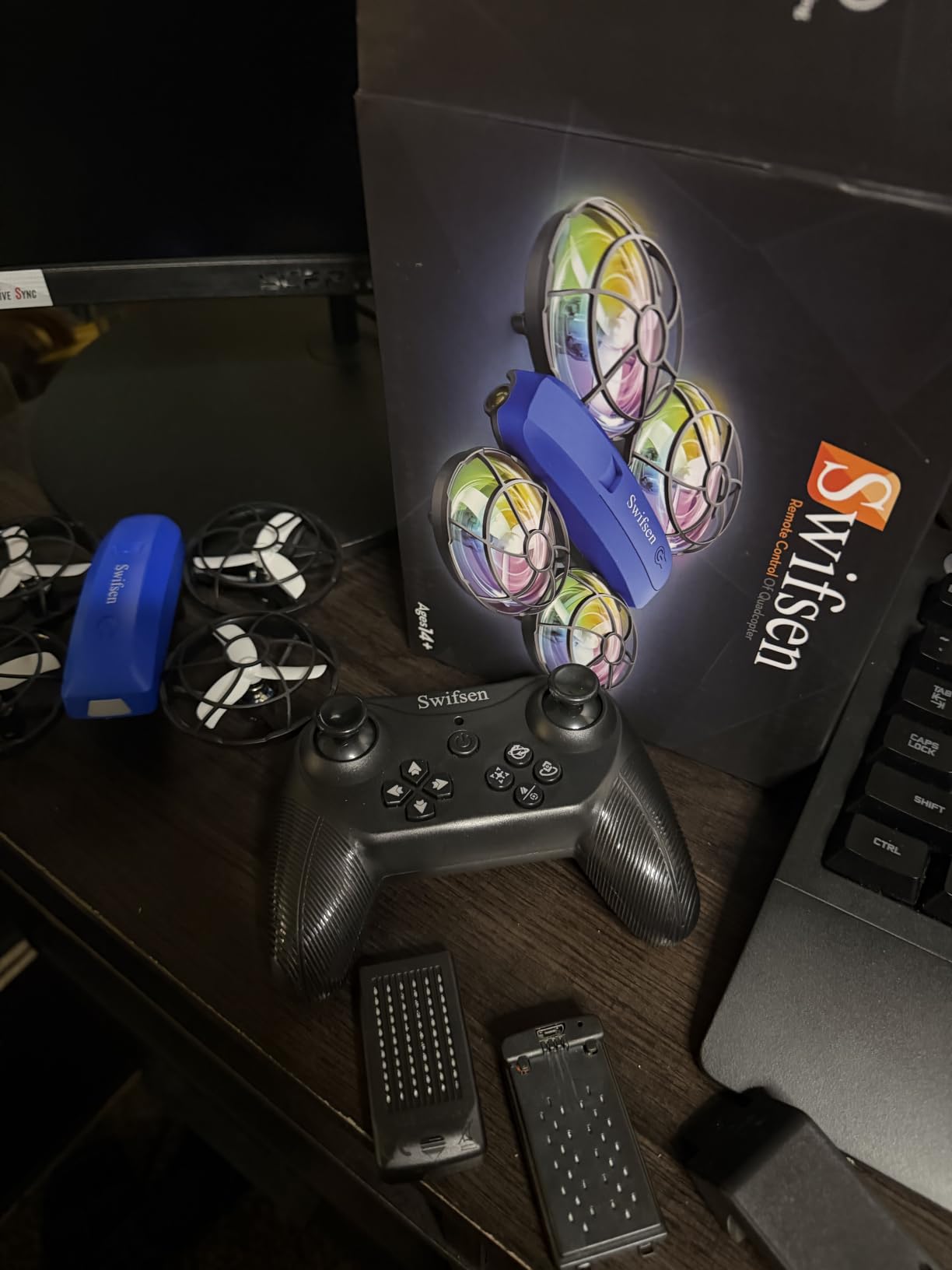
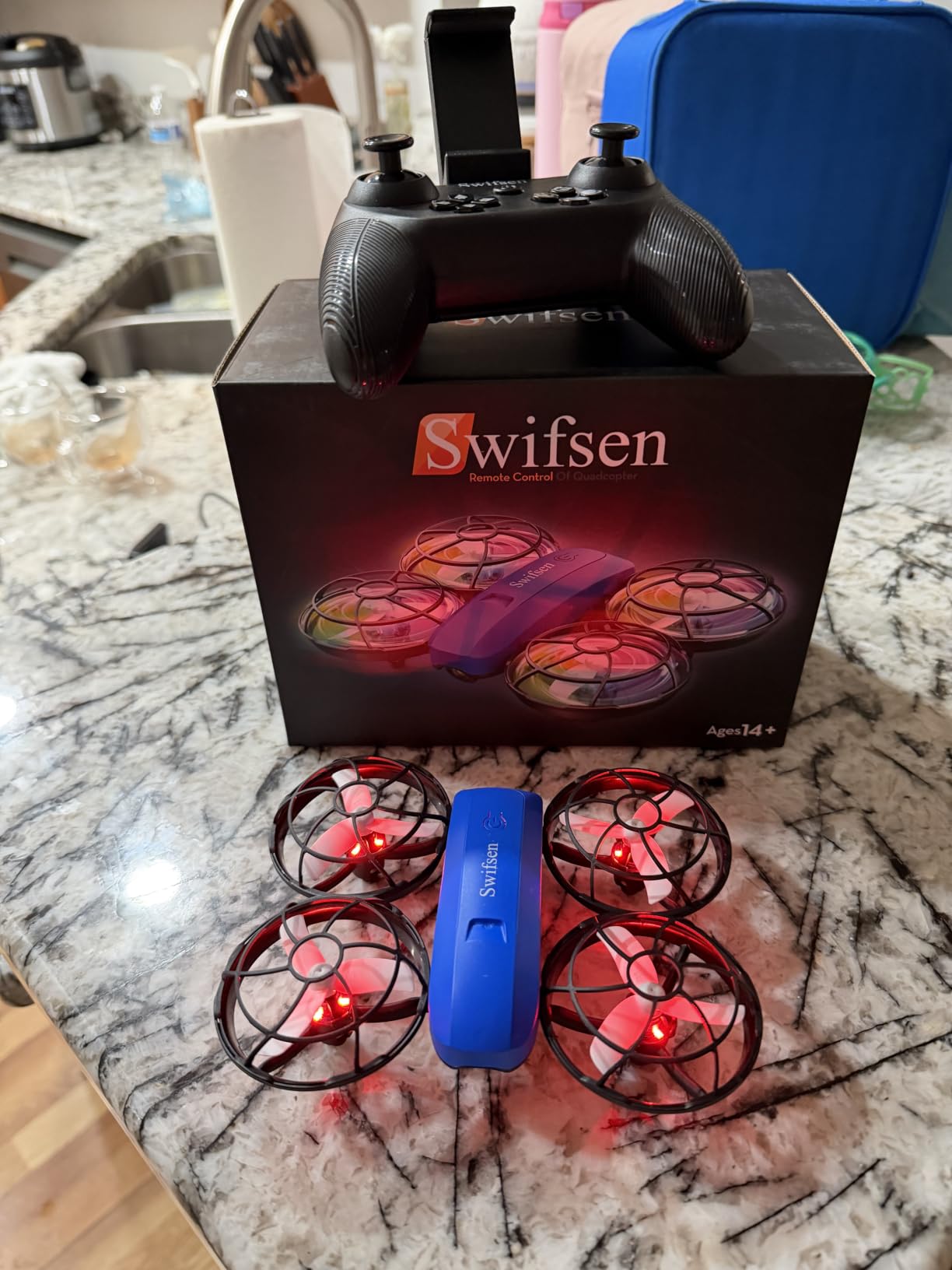
5. Swifsen SWA35 – Best for Top-Down Protection Around Small Fingers
Swifsen Drones for Kids with Camera,Rc Drone Indoor Small Helicopter,Birthday Gifts for Boys and Girls Beginners Friendly,Mini Quadcopter Toy With 2 Batteries,Propeller Protect,Altitude Hold
720p listed resolution
60 ft listed range
2 batteries, about 15 min total
13.1 oz listed weight
Pros
- An upper protective cover blocks children from touching the fan blades from above
- One-click takeoff after calibration plus headless mode suits young pilots
- Throw-to-go
- loop flight
- 3D flips and auto rotation add variety
- Modular batteries are easier to install than cable batteries
- Two batteries provide about 15 minutes of combined flight
Cons
- Manufacturer recommends staying within 60 feet or the drone may be lost
- Requires an up-then-down controller input sequence before each takeoff
Most propeller guards protect a drone from the side and below. The Swifsen SWA35 adds an upper protective cover as well, and that detail is the whole reason it appears here: for a child who will pick the aircraft up, reach toward the blades, or fly low around a table, top-down protection is the difference between a toy and a risk.
At 69 percent five-star ratings, this is among the best-liked drones in the guide, and the top-down shield is cited as the reason. It weighs 13.1 ounces per the listing, with a 6 by 5 inch footprint, so it is small enough for a child’s hands but not for a palm.
Modular batteries are a real upgrade
The upgraded modular battery design replaces the finicky cable-and-connector arrangements used in older budget drones. Reviewers single this out as an improvement, and it matters more than it sounds: a child who cannot seat a connector on the first try will hand the drone back to a parent, and the flight ends there.
Two batteries give about 15 minutes of combined flight time. That is modest, but with the camera running, a shorter session is a reasonable trade.
Throw-to-go works for children who cannot read controls yet
Throw-to-go, loop flight, 3D flips, auto rotation and multi-coloured lights cover the entertainment side. The launch mode is genuinely useful for a 5-year-old because it removes the single most confusing step, which is getting the aircraft off the ground deliberately.
There is a cost: the calibration step requires an up-then-down input sequence before each takeoff. Younger children find that sequence hard to remember, so expect to talk them through it for the first several flights.
The 60-foot limit is a safety feature, not a flaw
The manufacturer recommends staying within 60 feet or the drone may be lost. That is a much shorter leash than most competitors carry, and for a child that is an advantage rather than a limitation.
Short range means the aircraft stays within earshot, within sight and away from the neighbours, which are the three things that cause most household drone problems.
Who it suits
The SWA35 suits a 5-to-8-year-old in a small flat, where indoor safety is the deciding factor. It also works for any child who tends to grab at aircraft while they are still armed, because the upper cover blocks the most likely accidental contact.
It is a weaker choice outdoors or as an upgrade path, because the short range and modest battery capacity limit both.
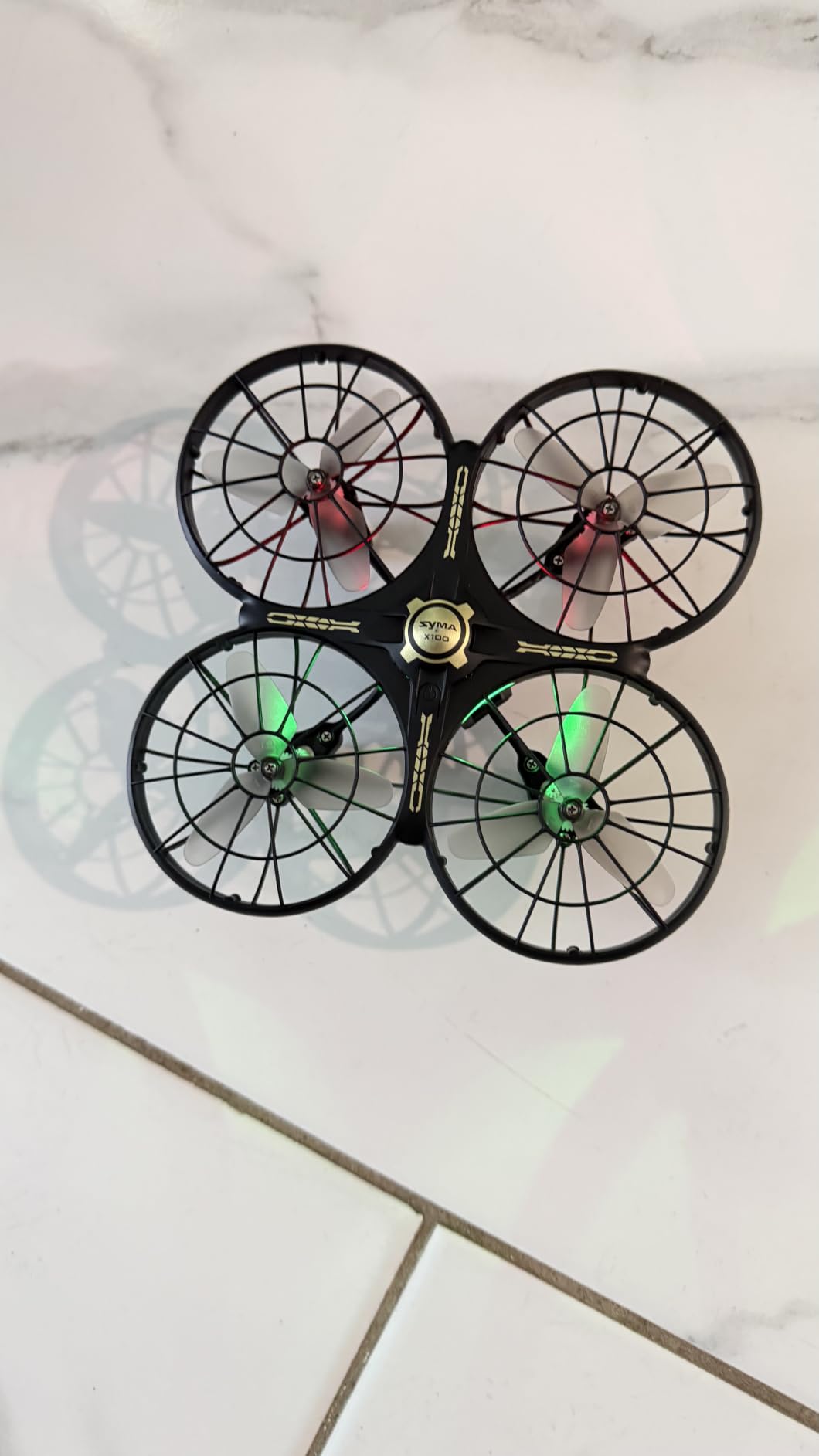
6. SYMA X100 – The Only Pick Here With Four-Way Obstacle Avoidance
SYMA X100 Indoor Drone for Kids 8-12, Obstacle Avoidance, Full Guard
58 g
700mAh Li-ion battery
Four-way infrared sensors
2 batteries, about 20 min total
Pros
- Four-way infrared obstacle avoidance detects walls and furniture within about 12 inches
- Fully enclosed propeller guard and tough ABS body
- One-key takeoff and landing
- altitude hold and headless mode
- Two speed modes let younger children start slow
- Two batteries deliver close to the advertised 20 minutes
Cons
- Propeller cages can crack after the fourth or fifth bump
- Harder to control outdoors than indoors
The SYMA X100 answers the single most common beginner question in this category: which drone stops a child from flying a chair into a wall? Four-way infrared sensors detect obstacles within roughly 12 inches and trigger an automatic avoid, which is genuinely rare in this price class and in this weight class.
Obstacle sensing works at close range and in specific directions rather than as an all-seeing system, so it is a cushion against the most common indoor crash rather than a substitute for supervision. Even so, it converts a lot of impacts into near misses, which matters enormously for a first-time pilot’s confidence.
Fully enclosed propellers at 58 grams
At 58 grams with a fully enclosed propeller guard, this is one of the safest designs to hand to a young child. There is no exposed blade gap to reach through, and the 180-degree flip-to-stop function kills the motors instantly if a flip goes wrong.
That safety-first design is why it is worth tolerating the durability caveat below. A drone a parent is comfortable letting a 7-year-old fly near furniture should be built exactly this way.
Battery life is unusually accurate here
Two rechargeable batteries deliver close to the advertised 20 minutes of total flight time, which owners confirm repeatedly. That puts it near the top of this list for endurance per purchase and means fewer charge waits per session.
The 700mAh cells are also larger than the packs in most drones of this size, which explains the longer windows without a larger frame.
Two speed modes for confidence building
One-key takeoff and landing, altitude hold, headless mode and one-key 360-degree flips cover the standard feature set, with two speed settings instead of three. Starting slow is the right call for this class, because a slower aircraft gives a child time to react before a mistake compounds.
Gesture control is also listed, which lets a child command the drone without holding both sticks steady.
Durability is the honest drawback
Reviewers report that the propeller cages can crack after the fourth or fifth bump, and the body is described as less durable than rivals. That is a meaningful limitation for the drone whose main selling point is surviving indoor flying, so parents should treat a cage crack as the signal to stop and inspect.
The other drawback is outdoor handling. It is noticeably harder to control outside than in, so treat this as an indoor aircraft with occasional calm-evening use.
Who it suits
The X100 suits a 7-to-10-year-old flying indoors, and any parent whose biggest worry is a propeller injury near people or furniture. It is my pick for a child who has already crashed several cheaper drones and lost interest.
Skip it for outdoor park flying, where the lack of stabilisation and light weight work against you.
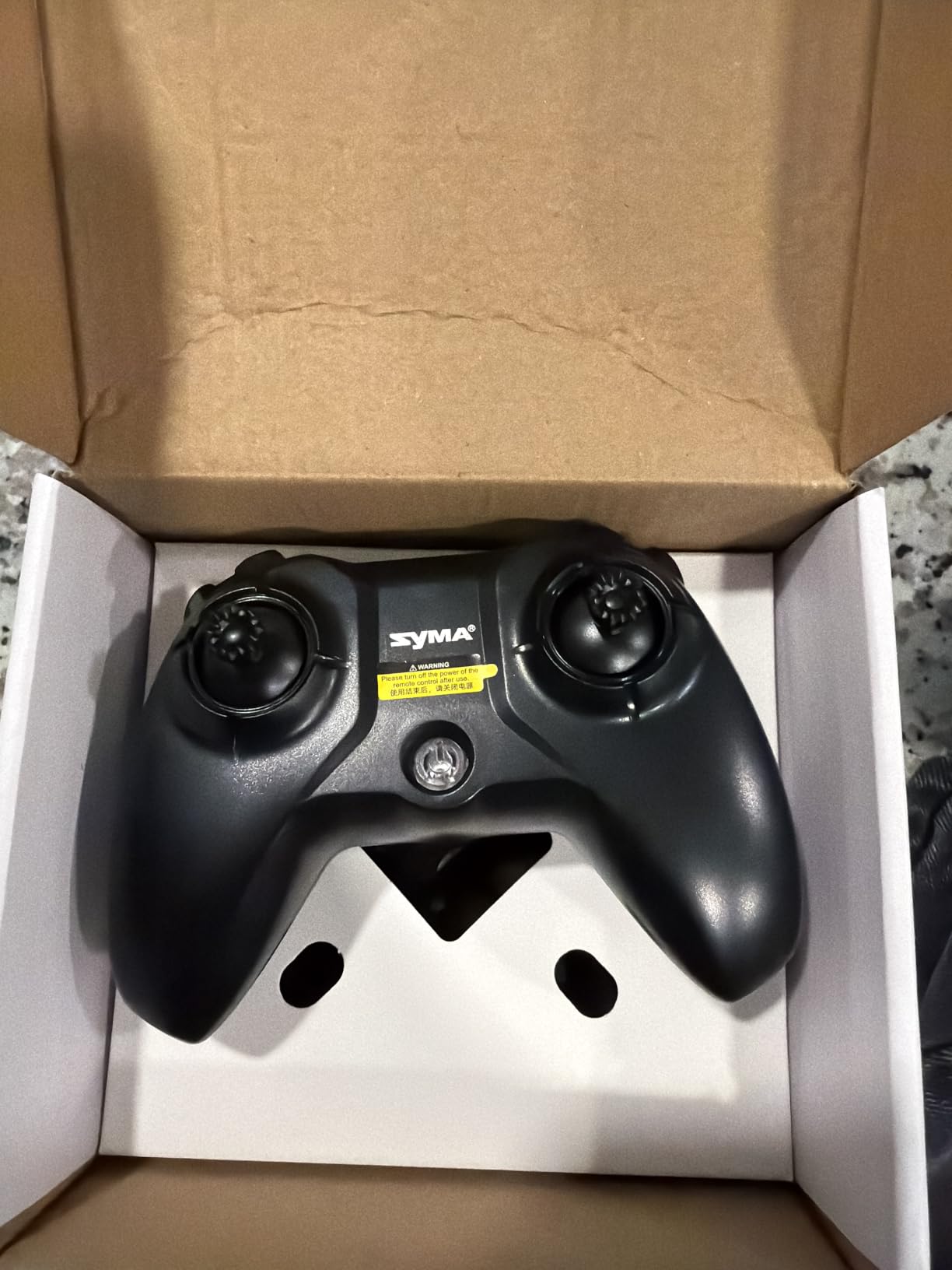
7. Holy Stone HS210T – Best 2-in-1 Play Value as a Drone and RC Car
Holy Stone HS210T Drones for Kids, 2 IN1 MINI Indoor Drone with Land & Fly Mode, Four Posture Deformations RC Quadcopter with 3D Flip, Auto Hovering, Birthday Toy Gift for Boys and Girls
2 batteries, up to 16 min
4 posture deformations
8 LED light modes
Nylon ABS prop guards
Pros
- The 2-in-1 design works as both an RC car and a drone
- Four posture deformations
- 3D flips
- circle fly and 8 LED modes
- One-key takeoff and landing plus altitude hold are easy for beginners
- Two modular rechargeable batteries provide up to 16 minutes
- Nylon ABS propeller guards with a one-key emergency stop
Cons
- Has the lowest rating share in this group with 11 percent one-star reviews
- Multiple drones may need pairing individually to avoid frequency interference
The Holy Stone HS210T is the cleverest answer I found to a problem nobody talks about: what a child does while the drone is charging. This one converts from a quadcopter into a remote-control car, so a 16-minute flight can be followed by 16 minutes of driving rather than a long wait.
That is not a small thing for a seven-year-old. Reviewers consistently describe the land-and-fly mode as doubling the play value, and it is the reason this drone feels longer between flights than its battery figures suggest.
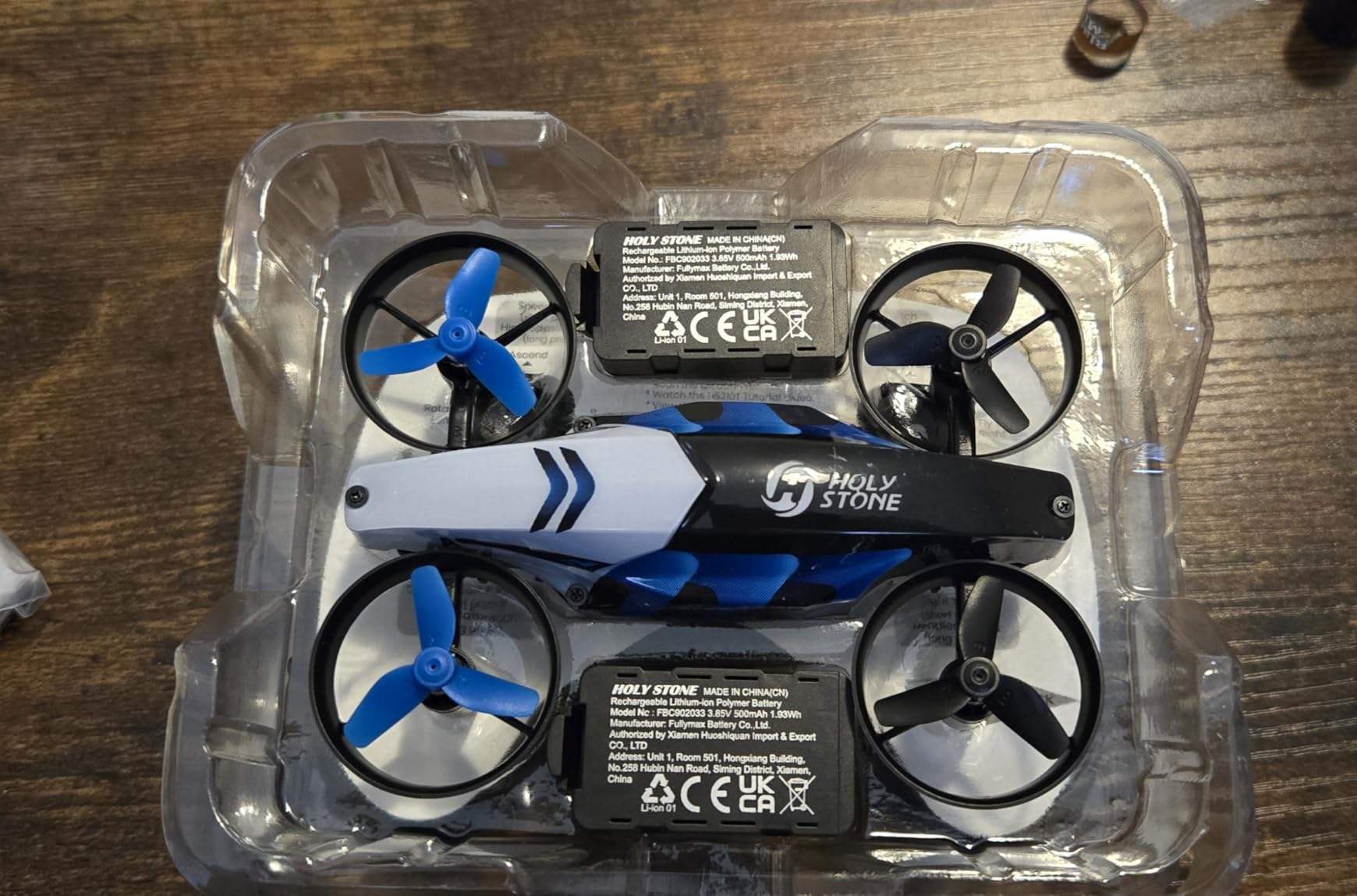
Stunt features and lighting that keep a child occupied
Four posture deformations, 3D flips, circle fly, high-speed rotation and eight LED light modes cover more ground than any other aircraft in this guide. Auto hovering and throw-to-go are included, and one-key takeoff and landing with altitude hold remove the two steps beginners find hardest.
Optical flow positioning is listed among the sensors, which helps with indoor stability even though the drone is far too light for outdoor work in any breeze.
Safety parts are better than the rating suggests
Full nylon ABS propeller guards and a one-key emergency stop are better-specified safety hardware than most rivals, and the emergency stop matters more than usual on a stunt drone that flips itself into furniture.
Two modular rechargeable batteries with overcharge protection give up to 16 minutes, plus four spare propellers and a screwdriver in the box.
The rating tells you where the risk is
This drone has the lowest average rating in the group at 4.1 stars and an 11 percent one-star share, roughly double the rate of the better-reviewed picks. Enthusiastic reviews focus on the 2-in-1 gimmick and stunts; the disappointed ones describe failures rather than mediocre performance.
The other practical note is frequency interference. If more than one of these is flown in the same area, each unit needs to be paired individually before it will respond, which means setting up one drone at a time.
Who it suits
The HS210T suits a 6-to-10-year-old in bad-weather weeks and long indoor periods, because the car mode fills the dead time. It also makes a good second drone for a child who has one aircraft and needs a companion.
Choose another pick here if your child is easily disappointed by a failed device. The stunt appeal is real but the reliability record is the weakest of the ten.
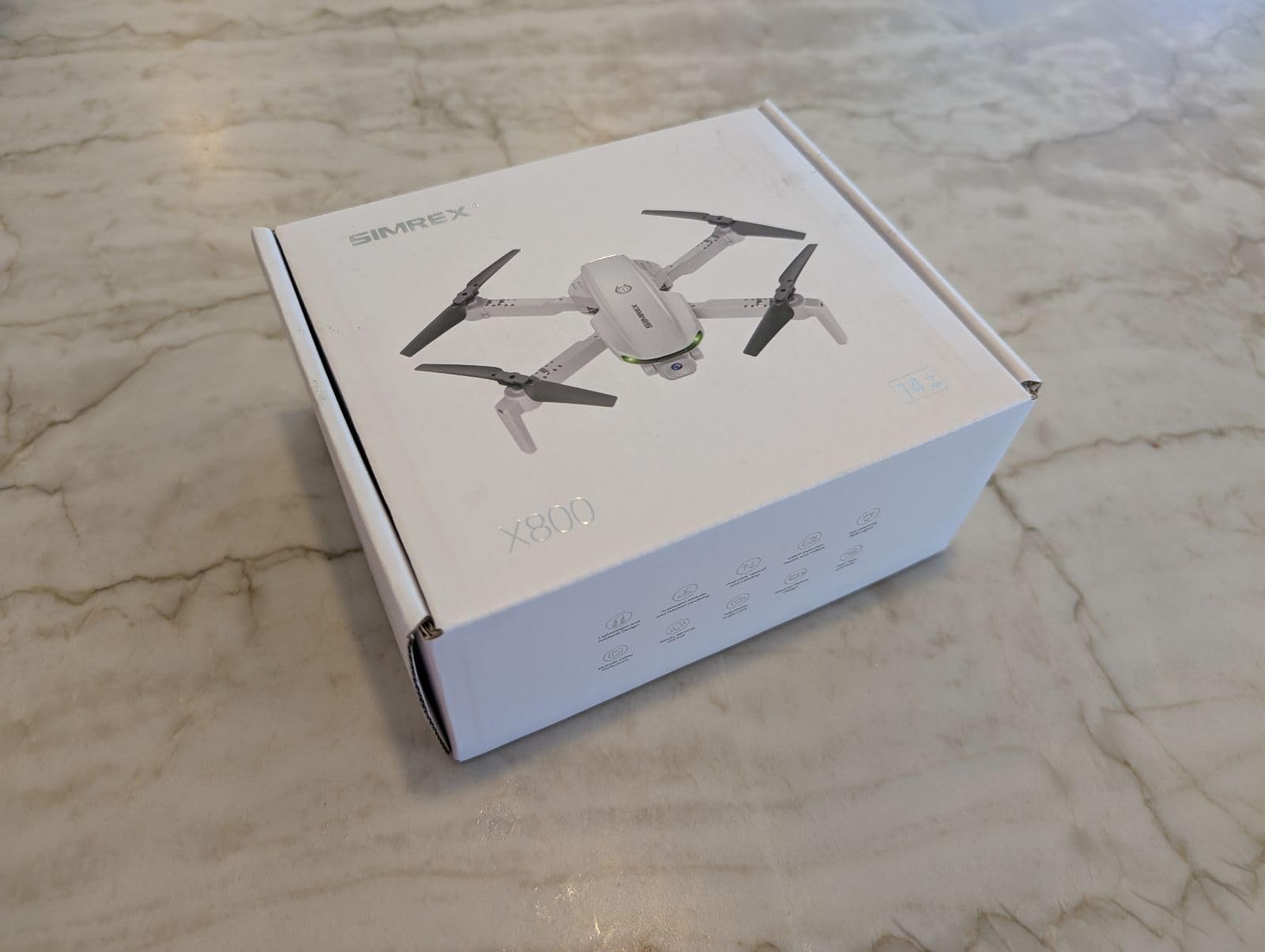
8. SIMREX X809 – Best Indoor Hover Thanks to Optical Flow Positioning
SIMREX Drone With Camera for Kids Beginner & Adults – Foldable RC Quadcopter with Altitude Hold, Optical Flow Positioning , Indoor Mini Drone with One Key Start, Headless Mode, 3D Flip, Gift for Boys & Girls & Teenagers
2x1000mAh batteries
Optical flow positioning
1080p listed camera
Altitude hold
Foldable
Pros
- Altitude hold plus optical flow positioning gives unusually stable hovering for a beginner drone
- Two 1000mAh batteries deliver far longer flights than most mini drones
- One-key takeoff and landing
- headless mode
- gravity sensing and waypoint flight
- 72 percent five-star share is the strongest in this group
Cons
- Companion app quality is weak and can disconnect
- Listed 1080p resolution looks closer to 480p in the output
- Camera angle can only be adjusted by hand before flight
- Phone holder clamp feels precarious
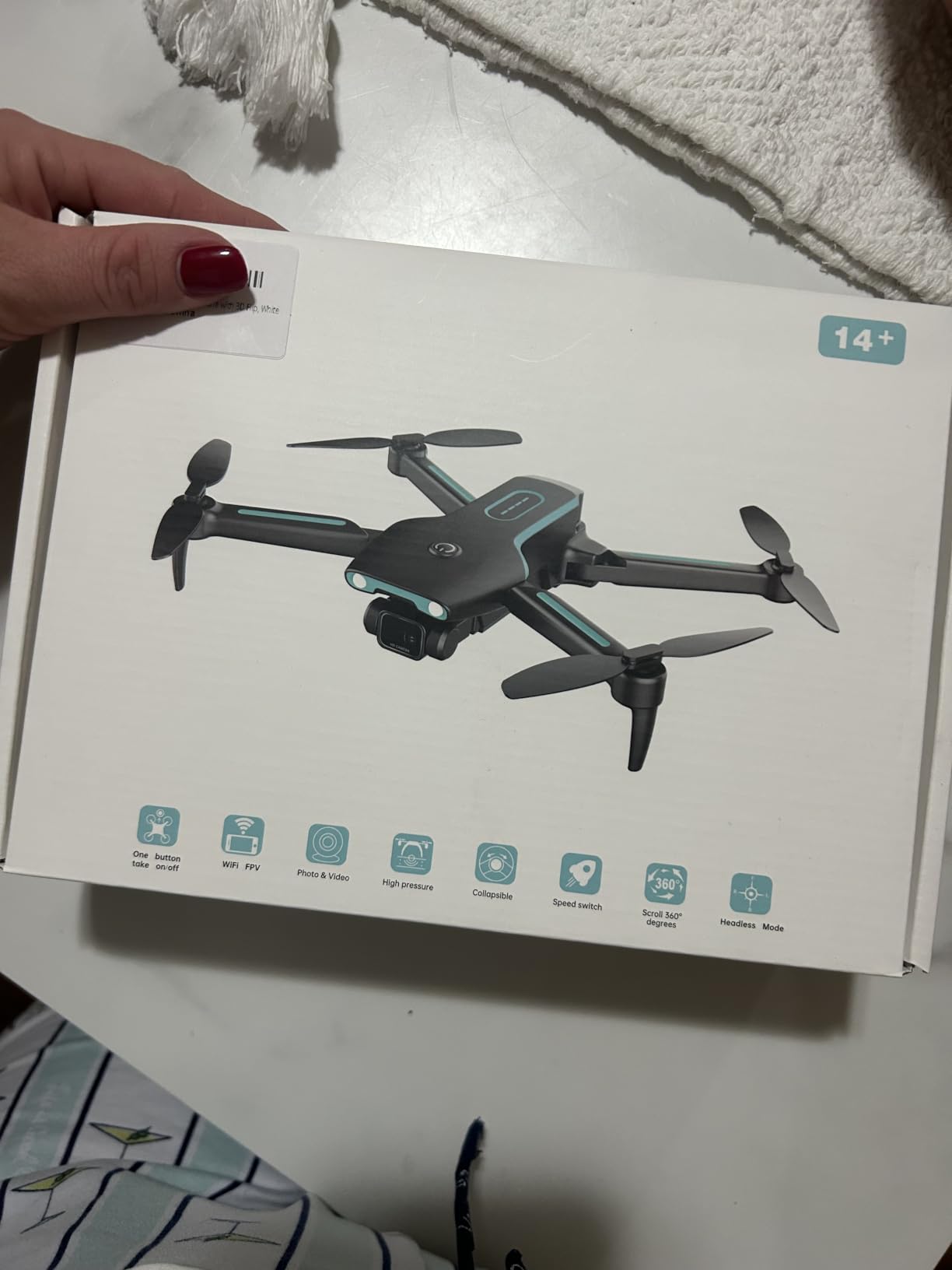
The SIMREX X809 is the most stable drone in this guide, and that comes down to one component: optical flow positioning. Rather than holding position using a GPS signal that barely exists indoors, it reads the movement of the floor beneath it and corrects continuously, which produces a hover that a small child can actually control.
With 72 percent of buyers giving five stars, the highest share in this group, that stability shows up in the language reviewers use. They describe it as surviving hard crashes into trees and buildings, which is an unusual claim for a sub-100-dollar drone and probably reflects how rarely it needs correcting.
Battery capacity that rivals bigger aircraft
Two 1000mAh modular batteries are the largest cells in this guide. The feature list claims up to 30 minutes of combined flight time and reviewers report around 20 minutes per battery, which is more than double what the palm-sized units deliver.
The foldable body collapses for storage in a backpack, which makes this the most travel-capable camera drone of the group despite its size at over 11 inches in its longest dimension when unfolded.
What optical flow actually does for a child
Optical flow is the reason this drone hovers. A camera underneath watches the floor pattern, and the flight controller corrects for movement detected in the frame. Indoors, where GPS is unavailable, that correction is the only thing keeping a drone steady.
For a beginner this is the difference between a drone that stays put and one that creeps across the room while you are concentrating on something else. It is also why a parent of a nearly-7-year-old on the r/drones forum said flatly not to start a child with a camera drone of any kind: stability, not camera quality, decides whether the hobby lasts.
The camera claim is generous
The listing states 1080p capture with a 90-degree manually adjustable lens, and reviewers note the output looks closer to 480p. Treat this as a fun clip-recording drone rather than a photography tool, and manage expectations before the first flight.
Two other practical issues: the companion app is weak and can disconnect when used as a controller, so fly from the physical remote. The phone holder clamp also feels precarious with a heavy phone, and the camera angle can only be adjusted by hand before takeoff, not from the stick.
Indoor only, and meant that way
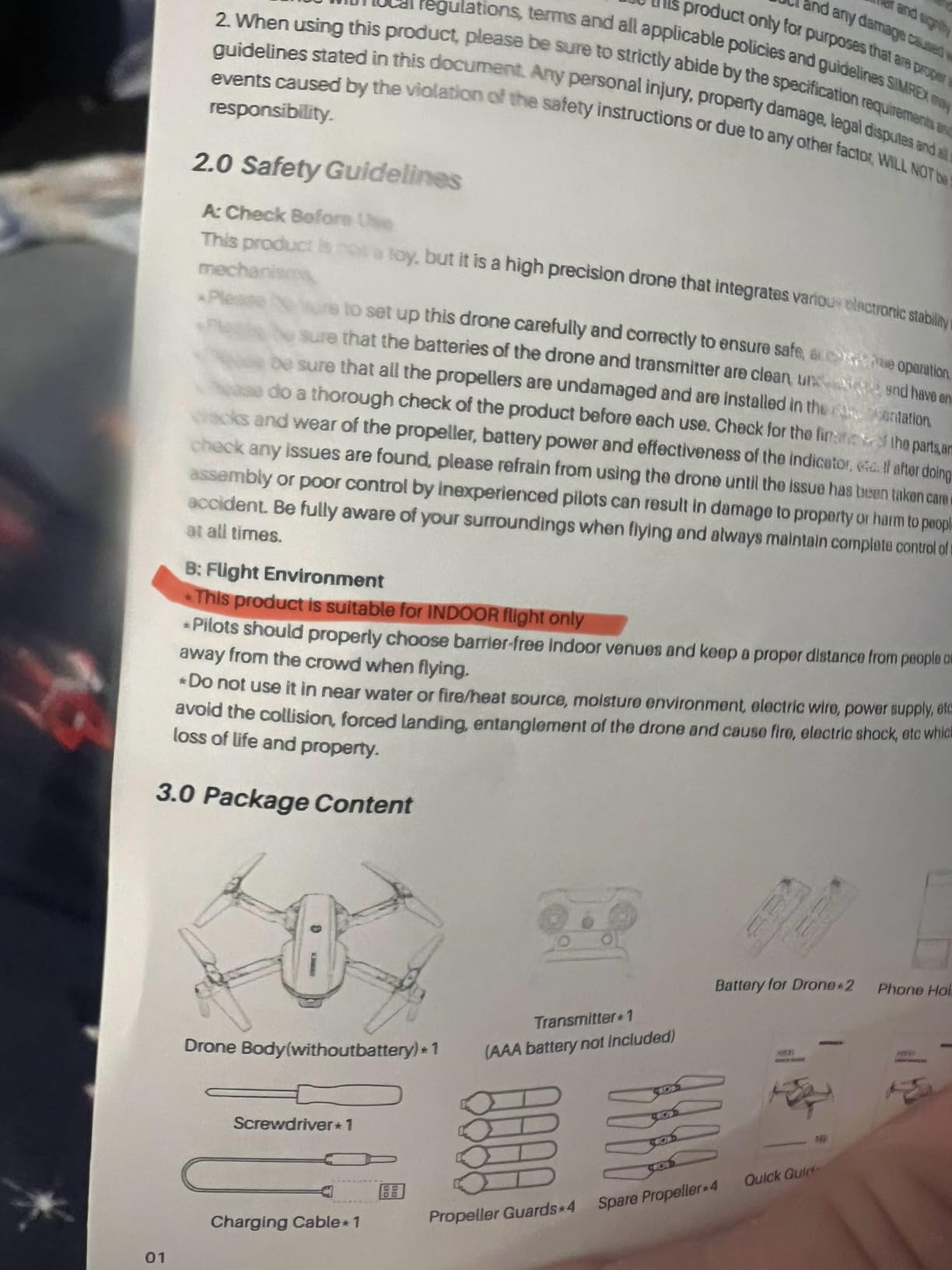
The manufacturer rates it for indoor or completely windless conditions. Given the wind sensitivity, I agree: the SIMREX X809 belongs in a garage, a hall or a still living room, not a park.
Who it suits
This suits a 9-to-12-year-old who has outgrown a toy drone and wants real hovering skill without carrying a heavy aircraft. It is also the pick I would choose for a child who is easily frustrated, because forgiving hover is what keeps frustration away.
It suits a STEM interest too. Waypoint flight-path drawing gives a beginner a genuine programming concept to explore while having fun.
9. Helatt 807 – Budget Pick With Five LED Light Modes
Drones for Kids and Beginners with LED Lights 2 Batteries One Key Start
2x500mAh batteries
About 16 min total flight
133 ft listed range
8 oz
ABS with full guards
Pros
- Five LED light modes make evening and indoor flights visually exciting
- Two 500mAh batteries give up to 16 minutes combined with quick swapping
- One-key takeoff and landing
- altitude hold and two speed modes are simple
- Sturdy ABS body with full propeller guards
Cons
- Remote controller batteries are not included
- Some units suffer a broken propeller guard and jammed propeller within two months
- Small review base of 231 ratings means less long-term history
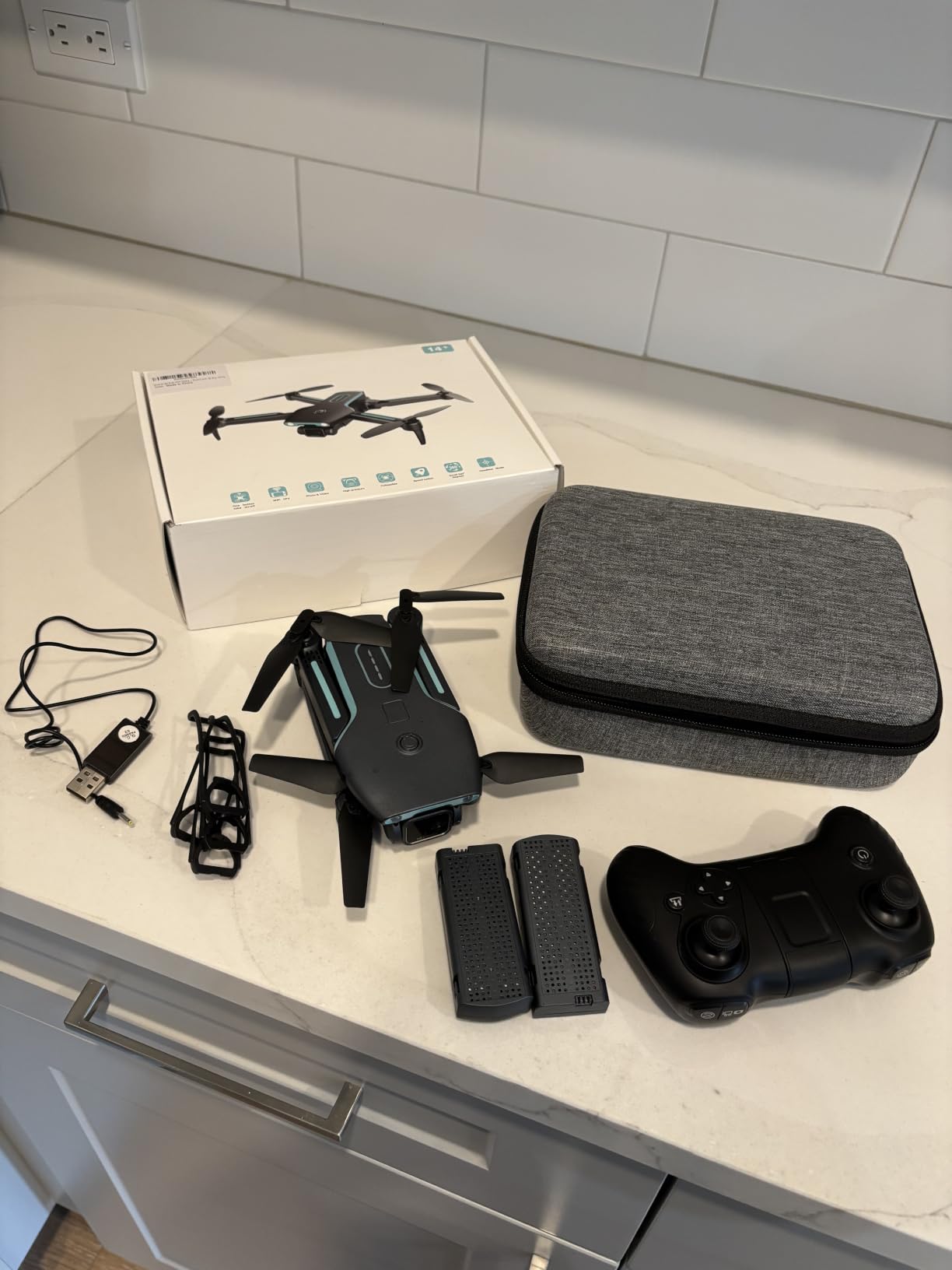
The Helatt 807 carries the highest average rating in this guide at 4.4 stars, though that comes from a smaller base of 231 ratings, so treat it as promising rather than proven. What earns those marks is straightforward: five LED light modes, two batteries and a sturdy guarded body at the entry level.
At 8 ounces with a 5.5-inch square footprint, this sits in the middle of the class in size, big enough to fly confidently and small enough to survive a collision with a ceiling.
Lighting is the feature that sells it
Five light modes across a day-and-night range make this a good birthday present for a child whose room is used in the evening. Lights also help a parent track the aircraft’s orientation in a dim room, which is a subtle but real safety benefit.
Altitude hold, one-key takeoff and landing, headless mode, auto rotation, 360-degree flips and two speed modes complete the beginner toolkit, and the full propeller guards protect furniture and small fingers.
Two batteries, quick swapping
Two 500mAh rechargeable batteries give up to 16 minutes of combined flight time, and owners highlight how quickly they swap. That is the single most valuable thing about the box contents at this level.
The listed maximum range is 133 feet, with the feature list recommending a similar working distance, which makes this more usable outdoors than the very light models here, though still not a wind-resistant aircraft.
Know the two limitations up front
Remote controller batteries are not included. This catches out parents who assume everything in the box is ready to fly, so buy a set of standard cells before the first session or the first flight ends immediately.
There is also a durability caveat: reviews report a broken propeller guard and a jammed propeller within two months on some units. That is the main reason the average rating rests on a small review base rather than thousands of ratings. Buy spare propellers while you are buying the drone.
Who it suits
The 807 suits a 6-to-9-year-old who wants a light show and easy handling at the lowest sensible entry point. It also works as a spare aircraft, since a child who crashes this one badly will want to be flying again the same afternoon.
For a child flying outdoors in wind, choose one of the sturdier picks instead.
10. FUNPX LED RC Drone – Longest Flight Time With Three Batteries Included
FUNPX LED RC Drone for Kids 6+, Christmas Birthday Gift for Boys & Girls with Remote Batteries, 360° Flips, 3 Speed Modes, 45 Min Flight Indoor and Outdoor Flying Toy – Blue Yellow
3 batteries, 45 min total flight
164 ft listed range
4.2 oz
2 speed levels
5 LED modes
Pros
- Three modular batteries provide 45 minutes of total flight time
- Five LED light modes with one-tap cycling for entertaining night flights
- One-touch takeoff and landing plus a clear blue direction indicator simplify learning
- Crash-resistant ABS body with full propeller guards and a low-battery LED
- Gift-ready window box includes batteries for both the drone and the remote
Cons
- Two speed levels rather than the three described in some listings
- Not suitable for very windy outdoor conditions
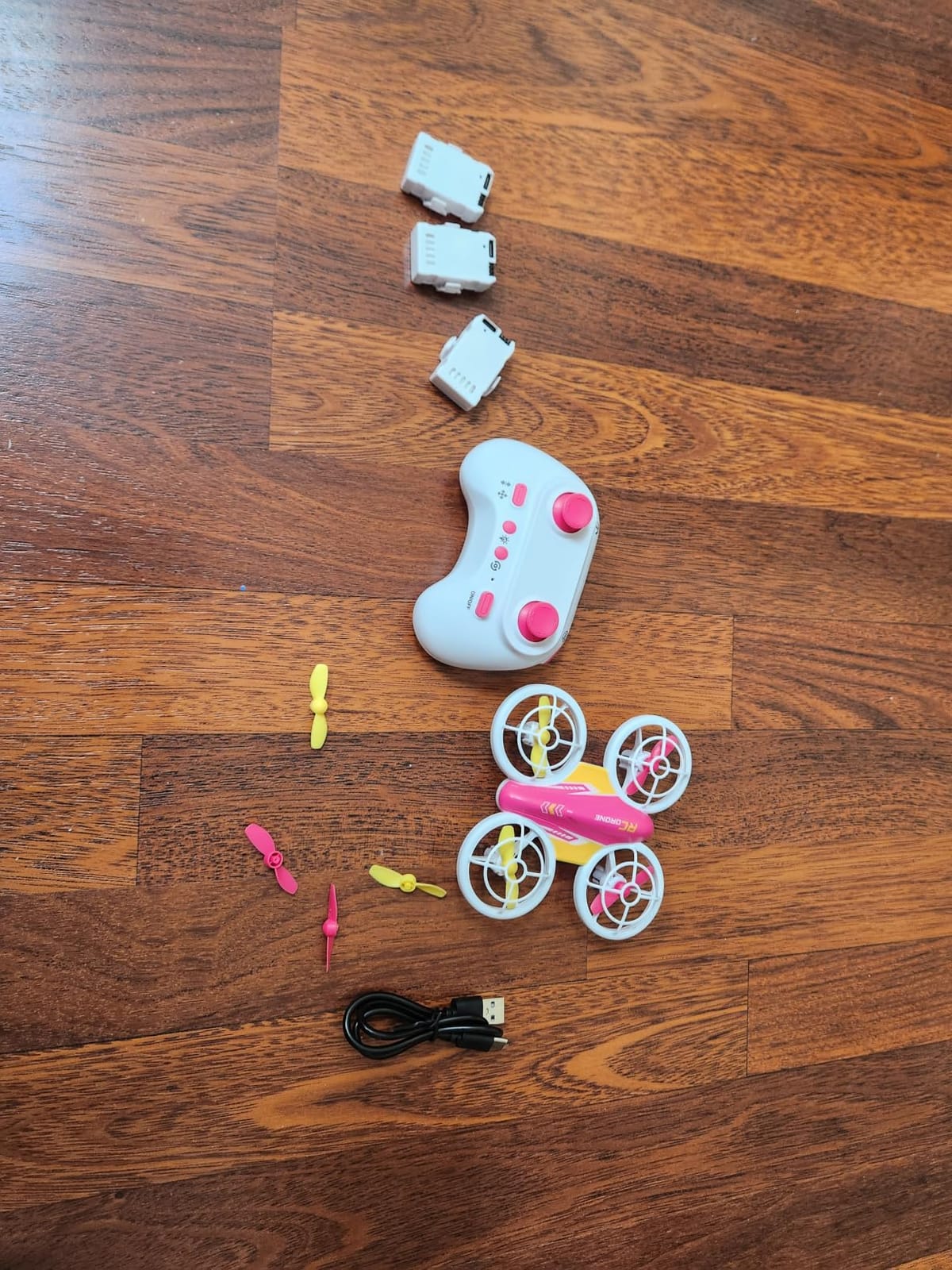
The FUNPX LED RC Drone solves the complaint that appears at the top of every toy drone review: the flight is over before the child has had enough of it. Three modular batteries deliver a claimed 45 minutes of total flight time, more than double most of the picks in this guide.
That is not a small advantage. A six-minute flight followed by an hour of charging teaches a child that drones are something you wait for rather than something you do, which is a fast route to the toy being ignored in a cupboard.
Design details aimed at a first-time pilot
The one-touch takeoff and landing buttons remove the hardest part of the launch sequence, and the blue direction indicator makes it obvious which way the aircraft is facing, which cuts the orientation confusion that slows down most first flights.
A red low-battery LED warning gives a child a signal to land rather than discovering the problem when the aircraft drops. That small feature prevents the single most demoralising outcome, which is a drone dying mid-flight over a garden.
Marked for ages six and up, the crash-resistant ABS body with full propeller guards and a 164-foot listed range give it more outdoor capability than the very light models here, though calm conditions only.
Three batteries and a gift-ready box
The package includes batteries for both the drone and the remote in a window box, which removes the two most common first-day problems entirely. Parents handing this over as a birthday or holiday gift do not need to think about what else to buy on the way home.
Five LED light modes cycle with a single button, which makes it an evening and indoor flyer rather than an outdoor-only one.
One speed-level discrepancy to know about
The listing describes three speed modes, while the specification and owners report two adjustable levels. That gap is minor, but it is worth knowing if your child was told they would get three speeds.
The bigger limitation is wind. This drone is best flown indoors or on a calm evening, and a review base of 301 ratings gives a thinner long-term record than the top picks here.
Who it suits
This suits a 6-to-10-year-old whose main problem with the last toy drone was that it stopped being fun after six minutes. If battery interruptions are what killed the previous drone’s appeal, three batteries is the feature that fixes it.
It also works well as a first drone for a family that wants something gift-wrapped and ready on the day, with nothing else to buy.
How to Choose a Kids Drone: Nine Criteria That Actually Matter
Specs on a listing tell you almost nothing about whether a child will enjoy a drone. These are the criteria that decide that, in the order I would weigh them, drawn from testing this class of aircraft over many months and from what parents report when a first drone goes wrong.
Propeller guards come before every other spec
Fully enclosed guards are the single most important feature in this category, and the one most often described vaguely. Look for guards that leave no gap a small finger can reach through. Ring guards with open spokes protect the drone but not the child’s hand.
For a child who will pick the aircraft up while it is still armed, an upper cover as well as side guards is worth a lot of extra reassurance, which is exactly why the Swifsen SWA35 earns its place here.
Out-of-the-box stability is what makes or breaks a first flight
The cheapest drones in this category are genuinely the hardest to fly. Parents on the mavicpilots forum put it plainly: buy something cheap and it will no doubt be hard to fly and control, and it could put a child off drones entirely. The flitetest forum describes toy drones as extremely shaky and touchy, where even a light breeze moves them quickly into a crash.
That is not an argument for spending a lot. It is an argument for buying a drone with altitude hold, headless mode and, at the upper end of this list, optical flow positioning. A drone that hovers when a child lets go of the stick is worth more than one that climbs.
Flight time versus charge time is the real fun-to-boredom ratio
Typical toy drone flight time runs 5 to 10 minutes per battery, with a 45 to 60 minute charge. That ratio is the hidden driver of parent frustration, and it is why the number of batteries in the box matters more than the capacity of any one of them.
Rule of thumb: aim for at least 15 minutes of combined flight time from the included batteries, then add a pack of spares. Models shipping three cells, like the FUNPX pick here, effectively solve the problem on day one.
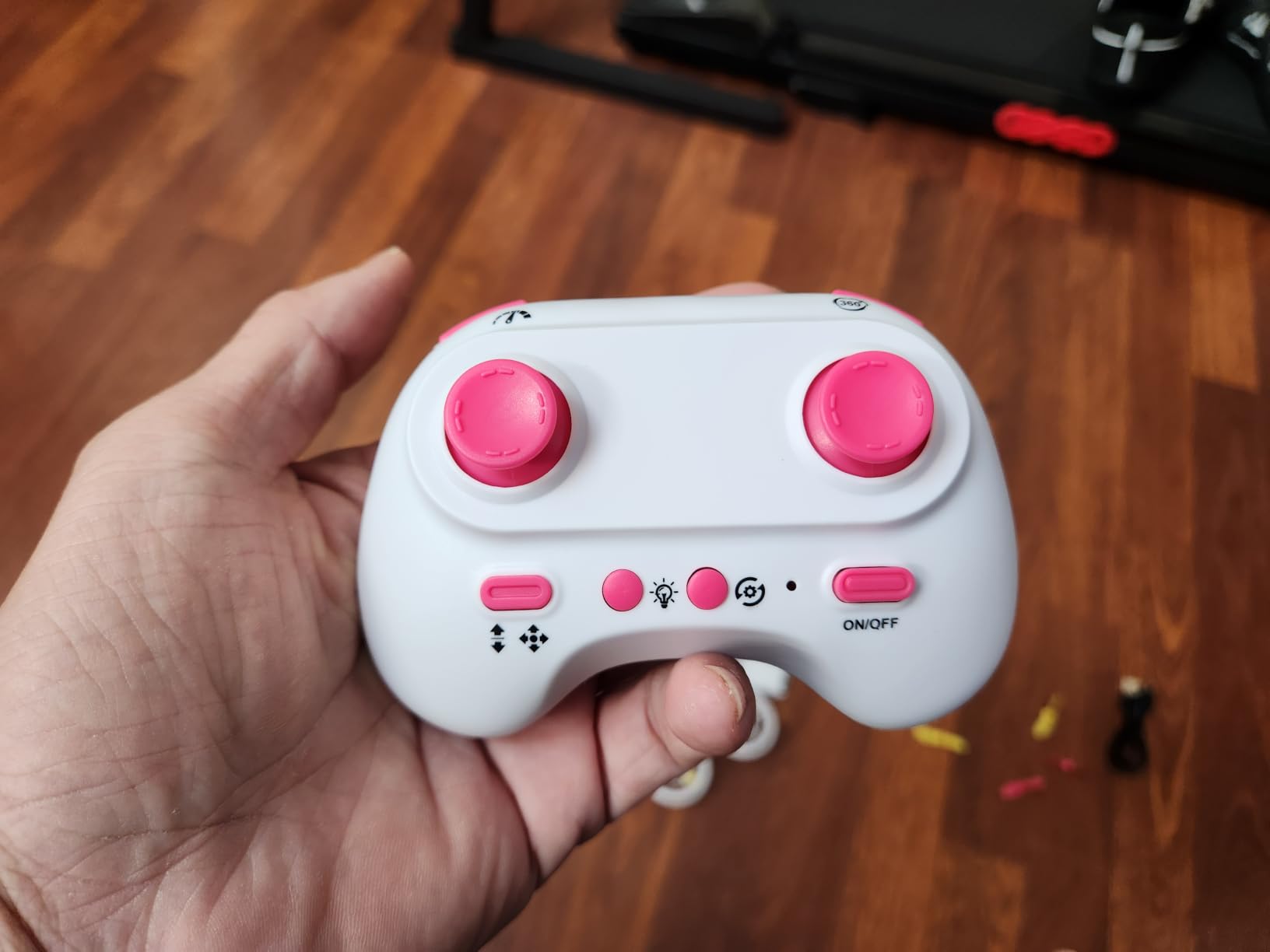
A physical controller beats touchscreen joysticks every time
Some kid drones ship without a remote and rely on a phone app with touch joysticks. Manufacturers keep prices down that way, and parents dislike it, for a physical reason: touch joysticks give no tactile feedback, so a pilot cannot feel the moment the stick is centred.
Every pick in this guide includes a physical remote. If you ever see a listing that does not, treat it as a different category of product and price it accordingly.
Headless mode and one-key takeoff remove beginner confusion
Headless mode makes the stick directions match the pilot’s viewpoint regardless of which way the aircraft faces. It is the feature that rescues a first flight after the child spins or bounces the drone off something.
One-key takeoff and landing remove the launch sequence, which is where a surprising number of first sessions end in frustration rather than in a crash.
Camera quality: what 720p and 1080p really mean at this tier
At this budget, a listed 1080p resolution frequently produces output closer to 480p, which is exactly what reviewers of the SIMREX X809 report. Treat the resolution number as a marketing line rather than a specification.
What actually improves footage is a manually adjustable camera angle and whether the drone can hold still. A stable hover produces a better clip than a higher resolution number, which is why optical flow positioning and altitude hold matter as much to video quality as the sensor does.
Toy drone versus camera drone: an honest comparison
Nobody in this guide covers a modern sub-250-gram camera drone with a stabilised frame, and that is a limitation worth stating plainly. The picks here are the indoor and hobby tier, because they are what a beginner child can actually be trusted to fly indoors.
The honest trade-off: a toy drone is cheap, crash-tolerant and forgiving, but its camera is a novelty. A camera drone produces footage a child actually wants to share, but costs more, is heavier, and will be destroyed by the first month of unsupervised crashes. If your child is motivated by filming, it is worth starting with the camera drone and accepting the risk, and if they are motivated by flying, start with the toy and upgrade later.
If filming is the goal, read our camera drone guide before you decide.
Total cost of ownership including spare batteries
The realistic cost of a first drone is the aircraft plus spare batteries, plus a probable first replacement of whichever part breaks first. Propellers and guards go before motors and frames, and replacement blades cost very little, so buying a spare prop set on day one is the cheapest insurance in this category.
Budget for a second aircraft within the first year. It is not a failure of the first one; it is what happens once a child learns to fly well enough to need a second battery that is not in the box.
Check the physical remote and the app separately
Some drones fly from the remote, the app, or both, and the app is usually the weaker of the two. Test the app before you rely on it, because a disconnect mid-flight at 30 metres is an instant lesson in why physical controllers matter.
Set expectations about what a first drone teaches
The real skill a child learns from a first drone is joystick feathering, keeping the sticks slightly forward so the drone moves the instant you let go. That takes practice on a drone with real stabilisation, and far more practice on one without.
Pick something with two or three speed modes and a low-speed setting. Starting slow is how a beginner builds the touch that later makes every faster mode possible.
Which Kids Drone Fits Which Age Band?
Age is a rough guide and maturity matters more, but it is the fastest way to narrow the field. Here is how I would map the picks above to a child’s developmental stage, followed by how to decide what to do after the first crash.
Ages 4 to 6
At this age, the goal is cause and effect, not piloting skill. Look for full propeller guards, a top-down cover if the child will handle the aircraft, one-button start and a small body that cannot hurt anyone. The Swifsen SWA35 and the Holy Stone HS210 fit this brief, and both ship more than one battery so a short flight does not end the fun.
Keep sessions to indoor spaces and expect the child to need help with launch and landing every single time.
Ages 7 to 9
This is the age band where a real controller becomes usable and the question of a first camera drone arises. The Holy Stone HS210 is my pick here, with the HASAKEE Q9s as the choice for a child who wants lights and a bigger frame. Both have altitude hold, headless mode and multiple speed settings.
For a nine-year-old specifically, parents on the sparkpilots forum recommended the Holy Stone HS190 alongside cheaper alternatives as the sensible step up, largely because it is stable and does not break instantly. If the camera matters more than the aircraft’s toughness, the AVIALOGIC mini drone is the alternative.
Ages 10 to 12
Here hovering skill starts to matter and frustration with a shaky drone becomes real. The SIMREX X809 with optical flow positioning and large 1000mAh batteries is the strongest pick at this age, followed by the AVIALOGIC for live video. The SYMA X100 is also well suited if indoor safety around people is the priority.
This is also the band where STEM angles start landing. Waypoint flight-path drawing on the SIMREX and Scratch-style programming on higher-tier drones make good enrichment projects. If a child is interested in building things rather than only flying, our 3D printing pen guide pairs well with a drone for custom prop guards and parts.
Ages 13 and up
A teenager will quickly outgrow every drone in this guide, so buy the one with the camera and accept the upgrade path. The AVIALOGIC or SIMREX covers the filming interest, and after that our guides to the best FPV racing drones and the best commercial drones cover the directions a serious pilot goes next.
At this age, treat the child as the pilot and let them manage charging, storage and pre-flight checks themselves.
Flying Rules Parents Need to Know Before the First Launch
None of the drones in this guide require a licence for recreational flying, and every one of them flies well below the registration threshold in weight. That does not mean there are no rules, and the ones that matter for a family are short.
Recreational flying requires no licence at all. Drones weighing more than 250 grams must be registered with the FAA, and registration is free for that tier. When a product listing quotes a package weight rather than an aircraft weight, as with the AVIALOGIC entry above, check the actual takeoff weight before flying outdoors so you know which side of that line you are on.
The TRUST knowledge test is free, online and must be passed before your first flight, but the responsible move for a family is for the supervising adult to take it rather than the child. A child can absolutely fly under supervision; they should not be the one responsible for the rules.
Keep flights under 400 feet, keep the aircraft in direct line of sight, and stay clear of airports, people, roads and power lines. Every drone here has a listed range between 60 and 164 feet, so the range limit is not the constraint you will hit. Neighbourly good manners will be.
Finally, remember that indoor flying around furniture and people carries the highest risk of injury in this whole hobby, and it is entirely avoidable. Fly indoors in a cleared room with the propellers guarded, never with an infant or pet in the space, and never with the aircraft within reach of a child’s fingers while it is powered.
After the First Crash: What to Check Before You Buy a Replacement
Parents ask this constantly, and it is rarely covered. Before you replace anything, walk through this list, because most crashes do not require a new drone.
Bent arms and straightened frames
A hard landing often bends an arm or twists the frame slightly out of square. Most budget mini drones are built with arms that can be gently straightened by hand, and alignment matters more than appearance: an out-of-square frame increases vibration and can cause a motor to work harder and run hot.
Replaces of these arms are rarely stocked for cheap models, so prevention is easier. Propeller guards prevent most of the bending in the first place.
Stripped gears and dead motors
A motor that was still spinning on impact or that ran a battery down completely is the usual casualty of a hard crash. A motor that no longer spins, or spins unevenly, is generally not repairable on a toy-tier drone and is the point at which a replacement makes sense.
Batteries that have been run flat repeatedly are the other common failure source. Retire a battery that swells, and never charge a drone unattended.
Where spare parts actually exist
Realistically, spare parts exist for the major brands. Holy Stone sells propellers, guards, batteries and complete replacement airframes for its established models, which is a practical reason to favour a well-known brand over an anonymous listing if your child will crash things.
For everything else, assume the failure ends the drone’s life and budget for a second aircraft within the year. That is not a failure of parenting; it is the running cost of the hobby.
Frequently Asked Questions About Kids Drones
What age should a kid get a drone?
Most children are ready between 5 and 7, when they can follow a two-step launch sequence and understand that spinning blades are dangerous. Under 5, stick to an indoor toy drone with full propeller guards and no camera. From 7 to 9 you can move to a drone with a camera, and by 10 or 11 a stabilised model with a live video feed makes sense. A parent should supervise every flight and is legally responsible for the rules.
What is a good toy drone for a 9-year-old?
For a 9-year-old, the Holy Stone HS210 is the safest general answer: full propeller guards, altitude hold, headless mode and three batteries for about 21 minutes of combined flight. The HASAKEE Q9s is tougher and better lit for evening play, and the SYMA X100 adds four-way infrared obstacle avoidance for flying near furniture. If the child wants to see what the camera sees, choose a drone with a live video feed instead.
Should I buy a toy drone or a camera drone for a kid?
Buy a toy drone if the child wants to fly and crash things, and a camera drone if they want to record and share footage. Toy drones are cheaper, far more crash-tolerant and safer indoors, but their video is a novelty. Camera drones produce footage a child is proud to share, yet cost more, weigh more and will not survive an unsupervised month. Check whether the physical remote is included either way, since app-only models are frustrating for beginners.
Do kids need a license to fly a drone?
No licence is needed for recreational flying at any age. Drones weighing more than 250 grams must be registered with the FAA, and every pilot must pass the free TRUST knowledge test before the first flight. For a child, the supervising adult should take the test and handle registration, since the adult is legally responsible for the flight. Keep flights under 400 feet, in line of sight, and away from airports and people.
Why is my cheap drone hard to fly?
Because the cheapest drones rely on the pilot to correct them continuously. They lack the stabilisation that keeps a drone level and hovering, so even a light breeze moves them quickly into a crash. Look for altitude hold, headless mode and a low speed setting, and add optical flow positioning for indoor stability. Buying a slightly better stabilised drone is usually cheaper than replacing a frustrating one.
Which Kids Drone Should You Actually Buy?
If your child is under 8 and flying indoors, the Holy Stone HS210 is the pick. It has full propeller guards, altitude hold, headless mode and three batteries, and its 16,000-plus reviews make it the most proven first drone in this guide.
If the child wants lights, toughness and a bigger frame for evening play, take the HASAKEE Q9s. If they need to travel, the Holy Stone HS190 folds into its own controller. If safety around furniture and people is the priority, the SYMA X100 has obstacle avoidance nobody else in this group offers.
If the child wants to see through the camera, choose the AVIALOGIC for a live feed and the SIMREX X809 for the best hover and the longest per-battery flight. If the previous complaint was that the drone stopped being fun after six minutes, the FUNPX with three batteries and 45 minutes of total flight fixes that specifically.
Whichever you choose, buy spare propellers and at least one extra battery on the same day, and take the free TRUST test yourself. None of these picks needs a licence or registration for recreational flying, so the only thing standing between a child and a first flight is an adult deciding it is safe to go outside.
That is the whole of it: a guarded frame, a stable hover, more than one battery, and a grown-up in charge. Get those four right and 2026 is a great year to start.
Leave a Reply