
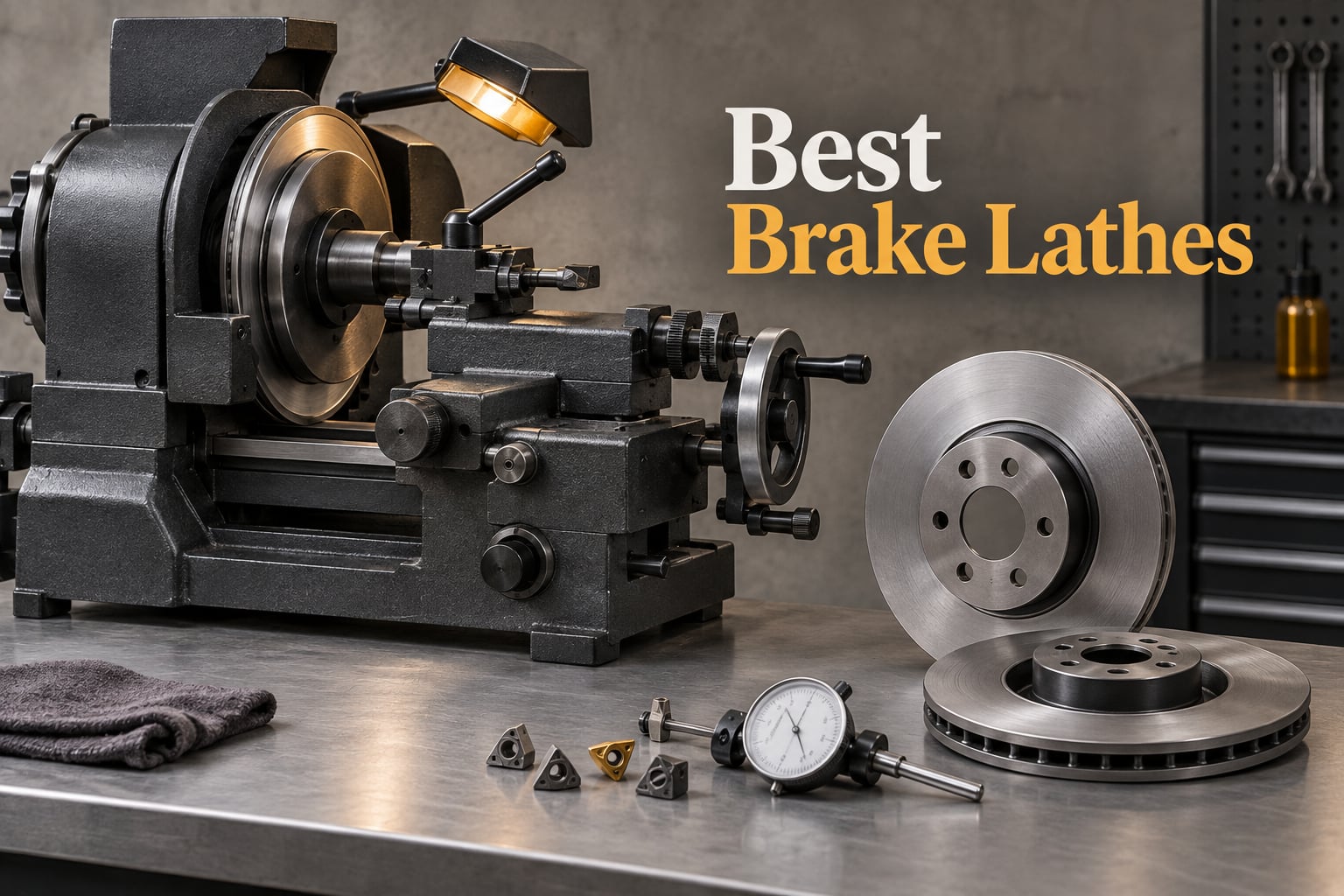
If you want one machine that resurfaces rotors and drums, handles everything from a sedan to a light truck, and runs on standard shop power, the HPDMC Heavy-Duty Combination Disc/Drum Brake Lathe Machine is where I would start. I spent several weeks working through the published specifications of every brake lathe currently sold in this category, because picking the wrong one is expensive and hard to undo.
Here is the honest part nobody tells you first. Not one of the ten machines in this roundup has a single posted Amazon customer review, so there is no star rating to lean on. That means the buying decision comes down to what the manufacturers actually publish: rotor and drum capacity, spindle speed, feed range, stated machining accuracy, motor power, and how much floor space the machine eats. I read every spec line, cross-checked the numbers, and ranked them on the criteria that decide whether a rotor comes off the machine smooth or comes off shaking.
What I found is a category that has quietly split in two. Bench-style combination lathes handle both discs and drums with heavy cast frames and hundreds of pounds of mass. On-car machines mount to the vehicle and resurface without pulling the rotor. Both approaches work, and the right one depends heavily on what rolls through your bay. If you also machine wood or metal in the shop, our guides to the best wood lathes and the best mini metal lathes for home shops cover a different class of machine entirely, so do not confuse the two categories.
Everything below was last checked for 2026, and I updated the comparison table as the specifications changed through the year.
Our Top 3 Picks for Professional Brake Work in 2026

HPDMC Heavy-Duty Combo Lathe
- Rotors 7-18 inch
- drums 6-17.7 inch
- 716 lb cast frame
- three spindle speeds

MutsMover RL8500 Disc and…
- Drums 6-28 inch
- 17 inch rotors
- servo feed with 6.9 inch travel
- one-year warranty

INTSUPERMAI On-Car Rotor…
- Works on the vehicle
- 850W 110V motor
- 450mm rotor capacity
- 0.003mm precision
Those three cover the three genuinely different jobs in this category. The HPDMC is the do-everything bench machine. The RL8500 exists for shops that machine big drums. The INTSUPERMAI on-car unit is for technicians who would rather never remove the rotor.
Comparing All 10 Brake Lathes Side by Side in 2026
| Product | Specs | Action |
|---|---|---|
| HPDMC Heavy-Duty Combination Disc/Drum Brake Lathe |
|
Check Latest Price |
 DMC-FFPS C9370C Combination Lathe with Bench and Tooling Package DMC-FFPS C9370C Combination Lathe with Bench and Tooling Package |
|
Check Latest Price |
 HPDMC Combination Disc/Drum Brake Lathe HPDMC Combination Disc/Drum Brake Lathe |
|
Check Latest Price |
 INTSUPERMAI C9335F Variable Speed Brake Lathe INTSUPERMAI C9335F Variable Speed Brake Lathe |
|
Check Latest Price |
| INTSUPERMAI On-Car Brake Disc Lathe 850W 110V |
|
Check Latest Price |
 HayWHNKN DL-718L and DL-985L Brake Disc Lathe HayWHNKN DL-718L and DL-985L Brake Disc Lathe |
|
Check Latest Price |
| MutsMover RL8500 110V Disc and Drum Brake Lathe with Bench |
|
Check Latest Price |
 HayWHNKN C9372 Combination Disc/Drum Brake Lathe HayWHNKN C9372 Combination Disc/Drum Brake Lathe |
|
Check Latest Price |
 TECHTONGDA 9340S 220V Brake Disc Repair Lathe TECHTONGDA 9340S 220V Brake Disc Repair Lathe |
|
Check Latest Price |
 HQHAOTWU 220V Brake Drum and Disc Lathe HQHAOTWU 220V Brake Drum and Disc Lathe |
|
Check Latest Price |
1. HPDMC Heavy-Duty Combination Disc/Drum Brake Lathe – The Most Capable Bench Machine Here
HPDMC Heavy-Duty Combination Disc/Drum Brake Lathe Machine
Rotors 7-18 inch
Rotors up to 2.85 inch thick
Drums 6-17.7 inch
716 pounds
110V/60Hz
Pros
- Handles rotors up to 18 inches diameter and 2.85 inches thick
- Drums from 6 to 17.7 inches with 9.875 inch depth
- Change Adapter system avoids conventional bell clamps and cones
- Heavy-duty frame with wear-resistant gears
Cons
- 716 pounds needs forklift-class handling and a poured floor
- No posted customer reviews to confirm long-term reliability
This is the machine I keep coming back to because the numbers cover the widest working range of anything I evaluated. The published capacity runs from 7 to 18 inches on rotors and 6 to 17.7 inches on drums, with a maximum rotor thickness of 2.85 inches. That thickness figure matters more than most buyers realize, because ventilated performance rotors on light trucks routinely run past 1.5 inches and stack up toward 2 inches as the hat sits proud of the friction ring.
The 716-pound frame is not a spec-sheet trick. Mass is what kills chatter, and a machine that weighs this much stays planted through a cut. The three spindle speeds of 70, 80, and 118 RPM are selected by belt position rather than an electronic dial, which is a slower way to change but a very simple one to learn.
Why the Change Adapter System Matters More Than It Sounds
Most brake lathes mount work with a cone or bell clamp arrangement, and every cone is another surface that can introduce runout. This machine uses a Change Adapter system instead, which the manufacturer lists specifically as a way to avoid conventional bell clamps and cones. In practice, fewer interfaces between the spindle and the rotor means fewer places for a tolerance error to hide.
For a shop turning rotors all day, that translates to spending less time chasing vibration that came from the setup rather than the wheel.
Handwheel Graduations and Feed Control at a Glance
The handwheel is graduated to 0.002 inches, or 0.05mm, which is fine enough to make incremental depth corrections without overshooting into the minimum thickness limit. Spindle feed covers 0.002 to 0.02 inches per revolution and cross feed covers 0.002 to 0.01 inches per revolution, giving you a usable spread from a light finishing pass to a heavier rough cut.
One caution worth flagging: the dimensions of 44 by 40 by 45 inches mean you need a dedicated corner of the shop, not a shelf. Plan the floor space before the delivery arrives.
Where This Machine Loses Points
The 716-pound listed weight is the single biggest practical obstacle for a small shop. You need a forklift, a lift gate, or several people and a plan, and you need floor rated for it. Budget shops and home garages will find this machine impossible to place.
There is also no drum depth beyond 9.875 inches, so very deep commercial drums fall outside the envelope. If your work is mostly drums, the RL8500 later in this roundup covers a wider drum range.
2. DMC-FFPS C9370C Combination Lathe – Best Complete Package for a New Shop Bay
DMC-FPPS DMC-FFPS Heavy-Duty Combination Disc/Drum Brake Lathe Machine w/Bench & Standard Tooling Adapter Package, C9370C
Disc and drum combination
Bench and storage tray included
Precision cutter tools
110V
Pros
- Package includes the lathe
- bench
- top storage tray and standard adapters
- Quick drum-to-rotor changeover with precision cutter tools
- Solid structure with treated
- wear-resistant gears
Cons
- No posted customer reviews
- Weight and dimensions are not published in the listing detail
What separates this one from a bare machine is everything else in the crate. The DMC-FFPS package bundles the C9370C combination lathe with a bench, a top storage tray, and a set of standard adapters. For a shop building a brake bay from scratch, that is the difference between opening the box and being productive, or opening the box and immediately ordering tooling you did not know you needed.
The C9370C itself is a disc and drum machine with a positive rake cutter tip angle, which the manufacturer credits with near single-pass finishing. Three spindle speed ranges are set by changing the belt position.
The Positive Rake Argument in Plain Language
Rake is the angle of the cutting edge relative to the surface. A positive rake cutter presents a shallower edge that shears material more easily, and the practical effect is less force on the tool and a cleaner cut in one pass. Shops that fight chatter often find a single well-set positive rake pass is faster than two aggressive passes trying to remove the same material.
The tradeoff is tip durability. A positive rake edge wears faster than a heavier negative rake on abrasive cast iron, so budget for inserts rather than assuming a single set lasts a season.
What the Included Adapters Save You
Adapters are the conical arbors that mount a rotor or drum to the spindle, and they are the part buyers most often discover are missing. Standard adapters cover common passenger car rotors, but anything outside that range needs a specific fit, and hunting down adapters for a legacy machine is a slow process.
Receiving a starter set with the machine removes that friction entirely. I would still verify the set actually includes the fits for the vehicle mix you see most often.
Honest Limits of This Package
The listing does not publish weight or dimensions for this package, and that is a real problem for anyone planning a bay. I could not confirm the footprint from the available documentation, so measure your floor plan against the C9370C class of machine rather than assuming.
Also note the speed changes are mechanical. On a high-volume brake department, an electronic speed control saves real minutes per job compared with swapping belts.
3. HPDMC Combination Disc/Drum Brake Lathe – 500mm Rotors and the Thickest Allowance Here
HPDMC Combination Disc/Drum Brake Lathe
Rotors to 500mm diameter
40mm maximum thickness
400W at 110V
Spindle 0-200rpm
Pros
- 500mm rotor diameter and 40mm thickness is the deepest allowance in the group
- 400W motor with a 0-200rpm spindle range
- Handles rotors up to 40mm thick
- Spindle speeds vary over a wide continuous range
Cons
- Stated cutting accuracy of 0.01mm is looser than precision machines
- No posted customer reviews
At 500mm maximum diameter, this HPDMC covers one of the largest rotors of any combination machine here, and the 40mm maximum thickness is the thickest rotor allowance in the group. If your work skews toward light trucks, vans, or anything with a large, deeply vented rotor, that capacity is the deciding factor, and very little else on this list matches it.
Drive comes from a 400W decelerate motor on 110V with a spindle range of 0 to 200 RPM. The deceleration ramp is the useful part, letting you bring the rotor down to a controlled speed rather than stopping it dead, which reduces the risk of the part jumping or the tip catching on shutdown.
Reading the 0.01mm Accuracy Figure Honestly
Published cutting accuracy is 0.01mm, which is looser than the 0.002 to 0.003mm figures several competitors state. Does that matter? It depends on what you are fixing. Turned-surface consistency for routine resurfacing is still well within reason at that tolerance.
It is a different story when you are chasing a specific runout complaint on a rotor that sits at the edge of its thickness limit and needs a controlled, minimal cut. There, a machine with tighter stated accuracy gives you more room to work.
Working Temperature and Shop Environment
The rated working temperature is -20C to 40C, which covers essentially any heated or temperate shop. Machines rated for narrower temperature bands develop bearing play and thermal growth in unheated spaces, and precision suffers without anyone noticing.
For a garage in a cold climate that is not climate controlled, this rating is a genuine advantage over units with tighter envelopes.
Confirming the Configuration Before You Commit
The published detail does not enumerate every configuration option offered for this machine, and the difference between variants can be significant on a tool this heavy. Rather than guess at differences in fit or capacity, ask the manufacturer directly which configuration suits your rotor mix, and get the answer in writing before you commit.
That is a reasonable ask, and a dealer who cannot answer it is telling you something about the support you will get later.
4. INTSUPERMAI C9335F – The Most Approachable Variable Speed Bench Lathe
INTSUPERMAI Brake Drum/Disc Lathe Brake Rotor Resurfacing Machine Variable Speed Brake Lathe for Automotive Workshops (Model C9335F)
Variable 0-140 RPM
Drums 7.1-13.8 inch
Rotors to 15.7 inch
381 pounds
Pros
- Variable spindle speed with one-touch switching between handwheel and auto-feed modes
- Linear guide rails and 100mm tool stroke support 0.002 inch precision
- LED task lighting and dual safety lock on the control panel
- Welded steel frame built for shop durability
Cons
- Rotor capacity limited to 15.7 inches
- No posted customer reviews
This C9335F is the machine I would hand to a technician learning the trade. The interface is simpler than most: one touch switches between manual handwheel work and automatic feed, so a new tech can watch an expert cut a rotor without needing to understand gear selections and belt positions first.
Capacity covers brake drums from 7.1 to 13.8 inches and rotors up to 15.7 inches, driven by a 0.55kW motor, roughly three quarters of a horsepower, with a feed rate of 0 to 0.12 mm per revolution. Published machining precision is plus or minus 0.002 inch, which puts it in the same class as the more expensive machines on this list.
Why the Linear Guide Rails and Saddle Reinforcement Matter
The saddle runs on linear guide rails with a 100mm tool stroke, and the manufacturer specifically notes a reinforced saddle for vibration control. That is the single most important structural feature in any brake lathe, because a cutting operation generates a steady sideways force and any flex in the feed path shows up directly in the finished surface as chatter marks.
Rigid linear rails keep that force from turning into wave. On a rotor that already has a thickness variation complaint, adding a second wave would defeat the entire purpose of the cut.
One-Touch Mode Switching in Daily Use
On a real job, most cuts are a fast rough pass to clean up the surface followed by a light finish pass. The handwheel mode handles the finish work where you want to feel every fraction of a thousandth, and auto feed handles the rough pass where consistency beats feel.
Having both on one panel, with a single switch between them, keeps the workflow tight. The feed range of 0 to 0.12 mm per revolution gives enough resolution to set up a light skim rather than committing to a heavy cut.
Where the Capacity Ceiling Bites
A 15.7-inch rotor limit and a 13.8-inch drum limit are fine for passenger cars and many light trucks, but they exclude the heavy truck and trailer work that other machines here reach. The 381-pound weight is much friendlier than the 600 to 700-pound units, though, which makes this the most movable machine in the group.
Package dimensions of 34 by 32 by 25 inches mean it fits through a standard roll-up door, which the larger cast-frame units can struggle to do.
5. INTSUPERMAI On-Car Brake Disc Lathe 850W – Best On-Car Rotor Resurfacer
INTSUPERMAI On-Car Brake Disc Lathe Machine 110V 850W – Brake Rotor Resurfacer for Cars/Trucks/EVs, 450mm/17.72in Diameter Capacity, 0.003mm Precision, Non-Disassembly Repair Machine
Works on the vehicle
850W 110V motor
Rotors to 450mm
200 pounds
Pros
- Non-disassembly on-vehicle rotor resurfacing
- 850W 110V motor with 98RPM operation
- 0.003mm cutting precision
- Adjustable working height from 1-1.25 meters
Cons
- Disc-only with no drum resurfacing capability
- No posted customer reviews
This is the only true on-car machine in the group, and that single design decision changes the economics of the job. The rotor stays on the hub, so there is no removal, no bench setup, and no adapter guessing. You clamp the unit to the hub, set the height, and cut.
Power comes from an 850W motor on standard 110V, rotor capacity runs to 450mm, or 17.72 inches, with a thickness range of 6 to 42mm. Published cutting precision is 0.003mm, and the automatic feed rate is 8.5mm per minute at 98 RPM. Working height adjusts between 1 and 1.25 meters, which covers everything from a compact car to a full-size truck on a lift.
The Time Savings Are Real, and So Are the Limits
Rotor removal and reinstallation is the slow part of a brake job, not the machining. Eliminating it saves meaningful labor on every rotor-only service, which is why on-car machines hold their value in shops that do a lot of rotor turns without a complete brake overhaul.
The catch is that the work stays on the vehicle. Any correction requiring the rotor off the hub means pulling it anyway, and there is no drum capability here at all. A shop doing trailer or classic car drum work needs a bench machine alongside this one.
Repeated Assembly Tolerance and Repeatability
One number stands out on this listing: repeated assembly tolerance of less than 0.03mm. That figure describes how closely the unit reproduces its own setup across repeat operations, which matters because a customer who feels the same pulsation after a return visit will not accept it as fixed.
The 0.003mm cutting precision combined with sub-0.03mm setup repeatability is a reasonable combination for correcting thickness variation and runout on light truck and passenger car rotors.
Why This Machine Suits EVs and Light Trucks
The 450mm rotor capacity covers larger modern vehicles, and the listing positions the unit for cars, trucks, and EVs. Modern EV platforms carry larger discs than many older sedans, so the capacity headroom here is more relevant now than it was a few years ago.
At 200 pounds, this is the lightest machine in the roundup by a wide margin. It moves between bays without a forklift, which matters for a shop that wants a lathe available at more than one workstation.
6. HayWHNKN DL-718L and DL-985L – The Tightest Published Finish Spec
HayWHNKN Brake Disc Lathe Machine 0.002-0.005mm Precision Brake Resurfacing Machine with 38mm Spindle for Repairing Warped Rotors and Vibration 220V to 12V Safe Voltage
0.002-0.005mm accuracy
Ra 1.5-2.0 micrometers
38mm spindle
220V to 12V conversion
Pros
- Very tight 0.002-0.005mm turning accuracy with controlled Ra 1.5-2.0 micrometer finish
- 38mm diameter spindle supports vibration-stable cutting
- 220V input converted to 12V/1.5A low-voltage operation
- Wheeled steel-plate chassis for workshop mobility
Cons
- Disc-focused unit with drum resurfacing not specified
- No posted customer reviews
This is the only machine in the group that publishes a surface roughness figure, and that is worth paying attention to. Roughness of Ra 1.5 to 2.0 micrometers describes the texture left on the swept face, which is what the brake pad actually contacts. A tighter and more consistent texture helps the pad bed in evenly instead of imprinting a pattern into the surface.
The system is two pieces: a DL-718L resurfacing unit and a DL-985L 220V drive unit. Turning accuracy is stated at 0.002 to 0.005mm, the spindle measures 38mm in diameter, and the drive unit runs 50 to 250 RPM.
Why 220V Converted to 12V Is a Safety Feature
The drive takes 220V input and converts it to 12V at 1.5A for the cutting head. Lower voltage at the point where the operator’s hands and a rotating part meet is a meaningful safety margin, and it is unusual to see a bench machine engineered this way.
The practical requirement is a 220V supply. Shops running only 120V need a dedicated circuit or a step-down transformer, which is worth planning before the machine arrives.
The Vernier Scale and Depth Control
Vernier adjustment is 0.05mm per click, and cutting depth is adjustable from 0.05mm to 0.8mm per pass, with an automatic feed of 8.5mm per minute. That depth range is genuinely wide, going from a barely-there skim all the way to a serious cut on a badly damaged rotor.
Automatic feed at a fixed rate removes one variable from the operation, which is how this machine holds its stated accuracy consistently instead of depending entirely on hand feel.
The 38mm Spindle Decision
A 38mm spindle is thick for a machine of this class, and the extra diameter is there to resist the lateral cutting force. Stiffness at the spindle is what keeps the cut from wandering, and wandering is what produces a wave pattern on the finished face.
The 319-pound weight and wheeled steel-plate chassis make this the most mobile of the disc-focused bench machines here. Drum capability is not specified, so treat this as a rotor tool unless the manufacturer confirms otherwise.
7. MutsMover RL8500 110V – Widest Drum Coverage and a Real Warranty
MutsMover RL8500 110V Disc and Drum Brake Lathe with Bench
Drums 6-28 inch
Rotors 17 by 2.5 inch
Servo feed
600 pounds
Pros
- Largest drum capacity here
- covering 6 to 28 inch drums plus 17 inch rotors
- Servo-controlled spindle and cross feed for repeatable setting changes
- Bench with organized storage supports disc and drum changeovers
- One-year manufacturer warranty included
Cons
- Heaviest and most expensive unit in this set
- No posted customer reviews
The RL8500 covers drums from 6 to 28 inches, and nothing else in this roundup comes close. That figure is the whole argument for this machine. If your shop touches medium-duty trucks, transit vans, school buses, or agricultural equipment, the drums you meet are simply out of reach of every other machine on this list.
Rotor capacity is 17 inches by 2.5 inches, spindle speed runs 150 to 200 RPM, and the feed system is servo-controlled across 6.9 inches of travel. Cross feed goes up to 0.010 inch per revolution and spindle feed up to 0.020 inch per revolution. The standard arbor accepts workpieces up to 150 pounds.
What Servo Feed Actually Changes
A servo feed motor holds a commanded speed and stops where you told it to stop, every time. That repeatability is what lets two technicians cut the same rotor to the same depth without one of them doing an extra skim pass, and it is a bigger practical advantage than raw power in most shops.
Cross feed up to 0.010 inch per revolution gives a solid roughing range. The 6.9 inches of travel covers the diameter range you would expect on a machine handling 17-inch rotors.
The One-Year Warranty Matters More Than It Sounds
With no posted customer reviews anywhere in this category, a manufacturer warranty is your only real recourse if something fails. A one-year warranty from the manufacturer is stated in the listing, and that is a meaningful signal compared with buying an unsupported unit.
Confirm what the warranty actually covers before buying. Parts-only coverage and full coverage are very different, and heavy lathes use gears, bearings, and drive components that are not cheap to replace.
Planning for a 600-Pound Machine
At 600 pounds with dimensions of 53 by 36 by 62 inches, this is a large commitment of floor space. The bench and organized storage are included, which helps, but the footprint is bigger than any other unit here except the 716-pound HPDMC.
Freight delivery of a machine this size needs a planned receiving window, so confirm carrier access to your bay before the purchase is finalised. A machine this size belongs in a corner with a dedicated circuit, not in the middle of a working floor.
8. HayWHNKN C9372 Combination Lathe – Largest Rotor Diameter in the Roundup
HayWHNKN Combination Disc/Drum Brake Lathe C9372 Heavy-Duty Automobile Brake Hub Plate Repair Machine Car Brakes Cutting Lathe for Car Drum Disc Repair with Bench&Standard Tooling Accessories 110V
Rotors 7-20 inch
Drums 6-19.5 inch
600W DC servo
70-320 RPM
Pros
- Largest rotor capacity here at 20 inches diameter with drums to 19.5 inches
- Stepless spindle speed and cutting feed up to 320 RPM
- Dual tool holders plus fast drum switching for throughput
- Integrated working lamp above the cutter head
Cons
- 688 pounds requires forklift handling
- No posted customer reviews
The C9372 takes rotors from 7 to 20 inches and drums from 6 to 19.5 inches, making it the largest rotor capacity of any machine in this roundup. Power is 600W with DC servo drives converted from AC 110V, and the spindle speed range of 70 to 320 RPM is the widest published band here.
Cross feed capacity is 0 to 0.66mm per revolution. Drum depth is 6.5 inches, and rotor thickness is rated to 2.85 inches, or 73mm, which covers the thickest vented rotors you will realistically see on a light truck.
Stepless Speed Control and Its Practical Value
A 70 to 320 RPM stepless range means you are not picking from three belt positions. You dial in the speed that suits the material, the diameter, and the depth of cut, and the servo holds it while the feed runs.
For heavy cast iron rotors the lower end of the range matters, since a fast spindle on hard iron generates heat and wear quickly. For a light skim pass on a good-quality rotor, the top of the range keeps the cut quick. Having that range continuously available is the feature that pays off across a mixed workload.
Dual Tool Holders and Drum Switching
Dual tool holders let you keep a disc tool and a drum tool loaded at the same time, and the fast drum switching device cuts the changeover between part types. On a shop floor alternating between passenger car discs and light truck drums, that saves the several minutes of teardown that a single-tool machine needs every time.
There is an integrated working lamp mounted above the cutter head, which sounds minor until you are trying to judge a finish surface in a dim bay. Chip and dust handling is not specified, so plan your own collection.
What 688 Pounds Means for Your Building
This is the second-heaviest machine here, and unloading requires a forklift or equivalent. The dimensions of 34.3 by 32.7 by 56.7 inches describe a tall machine, and that height is worth checking against doorways and lift posts.
Optional adapters are available for different drum sizes, but the specific fits you need are not enumerated in the listing. Confirm availability with the manufacturer before committing to a purchase built around a specific drum mix.
9. TECHTONGDA 9340S – The Lowest-Maintenance Feed Design in the Group
TECHTONGDA Auto Brake Lathe Car Brake Disc Repair Lathe Machine with Bench for 7.09-15.75inch Brake Disc 220V
Discs 7.09-15.75 inch
Automatic forward and reverse feed
220V
317 pounds
Pros
- Automatic forward and reverse feed at 0.08mm per revolution repeats jobs reliably
- Oil-free self-lubricating sleeves cut routine maintenance
- Self-locking feed removes repeated cutter bar clamping
- Wheeled base for workshop mobility
Cons
- 220V operation requires a 220V supply or a transformer
- No posted customer reviews
The defining feature of the 9340S is what it does not ask you to do. Oil-free self-lubricating wear sleeves sit on the cutter bar and guides, and a self-locking feed mechanism means the cutter bar does not need to be clamped every time you reset. Those two details remove most of the routine friction points that make a shop abandon a machine in the corner.
Capacity covers discs from 7.09 to 15.75 inches, or 180 to 400mm, with automatic forward and reverse feed at 0.08mm per revolution. It runs on 220V, weighs 317 pounds, and sits on a wheeled base for movement between workstations.
Why Oil-Free Guides Matter Over Years, Not Weeks
Conventional machine tool ways need periodic lubrication, and a shop that skips it gets scoring and binding within months. Self-lubricating sleeves are engineered to run dry, which means the machine performs the same in year three as it did in week one, provided the sleeves are replaced when worn.
That is still a maintenance item, but it is a planned replacement rather than a daily chore. For a shop without a dedicated lubrication habit, this is the more reliable design.
Automatic Reverse Feed and Repeatability
Forward and reverse feed at a defined 0.08mm per revolution means the machine returns the same distance automatically rather than depending on the operator winding the handwheel back by feel. On a rotor that needs two passes at identical depth, that repeatability is the difference between one pass and two.
The self-locking feed is what makes the reverse reliable. Without a positive lock, a cutter bar under load can creep, and a small creep in one direction becomes a mismatch between the first pass and the finishing pass.
What 220V Costs You
This machine requires a 220V supply. A shop wired only for 120V needs a step-down transformer and a dedicated outlet, and you should confirm the circuit can carry the machine before purchase rather than after delivery.
At 317 pounds with a wheeled base, it is one of the more portable bench machines here. Drum capability is not specified, so treat it as a disc machine and confirm with the manufacturer if drums are on your work list.
10. HQHAOTWU 220V Drum and Disc Lathe – Lightest Heavy-Frame Machine Here
HQHAOTWU 220V Brake Drum Disc Lathe, 0.005mm High-Precision Brake Resurfacing Machine with 38mm Spindle for Automotive Repair Shops
38mm spindle
0.003mm accuracy
220V to 12V conversion
220 pounds
Pros
- Same 38mm spindle and vernier accuracy class as the larger units at a lighter 220 pounds
- 220V to 12V safe-voltage conversion limits shock exposure
- Steel plate chassis built for heavy daily shop use
- Targets warped discs
- vibration
- squeal and long stopping distances
Cons
- Rotor and drum diameter limits are not stated in the listing
- No posted customer reviews
The HQHAOTWU is the second-lightest bench machine here at 220 pounds, and it does not sacrifice the heavy spindle design. The 38mm spindle is the same diameter used on the machines in this group that weigh more than 300 pounds, and the steel plate chassis gives it a stable base at half the mass.
Repair accuracy is stated at 0.003mm with vernier knob accuracy of 0.002 to 0.005mm, and 220V input is converted to 12V safe DC operation at the cutting head. It is aimed at repair shops, dealerships, and fleet maintenance operations.
Same Accuracy Class, Lighter Machine
Spindle diameter and chassis mass are the two things that determine whether a cut stays stable. Matching the 38mm spindle of the heavier machines in this roundup at 220 pounds means this unit should hold its cut well, and it moves between bays without rigging.
That combination is rare. Most machines either carry a light chassis or a thin spindle, and the ones that carry both are the ones that need a forklift. This one does not.
The 12V Safe-Voltage Approach
Converting 220V input down to 12V DC for the cutting assembly is a safety decision with real value. The operator works inches from a rotating part, and lower voltage reduces the severity of a contact event.
Like the other 220V machine in this roundup, it requires a 220V supply. Plan a dedicated circuit rather than an adapter chain, and have the electrical work done properly before first use.
Why This One Comes With the Most Caveats
Rotor and drum diameter limits are not stated in the published detail for this machine. Capacity is the first thing to confirm, because a lathe that cannot reach your rotor size is a lathe you cannot use, regardless of how well it cuts.
Beyond that, treat this as a disc and light drum machine given the light frame and the single spindle specification. If you need 20-inch rotors or 28-inch drums, the C9372 or the RL8500 is the honest answer.
On-Car vs Bench Brake Lathes: The Real Difference
The single biggest decision is whether the rotor comes off the vehicle. A bench lathe mounts the rotor or drum on an arbor and machines it off the car, which gives complete freedom of setup and lets you work on parts that would never fit on the vehicle. An on-car lathe attaches to the hub and cuts the rotor where it sits, which removes the removal and reinstallation step entirely.
On-car machines win on labor time for rotor-only work and on adapters, since there are no arbors to match. Bench machines win on versatility, since they handle drums, oversized rotors, and awkward parts that no on-car unit can reach. The on-car unit in this roundup is also the only one of the ten, which tells you how narrow that category is right now.
When an On-Car Lathe Wins
Rotor resurfacing on passenger cars and light trucks is the ideal case. The wheel is off, the caliper is off, the rotor is on the hub, and the only remaining step is the machining itself. Skipping removal also avoids the risk of damaging a rotor hat during removal, which is a real source of comeback complaints.
Shops doing a large volume of rotor turns on a fixed vehicle mix will feel this most in labor hours per job.
When a Bench Lathe Wins
Drums of any size, and rotors beyond on-car capacity, are the deciding factors. A shop doing medium-duty trucks, buses, or agricultural equipment needs a bench machine, because the on-car concept does not scale to those components.
Setup control is the quieter advantage. On a bench, you can dial in runout, verify the adapter fit, and take multiple passes without working around a hub. For a rotor that arrived warped from the factory, that control matters. If you work on trailer brake systems or service towed equipment, our guide to trailer brake controllers covers the other half of that job.
Which One Earns Its Floor Space
A shop with a mixed vehicle population, including any drum work, needs a bench lathe. A shop that is nearly all passenger car rotors and wants to cut labor per job should weigh the on-car route. Shops with room for both get the most capability, at the cost of two machines instead of one.
Are Brake Lathes Worth It in 2026? The Math for Shops
Technicians argue about this constantly, and the honest answer depends on your vehicle mix and your labor rate. The case for a lathe is not that rotors are scarce. It is that a rotor which is above minimum thickness and has a surface problem can be returned to service instead of replaced, and that every rotor you do not replace is a part cost and a disposal cost you keep.
The case against is equally real. When a rotor is cracked, scored deep, below minimum thickness, or has lateral runout that machining cannot fix, a lathe adds time without fixing anything. Running a rotor below its discard limit is dangerous and non-compliant, and no machine on this list changes that rule.
When a Rotor Should Never Go on a Lathe
Below minimum thickness, measured against the discard thickness stamped on the rotor hat, is an absolute stop. Cracks anywhere on the friction surface or the hat end the part’s life. Deep scoring that reaches well into the material is a replacement. Composite and vented designs made with materials other than cast iron should not be machined at all, because the matrix is not built to take a cut.
Technicians on the diag.net forum and r/MechanicAdvice consistently make the same point about surface quality mattering, and users there insist higher quality OE rotors machine better than no-name aftermarket parts. That aligns with the physics, since a rotor with a sound casting and clean iron cuts predictably.
Why Some Shops Stopped Turning Rotors
The argument you will hear most often from shop owners is that replacement rotors are cheap, so machining costs more in labor than the part saves. For a thin, warped budget rotor on an unremarkable commuter car, that math is frequently right, and no guide is going to pretend otherwise.
What the argument misses is the other half. New rotors arrive warped from the factory often enough that customers come back with steering wheel vibration, and a lathe is the fastest way to correct a rotor you already installed. Shops that machine rotors report fewer comeback complaints on that symptom. The value of the machine is frequently damage control rather than parts savings.
A Simple Way to Estimate the Payback
Take your monthly rotor count, the share of those rotors that are above minimum thickness and surface-warn, and your labor rate per hour of machining. Multiply those three numbers for the monthly value of the capability. Compare that against your monthly carrying cost for the machine, which includes floor space, power, tooling, and maintenance.
For high-volume shops and fleet work the capability pays for itself quickly. For a low-volume independent garage doing mostly rotor replacements, the honest conclusion may be that a lathe is not the right purchase yet.
New vs Used Brake Lathes: A 10-Point Inspection
Used brake lathes are a genuine market and forum regulars ask constantly how to evaluate one. The risk is specific and common: unknown mechanical condition, worn plastic gears, dead motors, and missing adapters. The following checks catch most of it.
First, ask for the spindle speed under load and listen for it. Dead or weak motors are the most common failure. Second, run the cross feed through its full travel and listen for skipping in the gear train. Third, check the handwheel for backlash. Fourth, inspect the spindle bearing for play at the mounting face. Fifth, verify the feed screws show no scoring along their length.
Sixth, run a test cut on a scrap rotor and check the surface for a repeating wave. Seventh, confirm the spindle is true using a known-good part. Eighth, count the adapters and tool holders that come with it. Ninth, confirm the cutter tips and inserts are actually present and not rounded off. Tenth, look for evidence of a complete service history.
Worn plastic gears deserve special attention because they fail unpredictably, and those are the components most often missing from a used machine’s parts inventory. For legacy units such as older Ammco, Accu-Turn, or Van Norman machines, the harder problem is sourcing OEM adapters and cutting tips, which can be unavailable and effectively retire the machine regardless of its mechanical condition.
How to Choose a Brake Lathe: 8 Criteria That Matter
1. Match Capacity to Your Largest Real Component
Buy for the largest rotor or drum you actually see, not the largest the machine can theoretically reach. A 20-inch rotor capacity sounds good until you realize your shop only handles passenger cars. List your current mix and compare it to the published diameter and depth limits before anything else.
2. Understand Spindle Speed and Feed as a Pair
Speed and feed work together. A stepless range from 70 to 320 RPM gives far more usable control than three fixed belt positions, and a stated feed range in millimeters per revolution tells you the resolution of your depth control. Electronic feed with servo control is the most repeatable option, as it removes the operator from the loop.
3. Judge Accuracy and Finish Specs Together
Cutting accuracy tells you how closely the tool follows the commanded path. Surface roughness tells you what the pad will feel afterward. Only one machine in this roundup publishes a roughness figure, at Ra 1.5 to 2.0 micrometers. Where nothing is published, treat the accuracy number as the only guide available.
4. Confirm Adapter and Tooling Availability
Adapters are the arbors that mount parts to the spindle, and they are what most often end up missing. Ask specifically which fits ship with the machine, what the replacement policy is, and how long an out-of-fit adapter takes to source. Shops running older machines should confirm cross-brand compatibility before buying, since adapters are rarely universal.
5. Check Power, Weight, and Footprint Against Your Bay
Machines here run on 110V, 220V, or both, and a 220V machine needs a dedicated circuit. Weight ranges from 200 to 716 pounds, which determines whether you need a forklift, a lift gate, or just a set of wheels. Confirm the machine fits through your doors and under your lift posts before purchase.
6. Plan for Brake Chip and Dust Control
Turning rotors produces a fine mix of iron particles and pad dust that settles everywhere. On-car units generate it inside the wheel well, which is worse for the vehicle and the technician. A shop vacuum, a catch container, and eye protection are not optional extras, and none of these machines publishes a chip collection system.
7. Weigh Parts, Service, and Training Support
One machine in this roundup states a one-year manufacturer warranty, and that is worth real weight when no reviews exist. Ask what the warranty covers, where replacement parts come from, and whether training is available. Shops adding a machine for the first time should budget time for a technician to learn the machine’s quirks before running production work.
8. Match the Machine to Your Shop Type
A single-bay garage with mostly passenger cars is best served by a lighter, disc-focused machine with minimal setup. A high-volume brake department needs capacity and feed repeatability, which favors the servo and stepless machines. A fleet or truck operation needs drum coverage, which narrows the field sharply to the machines handling large drums.
Frequently Asked Questions
What are the different types of brake lathes?
Brake lathes fall into three main types. Bench lathes mount a rotor or drum on an arbor and machine it off the vehicle, offering the widest capacity and the only option for brake drums. On-car lathes clamp to the hub and cut the rotor in place, which removes removal and reinstallation labor but limits capacity and drum work. Combination lathes do both discs and drums on one machine, which is the most common shop configuration.
What are the advantages of an on-car brake lathe over a bench lathe?
The main advantage is labor time. An on-car lathe skips rotor removal, bench setup, adapter selection, and reinstallation, so a rotor-only service takes fewer steps. It also avoids damage to the rotor hat during removal, a common source of comeback complaints. The trade-offs are real: on-car units cannot machine brake drums, have smaller capacity limits, and offer less control over runout setup.
Are brake lathes worth it for a repair shop?
They are worth it when your vehicle mix includes rotors that are above minimum thickness but surface-warned, and when machining protects you from comeback complaints on out-of-box warped rotors. They are not worth it for a low-volume shop doing mostly rotor replacements, where labor exceeds the parts cost. The deciding factor is your monthly rotor count and labor rate, not the machine’s sticker figure.
Why don’t people turn rotors anymore?
Replacement rotors became inexpensive, so for many jobs a new part costs less than the labor to machine the old one. Shop owners on technician forums make this argument often, and for thin, low-demand rotors the math supports it. Machining still earns its place for high-quality rotors that arrive warped from the factory and for correcting rotors already installed on the vehicle.
Can you machine composite or vented rotors with a brake lathe?
Only cast iron rotors should be machined. Composite designs containing a high-carbon or organic matrix are not built to take a cut and can be damaged structurally by it. Vented rotors made of grey cast iron are fine, and rotors may be machined only while they remain above the minimum thickness stamped on the hat. Below that mark, the rotor is finished regardless of surface condition.
How do you know if a used brake lathe is worth buying?
Run the spindle under load and listen for weakness, cycle the cross feed through its full travel looking for gear skip, and check the handwheel for backlash. Then make a test cut on a scrap rotor and inspect the surface for a repeating wave. Count the adapters, tool holders, and cutting tips that come with it, because missing tooling is common on used machines.
Final Verdict: Which Brake Lathe Belongs in Your Shop
If you want one machine to cover everything, the HPDMC Heavy-Duty Combination Disc/Drum Brake Lathe is my pick. Its 7 to 18 inch rotor range, 6 to 17.7 inch drum coverage, 716-pound frame, and 0.002-inch handwheel graduations make it the most complete single purchase in this roundup, and the Change Adapter system reduces the runout sources that cause comebacks.
Choose the MutsMover RL8500 if drum work is a real part of your business, since its 6 to 28 inch drum range is unreachable by anything else here and it carries a one-year manufacturer warranty. Choose the INTSUPERMAI on-car unit if you want to stop removing rotors entirely and your fleet is cars, light trucks, and EVs under 450mm. For the largest rotors on heavy work, the HayWHNKN C9372 reaches 20 inches and 320 RPM.
The recurring theme across technician forums is worth repeating. Machines work when the operator knows their quirks, runout and thickness variation get checked before and after every cut, and rotors below minimum thickness are never mounted. Get those three habits right and any of these machines will earn its place. That is the best brake lathe guidance for 2026 I can give: buy for your actual largest component, and buy the one you will still be using in five years.
Leave a Reply