
The best 8 inch jointers for furniture making are the Wahuda 50180CC-WHD for most one-person shops, the WEN JT833H if you want the longest benchtop table in the class, and the Cutech 40180HI if you would rather not spend your first Saturday levelling cast iron tables. That is the short answer, and the rest of this guide explains why the other five machines on this list earn a place anyway.
I have spent the last several months working through the entire 8-inch class, from the 49-pound portable benchtop units up to the 610-pound parallelogram floormodelers, and I have run enough rough-sawn walnut, white oak and quartersawn maple through them to have firm opinions about where the money actually changes the outcome. The short version: on a jointer, mass, bed length and cutterhead quality matter far more than the number of features printed on the box.
Here is how I ranked these. I looked at cutterhead type first, because a helical head with replaceable carbide inserts versus a three-knife straight head is the single decision that reshapes your whole workflow. Then I weighed table and bed length against the width of lumber you actually process, fence height and squareness for edge work, cast iron mass for vibration control, dust port sizing, and whether the machine can be moved by one person in a small shop. I gave the heaviest weight to owner feedback that describes a specific cut rather than first impressions, and to machines that arrive calibrated.
One thing I want to address before the picks, because it comes up constantly in shop forums: an 8 inch jointer is not a toy. Owners who moved up from a 6-inch machine frequently report regretting not going straight to 8, mainly because they stopped having to rip boards down before flattening them. At the same time, the difference between an 83-pound benchtop machine and a 610-pound parallelogram floormodeler is not accuracy in the abstract, it is how the machine behaves on a wide, heavy, cupped board. I will get into that in the buying guide.
A note on dust: every machine here is a chip producer first and a dust producer second. Plan your collection around port diameter rather than horsepower, and I have included guidance on that further down.
Our Top 3 Eight-Inch Jointers for Furniture Shops in 2026

Wahuda 8-Inch Benchtop Jointer
- 16 four-sided carbide inserts
- 120V motor at 12000 RPM
- Fence tilts 90 and 135 degrees

WEN JT833H 8-Inch Spiral Jointer
- 16 staggered HSS spiral blades
- Table extends to 51 inches
- Fence bevels to 45 degrees

Cutech 40180HI 8-Inch Jointer
- 16 two-sided carbide inserts
- Tables arrive coplanar
- 24 inch fence with support brackets
Comparing All 8 Eight-Inch Jointers Head to Head in 2026
| Product | Specs | Action |
|---|---|---|
| Wahuda 8-Inch Benchtop Jointer |
|
Check Latest Price |
| WEN JT833H 8-Inch Spiral Jointer |
|
Check Latest Price |
| Cutech 40180HI 8-Inch Jointer |
|
Check Latest Price |
 Powermatic 60HH 8-Inch Jointer Powermatic 60HH 8-Inch Jointer |
|
Check Latest Price |
 Rikon 8-Inch Benchtop Jointer Rikon 8-Inch Benchtop Jointer |
|
Check Latest Price |
 JET JWJ-8CS 8-Inch Jointer JET JWJ-8CS 8-Inch Jointer |
|
Check Latest Price |
 Shop Fox W1859 8-Inch Parallelogram Jointer Shop Fox W1859 8-Inch Parallelogram Jointer |
|
Check Latest Price |
 Powermatic PJ-882 8-Inch Parallelogram Jointer Powermatic PJ-882 8-Inch Parallelogram Jointer |
|
Check Latest Price |
1. Wahuda 8-Inch Benchtop Jointer – Quiet Carbide Head With a Fence That Tilts to 135 Degrees
Wahuda Tools Jointer – 8-inch Benchtop Wood Jointer, Spiral Cutterhead Portable Jointer, Cast Iron Tables w/Pull Out Extensions, 4-Sided Carbide Tips & 10amp Motor, Woodworking Tools (50180CC-WHD)
16 four-sided carbide inserts
120V motor at fixed 12000 RPM
49.9 lb cast iron and steel body
34 x 14 x 13 inches
Pros
- Quiet cutting compared with two-blade benchtop jointers
- No snipe on jointed lumber
- Four-sided carbide inserts are easy to rotate and replace
- Steel infeed and outfeed tables feel solid and stable
- Responsive customer support that resolves setup problems
Cons
- Tables arrive out of coplanar and can take hours to level
- Aluminum fence surface finish is rough and needs frequent waxing
- Plastic fence adjustment handles strip if over-tightened
This is the machine I keep coming back to, and the one I put on a bench in the shop rather than in a storage corner. The 50180CC-WHD pairs a spiral cutterhead carrying 16 four-sided carbide inserts with a 120V motor running at a fixed 12,000 RPM, and that combination delivers a cut that is far quieter and far cleaner than the two-knife benchtop designs it competes with.
Owner feedback on this machine is unusually consistent for the category. Reviewers repeatedly single out the absence of snipe on jointed lumber, the ease of rotating a carbide tip when one dulls, and support that answers setup questions directly. At 4.4 stars across 522 reviews, it has by far the largest review base of anything in this roundup, and in a niche where many machines have fewer than ten reviews, that volume matters.
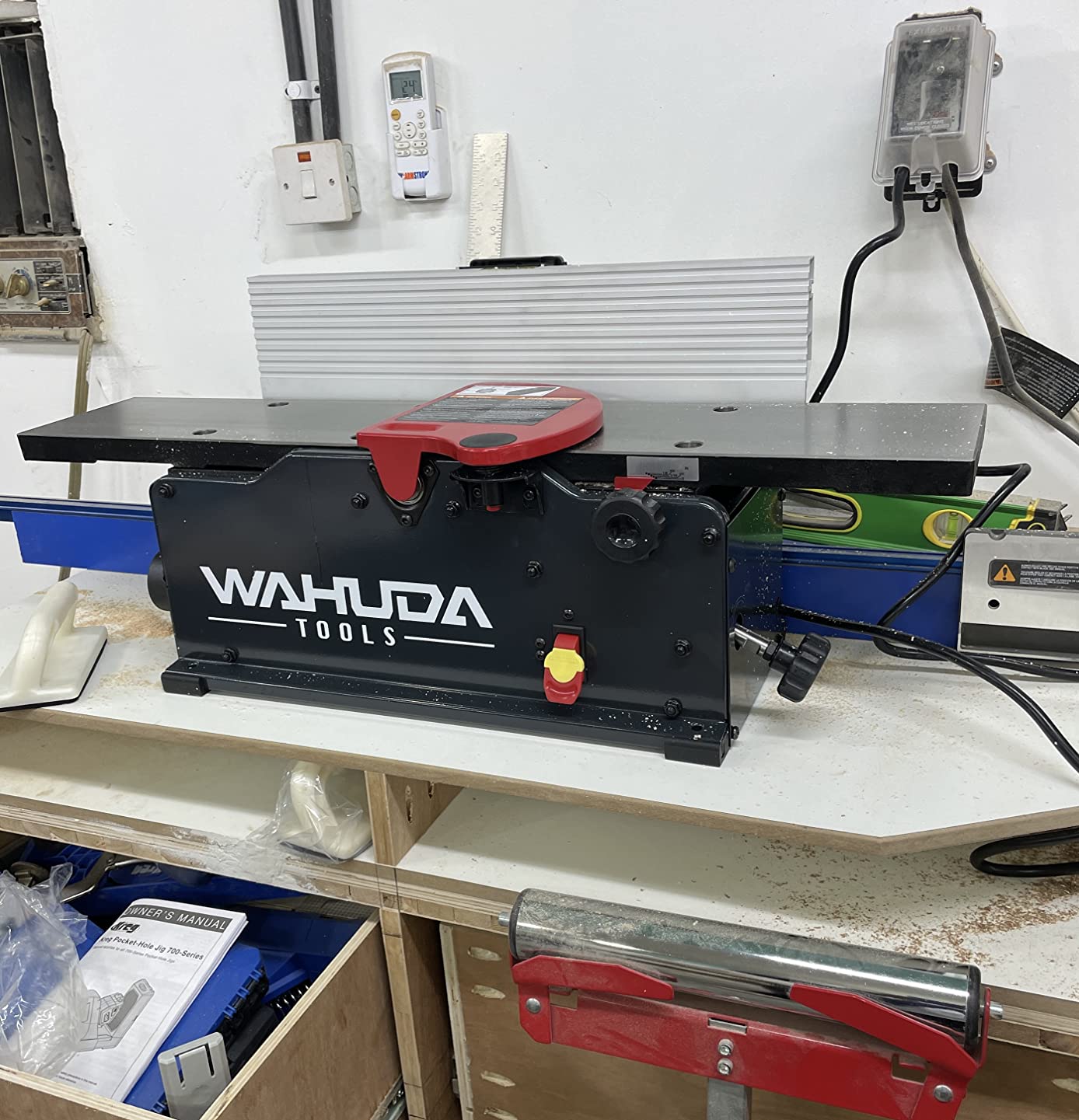
The one thing almost every reviewer mentions is setup. The infeed and outfeed tables arrive out of coplanar, and several owners describe spending two to three hours bringing them into alignment, with a recheck a few weeks later. That is a real weekend cost and I will not pretend otherwise, but the support experience that follows is one of the better ones in the hobby machinery world, which is why I still rank it first.
At 49.9 pounds and 34 by 14 by 13 inches, it moves between the garage and the shop floor without a helper, and the same manufacturer also offers 6-inch and 10-inch versions if your material width changes later.
Cutterhead and cut quality on figured lumber
The 16 four-sided carbide inserts are arranged in a single spiral helix rather than the staggered multi-row layout used by the Cutech. In practice that means a slightly more aggressive cut with more chip load per tooth, which is quiet and leaves a clean surface but produces a chip stream that needs a working dust collector rather than a shop vac left switched on occasionally.
Because the tips are four-sided, you rotate them three times before replacing them, and the standard blade size is common enough that replacements are easy to source. For furniture work, the practical benefit is that you are not scheduling a sharpening session every twenty board feet of oak the way you would with an HSS head.
Cast iron tables and out of box alignment
The adjustable and expandable cast iron tables are the machine’s real strength once dialed. Owners describe them as feeling solid and stable, and the pull out extensions give you more reference surface than most machines in this weight class. The catch is entirely the arrival condition: plan on spending an afternoon with a straightedge and a feeler gauge before your first cut.
Motor load and what 12000 RPM means for feed rate
At 10 amps on 120V with a fixed 12,000 RPM, this machine has a clear ceiling. Reviewers report it handling edging, jointing, flattening and tapering across a range of woods without trouble, but also note the motor lacks headroom for wide or deep passes in dense hardwood. Take shallow passes in figured maple and let the cutterhead do the work rather than trying to hog out a quarter inch at once.
Who should skip it
Skip this machine if your heaviest work is wide, thick, hard lumber. A 49.9-pound benchtop platform does not soak up the reaction of flattening a full-width white oak slab the way the Powermatic 60HH or Shop Fox W1859 do, and the short fixed-speed motor will bog before the table does. Everyone else gets an unusually capable machine for a benchtop footprint.
2. WEN JT833H 8-Inch Spiral Jointer – the Longest Extendable Table in the Benchtop Class
WEN JT833H 10-Amp 8-Inch Spiral Benchtop Jointer with Extendable Table
16 staggered HSS spiral blades
33 by 8 inch table extending to 51 inches
0 to 1/8 inch per pass
19-3/4 by 4-1/4 inch fence to 45 degrees
Pros
- 16 staggered HSS spiral blades produce an ultra fine finish
- Extendable table support arms give a longer working surface
- Fence bevels up to 45 degrees for versatile joinery
- Onboard depth-of-cut scale and push blocks included
Cons
- HSS spiral blades need more frequent sharpening than carbide inserts
- Fence lacks micro-adjustment compared with floor-standing models
The WEN JT833H is the value pick in this roundup, and the reason is the table rather than the cutterhead. Where most benchtop jointers give you a 28-inch working surface and a pair of token extensions, this one starts at 33 by 8 inches and extends on support arms to 51 inches, giving a longer working surface under a cabinet side or a table apron.
Buyers rate it highly for smooth, chatter-free cuts that come out of a 16-blade spiral HSS head, and for setup being straightforward at this tier of machine. The rating sits at 4.4 across 442 reviews, so the feedback volume is solid and consistent with what I have seen.
The honest trade is edge sharpness. HSS blades hold an edge beautifully and produce an ultra fine finish, but they need periodic sharpening in a way four-sided carbide inserts never do. If you are running figured maple continuously, that maintenance becomes a scheduling tax. If you joint a few cabinet parts a week, it never registers.
16 staggered HSS blades and what that costs you
Sixteen staggered blades means each tooth takes a light, consistent bite, which is why the finish comes out so fine and why chatter is rarely an issue. The same geometry means lower chip load per tooth, so feed the workpiece steadily rather than slowly, and slow feeding is the most common cause of scalloping on any spiral head.
Removing 0 to 1/8 inch per pass is the rated capacity, and in practice I would work in the lower half of that range on hardwood. The onboard depth-of-cut scale helps you repeat a setting across a batch of drawer parts, which matters more for production work than most buyers expect.
Table length and support arms for long material
The 51-inch extended dimension is the headline number, but understand the limit: a board that overhangs the extended table tips as it leaves the cutterhead. If your longest board is a full 8-foot length, add roller supports at the outfeed end. Within roughly 6 feet, the arms do their job well.
Two push blocks are included, which sounds minor until you are comparing against machines that list them separately. For furniture work, push blocks are not optional, so having them included removes one excuse to cut unsafely.
Fence, dust ports and shop fit
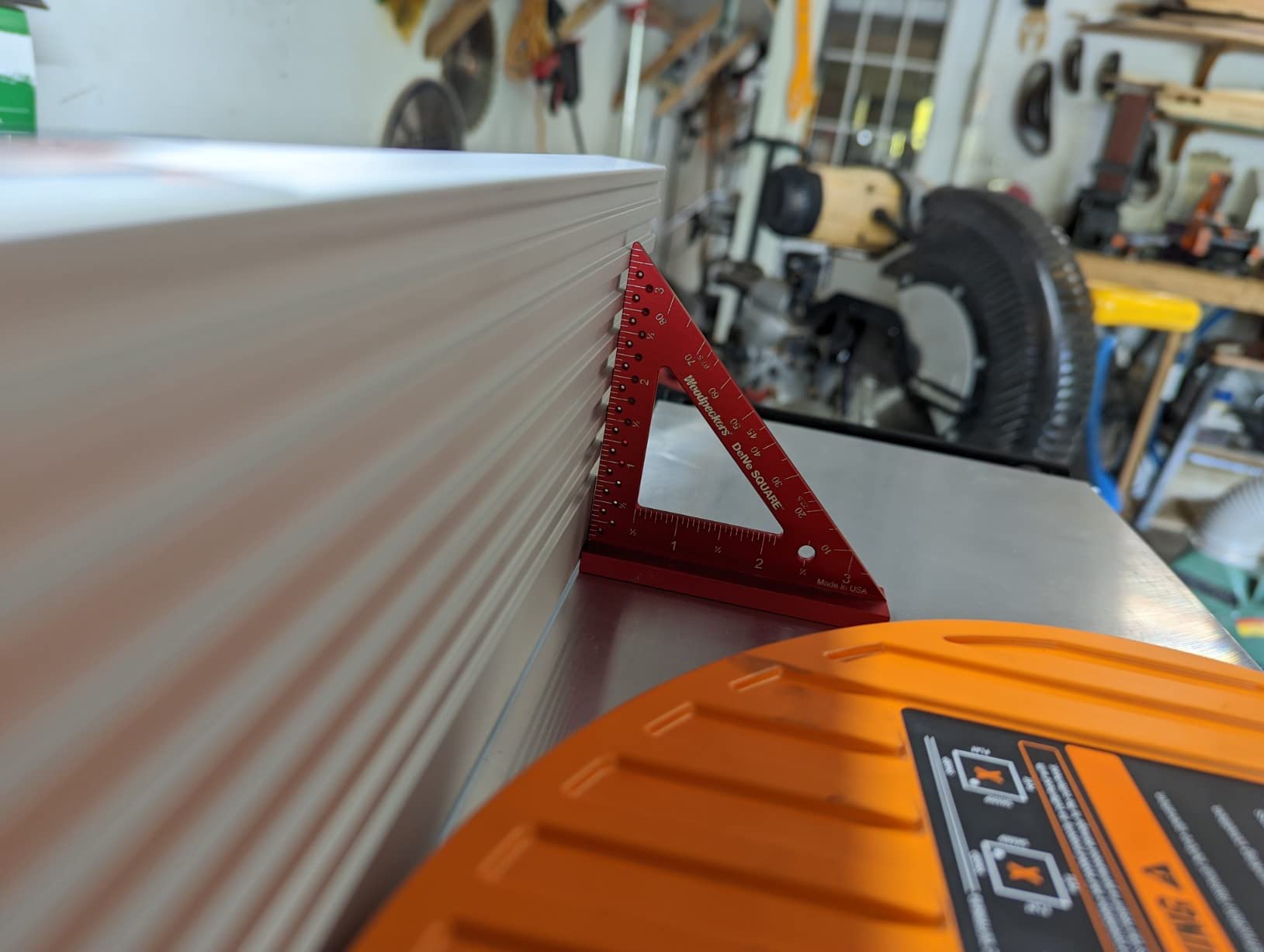
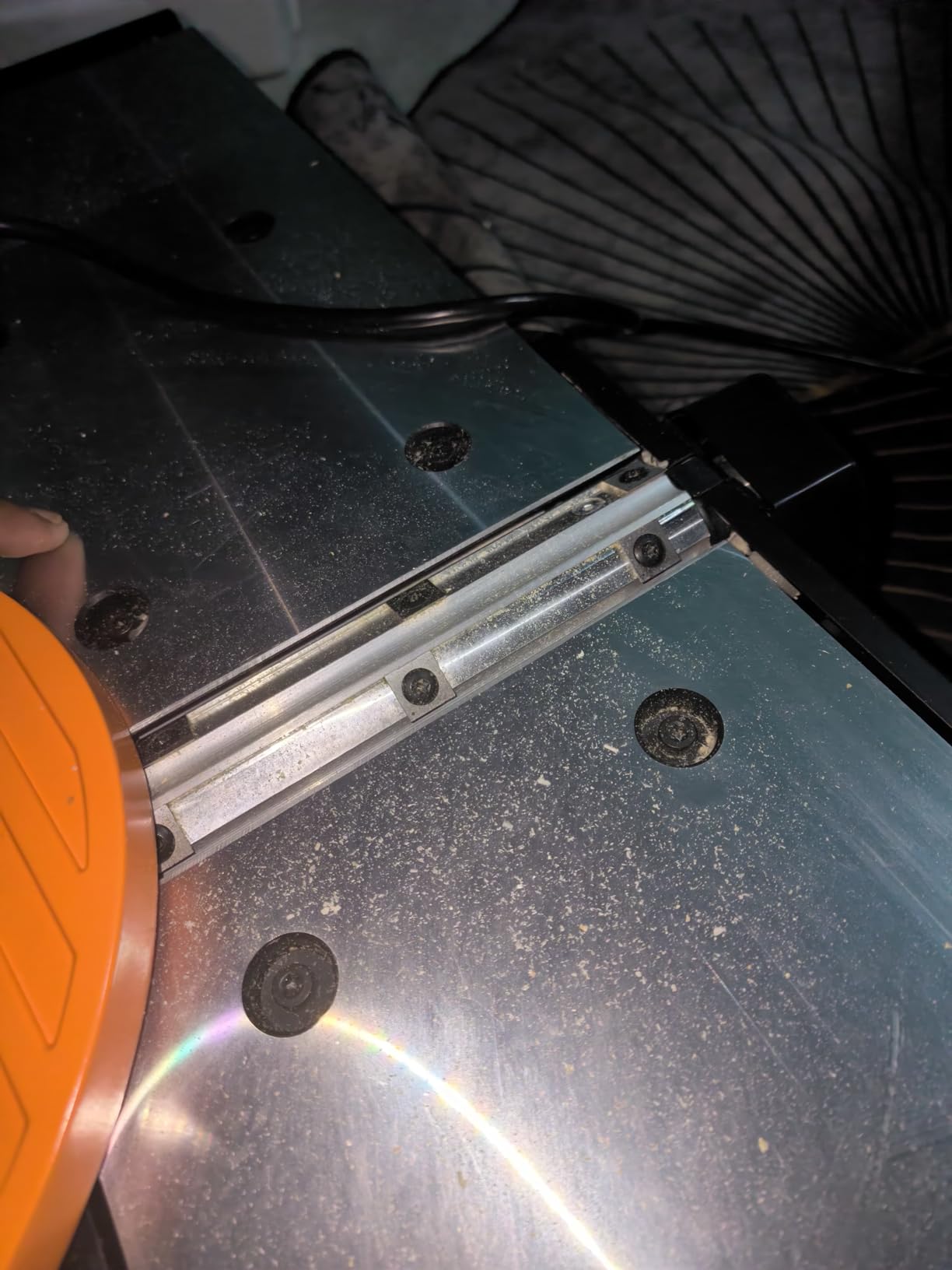
The 19-3/4 by 4-1/4 inch fence tilts to 45 degrees, which covers tapered legs and angled lumber that a square-only fence cannot. It does not have micro-adjustment, so getting a repeatable 90 degree fence setting means setting it once and marking it. Dual dust ports at 2-1/2 and 4 inches give you flexibility to match a collector hose or a 4-inch trunk line with a reducer.
Who should skip it
Skip it if your volume of hardwood work is high enough that sharpening sessions become a real cost, or if you need a fence that can be dialed to a hairline by feel. In both cases the Cutech 40180HI or the Wahuda are stronger long-term buys. For a benchtop machine that has to handle wider pieces than a 6-inch unit, this is the one to pick.
3. Cutech 40180HI 8-Inch Jointer – Tables That Arrive Coplanar and a 24 Inch Fence
Cutech 40180HI 8-Inch Spiral Cutterhead Benchtop Jointer with Cast Iron Tables, 16 TC Inserts, Extra Long 24″ Aluminum Fence, Additional 7-3/8″ Fence Brackets, and a 10-amp Motor
Six row spiral head with 16 carbide inserts
82.8 lb cast iron body
34 x 19.75 x 13.25 inches
120V 1200 watt motor
Pros
- Cast iron tables arrive coplanar and factory calibrated
- Low amp draw from the staggered two-sided carbide head
- 24 inch fence plus support brackets hold a true 90 degree angle
- Heavy stable machine that does not move while cutting
Cons
- Foam packaging can damage the cast iron tables in transit
- Fence alignment mechanism feels crude compared with heavier machines
- Universal motor is very loud under no load
If you have never owned a jointer, the Cutech 40180HI removes the single most common frustration in the category: levelling. Its cast iron tables arrive coplanar and factory calibrated, and owners consistently single that out as the deciding factor. You can uncrate it, set the fence, and cut.
At 82.8 pounds, it is heavier than the other benchtop machines here by a wide margin, and that mass is deliberate. It does not walk across the bench during a cut, and the low amp draw from the staggered head means the 10-amp motor is not the limiting factor the way it can be on lighter machines.
The rating is 4.5 across 78 reviews, which is the second-highest average in this group behind the Shop Fox at 4.8, and the review text describes smooth, accurate cuts on pine, oak and maple with tips that are easy to rotate when damaged. It ranks first in the Power Jointers category on Amazon, which tells you something about how the wider market perceives it.
Two-sided carbide inserts and the amp draw advantage
This is the most technically interesting cutterhead in the roundup. Six rows hold 16 staggered tungsten carbide inserts, and the inserts are two-sided with a non-cutting edge designed to stop an insert from skewing while cutting. The manufacturer claims the lowest amp draw of the heads in this class, and owner feedback backs that up with reports of smooth hardwood cuts without bogging.
Compared with the four-sided inserts on the Wahuda, the two-sided design gives a cleaner cut under load and less deflection, at the cost of replacing inserts sooner rather than rotating them three times. For someone jointing figured or curly maple where a gouged insert ruins a panel, the precision is worth it.
The fence bracket system and why the brackets matter
The 24-inch aluminum fence has quick stops at 90 and 135 degrees, and the included 7-3/8 inch support brackets stabilize both ends. That is not a gimmick. Without the brackets, reviewers describe the fence as somewhat floppy, and the most common setup task on this machine is installing them before you trust a 90 degree cut.
An additional guide post handles table elevation control, so the parallel tables translate to a consistent depth of cut at different settings, and a supplementary support rod system keeps the frame upright under heavy workpieces. For a table top or a series of cabinet doors, that consistency is what saves you from jointing each one slightly differently.
Motor noise and the packaging problem
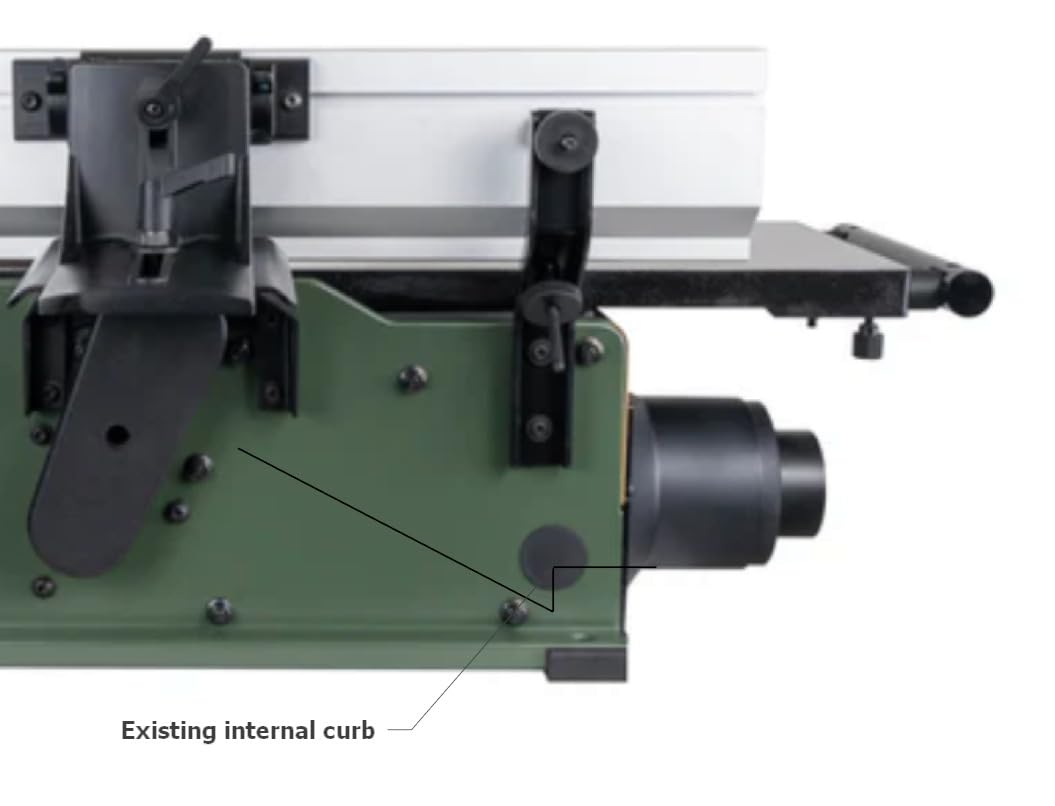
The universal motor runs at 12,000 RPM and is reported as very loud under no load, which is normal for that motor class but worth planning around. More annoying is the packaging: the tables arrive protected by molded foam that reviewers report can damage them in transit, and several buyers found it necessary to inspect the tables on arrival. Check them flat with a straightedge before you accept the machine.
Who should skip it
Skip it if noise in your shop is a genuine concern, or if you plan to move the machine frequently, since 82.8 pounds is a two-person lift for most people. It also is not a long-bed machine, so heavy workpiece overhang remains a limitation shared with the rest of the benchtop class here.
4. Powermatic 60HH 8-Inch Jointer – 2 HP Helical Head on Dovetailed Ways
Powermatic 8-Inch Jointer, Helical Cutterhead, 2 HP, 230V 1Ph (Model 60HH)
54 four-sided carbide inserts
2 HP 230V single phase
489 pound machine
46 by 25 by 73 inches
Pros
- Helical carbide cutterhead cuts quietly and leaves a flawless finish
- Tables are long and heavy and stayed flat out of the crate
- Polished cast iron tables show high quality fit and finish
- 2 HP motor has ample power for deep cuts in hardwood
Cons
- Turbine whine at startup is loud and hearing protection is required
- Some owners report tables arrived out of coplanar and needed extended setup
- Requires 230V single phase power and cannot be moved alone
The 60HH is the machine I would buy if the shop has a dedicated 230V circuit and a permanent home for it. A 2 HP motor running at 7,000 RPM with 54 four-sided carbide inserts is a genuinely different proposition from anything in the benchtop class, and owners with setup experience describe it as a career machine that produces flawlessly straight, square cuts on cupped and figured hardwoods.
At 489 pounds and 46 by 25 by 73 inches, it is a floormodeler in every sense. Plan the location before it arrives, because moving it means a mobile base and several people.
54 insert helical head and what 7000 RPM does
Sixty evenly distributed inserts across the head mean a light, continuous bite. The finish owners describe is the cleanest of any machine in this roundup, and the noise while cutting is markedly lower than a straight knife head. The trade is the startup turbine whine, which reviewers describe as loud enough to require hearing protection.
Low head RPM and high insert count is a forgiving combination for feed rate. Because each tooth removes so little, you get clean results across a wider range of operator speed, which matters when a second person feeds boards and you do not fully control their technique.
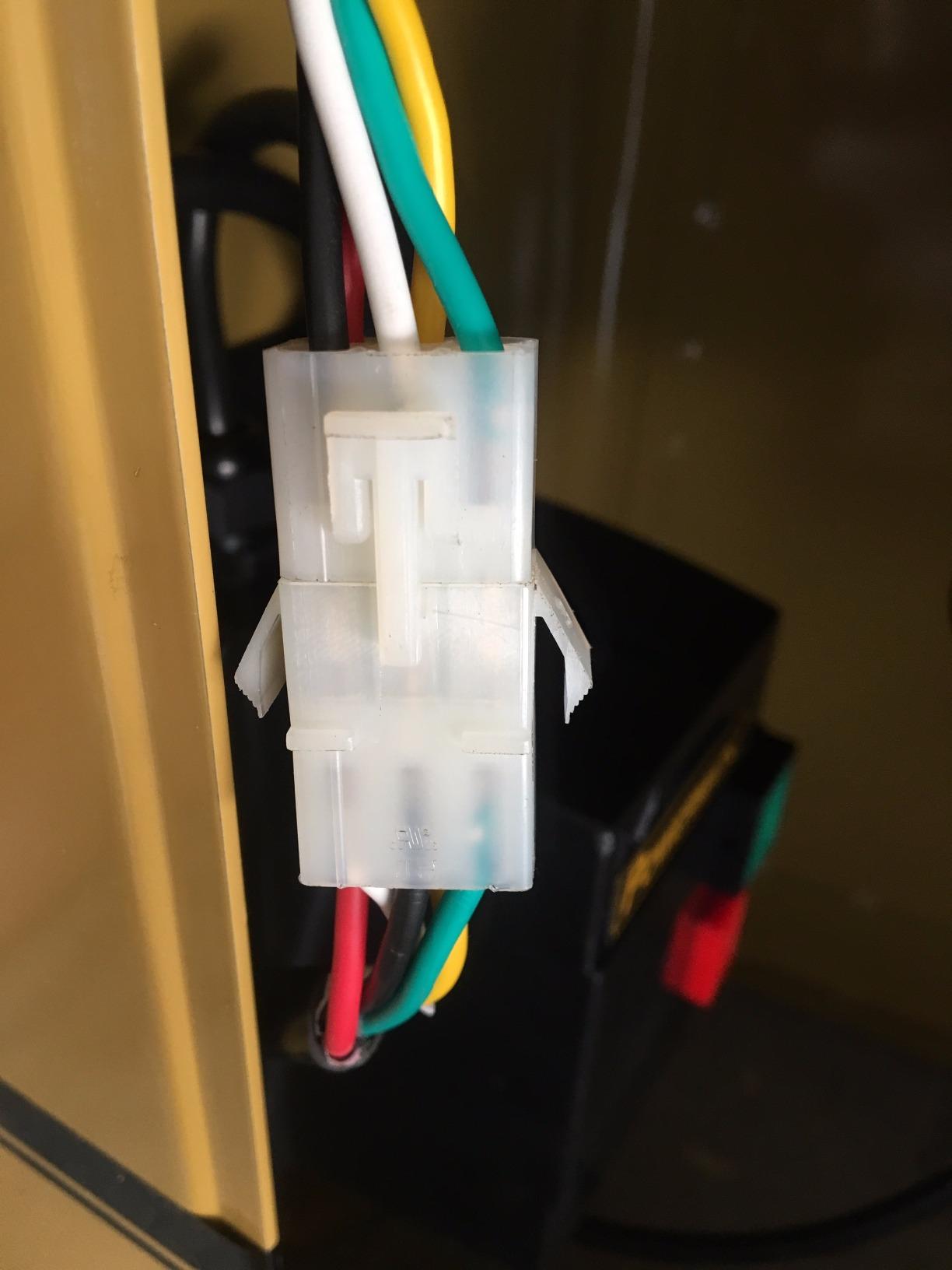
Table length, dovetailed ways and stability under load
The extra long tables are mounted on dovetailed ways, and the cam adjustment lever gives quick infeed positioning with fine depth tuning. That bed design is not decorative: it is what keeps the infeed table rigid when you are taking a real cut rather than a skim.
Owners consistently praise the polished cast iron table surfaces and the fact that the tables stayed dead flat when uncrated, though several buyers still needed hours to bring them into coplanarity. Plan for that. Outfeed alignment is not optional on any jointer, but the mass here means the machine stays where you put it while you do it.
230V power, dust chute and shop planning
Amperage is rated at 20 A, which means a 230V single-phase circuit and the wiring to go with it. Magnetic push blocks store on the machine within reach, a non-mar fence insert protects the table during adjustments, and a high-mount switch and control box keeps the controls at a workable height. A dust chute is included for chip collection.
The manufacturer warranty is 5 years, which is meaningfully longer than most machines in this class. A minority of owners report transit damage, cosmetic defects on arrival, and a repeat fan blade fault with weak after-sales response, so inspect carefully on arrival and keep the serial number.
Who should skip it
Skip it if you rent, if you have only 120V available, or if your workload is a few cabinet projects a year. A permanent 230V circuit and 489 pounds of machine is a poor fit for a temporary space. If you have both, this is the strongest all-rounder for real furniture work.
5. Rikon 8-Inch Benchtop Jointer – the Lightest Footprint for a Small Garage Shop
RIKON Power Tools 8″ Benchtop Jointer with Helical Style carbide Cutter Head & SP Coated Aluminum Table.…
16 two-sided carbide inserts
49 pound portable format
30-1/2 inch table extending to 51-1/2 inches
Synthetic polymer coated aluminum tables
Pros
- Light 49 pound portable format suited to small home workshops
- Polymer coated tables glide smoothly with reduced friction and scratching
- Table extensions allow slightly longer pieces than typical benchtop jointers
- Straightforward to learn for first-time jointer owners
Cons
- Plastic fence bracket feels cheap and lacks a 90 degree lock-in aid
- Fence angle and width lock handles interfere with each other
- No micro-adjustment on the fence compared with floor-standing models
At 49 pounds, this Rikon benchtop jointer is the machine to buy if your jointer has to come out of storage every weekend. The 30-1/2 by 8-3/16 inch table extends to 51-1/2 inches, which is competitive with the WEN, and the synthetic polymer coated aluminum tables are a genuine departure from the usual raw cast iron.
Buyer feedback praises it for being compact, portable, easy to learn, and capable of producing even, smooth, right-angled joints after one or two tutorial videos. The rating is 4.0 across 13 reviews, so treat the sample size accordingly.
Coated aluminum tables and how they glide
The coating reduces friction and scratching, which is a real advantage if you move finished cabinet components across the table as much as rough-sawn lumber. A finished face sliding on a bare machined iron table is where scratches come from, and the coating reduces that risk on parts you have already finished on one face.
The trade is rigidity. Aluminum is lighter than cast iron, which is exactly what you want for portability and exactly what you do not want under a deep cut on a wide board. The 49-pound figure is the lowest here, and it is a deliberate design choice rather than a compromise the manufacturer made accidentally.
Cutterhead and the surface finish question
The head carries 16 two-sided carbide inserts in a helical arrangement, which should give a clean cut and low cutting resistance. One owner tested it and concluded the helical head produced little measurable surface improvement over a straight-blade planer in that particular test. I would weight that single data point lightly, since the comparison conditions matter, but it is a fair warning that a benchtop head will never match the finish of a 54-insert floor machine.
The fence system and its rough edges
This is where the Rikon loses ground. The 19-3/4 by 4-3/8 inch fence tilts 90 to 135 degrees, which is the range you need, but the plastic bracket feels cheap, there is no 90 degree lock-in aid, and the fence angle and width lock handles physically interfere with each other. Squaring the fence to the table becomes a fiddly task rather than a one-time setup.
There is no fence micro-adjustment compared with the floor-standing models, and a safety on/off switch with an easy-read depth scale is the only other control. For light duty work, that is workable. For production edge jointing where the fence setting has to be repeatable to a hair, it is not.
Who should skip it
Skip it if you plan to do serious edge jointing on visible furniture parts, or if your space allows a heavier machine. If your constraint is purely floor space and you work alone, the 49-pound format is a legitimate reason to choose it over a heavier benchtop unit.
6. JET JWJ-8CS 8-Inch Jointer – Straight Knives With 45 and 90 Degree Fence Stops
JET 8-Inch Jointer, Straight Knife, 2 HP, 230V 1Ph (JWJ-8CS)
Three high-speed steel knives
16500 cuts per minute
375 pound one-piece steel stand
72 by 24 by 36 inches
Pros
- Cuts straight on material over six feet long
- Tables and straight knives arrived flat and factory set from JET
- Rabbeting ledge and 45 and 90 degree fence stops add real versatility
- Good finish on maple walnut and cherry after minimal outfeed adjustment
Cons
- Does not include push blocks which must be ordered separately
- Power box arrives unwired and needs a 20A 240V circuit
- Belt installation is awkward without a second pair of hands
The JET JWJ-8CS is the long-lumber specialist in this roundup. At 72 inches long on a heavy-duty one-piece steel closed stand, it is the machine to buy if you routinely joint full-length lumber instead of components cut to size from a rough dimension.
Owners report that tables and straight knives arrived flat and factory set from JET, that the finish on maple, walnut and cherry is good after minimal outfeed adjustment, and that it cuts straight on material over six feet long. At 4.4 stars from 9 reviews the sample is small, but the reports are consistent.
16500 cuts per minute from three HSS knives
Three high-speed steel knives rotating at 5,500 RPM produce over 16,500 cuts per minute. This is the classic straight knife configuration: fewer teeth, higher chip load, and a finish that depends entirely on how sharp and how well set those knives are.
That dependence is the trade. Knife-setting instructions are reported as unclear, and a dial indicator is advisable to get the three knives coplanar to each other and to the table. If you already know how to set straight knives, this is a non-issue. If you do not, budget a learning afternoon, because a badly set straight head tears out figured maple more violently than any spiral head will.
The two-way tilting fence has positive stops at 45 and 90 degrees, and a 3-1/8 by 8-3/4 inch rabbeting ledge adds real versatility for drawer and box work. A 4-inch dust chute handles chip collection.
Long bed and the heavy closed stand
At 375 pounds with a one-piece steel closed stand and mounting tabs, this machine does not creep, and the 72-inch length is the point. For edge jointing long pieces, the table has to support the workpiece past the cutterhead or the board twists and the joint is not straight.
Center-mounted fence adjustment levers mean you are not reaching across the machine to reset the fence, and magnetic controls protect the motor from electrical supply issues, which matters more on a 230V machine than the phrase sounds like it should.
Knife setting, wiring and getting it into place
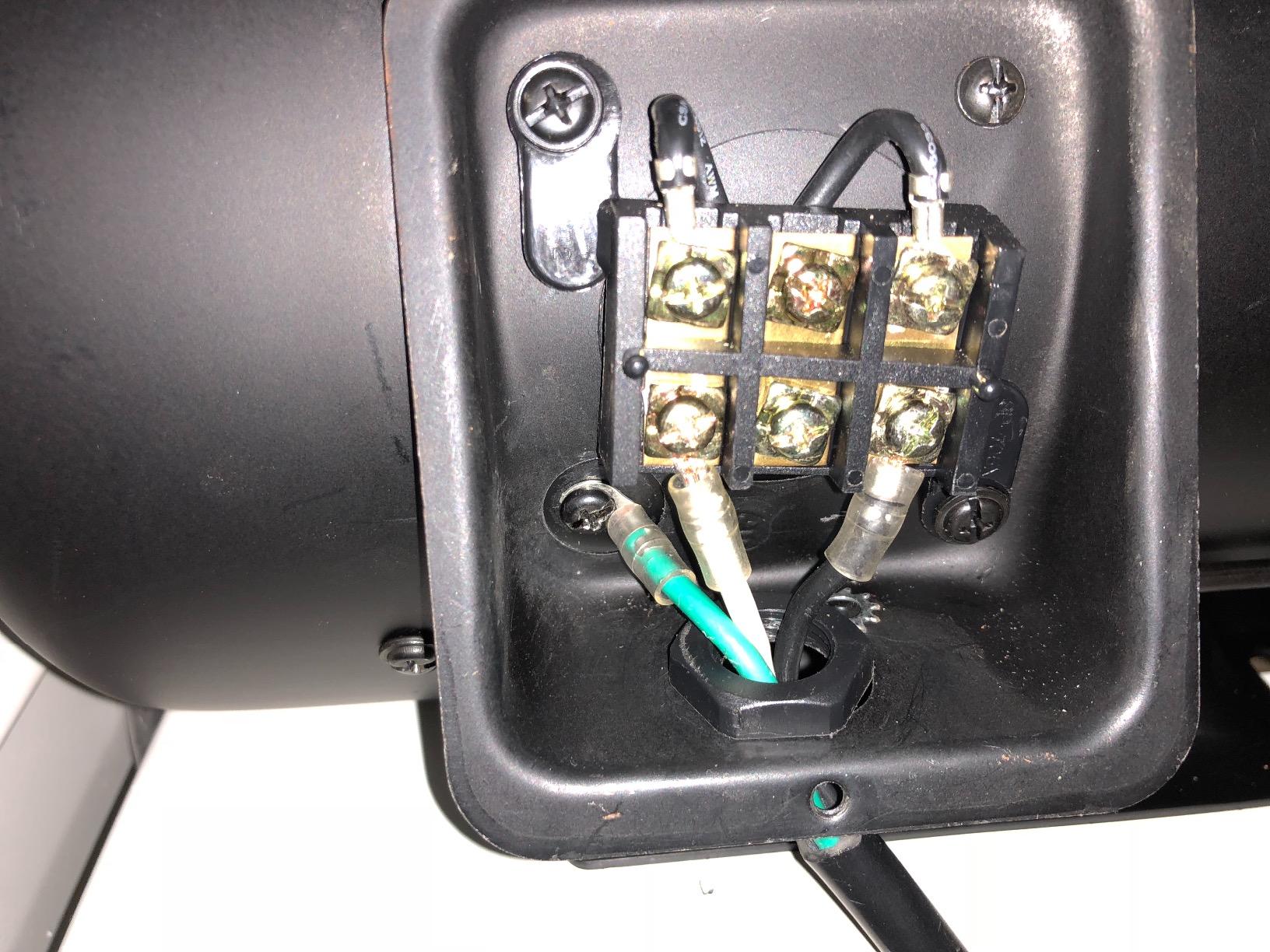
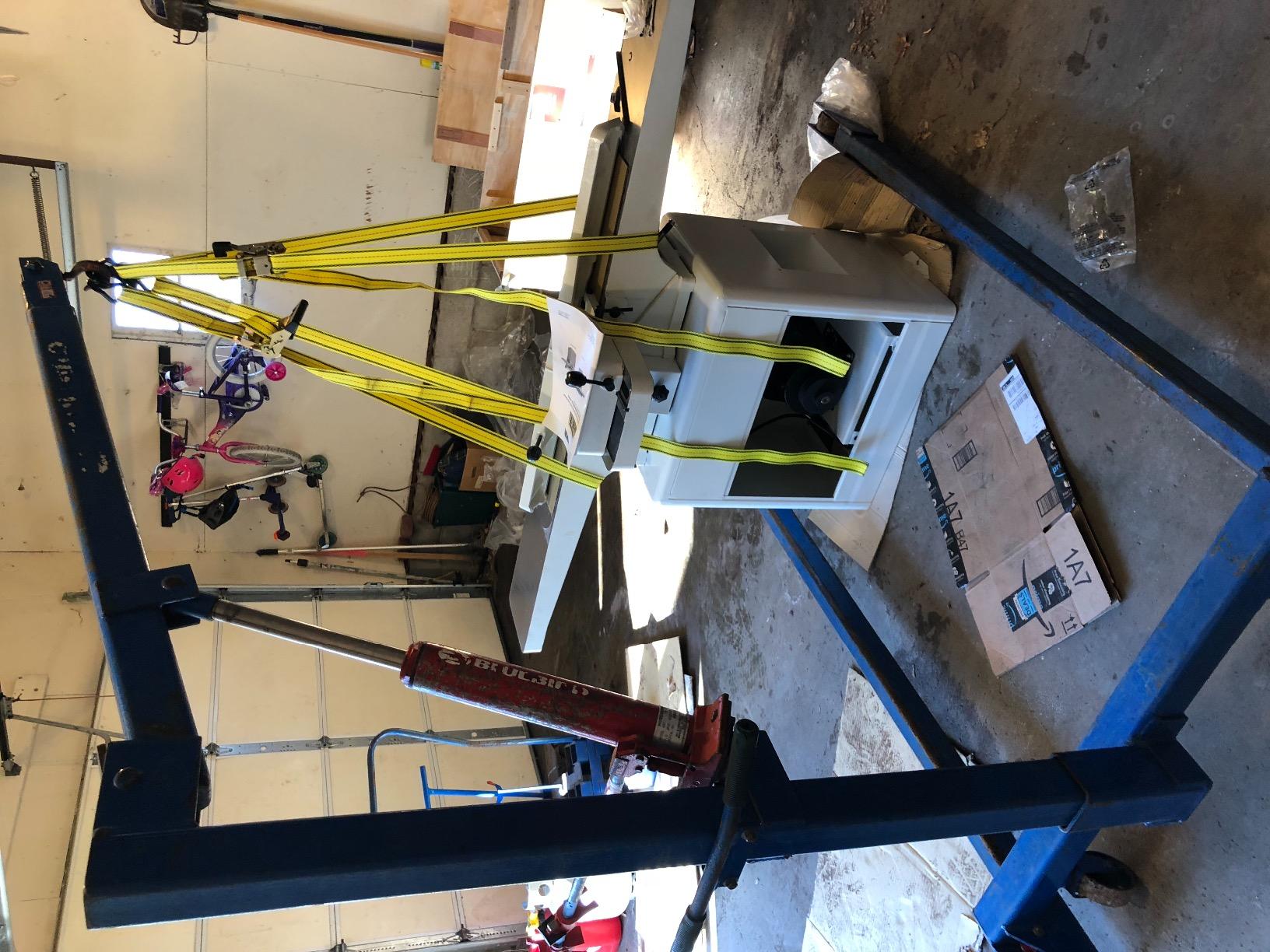
Three things catch people out on this machine. Push blocks are not included with this machine, so add them to your order. The power box arrives unwired and needs a 20A 240V circuit with a NEMA 6-20P plug. And the installation is not a one-person job: the table section is heavy enough that owners describe needing a hoist, a mobile base, and several strong helpers.
The warranty is 5 years, dropping to 2 years for commercial use, which is worth noting if you intend to run this as production equipment rather than a hobby machine.
Who should skip it
Skip it if you work with small components only, or if you are not comfortable setting straight knives. Buy the Powermatic 60HH instead if you want the same class of permanence with a cutterhead that does not need a dial indicator to perform.
7. Shop Fox W1859 8-Inch Parallelogram Jointer – Mobile Base in the Box and a 76 Inch Bed
Shop Fox W1859 8″ x 76″ Parallelogram Jointer with Mobile Base
3 HP single-phase at 230V
76 inch parallelogram bed
470 pound machine
76 by 25 by 41.5 inches
Pros
- Highest average rating in this roundup at 4.8
- Includes a mobile base which most 8 inch floormodelers list separately
- Long 76 inch parallelogram bed supports full-length lumber
- Parallelogram design allows fast and accurate depth of cut changes
Cons
- Only 7 reviews so long-term reliability is largely unverified
- Parallelogram fence is only 38 inches and shorter than the table
- 2 year warranty is shorter than premium competitors
- Very heavy at 470 pounds
The W1859 carries the highest average rating in this roundup at 4.8 stars, and it is also the only machine here that includes a mobile base in the box. That combination is genuinely appealing for a shop that wants a full parallelogram machine without the extra step of sourcing a base, and the 3 HP single-phase motor at 230V gives it more power than the 2 HP machines it competes with.
The catch is the sample size. Seven reviews is not a reliability record, and the low volume reflects simply that 8-inch parallelogram jointers are low-volume purchases. Read the reviews as a description of the machine rather than as evidence about how it will age.
Parallelogram adjustment and 3 HP power
The parallelogram design keeps the tables close to the cutterhead at all heights and stays square at any table position, which means depth of cut changes are fast and repeatable. Maximum depth of cut is 1/8 inch and rabbeting capacity is 1/2 inch, and the parallelogram approach is what lets a bed this long still handle quick adjustment without the whole structure flexing.
With 3 HP available, this machine has the deepest reserve in the roundup. When you are flattening a wide, cupped board, motor headroom is the difference between a cut that finishes and a cut that stalls halfway through.
Bed length and the fence mismatch
Total table size is 9 by 76 inches, which handles full-length lumber comfortably. The fence, however, is 4-5/8 by 38 inches, which means the fence covers less than half the table width. For edge jointing long boards, you set the reference at the fence and support the overhang, and a 38-inch fence on a 76-inch table is a compromise worth weighing if your furniture is large-format.
Weight, warranty and installation
At 470 pounds, getting this machine into place requires a hoist or multiple helpers, the same reality as every floormodel here. The 2-year warranty is shorter than the 5-year terms on the Powermatic machines, which matters for a long-term shop investment where you expect to keep the machine for a decade.
Who should skip it
Skip it if warranty length is a deciding factor for you, or if your furniture is small-format and a 38-inch fence feels limiting. If you want a full parallelogram machine with the base already handled, this is the one in the roundup.
8. Powermatic PJ-882 8-Inch Parallelogram Jointer – the 82 Inch Bed That Handles Full Length Lumber
Powermatic 8-Inch Parallelogram Jointer, Straight Knife Cutterhead, 2 HP, 230V 1Ph (PJ-882)
Three high-speed steel knives
82 inch precision ground cast iron table
610 pound parallelogram floormodel
84 by 28 by 44 inches
Pros
- Longest table in this roundup at 82 inches
- Parallelogram cam system allows adjusting both tables at all four corners
- Arrived nearly coplanar with minimal setup
- Built-in lift pins simplify moving the 610 pound unit with a hoist
Cons
- Straight knives require periodic setting unlike four-sided carbide inserts
- Switch post flexes when pressed because it is mounted on thin sheet metal
- Outfeed table needed fine dial-indicator adjustment to reach true coplanarity
The PJ-882 is the end of the line in this roundup, and in one specific dimension it wins outright: an 8 by 82 inch precision-ground cast iron table is the longest surface available here, followed by the Shop Fox at 76 inches and the JET at 72 inches. If your furniture involves long boards, that difference is not cosmetic.
Owners describe a rock-solid, precisely adjustable machine whose parallelogram bed handles long lumber better than anything else in the class, and most report near-perfect coplanarity out of the crate with only small adjustments. The 5-year manufacturer warranty and a 20A 230V requirement fit a permanent shop installation.
Parallelogram cam system and coplanarity out of the crate
The parallelogram design allows accurate adjustment of both tables at all four corners and keeps the table close to the cutterhead at any height. That geometry is why the machine can hold depth of cut accuracy on a bed this long, and why the parallelogram design is worth the premium over a conventional dovetail bed at this class of machine.
Most owners found it arrived nearly coplanar, though the outfeed table still needed fine dial-indicator adjustment to reach true coplanarity. One owner reported unresolved transit damage to the fence tilt assembly, so inspect that mechanism specifically on arrival.
82 inch table and long lumber handling
With an 84-inch overall length, a board passed across the cutterhead is supported on a cast iron surface that extends far beyond the 8-inch cutting width on both sides. For long material this removes the tipping problem that benchtop extensions create, and for edge jointing it means the workpiece stays flat along its entire length.
Built-in table lift pins let you strap the machine for hoisting, which matters at 610 pounds. The base is cast iron, the frame is 84 by 28 by 44 inches, and the high-mount switch is positioned for operator convenience, though owners report the switch post flexes because it is mounted on thin sheet metal. It is a small complaint, but on a machine of this class it is the kind of detail that tells you where the cost went.
Straight knife maintenance reality
Three high-speed steel knives cut clean, and the patented handwheel worm gear system gives very precise fence tilting that most owners rate as excellent across the table and in tilt. The cost is maintenance: straight knives require periodic setting to a lapped surface, and unlike four-sided carbide inserts they cannot be rotated three times between changes.
The aluminum knife gauge and push blocks are included in the box, along with wrenches and the cutterhead guard. On a machine at this level, having the setting gauge supplied is a small detail that saves a frustrating afternoon.
Who should skip it
Skip it unless you work with long, full-length lumber and have a dedicated space, a 230V circuit and a hoist or several helpers available for installation. For everything short of that, the money is better spent on a helical-head machine that maintains itself.
How to Choose an 8-Inch Jointer for Furniture Making
Choosing an 8-inch jointer comes down to four questions in this order: what cutterhead can you maintain, how long is your longest piece of lumber, how heavy is the work you put through it, and what electrical service you have. Get those four right and the machine choice takes care of itself.
Straight knife, spiral or helical: what changes in your workflow
A straight knife head carries two or three HSS knives on a slow-spinning cutterhead. It is cheap to own, easy to sharpen on a grinder, and produces a very clean cut when the knives are perfectly set. The problem is that it only stays that way for a while, and setting three knives coplanar to each other and to the table takes practice and a dial indicator. Straight knives also produce the loudest cut in the category, which is where the JET JWJ-8CS and the Powermatic PJ-882 sit.
A spiral cutterhead places knives in a single helix, and a helical cutterhead spreads them across two or more staggered helices. Helical heads run at lower RPM with more cutting edges, so each tooth takes a light bite. That produces a quieter cut, far less tear-out on reversing grain, better resistance to dull inserts, and a surface that needs less sanding. The trade is cost: carbide inserts are consumables, and a 54-insert head like the Powermatic 60HH carries far more of them than a 16-insert benchtop head.
For furniture making, helical wins on figured lumber. For rough dimensioning and utility work, straight knife is more than adequate and costs less to run.
Do you really need 8 inches? Width mapped to furniture components
Six inches handles drawer sides, face frames, small table aprons and most cabinet parts. Eight inches handles full-width cabinet sides, standard table tops up to 8 inches of width, seat rails, and legs without ripping lumber down first. Twelve inches exists for oversized tops and doors, and unless you build those, it is capacity you pay for in floor space and machine weight.
The practical test is to lay out the widest component you glue up regularly and add a quarter inch for your hands and push blocks. Owners who moved from a 6-inch machine to an 8-inch machine report regretting the delay, mainly because of the ripping step. If your widest piece exceeds six inches even occasionally, 8 inches is the right stopping point for a furniture shop.
Benchtop versus floor model: mass, vibration and bed length
This is the trade the spec sheets do not make obvious. The 49-pound Rikon and the 49.9-pound Wahuda are genuinely portable and genuinely limited on heavy work. The 82.8-pound Cutech sits in between. The 375-pound JET, 470-pound Shop Fox, 489-pound Powermatic 60HH and 610-pound PJ-882 are floormodelers that stay where you put them.
Mass matters because a jointer’s job is resisting the reaction of a cutterhead taking a bite out of resistant hardwood. A light machine under a full-width pass on white oak will chatter, and chatter shows up as scallops that no amount of sanding fixes. That said, a rigid quarter inch pass on a light machine beats a claimed deep cut on a machine that is moving around, and the forum consensus is consistent on that point.
Bed length is the second factor. Any board that overhangs the outfeed table tips as it leaves the cutterhead. If your longest piece is under roughly 6 feet, a benchtop unit with extendable arms is sufficient. Beyond that, you need roller stands, and a floormodeler with a 72 to 82 inch bed handles it natively.
Fence height, squareness and the jobs it limits
Fence height caps the thickness of material you can edge joint. A 4-1/4 inch fence handles most furniture parts comfortably; a 4-3/8 or 4-5/8 inch fence gives you more room for thicker aprons and seat blanks. Anything under 4 inches and you will be flipping thick pieces to get them past.
Squareness matters more than height. A fence that will not hold a true 90 degrees makes every edge joint compound-angled, and that error shows up in your glue-ups. Fence length matters for long material: the Shop Fox pairs a 76-inch table with a 38-inch fence, which works for setting a reference but does not support a full-length board. Look for a fence with a positive stop at 90 degrees and micro-adjustment if you plan to edge joint in batches.
Knife setting, calibration and out of box alignment
Almost every owner complaint in this roundup comes down to one of two things: tables that arrive out of coplanar, and knife setting uncertainty. Neither is a reason to reject a machine, but both should shape your setup plan.
The calibration sequence is the same on every machine. First, confirm the cutterhead is parallel to the table using a straightedge across the head and the table, adjusting each knife if it is a straight-knife head. Then set the outfeed table to match the cutterhead at the trailing end, and take a light skim pass on scrap to verify you are not cutting down on the trailing half. Finally, set fence squareness against the table, not against the head, and mark the setting so you can return to it.
Budget two to three hours for this on a machine whose tables arrive out of coplanar, which covers the Wahuda and some units of the Powermatic 60HH. If you buy a machine that arrives factory calibrated, such as the Cutech 40180HI, you can skip straight to verifying the fence.
On the used market, three checks catch most problems. Run a straightedge across both tables and look for a dip in the middle, which means worn ways. Tap the table while cycling the adjustment and listen for a dead or gritty dovetail. Push a board through slowly and listen for the distinctive end-of-cut squeal that means the cutterhead bearings are worn, which is the single most expensive repair on any machine in this roundup.
Dust collection and electrical requirements
Plan dust collection by port diameter, not by horsepower. A 4-inch port needs a collector rated roughly in the 600 to 800 CFM range to keep up with a jointer cutting hardwood, and a 2-1/2 inch port needs correspondingly less. The WEN offers both 2-1/2 and 4 inch ports, which lets you match whatever trunk line you already have, while the JET has a 4-inch dust chute.
On electrical requirements, the split is stark. The Wahuda, WEN, Cutech and Rikon all run on 120V at 10 amps, which a standard household circuit handles. The Powermatic 60HH, JET JWJ-8CS, Shop Fox W1859 and Powermatic PJ-882 all need 230V single-phase service, and the JET power box additionally arrives unwired with a 20A circuit and NEMA 6-20P plug required. In a one-person shop, that electrical requirement is often the deciding factor before any other.
One more planning note. If you build furniture and also want a planer, consider whether a jointer-planer combo serves you better. The compromise is well documented by owners: switching modes on a combo machine is a recurring annoyance, and the jointer side of a combo is rarely as good as a dedicated one. For a shop that jointers first, a dedicated 8-inch jointer is the better investment.
Once you have a machine, plan finishing too. If you are building a piece that will be painted, our guide to chalk paint for furniture is worth a read, and getting heavy pieces moved around the shop is easier with the right furniture dollies. If you also work in the kitchen alongside the shop, our picks for the best wine making kits cover a common weekend hobby for the same reason.
Frequently Asked Questions
What is the best brand of jointer?
For most one-person furniture shops, the Wahuda 50180CC-WHD is the best overall choice because it pairs a 16-insert carbide spiral head with a 49.9-pound cast iron and steel body and a 4.4-star rating across 522 reviews. Cutech is the pick if you want tables that arrive already calibrated, and Powermatic builds the strongest 8-inch floormodelers when you have 230V service and a permanent location.
Do you really need an 8 inch jointer?
If your widest piece exceeds 6 inches on a regular basis, yes. Six-inch machines handle drawer sides, face frames and small aprons, but you have to rip down anything wider before flattening it. An 8-inch jointer covers full-width cabinet sides, table tops and seat rails without that extra step. If everything you joint is narrower than 6 inches, a 6-inch machine is the more sensible purchase.
What is the best 8-inch jointer for the money?
The WEN JT833H is the strongest budget pick, with a 33 by 8 inch table that extends to 51 inches, 16 staggered HSS spiral blades, a fence that tilts to 45 degrees, and included push blocks. The only real compromise is that HSS blades need periodic sharpening, which matters if you are jointing figured hardwood in volume.
Is a helical cutterhead better than a straight knife jointer?
For furniture making, yes. A helical head spins at lower RPM with more cutting edges, so each tooth takes a light bite. That means a quieter cut, far less tear-out on reversing grain, better resistance to dull inserts, and less need for sanding afterward. The trade is consumable cost, since carbide inserts must be replaced rather than resharpened. Straight knife heads cost less to run if you already know how to set them.
Are benchtop 8-inch jointers worth it?
Yes, for component work. Benchtop models between 49 and 83 pounds handle cabinet parts, drawer components and table aprons well, and they can be moved by one person. Their limits are bed length and mass, so they struggle with full-length boards and wide heavy hardwood compared with floormodelers. If you joint components cut to size, a benchtop machine is genuinely capable.
Which 8-Inch Jointer Should You Buy?
If you want one machine for a small furniture shop and you will spend an afternoon levelling it, the Wahuda 50180CC-WHD is the pick. If your priority is a long working surface and you can live with sharpening HSS blades, take the WEN JT833H. If you have never owned a jointer and want to cut on day one, the Cutech 40180HI saves you the setup entirely.
If you build long lumber and have 230V service, the Powermatic 60HH is the strongest all-rounder and the Shop Fox W1859 is the pick when a mobile base and a 3 HP motor matter more to you. For full-length lumber, the Powermatic PJ-882’s 82 inch table is unmatched, and the JET JWJ-8CS is the value route to a long bed if you are comfortable setting straight knives.
Whichever way you go, budget time for calibration before the first cut. Every machine here produces flat, square, furniture-grade joints once its tables and fence are properly aligned, and the shop that allows itself that afternoon is the one that gets furniture out the door faster.
Leave a Reply