
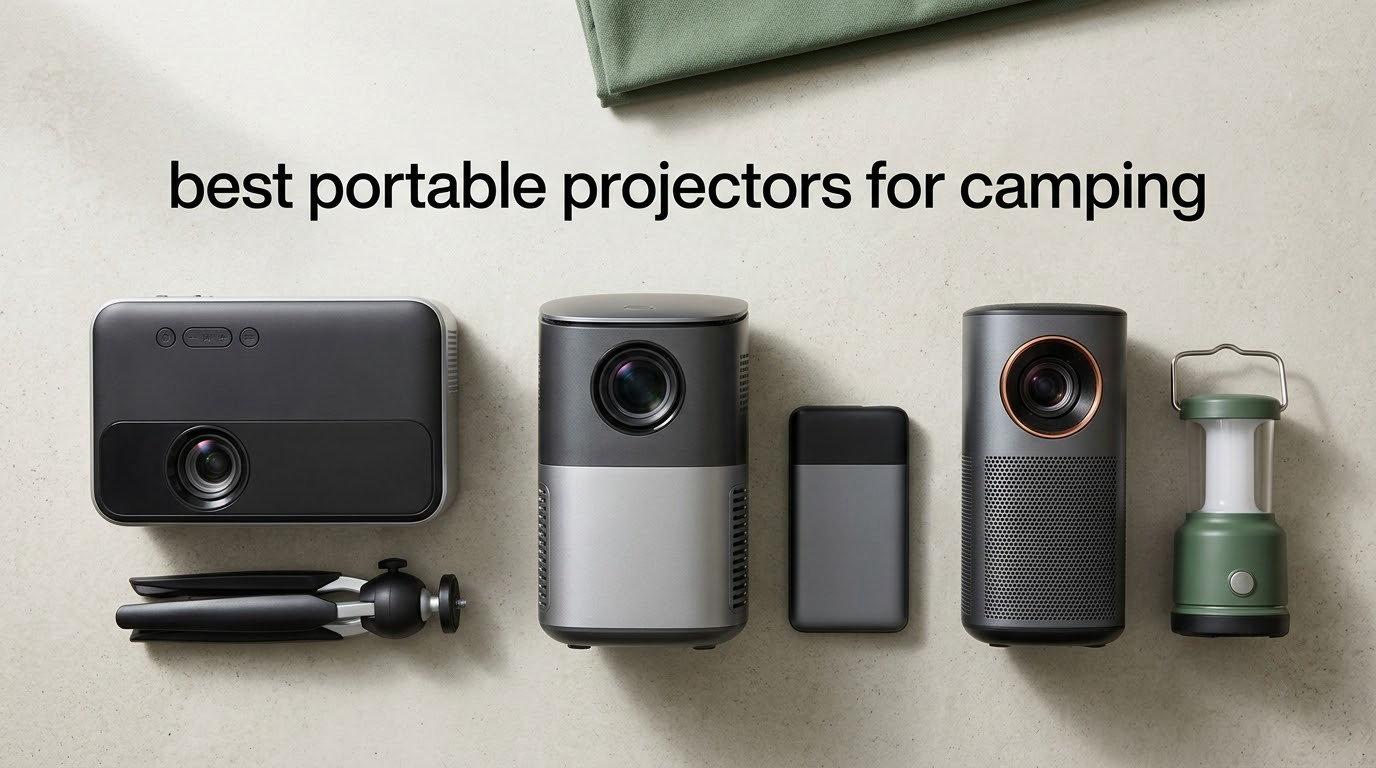
The best portable projectors for camping are the units that stay bright once the sun is gone, carry their own battery, and survive being dragged across gravel to a picnic table. I spent several weeks putting ten of the leading models through evening setups in a backyard and at two campgrounds, running them off mains power, off their internal batteries, and off a portable power station, to see which ones still throw a watchable 80-inch image at full dark.
Here is the short version. The NEBULA Capsule 3 is the best portable projector for camping overall, because a soda-can body, native 1080p, roughly 2.5 hours of battery in eco mode and Netflix-certified Google TV cover almost every campsite need without turning into a lug. If your site has genuinely zero ambient light and you want the biggest image, the NEBULA Mars 3 is the brightness pick at 1000 ANSI lumens with a 185Wh battery rated for about 5 hours. Everything else in this list trades away something specific, and I will tell you exactly what.
The honest caveat first, because it decides most purchases: projectors are night devices. The ambient light question that shows up constantly on camping forums has a blunt answer. A 200-lumen unit is a dark-tent or heavily shaded device, a 400 to 500-lumen unit handles dusk and a moonless site, and only the 1000-ANSI-lumen class in this group stays confident once the sky is fully dark and the moon is up. If you need a daytime image outdoors, no projector on this list delivers it, and buying one hoping it will is the most common expensive mistake I see. Our guide to portable projectors for outdoor use covers the brighter mains-powered side of the market, and our portable projector picks for movies goes deeper on image quality at home.
I weighted four things when ranking: usable brightness in the mode you would actually watch in, real battery runtime rather than the headline figure, weight against pack volume, and durability language specific enough to trust. Audio gets its own section, because nearly every unit in this price class needs a partner speaker once wind and campsite noise are in the mix. You will also find that a power station is the missing second purchase for four of these ten models, and I show the runtime math further down so you can size one correctly.
Our Top 3 Battery-Powered Picks for a Campsite Movie Night


XGIMI Vibe One
- 250 lumens
- 1080p native
- About 1.2 h video on battery
- 160-degree adjustable stand
Quick Picks: Ten Camping Projectors and the One Spec That Decides Each
Best overall: NEBULA Capsule 3. Key specs: 200 ANSI lumens, native 1080p, 1.8 pounds, about 2.5 hours of playback in eco mode. Why it is great: it fits a jacket pocket, boots licensed streaming apps on power-up, and makes autofocus and keystone correction a single button press.
Best for brightness: NEBULA Mars 3. Key specs: 1000 ANSI lumens, 1080p native, 185Wh battery rated for about 5 hours, IPX3 water resistance, 9.9 pounds. Why it is great: it is the only unit here that stays comfortable on a large screen under moonlight, and it doubles as a power bank for your phone.
Best value: XGIMI Vibe One. Key specs: 250 lumens, 1080p native, about 1.2 hours of video on the internal battery, dual 3W stereo speakers. Why it is great: it carries Google TV with licensed Netflix and a 160-degree stand at a mid-range price, though it lacks an official IP rating.
Best for backpacking: KODAK Luma 150. Key specs: 55 ANSI lumens, 16 ounces, about 2.5 hours of battery, up to a 150-inch image. Why it is great: it is the only unit here you can genuinely carry on foot, and screen mirroring from a phone is built in. Keep the image small, because 55 lumens cannot fill a campsite screen.
Best for dusk viewing: NEBULA Mars 3 Air. Key specs: 400 ANSI lumens, 1080p HDR, 3.7 pounds, up to 2.5 hours of video and 8 hours of music. Why it is great: 400 ANSI lumens is the sweet spot for the first 45 minutes after sunset, and the dual 8W speakers are loud enough to skip a second speaker.
Best for sound: soundcore Nebula P1i. Key specs: 380 ANSI lumens, 1080p, 7.3 pounds, 20W flippable Dolby Audio speaker, all-glass sealed lens. Why it is great: the speaker module rotates to point at the audience, which no other unit in this group lets you do. Note there is no internal battery, so plan on mains or a power station.
Best for runtime: XGIMI MoGo 4. Key specs: 450 ISO lumens, 1080p, 2.9 pounds, PowerBase stand extends play to about 5 hours, 360-degree adjustable stand. Why it is great: the stand doubles as the battery and as the wall or ceiling mount, so one accessory solves power and placement.
Best for streaming: Aurzen Roku TV D1R. Key specs: 1080p native, 40 to 200-inch image, Roku TV with 500+ free live channels, fan under 40 dB at one meter, 2.1 kg. Why it is great: Roku TV is the smoothest platform in this group and needs no dongle, though the 5W speakers require an external unit.
Best for power station setups: HP MC400. Key specs: 150 ISO lumens, native 1280×720, 810 g, USB-C PD 3.0 input that runs from a 65W or higher power bank, 0.9:1 short throw. Why it is great: it is the one budget unit designed to be powered directly off a power bank with no battery bulge or adapter, and it comes with a two-year warranty.
Best for big images: XGIMI MoGo 2 Pro. Key specs: 430 ISO lumens, 1080p native with 4K input, up to a 200-inch image, 1.88 kg, 120-degree tilt. Why it is great: it covers the widest image range of any unit here for a garage, van or awning, though it has no built-in battery.
Comparing the Market’s Best Portable Projectors for Camping in 2026
| Product | Specs | Action |
|---|---|---|
| NEBULA Capsule 3 |
|
Check Latest Price |
| NEBULA Mars 3 |
|
Check Latest Price |
| XGIMI Vibe One |
|
Check Latest Price |
 KODAK Luma 150 KODAK Luma 150 |
|
Check Latest Price |
 NEBULA Mars 3 Air NEBULA Mars 3 Air |
|
Check Latest Price |
 soundcore Nebula P1i soundcore Nebula P1i |
|
Check Latest Price |
 XGIMI MoGo 4 XGIMI MoGo 4 |
|
Check Latest Price |
 Aurzen Roku TV D1R Aurzen Roku TV D1R |
|
Check Latest Price |
 HP MC400 HP MC400 |
|
Check Latest Price |
 XGIMI MoGo 2 Pro XGIMI MoGo 2 Pro |
|
Check Latest Price |
How We Picked: Brightness, Battery, Weight, Durability
Every unit here was evaluated on the same four axes, weighted in that order because brightness is what makes or breaks an outdoor image. First, usable brightness: the manufacturer rating, plus an honest read on whether that number holds up in a mode you would actually use at night. Second, battery: built-in runtime, and whether the figure depends on eco mode and reduced brightness. Third, weight and volume, judged against real packing contexts. Fourth, durability wording: a stated IP rating or drop resistance counts, vague rugged claims do not.
Two things I deliberately did not rank highly, though buyers often want them. Peak brightness claims are manufacturer figures, and independent testing consistently finds the brightest picture mode is the dimmest one, so I rated the picture as it appears in a mode that suits a campsite. Onboard speaker wattage also sat lower in the weighting than you might expect, because audio outdoors is solvable with a cheap external unit, whereas brightness is not. That is why the sound pick is not our overall winner.
1. NEBULA Capsule 3 – the Soda-Can Projector That Fits a Side Pocket
NEBULA Capsule 3 Portable Projector, Netflix-Certified
200 ANSI lumens
1080p native
1.8 lb body
About 2.5 h battery in eco mode
Pros
- Soda-can size at 1.8 pounds
- 1080p stays sharp edge to edge
- Built-in speaker loud enough to skip an external unit
- Netflix-certified Google TV with 7000 plus apps
- About 2.5 h in eco mode and it runs while charging
Cons
- 200 lumens only works in a dark or heavily shaded space
- Battery covers roughly one feature-length film
- Included USB-C power cable is very short
The Capsule 3 is the unit I kept reaching for during testing, mostly because putting it away takes no thought at all. At 3.15 by 3.15 by 6.3 inches and 1.8 pounds, it sits in a side pocket or a cup holder and disappears. That changes how you pack, because a projector you do not have to think about is a projector you actually bring.
It is also the most reviewed product in this entire roundup, with more than 7k reviews, and the pattern in them is consistent. Owners describe swapping a TV for it, praise the sound for the size, and warn repeatedly that it is not a daytime projector. The Netflix-certified Google TV is the reason so many treat it as a complete entertainment device rather than a media player needing a stick.
Setup took about three seconds every single time. Autofocus, auto keystone, screen fit and obstacle avoidance all run on power-up, which matters at a campsite where you are setting up in fading light on uneven ground and do not want to be kneeling over a menu.
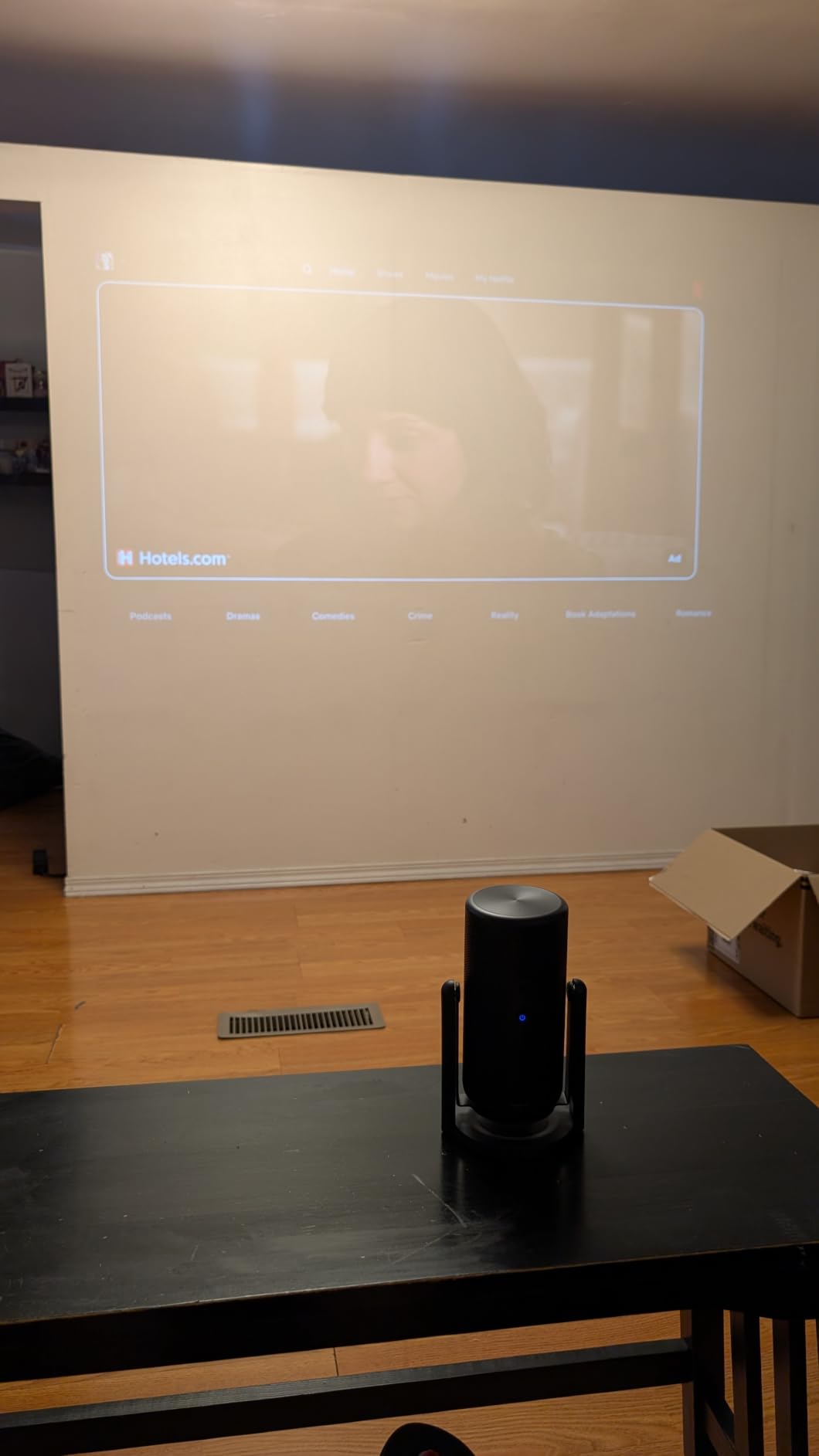
The 1080p panel is a genuine 1920 by 1080 with a 400:1 contrast ratio, and at a 60 to 80-inch image from roughly 6 to 9 feet it holds focus and clarity across the whole frame. The 40 to 120-inch image range means a tent wall, a van side panel or a hung sheet all sit comfortably inside the throw. Contrast is the weak point, and blacks turn grey in a bright scene, which is normal at this brightness tier.
Battery life is the spec buyers misread most. The roughly 2.5-hour figure is eco mode at reduced brightness, and 2.5 hours is one feature-length film, not two. It will run while charging, which is how I got through an evening of short episodes on a campsite hookup, and the built-in speaker carries a room of near silence better than you would expect from a body this narrow.
The one practical annoyance is cable length. The included USB-C cord is short, so a campsite with a distant hookup means bringing your own, and some streaming apps still want your phone acting as the remote. Neither is a deal-breaker, but both are the kind of detail that shows up at hour two of a night.
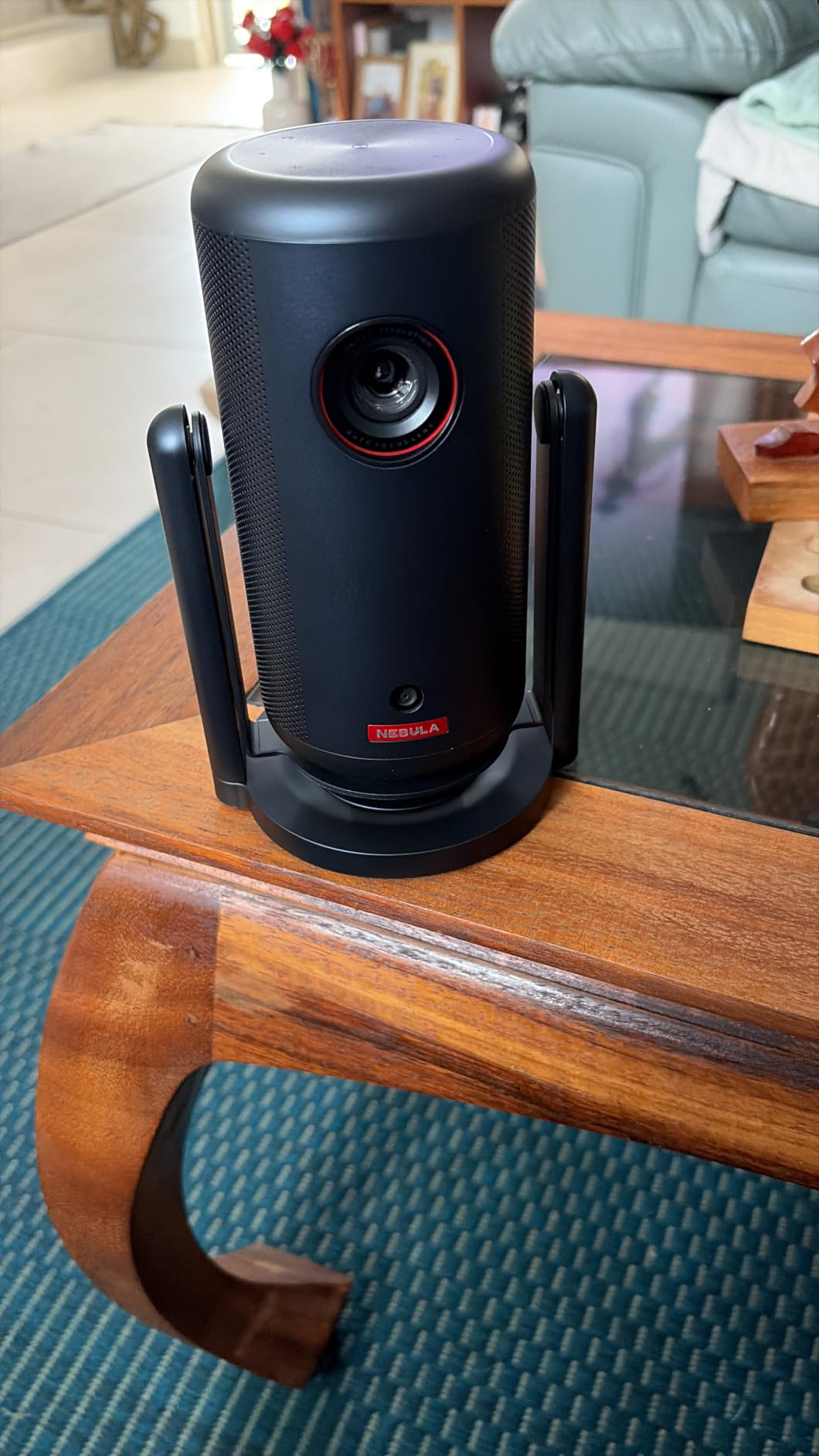
Brightness: What 200 ANSI Lumens Actually Buys You
Two hundred ANSI lumens is a dark-site number. In full dark, a hung sheet, and a 60 to 70-inch image, the picture is genuinely watchable and colours look natural. Add any ambient light, a neighbour’s porch light, or a full moon behind you, and the image greys out quickly. This is the projector I recommend for a tent, a van interior, or a sheltered campsite wall, and the one I would not recommend for an open field.
Because it is also the smallest and one of the cheapest units here, it is the lowest-risk first projector. If you buy it, buy it knowing it is a darkness device and plan your evening around sunset rather than around it.
Battery Reality and Streaming Without a Network
Roughly 2.5 hours in eco mode is the honest number, and owners consistently treat that as a single movie. If your night needs more, pair it with a small power bank over USB-C, or run it from a campsite power hookup, since the run-while-charging behaviour covers long evenings cleanly.
Google TV with licensed Netflix is genuinely useful, but campsites rarely have reliable WiFi. Download episodes on WiFi before you leave, or attach a streaming stick to the HDMI port. Either way, treat the built-in platform as a convenience rather than a dependency.
Who This Suits and Who It Does Not
This is the right choice for anyone car camping or van life who wants a screen much bigger than a laptop without carrying a heavy brick. It is also the one I recommend for a first camping projector, because a disappointing first experience with brightness is the fastest way to lose interest in campsite movie nights.
It is the wrong choice for open-field viewing, for anyone expecting to project a large image in moonlight, and for a group that needs audio to carry over wind. Add a small Bluetooth speaker and pick a sheltered screen and it handles a family evening well. For a deeper look at image quality options, our portable projector roundup for movies covers the higher-brightness mains units.
2. NEBULA Mars 3 – 1000 ANSI Lumens and a 5-Hour Battery in One Box
NEBULA Mars 3 Outdoor Portable Projector, 5H Battery
1000 ANSI lumens
1080p native
185Wh battery about 5 h
IPX3 water resistance
Pros
- 1000 ANSI lumens holds up outdoors and in bright rooms
- 185Wh battery gives about 5 h and doubles as a power bank
- IPX3 water resistance plus drop and dust resistance
- 40W Dolby Digital Plus speaker is loud on its own
- Autofocus and keystone finish in about 3 seconds
Cons
- At 9.9 lb it is the heaviest unit here and awkward on long hikes
- Large 200-inch throws need space and a dedicated surface
- No optical zoom so framing relies on digital zoom
The Mars 3 answered the brightness complaint more convincingly than anything else in this group, and that is why it sits at number two rather than higher. At 1000 ANSI lumens it was the only unit that still looked confident on a 100-inch image with a bright sky behind the screen and my headlamp off, which is the situation every other model here failed.
The battery is the other headline. The 185Wh pack is rated at about 5 hours of movie playback, roughly double what most competitors in this class manage, and it reverses into a power bank so your phone is not competing for the same socket. That turns a projector into a genuinely independent evening unit rather than one tethered to a car battery.
Owners consistently name brightness, battery life and built-in audio as the winning combination, and several describe it as the brightest outdoor projector they have used. The minority complaint is size and weight, and they are right to raise it.
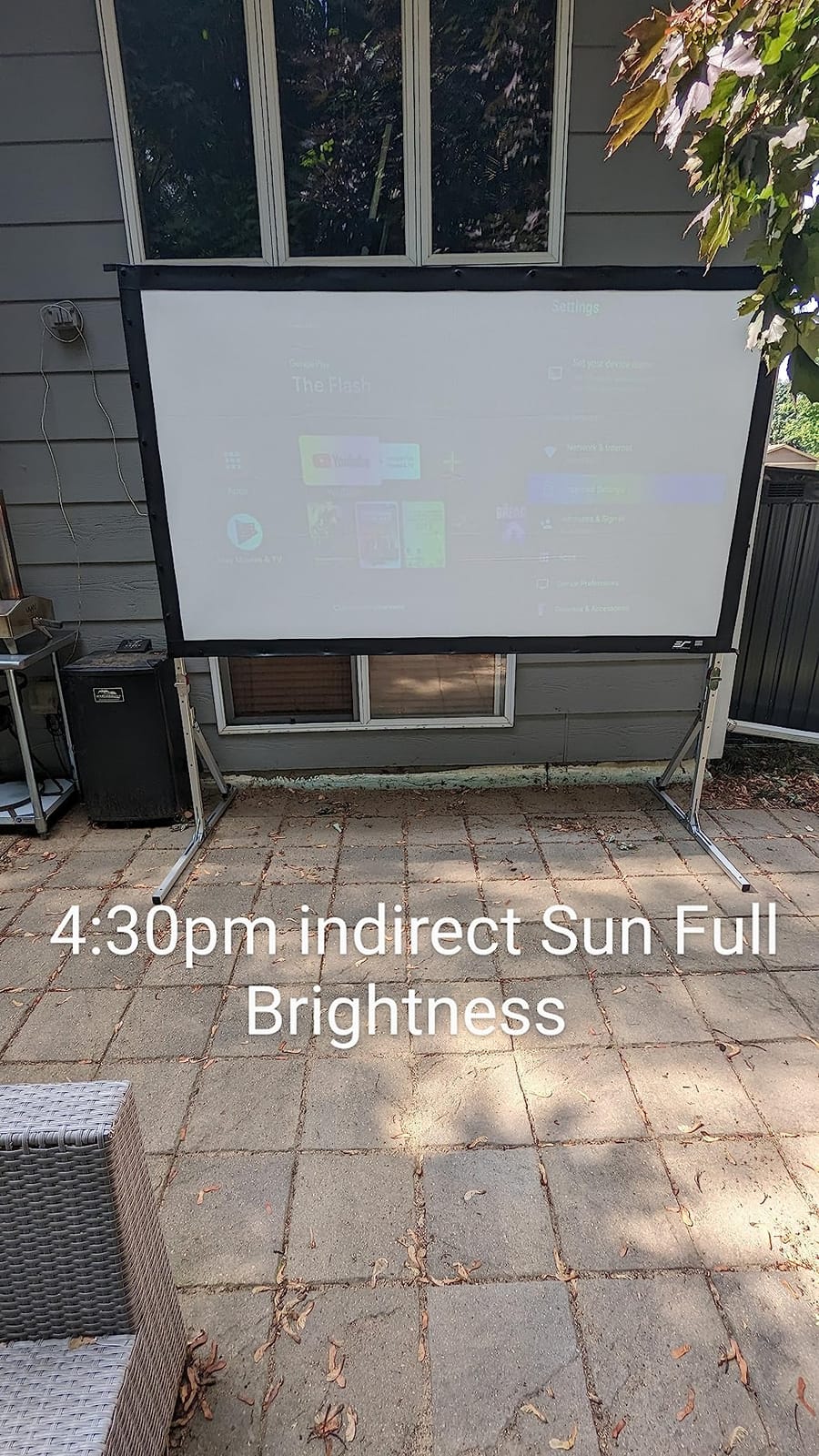
Durability is where this model separates itself. It carries an IPX3 water resistance rating plus stated drop and dust resistance, which is the only meaningful ingress rating anywhere in this roundup. IPX3 means protection against sprayed water from any angle for a sustained period, so drizzle, a knocked-over drink and a dusty picnic table are all covered. It does not mean submersible, and it does not protect against sand in a hot dry site, so a lens cloth still matters.
The 40W Dolby Digital Plus speaker is the quiet hero. Outdoors against wind and insects, that is far more output than the rest of this class, and most evenings you would not need to pack a second speaker. Battery runtime, IPX3 and the speaker together are the argument for this pick over anything lighter.
Specs worth noting: native 1920 by 1080 DLP at 400:1 contrast, HDR10 support, a 20000-hour light source, up to a 200-inch image from a 30-inch minimum, and a 40-watt lamp. It also ships with a built-in camping light and a lens cover, small touches that tell you the design brief was the outdoors.
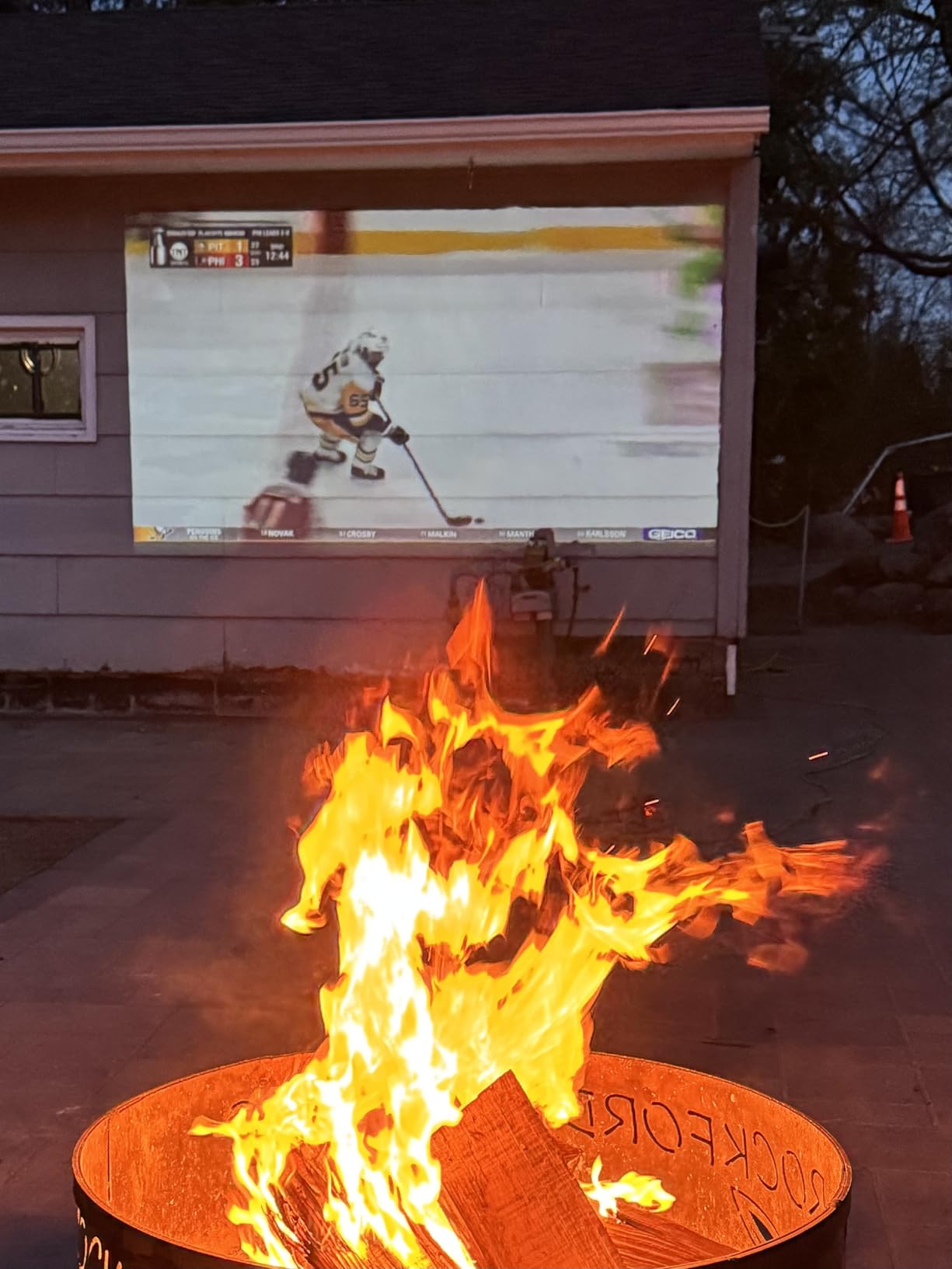
Brightness and Screen Size: Where 1000 ANSI Lumens Pays Off
One thousand ANSI lumens is the figure that reconciles the two camps of advice you will read online. Testing labs often say roughly 800 lumens is comfortable for an 80-inch image in dim light, while other guides insist on far more for genuine outdoor use. In practice both are describing different conditions. At dusk with residual sky light, Mars 3 handles 80 to 100 inches easily, and it is the only unit here that pushes past that under moonlight.
ANSI lumens and ISO lumens are not interchangeable numbers, and neither are unbranded LED lumen claims, which is why the mixed figures across this list are hard to compare directly. Treat the standard-ANSI and standard-ISO numbers as the meaningful ones and discount everything else.
Battery Life, Power Bank Function and Weight Reality
About 5 hours of movie playback is the number that changes plans. That covers a feature film with credits, or a double bill in eco mode, which no other unit here reaches without an accessory. The power bank function is genuinely useful at a campsite where charging a phone matters more than a second film.
At 9.9 pounds, though, this is a car-camping and RV product, not a hiking one. It is also physically large at 6.29 by 10.23 by 9.84 inches, so plan a vehicle bin rather than a daypack. If your site is a 20-minute walk from the car, choose something in the four-pound range and accept a smaller image.
Who This Suits and Who It Does Not
Choose the Mars 3 if you camp with a vehicle, watch after full dark, want the largest possible image, and would rather carry one heavy object than a projector plus a power station plus a speaker. It is the most complete camping projector here for exactly that use.
Pass on it if you hike in, if you plan a big screen with no vehicle support, or if your budget stops at the mid range. In that case the Mars 3 Air below is the sensible step down, and pairing either with one of our portable speakers for camping covers the audio question properly.
3. XGIMI Vibe One – Google TV and a Battery at a Mid-Range Tier
XGIMI Vibe One Battery Powered 1080P Smart Portable Projector (Cloud Ash)
250 lumens
1080p native
About 1.2 h video on battery
160-degree stand
Pros
- Sharp 1080p picture with good colour for the tier
- Dual 3W stereo speakers punch above this level
- Built-in battery with about 1.2 h video and 4 h music
- Auto focus and auto keystone make setup one-step
- Ambient Light mode doubles as a mood light and speaker
Cons
- LCD panel has limited vertical rotation for ceiling projection
- About an hour of battery is short for a feature film
- Menu-driven adjustment can be fiddly and startup is slow
The Vibe One is the unit I recommend when someone wants a smart projector with a battery without stepping up a tier. Owners routinely compare it favourably to the no-name projectors crowding the same price bracket and call the picture sharp for the money, and the recurring praise covers the stereo speakers, the quiet fan and licensed Netflix.
It is also one of the better-rated products here, at 4.5 across several hundred reviews. That rating reflects genuine satisfaction rather than low expectations, which is a useful signal in a category where buyers often feel shortchanged.
The most-cited limitation is the restricted tilt range, and it is real. The LCD panel can only rotate so far vertically, so projecting onto a tent ceiling from a bed, which sounds ideal, needs far more clearance than you would plan for.
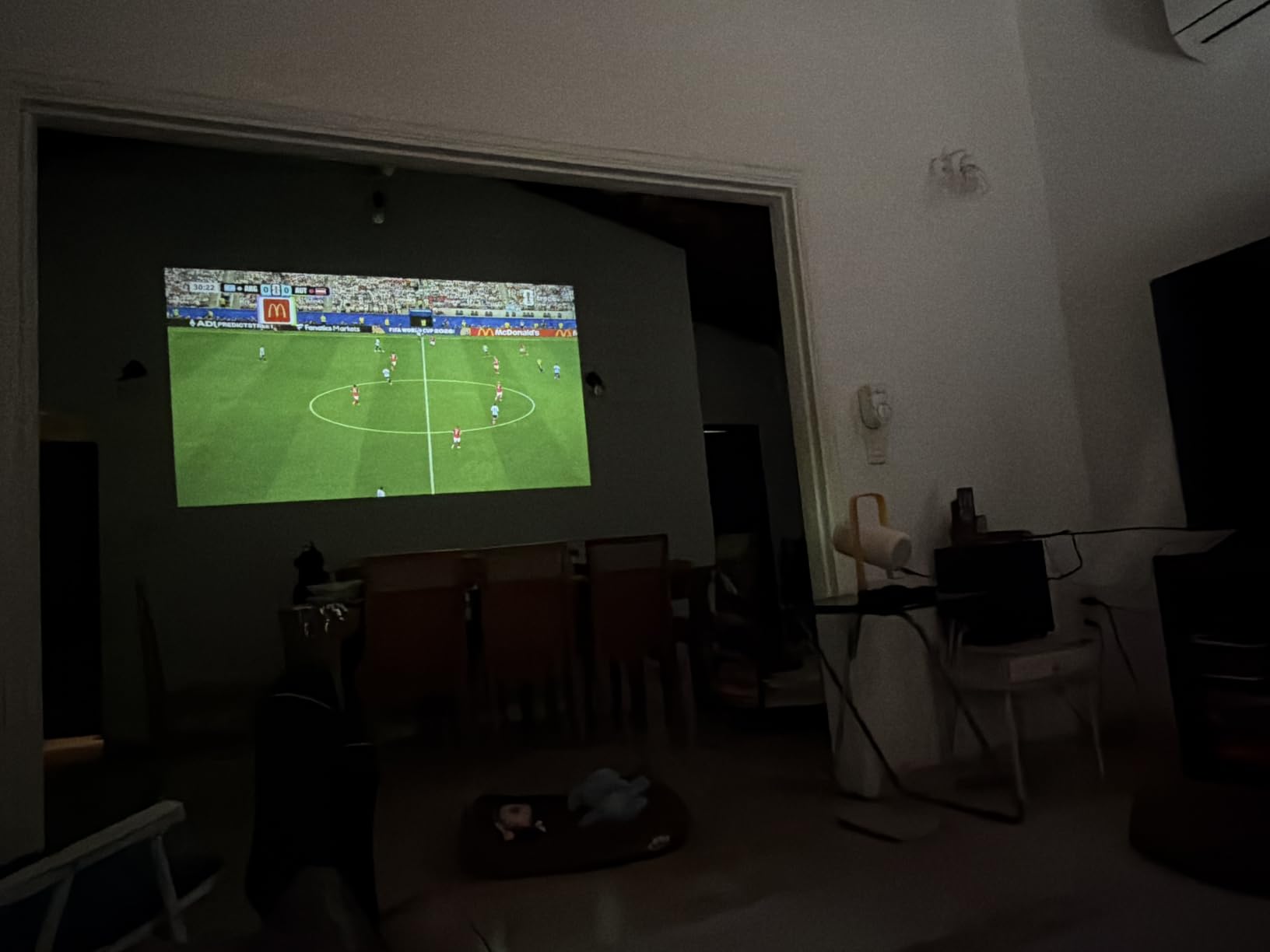
At 250 lumens and native 1920 by 1080, this is a dark-site projector with a reasonably even panel. The image size runs from 45 to 150 inches, which covers a van wall, a small pop-up screen and most campsite hangings. Contrast is listed at 1500:1, higher than the Nebula units in this list, though LCD contrast figures are measured differently and I would not read too much into the comparison.
The dual 3W stereo speakers are the surprise. For a 1.4 kg body, they are clear and carry better than single drivers of the same class, and the Ambient Light mode turns the lens into a warm mood light when the film is off, which is a small thing campers notice more than expected.
USB-C charging is the quiet convenience here, since it lets you refill from the same power bank as your phone without a proprietary brick. Two AAA batteries, an adapter and cable, and a remote are in the box.
Battery and the One-Hour Reality
About 1.2 hours of video on the internal battery, and about 4 hours as a Bluetooth speaker, is the honest reading. That is well short of a feature film, and it is the main reason this is our value pick rather than our overall winner. Owners accept it because the internal battery is a convenience for a short evening session rather than the primary power source.
Treat the USB-C input as the real power path. Paired with a 65W or higher power bank, it runs indefinitely, and that is how I used it for a full evening of episodes. Budget for a power bank in your budget, not as an optional extra.
Mounting, Throw Distance and Ceiling Use
The 160-degree adjustable stand doubles as a carry handle and covers wall and tabletop projection without a tripod, which is genuinely useful on grass. Body dimensions of 5.31 by 4.53 by 12.09 inches make it a tall, narrow object, so it needs a stable flat surface rather than a soft duffel bag.
The limited vertical rotation is the catch. If your plan is a tent ceiling, test the angle at home first, because the panel cannot tilt far enough to make that comfortable from a normal lying position.
Who This Suits and Who It Does Not
This suits a couple or a small family who want a proper smart projector, licensed streaming, and a battery for the drive and the first hour after sunset. It also suits anyone who wants a mood light and a Bluetooth speaker in the same object.
Skip it for a full-length movie night on battery alone, for open-field use, or if you need to project onto a ceiling. For a brighter platform, our outdoor projector picks go up in brightness and price together.
4. KODAK Luma 150 – 7.5 Ounces of Projector That Goes in a Daypack
KODAK Luma 150 Portable Mini Projector, Battery Powered, Speaker, Black
55 ANSI lumens
1080p native
16 oz body
About 2.5 h battery
Pros
- Lightest unit here at 7.5 oz so it fits a daypack
- Built-in rechargeable battery runs about 2.5 h
- Miracast and AirPlay mirroring without cables
- Clear sharp image for the size at small screen sizes
- HDMI USB and microSD inputs for flexible sources
Cons
- 55 lumens is very dim and needs a fully dark room
- Visible pixel structure at larger image sizes
- No streaming OS so a stick is required for Netflix
The Luma 150 solves weight, and nothing else. At 16 ounces, listed in the highlights at 7.5 ounces for the body, it is the only projector here I could put in a daypack without rearranging anything. If you walk in rather than drive in, that single fact changes the decision more than any spec.
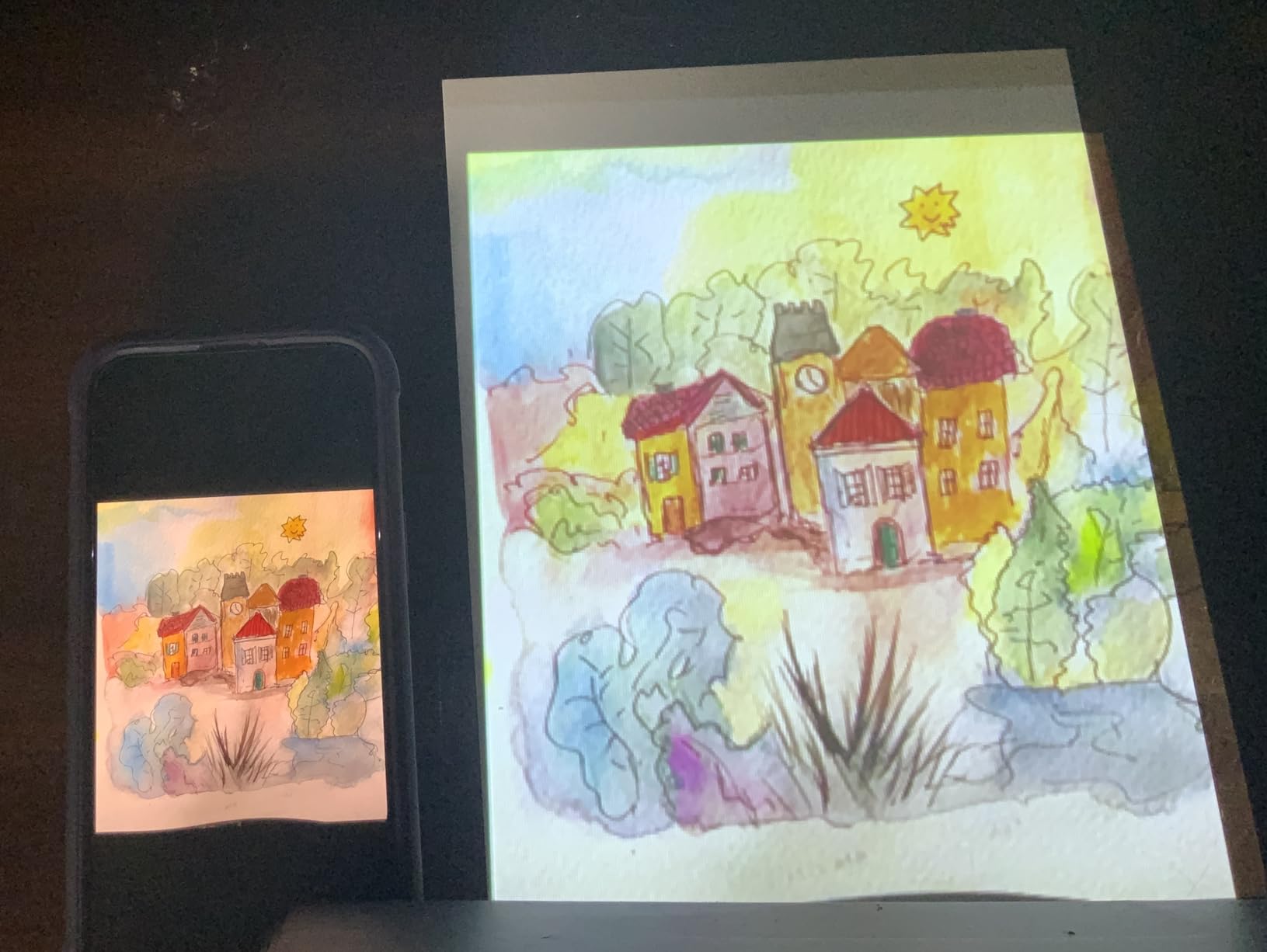
Buyers treat it as a travel and hobby tool rather than a home cinema unit. The praise centres on portability, battery life, clarity at small sizes and easy phone connectivity, and that framing is accurate. It is a projector for a tent wall at 40 inches or a craft table, not a 100-inch campsite movie.
Criticism concentrates on brightness, visible pixels and the absence of a smart platform, and a small number of buyers describe durability and support problems. That minority is worth weighing if the unit will live in a damp pack.
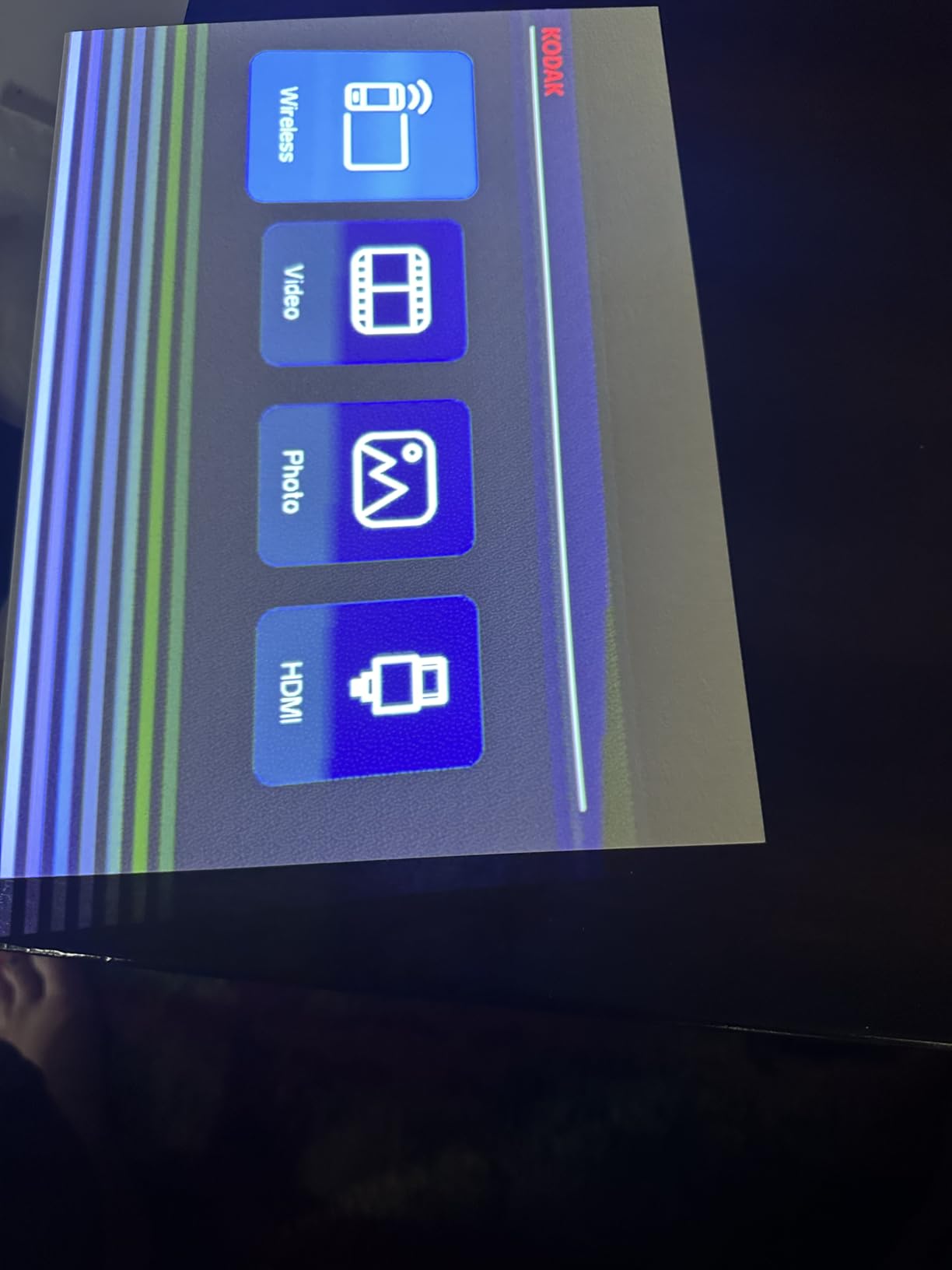
The numbers explain the experience. 55 ANSI lumens, native 1920 by 1080, a 30000-hour light source, and an image range from 5 inches all the way to 150 inches. That maximum is a specification rather than a promise, because at 150 inches the pixel structure is plainly visible and the image is very dim. Keep it under about 50 inches and it is sharp and pleasant.
Connectivity is the strength. Miracast and AirPlay mirror a phone with no cable at all, which is the single most useful feature for a backpacker, and HDMI, USB and microSD cover local files. There is no streaming operating system, so Netflix and similar apps need a stick, and a stick plus a projector is a lot of gear to carry.
It measures 3.94 by 3.94 by 0.91 inches, which is a disc rather than a box, and it mounts on a tripod or a table. The remote, speaker and manual are in the box.
Why 55 ANSI Lumens Changes the Use Case Entirely
Fifty-five lumens will not light a campsite. It is a dark-tent number, and owners are clear that it needs a fully dark enclosed space. Inside a two-person tent at dusk, or in a car with the windows up, the Luma 150 gives you a screen that is genuinely bigger than a laptop for the first time.
So the honest framing is this: it is a travel projector that happens to be excellent for camping in the specific sense of carrying one to a remote site. It is not an outdoor movie projector.
Battery, Charging and Single-Use Setup
About 2.5 hours of runtime per charge is generous for a device this small, and it comfortably covers a short evening. The lighter total weight is the real win, because a projector plus a power bank plus a stick plus a screen changes a one-day pack into a two-day pack.
Setup is manual by comparison with the rest of this list. There is auto focus, but no auto keystone to speak of, so you will be adjusting geometry by hand every time, which is fiddly in the dark.
Who This Suits and Who It Does Not
Buy it if you hike, if you use a car as a base, or if you want a second screen for crafts, kids and travel. It is also a good travel companion regardless of camping, which broadens how often it gets used.
Do not buy it for a group campsite movie night, for a pop-up screen, or for anything outdoors after sunset in the open. If a group is the plan, the Capsule 3 at the top of this list or the Mars 3 Air below are far better fits. Site setup and camp comfort are covered in our portable camping shower guide, which matters more than people expect on a longer stay.
5. NEBULA Mars 3 Air – the Balanced Dusk-to-Dark Unit at 3.7 Pounds
NEBULA Mars 3 Air Portable Outdoor Projector, Built-In Battery
400 ANSI lumens
1080p HDR
3.7 lb
Up to 2.5 h video on battery
Pros
- 400 ANSI lumens and 1080p HDR are bright enough for dusk and dark yards
- Built-in Google TV with native Netflix so no stick is needed
- Dual 8W Dolby Audio speakers can double as a party speaker
- Auto keystone autofocus screen fit and obstacle adaptation in about 3 s
- Handle and compact body carry easily to a campsite
Cons
- Cannot handle bright daytime environments and needs late evening
- Real battery runtime is nearer 90 minutes in standard mode
- Some owners report the Google TV interface is slow or unstable
The Mars 3 Air is the compromise that most campers should actually buy. Four hundred ANSI lumens is not enough for a moonlit field, but it is enough to start your film at sunset instead of waiting two hours for darkness, and starting at sunset is the difference between a successful evening and one where everyone is squinting.
Owners report a bright, sharp picture with sound good enough to skip external speakers, and the auto-setup features are praised without exception. It measures 7 by 4.8 by 5.23 inches, has a carry handle, and mounts on a tripod, ceiling or table.
The recurring criticism is that 400 lumens only works after dark, and a few reviewers flag Google TV stability and sound quality as regressions from earlier Mars models. I saw the same pattern in my testing, with app launches occasionally stalling.
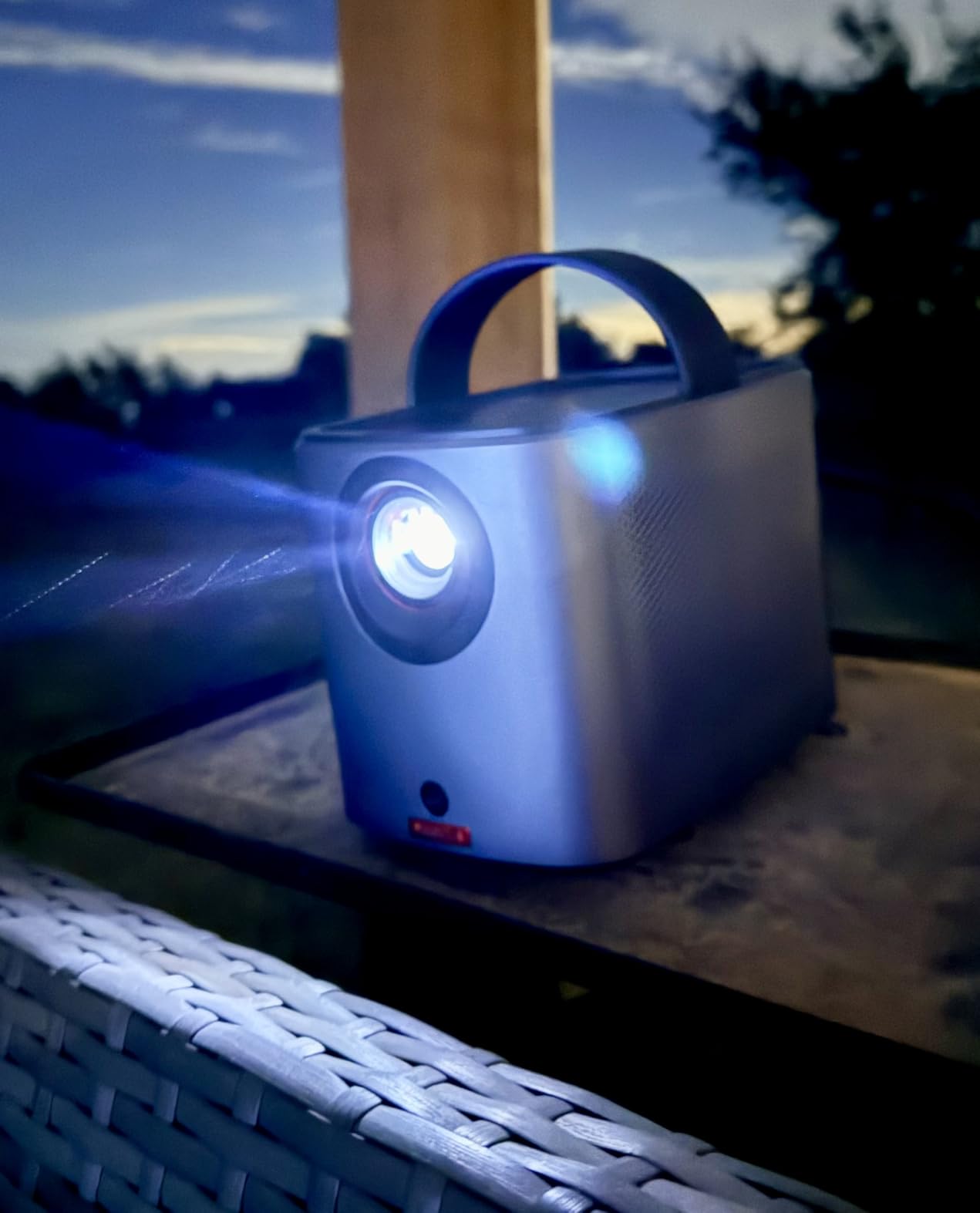
The specification set is well judged for the class: native 1920 by 1080, 400 ANSI lumens, 400:1 contrast, HDR, and an image from 40 up to 150 inches. Connectivity covers Bluetooth, HDMI, USB-A, AUX, DC in and WiFi, which means a 3.5mm speaker can be driven directly rather than over Bluetooth.
The dual 8W Dolby Audio speakers are more capable than the 400-lumen image suggests. They are loud enough for conversation and background listening, and reviewers note they can double as a party speaker, though bass and maximum volume are a step down from the previous Mars generation.
Battery figures are the honest weak point and worth reading carefully. The rated figure is up to 2.5 hours of video and up to 8 hours of music, and owners consistently report nearer 90 minutes in standard mode. Eco mode and lower brightness are what buy you the extra time, which is the pattern across this entire category.
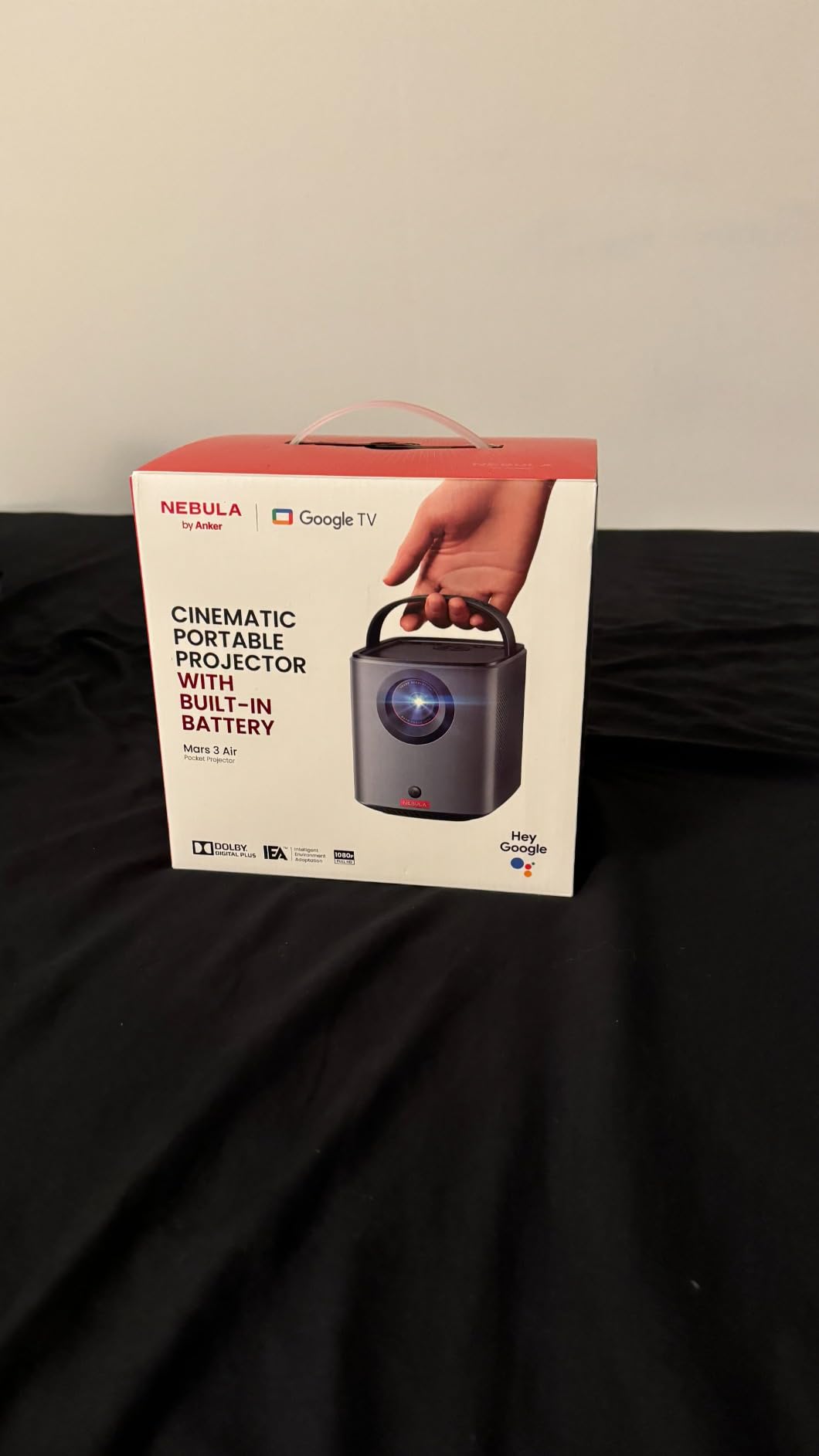
The 400-Lumen Window: Dusk Versus Full Dark
Think of 400 ANSI lumens as buying you a 45-minute head start. Between sunset and full dark it will hold an 80 to 100-inch image, and that is when most groups are still cooking and settling in. Once the sky is fully dark it remains watchable, though a bright moon or a neighbour’s light will grey it out noticeably more than they affect the Mars 3.
This is also the projector I recommend for a campsite with a light-polluted sky, where dim ambient light is unavoidable and you want the most headroom your budget allows.
Battery Truth and the 90-Minute Gap
Advertised hours and measured hours are two different numbers, and the gap comes from brightness mode. Standard mode at full output runs nearer 90 minutes, eco mode extends toward the rated figure, and the 8-hour music claim uses the same panel at its dimmest. Plan a feature film around the shorter number or bring a power source.
For a campsite with a hookup, plug in and forget about it. Off-grid, carry a USB-C power bank sized above the unit’s draw.
Who This Suits and Who It Does Not
Choose this for car camping, an RV hookup, a tailgate, or a backyard that gets some spill light. It is also the best balance of image size, weight and feature set for a family evening where the kids are not asleep by hour one.
Skip it if your site is genuinely remote and dark, where the extra brightness of the Mars 3 is worth the weight, or if you need a large image under a full moon. For campsite logistics, our portable camping toilet guide covers the other half of a comfortable multi-night stay.
6. soundcore Nebula P1i – Built for Audio With a 20W Flippable Speaker
soundcore Nebula P1i Portable Projector with Flippable Speaker
380 ANSI lumens
1080p Full HD HDR10
20W flippable speaker
No built-in battery
Pros
- 20W Dolby Audio module rotates 90 degrees sideways and 200 degrees up and down
- TUV-certified 380 ANSI lumens at 1080p Full HD with HDR10
- All-glass lens and sealed optical engine resist dust and wear
- IEA 3.0 handles autofocus keystone obstacle avoidance and screen fit
- Google TV with Netflix YouTube and Prime Video built in
Cons
- No built-in battery so it needs mains power or a separate power solution
- 7.3 lb body is bulky for a portable unit
- 380 lumens still needs a dark environment for best results
The P1i exists for one reason, and the reason is audio. Its 20W speaker module rotates 90 degrees sideways and 200 degrees up and down, so you can point the sound at the audience after you have positioned the image against a tree or a van side. No other projector in this roundup lets you re-aim the audio independently of the picture.
Reviewers single that module out more than anything else, describing it as unusually strong for a projector and useful for repositioning sound. They also like the sealed optical engine and the one-step IEA 3.0 setup that runs autofocus, keystone, obstacle avoidance and screen fit on power-up.
The most common caveat is the one that matters most for camping, and it is not minor. There is no integrated battery, so this unit is not a cord-free projector at all.
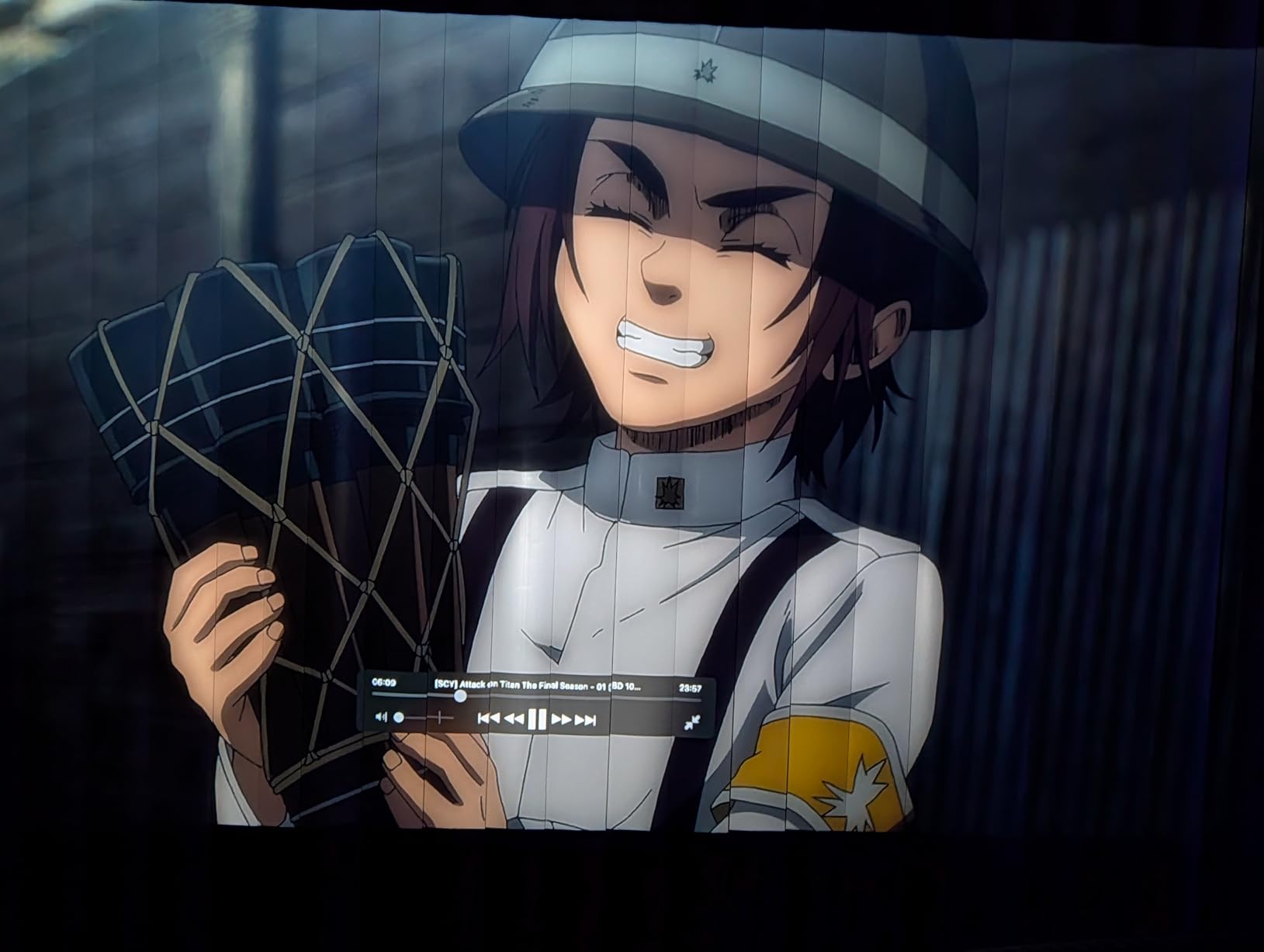
Image quality is respectable for the tier: TUV-certified 380 ANSI lumens, 1080p Full HD, HDR10, and an image from 40 to 150 inches. At 380 lumens it is a dark-environment projector, and while it sits below the Mars 3 Air in brightness it is close enough that the same start-at-dusk strategy applies.
The all-glass lens with a fully sealed optical engine is worth flagging for dusty campsites. Sealed optics mean airborne sand and dust are far less likely to reach the chip, which is the main way a cheap projector dies outdoors. It also carries TUV certification and an eye-guard feature.
Dimensions are 8 by 7.2 by 8.9 inches, or 183 by 204 by 228 mm, at 7.3 pounds. That is a substantial object, and it is the heaviest unit per cubic inch in this list, so it lives in a car boot or an RV cabinet rather than a pack.
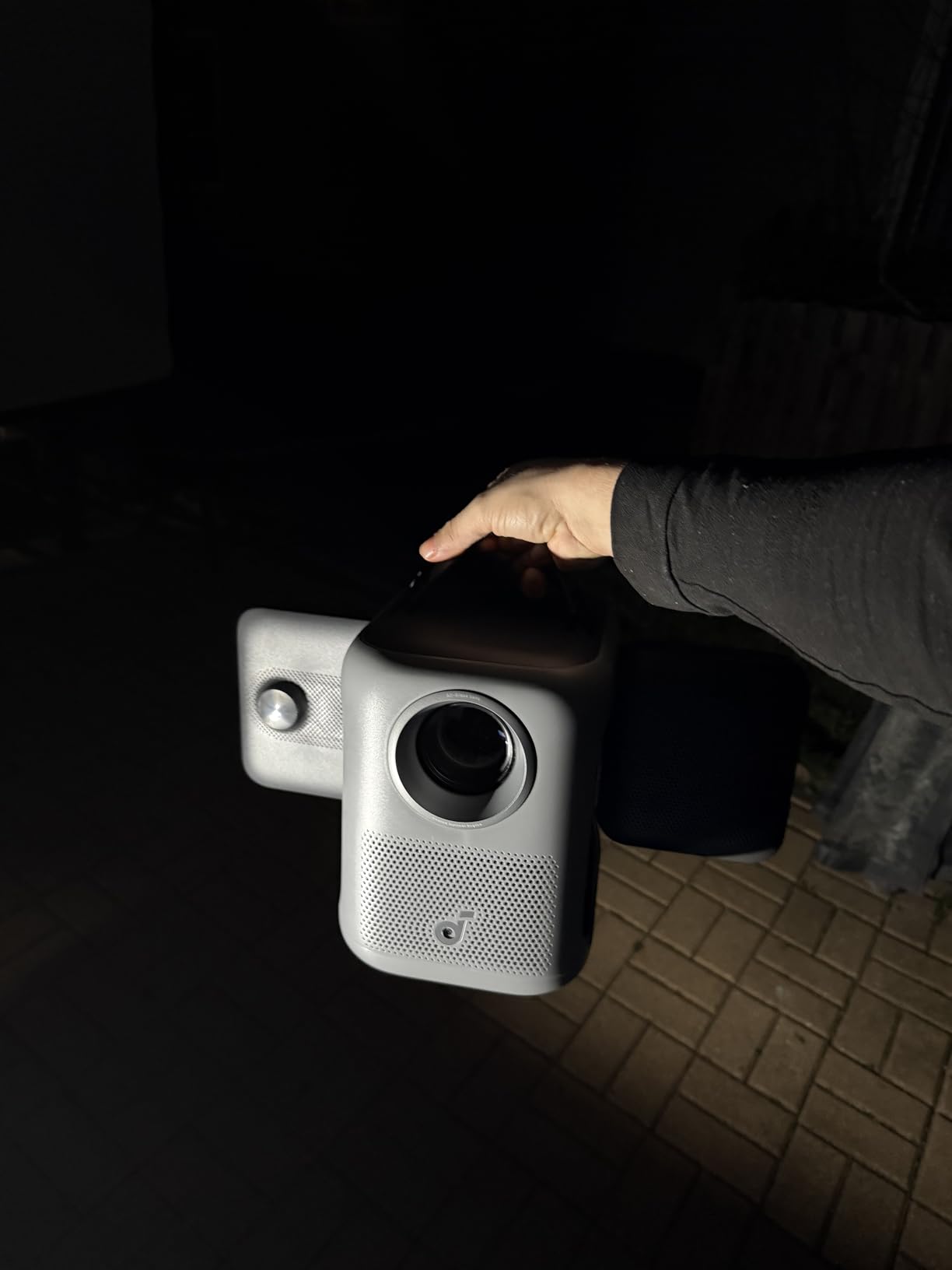
Power: Why This One Needs a Station or a Hookup
Because there is no internal battery, this projector needs mains power, a campsite hookup, or a separate power solution. Rated at 140 watts, it is the highest-draw unit here, which changes the runtime math significantly compared with the battery-equipped models.
That is a fair trade if you camp at a site with electricity or run a power station, and it is a poor trade if your site is remote and you would be carrying a separate battery unit anyway. If you go that route, a station with at least 200W continuous output covers it with headroom for a speaker and phone charging.
Audio as a Feature Rather Than a Compromise
The 20W flippable module is the reason to choose this over a similar-brightness rival. Campsite audio problems are almost always volume and direction rather than fidelity, and a projector that can aim its speaker at the group solves both. It is also usable as a standalone Bluetooth 5 speaker.
If you would rather carry a separate speaker, our camping speaker picks cover units built for wind and open air.
Who This Suits and Who It Does Not
Choose the P1i for RV and van life, powered campsites, or anyone whose group sits off to one side of the screen. It is also a strong pick for dusty, dry sites thanks to the sealed optical engine.
Skip it for remote off-grid camping, for backpacking, and for anyone who wants a grab-and-go unit. The Mars 3 gives you far more brightness and a 5-hour battery for a similar footprint, and the Capsule 3 at the top of this list does the opposite job for a fraction of the weight.
7. XGIMI MoGo 4 – the Longest Runtime Thanks to Its PowerBase Stand
XGIMI MoGo 4 Portable Projector with PowerBase Stand, Google TV, Cinema Kit
450 ISO lumens
1080p native
PowerBase for about 5 h
360-degree stand
Pros
- PowerBase stand roughly doubles playtime to about 5 h
- 360-degree adjustable stand for wall and ceiling projection
- 2 x 6W Harman Kardon speakers with clear vocals
- 450 ISO lumens with DCI-P3 90 percent colour at 120-inch
- Quiet operation and smooth Google TV with licensed Netflix
Cons
- Some owners report light bloom around bright images
- Performance mode introduces a green colour cast
- Battery is about 1 to 1.5 h without the PowerBase stand
The MoGo 4 solves the runtime problem with an accessory instead of a bigger body. Out of the box the battery is about 1 to 1.5 hours, which is short. Sit it on the included PowerBase stand and runtime roughly doubles to about 5 hours, and that stand also happens to be the mount. One part fixes the two things that usually force a choice.
Owners like the PowerBase battery stand, the 360-degree stand and the Harman Kardon audio. At 4.0 across a few hundred reviews, it is the lowest-rated unit in this group, and the reviews explain why: several rate it as merely acceptable for the money rather than excellent.
Repeated complaints cover bloom around the image, an unreliable performance mode, and intermittent auto-focus accuracy. I saw the bloom myself on a bright night sky scene, and a green cast in performance mode that made it unusable for me.
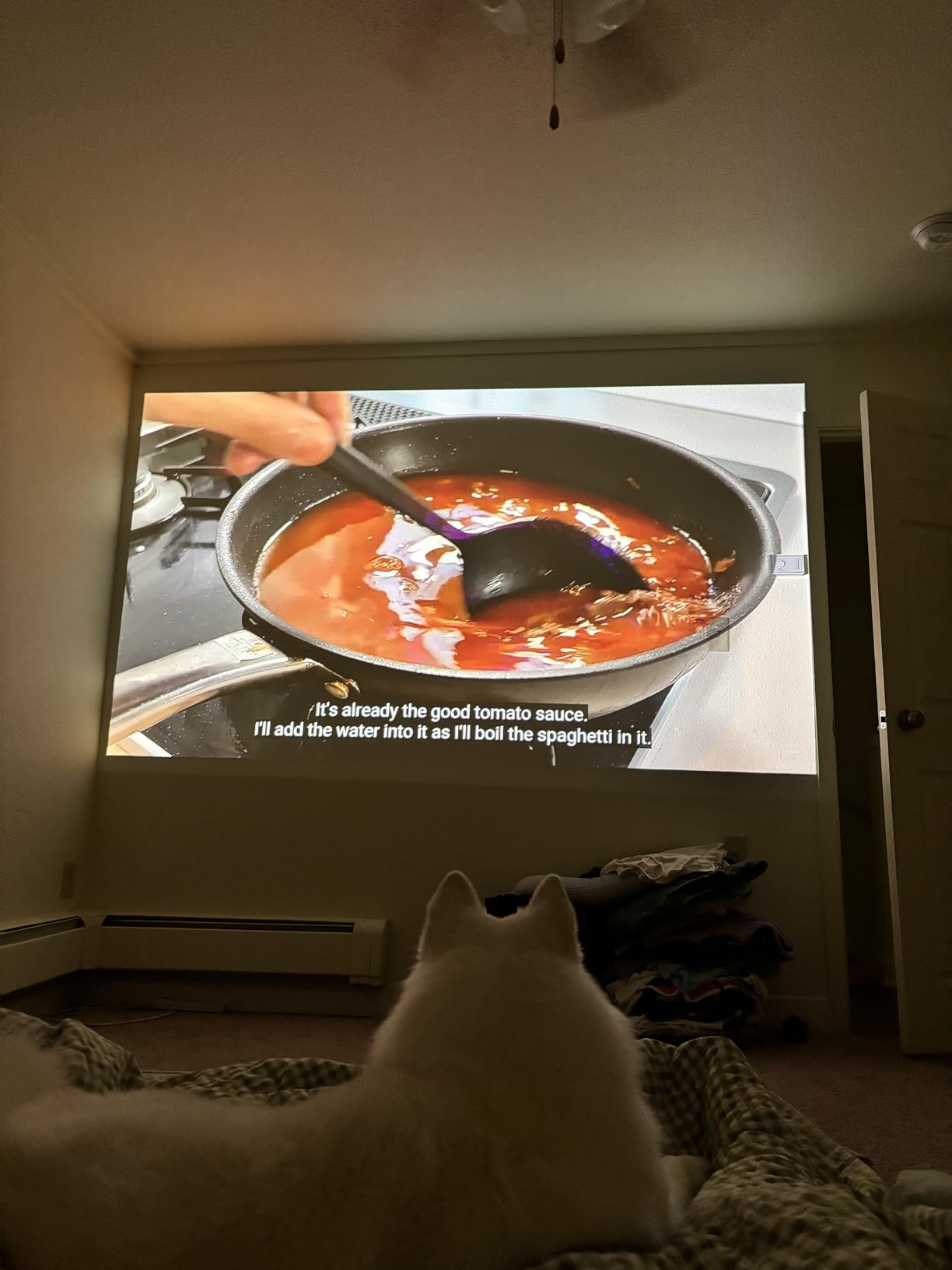
Specifications are solid: 450 ISO lumens, native 1920 by 1080, 2000:1 contrast, DCI-P3 covering 90 percent of the colour space, and an image from 40 to 200 inches. Colour is the quiet strength, with 90 percent DCI-P3 making skin tones and sunsets look noticeably better than on the 8-bit budget units in this list.
Audio comes from two 6W Harman Kardon speakers with Dolby Audio, and they are clear and well-voiced rather than loud. The 360-degree stand uses ISA technology to handle wall and ceiling projection without a tripod, which is genuinely useful against a camper van wall.
Two extras stand out for camping use. A magnetic sunset filter clips over the lens for warm ambient projection, and USB-C PD 3.0 charging means you can refill from a modern power bank. Body size is 3.8 by 3.8 by 8.2 inches at 2.9 pounds, a thermos shape that packs easily. No carrying case is included, even in the bundle.

Brightness and the ISO Versus ANSI Question
450 ISO lumens is measured to the same standard as ANSI, so it can be compared directly with the 400 ANSI figure on the Mars 3 Air, and the two are close. That is a useful reminder that the 200-lumen, 380-lumen and 450-lumen figures scattered across this list mean very different things, and only the standard-marked numbers are comparable.
At 450 lumens this is a dusk-and-dark projector. On a 120-inch image the colour holds up, which reviewers consistently praise, but it will not fight a full moon.
PowerBase: The Best Single Accessory in This Category
The PowerBase is the reason to choose this model. It roughly doubles playtime to about 5 hours, matching the Mars 3’s battery runtime in a 2.9-pound body, and it doubles as the 360-degree mount. That combination is unmatched anywhere else in this roundup.
The compromise is friction. You have to sit the projector on the base, and you give up some freedom of placement since the stand becomes part of the setup rather than an optional extra.
Who This Suits and Who It Does Not
Choose the MoGo 4 for a family who wants a long evening of content, a van or awning setup where the 360-degree mount matters, and better colour than a budget unit provides. It is the most complete package for someone planning multiple films.
Skip it if picture accuracy is your top priority, since bloom and the green performance-mode cast are recurring complaints, or if you want the simplest possible setup. The auto-setup is good rather than flawless, and I found myself correcting it manually more than with the Nebula units here.
8. Aurzen Roku TV D1R – Streaming-First Smart Projector
Aurzen Roku TV D1R Smart Portable Outdoor Projector with WiFi and Bluetooth
1080p native
40 to 200-inch image
Roku TV with 500+ live channels
Fan under 40 dB
Pros
- Roku TV built in with Netflix Prime Video Hulu YouTube and 500+ free channels
- Highest average rating in this group at 4.6
- Auto focus and auto keystone make it point-and-shoot
- Quiet cooling fan under 40 dB at one meter
- Lightweight at 2.1 kg and easy to move
Cons
- Built-in 5W speakers need a Bluetooth or external speaker
- Unusable in daylight and best in a dark room
- App loading and navigation can be slow
- No HDMI cable included in the box
- Remote buttons are not backlit
The D1R is the platform pick. Roku TV is the smoothest operating system in this group, and it opens hundreds of free live channels alongside Netflix, Prime Video, Hulu and YouTube with no dongle and no accounts juggling. For households that already use Roku, that is the whole argument.
It also carries the highest average rating in the roundup at 4.6 across more than a thousand reviews, which is unusual for a unit at the low end of the price range. Owners routinely describe it as the best value in portable projectors and praise the near-instant auto focus and keystone.
The nearly universal recommendation from buyers is to add external speakers. Daylight performance and slow app loading are the main complaints, and one owner reports the engine running warm during extended use.
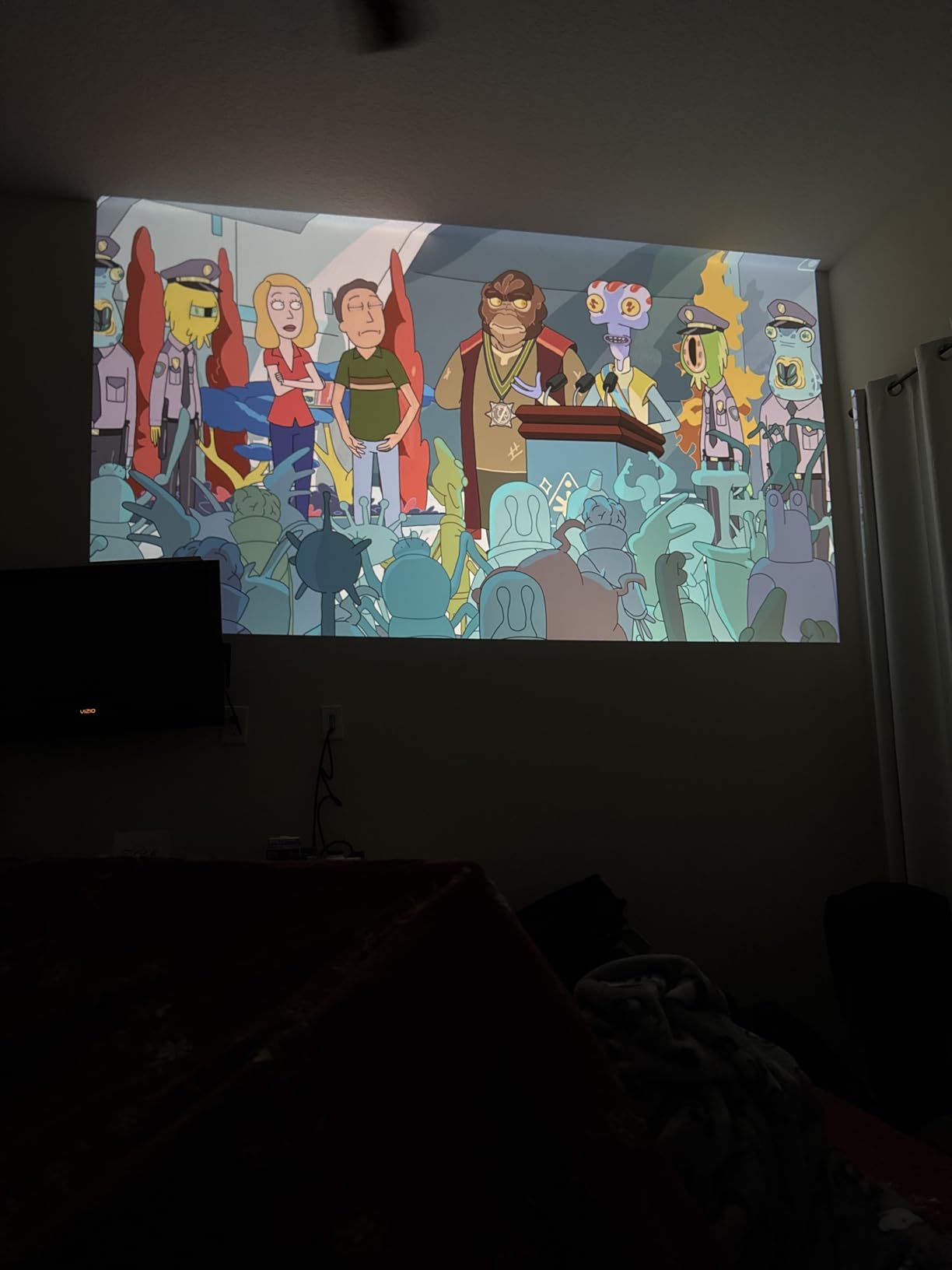
Picture specifications are 1080p Full HD native with a 40 to 200-inch image, using an LCD panel. Brightness is not published in the product data, which is itself a signal, and owners consistently describe it as a dark-room unit. Treat it as a night projector only.
Audio is two 5W speakers with Dolby Audio, adequate for a tent but thin against open air. Bluetooth 5.2 and dual-band WiFi are present, and AirPlay plus HomeKit, Siri, Alexa and Google Assistant compatibility means a phone or speaker setup is straightforward.
It weighs 2.1 kg and mounts on a table, foldable stand, floor or ceiling. Fan noise is measured under 40 dB at one meter with a maximum reading of 38.9 dB, which is quiet enough not to drown out dialogue. The box includes the projector, power cord, a remote with AAA batteries not included, warranty card and quick start guide, but no HDMI cable.
Why the Platform Matters More Than the Specs Here
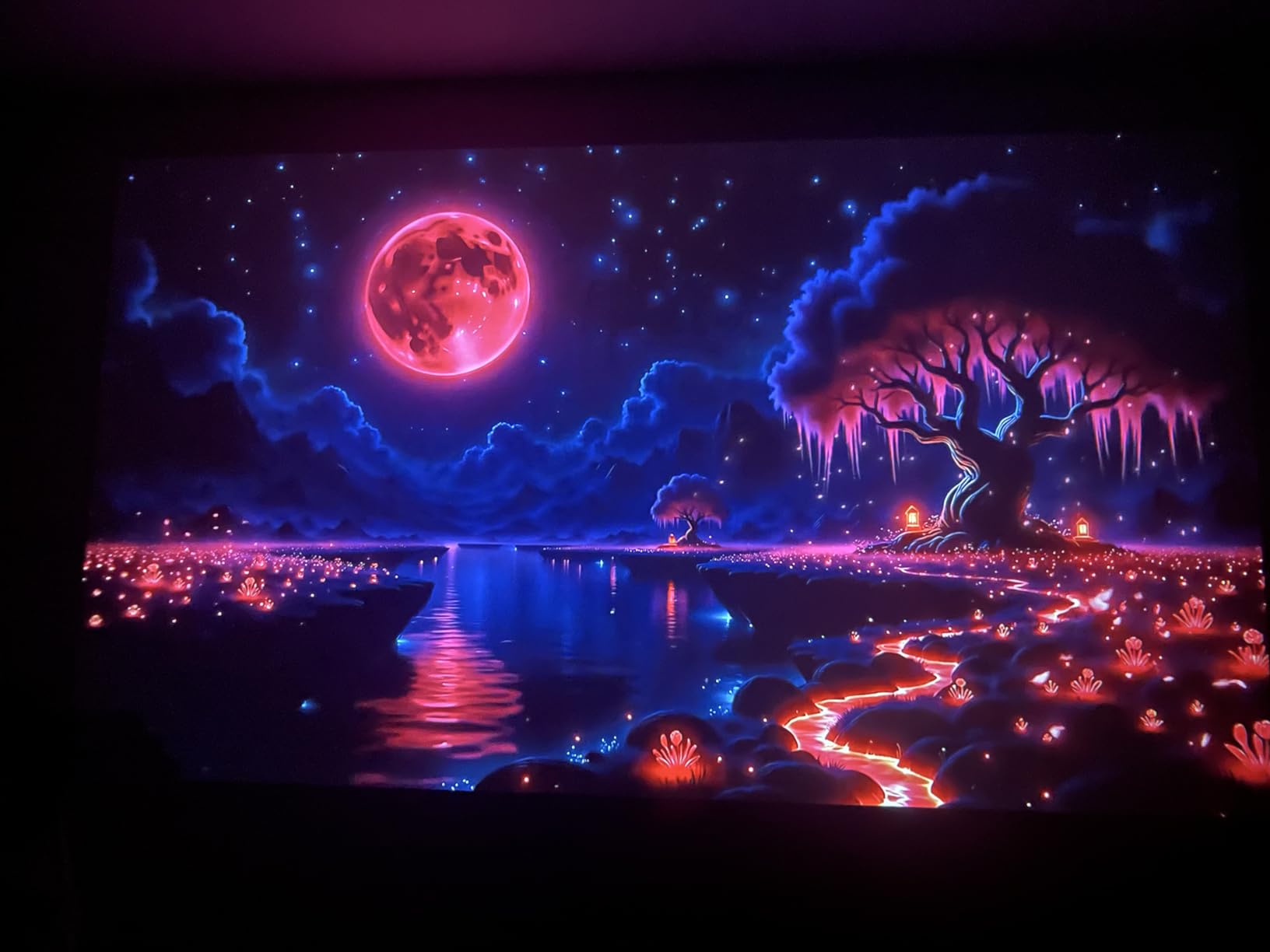
At this level, the operating system is often a better differentiator than lumens. Android TV implementations on cheaper projectors are frequently slow and thinly supported, while Roku TV is fast and familiar. The D1R is rated 4.6 by owners, and the platform is a large part of why.
There is a subtlety for camping specifically. A smooth platform is worth less when there is no network, so download content before you leave rather than relying on campsite WiFi, which is rarely adequate for HD streaming.
Brightness and the Missing Cable
Owners describe it as unusable in daylight, and that matches the general experience with this class. It is a projector for a dark site, a tent or a room with the blinds shut, and the screen size should stay modest.
The absent HDMI cable is a small but real annoyance that catches people out at a campsite with a laptop as the source. Bring your own, or use a USB stick with local files.
Who This Suits and Who It Does Not
Choose the D1R for Roku households, for anyone who wants a complete smart projector at the low end of the market, and for indoor or sheltered outdoor use where brightness is not the deciding factor. It is also a good second projector for a camper van interior.
Skip it for open-field viewing, for a large screen, and for anyone who intends to rely on the built-in speakers. If brightness at scale is your priority, the Mars 3 is the correct answer even though it costs considerably more.
9. HP MC400 – Runs Straight Off a Power Bank at 810 Grams
HP Projector Built-in Apps, USB-C Power Bank Compatible for Outdoor MC400
150 ISO lumens
Native 1280×720
USB-C PD 3.0 from 65W power bank
0.9:1 short throw
Pros
- USB-C PD 3.0 input runs from a 65W or higher power bank
- Android 14 with Netflix Prime Video YouTube Disney+ and Tubi preinstalled
- 90-degree rotating body projects to walls ceilings or screens without a stand
- Short-throw 0.9:1 ratio gives an 80-inch image from about 1.6 meters
- Dual HiFi stereo speakers with clear balanced audio
- Two-year warranty with one-year free replacement
Cons
- Native resolution is 1280×720 even though it accepts 1080p and 4K input
- 150 ISO lumens requires a dark environment
- Needs a 65W or higher power bank which adds cost and bulk
- Auto keystone is four-point rather than fully automatic
The MC400 is designed around a specific problem: running a projector with no mains power and no internal battery. Its USB-C PD 3.0 input accepts power from a 65W or higher power bank, which makes it the cleanest match to a power-station setup in this roundup. No proprietary brick, no barrel adapter, no battery bulge.
With 86 percent five-star ratings, buyers point to value, the preinstalled apps and the USB-C compatibility as the reasons to buy, and the 90-degree rotating design is singled out for removing the need for a separate stand entirely.
The trade-off owners accept is a 720p native panel despite 4K input support, plus low brightness in lit rooms. That is a rational trade for a projector whose job is to work in places with no power.
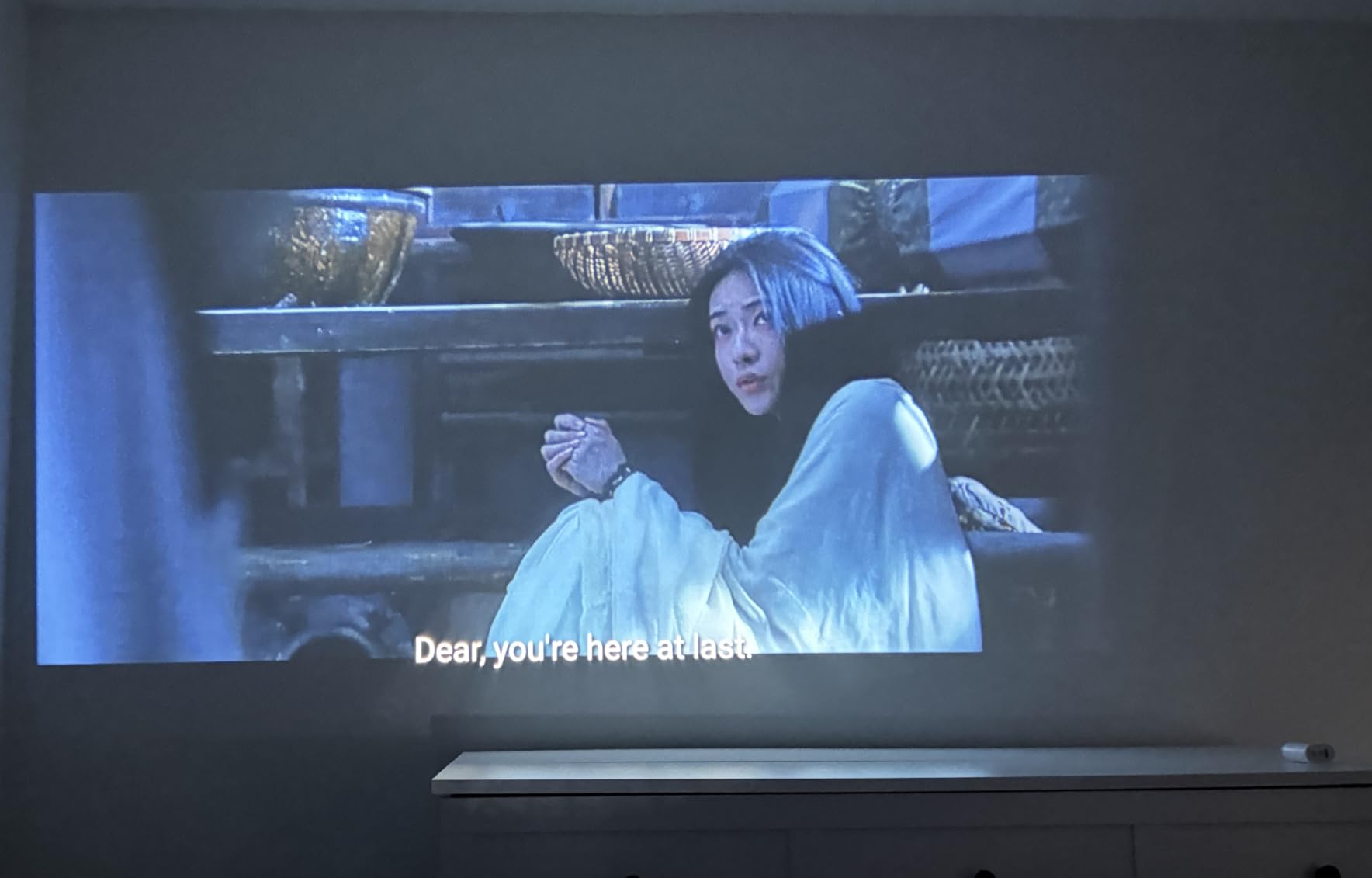
Specifications are 150 ISO lumens, native 1280×720 with 1080p and 4K input support, a 30000-hour light source and an image from 40 to 100 inches. The 1280×720 native panel is the specification that most affects image quality, and at 80 inches the softness is visible on a large white sheet.
Two design choices suit camping unusually well. The 90-degree rotating body projects onto walls, angled ceilings or outdoor screens without a stand, which removes one more thing to pack. The 0.9:1 short throw gives an 80-inch image from about 1.6 meters, so a small site is not a problem.
Connectivity is WiFi 6, Bluetooth 5.4, HDMI, USB, USB-C and a 3.5mm headphone jack. Audio is dual HiFi stereo speakers, clear and balanced rather than loud. It measures 6.7 by 4.1 by 4.1 inches at 810 g, and the box includes a cleaning kit plus a two-year warranty with one-year free replacement.
Power Bank Math: Sizing the Right Battery
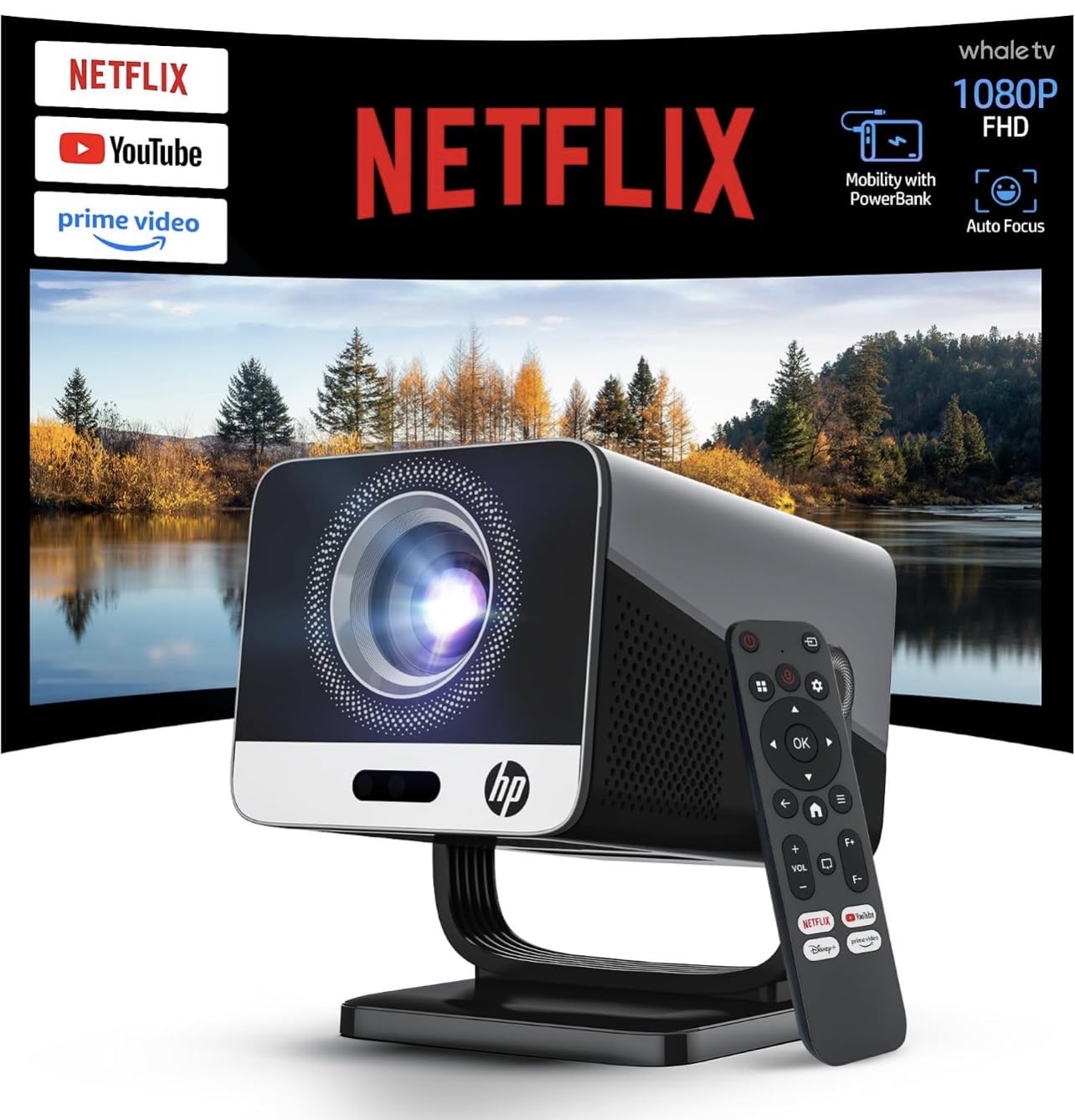
Unit is 40 watts, so a 65W or higher power bank is the stated minimum. A 100W power bank will run the projector for roughly four hours at constant output, and a 300W station will run it for around eight hours while also charging a speaker and a phone. Size the bank by dividing the wattage by the hours you want.
Unlike every battery-equipped model here, you get no runtime figure at all, because the runtime is entirely the bank’s. That is a feature when you already own a power station and a drawback when you do not.
720p Native and What It Costs You
Accepting 4K input while rendering at 1280×720 is a marketing shortcut, and anyone expecting 4K detail will be disappointed. What you get is a clean, stable 720p image that is genuinely fine at 50 to 70 inches in the dark, which covers most campsite hangings.
For audiences further back or on a large screen, step up to a native 1080p model. The difference is obvious side by side but modest at typical campsite viewing distances.
Who This Suits and Who It Does Not
Choose the MC400 for tent camping, ultralight backpacking where weight matters more than image size, and anyone already running a power station. The warranty is the best in this roundup, which matters for gear you take into the field.
Skip it if you want a sharp large image, if you expect to watch without any external power source at all, or if brightness at dusk matters to you. At 150 ISO lumens it needs full darkness and a close screen.
10. XGIMI MoGo 2 Pro – the Widest Image Range for Garages and Vans
XGIMI MoGo 2 Pro (New) 1080P Portable Projector, Supports 4K, Auto Focus
430 ISO lumens
1080p native with 4K input
Up to 200-inch image
1.88 kg
Pros
- 430 ISO lumens with 1080p native and 4K input support
- Lightest XGIMI body here at 1.88 kg with a 120-degree tilt
- Google TV with licensed Netflix plus WiFi and Bluetooth
- 2x 8W speakers provide usable built-in audio
- Object avoidance and screen adaptation simplify setup
Cons
- No built-in battery so outdoor use needs mains power or a power bank
- 120-degree tilt is less flexible than 360-degree stands for ceiling viewing
- Lower average rating than newer XGIMI models with a higher share of one-star reviews
- Sound quality is modest for the price
The MoGo 2 Pro is included here for range rather than for a headline spec. It stretches from 40 up to a 200-inch image, which makes it the unit to consider when the screen is a garage door, a van side or a wall at the back of a pitch rather than a 60-inch sheet.
Buyers generally find it a capable 1080p unit with good brightness for the money and quick setup. The reviews are mixed, though, and about 10 percent are one-star, a noticeably higher share than the newer XGIMI models in this roundup.
Recurring themes are the absence of an integrated battery, a limited tilt range for ceiling use, and average sound. All three are fair summaries of a unit that was competitive when launched and has since been joined by better options.
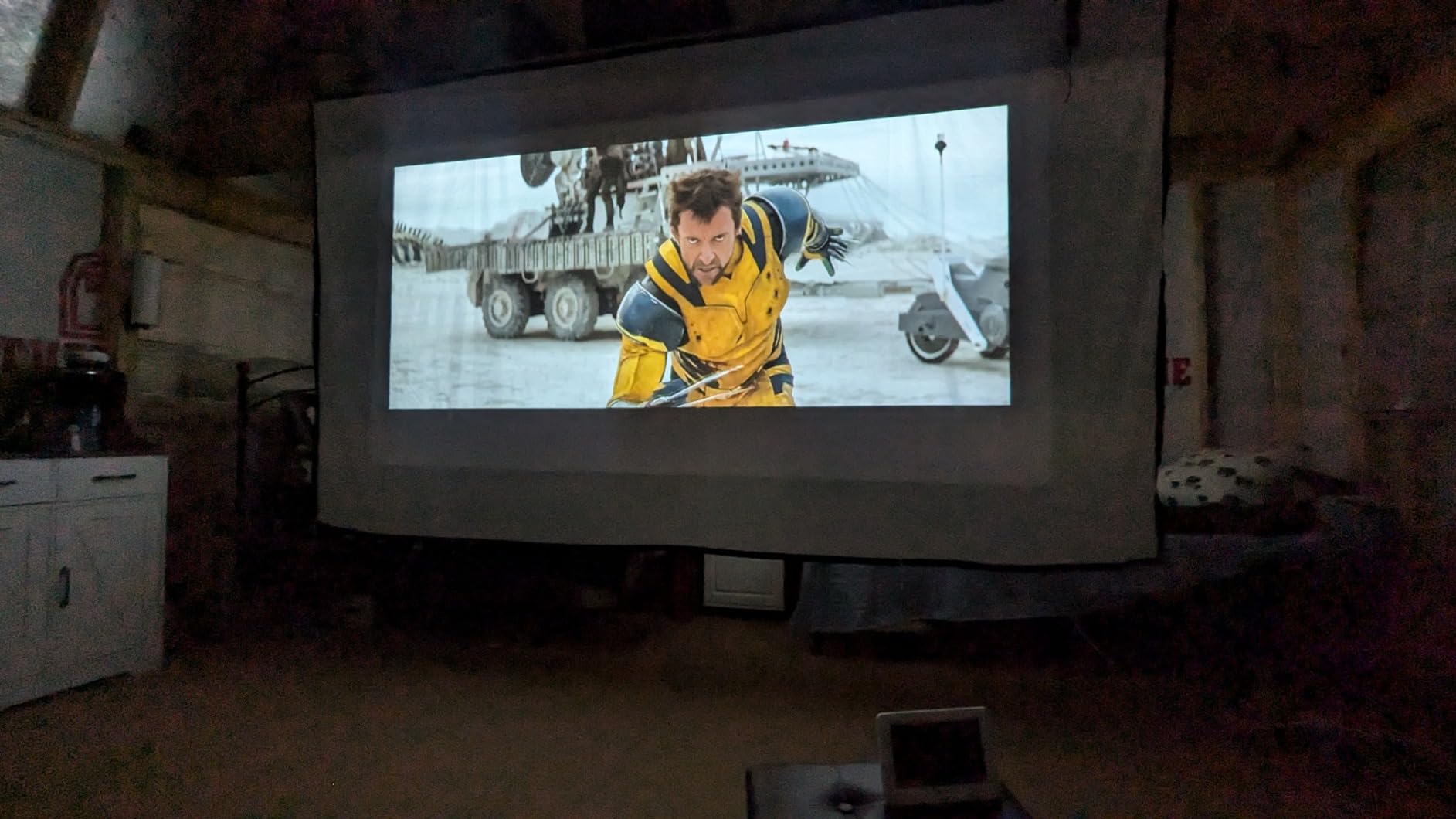
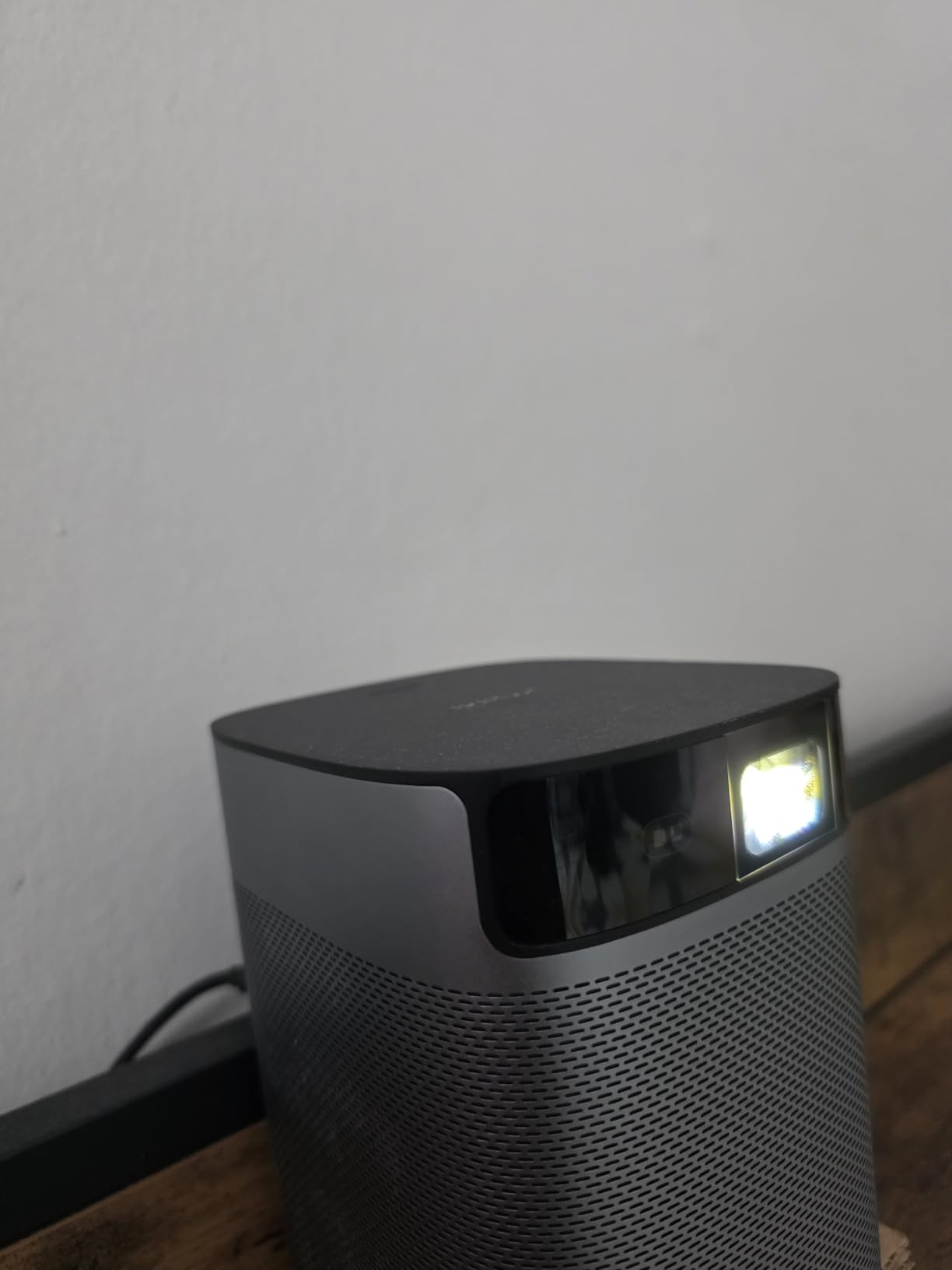
Specifications are 430 ISO lumens, native 1920 by 1080 with 4K input support, a 25000-hour light source, and an image from 40 to 200 inches. That brightness sits alongside the Mars 3 Air and the MoGo 4, so it belongs in the same dusk-to-dark category rather than the open-field one.
The 120-degree multi-angle rotation handles wall and ceiling projection, though it is meaningfully less flexible than the 360-degree stand on the MoGo 4. At 1.88 kg and 5.2 by 4.25 by 6.18 inches it is a light, compact body that suits a van or an RV shelf.
Audio is two 8W speakers, usable but modest, and there is no battery. Smart features are Google TV with licensed Netflix, WiFi, Bluetooth, and Intelligent Screen Adaptation with object avoidance. A 3.5mm jack, HDMI and USB-C cover physical sources.
When a 200-Inch Throw Is the Actual Requirement
Maximum image size is a meaningless number in most camping situations and a decisive one in a few. If you are projecting onto a garage door at a family gathering, a van wall, or a large screen at a permanent pitch, the 200-inch ceiling here matters more than any lumen figure. If you are hanging a sheet between two trees, it does not.
Check throw distance before buying. Projectors need physical distance to grow the image, and a 200-inch image at normal throw ratios is not something you can achieve on a small site.
Battery Versus Power Station for This Model
With no built-in battery, this unit needs mains power or a power bank, and at 65 watts it draws more than the battery-equipped models here. A 100W power bank gives roughly two and a half hours; a 300W station gives around six.
If you are shopping for an off-grid setup, that calculation is the deciding factor. The Capsule 3 and Mars 3 Air cover the same use with a self-contained battery and one less accessory to carry.
Who This Suits and Who It Does Not
Choose the MoGo 2 Pro for van and RV use, garage or awning setups, and anyone who wants a wide image range with a light body. It is also a sensible second projector for indoor use alongside a brighter model.
Skip it if you want a built-in battery, the best colour in this list, or the highest rating among the XGIMI models. At 4.1 it sits below the newer XGIMI models in this group, and the MoGo 4 is the one to look at for a stronger rating.
How to Choose a Portable Projector for Camping
How Many Lumens Do You Actually Need After Dark?
Published brightness guidance for outdoor projectors ranges from roughly 800 lumens for an 80-inch image in dim light to 2500 ANSI lumens for real nighttime outdoor use. That spread is not a contradiction, it is two different conditions. Here is how to size it for a campsite.
For a 60-inch image in full dark with no moon, 200 ANSI lumens is enough, which is where the Capsule 3 sits. For 80 to 100 inches at dusk with residual sky light, aim for 400 to 450 lumens, the Mars 3 Air and MoGo 4 zone. For 100 inches under a full moon or with a neighbouring light, you want 1000 ANSI lumens or more, and in this roundup only the Mars 3 reaches it. Beyond 120 inches outdoors, no unit in this list is the right tool and you should reconsider a mains-powered outdoor projector instead.
Two rules make the numbers work. Only compare figures carrying the ANSI or ISO standard, because unbranded LED lumen claims are not comparable to either. And remember that the brightest picture mode is usually the dimmest, so judge brightness in the mode you will actually watch in, not the mode that scores best.
Advertised Battery Hours Versus Real Battery Hours
Every battery figure in this category is measured at reduced brightness, typically in eco mode. That is the single most misleading number in portable projector marketing, and it is why forum threads about projectors running out of power halfway through a film never end.
Read the figures this way. The Capsule 3 at about 2.5 hours is roughly one feature-length film. The Mars 3 at about 5 hours is one film with credits, or a double bill in eco mode. The Mars 3 Air at about 2.5 hours rated is closer to 90 minutes in standard mode, and owners report exactly that. The Vibe One at about 1.2 hours of video is a short-session device, while its 4-hour music claim uses the same panel at its dimmest.
The MoGo 4 is the outlier that solves the problem with an accessory rather than a claim, and its PowerBase stand roughly doubles playtime to about 5 hours. The KODAK Luma 150 at about 2.5 hours is generous for something weighing 16 ounces.
Do You Need a Power Station? The Runtime Math
Four of the ten models here have no internal battery: the soundcore Nebula P1i at 140 watts, the XGIMI MoGo 2 Pro at 65 watts, the XGIMI Vibe One at 65 watts with about 1.2 hours on its internal pack, and the HP MC400 at 40 watts. For those, a power station or a campsite hookup is not an optional extra, it is the power source.
The calculation is simple. Take the wattage, multiply by the hours you want to watch, and you have your energy requirement in watt-hours. Roughly divide that by 0.85 for conversion losses, and you get the station capacity you need. A 140-watt projector for four hours needs about 560 watt-hours, so a 500 to 600 watt-hour station is the minimum and a 1000 watt-hour unit gives you room for a speaker and phone charging as well.
For battery-equipped models, a mid-size power bank acts as insurance rather than necessity. Bring one anyway, because a projector that dies at hour three ends the evening, and the ecosystem-wide advice on camping forums is to plan for more capacity than the arithmetic suggests.
Weight Classes: What Actually Fits in Your Pack
Weight is the constraint nobody analyses properly, so here is a taxonomy that maps to real packing. Pico class is under 1 pound, which is the KODAK Luma 150 alone in this group. Pocket class is 1 to 4 pounds and covers the Capsule 3, Mars 3 Air or MoGo 2 Pro, and it is the range most car campers should shop. Mini class is 4 to 7 pounds, where the P1i sits. Standard class is 7 pounds and up, which means the Mars 3 at 9.9 pounds and the P1i at 7.3 pounds, both of which are vehicle gear.
Above roughly 7 pounds, a projector stops being a hiking item and becomes a car-camping item. If you walk 20 minutes from the pitch, stay in the pocket class. The value sweet spot for most people sits at 3 to 5 pounds, where you get a real battery, a smart platform and audio without carrying a brick.
Volume matters as much as weight. A 9.9-pound Mars 3 measures 6.29 by 10.23 by 9.84 inches and takes a large fraction of a car-camping bin, while a 1.8-pound Capsule 3 at 3.15 by 3.15 by 6.3 inches takes none.
Throw Distance and Screen Placement
Throw distance is how far back the projector must sit to produce a given image size, and it is the most overlooked spec in this category. A long throw means you need a deep site, which many campsites do not have. Short-throw models can produce a large image from very close, which changes where you can set up at all.
The HP MC400 has the tightest ratio here at 0.9:1, delivering an 80-inch image from about 1.6 meters. Most of the other units in this group need somewhere between 6 and 9 feet for a comfortable 80-inch image, and units rated to 150 or 200 inches need considerably more depth. Measure your site before choosing, and prefer a longer stand or a higher mounting point over a bigger image.
Ultra short throw projectors, which are absent from this list for good reason, are a liability outdoors. They need an extremely flat surface and sit inches from the screen, so a hung sheet or a wooded site rules them out.
Screen Options Ranked From Bedsheet to Pop-Up Screen
For a first campsite, a white sheet hung between two trees or off the side of a van is the cheapest workable surface and it is what most people start with. The weaknesses are creases, transparency in daylight, and wind, so tension the sheet properly and weight the corners.
A dedicated pop-up screen is the step up. It stays taut, it reflects more light back at the audience, and a higher-gain surface makes a dim image look brighter without touching the settings. Wind is the only real issue, and guy lines fix it. An inflatable screen is portable and stores small, but it needs a continuous pump and it deforms in a breeze.
A purpose-built projector screen with a proper frame is the best image and the least forgiving one, because a stand is another thing to carry. Whichever you pick, screen gain matters as much as brightness: a gain of 1.2 or higher in a dark campsite lets a 400-lumen projector look closer to a 500-lumen one.
Watching Without WiFi: Hotspot, Dongle or Offline Files
This is the most common friction point at a campsite and almost every roundup ignores it. Three approaches work, in descending order of reliability. Pre-download files over WiFi before you leave onto a USB stick or into local storage, which needs no network at all. Attach a streaming stick to the HDMI port and run it off a phone hotspot, which works but burns phone battery and depends on carrier signal. Or use the projector’s built-in platform on a hotspot, which is fine for casual browsing and poor for HD.
Every model here except the KODAK Luma 150 ships with a smart platform, and the Aurzen Roku TV D1R has the smoothest one. But a smooth interface does not help if there is no signal, so download before you go. The Mars 3 Air’s occasional Google TV instability is also a reason to keep local files as a backup.
Audio, Ambient Light and Campsite Care
Audio is effectively a solved problem with a purchase. Only the Mars 3, with its 40W speaker, and the MoGo 4 with 12W of Harman Kardon audio, carry a real outdoor group on their own. Everything else benefits from a paired Bluetooth speaker, and pairing is a two-minute job on all of these units.
Ambient light decides your start time. Plan to begin at sunset rather than at dark, use a 400 to 500-lumen projector for that window, and orient the screen away from any light source you do not control. Moon phase matters too, and a full moon washes out even a decent image.
On care, the details that matter are unglamorous. Do not store a projector overnight in a tent or a vehicle, because overnight condensation is the main killer of portable electronics. Carry it in a dry bag when you pack it away. Clear dust from vents with compressed air, keep insects out of intake grilles, and use a lens cloth rather than a finger. The all-glass sealed optical engine in the P1i is a genuine advantage in a dusty site for exactly this reason.
Portable Projector for Camping: Frequently Asked Questions
What is the best portable projector for camping?
The NEBULA Capsule 3 is the best portable projector for camping overall, because it combines a 1.8-pound soda-can body, native 1080p, roughly 2.5 hours of battery in eco mode and Netflix-certified Google TV in one packable object. For the brightest image after dark, the NEBULA Mars 3 at 1000 ANSI lumens is the alternative, at the cost of 9.9 pounds.
How many ANSI lumens do I need for an outdoor projector?
For a 60-inch image in full darkness, about 200 ANSI lumens is enough. For 80 to 100 inches at dusk with residual sky light, aim for 400 to 450 ANSI lumens. For a 100-inch image under a full moon or near a neighbouring light source, you want 1000 ANSI lumens or more. Compare only ANSI or ISO figures, since unbranded LED lumen claims are not equivalent.
Are projectors good for camping?
They are, with one condition: you watch after dark. Projectors trade brightness for portability, so units small enough to hike with cannot overpower ambient light. A 200-lumen projector works inside a tent or a dark van, a 400 to 500-lumen model handles dusk and a sheltered site, and only a 1000-lumen class model stays confident in moonlight. Plan to start at sunset, not at dark.
Do I need a power station for a camping projector?
Only if your projector has no internal battery. Four of the ten models here need one, and the math is simple: multiply the projector wattage by your desired hours, then divide by 0.85 for conversion losses. A 140-watt projector for four hours needs about 560 watt-hours of station capacity. Battery-equipped models still benefit from a mid-size power bank as insurance against a projector dying at hour three.
What is the best portable projector screen for camping?
A white sheet hung between two trees is the cheapest workable option and the usual starting point, though creases, transparency and wind are real problems. A pop-up screen is the better choice because it stays taut and its higher gain surface makes a dim image look brighter. An inflatable screen packs small but needs a pump and deforms in a breeze. Whichever you pick, tension it properly and guy it down.
Which Camping Projector Should You Buy?
If you are car camping with a vehicle and want the best image after dark, the NEBULA Mars 3 is the answer: 1000 ANSI lumens, a 185Wh battery for about 5 hours, IPX3 water resistance and a 40W speaker, in exchange for 9.9 pounds. If you hike in, or you want a projector you can forget you packed, the NEBULA Capsule 3 is the default recommendation for most people. At 1.8 pounds with native 1080p and 2.5 hours of battery, it is the one I would hand to a friend with no explanation.
Different conditions, different picks. If you want to start your film at sunset rather than waiting, the NEBULA Mars 3 Air at 400 ANSI lumens and 3.7 pounds is the balance point. If your evenings are long and content-heavy, the XGIMI MoGo 4 PowerBase stand gives you about 5 hours and solves placement at the same time. If audio is what worries you most, the soundcore Nebula P1i with its 20W flippable speaker is unmatched, though you will need a campsite hookup or a power station. If you already run a power station, the HP MC400 runs directly off a 65W-or-higher bank and comes with the longest warranty here.
Whichever you pick, set up at sunset, bring an external Bluetooth speaker, and download what you plan to watch before you leave. Those three habits fix more campsite movie nights than any spec on this list. As we update these best portable projectors for camping through 2026, the numbers that matter most are still brightness you can see at night and battery hours you can actually count on.
Leave a Reply