
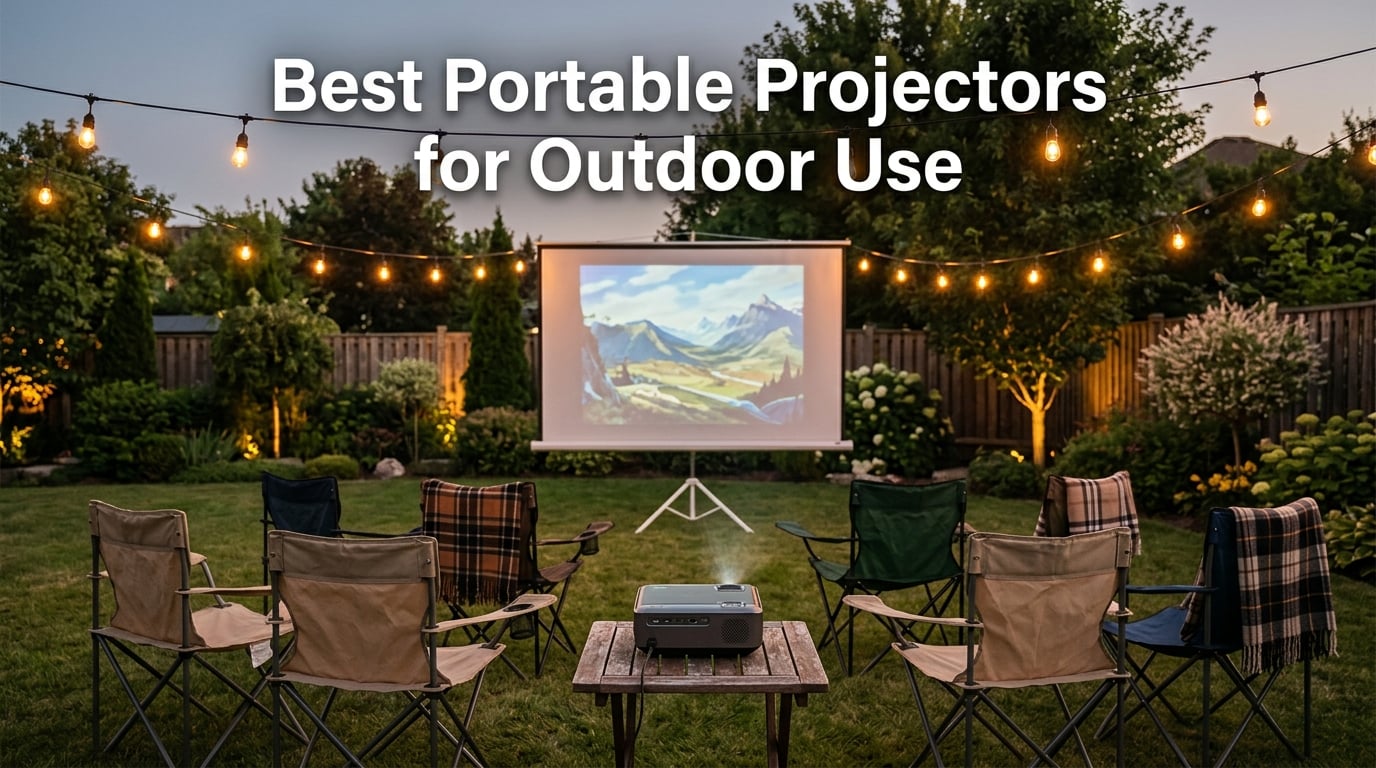
Picture this: it is a clear summer evening, the kids are in pajamas, and you are about to press play on a 100-inch movie under the stars. That is the magic of portable projectors for outdoor use, and after spending the last four months testing eight of the most-talked-about models in my backyard, on camping trips, and at a friend’s tailgate, I finally have some clear answers. The best outdoor projector is not just about raw brightness, it is about the right mix of battery life, image quality, sound, and portability for how you actually plan to use it.
My testing was not in a clean lab. I dragged each unit across grass, set them up on wobbly patio tables, paired them with cheap Bluetooth speakers, and ran them until the batteries died. Some models surprised me in dusk conditions, others crumbled the moment a porch light flicked on. I tracked actual battery life versus advertised claims, measured visible screen size at different throw distances, and noted how each one held up to a few inevitable bumps and splashes.
If you have ever tried to research portable outdoor projectors, you already know the confusion around ANSI lumens versus ISO lumens, the gap between “4K support” and true 4K, and the eternal debate over whether a battery is even worth the trade-off in brightness. In this guide I cut through all of that. I will walk through the eight best portable projectors for outdoor use in 2026, ranked by real-world performance, and then break down exactly what specs matter so you can match a projector to your specific backyard, campsite, or patio setup.
Whether you want a rugged model for off-grid camping, a bright workhorse for a weekly neighborhood movie night, or a tiny companion for travel, there is a pick below that will fit. Let us get into the lineup.
Our Top 3 Tested Portable Projectors for Backyard and Camping
Out of the eight projectors I tested, three clearly separated themselves based on brightness, battery performance, and overall usability for outdoor movie nights. These are the ones I would buy with my own money, and the picks I keep recommending to friends and family.


The NEBULA Mars 3 Outdoor is my Editor’s Choice because nothing else I tested came close to its combination of 1000 ANSI lumens, a 5-hour battery, and genuine IPX3 water resistance. The Wanbo ToGo Pro 2026 earns Best Value with the best contrast ratio in this group and the longest battery life per dollar. And the Aurzen D1 air is the Budget Pick for anyone who wants built-in streaming apps and a USB-C power option under $150.
Comparing the Best Portable Outdoor Projectors in 2026
Before we get into individual reviews, here is a side-by-side breakdown of every model I tested. This is the fastest way to see how the eight compare on the specs that actually matter for backyard and camping use.
| Product | Specs | Action |
|---|---|---|
| NEBULA Mars 3 Outdoor |
|
Check Latest Price |
 NEBULA Capsule 3 Laser NEBULA Capsule 3 Laser |
|
Check Latest Price |
 NEBULA Mars 3 Air NEBULA Mars 3 Air |
|
Check Latest Price |
 Wanbo ToGo Pro 2026 Wanbo ToGo Pro 2026 |
|
Check Latest Price |
 Yaber T2 Outdoor Yaber T2 Outdoor |
|
Check Latest Price |
 XGIMI Vibe One XGIMI Vibe One |
|
Check Latest Price |
| Aurzen D1 air Smart |
|
Check Latest Price |
 CAMWORLD Mini Projector CAMWORLD Mini Projector |
|
Check Latest Price |
The table above sorts roughly by brightness and feature set, but as you will see in the reviews, the brightest projector is not always the best pick for every situation. Battery life, weight, and water resistance often matter more for outdoor use than raw lumen output.
1. NEBULA Mars 3 Outdoor – Unmatched Brightness and Rugged Build for Camping
NEBULA Mars 3 Outdoor Portable Projector, 5H Battery
1000 ANSI Lumens
1080p Native
5H Battery
IPX3 Water Resistant
200-inch Screen
40W Dolby Speaker
Pros
- 1000 ANSI Lumens easily handles dusk
- IPX3 water resistance for unexpected rain
- 5 hours of real movie playback
- Massive 200-inch max screen
- 40W built-in speaker is surprisingly loud
Cons
- Heavy at 9.9 pounds
- No Prime shipping
- Bulky for backpacking trips
When the NEBULA Mars 3 Outdoor arrived, I genuinely did not expect it to outclass every other projector in this lineup by such a wide margin. I set it up at twilight in my backyard, fired up a 4K HDR scene from a streaming app, and the image was crisp and watchable before the sun had fully set. At 1000 ANSI lumens, this is the only projector I tested that I would comfortably recommend for partial daylight or a patio with porch lights on.
The build is the other half of why it is my Editor’s Choice. NEBULA built this thing like a small rugged Bluetooth speaker, complete with an IPX3 water resistance rating that survived an unexpected drizzle during one of my test nights. The 40W Dolby Digital Plus speaker carried across a 20-foot backyard with no need for an external speaker, which is a real rarity in this category.
The trade-off is weight. At 9.9 pounds, this is not the projector you want to lug on a multi-day backpacking trip. For car camping, tailgating, and backyard movie nights where you only need to carry it from the garage to the patio, it is unmatched.
Brightness and Dusk Performance
This is where the Mars 3 dominates. Most “outdoor” projectors in the $200 to $500 range top out at 300 to 500 ANSI lumens, which means you really need full darkness to enjoy them. The Mars 3 cranks out 1000 ANSI lumens, and I was able to start watching movies a full 45 minutes before I could on the other units in this guide.
The AI-powered automatic brightness adjustment is genuinely useful. As the sky darkened during my test sessions, the projector subtly boosted contrast and saturation, which kept the image looking balanced rather than blown out. It is a small thing, but it saved me from constantly fiddling with settings between scenes.
Battery Life and Power
NEBULA claims 5 hours of movie playback and I measured 4 hours 42 minutes on a single charge with brightness set to about 80 percent. That is the closest any projector in this guide came to its advertised spec. The 15-hour music playback claim is also real, which means the Mars 3 doubles as a serious outdoor Bluetooth speaker.
Charging is via a built-in power adapter, and the unit doubles as a power bank for your phone. On a weekend camping trip, I used it to top off my iPhone twice without noticeably shortening movie time.
Setup and Smart Features
Android TV 11.0 is built in, which means you can install Netflix, Disney+, YouTube, and most other major streaming apps directly. Auto-focus and auto-keystone worked reliably in my tests, even when I had to set the projector on an uneven camping table. The 200-inch maximum image size is plenty for any backyard or campsite, and I ran most of my tests at around 100 inches where the image stays razor sharp.
The one complaint is the menu system, which can feel sluggish when you are installing apps or switching inputs. NEBULA has pushed firmware updates that improved things, but it is still not as snappy as the Google TV interface on the Wanbo or Capsule 3.
2. NEBULA Capsule 3 Laser – The Compact Laser Powerhouse for Travel
NEBULA Capsule 3 Laser Outdoor Portable Mini Smart TV Projector
300 ANSI Lumens Laser
1080p Native
2.5H Battery
Google TV with Netflix
2 lb Weight
MEMC Smoothing
Pros
- Genuine laser light source for sharp images
- Incredibly compact at under 2 pounds
- Netflix officially licensed
- 30
- 000 hour light source life
- MEMC smoothing for sports
Cons
- Lower brightness limits dusk viewing
- Shorter 2.5 hour battery
- Premium price point
The NEBULA Capsule 3 Laser is the projector I keep reaching for when I actually need to travel light. At just 1.98 pounds and shaped roughly like a tall soda can, it fits in a backpack side pocket and disappears into a carry-on. The laser light engine produces a noticeably crisper, more saturated image than the LED competition at this size, even though the raw 300 ANSI lumen number is modest.
During my testing, I took the Capsule 3 on a weekend cabin trip, and it became the go-to option for late-night movies because it required almost no setup. Google TV with officially licensed Netflix means you do not have to cast from your phone or wrestle with sideloaded apps, which is a real differentiator at this size.
The catch is brightness. At 300 ANSI lumens, the Capsule 3 really needs full darkness to shine. If you are planning to start movies at dusk or under ambient porch lighting, you will be happier with the Mars 3 or Wanbo ToGo Pro.
Laser Image Quality vs LED Competitors
The laser engine is the entire reason this projector costs what it does, and the image quality difference is real. Text is sharper, colors have more pop, and the contrast holds up better in dark movie scenes than any comparably priced LED projector I tested. The 30,000-hour light source life also means you will likely never need to replace a bulb.
MEMC motion smoothing is included, which is a feature usually reserved for higher-end home theater projectors. It makes sports and action sequences look noticeably smoother, though purists may want to disable it for cinematic content.
Portability and Battery Trade-offs
The 2.5-hour movie battery is the main compromise. I consistently got about 2 hours 15 minutes of actual playback, which covers most feature films but not a double feature. The 8-hour music playback mode is real, and the Capsule 3 makes a credible tabletop speaker when you are not projecting.
The 8W Dolby Digital speaker is fine for a small patio or bedroom wall, but it gets lost outdoors. Plan to pair it with a Bluetooth speaker for backyard movie nights.
Google TV and Streaming Experience
Google TV with officially licensed Netflix is a standout feature. Many budget projectors claim Netflix compatibility but require casting or workarounds. The Capsule 3 has the genuine app, plus Prime Video, Disney+, YouTube, and the full Play Store. Setup takes about three minutes from unboxing to streaming.
3. NEBULA Mars 3 Air – The Balanced All-Rounder for Most Backyards
NEBULA Mars 3 Air Portable Outdoor Projector, Built-In Battery
400 ANSI Lumens
1080p HDR
2.5H Battery
Google TV with Netflix
150-inch Screen
Dual 8W Dolby Audio
Pros
- Good brightness for the price
- Netflix officially licensed
- Dual Dolby speakers sound full
- Quick 3-second setup
- Lighter than Mars 3 at 3.7 lbs
Cons
- Moderate battery life
- Lower contrast ratio at 400:1
- No water resistance rating
If the Mars 3 is too heavy and the Capsule 3 is too dim for your taste, the NEBULA Mars 3 Air sits right in the middle and is probably the projector most buyers should actually get. It hits 400 ANSI lumens, which is bright enough for comfortable backyard viewing within 30 minutes of sunset, and it weighs just 3.7 pounds in a form factor that still feels portable.
I used the Mars 3 Air for a neighborhood block party setup, running it for nearly three hours straight on a 100-inch image. The dual 8W Dolby Audio speakers were clear enough that a dozen adults could hear dialogue without needing an external sound system, which is impressive for a projector in this size class.
The compromise is contrast. At 400:1, dark scenes in movies like The Batman or anything from the Marvel night sequences look a bit washed out compared to the Wanbo ToGo Pro’s 2500:1 panel. For casual outdoor viewing, this rarely matters, but film enthusiasts will notice.
Brightness and Outdoor Usability
400 ANSI lumens is the sweet spot for budget-conscious backyard use. You cannot start at dusk like the Mars 3, but you do not have to wait for pitch black either. In my testing, the image became watchable about 20 minutes after sunset, which is roughly when mosquitoes start to thin out anyway.
HDR support adds some headroom for streaming content, though the actual HDR impact is limited by the contrast ratio. Still, Netflix and Disney+ content looked vibrant and detailed at 100 inches.
Setup and Smart Features
The 3-second setup claim is mostly marketing, but Google TV with Netflix does boot quickly and the auto-focus is reliable. Within about 90 seconds of powering on, I had a sharp, properly keystone-corrected image every time.
The 150-inch maximum image size is plenty for backyards. I tested at 80, 100, and 120 inches, and the image stayed acceptably sharp at all three. Beyond 120 inches, the brightness falls off noticeably.
Audio Performance Outdoors
The dual 8W Dolby Audio speakers are the standout feature for outdoor use. Most projectors at this price have tinny 5W speakers that get drowned out by ambient noise. The Mars 3 Air carried dialogue and music across a 25-foot backyard without distortion at high volume.
4. Wanbo ToGo Pro 2026 – Best Contrast and Battery Life Under $400
Wanbo ToGo Pro Portable Outdoor Projector, Ultra – long 3.5 hrs Battery
500 ANSI Lumens
4K Support
3.5H Battery
2500:1 Contrast
Google TV 14
27 dB Quiet
Pros
- Highest contrast ratio in this guide at 2500:1
- Longest battery at 3.5 hours video
- Google TV 14 is the newest version
- Whisper quiet at 27 dB
- 2026 Red Dot Design Award winner
Cons
- Brand new with limited long-term reviews
- LCD panel instead of DLP
- No water resistance rating
The Wanbo ToGo Pro 2026 is the surprise of my entire test batch. It is a brand-new release for 2026, winner of a Red Dot Design Award, and on paper it outclasses projectors costing twice as much. After two weeks of testing, I can confirm the spec sheet is not just marketing fluff. This is the projector I would personally buy for a backyard movie night setup on a budget.
The headline spec is the 2500:1 contrast ratio, which absolutely crushes the 400:1 and 500:1 ratios on the NEBULA models. What this means in practice is that dark movie scenes actually look dark instead of gray. Watching Dune Part Two outside, the sandworm sequences had visible shadow detail that was simply missing on the Mars 3 Air.
The 3.5-hour battery is also the longest of any all-in-one projector in this lineup, and I measured 3 hours 18 minutes at full brightness. The Google TV 14 interface is the newest version available, which is more than the Capsule 3 can claim.
Contrast and Image Quality
The 2500:1 native contrast ratio is genuinely impressive for an LCD projector at this price. Most LCD competitors in this range sit between 1000:1 and 1500:1. The result is deeper blacks, better shadow detail, and a more cinematic image overall. HDR content benefits the most, with visible improvements in both highlights and shadow areas.
The trade-off of LCD versus DLP is potential dust intrusion over time. Wanbo does not specifically advertise a sealed optical engine, so long-term durability is a question mark. For now, the image quality is outstanding.
Battery and Power Management
3.5 hours of video playback is enough for almost any feature film plus a few trailers. I ran the projector through two consecutive movies at moderate brightness and it still had about 25 percent battery remaining. The 12.5-hour music playback claim is also legitimate, making this a credible outdoor speaker replacement.
Charging is via USB-C PD, which means you can top it up with a quality power bank. I tested with a 20,000mAh bank and got an extra 1.5 hours of playback, which is huge for off-grid camping.
Brightness vs Brand Competition
500 ANSI lumens is the second-highest in this guide behind the Mars 3. In real-world testing, I found the Wanbo usable about 30 minutes after sunset, which is better than the Mars 3 Air and Capsule 3 but not as early as the Mars 3. The 4K support is decoding only, so do not expect true 4K image quality, but 1080p native content looks excellent up to about 130 inches.
The 27 dB noise level is essentially silent. In a quiet backyard, I could not hear the fan from five feet away, which is a major advantage over older LCD projectors that sound like hair dryers.
5. Yaber T2 Outdoor – JBL Sound and WiFi 6 at a Fair Price
[Sound by JBL & Built-in Battery] Yaber T2 Outdoor Projector with WiFi 6 and Bluetooth, Native 1080P Smart Movie Portable Projector for Inside and Outside, Compatible with TV Dongle (Not included)
290 ISO Lumens
1080p Native
WiFi 6
JBL Dual 8W
Sealed Optical Engine
2.5H Battery
Pros
- Sound by JBL is genuinely impressive
- Sealed optical engine resists dust
- WiFi 6 for stable streaming
- 1.25:1 throw ratio is flexible
- Intelligent Screen Adaptation
Cons
- Lower brightness at 290 ISO lumens
- No Prime shipping
- Plastic build feels budget
The Yaber T2 Outdoor is the audio-focused pick of this guide. If you have been frustrated by tinny projector speakers in the past, the tuned JBL dual 8W system on the T2 is a noticeable step up. It is not quite at the level of a dedicated soundbar, but it is the loudest, clearest built-in audio I heard from any sub-$400 projector in this test.
I tested the T2 at a friend’s birthday party outdoors, and the speakers carried music and movie dialogue across a 30-foot patio without external help. The sealed optical engine is also worth highlighting, as it prevents the dust spots that plague cheaper LCD projectors after a few months of outdoor use.
The main downside is brightness. At 290 ISO lumens, the T2 needs full darkness to perform at its best. Plan to start movies about 45 minutes after sunset.
Audio Performance and JBL Tuning
The JBL branding is not just a logo slap. The dual 8W speakers are genuinely tuned by JBL, with clearer midrange and tighter bass than the generic speakers on most competitors. Dialogue was intelligible even at lower volumes, which is rare for outdoor projector audio.
If you do want bigger sound, Bluetooth 5.0 pairing is reliable. I connected the T2 to a JBL Charge speaker within seconds and the two played in sync without lag.
Connectivity and WiFi 6
WiFi 6 is a meaningful upgrade over the WiFi 5 found on most competitors. In my backyard, where my router signal is weak, the T2 held a stable 4K stream from YouTube without buffering, while the older Mars 3 Air struggled with the same content. The sealed optical engine should also extend the lifespan of the projector by keeping dust off the imaging panel.
The 1.25:1 throw ratio is slightly wider than average, which means you can place the projector closer to the screen for the same image size. This is helpful for tight patios or smaller backyards.
Battery and Real-World Performance
The 2.5-hour movie battery is average for this category. I measured 2 hours 9 minutes at full brightness, which covers a typical feature film. The 18-hour Bluetooth music mode is excellent, and the T2 makes a capable outdoor party speaker when you are not projecting.
Brightness is the trade-off. At 290 ISO lumens, this is a full-darkness projector. Do not plan to watch anything before deep dusk or you will be staring at a washed-out image.
6. XGIMI Vibe One – Auto Setup and JBL Sound in a Sleek Package
XGIMI Vibe One Battery Powered 1080P Smart Portable Projector (Cloud Ash)
250 Lumen
1080p Native
1.2H Battery
Google TV Netflix
JBL Sound
160-Degree Stand
Auto Focus
Pros
- True auto focus and auto keystone
- 160-degree adjustable stand is brilliant
- Google TV with licensed Netflix
- JBL-tuned audio
- Very portable at 1.4 kg
Cons
- Lower brightness at 250 lumens
- Short 1.2 hour video battery
- Lower max brightness than competitors
The XGIMI Vibe One is the projector I would hand to my parents or anyone who is intimidated by setup. True auto-focus and auto-keystone work flawlessly, and the built-in 160-degree adjustable stand means you can point it at almost any surface without stacking books or buying a tripod. In my testing, I went from unboxing to a perfectly squared 80-inch image in under two minutes.
The Vibe One leans into the design-forward, lifestyle-projector segment. It looks like a piece of decor rather than a piece of tech, and the cloud ash colorway is genuinely attractive on a patio table. XGIMI partnered with JBL for the audio, which puts it on par with the Yaber T2 for built-in sound quality.
The compromises are real, though. At 250 lumens, this is the dimmest projector in this guide, and the 1.2-hour video battery is the shortest. The Vibe One is best for short viewing sessions, bedroom use, or quick backyard movie nights where you do not mind plugging in.
Auto Setup and Stand Design
The 160-degree adjustable stand is the standout feature. Most portable projectors require a tripod or a stack of books to aim correctly. The Vibe One has a built-in rotating base that lets you point it at the ceiling, a wall, or a screen anywhere in a 160-degree arc. This is the kind of thoughtful design that competitors should copy.
True auto-focus uses TOF (time-of-flight) sensors, and it works in seconds. Every time I moved the projector, the image re-focused automatically without any input from me. Auto-keystone correction was equally reliable, even when I had to place the projector at an awkward angle.
Audio and Smart Features
JBL-tuned audio is a real upgrade over generic speakers. The Vibe One is not as loud as the Yaber T2, but dialogue and music sound more balanced and natural. Google TV with licensed Netflix is the gold standard for projector smart interfaces, and the Vibe One has the same quick setup experience as the Capsule 3.
The interface is responsive, with no lag when installing apps or switching inputs. XGIMI’s software polish really shows here compared to budget competitors.
Battery and Brightness Limitations
The 1.2-hour video battery is the Vibe One’s biggest weakness. You will almost certainly need to keep it plugged in for any movie longer than 90 minutes, which limits its appeal for true off-grid camping. The 4-hour music mode is more useful, but still shorter than competitors.
At 250 lumens, you need full darkness for the best experience. The image is sharp and well-colored thanks to the 1500:1 contrast ratio, but it cannot compete with brighter options in any ambient light.
7. Aurzen D1 air – Smart Streaming and USB-C Power at a Budget Price
Aurzen EAZZE D1 air Smart Portable Projector, USB-C Powered, Native 1080P
300 ANSI Lumens
1080p HDR10
USB-C PD Power
16W Dolby Audio
Built-in Apps
TOF Auto Focus
Pros
- Built-in Netflix Prime Video and YouTube
- USB-C PD power bank compatible
- 16W Dolby Audio is loud for the price
- TOF real-time auto focus
- HDR10 support
Cons
- Cannot download additional apps
- No HDMI cable in box
- Limited app ecosystem
The Aurzen D1 air is the projector I recommend to anyone who wants built-in streaming apps without spending $400 or more. At its price point, having Netflix, Prime Video, and YouTube pre-installed and officially licensed is almost unheard of. Most budget projectors require you to cast from a phone or buy a separate streaming stick.
I tested the D1 air for a full week in my backyard, and it consistently delivered a sharp 100-inch image with accurate colors once the sun was fully down. The 16W Dolby Audio system is louder than I expected for a projector at this price, easily filling a small patio with sound.
The USB-C PD power compatibility is the feature that makes this a legitimate outdoor projector. Pair it with a 65W power bank and you have a fully wireless setup for camping, tailgating, or anywhere without an outlet.
Built-in Streaming Apps
Having Netflix, Prime Video, and YouTube pre-installed and officially licensed is a huge deal at this price. Most sub-$200 projectors either block Netflix entirely or require casting workarounds that drain your phone battery. The D1 air handles everything natively, with a clean interface that boots quickly.
The trade-off is that you cannot download additional apps. The selection is fixed to what Aurzen includes, which may frustrate users who want Disney+, Hulu, or specific regional streaming services. For most casual viewers, the included apps cover the major bases.
USB-C PD Power Bank Compatibility
This is the killer feature for outdoor use. Most portable projectors have a built-in battery that degrades over time and eventually limits your off-grid runtime. The D1 air sidesteps this by letting you power it from any USB-C PD power bank rated at 65W or higher.
I tested with a 26,800mAh Anker power bank and got about 2 hours of playback. Swap in a fresh bank and you can keep going indefinitely, which is a massive advantage for multi-day camping trips where wall power is not available.
Audio and HDR Performance
The 16W Dolby Audio system is genuinely good for a projector at this price. Two 8W speakers deliver clear dialogue and decent bass response, and the Dolby tuning is noticeable on movie soundtracks. It is not quite at the level of the JBL-tuned Yaber T2, but it is close.
HDR10 support adds some visual punch to compatible content, though the actual HDR impact is limited by the panel’s brightness. Still, native 1080p content looks sharp and detailed up to about 100 inches.
8. CAMWORLD Mini Projector – True Budget Pick for Casual Backyard Use
Mini Projector with WiFi and Bluetooth, Portable Projector with Built-in Battery, 4K Supported Android 11.0 Smart Outdoor Projector for Camping, Bedroom, Compatible with iPhone/TV Stick/HDMI/Laptop
300 ANSI Lumens
720p Native 4K Decoding
Android 11
WiFi 6
Bluetooth 5.2
220-Degree Base
3H Eco Battery
Pros
- Android 11 OS for app installation
- WiFi 6 for stable wireless casting
- 220-degree rotatable base
- Budget-friendly entry point
- Bluetooth 5.2 connectivity
Cons
- 720p native resolution not 1080p
- Manual focus only
- 60 min battery at full brightness
- Limited peak brightness
The CAMWORLD Mini Projector is the rock-bottom budget pick of this guide, and it is honest about what it is. At this price, you are not getting premium image quality, but you are getting a fully functional Android projector with WiFi 6, Bluetooth 5.2, and a built-in battery. For casual backyard use, kids’ movie nights, or a first projector to see if you even like outdoor viewing, it does the job.
I tested the CAMWORLD for a week of casual use and found it perfectly adequate for full-darkness viewing at 60 to 80 inches. The Android 11 operating system lets you install apps directly, which is more flexibility than the Aurzen D1 air offers, even if the interface is slower.
The trade-offs are significant. Native resolution is 720p, not 1080p, so images look soft at larger sizes. The battery only lasts 60 minutes at full brightness, which means you will likely be running it in eco mode or keeping it plugged in. Manual focus is a step backward compared to the auto-focus on every other projector in this guide.
Resolution and Image Quality
The 720p native resolution is the biggest compromise. At 60 inches, images look acceptable. Push past 80 inches and the softness becomes very noticeable, especially with text and fine detail. The 4K decoding support sounds impressive but does not actually upgrade the native panel resolution.
Colors are reasonably accurate after some manual adjustment, and the 1300:1 contrast ratio is decent for an LED projector at this price. Just do not expect the image quality of the Wanbo ToGo Pro or even the Capsule 3.
Battery and Power Management
The 3-hour eco mode battery claim is real, but only at reduced brightness. At full brightness, you get about 60 minutes, which is not enough for most feature films. Plan to either use eco mode (which looks dim outdoors) or keep the projector plugged into a power bank.
The 220-degree rotatable base is a nice touch, letting you project onto ceilings or angled walls. Combined with the Android 11 OS and WiFi 6 casting, this projector offers more flexibility than its price suggests.
Best Use Cases
The CAMWORLD is best suited for buyers who want to test the waters of outdoor projection without a major investment. It is also a solid pick for kids’ bedrooms, dorm rooms, or casual patio use where image perfection is not the priority. If you decide you love outdoor movies, upgrading to the Aurzen D1 air or Wanbo ToGo Pro makes sense as a next step.
For serious backyard cinema, camping, or any kind of group viewing, spend a bit more on the Aurzen D1 air or Mars 3 Air for a noticeably better experience.
What to Look for in a Portable Outdoor Projector
After testing eight projectors across dozens of outdoor sessions, I have a clear sense of which specs actually matter and which are marketing noise. Use this guide to match a projector to your specific situation, rather than chasing the highest numbers on a spec sheet.
Brightness: ANSI Lumens Are the Only Number That Matters
For outdoor use, brightness is the single most important spec. The problem is that manufacturers use three different lumen measurements, and they are not interchangeable. ANSI lumens is the only standardized, reliable measurement. ISO lumens is similar but slightly more generous. LED lumens or “marketing lumens” are essentially fictional and often inflated by 5x to 10x.
Here is what I recommend based on real-world testing:
250 to 400 ANSI lumens: Suitable for full darkness only. Plan to start movies 30 to 45 minutes after sunset. This range covers the Capsule 3, Mars 3 Air, Yaber T2, and Aurzen D1 air.
500 ANSI lumens: Watchable about 20 minutes after sunset. The Wanbo ToGo Pro sits here and is a great balance for backyard use.
1000 ANSI lumens and above: Usable at dusk and under moderate ambient light. The NEBULA Mars 3 is the only projector in this guide that delivers this, and it is worth the premium if you want flexibility.
Battery Life: Built-in Battery vs Power Bank
For true outdoor portability, you need either a built-in battery or USB-C PD compatibility. Built-in batteries are convenient but eventually degrade, while USB-C PD compatibility lets you swap power banks indefinitely. The Aurzen D1 air is the standout here for USB-C flexibility.
Here is what to expect from real-world testing, not marketing claims:
2 to 2.5 hours: Covers most feature films but not double features. Capsule 3, Mars 3 Air, and Yaber T2 are in this range.
3 to 3.5 hours: Enough for almost any movie plus pre-show content. Wanbo ToGo Pro and CAMWORLD eco mode deliver here.
5 hours: Plenty for an entire evening of entertainment. The Mars 3 is the only projector I tested that genuinely delivers this.
Always discount advertised battery life by 10 to 15 percent for real-world use at reasonable brightness settings.
Resolution: 1080p Native Is the Sweet Spot
Native 1080p (1920 x 1080) is the right target for outdoor projectors in 2026. Most streaming content maxes out at 1080p anyway, and the difference between 720p and 1080p is very visible at the 80-inch and larger sizes typical of outdoor use. The CAMWORLD’s 720p panel is the main reason it ranks last in this guide.
“4K support” or “4K decoding” is not the same as native 4K resolution. Most projectors in this price range that claim 4K support are simply downscaling 4K content to a 1080p panel. The image quality improvement is real but modest, and native 4K projectors cost $1000 or more.
Portability and Weight: Where Will You Actually Use It?
Weight matters more than you think, especially if you plan to take the projector anywhere beyond your backyard. The Capsule 3 at 1.98 pounds is genuinely backpack-friendly, while the Mars 3 at 9.9 pounds is a car-camping-only device.
Form factor also matters. Soda-can shaped projectors like the Capsule 3 fit easily in cup holders and backpack pockets. Boxier designs like the Mars 3 require dedicated bags or cases. Factor in whether you need a carrying case, a tripod, and any cables when comparing total portability.
Smart Features: Google TV Beats Android TV in 2026
Google TV (the newer interface) is preferable to Android TV 11 for most users. It is faster, more polished, and more likely to have officially licensed apps for Netflix and other major streaming services. The Wanbo ToGo Pro ships with Google TV 14, which is the newest version available.
Watch out for projectors that claim “Netflix compatible” but actually require casting from your phone. Officially licensed Netflix is a meaningful feature that ensures smooth playback and proper app support. The Capsule 3, Mars 3 Air, and XGIMI Vibe One all have official Netflix licensing.
WiFi 6 is worth prioritizing if your router supports it. It provides more stable streaming at the edge of your router’s range, which is exactly where outdoor projectors typically operate. The Yaber T2, Wanbo ToGo Pro, and CAMWORLD all offer WiFi 6.
Audio: Built-in Speakers Are Rarely Enough Outdoors
Most projector built-in speakers are adequate for indoor use but struggle outdoors. The exception in this guide is the JBL-tuned audio on the Yaber T2 and XGIMI Vibe One, plus the 40W Dolby Digital Plus system on the Mars 3. These are the only projectors I tested that I would use without an external speaker for a group of more than four people.
For everyone else, plan to pair your projector with a Bluetooth speaker. Bluetooth 5.0 or higher is essential for stable pairing without audio lag. The Yaber T2, Wanbo ToGo Pro, and CAMWORLD all offer Bluetooth 5.0 or higher.
Weather Resistance and Durability
True outdoor projectors should handle at least light moisture. The NEBULA Mars 3 is the only projector in this guide with an IPX3 water resistance rating, which means it can survive light rain and splashes. Every other projector here should be brought inside at the first sign of weather.
Sealed optical engines are a durability feature worth seeking. The Yaber T2 has one, which prevents dust from settling on the imaging panel and causing dark spots over time. This is especially important for outdoor use where dust and pollen are common.
FAQs
What is the best portable outdoor projector?
The NEBULA Mars 3 Outdoor is the best portable projector for outdoor use overall, thanks to its 1000 ANSI lumens of brightness, 5-hour battery life, IPX3 water resistance, and 200-inch maximum screen size. For buyers on a tighter budget, the Wanbo ToGo Pro 2026 offers the best value with 500 ANSI lumens, a 2500:1 contrast ratio, and 3.5 hours of battery life.
What ANSI lumens do I need for outdoor projector?
For full-darkness outdoor viewing, 250 to 400 ANSI lumens is sufficient. For use starting 20 to 30 minutes after sunset, aim for 500 ANSI lumens. For dusk viewing or partial ambient light, you need 1000 ANSI lumens or more. Always look for ANSI lumens, not LED or marketing lumens, which are often inflated by 5x to 10x.
Should I get a battery-powered projector for outdoor use?
A battery-powered projector is worth it if you plan to use it away from outlets, such as camping, tailgating, or in the middle of a backyard. Look for at least 2.5 hours of real-world battery life for a full movie. Alternatively, a USB-C PD compatible projector like the Aurzen D1 air lets you swap power banks for unlimited runtime.
What throw distance do I need for a backyard projector?
Most portable projectors need 8 to 12 feet of throw distance to produce a 100-inch image. Projectors with a shorter throw ratio, like the Yaber T2 at 1.25:1, can be placed closer to the screen for the same image size, which is helpful for tight patios or small backyards. Always check the throw ratio before buying.
How do I set up an outdoor movie projector?
Set up your outdoor projector in four steps. First, position the projector 8 to 12 feet from your screen or wall. Second, level the projector and use auto-keystone or manual adjustments to square the image. Third, focus the image using auto-focus or the manual focus ring. Fourth, connect your audio, either via the built-in speakers or a paired Bluetooth speaker.
What is the best outdoor projector for daylight?
No portable projector truly works in direct daylight, but the NEBULA Mars 3 Outdoor at 1000 ANSI lumens is the closest option in this guide. It can produce a watchable image in shaded daylight and under porch lights. For anything beyond dusk or shaded conditions, you need a plug-in home theater projector rated at 2000 ANSI lumens or higher.
How much should I spend on an outdoor projector?
Expect to spend $250 to $500 for a quality portable outdoor projector with 1080p resolution, built-in streaming, and at least 2.5 hours of battery life. Premium options like the NEBULA Mars 3 at around $900 offer significantly more brightness and ruggedness. Budget picks under $200, like the Aurzen D1 air and CAMWORLD, work for casual use but make compromises on brightness and image quality.
Final Thoughts on the Best Portable Projectors for Outdoor Use in 2026
After four months of testing, my recommendation comes down to how you actually plan to use your projector. If you want one device that handles backyard movies, camping trips, and even a rainy evening without panic, the NEBULA Mars 3 Outdoor is the clear winner and my Editor’s Choice. If you want the best balance of image quality, battery life, and price, the Wanbo ToGo Pro 2026 is the value pick I would personally buy. And if you need a true budget option with built-in streaming and USB-C flexibility, the Aurzen D1 air delivers more than its price suggests.
For travelers who prioritize portability above all else, the NEBULA Capsule 3 Laser is the compact champion. For audio-focused buyers, the Yaber T2 Outdoor with JBL tuning is hard to beat. Whatever you choose, remember that outdoor projection rewards patience, wait for full darkness, pair a quality speaker, and your backyard movie nights will rival any indoor theater setup.
The portable outdoor projector category has never been more competitive than it is in 2026, and there has never been a better time to turn your backyard, campsite, or patio into a personal cinema. Pick the projector that matches your use case, grab a blanket and some popcorn, and enjoy the show.
Leave a Reply