
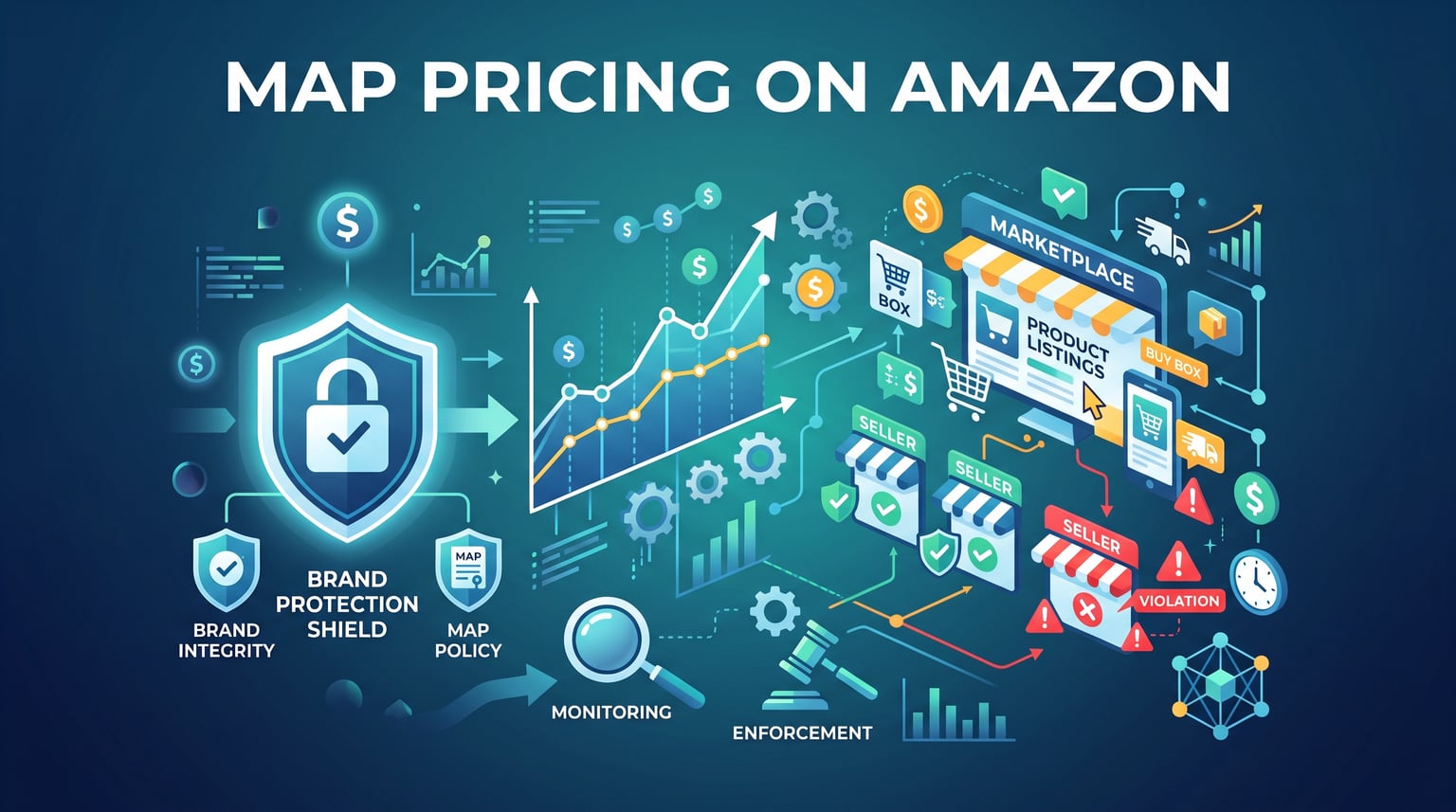
MAP pricing on Amazon represents one of the most misunderstood and frustrating challenges that brand owners face in 2026. You can draft a carefully structured Minimum Advertised Price policy, distribute it to every authorized reseller in your network, and still watch your products get undercut within days. The reality is that Amazon’s marketplace architecture was not designed to accommodate brand-level pricing controls, and this structural mismatch causes endless headaches for sellers and manufacturers alike.
Brands lose millions each year to price erosion caused by unauthorized sellers, automated repricing tools, and gray market inventory flooding onto Amazon listings. When a single reseller drops below the established price floor, competing sellers’ repricing software responds instantly, triggering a cascading race to the bottom that can destroy profit margins across an entire product line. The damage extends beyond revenue, eroding brand equity and undermining the relationships you have built with compliant authorized sellers who feel penalized for following the rules.
This guide breaks down exactly how MAP pricing on Amazon works, why enforcement is structurally limited, and what actionable steps brands can take to protect their pricing integrity. Whether you are a manufacturer launching your first product on Amazon or an established brand battling persistent violators, you will find a practical enforcement framework here that reflects the current marketplace realities of 2026. For a broader view of how MAP fits into your overall Amazon pricing strategy, that resource covers the full pricing lifecycle beyond MAP alone.
What this guide covers:
- What MAP pricing actually means and how it differs from MSRP
- Whether Amazon enforces MAP policies (and why the answer matters)
- How unauthorized sellers and gray market inventory drive violations
- Step-by-step enforcement workflow for protecting your brand
- Amazon Brand Registry and Transparency program as enforcement tools
- Legal context and antitrust considerations for MAP policies
Understanding MAP Pricing on Amazon
Minimum Advertised Price, commonly referred to as MAP, is a brand-level policy that establishes the lowest price at which a product may be publicly advertised for sale. It is a private contractual agreement between a manufacturer or brand owner and its authorized distribution partners. When a seller agrees to a MAP policy, they consent not to display or advertise the product below the specified price floor in any public marketing channel, including Amazon listings.
It is important to distinguish between advertised price and actual transaction price. MAP policies govern only the publicly displayed price. They do not restrict what a seller charges at the point of sale. A reseller could theoretically sell a product below MAP in a private transaction, over the phone, or through a gated checkout process where the discounted price is only revealed after the customer adds the item to their cart. On Amazon, however, the listed price serves as both the advertisement and the transaction price, which complicates this distinction significantly.
MAP policies serve several strategic purposes for brands. They protect premium brand positioning by preventing visible discounting that could signal lower quality to consumers. They shield authorized resellers from being undercut by unauthorized competitors who acquire inventory through irregular channels. And they prevent the price erosion that destroys profit margins across entire distribution networks when one seller breaks ranks and others follow through automated repricing responses.
What Is Amazon MAP Pricing?
Amazon MAP pricing refers to the application of a brand’s Minimum Advertised Price policy specifically within the Amazon marketplace environment. On Amazon, every product listing carries a unique ASIN (Amazon Standard Identification Number), and multiple sellers can offer the same product under that shared ASIN. This shared-listing architecture is what makes MAP enforcement on Amazon uniquely difficult compared to other retail channels.
When a brand enforces MAP on its own direct-to-consumer website, it controls the listed price completely. On Amazon, a brand’s authorized seller may display the correct MAP-compliant price, but another seller on the same ASIN can list below MAP at any time. Amazon’s system then features whichever offer has the lowest landed price in the Featured Offer position, commonly known as the Buy Box. This dynamic means that a single violator can effectively control the customer-facing price for an entire product, regardless of how many compliant sellers exist.
The core tension here is that Amazon’s marketplace is designed to surface the lowest price for consumers, while MAP policies exist to maintain price floors that benefit brands and compliant sellers. These two objectives are fundamentally opposed, and understanding this conflict is essential to developing realistic enforcement expectations. Your Amazon pricing strategy must account for this structural reality rather than fighting against it.
How Does Minimum Advertised Price Work on Amazon?
On Amazon, MAP functions through a combination of policy agreements and active enforcement by the brand. Here is how the mechanism works in practice. A manufacturer establishes a MAP price for each product, typically expressed as a dollar amount that reflects a balance between competitive positioning and margin protection. The brand then requires every authorized distributor and reseller to sign a MAP compliance agreement before they are permitted to purchase inventory.
Once products reach Amazon’s marketplace, the brand must actively monitor every ASIN for pricing compliance. This monitoring involves checking the displayed price on each listing, identifying which seller holds the Featured Offer, and flagging any offer that appears below the MAP threshold. When a violation is detected, the brand follows its enforcement protocol, which typically begins with a formal warning letter to the seller and escalates to supply cutoff and potential legal action if the violation persists.
The challenge is that Amazon’s pricing algorithm continuously evaluates all offers on a shared ASIN and awards the Featured Offer based on multiple factors including price, shipping speed, seller performance signals, and fulfillment method. Automated repricing tools used by many Amazon sellers adjust prices in real time, sometimes hourly, in response to competitor movements. When one seller drops below MAP, repricing software can drag other sellers down with it, creating rapid price erosion that spreads across the listing before a brand can respond.
This is why brands operating on Amazon must treat MAP monitoring as a continuous discipline rather than a periodic check. Manual daily reviews of a handful of ASINs may suffice for small catalogs, but brands with dozens or hundreds of products increasingly rely on dedicated monitoring tools that scan the digital shelf around the clock and generate automated MAP violation alerts when prices dip below the threshold.
Does Amazon Enforce MAP Pricing?
No, Amazon does not enforce MAP pricing. Amazon is not a party to the private agreements between brands and their authorized sellers. Amazon’s marketplace policies do not recognize MAP as a standalone violation, and the platform will not remove listings, suspend sellers, or take corrective action based solely on a MAP policy breach. This is the single most important fact for any brand to understand before investing time and resources into MAP enforcement on Amazon.
Reporting a MAP violator to Amazon Seller Support will generally produce no action. Amazon considers MAP to be a contractual matter between the brand and the reseller, not a marketplace compliance issue. Sellers on Amazon’s forums consistently confirm this reality, with attorneys advising that MAP enforcement falls entirely on the brand’s shoulders. Amazon’s systems are built to promote competitive pricing for consumers, and intervening in private pricing agreements would conflict with that core marketplace philosophy.
This does not mean brands are powerless. It means that effective MAP enforcement on Amazon requires a different toolkit than simply reporting violations to the marketplace. Brands must control their distribution channels, identify unauthorized sellers, leverage Amazon programs like Brand Registry and the Transparency program, and pursue direct action against violators through their reseller agreements. The enforcement burden falls entirely on the brand owner.
There is one notable complication: when brands sell wholesale to Amazon Retail as a first-party (1P) vendor, Amazon itself becomes the seller of record. Amazon Retail does not consider itself bound by MAP policies, and brands selling through the 1P model frequently report that Amazon lists their products below the agreed MAP price. This creates friction with third-party sellers who are complying with the MAP policy and watching Amazon undercut them on the same ASIN. For more context on how fulfillment models affect your distribution strategy, our comparison of dropshipping versus Amazon FBA covers the trade-offs of different approaches.
The Importance of MAP Pricing for Brand Protection
Despite the enforcement challenges, maintaining a MAP policy on Amazon delivers concrete value for brands that commit to active enforcement. The brands that succeed treat MAP not as a document filed away but as a living policy backed by consistent monitoring and decisive action. Here is why MAP pricing remains essential for protecting your brand on Amazon.

Preserving Brand Equity and Perceived Value
Consistent pricing across all sales channels signals to consumers that a product has a defined market value. When shoppers see the same price on Amazon, your direct website, and retail partner stores, they perceive the product as fairly priced and the brand as professionally managed. Visible discounting, by contrast, trains customers to wait for deals, erodes perceived quality, and undermines premium brand positioning that may have taken years to establish.
Price erosion on Amazon is particularly damaging because Amazon’s pricing data feeds into comparison shopping engines, price tracking services, and competitor pricing algorithms. A single low-priced listing on Amazon can pull down the perceived value of your product across the entire e-commerce ecosystem, not just on Amazon itself. This ripple effect makes MAP enforcement on Amazon disproportionately important compared to other channels.
Protecting Authorized Reseller Relationships
Your authorized resellers are the partners who invest in your brand, maintain inventory, provide customer service, and represent your products professionally. When unauthorized sellers undercut them on Amazon, compliant resellers lose sales and grow frustrated. Over time, they may question the value of their authorized partnership, demand deeper wholesale discounts to compensate, or abandon your brand entirely for competitors who enforce pricing more effectively.
Maintaining MAP compliance protects the margins of your legitimate distribution channel partners. When authorized sellers can count on fair pricing, they are more likely to invest in advertising your products, building out inventory depth, and recommending your brand to their own customer bases. MAP enforcement is therefore not just about protecting your own revenue but about sustaining the ecosystem of partners who help your brand grow.
Preventing Profit-Destroying Price Wars
Without a price floor, Amazon’s competitive dynamics virtually guarantee a race to the bottom. When one seller reduces their price to win the Featured Offer, automated repricing tools deployed by competing sellers respond within minutes, each trying to undercut the other by a small margin. This cycle can compress margins to near zero before any human reviewer notices what is happening. MAP pricing establishes a boundary that stops this cascade before it begins, provided the policy is actively enforced.
Protecting your margins through MAP has a direct impact on your advertising economics as well. When prices hold steady, your ACoS and overall Amazon profitability remain predictable and sustainable. Price erosion, by contrast, can make advertising campaigns unprofitable overnight, since ad spend that was justified at one price point becomes a losing proposition after margin compression.
MAP vs MSRP: Understanding the Difference
One of the most common sources of confusion in Amazon pricing discussions is the difference between MAP and MSRP. These are distinct concepts with different legal implications, enforcement mechanisms, and marketplace effects. Confusing them can lead to ineffective pricing strategies and miscommunication with resellers.
MSRP stands for Manufacturer’s Suggested Retail Price. It is exactly what the name implies: a recommendation. MSRP has no contractual force, and no seller is obligated to price at or above it. MSRP is primarily a marketing tool that helps consumers understand the typical selling price of a product and allows sellers to display discount percentages. On Amazon, the MSRP is often shown as a crossed-out reference price next to the actual selling price.
MAP, by contrast, is a contractual obligation. When a reseller signs a MAP agreement, they are legally bound to comply with its terms. While MAP cannot control the actual sale price, it can control the publicly advertised price, which on Amazon means the displayed listing price. Violating a MAP agreement constitutes a breach of contract, giving the brand legal recourse that does not exist with MSRP.
The table below summarizes the key distinctions that brands and sellers need to understand:
- Nature: MSRP is a suggested price; MAP is a contractual price floor
- Scope: MSRP covers the actual selling price; MAP covers only the advertised price
- Enforceability: MSRP carries no contractual obligation; MAP violation is a breach of contract
- Legal standing: MSRP is a pure recommendation; MAP is governed by contract law and antitrust considerations
- Amazon display: MSRP appears as a reference strikethrough; MAP governs the actual displayed listing price
- Brand recourse: MSRP violations have no remedy; MAP violations can trigger supply cutoff and legal action
Understanding this distinction matters because some brands attempt to enforce MSRP as if it were MAP, sending cease and desist letters for prices that fall below the suggested retail price. Without a signed MAP agreement in place, these communications have no legal force. Brands that want pricing control must implement a formal MAP policy with signed reseller agreements, not simply publish an MSRP and hope for compliance.
Unauthorized Sellers and the Gray Market Problem
The single largest driver of MAP violations on Amazon is unauthorized seller activity. These are sellers who have never signed your MAP agreement, have no contractual relationship with your brand, and have acquired your products through indirect channels that bypass your authorized distribution network. They have no obligation to follow your pricing policy, and from a legal standpoint, they are generally free to sell authentic products at whatever price they choose.
Unauthorized inventory reaches Amazon through several well-documented channels. Retail arbitrage involves individuals purchasing products from retail stores at discount or clearance prices and reselling them on Amazon for a profit. Holiday returns and open-box merchandise often find their way back into the marketplace at reduced prices. Cross-border inventory enters when products manufactured for international markets are imported and listed on Amazon’s US marketplace, sometimes without proper authorization. And distributor leakage occurs when authorized wholesale distributors sell to sub-distributors or resellers who are not bound by your MAP policy, intentionally or accidentally.
This gray market inventory is the structural reason MAP enforcement on Amazon is so difficult. Even if every authorized seller complies perfectly with your MAP policy, unauthorized sellers can still list your authentic products at any price they choose. The first sale doctrine in United States law generally permits the resale of legitimately purchased goods without the manufacturer’s consent, meaning you cannot simply prohibit unauthorized sellers from listing your products based on ownership alone.
Forum discussions on Reddit and Amazon Seller Central reveal the depth of frustration this creates. Brand owners report rogue sellers crushing their MAP pricing and syphoning business, with no effective way to report these violators to Amazon. Sellers note that half the sellers on some listings appear to ignore MAP policies entirely. The lack of Amazon enforcement for what is fundamentally a private contractual matter leaves brands to solve this problem through their own distribution channel management and enforcement actions.
The most effective strategy against unauthorized sellers combines multiple approaches. First, tighten your distribution channels to reduce inventory leakage. Second, use product serialization to trace unauthorized inventory back to its source distributor. Third, conduct test purchases to identify sellers and document violations. Fourth, leverage Amazon Brand Registry tools to address intellectual property infringement where applicable. And fifth, send professional enforcement communications that reference your contractual rights and escalate progressively.
What Is a MAP Violation on Amazon?
A MAP violation occurs when a seller publicly advertises or displays a product at a price below the minimum specified in the brand’s MAP policy. On Amazon, this means any listing price, Featured Offer price, or visible promotional price that falls beneath the MAP threshold constitutes a violation. The violation exists regardless of whether the seller is authorized or unauthorized, though the brand’s enforcement options differ significantly between the two categories.
Violations by authorized sellers who have signed your MAP agreement represent a breach of contract. These are the most straightforward to address because you have a legal relationship with the seller and defined remedies within your agreement. The standard response begins with a formal written warning, followed by progressive penalties that may include reduced order allocations, suspended supply, and termination of the reseller relationship for repeat offenders.
Violations by unauthorized sellers are far more complex. Since no contractual relationship exists, you cannot enforce MAP through contractual remedies. Your options include identifying the inventory source through serialization or test purchases, pressuring the upstream distributor who supplied the product, filing intellectual property complaints if the listing uses your copyrighted images or trademarked content improperly, and in some cases pursuing legal claims related to trademark infringement or false advertising. Simply sending a MAP violation notice to an unauthorized seller who never signed your agreement carries limited legal weight.
Legal Context: Is MAP Pricing Legal in the US?
The legal status of MAP pricing in the United States is nuanced and depends heavily on how the policy is structured and enforced. MAP policies are generally legal, but they exist in proximity to antitrust laws that prohibit price-fixing agreements between manufacturers and retailers. Understanding the legal framework helps brands design policies that achieve pricing goals without triggering antitrust exposure.
The foundational legal principle is the Colgate doctrine, established by the United States Supreme Court in 1919. Under this doctrine, a manufacturer may announce its pricing policies in advance and unilaterally refuse to deal with resellers who do not comply. The key word is unilaterally. A manufacturer can set a policy and choose its trading partners, but it cannot enter into a bilateral agreement with retailers to maintain specific prices. The distinction matters: a MAP policy that operates as a unilateral statement of the brand’s terms, backed by the right to refuse supply, is generally defensible, while a cooperative pricing agreement between brand and retailer risks being classified as illegal vertical price-fixing.
In 2007, the Supreme Court’s decision in Leegin Creative Leather Products v. PSKS, Inc. shifted the legal landscape further by ruling that minimum resale price maintenance agreements should be evaluated under the rule of reason rather than treated as automatically illegal. This gave manufacturers more flexibility, but it did not eliminate antitrust risk entirely. MAP policies must still be structured carefully to avoid appearing as coordinated price-fixing arrangements.
International enforcement differs significantly. In the United Kingdom and European Union, resale price maintenance is treated more strictly, and regulators have taken active enforcement action against brands that impose pricing controls on retailers. Brands operating across multiple jurisdictions should consult qualified legal counsel to ensure their MAP policies comply with local competition law in each market where their resellers operate.
How Amazon’s Featured Offer and Pricing Algorithm Affect MAP

To understand why MAP violations are so damaging on Amazon specifically, you need to understand how the Featured Offer works. Formerly known as the Buy Box, the Featured Offer is the primary price display that appears when a customer views a product detail page. Amazon’s algorithm selects one seller’s offer to feature prominently based on factors including price, shipping speed, seller performance metrics, fulfillment method (FBA versus FBM), and inventory availability.
When multiple sellers list the same ASIN, only one wins the Featured Offer at any given time. The seller who holds this position captures the vast majority of sales for that listing, since most customers simply click the Add to Cart button without scrolling through competing offers. This means that a single seller with a below-MAP price can effectively control the customer-facing price for your product, even if dozens of compliant sellers exist on the same listing.
The competitive pressure this creates is enormous. When an unauthorized seller wins the Featured Offer at a price 15 percent below MAP, compliant sellers lose nearly all sales on that ASIN. Their repricing tools may automatically lower their prices to compete, dragging them into violation of the MAP policy as well. This cascading effect can spread across an entire product catalog within hours, creating widespread violations that are difficult to reverse once they begin.
Another frustration reported by sellers involves MAP price increases triggering Featured Offer suppression. When a brand raises its MAP price, Amazon’s algorithm may temporarily remove or suppress the Buy Box while it recalibrates pricing expectations. Sellers report losing significant sales during these transition periods, which creates tension between brands and their reseller partners even when no violation has occurred.
Step-by-Step MAP Enforcement Workflow for Brands

Effective MAP enforcement on Amazon requires a structured, repeatable process. Brands that succeed do not react to violations ad hoc but follow a defined escalation protocol that treats each violation consistently. Below is a comprehensive enforcement workflow that reflects current best practices from leading brand protection professionals.
Step 1: Monitor Continuously Across the Digital Shelf
The first step is implementing systematic monitoring of every ASIN in your catalog. For small catalogs, this may involve manual daily checks of each listing’s displayed price. For larger catalogs, dedicated MAP monitoring tools scan Amazon and other marketplaces around the clock, generating automated alerts whenever a price drops below the MAP threshold. The goal is to detect violations within hours, not days, because the longer a violation persists, the more repricing cascades it triggers across the listing.
Cross-channel monitoring is equally important. Price drops on Walmart, eBay, or emerging platforms like TikTok Shop can trigger Amazon repricing tools that adjust prices to maintain parity. Monitoring only Amazon misses the upstream cause of many violations. Leading brands monitor the full digital shelf across all marketplaces where their products appear.
Step 2: Identify and Document the Violating Seller
When a violation is detected, the next step is identifying the seller responsible. Amazon displays seller names on the listing, but many unauthorized sellers operate under generic storefront names or multiple anonymous accounts to evade detection. Document the violation with dated screenshots showing the seller name, the listed price, the ASIN, and the MAP threshold. This evidence trail is essential for enforcement communications and any subsequent legal action.
If the seller is unauthorized, consider conducting a test purchase. Buying the product from the violating seller allows you to inspect the item for authenticity, check for product serialization codes that trace the inventory source, and document the transaction as evidence. Test purchases are one of the most effective techniques for identifying which distributor leaked inventory into the gray market.
Step 3: Send a Formal MAP Violation Notice
For authorized sellers, send a formal written notice referencing the specific MAP policy terms they agreed to, the product and ASIN in question, the observed price, and the required corrective action with a deadline. The notice should be professional and specific, referencing the contractual agreement and the consequences of non-compliance. Document the delivery and response.
For unauthorized sellers, the communication strategy differs. Since no contract exists, the letter should focus on your trademark rights, any improper use of your copyrighted listing content or images, and a request that the seller either comply with your MAP pricing or cease selling your products. Some unauthorized sellers will voluntarily raise prices or delist to avoid conflict. Others will ignore the communication entirely, requiring escalation.
Step 4: Escalate Through Progressive Enforcement
If the initial notice does not resolve the violation, escalate progressively. For authorized sellers, this means reducing order allocations, suspending supply temporarily, and ultimately terminating the reseller agreement for persistent violators. The credibility of your MAP policy depends on following through on consequences. Brands that issue warnings without enforcement teach sellers that violations carry no real cost.
For unauthorized sellers who refuse to comply, available measures include filing intellectual property complaints through Amazon Brand Registry for improper use of your trademarks or copyrighted content, pursuing the upstream distributor who leaked the inventory, and in cases of significant and willful violations, consulting legal counsel about potential claims for trademark infringement, false advertising, or tortious interference with your distribution contracts.
Step 5: Address the Root Cause Through Distribution Channel Control
Enforcement alone is reactive. The most effective brands complement their enforcement workflow with proactive distribution channel management that reduces the flow of unauthorized inventory to Amazon in the first place. This includes requiring serialized product codes on all outbound shipments, auditing distributor sales records periodically, limiting the number of wholesale accounts per region, and writing MAP compliance requirements directly into purchase agreements at every tier of distribution.
Brands that use product serialization can trace any unauthorized listing back to the specific distributor who supplied the inventory, creating accountability at the wholesale level. This is one of the most powerful deterrents against gray market leakage, because distributors know that violations can be traced directly to their accounts.
Amazon Brand Registry and the Transparency Program
While Amazon does not enforce MAP directly, the platform offers programs that give brands tools to protect their listings and identify unauthorized activity. Two of the most important are Amazon Brand Registry and the Amazon Transparency program. These are not MAP enforcement tools in the strict sense, but they provide capabilities that support broader brand protection strategies on the marketplace.
Amazon Brand Registry
Brand Registry is Amazon’s program for brand owners who hold active registered trademarks. Enrollment gives brands enhanced control over their product listings, including the ability to create and edit product detail pages, access to search tools for finding listings that may misuse your brand name or intellectual property, and a streamlined process for filing takedown requests against sellers who use your copyrighted content without authorization.
Brand Registry does not give you the power to remove a seller for MAP violations alone, since Amazon still considers pricing a private matter. However, it does enable you to act against unauthorized sellers who use your trademarked images, copyrighted product descriptions, or other brand assets without permission. Many unauthorized sellers use copy-pasted content from your legitimate listings, and Brand Registry gives you the mechanism to file complaints that can result in listing removal or seller suspension.
The Amazon Transparency Program
The Transparency program takes brand protection a step further by applying unique serial numbers to individual product units. Brands enrolled in the program apply a Transparency code to each unit at the manufacturing stage, and Amazon scans these codes at fulfillment centers to verify authenticity before shipping products to customers. This prevents counterfeit inventory from reaching buyers and creates a mechanism for detecting unauthorized or inauthentic units entering the supply chain.
For MAP enforcement purposes, the Transparency program provides indirect but meaningful benefits. When every unit carries a unique identifier, unauthorized sellers who acquire gray market inventory without Transparency codes may find their listings flagged or blocked. This raises the barrier for unauthorized sellers and reduces the volume of below-MAP inventory reaching Amazon. Combined with distribution channel audits, serialization creates a powerful deterrent against the gray market activity that drives most MAP violations.
Amazon Marketplace Fair Pricing Policy
Amazon maintains its own Marketplace Fair Pricing Policy, which prohibits pricing practices that harm customer trust, including setting prices that are significantly higher than recent prices offered on or off Amazon, removing the Featured Offer for a product, or engaging in excessive shipping charges. While this policy addresses pricing behavior, it is focused on protecting consumers from price gouging and deceptive practices, not on enforcing brand-level MAP agreements.
Brands sometimes attempt to frame MAP violations as Fair Pricing Policy violations when reporting to Amazon, but this approach rarely succeeds. Amazon evaluates Fair Pricing Policy complaints based on consumer harm metrics, not brand pricing preferences. Understanding the scope and limitations of this policy prevents wasted enforcement effort.
MAP Monitoring Tools and Technology
Manual monitoring becomes unsustainable once a brand’s catalog exceeds more than a handful of ASINs. The marketplace’s 24-hour pricing dynamics, combined with repricing tools that adjust offers continuously, mean that violations can appear and trigger cascading effects at any time of day or night. Specialized MAP monitoring technology has become an operational necessity for serious brand protection.
Modern MAP monitoring platforms scan Amazon and other marketplaces on configurable intervals, comparing displayed prices against brand-defined MAP thresholds for each product. When a violation is detected, the system generates an alert with details including the ASIN, the violating seller, the observed price, and a timestamped screenshot for documentation. Some platforms also track the Featured Offer holder separately, since this position drives the majority of sales and warrants priority enforcement attention.
Leading solutions combine monitoring with seller identification features that attempt to uncover the real entity behind generic storefront names, link violations to upstream distributors through serialized product tracking, and generate automated enforcement communications that can be dispatched with minimal manual intervention. For brands operating across multiple marketplaces, these platforms also monitor Walmart, eBay, TikTok Shop, and other channels where pricing data feeds into Amazon’s competitive algorithm.
When evaluating MAP monitoring tools, brands should consider the frequency of scanning, the breadth of marketplace coverage, the quality of seller identification data, the ability to integrate with existing ERP and distribution management systems, and the platform’s reporting capabilities for tracking enforcement outcomes over time. The investment in monitoring technology typically pays for itself by catching violations early, before repricing cascades compress margins across an entire catalog.
MAP Pricing on Amazon: Frequently Asked Questions
Is MAP pricing legal in the US?
Yes, MAP pricing is generally legal in the United States when structured as a unilateral policy that the brand enforces consistently across all sellers. Under the Colgate doctrine, a manufacturer may announce pricing policies and refuse to deal with non-compliant resellers. However, MAP policies must be designed carefully to avoid antitrust exposure, particularly the appearance of bilateral price-fixing agreements. Brands should consult qualified antitrust counsel when drafting MAP policies.
Does Amazon enforce MAP pricing?
No, Amazon does not enforce MAP pricing. Amazon considers MAP a private contractual agreement between brands and their authorized sellers, not a marketplace policy violation. Reporting a MAP violator to Amazon Seller Support will not result in listing removal or seller suspension. Enforcement responsibility falls entirely on the brand owner through their distribution agreements and legal rights.
How does MAP pricing work on Amazon?
MAP pricing on Amazon works through private agreements between brands and authorized resellers. The brand sets a minimum advertised price, and sellers who sign the agreement commit not to display their products below that threshold. On Amazon’s shared ASIN listings, the brand must actively monitor prices, identify violators, and enforce the policy through warnings, supply cutoffs, and legal action, since Amazon itself will not intervene.
What is a MAP violation on Amazon?
A MAP violation occurs when a seller displays a product below the brand’s established minimum advertised price on an Amazon listing. This includes the Featured Offer price, any visible offer on a shared ASIN, or promotional pricing shown publicly. Violations by authorized sellers breach their contract, while violations by unauthorized sellers require different enforcement approaches since no contractual relationship exists.
Can you report MAP violators on Amazon?
You can report unauthorized sellers to Amazon through Brand Registry if they are misusing your intellectual property, such as copyrighted images or trademarked content. However, you cannot report MAP pricing violations as standalone policy breaches, because Amazon does not recognize MAP as a marketplace violation. Enforcement must be handled through your reseller agreements and legal channels.
What happens if you don’t follow MAP pricing?
Authorized sellers who violate MAP agreements face progressive enforcement including formal warnings, reduced supply allocations, suspended purchasing privileges, and termination of their reseller relationship. For brands that fail to enforce MAP, the consequences include price erosion, lost profit margins, damaged reseller relationships, and diminished brand equity as visible discounting trains consumers to expect lower prices.
What is the difference between MAP and MSRP?
MAP (Minimum Advertised Price) is a contractual price floor that sellers agree to when signing a brand’s reseller agreement, while MSRP (Manufacturer’s Suggested Retail Price) is a non-binding price recommendation. MAP governs the advertised price but not the actual sale price, and violations carry contractual consequences. MSRP carries no enforcement mechanism and serves mainly as a reference point for displaying discounts.
Related Reading: For more on protecting your Amazon presence, see our guides on handling bad reviews on Amazon and dealing with negative Amazon customer reviews.
Conclusion: Building a Sustainable MAP Enforcement Strategy
MAP pricing on Amazon is not a set-and-forget exercise. The marketplace’s architecture actively works against brand-level price controls, and the flow of unauthorized inventory through gray market channels ensures that violations will continue appearing as long as your products carry value. Success requires a sustained commitment to monitoring, enforcement, and distribution channel discipline that treats MAP protection as an ongoing operational function rather than a one-time policy document.
For brands just starting out, the priority should be building a solid foundation: a well-drafted MAP policy, signed reseller agreements at every distribution tier, and a monitoring system that catches violations early. Established brands battling persistent violators should focus on tightening distribution channels through product serialization, conducting test purchases to trace inventory sources, and leveraging Brand Registry and the Transparency program to create additional barriers for unauthorized sellers. For broader context on how MAP fits into your overall approach, our comprehensive Amazon pricing strategy guide covers the full spectrum of pricing decisions beyond MAP alone.
The brands that succeed on Amazon in 2026 are those that understand the structural limitations of MAP enforcement, work within those constraints rather than against them, and invest in the tools, processes, and partnerships needed to protect their pricing integrity over the long term. Consistent enforcement builds credibility with your authorized sellers, signals quality to consumers, and preserves the margins that fund your brand’s continued growth on the world’s largest marketplace.
Leave a Reply