
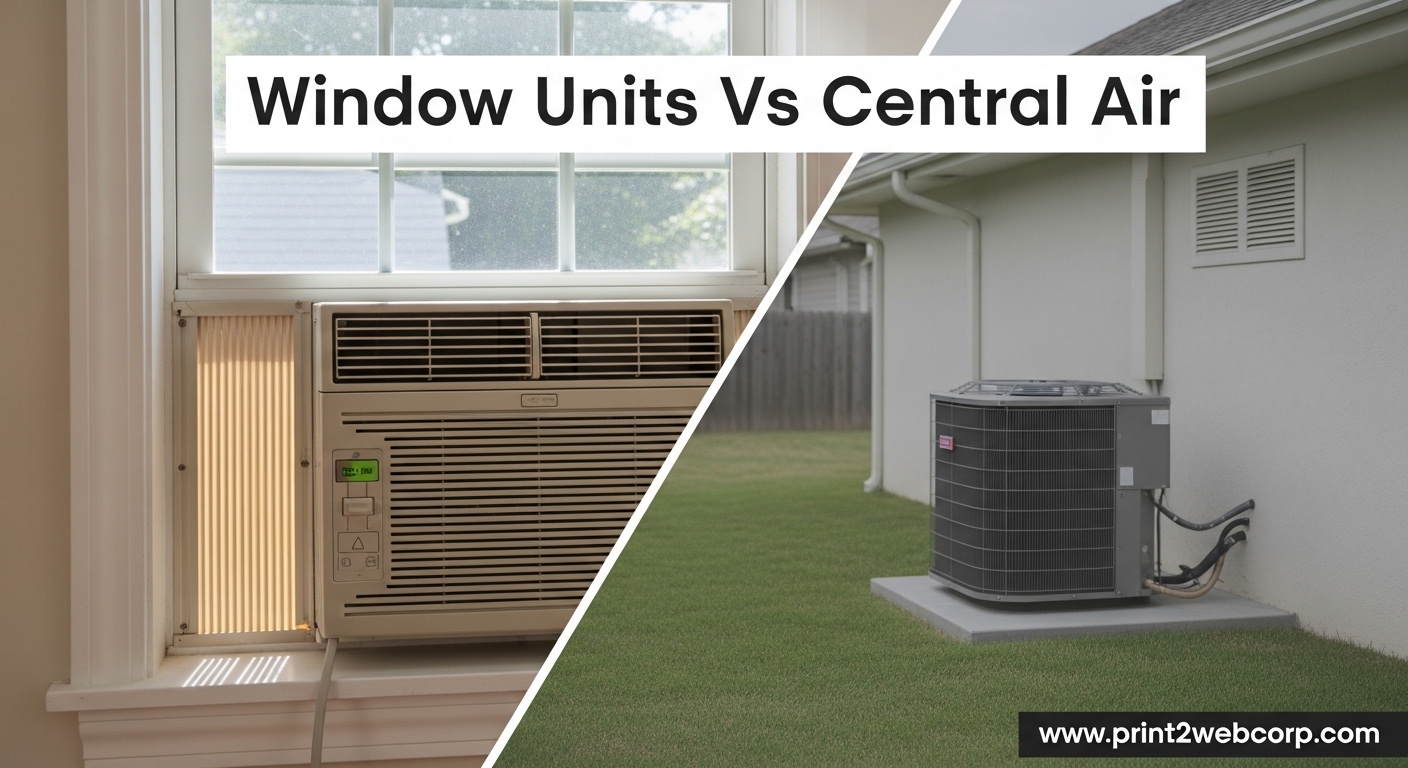
Choosing the right cooling system for your home is one of the most important decisions you’ll make for comfort and energy costs. Window units vs central air is a debate that homeowners and renters have been having for decades, and the answer isn’t always straightforward. The right choice depends on your budget, home layout, long-term plans, and cooling needs. After analyzing thousands of real-world experiences and cost data, I’ll break down exactly which option makes sense for your situation.
Window units offer an affordable, quick solution for cooling individual rooms without any installation hassle. Central air conditioning provides whole-home comfort with consistent temperatures and higher efficiency. The difference in upfront costs is staggering—window units cost between $250-$1,500 while central AC installation runs $3,000-$7,000 or more. But the long-term operating costs tell a different story that might surprise you.
This comparison covers everything from daily electricity costs to lifespan expectations, noise levels to maintenance requirements. I’ve gathered data from HVAC professionals, real user experiences on Reddit and Quora, and industry sources to give you the complete picture.
Quick Comparison: Window Units vs Central Air
| Factor | Window Units | Central Air |
|---|---|---|
| Upfront Cost | $250-$1,500 per unit | $3,000-$7,000+ for system |
| Installation | DIY-friendly, minutes | Professional, 1-3 days |
| Cooling Coverage | Single room (100-500 sq ft) | Entire home |
| Daily Operating Cost | $0.40-$1.20 per unit | $1.50-$4.00 for whole home |
| Lifespan | 8-10 years | 15-20 years |
| SEER Rating | 8-12 EER | 14-22 SEER |
| Noise Level | 50-60 dB (in room) | 60-70 dB (outdoor) |
| Maintenance | Filter cleaning, seasonal removal | Annual professional service |
| Best For | Renters, single rooms, budgets | Homeowners, whole-home comfort |
Window Air Conditioning Units: Complete Breakdown
Window units are self-contained air conditioning systems that mount directly in your window frame. They’re designed to cool a single room by pulling warm air from inside, running it through cooling coils, and expelling the heat outside through the back of the unit. The entire cooling mechanism—compressor, coils, fan, and controls—is housed in one compact box that sits partially inside and partially outside your window.
These units have been around since the 1930s and remain popular for their simplicity and low upfront cost. Modern window units range from 5,000 BTU for small bedrooms up to 25,000 BTU for large living spaces. They’re ideal for situations where you only need to cool one or two rooms, or when installing central air isn’t practical due to budget or home constraints.
Window Unit Pros
Low upfront cost is the biggest advantage. You can buy a quality window unit for $300-$600, compared to thousands for central AC installation. This makes window units accessible to almost anyone, regardless of budget. Installation takes minutes—literally. You just need to secure the unit in the window, plug it in, and you’re done. No contractors, no permits, no waiting weeks for scheduling.
Targeted cooling saves money. Instead of paying to cool empty rooms, you only cool the spaces you’re actually using. This is why many Reddit users in r/Frugal report window units can be cheaper to run than central AC if you’re only cooling one or two rooms. A 5,000 BTU unit costs about 52 cents per day to run continuously.
Portability is another hidden benefit. When you move, you take your window unit with you. This makes them perfect for renters who can’t modify their home’s infrastructure. You can also move units between rooms as needed—cool the bedroom at night, the living room during the day.
Window Unit Cons
Noise is the number one complaint from users. Window units run at 50-60 decibels right in your living space. That’s comparable to normal conversation volume, running constantly while you’re trying to sleep or watch TV. Multiple Reddit users in r/Apartmentliving report window units disrupting sleep and making it difficult to concentrate on work or study.
Uneven cooling creates cold spots near the unit while distant areas remain warm. You’ll find yourself constantly adjusting between too cold and too warm. The unit blocks natural light from your window and creates an eyesore both inside and outside your home. Some homeowners associations prohibit visible window units for aesthetic reasons.
Security risk is a concern many overlook. Window units can be removed from the outside, providing easy access for burglars. Ground-floor windows with AC units become vulnerable entry points. The installation also leaves gaps that can let in insects and drafts even with proper sealing.
Electricity bills add up quickly if you’re running multiple units. Three window units cooling different rooms can cost more in monthly electricity than running central AC for the whole house. Each unit runs its own compressor, which is the most energy-hungry component of any air conditioning system.
Best Use Cases for Window AC
Renters and apartment dwellers are the ideal candidates for window units. When you don’t own the property, you can’t install central air even if you wanted to. Window units give you cooling comfort without making permanent modifications to the building. Students in dorms, people in temporary housing, and anyone planning to move within a few years should stick with window units.
Older homes without existing ductwork are another perfect fit. Installing ductwork in a historic home can cost $10,000+ and requires tearing into walls and ceilings. Window units provide cooling without destroying your home’s character. If you only need cooling for a few weeks each year, the investment in central AC simply doesn’t pencil out.
Single-room cooling needs make window units the practical choice. If you work from home and only need your home office cooled during the day, a window unit is far more efficient than cooling the entire house. Spare bedrooms that see occasional use, garages converted to workshops, and additions without duct connections are all ideal for window AC units.
Central Air Conditioning: Complete Breakdown
Central air conditioning uses a split system with an outdoor compressor/condenser unit and an indoor evaporator coil connected to your home’s ductwork. The outdoor unit pumps refrigerant to the indoor coil, cooling it, and a blower fan pushes air across this cold coil and through ducts to every room in your house. The same ducts used by your furnace deliver cooled air throughout your home via vents in each room.
This whole-home approach provides consistent temperatures across every room, with no cold spots or uneven cooling. A central thermostat controls the entire system, maintaining your desired temperature throughout the house. Modern central AC systems can achieve SEER ratings of 14-22, making them significantly more efficient than window units when cooling the entire home.
Central AC Pros
Whole-home comfort is the game-changer. Every room stays at the same comfortable temperature, and the system removes humidity evenly throughout the house. You don’t get the extreme temperature differences between rooms that happen with window units. The temperature consistency alone is enough to convince many people to make the switch.
Quiet operation because the noisy compressor sits outside. Inside your home, you only hear the gentle whoosh of air through the vents. Indoor noise levels are typically under 40 decibels—quieter than a whisper. This is a huge upgrade for anyone who’s tried sleeping next to a window unit rattling away all night.
Energy efficiency when cooling the entire home. Central AC loses about 20-30% of its cooling power through ductwork, but it’s still far more efficient than running multiple window units. One large compressor is more efficient than several small ones. Central AC systems with high SEER ratings can actually be cheaper to run than cooling a whole house with window units.
Home value increase is a significant benefit. According to real estate professionals, central AC can add 5-10% to your home’s value. In hot climates, homes without central AC sit on the market longer and sell for less. If you’re planning to stay in your home for 5+ years, the investment in central AC often pays for itself in increased home value.
Air quality improvements come with central systems. The air filter cleans every cubic foot of air circulating through your home, removing dust, allergens, and pollutants. Many homeowners report fewer allergy symptoms after installing central AC. Some systems even integrate air purification, humidity control, and fresh air ventilation.
Central AC Cons
High upfront cost is the biggest barrier. A basic central AC installation starts around $3,000 for a small home and can easily exceed $7,000 for larger homes or high-efficiency systems. If your home doesn’t have existing ductwork, add another $5,000-$10,000 for duct installation. This is a major home investment that requires financing for most people.
Professional installation is mandatory and takes 1-3 days. You need licensed HVAC contractors who may be booked weeks out during peak season. Permits are often required, and the installation involves electrical work, refrigerant handling, and sometimes modifications to your home’s structure. This isn’t a DIY project.
Ongoing maintenance costs add up. You should have your central AC professionally serviced annually at a cost of $100-$200 per visit. Filter changes are needed every 1-3 months. When repairs are needed, they’re expensive—compressor replacement can cost $1,500-$2,500. These are costs you don’t really think about when calculating whether central AC is worth it.
Not ideal for all homes. If you have a small home under 1,000 square feet, central AC might be overkill. Homes with poor insulation or lots of windows might need such a large system that it never runs efficiently enough to dehumidify properly. And if you only need cooling a few weeks per year, it’s hard to justify the investment.
Best Use Cases for Central Air
Homeowners planning to stay put for 5+ years are the ideal candidates. The upfront cost amortizes over many years of comfort, and you’ll recoup some of the investment when you sell. Central AC is particularly valuable in hot climates where cooling is essential for livability. In the Sun Belt and humid southern states, central AC is almost considered a requirement rather than a luxury.
Homes with existing ductwork have a huge advantage. If your home already has ductwork for a furnace, adding central AC is much less expensive—typically $3,000-$5,000 for the equipment and installation. The ductwork infrastructure is already in place, making it a logical upgrade.
Families needing whole-home cooling benefit most from central AC. When every bedroom, the living room, and kitchen all need cooling simultaneously, central AC is far more practical than installing window units in every room. Families with young children, elderly members, or anyone with health conditions exacerbated by heat should prioritize central AC for consistent whole-home comfort.
Head-to-Head Comparison: The Numbers That Matter
Upfront and Installation Costs
Window units win by a landslide here. A quality 8,000-12,000 BTU window unit costs $300-$600 and installs in minutes with no special tools. You could buy three window units for different rooms and still spend under $1,500. Central AC starts at $3,000 for a small system and climbs quickly—$5,000 is typical for an average home, and $7,000+ is common for larger homes or high-efficiency equipment.
If your home needs ductwork installed, add $5,000-$10,000 to the central AC cost. We’re talking potentially $15,000+ for a complete central AC installation in a home without existing ducts. That’s more than ten times the cost of outfitting several rooms with window units. This is why the $5000 HVAC rule exists—if your central AC repair would cost more than $5,000, replacement might be the smarter choice.
Monthly Operating Costs
The answer here surprises many people. A single 5,000 BTU window unit running continuously costs about 52 cents per day, or roughly $15 per month. A 12,000 BTU unit costs about $1.20 per day, or $36 monthly. Running three window units simultaneously could cost $80-$100 per month during peak cooling season.
Central AC for a typical 2,000 square foot home costs $1.50-$4.00 per day to run, depending on electricity rates and system efficiency. That’s $45-$120 per month during peak season. Here’s the key insight: if you’re cooling your entire home, central AC is often cheaper than running multiple window units. But if you’re only cooling one or two rooms, window units win every time.
The break-even point depends on your electricity rates, how many rooms you’re cooling, and how efficient your central AC system is. Central AC with a high SEER rating (18+) can be significantly cheaper to run than window units when cooling the whole house. But old, inefficient central systems might actually cost more per month than several window units.
Energy Efficiency and SEER Ratings
Window units use EER (Energy Efficiency Ratio) ratings, typically 8-12 for modern units. Central AC uses SEER (Seasonal Energy Efficiency Ratio) ratings, with 14 being the minimum for new systems and premium units reaching 20-22 SEER. Higher is better for both ratings.
The efficiency advantage goes to central AC when cooling the entire home. One large, efficient compressor is better than multiple small inefficient ones. Central AC also benefits from being located outside where it can exhaust heat more effectively. However, 20-30% of that cooling power is lost through ductwork before it reaches your living space.
Window units lose less of their cooling power since they deliver air directly into the room. But they’re generally less efficient to begin with, and they have to work harder because they’re sitting in a hot window receiving direct sunlight. For pure efficiency cooling a whole home, central AC wins. For efficiency cooling a single room, window units win.
Noise Levels
Window units produce 50-60 decibels right in your living space. To put that in perspective, normal conversation is 60 decibels. Having a window unit running is like having someone constantly talking in your room. The noise comes from the compressor cycling on and off, the fan blowing air, and vibration against the window frame.
Central AC produces 60-70 decibels, but all that noise is outside where you barely notice it. Inside your home, you only hear the gentle sound of air flowing through the vents, typically 30-40 decibels. That’s quieter than a library. For anyone sensitive to noise, or for cooling bedrooms, central AC is vastly superior.
Reddit users consistently cite noise as their biggest complaint about window units, with many reporting difficulty sleeping and disrupted work-from-home concentration. The constant on-off cycling of older window units is particularly annoying because it’s unpredictable and can wake you up throughout the night.
Maintenance Requirements
Window units need filter cleaning every 2-4 weeks during heavy use, which involves removing the front panel and washing or vacuuming the filter. Annual deep cleaning is recommended to remove dust from the coils and fan. At the end of each season, you should remove the unit, clean it thoroughly, and store it properly to prevent damage. This DIY maintenance takes 30-60 minutes per unit, twice per year.
Central AC needs professional servicing annually at $100-$200 per visit. The technician will check refrigerant levels, clean coils, inspect electrical connections, and ensure everything is running efficiently. You need to change air filters every 1-3 months, which is a simple DIY task taking 5 minutes. When repairs are needed, they’re expensive and require professional service.
Over a 15-year lifespan, central AC maintenance costs $2,000-$3,000 for professional servicing, plus filters and any repairs. Window units need replacement every 8-10 years, so you might buy 2-3 units over that same period. The maintenance comparison is closer than most people realize, especially if you have multiple window units.
Lifespan and Durability
Central AC systems last 15-20 years with proper maintenance. The outdoor unit is built to withstand weather year-round, and the indoor components are protected inside your home. Consumer Reports data shows most central AC systems easily reach 15 years, and many reach 20+ years with good care.
Window units typically last 8-10 years. The constant exposure to weather, vibration from operation, and seasonal storage/reinstallation take their toll. Cheap units might only last 5 years, while premium models can reach 12 years with excellent care. The outdoor exposure is particularly hard on window units—rain, snow, UV radiation, and temperature extremes all degrade components faster.
Over a 20-year period, you might replace window units 2-3 times versus one central AC installation. This long-term perspective is important when calculating total cost of ownership. That $300 window unit becomes $900 when you factor in replacements over 20 years.
Which Should You Choose? Decision Guide
Choose window units if you’re renting, living in an apartment, or planning to move within 3 years. Window units also make sense for older homes without ductwork, if you only need to cool 1-2 rooms, or if upfront cost is your primary concern. Budget-conscious buyers who can’t afford $5,000+ for central AC should start with window units and upgrade to central AC when finances allow.
Choose central AC if you own your home and plan to stay 5+ years. Central AC is the right call for homes with existing ductwork, families needing whole-home cooling, anyone in hot climates where cooling is essential, and those who value quiet operation. If health conditions require consistent temperature control, or if you’re adding central AC to increase home value for resale, the investment makes sense.
Consider a mini-split system as a middle ground. These ductless systems cost $2,000-$5,000 per zone and offer central AC efficiency with window unit flexibility. You can cool specific rooms without window units, add zones over time, and avoid expensive ductwork installation. Mini-splits are especially ideal for older homes, room additions, and situations where window units aren’t practical but central AC is too expensive.
The $5000 HVAC rule is worth understanding: if your central AC needs a repair costing over $5,000, replacement is usually the better choice. At that point, you’re spending major money on an old system that will likely need more repairs soon. Better to invest that money toward a new, efficient system that will last 15+ years with warranty protection.
Frequently Asked Questions
Is it cheaper to run window units or central AC?
It depends on how many rooms you’re cooling. A single 5,000 BTU window unit costs about 52 cents per day to run. Central AC for a whole home costs $1.50-$4.00 per day. If you’re only cooling one or two rooms, window units are cheaper. If you’re cooling the entire home, central AC is typically more efficient and costs less per month than running multiple window units.
Do window units work as well as central air?
Window units work well for single rooms but can’t match central AC’s whole-home performance. Window units create cold spots near the unit while distant areas remain warm, they block natural light, and they’re noisy. Central AC provides consistent temperatures throughout every room, operates quietly, and removes humidity evenly. For cooling one room effectively, window units work great. For whole-home comfort, central AC is superior.
What is the $5000 rule for HVAC?
The $5000 HVAC rule states that if your central air conditioner needs a repair costing more than $5,000, you should replace the system instead. At that repair cost, you’re investing major money in an older system that will likely need additional repairs soon. Replacing a system over $5,000 in repairs makes more financial sense because you get a new unit with a warranty, 15-20 years of lifespan, and improved efficiency that lowers monthly operating costs.
What are the disadvantages of window air conditioners?
The main disadvantages of window units include noise (50-60 dB in your living space), uneven cooling with cold spots near the unit, blocked windows and natural light, security risks from outdoor access, short lifespan (8-10 years), and higher electricity costs when running multiple units. Window units also require seasonal removal and storage, and they can be prohibited by homeowners associations due to appearance. Multiple units can cost more to run monthly than central AC.
Conclusion
Window units vs central air comes down to your specific situation. For renters, apartment dwellers, and homeowners on tight budgets, window units provide effective cooling at a fraction of the upfront cost. They’re perfect for single-room cooling and situations where central AC isn’t practical. The low entry price of $250-$1,500 makes window units accessible to almost anyone.
For homeowners planning to stay put, central AC offers superior comfort, efficiency, and home value. The $3,000-$7,000+ upfront cost is steep, but you get 15-20 years of reliable whole-home cooling, quiet operation, consistent temperatures, and increased resale value. If your home already has ductwork, adding central AC is often the smartest long-term investment.
There’s no universal winner in the window units vs central air debate. The right choice depends on your budget, home, cooling needs, and long-term plans. Use the comparison above to evaluate your specific situation, and don’t be afraid to start with window units and upgrade to central AC when it makes financial sense. Many homeowners take this exact path—window units for the first few years, then central AC once they’re settled and finances allow.
Leave a Reply