
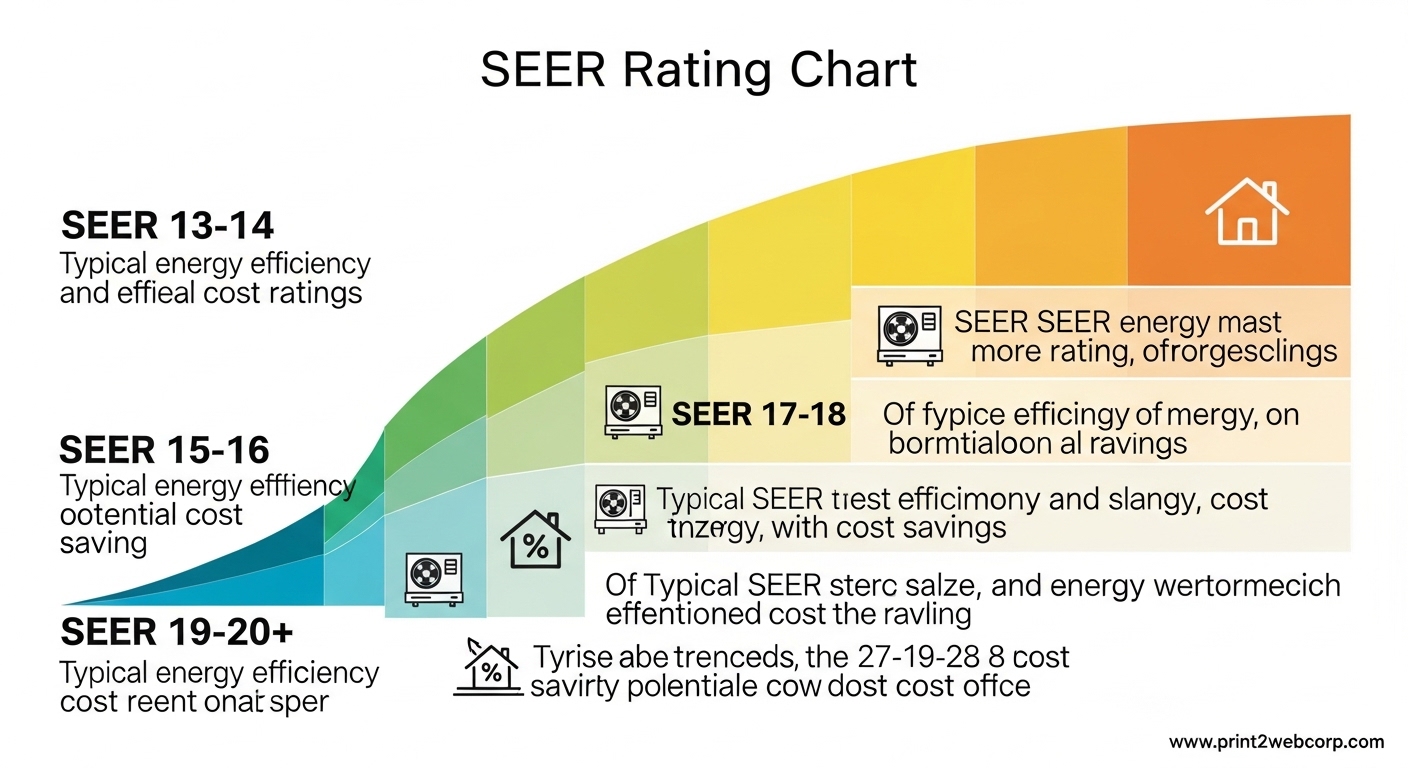
When shopping for a new air conditioner or heat pump, you’ll encounter SEER ratings everywhere. Understanding these numbers can mean the difference between saving hundreds of dollars annually on energy bills or overpaying for efficiency you’ll never use. This SEER rating chart breaks down exactly what different ratings mean, how they affect your wallet, and which efficiency level makes sense for your home.
SEER (Seasonal Energy Efficiency Ratio) measures how much cooling an AC unit delivers per watt of electricity consumed over a typical cooling season. Higher numbers indicate better efficiency, but the right choice depends on your climate, home size, and budget. Let’s decode what these ratings actually mean in real-world terms.
What Is a SEER Rating?
SEER stands for Seasonal Energy Efficiency Ratio, a standardized measurement that calculates an air conditioner’s cooling output divided by its energy input over a typical cooling season. The rating is determined under controlled laboratory conditions set by the Department of Energy, making it a reliable way to compare efficiency across different models and brands.
Think of SEER like miles per gallon for your car. A 16 SEER unit is roughly 30% more efficient than a 10 SEER unit, just as a car getting 30 MPG travels 30% farther on the same amount of fuel as one getting 23 MPG. This translates directly to lower monthly electricity bills, though the upfront cost increases with higher ratings.
The federal minimum SEER rating for new central air conditioners is 13.4 SEER2 (equivalent to 14 SEER under the old system) as of 2026. However, many regions require higher minimums, and premium units can reach 26+ SEER. Understanding where your current equipment falls on this scale helps determine whether upgrading makes financial sense.
SEER Rating Chart by Efficiency Tier
This SEER rating chart categorizes units by efficiency tier, showing what you can expect from each level. Use this as a quick reference when comparing models or estimating your current unit’s efficiency.
Minimum Efficiency (13.4-14 SEER2 / 14-15 SEER)
These units meet the federal minimum requirements and represent the most affordable option. Single-stage compressors run at full capacity until reaching the thermostat setting, then cycle off. This on-off operation works but isn’t the most efficient approach to cooling.
Basic models typically feature fixed-speed fans and standard efficiency components. While they cool your home effectively, expect higher monthly energy costs compared to higher-rated units. These make sense for mild climates where AC runs only a few hours per day during summer.
Better Efficiency (15-16 SEER2 / 16-17 SEER)
This sweet spot offers noticeable efficiency improvements without the premium price tag of top-tier models. Most feature two-stage compressors that can run at low capacity (around 60-70%) for milder days and ramp up when temperatures spike.
The two-stage approach reduces energy consumption and maintains more consistent temperatures throughout your home. You’ll also experience better humidity control since the compressor runs longer at lower capacity, removing more moisture from the air. This range typically offers the best payback period for most homeowners in moderate climates.
High Efficiency (17-19 SEER2 / 18-20 SEER)
Premium models in this range feature variable-speed or inverter compressors that can adjust output in small increments to match your home’s cooling needs precisely. Instead of cycling on and off, these units often run continuously at low speeds, eliminating temperature swings and humidity spikes.
The technology comes at a price premium of $1,500-$3,000 above standard models, but energy savings can reach 40-50% compared to older 10 SEER units. Features often include communicating systems that optimize performance, enhanced dehumidification, and quieter operation. Payback periods range from 5-10 years depending on your local electricity rates and cooling load.
Ultra-High Efficiency (20+ SEER2 / 21+ SEER)
The most efficient residential systems available, these units represent the cutting edge of HVAC technology. Advanced inverter compressors can operate at as low as 25% capacity, modulating output in tiny increments to maintain perfect conditions with minimal energy use.
Expect to pay $4,000-$8,000 more for these systems, making them difficult to justify purely on energy savings alone. However, they excel in hot climates where AC runs constantly, offering superior comfort, humidity control, and quiet operation. Many qualify for federal tax credits and local utility rebates, improving the return on investment.
How SEER Ratings Affect Your Energy Bills
The impact of SEER ratings on your monthly energy costs depends on several factors, including your local climate, electricity rates, and how often your AC runs. However, we can estimate potential savings using national averages.
A typical 2,500 square foot home in a moderate climate might spend $1,200 annually cooling with a 10 SEER unit. Upgrading to 14 SEER reduces costs to approximately $857 per year, saving around $343 annually. Jumping to 18 SEER drops annual cooling costs to about $667, saving $533 compared to the 10 SEER unit.
In hot climates like Arizona or Florida where AC runs 8-10 months per year, savings are even more dramatic. The same home might spend $2,400 annually with a 10 SEER unit but only $1,333 with an 18 SEER system, saving over $1,000 each year. These real-world examples help calculate your potential payback period when considering higher-rated equipment.
SEER vs SEER2: The 2026 Rating System
In 2023, the Department of Energy introduced SEER2, a new testing methodology that provides more accurate efficiency measurements. The new test uses different static pressure conditions that better reflect real-world installation scenarios, including ductwork and airflow restrictions common in actual homes.
SEER2 ratings are slightly lower than the old SEER ratings for the same equipment. A unit previously rated 16 SEER might now be rated 14.5 SEER2. This doesn’t mean the equipment became less efficient, just that the testing method changed. The conversion isn’t exact, but SEER2 ratings are typically about 4-7% lower numerically than the old SEER equivalent.
When shopping for equipment in 2026, you’ll see both ratings on some products. The federal minimum of 13.4 SEER2 replaces the old 14 SEER standard. Focus on SEER2 ratings when comparing new systems, as this reflects current testing standards and legal requirements.
Average SEER Rating by Age of Equipment
If you’re wondering about your current air conditioner’s efficiency, the installation year provides a rough estimate. This chart helps identify whether upgrading makes financial sense based on typical efficiency standards when your unit was manufactured.
Units installed before 1992 typically range from 6-10 SEER and consume 2-3 times more electricity than modern equipment. These older systems often lack basic efficiency features like scroll compressors and expanded surface area coils. If your AC falls into this category and requires major repairs, replacement almost always makes sense given the dramatic efficiency gains available.
Equipment from 1992-2005 usually falls between 10-12 SEER. These units represented a significant improvement over earlier models but still lag behind modern standards. If your system is in this age range and operating reliably, you might not see immediate savings from replacement, but efficiency gains of 30-50% are available by upgrading.
Systems installed between 2006-2015 typically rate 13-15 SEER, meeting or slightly exceeding the federal minimum at the time. These units offer respectable efficiency but still consume 15-30% more energy than current 16-18 SEER models. Consider upgrading if facing expensive repairs or if your climate drives high cooling costs.
Modern units from 2016-present range from 14 SEER to 26+ SEER, with most installations in the 14-16 SEER range. If your system is less than 10 years old and cooling efficiently, replacement is rarely justified based on energy savings alone. However, if it’s the minimum efficiency model and you face major repair costs, upgrading to a higher-rated unit might offer reasonable payback.
Regional Minimum Requirements
The federal government sets baseline SEER requirements, but many states and regions enforce stricter standards based on climate considerations. These regional minimums often exceed the national minimum, particularly in areas with heavy cooling demands.
The Southwest region (Arizona, California, Nevada, New Mexico) requires a minimum of 14 SEER2 (15 SEER) for split systems and 15 SEER2 for packaged units. The hot climate drives high AC usage, making efficiency crucial for grid reliability and consumer energy costs. Texas and most Southeastern states follow similar requirements.
Northern states with milder summers often follow the federal minimum of 13.4 SEER2. If you live in these regions and use AC only 2-3 months per year, investing in ultra-high efficiency rarely makes financial sense. The shorter cooling season limits energy savings, extending payback periods beyond the typical equipment lifespan.
Always verify local requirements before purchasing equipment, as non-compliant systems cannot be legally installed. Your HVAC contractor should know regional requirements, but understanding these minimums helps you make informed decisions about efficiency investments.
What SEER Rating Chart Should You Use?
Choosing the right SEER rating involves balancing upfront costs against long-term energy savings. This SEER rating chart provides general guidance, but your specific situation determines the optimal choice.
For hot climates (Arizona, Texas, Florida, Nevada) where AC runs more than 2,000 hours annually, 16-18 SEER2 units typically offer the best value. The extended cooling season generates substantial energy savings, often justifying the higher equipment cost. Homes with high electricity rates (above 15 cents per kWh) see even faster payback periods. Consider 20+ SEER if you plan to stay in your home for 10+ years and want maximum efficiency.
Moderate climates (Tennessee, North Carolina, Virginia, Missouri) with 1,000-1,500 cooling hours annually present a different equation. The sweet spot is usually 15-16 SEER2, which offers meaningful efficiency gains without excessive upfront costs. Higher-rated units (18+ SEER) may not pay back within the equipment’s 15-20 year lifespan unless electricity rates are exceptionally high.
Cooler climates (Ohio, Pennsylvania, Michigan, New York) with limited AC use make efficiency investments harder to justify. Meeting the federal or regional minimum (13.4-14 SEER2) usually makes the most financial sense. The short cooling season limits energy savings, so spending extra for high efficiency rarely provides reasonable return on investment.
Is Higher SEER Worth the Extra Cost?
The jump from minimum efficiency (14 SEER) to mid-range (16-17 SEER) typically costs $800-$1,500 more but saves 15-25% on cooling costs. For most homeowners, this offers a payback period of 5-8 years, making it a solid investment in areas with moderate to heavy cooling needs. The two-stage technology also improves comfort and humidity control.
Moving from mid-range to premium efficiency (18-20 SEER) adds another $1,500-$3,000 but only provides incremental savings of 10-15% over the mid-range unit. Payback periods stretch to 10-15 years, which often exceeds how long people stay in their homes. Consider this range if you value comfort features, plan long-term ownership, or live in extreme climates.
The ultra-premium category (21+ SEER) adds $3,000-$6,000 over standard models with savings that rarely justify the cost based on energy alone. These units make sense primarily for new construction, extreme climates, or homeowners prioritizing maximum efficiency regardless of payback period. Many qualify for tax credits that improve the economics.
SEER Rating Myths vs Facts
Myth: Higher SEER always means lower bills. Fact: SEER measures potential efficiency under ideal conditions. Poor installation, incorrect sizing, leaky ducts, and lack of maintenance can prevent high-SEER equipment from delivering rated efficiency. A 14 SEER system installed correctly often outperforms a poorly installed 20 SEER unit.
Myth: SEER ratings are guaranteed. Fact: The rating is a laboratory measurement, not a promise of real-world performance. Your actual efficiency depends on factors including proper sizing, ductwork design, airflow, and maintenance. Most installed systems perform 10-30% below their rated SEER due to installation issues.
Myth: You should always buy the highest SEER available. Fact: The optimal SEER depends on your climate, electricity rates, and how long you’ll own the system. In many regions, the extra cost of ultra-high efficiency never pays back. Choose based on your specific situation, not maximum rating.
Frequently Asked Questions
Is it worth going from 14 SEER to 16 SEER?
Yes, upgrading from 14 to 16 SEER typically saves 15-20% on cooling costs, amounting to $150-300 annually for average homes. The $800-1,500 equipment premium usually pays back in 5-8 years, making it a solid investment for most homeowners in moderate to hot climates who plan to stay in their home at least that long.
What is considered a good SEER rating?
A good SEER rating depends on your climate. For hot climates (Southwest, Southeast), 16-18 SEER is considered good and offers strong value. In moderate climates, 14-16 SEER provides adequate efficiency. Units below 14 SEER are below current minimum standards and should be replaced when repairs are needed. The highest ratings (21+ SEER) offer premium efficiency but may not justify the cost in milder regions.
What SEER for a 2000 sq ft house?
A 2000 sq ft house typically requires a 3-4 ton unit regardless of SEER rating. Focus on proper sizing first, then choose SEER based on your climate. For this size home in hot climates, 16-18 SEER offers good value. In moderate regions, 14-16 SEER is usually sufficient. Always have a professional perform Manual J load calculations to determine the correct tonnage, as oversizing reduces efficiency regardless of SEER rating.
Does a 16 SEER qualify for tax credits?
Federal tax credit availability changes periodically. As of 2026, the Inflation Reduction Act provides credits for high-efficiency equipment, but minimum requirements vary by equipment type. Some 16 SEER heat pumps qualify, while air conditioners typically need higher ratings (18+ SEER) to be eligible. Check current IRS guidelines and local utility rebates, as incentives change frequently and vary by location.
What is a typical SEER rating?
Typical SEER ratings vary by equipment age. Units installed before 2006 usually rate 10-13 SEER. Equipment from 2006-2015 typically falls in the 13-15 SEER range. Modern systems (2016-present) range from 14-26+ SEER, with most new installations in the 14-16 SEER range. The federal minimum for new equipment in 2026 is 13.4 SEER2, approximately equivalent to 14 SEER under the old rating system.
Conclusion
Understanding SEER ratings helps you make smarter decisions about air conditioner replacement and efficiency upgrades. This SEER rating chart provides a framework for comparing options, but the right choice depends on your specific circumstances including climate, electricity rates, and how long you’ll own the equipment.
Focus on finding the sweet spot where equipment cost and energy savings balance for your situation. For most homeowners in moderate to hot climates, 15-17 SEER2 units offer the best combination of efficiency, comfort features, and reasonable payback periods. Avoid overspending on ultra-high efficiency unless your climate and usage patterns justify the investment.
Remember that proper installation and sizing matter more than the SEER rating itself. A correctly installed 14 SEER system will outperform a poorly installed 20 SEER unit every time. Use this SEER rating chart as a starting point, but work with a qualified contractor who can assess your home’s specific needs and recommend equipment that makes financial sense for your situation.
Leave a Reply