
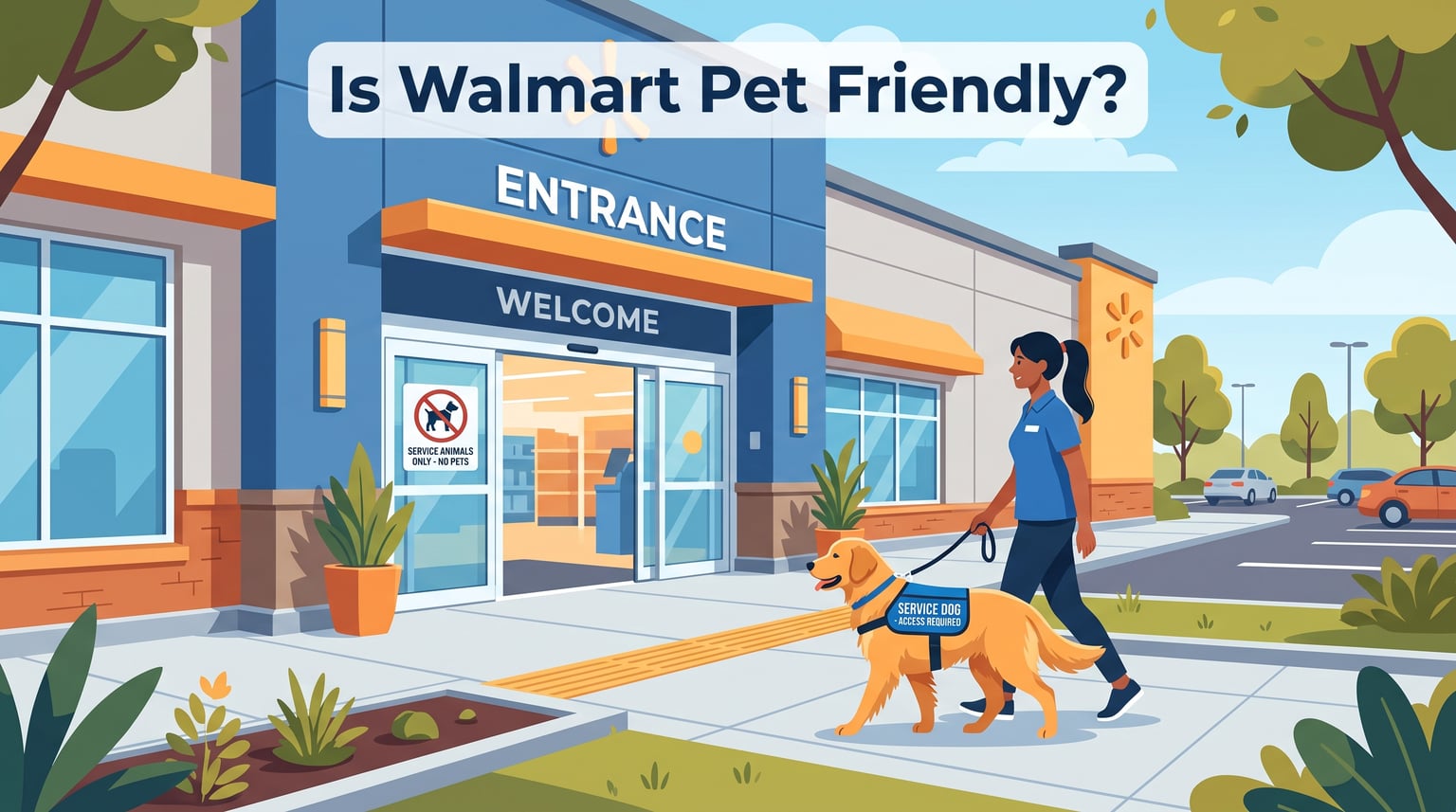
If you are wondering whether Walmart is pet friendly, the short answer is no. Walmart does not allow pets inside its stores, with one critical exception: service animals as defined by the Americans with Disabilities Act (ADA). This policy applies nationwide and has not changed as of 2026. Whether you are shopping for groceries, electronics, or household goods, only a trained service dog (or in rare cases, a miniature horse) may accompany you through the doors.
Many pet owners assume that bringing a small dog in a carrier, stroller, or handbag changes the rules. It does not. Walmart’s pet policy is tied to federal food safety regulations under the FDA Food Code, which prohibits non-service animals in establishments that sell or prepare food. This means the restriction is not merely a store preference but a legal requirement that applies to grocery-selling retailers across the country.
This guide breaks down the complete Walmart pet policy for 2026, including how service animals are defined under the ADA, what questions store staff are legally permitted to ask, how the rules apply to emotional support animals, and what alternatives exist for shoppers who want to bring their pets along.
Quick Summary: Is Walmart Pet Friendly?
Here is a quick-reference breakdown of what Walmart allows and does not allow:
- Pets (dogs, cats, etc.): Not allowed inside any Walmart store, regardless of size, breed, or containment method.
- Service animals (ADA-defined): Permitted. These are dogs individually trained to perform tasks for a person with a disability.
- Emotional support animals (ESAs): Not allowed. ESAs do not qualify as service animals under the ADA.
- Therapy dogs: Not allowed. Therapy dogs provide comfort to others but are not trained for a specific handler’s disability.
- Service dogs in training (SDITs): Not covered by federal ADA. Access depends on individual state law.
- Dogs in strollers, carriers, or bags: Not allowed. The policy does not change based on containment method.
- Dogs in shopping carts: Not allowed. This also violates Walmart’s cart sanitation policies.
Walmart’s Official Pet Policy Statement
Walmart has published its position on animals in stores directly on its corporate website. The official statement from Walmart’s corporate policy page reads:
“Walmart welcomes service animals as defined by the ADA in our stores, and we recognize the important role they play in many of our customers’ lives. We do not allow pets in our stores.”
This statement, sourced from corporate.walmart.com, is the definitive answer to whether Walmart is pet friendly. It draws a firm line between service animals (welcome) and pets (not welcome). The policy exists at the corporate level and applies to every Walmart location in the United States, though individual enforcement can vary depending on the store manager and staffing.
Some shoppers report seeing pets inside Walmart stores from time to time. This typically reflects inconsistent enforcement rather than an exception to the rule. A store greeter or manager may choose not to challenge a customer with a small dog, but that does not mean the policy has changed. The official corporate position remains unchanged for 2026.
Service Animals at Walmart: What the ADA Says
Under the Americans with Disabilities Act, a service animal is defined as a dog that has been individually trained to perform specific tasks or work for a person with a disability. The task(s) performed by the dog must be directly related to the person’s disability. This federal definition is the standard Walmart follows.
Importantly, the ADA does not require service animals to be certified, registered, or licensed. There is no federally recognized service dog registry or certification program. Any website claiming to “register” or “certify” a service dog for a fee is operating a business, not issuing a legal credential. Walmart staff cannot demand to see certification, registration paperwork, or identification badges for a service animal.
Types of Service Dogs Permitted at Walmart
Service dogs perform a wide range of tasks, and all recognized types are welcome at Walmart. Common categories include:
- Guide dogs for individuals who are blind or visually impaired, trained to safely direct their handlers.
- Hearing dogs that alert deaf or hard-of-hearing individuals to important sounds like doorbells, alarms, or approaching vehicles.
- Mobility service dogs that assist individuals with physical disabilities by retrieving items, opening doors, or providing balance support.
- Medical alert dogs trained to detect and respond to medical events such as drops in blood sugar (diabetic alert dogs), oncoming seizures (seizure alert dogs), or cardiac events (cardiac alert dogs).
- Psychiatric service dogs that perform specific tasks for individuals with conditions such as PTSD, anxiety disorders, or depression. These tasks may include grounding techniques, interrupting panic episodes, or creating physical space in crowds.
The ADA also extends service animal protections to miniature horses that have been individually trained to perform tasks for people with disabilities, though this is uncommon in retail settings.
The ADA Two-Question Rule: What Walmart Staff Can Ask
One of the most misunderstood aspects of the service animal policy concerns what store employees are legally allowed to ask. Under ADA regulations, when it is not obvious what service a dog provides, Walmart staff may ask only two specific questions:
- “Is the dog a service animal required because of a disability?”
- “What work or task has the dog been trained to perform?”
Staff cannot ask about the person’s disability, request medical documentation, demand to see a service dog certification or ID card, or require that the dog demonstrate its task on the spot. They also cannot require the dog to wear a vest, patch, or any other identifying gear. While many service dog handlers choose to use vests for clarity in public, the ADA explicitly states that such identification is not legally mandated.
This two-question framework protects the civil rights of individuals with disabilities while giving retailers a limited tool to distinguish legitimate service animals from pets. Walmart employees are trained to work within these boundaries, though individual awareness and enforcement can vary by location and staff member.
Service Dog Vest Requirements (or Lack Thereof)
A common point of confusion involves whether a service dog must wear a vest. Under the ADA, the answer is no. A service dog is not required to wear a vest, harness, ID tag, or any special gear to be granted public access. While vests are widely used and can help signal to store staff and other customers that the dog is working, they are a personal choice, not a legal prerequisite.
This means Walmart cannot turn away a legitimate service dog simply because it is not wearing identifying equipment. Conversely, the presence of a vest on a pet does not transform that animal into a service dog. Online retailers sell service dog vests to anyone, which has contributed to the growing problem of pet owners misrepresenting their animals.
Emotional Support Animals, Therapy Dogs, and Comfort Animals at Walmart
Emotional support animals (ESAs) provide therapeutic benefit to their owners through companionship and presence. Unlike service dogs, ESAs are not individually trained to perform specific tasks related to a disability. Because they fall outside the ADA’s service animal definition, they are not granted public access rights at Walmart or any other retail establishment.
This distinction is frequently misunderstood. An ESA letter from a licensed mental health professional grants housing rights under the Fair Housing Act and may allow the animal to accompany the owner in the cabin of an aircraft under certain airline policies (though most major airlines have tightened their ESA policies in recent years). However, neither an ESA letter nor an ESA registration grants access to stores, restaurants, or other public accommodations covered by the ADA.
Therapy dogs represent another distinct category. These dogs are trained to provide comfort and affection to people in settings such as hospitals, nursing homes, and schools. They do not have public access rights under the ADA and are not permitted at Walmart.
State Law Variations for Emotional Support Animals
Some states have passed laws extending limited public access rights to ESAs in specific situations, but these vary widely and typically do not override federal food safety regulations. Even in states with broader ESA protections, retailers that sell food such as Walmart are generally permitted to exclude non-service animals under FDA Food Code provisions. If you have an ESA, it is best to check your specific state’s laws, but do not assume that state law overrides Walmart’s corporate policy.
Service Dogs in Training at Walmart
A frequently asked question is whether service dogs in training (SDITs) are allowed inside Walmart. The federal ADA does not cover service dogs in training. It only protects fully trained service animals that are already performing tasks for a person with a disability. This means that under federal law, Walmart is not required to admit a dog that is still being trained.
However, many states have their own laws that grant access rights to service dogs in training, often specifying that the dog must be accompanied by a recognized trainer or the individual with a disability for whom the dog is being trained. States with SDIT access laws include California, Texas, Florida, New York, and many others, though the specific requirements differ.
If you are training a service dog and want to bring it to Walmart, research your state’s specific SDIT provisions. Even in states where access is legally permitted, Walmart staff may not be familiar with state-level SDIT laws, which can lead to confusion or conflict at the door.
Can I Bring My Dog to Walmart in a Stroller, Carrier, or Bag?
One of the most searched questions on this topic is whether a pet stroller, carrier, or enclosed bag changes Walmart’s pet policy. The answer is no. Walmart’s prohibition on pets applies regardless of whether the animal is walking, being carried, enclosed in a bag, seated in a pet stroller, or contained in any other manner.
The policy is based on the animal’s presence in the store, not its method of containment. Even if a small dog is fully enclosed in a carrier and never touches the floor, its presence still violates the FDA Food Code regulations that govern establishments selling food. Store staff are instructed to ask customers with any non-service animal to remove it from the premises.
The shopping cart policy is equally strict. Placing a pet in a Walmart shopping cart is prohibited for both policy and sanitation reasons. Carts are used for food items and children, and allowing pets in carts introduces contamination risks that violate health codes.
Why Walmart Does Not Allow Pets: The FDA Food Code and Beyond
The primary legal reason Walmart bans pets is the FDA Food Code. This federal model for food safety regulation, adopted by most state and local health departments, prohibits live animals in food establishments with limited exceptions for service animals. Because Walmart sells groceries, fresh produce, deli items, and prepared foods, it falls squarely within the scope of these regulations.
The FDA Food Code is not a suggestion. It is the regulatory framework that health inspectors use to evaluate grocery stores, restaurants, and other food retailers. Allowing non-service animals into areas where food is sold, displayed, or prepared would constitute a health code violation that could result in fines, inspection failures, or even temporary store closure. This is why every major grocery retailer in the United States enforces the same basic policy.
Beyond the legal requirement, there are several practical reasons why pets are excluded from retail environments:
- Food contamination risk: Animals can shed fur, dander, saliva, and waste in areas where food is handled or displayed. Even well-groomed pets introduce sanitation concerns that health inspectors take seriously.
- Allergic customers and employees: Pet dander is a common allergen. Allowing animals into enclosed retail spaces can trigger allergic reactions in other shoppers and staff members.
- Parasites and pests: Pets can carry fleas, ticks, and mites into a store environment. These parasites can spread to products, shelving, and other areas of the store.
- Behavioral unpredictability: Even well-trained pets can become stressed or reactive in crowded, noisy retail environments. Unfamiliar sights, sounds, and strangers can trigger barking, lunging, or aggressive behavior that endangers other customers.
- Property damage: Pets may chew, scratch, or soil merchandise and store fixtures. This creates financial losses and additional cleanup burdens for store employees.
- Customer comfort: Not all shoppers feel comfortable around animals. Some have phobias, cultural objections, or health conditions that make proximity to animals stressful or unsafe.
Fake Service Dogs and Legal Consequences
The misuse of service dog vests and fake service dog registrations has become a significant problem across the United States. Pet owners who purchase vests or ID cards online and misrepresent their pets as service animals to gain store access are committing fraud, and an increasing number of states are criminalizing this behavior.
As of 2026, more than 30 states have enacted laws that specifically penalize the misrepresentation of a pet as a service animal. Penalties vary by state but typically include fines ranging from $100 to $1,000 or more, and some states impose community service requirements or misdemeanor charges for repeat offenses. States with service dog fraud laws include California, Florida, Texas, Michigan, Colorado, Arizona, and many others.
Beyond the legal consequences, misrepresenting a pet as a service dog harms legitimate service dog handlers. Untrained dogs behaving poorly in stores create negative impressions that make it harder for real service dog teams to be taken seriously. Businesses that experience problems with fake service dogs may become more aggressive in questioning legitimate handlers, eroding the protections the ADA was designed to provide.
Walmart vs. Target Pet Policy
Many shoppers ask whether Target has a different pet policy than Walmart. The answer is no. Target enforces the same basic rule: only service animals as defined by the ADA are permitted inside Target stores. Pets, emotional support animals, and therapy dogs are not allowed, for the same FDA Food Code reasons that apply to Walmart.
Both retailers sell groceries and prepared food, which places them under the same food safety regulations. The distinction between the two stores on pet policy is effectively zero. If you are choosing between Walmart and Target based on which is more pet friendly, neither offers an advantage for non-service animals.
Pet-Friendly Store Alternatives to Walmart
If you want to shop with your pet, several national retail chains do allow well-behaved, leashed dogs inside their stores. These businesses typically do not sell food for immediate consumption, which removes the FDA Food Code barrier. Pet-friendly alternatives include:
- PetSmart and Petco — Pet supply stores welcome leashed pets of all kinds, including dogs, cats, and sometimes smaller animals.
- Bass Pro Shops and Cabela’s — These outdoor retailers are known for their dog-friendly policies and often provide water bowls and treats for visiting dogs.
- Ace Hardware — Many independently owned Ace Hardware locations welcome leashed dogs. Since stores are franchised, it is best to call ahead to confirm.
- Barnes & Noble — Many locations permit leashed dogs, though the policy can vary by store and local health regulations.
- Tractor Supply Co. — This rural lifestyle retailer is consistently pet-friendly and often hosts pet adoption events.
- Home Depot — While not an official corporate policy, many Home Depot locations are known to allow leashed dogs at the discretion of the store manager.
Always call ahead before visiting any store with your pet, as individual locations may have different policies based on local ordinances, lease agreements, or management decisions.
Walmart Curbside Pickup: A Practical Alternative
If you cannot or do not want to leave your pet at home, Walmart’s curbside pickup service offers a practical workaround. You can place your order online or through the Walmart app, park in a designated curbside pickup spot, and have a Walmart employee load your groceries directly into your vehicle. Your pet never needs to enter the store, and you never need to leave it unattended in a potentially dangerous parked car.
This service is available at most Walmart locations nationwide and is free on orders meeting the minimum threshold. For pet owners who need to run errands with their animals, curbside pickup eliminates the policy conflict entirely.
Walmart Pet Policy FAQs
Can I bring my pet dog to Walmart?
No. Walmart does not allow pet dogs inside its stores. Only service animals as defined by the ADA are permitted. This policy applies to all Walmart locations and is tied to FDA Food Code regulations governing establishments that sell food.
Can I put my dog in a shopping cart at Walmart?
No. Placing a pet in a Walmart shopping cart is prohibited. This violates both the store’s pet policy and cart sanitation standards. Only ADA-defined service animals are allowed inside, and they must remain on the floor or be carried by their handler.
Are dogs allowed in Target or Walmart?
Neither Target nor Walmart allows pet dogs inside. Both retailers enforce the same policy: only ADA-defined service animals are permitted. Both stores sell food and are subject to the same FDA Food Code regulations that prohibit non-service animals.
Is Walmart allowed to ask if your dog is a service dog?
Yes, but only within specific limits. Under the ADA, Walmart staff may ask two questions when it is not obvious the dog is a service animal: (1) Is the dog required because of a disability? and (2) What work or task has the dog been trained to perform? They cannot ask for documentation, certification, or a demonstration of the task.
Does Walmart allow service dogs in training?
Federal ADA law does not cover service dogs in training, so Walmart is not required to admit them. However, many states have their own laws granting access to service dogs in training. You should check your specific state’s laws before bringing a training dog to Walmart.
Can I bring my dog to Walmart in a stroller or carrier?
No. Walmart’s pet policy applies regardless of how the animal is contained. A dog in a stroller, carrier, bag, or arms is still a pet and is not permitted inside the store. Only ADA-defined service animals are allowed.
Are emotional support dogs allowed in Walmart?
No. Emotional support animals (ESAs) are not recognized as service animals under the ADA and are not permitted inside Walmart. An ESA letter provides housing rights under the Fair Housing Act but does not grant public access to retail stores.
Are small dogs allowed inside Walmart stores?
No. Size does not change the policy. Whether your dog is a 5-pound Chihuahua or a 100-pound Labrador, it is not allowed inside Walmart unless it is a trained service animal performing tasks related to a disability.
Is it illegal to fake a service dog at Walmart?
Yes, in most states. Over 30 states have laws criminalizing the misrepresentation of a pet as a service animal. Penalties range from fines of $100 to $1,000 or more, and some states impose misdemeanor charges. Fake service dogs also create problems for legitimate service dog handlers.
Are cats allowed in Walmart?
No. Walmart’s pet policy applies to all non-service animals, including cats. Only dogs (and in rare cases miniature horses) that qualify as service animals under the ADA are permitted inside Walmart stores.
Conclusion
Walmart is not pet friendly in the traditional sense. The store’s official policy, rooted in FDA Food Code regulations and ADA compliance, permits only trained service animals inside its locations. Pets, emotional support animals, therapy dogs, and service dogs in training (depending on state law) are not allowed, regardless of size, breed, or containment method.
If you rely on a service dog, Walmart is legally required to accommodate you under the ADA. Staff may ask only the two permitted questions and cannot demand certification, registration, or identification. If you are a pet owner without a service animal, alternatives include shopping at genuinely pet-friendly retailers like PetSmart, Petco, Tractor Supply, and Bass Pro Shops, or using Walmart’s curbside pickup to complete your shopping without leaving your pet alone in a vehicle.
Understanding the distinction between service animals, emotional support animals, and pets is essential for navigating retail policies in 2026. Walmart’s rules exist to protect food safety, public health, and the civil rights of individuals with disabilities. Respecting these policies helps ensure that legitimate service dog teams continue to receive the access and respect they are legally entitled to.
Leave a Reply