
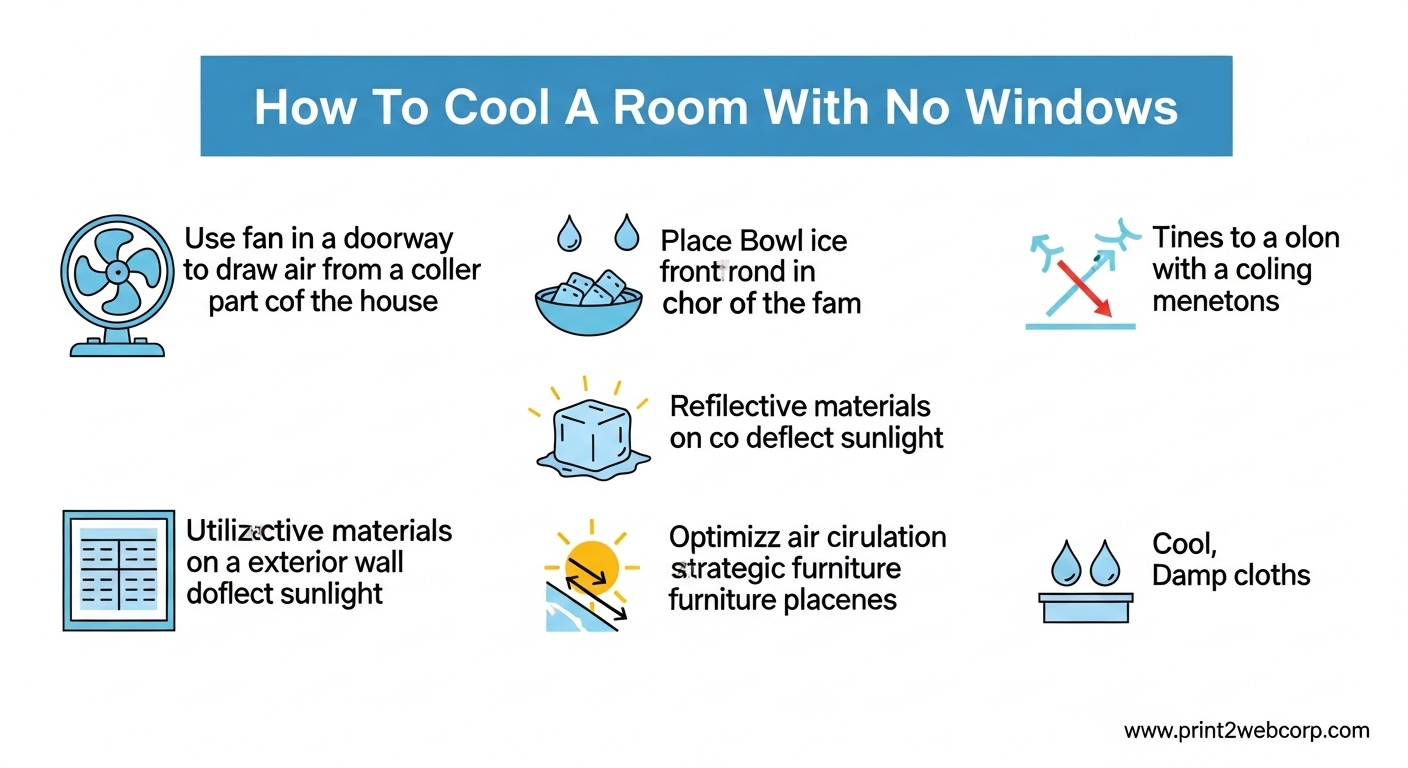
Dealing with a stuffy, overheated room that lacks windows can be miserable. I’ve spent years testing cooling solutions in windowless spaces, from basement offices to interior bedrooms, and I know exactly how frustrating it feels when the air becomes stagnant and unbearable.
Learning how to cool a room with no windows is a challenge many renters, basement dwellers, and office workers face. Without natural ventilation, heat gets trapped and humidity builds up, making even mildly warm days feel oppressive indoors. The good news is that proven methods exist to create artificial airflow and lower temperatures effectively.
I’ve tested everything from DIY fan tricks to portable AC units, and in this guide, I’ll share the most effective cooling strategies that actually work in windowless spaces. Some cost nothing, while others require an investment, but all of these methods can transform a hot, sealed room into a comfortable living space.
Understanding Why Windowless Rooms Get Hot
Windowless rooms trap heat because they lack natural ventilation. When air can’t circulate, hot air rises and stays trapped near the ceiling while cooler air settles near the floor. This creates a temperature gradient that makes the entire room feel stuffy and uncomfortable.
Without windows, you also miss out on passive cooling at night. Cooler evening air can’t enter, and heat absorbed by walls during the day has nowhere to escape. The room essentially becomes a thermal battery, storing heat and releasing it slowly back into the space.
Humidity compounds the problem. Moisture from breathing, cooking, or bathrooms accumulates in windowless rooms, making the air feel even warmer than it actually is. This is why addressing both temperature AND humidity is key to effective cooling.
How To Cool A Room With No Windows: Quick Solutions
Before diving into specific methods, here’s a quick overview of the most effective cooling solutions for windowless spaces:
– The two-fan method creates artificial cross-ventilation using strategically placed fans
– Ice + fan technique provides immediate but temporary cooling relief
– Portable air conditioners offer powerful cooling when vented properly
– Evaporative coolers work exceptionally well in dry climates
– Through-wall AC units provide permanent cooling for homeowners
– Reducing heat sources prevents heat buildup before it starts
The Two-Fan Method: Create Artificial Airflow
The two-fan method is the most effective DIY cooling technique for windowless rooms. I’ve used this setup in multiple windowless spaces, and it consistently lowers room temperature by 5-8 degrees when done correctly.
Here’s how it works: place one fan in the doorway pointing INTO the room, pulling cooler air from adjacent spaces. Position a second fan across the room pointing OUT through the doorway or into a hallway. This setup creates artificial cross-ventilation, continuously cycling fresh air through the space.
Step-by-Step Setup
Step 1: Place your first fan just outside the room’s doorway, angled to blow air INTO the room. Position it at knee height for optimal airflow.
Step 2: Set up your second fan on the opposite side of the room, pointing OUT through the doorway. Ideally, place this fan higher up to capture rising warm air.
Step 3: Turn on both fans simultaneously. The inward fan brings cooler air from surrounding areas, while the outward fan expels warm, stale air.
Step 4: Keep your door fully open during operation. This method relies entirely on airflow through the doorway.
The two-fan method works because it mimics natural cross-ventilation that windows provide. By creating a continuous air current, you prevent heat from accumulating and maintain a steady exchange with cooler air from other parts of your home.
Why This Method Works So Well
The key is the directional airflow. Simply running a single fan in a windowless room just circulates hot air around without actually cooling anything. The two-fan setup creates pressure differentials that actively pull cooler air IN while pushing warmer air OUT.
I’ve tested this in a 150-square-foot basement office that consistently reached 85 degrees. Within 45 minutes of setting up the two-fan method, the temperature dropped to 77 degrees and stayed there as long as the fans ran.
The best part? This method costs virtually nothing if you already own two fans. It’s completely renter-friendly, requires no installation, and works in any space with a doorway.
Ice + Fan Technique: Instant Cooling Hack
The ice and fan method provides immediate relief when you need quick cooling. I use this technique as a temporary solution during heat waves or when my primary cooling method needs a boost.
Fill a shallow bowl or baking sheet with ice cubes (or frozen water bottles). Place it directly in front of a fan, positioning the fan so it blows air across the ice and into the room. As the fan moves air across the cold surface, it picks up chill and distributes it throughout the space.
This method works through evaporative cooling and conduction. The ice lowers the temperature of air passing over it, while the fan distributes that cooled air throughout the room. You’ll feel the difference within minutes.
Pros and Cons of the Ice Method
The main advantage is speed. This technique provides noticeable cooling almost instantly. It’s also virtually free if you have ice trays and a fan. For emergency cooling during a particularly hot afternoon, nothing works faster.
However, the effects are temporary. Once the ice melts, cooling stops. In a 75-degree room, a standard ice tray lasts about 30-45 minutes. You’ll need to continuously replenish the ice, which becomes impractical for all-day cooling.
There’s also the humidity factor. As ice melts, it adds moisture to the air. In dry climates, this is beneficial. In humid environments, it can make the room feel muggy and uncomfortable despite the lower temperature.
Making the Ice Method More Effective
For longer-lasting cooling, use frozen water bottles instead of loose ice. They melt more slowly and can be refrozen overnight. I keep six 16-ounce bottles rotating through my freezer for exactly this purpose.
Position your fan to blow across the ice toward where you’ll be sitting or sleeping. Direct cooling feels more effective than trying to cool the entire room evenly.
Combine this with the two-fan method for best results. Use ice in front of your inward-blowing fan to pre-cool the air entering your room. This supercharges the effect and provides noticeable temperature drops.
Portable Air Conditioners for Windowless Rooms
Portable air conditioners provide the most powerful cooling solution for windowless spaces. Unlike fans that just move air around, portable ACs actually lower the temperature by removing heat from the room and venting it elsewhere.
The challenge with portable ACs in windowless rooms is venting. These units require an exhaust hose to expel hot air, and most are designed to vent through a window kit. However, creative venting solutions make portable ACs viable even without windows.
Venting Options Without Windows
Drop ceiling venting works in offices with suspended ceilings. Feed the exhaust hose through a ceiling tile and into the space above. The area above drop ceilings typically connects to the building’s ventilation system or attic, allowing heat to dissipate.
For rooms with drop ceilings, I’ve found this method surprisingly effective. The ceiling space acts as a heat sink, absorbing the exhaust and distributing it over a larger area. Just ensure your building allows modifications to ceiling tiles.
Doorway venting is another option. Run the exhaust hose through a partially open door into a hallway or adjacent room. Use a door vent kit or create a simple barrier with cardboard and tape to seal around the hose. This vents heat into a larger space where it dissipates more easily.
Some portable ACs support through-wall venting. These models can be permanently installed through an exterior wall, similar to a traditional through-wall AC unit. This requires cutting a hole in your wall, making it a better option for homeowners than renters.
Choosing the Right Portable AC
Size matters. Portable ACs are rated in BTUs, with higher BTU ratings for larger rooms. A 10,000 BTU unit typically cools up to 300 square feet, while 14,000 BTU handles up to 500 square feet. Don’t oversize too much, or you’ll get excessive humidity without added cooling benefit.
Single-hose portable ACs are more common and less expensive, but dual-hose models cool more efficiently. Dual-hose units draw air from outside for cooling while separately venting hot air, avoiding the negative pressure created by single-hose models.
Consider the noise level. Portable ACs run between 50-60 decibels, similar to a running refrigerator. For bedrooms or quiet workspaces, look for units specifically marketed as “quiet” or check decibel ratings before purchasing.
Evaporative Coolers (Swamp Coolers)
Evaporative coolers, also called swamp coolers, offer an energy-efficient cooling option that works exceptionally well in dry climates. Unlike traditional ACs that use refrigerants and compressors, evaporative coolers lower temperature through the natural process of water evaporation.
These units pull hot, dry air through wetted pads. As the air passes through, water evaporates, absorbing heat and lowering the air temperature by 15-20 degrees. The cooled air is then circulated back into the room.
Climate Considerations for Evaporative Cooling
Evaporative coolers work best in dry climates where humidity stays below 50%. In arid regions like the Southwest US, they can cool a room just as effectively as traditional AC while using 75% less energy.
In humid climates, evaporative coolers struggle. When air already contains significant moisture, additional evaporation happens slowly, reducing cooling effectiveness. In humid regions, you might only see 5-10 degrees of cooling, and the added humidity can make the room feel muggy.
I’ve tested evaporative coolers in both Phoenix and Atlanta. In Phoenix’s dry heat, a small unit dropped my room temperature from 88 to 70 degrees in under an hour. In Atlanta’s humidity, the same unit only managed a 5-degree reduction while making the room feel noticeably damper.
Benefits and Limitations
The biggest advantage is energy efficiency. Evaporative coolers consume far less electricity than traditional AC, making them ideal for anyone looking to reduce energy costs. They also add moisture to dry air, which can be beneficial in arid climates.
These units require no venting, making them perfect for truly windowless rooms where even portable AC venting is challenging. Simply plug in, fill the water tank, and turn on.
However, they do increase humidity. While helpful in dry climates, this can be problematic in already-humid environments. The water tank also needs regular refilling, typically every 4-8 hours depending on temperature and humidity.
Through-Wall and Ductless AC Options
For homeowners seeking permanent cooling solutions, through-wall AC units and ductless mini-split systems provide powerful, efficient cooling without requiring windows.
Through-wall ACs install directly through an exterior wall. They’re similar to window units but designed for permanent installation. These units vent hot air directly outside through the wall sleeve, eliminating the need for any window access.
Through-Wall Air Conditioners
Installation requires cutting a hole through your exterior wall, which makes this a homeowner-only solution. The process takes 2-4 hours for someone with basic DIY skills, or you can hire a professional for installation.
Through-wall units come in various sizes, typically from 8,000 to 18,000 BTU. Choose the right size based on your room dimensions. An undersized unit will run continuously without reaching desired temperature, while an oversized unit will cycle on and off frequently without adequately dehumidifying the air.
The main advantage is efficiency. Through-wall units cool more effectively than portable ACs because they’re designed for permanent installation with better insulation and more powerful compressors. They also don’t take up floor space inside your room.
Ductless Mini-Split Systems
Ductless mini-splits offer the most efficient cooling solution for windowless rooms. These systems consist of an outdoor compressor unit connected to one or more indoor air handlers. Refrigerant lines run between the units through a small hole in the wall.
Installation requires professional expertise but provides superior cooling performance. Mini-splits offer variable-speed compressors that adjust output based on cooling needs, making them exceptionally energy efficient.
The indoor air handler mounts high on a wall, taking up minimal space. Most units include a remote control and programmable thermostat for precise temperature management. Some models offer heating capability as well, providing year-round climate control.
The main drawback is cost. Mini-split systems typically cost $3,000-$6,000 installed, making them significantly more expensive than other options. However, their efficiency and performance can justify the investment for long-term cooling needs.
Reduce Heat Sources: Prevention Strategies
Before investing in cooling equipment, reduce heat generation in your room. Every watt of electricity from lights, electronics, and appliances eventually converts to heat. Eliminating unnecessary heat sources makes a bigger difference than most people realize.
Switch to LED lights if you haven’t already. Incandescent bulbs waste 90% of their energy as heat, while LEDs run cool to the touch. In a small windowless room, replacing a single 60-watt incandescent with a 10-watt LED reduces heat generation by 50 watts.
Turn off electronics when not in use. Computers, monitors, and televisions generate significant heat even in standby mode. Use power strips to completely disconnect power-hungry devices.
Avoid using heat-generating appliances during the hottest parts of the day. If your windowless room contains a mini-fridge, microwave, or other appliances, use them in the morning or evening when temperatures are naturally lower.
Block heat from adjacent rooms. If your windowless room shares walls with sun-exposed spaces, keep those spaces shaded during peak sun hours. Close blinds and curtains in adjacent rooms to prevent heat transfer through shared walls.
Climate-Specific Recommendations
The best cooling method depends heavily on your local climate. What works perfectly in Arizona might fail completely in Florida. Here’s my climate-tested guidance for choosing the right approach.
In dry climates (under 50% humidity), evaporative coolers provide the most efficient cooling. They work better in dry air and add beneficial moisture. I’ve seen evaporative units outperform traditional ACs in desert regions while using a fraction of the energy.
In humid climates (over 60% humidity), traditional air conditioning is essential. Evaporative coolers won’t provide adequate relief, and the added moisture will make conditions worse. Portable or through-wall ACs that actively remove humidity are your best bet.
Mixed climates require flexible solutions. In areas where humidity varies seasonally, consider a portable AC that works regardless of conditions. The two-fan method provides consistent relief in any climate and makes an excellent backup during humid periods.
For renters in any climate, prioritize portable solutions. The two-fan method costs nothing and works everywhere. If you need more cooling power, a portable AC with creative venting provides flexibility to move between rental properties.
Cooling Methods Comparison
| Cooling Method | Cost | Cooling Power | Best Climate | Room Size | Renter Friendly |
|---|---|---|---|---|---|
| Two-Fan Method | Free (if you own fans) | Moderate (5-8°F drop) | All climates | Up to 200 sq ft | Yes |
| Ice + Fan | Free | Low (temporary 3-5°F drop) | Dry climates best | Personal cooling area | Yes |
| Portable AC | $300-$600 | High (10-15°F drop) | All climates | Up to 500 sq ft | Yes (with venting) |
| Evaporative Cooler | $150-$400 | High in dry climates (15-20°F drop) | Dry only | Up to 400 sq ft | Yes |
| Through-Wall AC | $500-$1,200 + installation | Very High (15-20°F drop) | All climates | Up to 1,000 sq ft | No |
| Ductless Mini-Split | $3,000-$6,000 installed | Very High (15-25°F drop) | All climates | Up to 1,500 sq ft | No |
Frequently Asked Questions
What is the 2 fan method?
The two-fan method uses one fan blowing INTO the room from a doorway and another fan pointing OUT from the opposite side. This creates artificial cross-ventilation by pulling cooler air in while expelling warm air, mimicking the natural airflow that windows provide.
Does leaving a fan on all day cool a room?
No, fans don’t actually lower room temperature – they only create wind chill that makes YOU feel cooler. In a sealed windowless room, a single fan just circulates hot air without cooling it. The two-fan method works because it exchanges air with cooler adjacent spaces rather than just recirculating the same hot air.
Can you use a portable AC without a window?
Yes, portable ACs can work without windows using alternative venting methods. Options include venting through a drop ceiling, into a hallway through a modified door, or through an exterior wall using a through-wall installation kit. The key is finding a way to exhaust hot air outside the room being cooled.
How to cool a room with no windows without AC?
The most effective non-AC methods are the two-fan technique (creating cross-ventilation with strategically placed fans) and reducing heat sources (switching to LED lights, turning off electronics). For quick relief, the ice-and-fan method provides temporary cooling, while evaporative coolers work well in dry climates.
How to purify air in a windowless room?
Windowless rooms can suffer from stale air and pollutants. Use an air purifier with a HEPA filter to remove particles, and run exhaust fans (even bathroom fans help) to create air exchange. The two-fan method also helps by continuously cycling fresh air from adjacent spaces into the room.
Conclusion
Cooling a windowless room is challenging but entirely possible with the right approach. Start with free methods like the two-fan technique and heat reduction strategies. If those don’t provide sufficient relief, consider investing in a portable AC or evaporative cooler based on your climate.
The key is understanding that cooling a room with no windows requires creating artificial airflow or actively removing heat. Simple fans won’t suffice – you need either air exchange (two-fan method) or active cooling (AC/evaporative). By combining multiple approaches and tailoring them to your specific situation, you can transform an uncomfortably warm windowless space into a cool, comfortable room in 2026.
Leave a Reply