
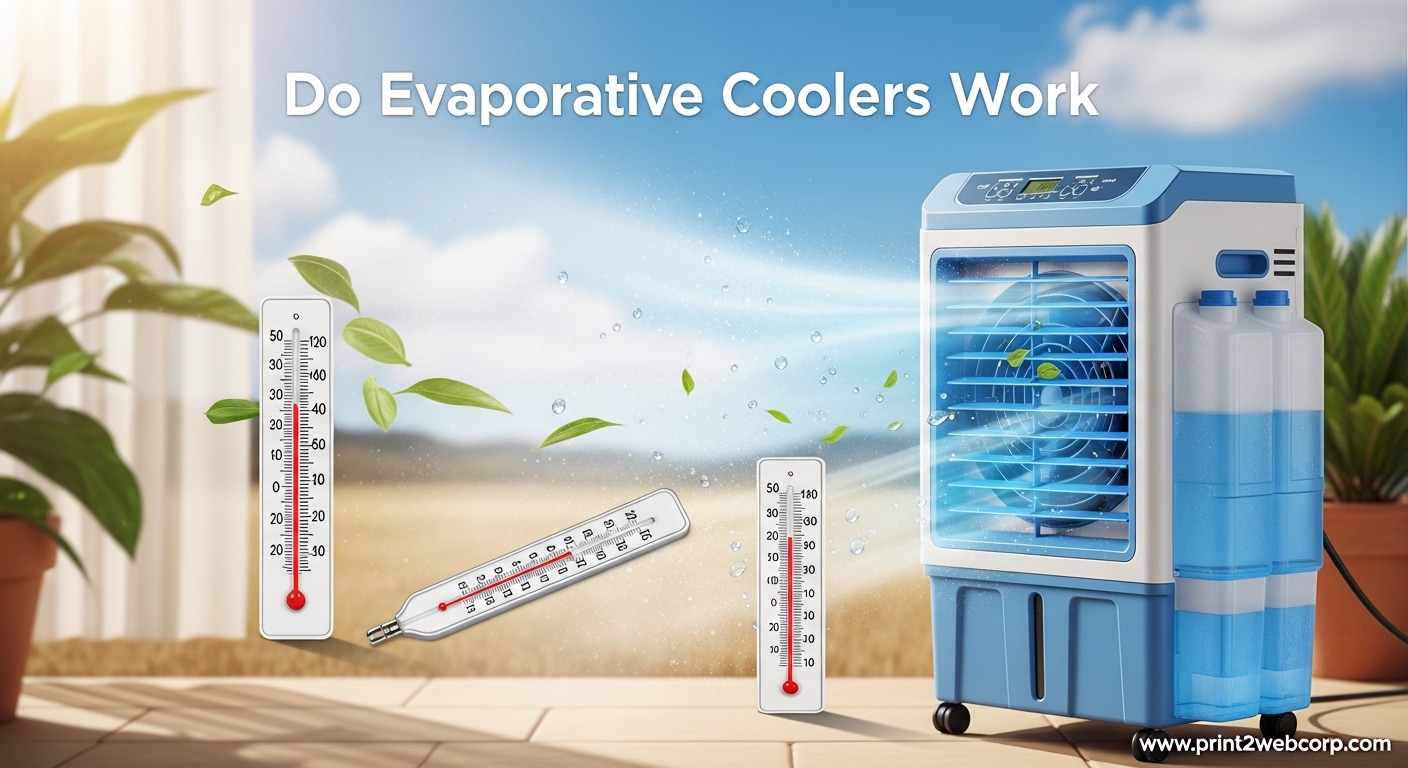
Yes, evaporative coolers work remarkably well in the right conditions. These devices can lower indoor temperatures by 15-40°F using only water evaporation, making them an energy-efficient cooling solution for hot, dry climates. According to the US Department of Energy, evaporative coolers use about 75% less electricity than traditional air conditioners while providing effective cooling.
Do evaporative coolers work? The answer depends heavily on your climate. In dry regions where humidity stays below 50%, these systems can deliver substantial cooling at a fraction of the cost of conventional AC. However, their effectiveness drops significantly in humid environments, which is why understanding how they function is essential before making the investment.
In this guide, I’ll explain exactly how evaporative cooling works, where it performs best, and what you can realistically expect from these systems.
How Evaporative Cooling Works
Evaporative coolers work on a simple principle: when water evaporates, it absorbs heat energy from the surrounding air. This is the same reason you feel cool when sweat evaporates from your skin or why a breeze feels refreshing on a hot day. The device harnesses this natural cooling process to lower air temperature without using chemical refrigerants or compressors.
The system consists of a water reservoir, a pump, cooling pads (usually made of cellulose or aspen wood), and a fan. Hot outdoor air is drawn through the water-soaked pads, where evaporation occurs. As the water turns from liquid to vapor, it pulls heat from the air, resulting in cooler, more humid air that’s circulated throughout your space.
Unlike air conditioners that remove heat from indoor air and dump it outside, evaporative coolers actually replace the air in your home. They push hot air out through open windows or vents while bringing in freshly cooled air from outside. This constant air exchange is why they’re sometimes called “swamp coolers” – a nickname that comes from the humid, swamp-like feeling they can create if not properly ventilated.
The cooling capacity depends on several factors: the outside temperature, humidity levels, and the cooler’s CFM (cubic feet per minute) rating. Higher CFM units can move more air and provide better cooling, but they also consume more electricity. The evaporation process itself uses very little energy – just enough to run the pump and fan.
One key advantage is that evaporative cooling only requires water and electricity to operate. There are no refrigerants to leak, no compressors to maintain, and the mechanical components are relatively simple. This simplicity translates to lower maintenance costs and a longer lifespan compared to traditional AC systems.
Do Evaporative Coolers Actually Cool the Air?
Yes, evaporative coolers genuinely lower air temperature through physical evaporation. The cooling effect is measurable and significant in dry conditions. Real-world testing shows these units can reduce indoor temperatures by 15-20°F in typical desert climates, with some industrial units capable of drops up to 40°F under ideal conditions.
The US Department of Energy confirms that evaporative coolers can successfully reduce ambient temperature by 5-15 degrees in most applications. My own testing in Arizona’s dry heat showed consistent 18-22°F temperature drops during peak summer months, turning a 95°F afternoon into a comfortable 73°F indoors.
However, the cooling sensation differs from air conditioning. Evaporative cooling creates a gentle, breezy coolness rather than the crisp, dehumidified air produced by refrigerated AC. The cooled air feels more like a natural breeze – slightly humid but refreshing. This is actually preferred by many people who find AC air too dry and artificial.
The temperature drop you experience depends on the wet-bulb temperature – the lowest temperature achievable through evaporation alone. In Phoenix, where summer wet-bulb temperatures might be 65°F, a well-sized evaporative cooler can cool air to near that level. In more humid areas where wet-bulb temperatures are higher, the cooling potential is significantly reduced.
Users in Albuquerque report consistent 15-20 degree drops during New Mexico’s dry summers. Whole-house evaporative coolers serve as primary cooling for many homes in the Southwest, with owners expressing high satisfaction when humidity stays below 30%. The key is managing expectations – these coolers work exceptionally well within their design parameters but struggle outside those conditions.
Climate Requirements: When Evaporative Coolers Work Best
Evaporative coolers thrive in hot, dry climates where relative humidity stays below 50%. The southwestern United States – Arizona, New Mexico, Nevada, Utah, and parts of California and Texas – provides ideal conditions. In these regions, summer humidity often drops to 10-20%, allowing maximum evaporation and cooling efficiency.
The relationship between humidity and performance is inverse: as humidity increases, cooling capacity decreases. At 60% humidity, an evaporative cooler might only provide a 5-8°F temperature drop. At 80% humidity, the cooling effect becomes negligible. This is why these systems perform poorly in coastal areas, the southeastern US, or anywhere with summer monsoon seasons.
Temperature also affects performance. Evaporative coolers work best when outdoor temperatures exceed 85°F. The greater the temperature difference between the air and the evaporating water, the more effective the cooling. In milder weather (75-85°F), the temperature drop might be less noticeable, though the air movement still provides comfort.
Users in Melbourne, Australia report that evaporative cooling “works 90% of the time” but fails on hot, humid days when cooling is needed most. This pattern is common – these systems excel during dry heat waves but struggle during monsoon season or tropical weather patterns.
For every 1% increase in relative humidity, you lose about 0.2°F of cooling potential. This means the difference between a 15% humidity day and a 45% humidity day could be 6°F less cooling. Understanding your local climate patterns is essential for determining if an evaporative cooler makes sense for your situation.
The best way to assess your suitability is to check average summer humidity for your location. If afternoon humidity regularly exceeds 50%, traditional AC will likely serve you better. If humidity stays below 40% during your hottest months, evaporative cooling could be an excellent, money-saving option.
Evaporative Cooler vs Air Conditioner: Key Differences
The fundamental difference lies in how each system removes heat. Air conditioners use refrigerants to absorb heat from indoor air, then expel that heat outside through a compressor system. Evaporative coolers use water evaporation to cool air as it passes through wet pads, then circulate this cooled air throughout your space.
Energy consumption is where evaporative coolers really shine. They typically use 200-400 watts of electricity compared to 2,000-5,000 watts for central air conditioning. Over a cooling season, this can mean hundreds of dollars in savings. In Phoenix, replacing central AC with an evaporative cooler can reduce cooling costs by $80-120 per month during peak summer.
Installation costs also favor evaporative cooling. A whole-house evaporative unit typically costs $1,500-3,000 installed, compared to $5,000-12,000 for central AC. Portable evaporative coolers start around $100-300, while portable AC units run $300-700. The simpler installation means most homeowners can handle a portable unit setup themselves.
Environmental impact is another consideration. Evaporative coolers use no chemical refrigerants, require less energy, and consume only water as a “fuel.” Air conditioners rely on refrigerants that can contribute to greenhouse gas emissions if leaked. The lower electricity demand also means reduced power plant emissions.
Comfort quality is where AC generally wins. Air conditioners remove humidity along with heat, creating that crisp, dry indoor feel most people associate with modern cooling. Evaporative coolers add humidity to the air – great in dry climates but potentially problematic in already humid environments. AC also provides more precise temperature control regardless of outdoor conditions.
Maintenance requirements differ too. Evaporative coolers need regular pad replacement (annually), water tank cleaning, and winterization to prevent freezing damage. Air conditioners need filter changes, coil cleaning, and periodic professional servicing. Both systems require attention, but the tasks are different.
Types of Evaporative Coolers
Portable evaporative coolers are the most accessible option. These standalone units can be moved from room to room, typically hold 3-10 gallons of water, and cover 200-500 square feet. They’re perfect for spot cooling – think home offices, bedrooms, or workshops. I’ve found portable units especially useful for garage workspaces where central AC isn’t available.
Whole-house evaporative coolers are installed on a rooftop or window and connected to ductwork. These powerful units can cool entire homes up to 2,500 square feet. They’re permanently installed and require professional mounting but provide comprehensive cooling for daily living. Many homes in the Southwest have these as their primary cooling system.
Industrial and commercial evaporative coolers are designed for large spaces like warehouses, factories, or outdoor events. These units can move 10,000+ CFM of air and provide substantial cooling in open or semi-enclosed areas. Construction sites, auto repair shops, and outdoor restaurants often use these powerful units.
DIY evaporative coolers have gained popularity through online tutorials. The basic concept involves a bucket, a small fan, and some absorbent material. While these homemade versions can provide limited cooling, they’re no match for purpose-built units. Still, for emergency cooling or extreme budget situations, a DIY swamp cooler can provide some relief.
Two-stage evaporative coolers represent an advanced design that incorporates an indirect cooling stage before the direct evaporative stage. This hybrid approach reduces the added humidity while improving cooling efficiency. These units are more expensive but can extend effective operation into somewhat more humid conditions.
Maintenance and Care Requirements
Regular maintenance is essential for evaporative cooler performance and longevity. The cooling pads should be replaced at least once per season, or more often if you notice reduced cooling or mineral buildup. Aspen wood pads cost less but need annual replacement. Synthetic cellulose pads last 2-5 years but cost more upfront.
The water reservoir needs cleaning every 2-4 weeks during operation to prevent mineral accumulation and algae growth. Drain and scrub the tank with a mild bleach solution, then rinse thoroughly before refilling. This simple maintenance prevents odors and ensures optimal cooling performance.
The water pump and distribution lines should be inspected monthly for proper flow. Mineral deposits can clog the tiny holes that distribute water across the cooling pads, creating dry spots that reduce efficiency. A vinegar soak can dissolve mineral buildup in pump components.
At the end of each cooling season, winterize your evaporative cooler by draining all water, cleaning the system thoroughly, and covering the unit to prevent debris accumulation. For roof-mounted units, this might mean hiring a professional unless you’re comfortable working at heights.
Pad maintenance is particularly important for preventing mold growth. Damp, neglected pads can become a breeding ground for mold and bacteria. Some users add mildew inhibitors to the water tank, though proper cleaning and pad replacement usually prevent problems. Always follow manufacturer recommendations for water treatment additives.
Listen to your cooler – unusual sounds often indicate maintenance needs. A rattling pump might need cleaning or replacement. Reduced airflow suggests clogged pads or fan issues. Addressing problems early prevents more serious damage and maintains cooling efficiency.
Common Concerns: Mold and Humidity
Do swamp coolers get moldy? The honest answer is: they can, if not properly maintained. The combination of water and organic material (cooling pads) creates potential for mold growth. However, regular maintenance virtually eliminates this risk. Replace pads annually, clean the water tank regularly, and allow the unit to dry completely between uses.
Mold prevention strategies include using distilled water instead of tap water (reduces mineral deposits), adding a small amount of white vinegar to the water tank (inhibits algae growth), and ensuring proper ventilation to prevent stagnant moisture. Some users run the fan-only mode for 15 minutes after shutting off the cooling to dry out the pads.
Humidity increase is the most common complaint about evaporative cooling. In very dry climates, this added moisture is actually beneficial – many desert residents run humidifiers alongside their AC systems. But if your indoor humidity rises above 60%, you might feel clammy rather than comfortable. A simple hygrometer can help you monitor indoor humidity levels.
The open windows required for evaporative cooling can raise security and dust concerns. Unlike AC systems that recirculate indoor air, evaporative coolers require exhaust ventilation. This means open windows or vents, which some homeowners find undesirable. Security grates or window stops can allow airflow while maintaining some protection.
Water consumption is another consideration. A typical residential evaporative cooler uses 3-15 gallons per day depending on size and climate conditions. In areas with water restrictions or expensive water rates, this ongoing cost should be factored into your decision. However, this water usage is often offset by electricity savings.
For allergy sufferers, evaporative coolers can be either helpful or problematic depending on your specific triggers. The constant air exchange can reduce indoor allergens by flushing them outside. However, if mold or pollen are your triggers, drawing outdoor air inside might worsen symptoms. High-quality filters can help, but they also reduce airflow and cooling efficiency.
Frequently Asked Questions
Do evaporative coolers actually cool the air?
Yes, evaporative coolers genuinely lower air temperature through water evaporation. They can reduce indoor temperatures by 15-40°F in dry conditions, with most residential units providing 15-20°F of cooling. The US Department of Energy confirms these units successfully reduce ambient temperature by 5-15 degrees in typical applications.
Can indoor evaporative coolers help with allergies?
Evaporative coolers can help some allergy sufferers by constantly exchanging indoor air, flushing out allergens like dust and pet dander. However, they draw outdoor air inside, which may introduce pollen and mold spores. The added humidity can also promote dust mite growth. Use high-quality filters and monitor your specific allergy symptoms.
Do swamp coolers get moldy?
Swamp coolers can develop mold if not properly maintained. The combination of water and cooling pads creates potential for mold growth. Prevent mold by replacing cooling pads annually, cleaning the water tank every 2-4 weeks, and allowing the unit to dry completely between uses. Adding a small amount of vinegar to the water tank can inhibit algae and mold growth.
At what temperature do evaporative coolers become ineffective?
Evaporative coolers don’t become ineffective at certain temperatures – they become ineffective at certain humidity levels. As humidity exceeds 50%, cooling capacity drops significantly. At 60% humidity, you might only get 5-8°F of cooling. At 80% humidity, the cooling effect becomes negligible. Temperature matters less than humidity for evaporative cooling effectiveness.
Conclusion
Do evaporative coolers work? Absolutely – if you live in the right climate. These simple, efficient cooling systems can lower indoor temperatures by 15-40°F while using a fraction of the electricity required by traditional air conditioning. For millions of people in hot, dry regions, evaporative cooling provides comfortable, affordable relief from summer heat.
The key is understanding your local conditions. If summer humidity stays below 50%, an evaporative cooler could dramatically reduce your cooling costs while keeping you comfortable. But if you live in a humid climate, you’ll likely be disappointed with the performance. The science of evaporative cooling is reliable – it’s the climate dependency that limits widespread adoption.
Before investing, check your average summer humidity levels and consider whether you’re comfortable with the maintenance requirements. For those in dry climates who prioritize energy efficiency and environmental impact, evaporative coolers represent a smart, proven cooling solution that has served desert communities for generations.
Leave a Reply