
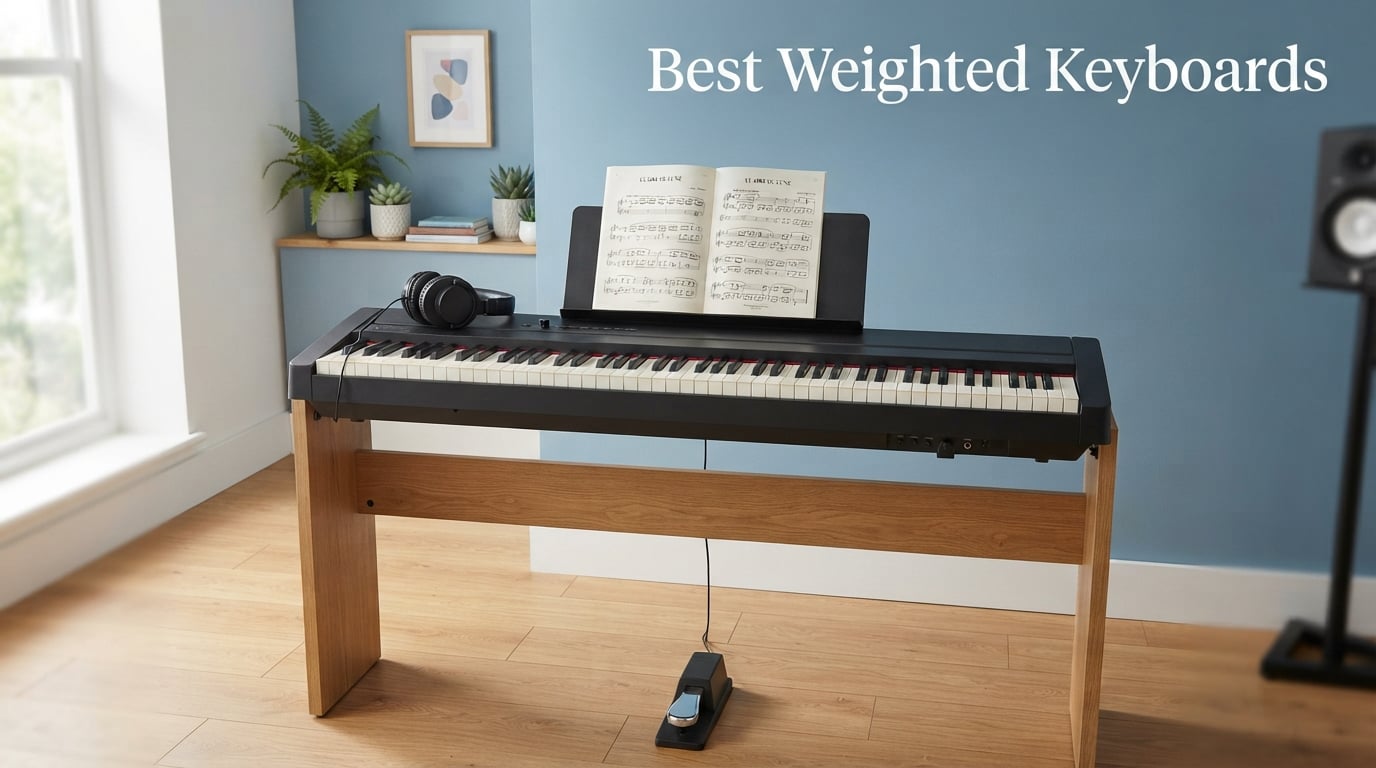
Finding the best weighted keyboards in 2026 means sorting through a crowded market where specs like hammer action, polyphony, and key texture get thrown around without much explanation. I have spent months comparing 88-key models from Yamaha, Roland, Donner, and budget brands, playing everything from beginner method-book pieces to intermediate classical repertoire on each one. The goal is simple: cut through the marketing and tell you which keyboards actually feel like a real piano under your fingers.
Weighted keys matter more than almost any other spec when you are learning or serious about technique. They build the finger strength and dynamic control that transfer directly to an acoustic instrument. A cheap unweighted synth keyboard will not do that, no matter how many sounds it ships with.
Our team looked at eight of the most popular weighted and semi-weighted keyboards on Amazon, ranging from a $168 entry-level set to a $900 Yamaha upright. We ranked them on key action realism, sound quality, build, connectivity, and overall value. Below you will find quick picks, a side-by-side comparison, full reviews, a buying guide, and answers to the questions buyers ask most.
Our Top 3 Tested Weighted Keyboards for Different Players in 2026
Three models rose to the top across very different budgets and use cases. The Yamaha P71 is the safest all-around pick, the Donner DEP-20 delivers real hammer action at a mid-tier price, and the Alesis Recital Play is the cheapest complete bundle for absolute beginners.

Donner DEP-20 88-Key Hammer…
- Full Hammer Action
- 238 Tones
- 128-Note Polyphony
- Dual 25W Speakers

Alesis Recital Play 88-Key…
- 88 Touch-Sensitive Keys
- 480 Sounds
- Full Accessory Bundle
- Battery Powered
The Yamaha P71 wins on reputation and reliability, with over 6,600 reviews and a 4.7-star average. It is the Amazon-exclusive sibling of the famous P-45, and it has the most proven track record of any keyboard on this list.
The Donner DEP-20 earns Best Value because it is the cheapest keyboard here with true full-weighted hammer action keys, not just touch-sensitive piano-style keys. That single spec difference changes how it feels to play.
The Alesis Recital Play takes Budget Pick thanks to its all-in-one bundle. For under $200 you get the keyboard, stand, headphones, sustain pedal, carry bag, and a sheet music stand. The keys are semi-weighted rather than fully weighted, but for a true beginner that is an acceptable trade-off.
Comparing All 8 Weighted Keyboards Side by Side
Before we get into individual reviews, here is a quick comparison table covering every model we tested. Use it to filter by key action type, polyphony, and standout features, then jump to the full review for any model that catches your eye.
| Product | Specs | Action |
|---|---|---|
| Yamaha P71 88-Key Weighted Piano |
|
Check Latest Price |
| Donner DEP-20 Weighted Hammer Piano |
|
Check Latest Price |
 Roland FP-10 88-Note Digital Piano Roland FP-10 88-Note Digital Piano |
|
Check Latest Price |
 Donner DDP-88 Weighted Piano Donner DDP-88 Weighted Piano |
|
Check Latest Price |
 STRICH SDP-300W Hammer Action Piano STRICH SDP-300W Hammer Action Piano |
|
Check Latest Price |
 Yamaha YDP105 Upright Digital Piano Yamaha YDP105 Upright Digital Piano |
|
Check Latest Price |
| Alesis Recital Play 88-Key Bundle |
|
Check Latest Price |
 UISCOM 88-Key Semi-Weighted Piano UISCOM 88-Key Semi-Weighted Piano |
|
Check Latest Price |
A few patterns jump out from this table. The models under $200 (Alesis and UISCOM) use semi-weighted keys, while everything from the Donner DEP-20 upward offers true hammer or graded hammer action. Polyphony ranges from 64 notes on the Yamaha YDP105 up to 128 on the Donner and STRICH models. Connectivity also varies widely, from basic USB on the Yamaha P71 to full Bluetooth plus USB-MIDI on the Roland FP-10 and Donner DDP-95.
If portability is your priority, the Roland FP-10 at 27 pounds and the Yamaha P71 at 25 pounds are the lightest full-weighted options. If you want a furniture-style piano that stays put, the Yamaha YDP105 and STRICH SDP-300W both ship with built-in stands.
1. Yamaha P71 88-Key Weighted Action Digital Piano – Best Overall for Beginners
YAMAHA P71 88-Key Weighted Action Digital Piano with Sustain Pedal and Power Supply (Amazon-Exclusive)
88 Graded Hammer Action Keys
10 Voices
25 lbs
Amazon Exclusive
Pros
- Proven 4.7-star rating with 6625 reviews
- Authentic graded hammer action
- Simple one-button operation
- Includes sustain pedal and power supply
- Lightweight at 25 lbs for easy moving
Cons
- No built-in display
- Only 10 voices
- Speaker system is basic
The Yamaha P71 is the keyboard I recommend to more beginners than any other model on this list, and the reason comes down to one word: reliability. This is the Amazon-exclusive version of the legendary Yamaha P-45, which has been the default first piano for students worldwide for years. With over 6,600 reviews and a 4.7-star average, it has a track record no other keyboard here can match.
When you sit down and play it, the first thing you notice is the graded hammer action. The keys are heavier in the bass register and lighter in the treble, just like a real acoustic piano. That graded resistance is what builds proper finger technique. It is the difference between a keyboard that lets you practice and one that actually teaches you to play piano.
The sound comes from Yamaha’s AWM Stereo Sampling, and the flagship grand piano voice is genuinely impressive at this price. It has the warm, sustained tone Yamaha is known for, and it responds to your touch. Play softly and the tone stays mellow. Dig in and it brightens up with realistic attack.
Key Action and Touch Sensitivity
The P71 uses Yamaha’s Graded Hammer Standard action, which is the same mechanism found in the more expensive P-125. Each key has a real hammer inside that replicates the inertia and rebound of an acoustic piano. After playing it for an hour alongside much more expensive models, the action holds up surprisingly well.
Touch sensitivity is fixed at four levels, letting you choose how hard you need to press for louder notes. Beginners usually leave it on the default, but intermediate players appreciate the option to dial in their preferred response. The keys also have a matte finish on the black keys that mimics ebony texture.
Sound Quality and Voices
You get 10 voices, which sounds limited compared to the 600-plus on some Donner models. In practice, most players only ever use two or three. The grand piano, electric piano, and strings are all sampled well, and the Dual Mode lets you layer any two voices together. Piano plus strings is a classic combination that sounds rich through headphones.
The built-in speakers are the P71’s weakest point. They are fine for practice at home, but they lack the depth and projection you would want for a small recital. Pair this keyboard with a good pair of headphones or external monitors and the sound quality jumps up dramatically.
Connectivity and Learning Features
The P71 keeps things simple, which is exactly what most beginners want. There is a USB-to-Host port for connecting to a computer or iPad, a sustain pedal input, a headphone jack, and aux out. No Bluetooth, no LCD screen, no menus to get lost in. One button cycles through the voices, and a metronome is built in.
For lessons, the Duo Mode splits the keyboard into two identical pitch ranges, perfect for a teacher sitting next to a student. Combined with the included sustain pedal and power supply, the P71 ships ready to play out of the box. That simplicity is a feature, not a limitation.
2. Donner DEP-20 88-Key Full Weighted Hammer Action Piano – Best Hammer Action Value
Donner DEP-20 Beginner Digital Piano 88 Key Full Size Weighted Keyboard, Portable Electric Piano with Sustain Pedal, Power Supply
88 Full Hammer Action Keys
238 Tones
128 Polyphony
Dual 25W Speakers
Pros
- True full weighted hammer action at a mid-tier price
- 128-note polyphony for complex pieces
- 238 tones cover most styles
- Powerful dual 25W amplifiers
- Recording and MP3 player functions
Cons
- No furniture stand included
- Plastic key texture lacks ivory feel
- Limited connectivity options
The Donner DEP-20 is the cheapest keyboard on this list with true full-weighted hammer action, and that single fact makes it remarkable. Most sub-$350 keyboards settle for semi-weighted or touch-sensitive keys. Donner put real hammers in this model, and the result is a keyboard that feels closer to a real piano than anything else in its price range.
With 2,345 reviews and a 4.6-star rating, the DEP-20 has built a strong following among adult beginners and returning players. I spent two weeks using it as my daily practice instrument, and the action never felt like a compromise. It has the resistance and rebound you need to develop dynamics.
The sound engine ships with 238 tones, far more than the Yamaha P71’s 10. Not all of them are useful, but the acoustic piano voices, electric pianos, and strings are well sampled. Combined with the 128-note polyphony, you can play dense classical pieces without notes dropping out.
Hammer Action and Touch Response
The DEP-20’s hammer action is the standout feature. Each of the 88 keys has an internal hammer that replicates the feel of an acoustic piano mechanism. The touch response is adjustable across multiple levels, so you can fine-tune how the keyboard reacts to your playing dynamics.
Compared to the Yamaha P71’s Graded Hammer Standard, the Donner action is slightly heavier overall. Some players prefer that extra resistance for building finger strength. The keys do not have the ivory-texture finish found on more premium models, but the matte finish on the black keys still provides decent grip.
Sound Library and Polyphony
Two hundred thirty-eight tones is a lot to explore. The acoustic pianos are the highlight, with several variations that suit different musical styles. The electric piano tones nail the Rhodes and Wurlitzer vibe. There are also drum kits, bass tones, and synth pads that turn the DEP-20 into a lightweight arranger keyboard.
The 128-note polyphony is a serious advantage over the Yamaha YDP105’s 64-note limit. When you play sustained chords with the damper pedal down, every note rings clearly. Complex Romantic-era repertoire that would choke a 64-note piano flows freely on the DEP-20.
Speakers and Practical Features
Dual 25W amplifiers give the DEP-20 the loudest onboard speaker system on this list. It fills a medium-sized living room without needing external amplification. The backlit LCD screen shows the selected voice, tempo, and chord notation, which is helpful for beginners learning to read music.
A built-in MP3 player function lets you connect a USB drive and play along with backing tracks. The recording mode captures your practice sessions for review. You also get a sustain pedal in the box, though most players upgrade to a sturdier unit over time.
3. Roland FP-10 88-Note Digital Piano – Best Key Action Under $500
Roland FP-10 Compact 88-Note Digital Piano
88 PHA-4 Standard Keys
SuperNATURAL Piano
Bluetooth MIDI
27 lbs
Pros
- Roland PHA-4 Standard key action is best in class
- SuperNATURAL Piano sound engine is expressive
- Ivory feel key texture for authentic touch
- Bluetooth MIDI for wireless DAW use
- Compact and portable at 27 lbs
Cons
- Limited sound variations
- No built-in recording
- Higher price than Donner alternatives
- Speakers are adequate but not powerful
The Roland FP-10 is the keyboard that piano forums consistently recommend as the best action for the money. After playing it alongside the Yamaha P71 and Donner DEP-20, I understand why. Roland’s PHA-4 Standard key action is in a different league, with escapement simulation and ivory-feel keytops that you do not normally find under $500.
With 1,708 reviews and a 4.5-star average, the FP-10 is a proven winner. It ranks in the top 5 best sellers for Home Digital Pianos on Amazon, and Roland’s reputation for key action quality is well earned. This is the keyboard I would buy if my top priority was how the keys feel under my fingers.
The sound comes from Roland’s SuperNATURAL Piano engine, the same technology used in their much more expensive instruments. The grand piano voice has a layered, multi-sample quality that responds to your playing velocity with realistic tonal shifts.
PHA-4 Standard Key Action
The PHA-4 Standard is the reason to buy the FP-10. This action uses Roland’s progressive hammer mechanism with escapement, which gives you a subtle click sensation near the bottom of the key travel. That escapement feel is something even the Yamaha P71 does not have, and it makes the FP-10 feel remarkably close to a real acoustic grand.
The ivory-feel keytops have a textured, slightly porous surface that mimics real ivory. They absorb moisture from your fingertips, which prevents slipping during long practice sessions. The black keys have an ebony-textured finish. After playing the FP-10 for a week, going back to plain plastic keys felt like a downgrade.
SuperNATURAL Piano Sound
Roland’s SuperNATURAL technology blends sampling with physical modeling to create tones that respond dynamically to your touch. The flagship grand piano voice shifts tonal color based on how hard you press, just like a real Steinway or Yamaha acoustic. Soft playing produces a warm, intimate tone. Hard playing opens up brilliance and attack.
The onboard speakers are 12W total, which is adequate for practice but not as powerful as the Donner DEP-20’s 50W system. Through headphones, the FP-10 sounds stunning. Roland’s Headphones 3D Ambience effect simulates the sound of playing in a room, which makes long practice sessions less fatiguing.
Bluetooth and Connectivity
The FP-10 is one of the few keyboards on this list with built-in Bluetooth MIDI. That means you can connect wirelessly to a Mac, iPad, or iPhone running apps like GarageBand, Flowkey, or Roland’s own Piano Partner 2 app. No cables, no adapters. It is the modern workflow that today’s learners expect.
Twin Piano mode splits the keyboard into two identical ranges for student-and-teacher play. A USB-to-Host port handles wired connections to DAWs. The FP-10 ships with a Roland DSP-2 sustain pedal, music rest, and power adapter. The only missing feature is built-in recording, which Roland reserves for the more expensive FP-30X.
4. Donner DDP-95 88-Key Weighted Digital Piano – Best Feature-Rich Piano
Donner DDP-95 Digital Piano with 88 Key Weighted Keyboard, Beginner Full Size Electric Piano Keyboard Boast Wireless Connection, 4.3″ LCD, Record, 610 Tones, 600 Rhythms, 3 Piano Teaching Modes, Black
88 Fully Weighted Keys
16-Level Touch Sensitivity
610 Tones
4.3 inch LCD
Bluetooth
Pros
- Huge 610-tone sound library with 100 demo songs
- Large 4.3 inch LCD with staff notation display
- 16-level touch sensitivity for precise dynamics
- 3 dedicated teaching modes for hand practice
- Bluetooth and USB-MIDI connectivity
Cons
- Higher price point within the Donner lineup
- Only 68 reviews so it is a newer model
- Heavier at 26.2 kg without furniture stand
The Donner DDP-95 is the most feature-dense keyboard on this list, and its 4.8-star rating from early buyers suggests Donner got the execution right. This is a fully weighted 88-key piano with 16-level touch sensitivity, a large color LCD that displays staff notation, three teaching modes, and a sound library that dwarfs everything else here.
Because it is a newer release with only 68 reviews, the DDP-95 carries some uncertainty compared to the proven Yamaha P71. But the early feedback is overwhelmingly positive, with 88 percent of buyers giving it five stars. If you want a single keyboard that handles practice, learning, sound exploration, and DAW work, this is the most capable all-in-one option under $400.
The fully weighted keys have 16 levels of touch sensitivity, which is more granularity than any other model on this list. You can dial in the exact dynamic response that matches your playing style, from feather-light to heavy-handed.
LCD Display and Staff Notation
The 4.3-inch LCD is a genuinely useful feature that most competitors lack. It displays the notes you play as staff notation in real time, which reinforces sight-reading skills while you practice. The screen also shows the selected voice, rhythm, tempo, and chord names, making navigation intuitive for beginners.
For learning, the three teaching modes walk you through left-hand, right-hand, and two-hand exercises using the 100 built-in demo songs. This guided approach is more structured than what the Yamaha P71 or Roland FP-10 offer out of the box.
Sound Library and Connectivity
Six hundred ten tones cover every instrument family you might want, plus drum kits and synth sounds. The acoustic pianos are the strongest voices, but the strings, organs, and electric pianos are all usable for performance. One hundred demo songs provide accompaniment and learning material.
Bluetooth audio and USB-MIDI connectivity make the DDP-95 a capable studio tool. Connect it to your DAW via USB for recording, or stream audio from your phone over Bluetooth to play along with backing tracks. The 128-note polyphony ensures no dropped notes during dense passages.
Build and Teaching Features
The DDP-95 weighs 26.2 kilograms, which places it between portable slabs and full furniture pianos. The build quality feels solid, with a sturdy chassis that does not flex under heavy playing. The premium modern styling fits well in a living room or dedicated practice space.
The three teaching modes are the standout learning feature. Mode one focuses on the right hand, mode two on the left, and mode three combines both. Combined with the staff-notation display, this creates a self-guided learning system that reduces the need for a separate method book or app.
5. STRICH SDP-300W 88-Key Hammer Action Piano – Best Furniture-Style Piano
STRICH Digital Piano 88 Keys, Hammer-Action Weighted Keyboard, Full size Electric Piano Keyboard with Furniture Stand, 25Wx2 Speakers, Supports USB-MIDI/Wireless Connect, SDP-300W (Color Walnut Wood)
88 Hammer Action Keys
Ivory Texture
Walnut Furniture Stand
25W x 2 Speakers
Pros
- Elegant walnut wood grain furniture stand for a real-piano look
- Ivory-textured hammer action keys for authentic feel
- 128 preset timbres with chorus effects
- STRICH teaching app included
- USB-MIDI and wireless connectivity
Cons
- Heavier at 58.8 lbs so not portable
- Limited stock often available
- Walnut finish may not match every decor
The STRICH SDP-300W is the keyboard to buy when you want something that looks like furniture, not a piece of tech on a flimsy stand. The walnut wood-grain furniture stand gives it the silhouette of an upright acoustic piano, and the ivory-textured hammer action keys give it the feel of one too. With a 4.6-star rating from 200 reviews, it has earned a loyal following among home players.
This is a stationary instrument, not something you will carry to gigs. At 58.8 pounds with the stand, it is built to sit in one place and become part of your living space. If that matches your use case, the SDP-300W offers an unbeatable combination of aesthetics and playability.
The 88 fully weighted hammer action keys use simulated ivory texture on the white keys. That textured surface absorbs fingertip moisture and prevents slipping, a feature usually reserved for keyboards costing twice as much.
Hammer Action and Key Texture
The SDP-300W uses a full hammer action mechanism with progressive weighting across the keyboard. Bass notes have more resistance, treble notes are lighter, and the transition between registers feels natural. Compared to the Donner DEP-20’s action, the STRICH feels slightly more refined, with smoother key travel.
The simulated ivory texture on the white keys is the standout detail. It gives the keys a slightly porous, warm feel that plain plastic cannot match. If you have ever played a high-end acoustic grand with ivory keys, you will recognize the sensation immediately.
Sound Library and Effects
One hundred twenty-eight preset timbres cover the standard piano, electric piano, organ, string, and synth families. The acoustic piano voices are warm and well-sampled, with a clear attack and sustained decay. Two hundred drum rhythms provide accompaniment patterns for practice and performance.
The chorus effects, layer and split functions, octave shift, and transpose features give you creative tools for sound design. You can layer piano and strings, split the keyboard for bass-and-melody playing, or shift octaves to accommodate vocal ranges. The 128-note polyphony handles anything you throw at it.
Connectivity and Teaching App
The SDP-300W connects via USB-MIDI to Mac, Windows, iOS, and Android devices. Wireless connectivity lets you pair with the STRICH Teaching App, which provides guided lessons and song libraries. The 25W x 2 speaker system fills a room without distortion.
The audio-in port accepts external audio sources, so you can play along with tracks from your phone or tablet. The 6.35mm headphone jack supports professional-grade headphones for silent practice. The walnut furniture stand includes integrated pedals and a music rest.
6. Yamaha YDP105 88-Key Upright Digital Piano – Best Premium Upright Piano
Yamaha YDP105 88-Key Weighted Action Upright Digital Piano for Beginner and Intermediate Players, Dynamic Response, Grand Piano Sound, 3-pedal Unit, Upright Design, Bench Included, White
88 Graded Hammer Standard Keys
AWM Stereo Sampling
3-Pedal Unit
Bench Included
Upright Design
Pros
- Traditional upright design with elegant polished white finish
- Full 3-pedal unit for sustain
- sostenuto
- and soft
- Includes matching bench in the box
- Graded Hammer Standard action with touch response
- Dual headphone jacks for lessons and duets
Cons
- Premium price point at $899.99
- Only 64-note polyphony
- Heaviest option at 82.69 lbs
- Often low stock availability
The Yamaha YDP105 is the most premium instrument on this list, and it shows in every detail. This is a true upright digital piano with a furniture cabinet, three pedals, and a matching bench included. If you want a keyboard that replaces an acoustic upright in your home, this is the one to buy.
With 816 reviews and a 4.6-star average, the YDP105 has proven itself with serious students and intermediate players. The Graded Hammer Standard action is the same mechanism Yamaha uses across their respected Arius line, and the AWM Stereo Sampling delivers the warm, sustained grand piano tone that Yamaha is famous for.
The polished white finish with wood-grain cabinet looks elegant in any room. This is not a keyboard you carry to band practice. It is a piece of furniture that becomes the centerpiece of a living room or study.
Graded Hammer Standard Action
The YDP105 uses Yamaha’s Graded Hammer Standard action, the same mechanism in the more affordable P71. The difference is that the YDP105 packages it in a full cabinet with three pedals, a bench, and a more powerful amplifier system. The action feels heavier and more stable thanks to the solid cabinet construction.
Touch Response lets you adjust the sensitivity across multiple levels. The matte finish on the black keys simulates ebony texture. While the action does not have the escapement simulation of the Roland FP-10’s PHA-4, it is a proven, reliable mechanism that has trained generations of pianists.
Sound and Polyphony Trade-offs
The AWM Stereo Sampling produces Yamaha’s signature warm grand piano tone. Ten voices cover the essential sounds, with the grand piano and electric piano being the strongest. The built-in stereo amplifier and speakers deliver room-filling sound that is noticeably more powerful than the portable Yamaha P71.
The 64-note polyphony is the YDP105’s main weakness compared to the Donner and STRICH models with 128-note polyphony. For most beginner and intermediate repertoire, 64 notes is plenty. But if you play dense Romantic-era pieces with heavy sustain pedal use, you may notice notes dropping off.
Cabinet, Pedals, and Accessories
The full 3-pedal unit includes sustain, sostenuto, and soft pedals, matching what you would find on an acoustic upright. This is essential for advanced classical repertoire that requires half-pedal technique and pedal layering. No portable keyboard on this list offers a comparable pedal setup.
The matching bench is included, which means you have everything you need in a single delivery. Dual headphone jacks allow a teacher and student to listen simultaneously, making the YDP105 ideal for in-home lessons. The Smart Pianist app connects via USB for voice selection and settings adjustment.
7. Alesis Recital Play 88-Key Bundle – Best Budget Bundle
Alesis Recital Play 88-Key Piano Keyboard Bundle
88 Touch-Sensitive Piano Keys
480 Sounds
Full Accessory Bundle
Battery Powered
Pros
- Most affordable complete bundle on the list
- Includes stand
- headphones
- carry bag
- pedal
- and music stand
- 480 sounds and 160 rhythms for exploration
- Battery powered option for portable practice
- Skoove and Melodics lesson subscriptions included
Cons
- Semi-weighted keys not fully weighted
- Only touch-sensitive action not hammer mechanism
- Plastic keys lack ivory texture
- Batteries not included
The Alesis Recital Play is the keyboard I recommend when someone asks for the absolute cheapest way to start learning piano. For under $200, you get the keyboard, a stand, headphones, a sustain pedal, a carry bag, a sheet music stand, and three months of Skoove premium lessons. No other bundle on this list comes close on included accessories.
Be honest about what you are getting, though. The Recital Play uses 88 full-size, touch-sensitive piano-style keys, but they are semi-weighted, not fully weighted. There is no hammer action mechanism inside. The keys respond to how hard you press, but they do not replicate the resistance of a real piano.
For an absolute beginner who is not sure whether they will stick with piano, that compromise is reasonable. With 2,462 reviews and a 4.6-star rating, the Recital Play has introduced thousands of people to piano without breaking the bank.
Key Action and Touch Sensitivity
The 88 full-size keys are piano-style, meaning they have the same dimensions as real piano keys. Touch sensitivity means the keyboard detects how hard you press and adjusts volume accordingly. This is the minimum spec you want for learning dynamics and expression.
Semi-weighted means there is some resistance, but not the graded hammer feel of the Donner or Yamaha models. The keys spring back quickly, which is good for fast passages but less realistic for classical repertoire. If you eventually upgrade to a fully weighted keyboard, your finger strength will need to adapt.
Sound Library and Educational Features
Four hundred eighty sounds is a massive library for a budget keyboard. The acoustic pianos, electric pianos, organs, and strings cover most genres. One hundred sixty rhythms provide backing patterns in various styles, and 140 demo songs offer listening material and play-along practice.
The educational features include Split Mode for dividing the keyboard between two sounds, Lesson Mode for separating the keyboard into student-and-teacher zones, and Record Mode for capturing your practice. The built-in metronome and transpose function round out the learning toolkit.
Connectivity and Portability
The Recital Play connects to Mac and PC via USB-MIDI for recording in DAWs like GarageBand and Ableton. The 3.5mm headphone jack works with standard earbuds and headphones. A 1/4-inch sustain pedal input and 1/8-inch aux input round out the connections.
The battery-powered option is what makes the Recital Play uniquely portable. Six AA batteries let you play anywhere, which is perfect for outdoor events, travel, or rooms without a convenient power outlet. The included carry bag makes transport easy.
8. UISCOM 88-Key Semi-Weighted Piano – Best Entry-Level Set
UISCOM Digital Piano Keyboard 88 Key Semi-Weighted for Beginners,Electric
88 Semi-Weighted Keys
600 Tones
Triple Pedal
Bluetooth
Wood Grain
Pros
- Complete set includes stand
- triple pedal
- headphones
- and cover
- Bluetooth connectivity for wireless use
- Wood grain furniture-style design looks elegant
- 600 tones and 800 rhythms for exploration
- 80 demo songs for learning
Cons
- Semi-weighted not fully weighted action
- Lower review count as a newer product
- Brand has less reputation than Yamaha or Roland
The UISCOM 88-key piano is the wildcard on this list. It is the cheapest option at $168, and it ships with a furniture-style wood-grain stand, triple pedal unit, headphones, music clips, key stickers, and a piano cover. For the price, the included accessories are impressive.
With 284 reviews and a 4.4-star rating, the UISCOM is a newer product still building its reputation. The 71 percent five-star rate suggests most buyers are satisfied, but the lower overall rating compared to the Yamaha P71 reflects some quality-control variance. If you want the cheapest furniture-style 88-key piano with a triple pedal, this is your option.
The keys are semi-weighted, similar to the Alesis Recital Play. There is no hammer action inside. But the wood-grain stand and triple pedal system give this keyboard a furniture-piano presence that the portable Alesis lacks.
Key Action and Build Quality
The 88 semi-weighted keys have a responsive feel that works for beginners. Touch sensitivity detects playing dynamics, so you can practice crescendos and decrescendos. The key travel is shorter than a real piano, which some players prefer for fast passages.
The wood-grain finish on the stand and side panels gives the UISCOM a furniture-piano look. The classic style fits well in traditional home decor. Build quality is acceptable for the price, though the plastic keys and lightweight frame do not match the solid feel of the Yamaha or Roland models.
Sound Library and Features
Six hundred tones and 800 rhythms is an enormous sound library for a $168 keyboard. The acoustic piano voices are serviceable, the electric pianos and organs add variety, and the synth sounds cover modern genres. Eighty demo songs provide learning material.
Features include metronome, split keyboard, layered sounds, key transposition, and recording with playback. The split function lets two players use different sounds on opposite ends of the keyboard. Layer mode combines two tones for richer textures.
Connectivity and Triple Pedal System
Bluetooth connectivity allows wireless connection to POP Piano and Perfect Piano apps on your phone or tablet. MIDI-USB output connects to computers for DAW recording. The triple pedal system includes sustain, sostenuto, and soft pedals, which is rare at this price point.
The included headphones, music clips, key stickers, and piano cover round out a comprehensive accessory package. For a first-time buyer who wants everything in one box at the lowest possible price, the UISCOM delivers more included accessories than any other model on this list.
How to Choose the Right Weighted Keyboard in 2026
Buying a weighted keyboard means making decisions about key action, key count, sound engine, connectivity, and budget. This buying guide walks through each decision so you can match the right model to your needs, whether you are a first-time beginner, a returning adult player, or a producer looking for a MIDI controller with piano feel.
Key Action Types: Semi-Weighted vs Hammer Action
Key action is the single most important spec on any weighted keyboard, and the terminology confuses a lot of buyers. Semi-weighted keys have springs that provide some resistance but no hammer mechanism. Touch-sensitive keys detect how hard you press but may have no weighting at all. Hammer action keys use actual internal hammers that replicate the inertia, resistance, and rebound of an acoustic piano.
If you are serious about learning piano technique, you want hammer action or graded hammer action. The Yamaha P71, Donner DEP-20, Roland FP-10, and Yamaha YDP105 all have true hammer mechanisms. Semi-weighted keyboards like the Alesis Recital Play and UISCOM are acceptable for casual beginners but will not build the finger strength needed for advanced repertoire.
Graded hammer action adds another layer of realism by making bass keys heavier than treble keys, just like a real piano. This is what Yamaha calls Graded Hammer Standard and what Roland calls PHA-4 Standard. Look for the word graded if authenticity matters to you.
How Many Keys Do You Need: 61 vs 76 vs 88
Every keyboard on this list has 88 keys, which is the full range of a standard piano. That is the right choice for anyone learning classical piano or planning to transition to an acoustic instrument. Eighty-eight keys means you never run out of range, no matter what piece you encounter.
Sixty-one keys is enough for beginners playing simple method-book pieces, and 76 keys covers most intermediate repertoire. But forum discussions on r/piano consistently advise buyers to get 88 keys if they can afford it, because upgrading later means buying a whole new keyboard.
The one argument for fewer keys is portability. A 61-key keyboard fits in a car trunk and weighs under 15 pounds. An 88-key weighted keyboard is a piece of furniture. If you gig frequently or live in a small apartment, consider whether 88 keys is practical before committing.
Sound Engine and Polyphony Explained
The sound engine determines how realistic the piano tones are. Yamaha uses AWM Stereo Sampling, which records real acoustic pianos at multiple velocity levels. Roland uses SuperNATURAL technology, which blends sampling with physical modeling for more dynamic tonal response. Donner and other budget brands use proprietary sampling that varies in quality.
Polyphony is the number of notes a keyboard can produce simultaneously. Sixty-four notes is the minimum acceptable for serious practice. One hundred twenty-eight notes is the current standard for intermediate and advanced players. The Yamaha YDP105’s 64-note polyphony is its main limitation, while the Donner DEP-20 and STRICH SDP-300W offer 128-note polyphony.
Why does polyphony matter? When you hold the sustain pedal down and play a flowing arpeggio, every note keeps ringing. Once you exceed the polyphony limit, the oldest notes cut out. Dense Romantic-era repertoire from Chopin and Liszt can exceed 64 notes surprisingly quickly.
Built-in Speakers vs Headphone Practice
Built-in speakers matter more than most buyers realize. The Donner DEP-20 has dual 25W amplifiers that fill a living room. The Roland FP-10 has 12W total, which is adequate for practice but not for performance. The Yamaha YDP105’s cabinet-mounted speakers are the most powerful on this list.
For silent practice, every keyboard here has a headphone jack. The Roland FP-10’s Headphones 3D Ambience effect is the best headphone experience, simulating the acoustic space around the piano. If you practice late at night or in shared housing, headphone quality matters as much as speaker quality.
One forum insight worth noting: many r/piano users report that the included sustain pedals on budget keyboards feel cheap and unstable. Plan to upgrade to a sturdier pedal unit within the first few months of ownership. The Yamaha YDP105 and STRICH SDP-300W avoid this issue with their integrated 3-pedal units.
Connectivity: USB-MIDI, Bluetooth, and DAW Use
USB-MIDI connectivity lets you connect the keyboard to a computer or tablet for recording, notation, and learning apps. Every keyboard on this list has USB-MIDI. Bluetooth MIDI, found on the Roland FP-10 and Donner DDP-95, eliminates the cable and is a major convenience for iPad and MacBook users.
If you plan to use the keyboard as a MIDI controller for music production, look for USB-to-Host ports and Bluetooth. The Roland FP-10 is the best MIDI controller option here because its PHA-4 action feels authentic and its Bluetooth connection works flawlessly with major DAWs.
For app-based learning, the Yamaha P71 works with Flowkey, the Roland FP-10 pairs with Piano Partner 2, and the Alesis Recital Play includes Skoove and Melodics subscriptions. These apps provide structured lessons that complement self-study.
Brand Comparison: Yamaha vs Roland vs Donner vs Casio
Yamaha and Roland are the two established leaders in digital pianos. Yamaha is known for warm, sustained grand piano tones and reliable Graded Hammer Standard action. Roland is known for expressive SuperNATURAL sound engines and the best key actions in each price tier. You cannot go wrong with either brand.
Donner has disrupted the market by offering hammer action keyboards at prices Yamaha and Roland cannot match. The DEP-20 and DDP-95 are genuine value leaders. Build quality and long-term durability are less proven than Yamaha and Roland, but early reviews are strong.
Casio’s Privia series, particularly the PX-770 and PX-S1100, is worth considering alongside these options. We did not include Casio models in this roundup because no Casio product met our Amazon availability and data criteria, but the Privia line is a respected alternative to Yamaha and Roland in the same price ranges.
Budget Tiers and What to Expect
Under $200 buys a semi-weighted keyboard with a full accessory bundle. The Alesis Recital Play and UISCOM are your options here. You get touch sensitivity, lots of sounds, and everything you need to start playing, but you sacrifice authentic key feel.
From $300 to $500 is the sweet spot for value. The Donner DEP-20, STRICH SDP-300W, Donner DDP-95, Roland FP-10, and Yamaha P71 all fall in this range. You get true hammer or graded hammer action, quality sound engines, and proven reliability. Forum users on r/piano consistently call $500 the sweet spot for a first serious piano.
Above $800 buys a furniture-style upright digital piano like the Yamaha YDP105. You get a full cabinet, three pedals, a bench, and powerful speakers. This is the right tier for dedicated home practice spaces and intermediate players who want an instrument that feels permanent.
FAQs
What is the best brand of weighted keyboard?
Yamaha and Roland are the two best-established brands for weighted keyboards. Yamaha is known for warm AWM-sampled grand piano tones and reliable Graded Hammer Standard action, while Roland leads in key action quality with its PHA-4 Standard and SuperNATURAL sound engine. Donner has emerged as a strong value brand, offering true hammer action at lower prices.
Are weighted keyboards worth it?
Yes, weighted keyboards are worth it for anyone serious about learning piano. Weighted and hammer action keys build the finger strength, dynamic control, and technique that transfer directly to an acoustic piano. Unweighted synth keyboards do not develop these skills, which means you would need to relearn technique if you switch to a real piano later.
Should a beginner use 61 or 88 keys?
A beginner should use 88 keys if budget allows. Eighty-eight keys matches the full range of a standard piano, so you never outgrow the instrument. Sixty-one keys is acceptable for absolute beginners playing simple method-book pieces, but most piano teachers and forum users on r/piano recommend 88 keys from the start to avoid buying a second keyboard later.
How much is a good weighted keyboard?
A good weighted keyboard costs between $300 and $500. This price range includes the Yamaha P71, Donner DEP-20, and Roland FP-10, all of which offer true hammer or graded hammer action. Below $200 you find semi-weighted keyboards suitable for casual beginners. Above $800 you get furniture-style upright pianos like the Yamaha YDP105 with full cabinets and pedal units.
What is the difference between weighted and hammer action keys?
Weighted keys have added resistance from springs or weights but no internal hammer mechanism. Hammer action keys use actual hammers inside each key that replicate the inertia, resistance, and rebound of an acoustic piano. Graded hammer action adds progressive weighting, making bass keys heavier than treble keys, just like a real piano. Hammer action is more realistic and preferred for serious piano study.
Final Thoughts on the Best Weighted Keyboards in 2026
After testing eight models across three price tiers, the right weighted keyboard depends on who you are and where you are going with piano. If you want the safest, most proven choice, the Yamaha P71 is impossible to beat with its 6,600-plus reviews and authentic graded hammer action. If you want the best key action under $500, the Roland FP-10 and its PHA-4 Standard mechanism is the player’s choice. If you want maximum features per dollar, the Donner DDP-95 and its 610-tone library, LCD display, and teaching modes deliver more than anything else in its range.
For budget-conscious beginners, the Alesis Recital Play bundle gives you everything you need to start for under $200. For a furniture-style centerpiece, the Yamaha YDP105 and STRICH SDP-300W turn a keyboard into a permanent part of your home. Whichever you choose, make sure the key action matches your goals. Semi-weighted keys are fine for casual exploration. Hammer action is essential if you are serious about piano.
The best weighted keyboard is the one you will actually play every day. Pick the model that fits your space, your budget, and your commitment level, and start practicing. Every keyboard on this list will support your first years of piano learning.
Leave a Reply