
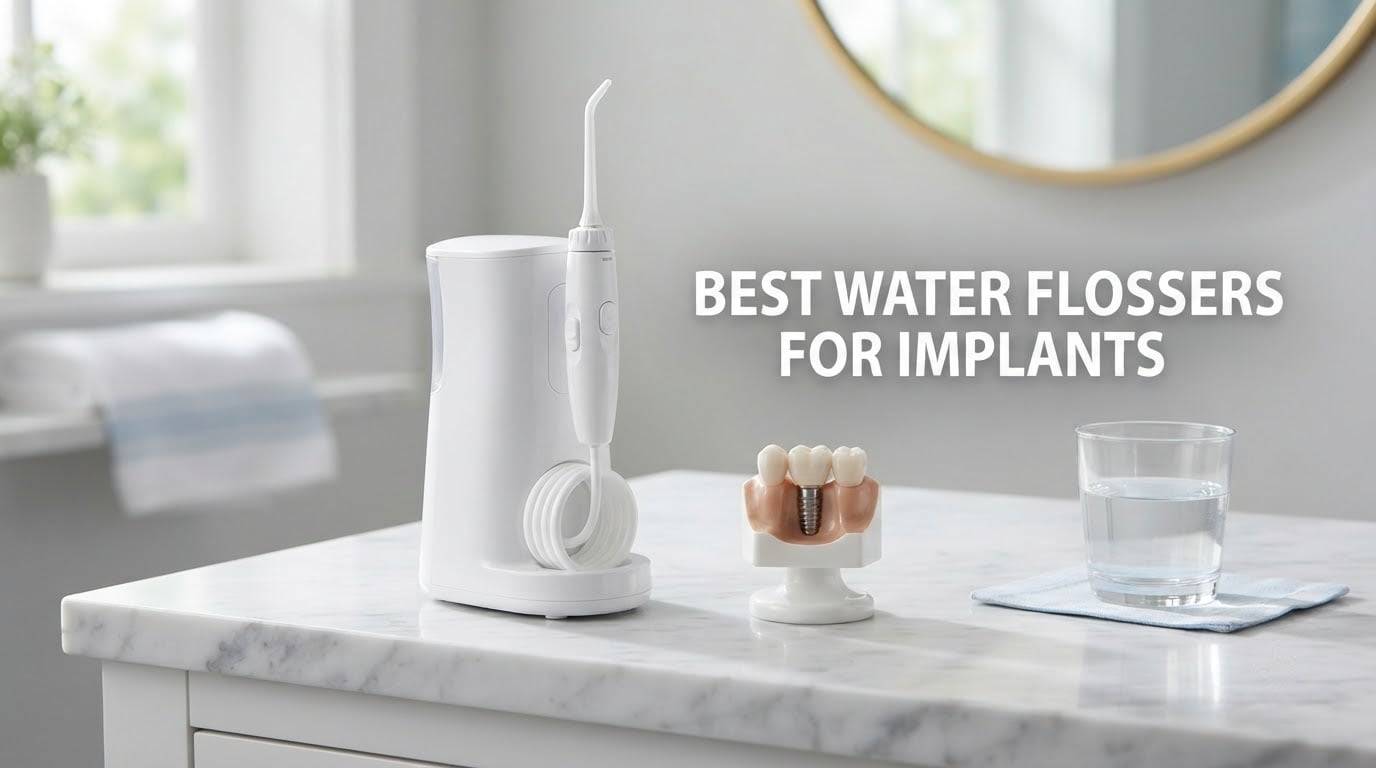
The best water flosser for implants is the Waterpik Aquarius, a countertop irrigator with 10 pressure settings, a 22 oz reservoir, seven tips and the ADA Seal of Acceptance. Nothing else on this list combines that pressure range with that runtime, and both matter when you are aiming a jet at a healing gumline.
Implants are not teeth. There is no periodontal ligament anchoring the crown and no natural gum seal around the abutment, so the soft tissue collar around an implant forms a deeper pocket than the one around a natural tooth. Plaque that would sit harmlessly on a tooth for months can start peri-implant mucositis around an implant in weeks, and untreated mucositis escalates to peri-implantitis, the inflammatory bone loss that can cost you the implant.
That is where an oral irrigator earns its place. It sends a pulsating stream into the sulcus and flushes biofilm out rather than rinsing past it. I compared eight of them, weighing each on pressure control, tip range, tank capacity, waterproofing and how it handles the awkward geometry of a molar implant at the back of the mouth. For a wider look at the portable side, start with our cordless water flosser guide.
Our Top 3 Water Flossers for Implants in 2026
Comparing 8 Water Flossers for Implants Side by Side
| Product | Specs | Action |
|---|---|---|
 Waterpik Aquarius Countertop Water Flosser Waterpik Aquarius Countertop Water Flosser |
|
Check Latest Price |
 Waterpik Cordless Advanced Portable Water Flosser Waterpik Cordless Advanced Portable Water Flosser |
|
Check Latest Price |
 COSLUS C20 Water Dental Flosser COSLUS C20 Water Dental Flosser |
|
Check Latest Price |
 Nicwell Water Dental Flosser F5025 Nicwell Water Dental Flosser F5025 |
|
Check Latest Price |
 COSLUS E40 Water Dental Flosser COSLUS E40 Water Dental Flosser |
|
Check Latest Price |
 Waterpik Promax Countertop Water Flosser Waterpik Promax Countertop Water Flosser |
|
Check Latest Price |
 Aquapik Mini Portable Water Flosser Aquapik Mini Portable Water Flosser |
|
Check Latest Price |
 AquaSonic Aqua Flosser AquaSonic Aqua Flosser |
|
Check Latest Price |
Why Implants Need a Different Kind of Cleaning
The gap between a toothbrush and an implant is not subtle. Bristles splay over the smooth convex crown and never reach underneath it, and string floss around a screw-retained implant either slides off the abutment or gets wedged somewhere you cannot see. Biofilm forms exactly there, at the margin where crown meets gum.
Peri-implant mucositis is the reversible early stage: bleeding on probing, redness, swelling, bone levels still intact. Peri-implantitis is what follows when that inflammation is never cleared, and it moves faster than ordinary gum disease because the implant surface harbours bacteria with no periodontal ligament defending against them.
One caution carried over from the forums. In a tooth implant thread that ranks organically for this query, a poster wrote that the periodontist they see swears by the Waterpik and to be sure to use it at low power. That instinct is correct, and it is why pressure control ranks first in our criteria. Worth noting too that on forums many people use the word waterpik as a stand-in for any water flosser.
1. Waterpik Aquarius – The Best Overall Water Flosser for Implants
Waterpik Aquarius Countertop Water Flosser with 10 Settings, 7 Tips, White
10 pressure settings
22 oz reservoir
7 tips
360 degree tip rotation
3-year warranty
Pros
- Widest pressure range in the group
- 10 settings plus a massage mode
- 22 oz tank covers a full-mouth clean with no refills
- ADA Seal of Acceptance
- Most reviewed irrigator in this roundup
Cons
- Needs counter space and a power outlet
- Wand hose is awkward around back abutments
- Stronger flow than cordless rivals so start low
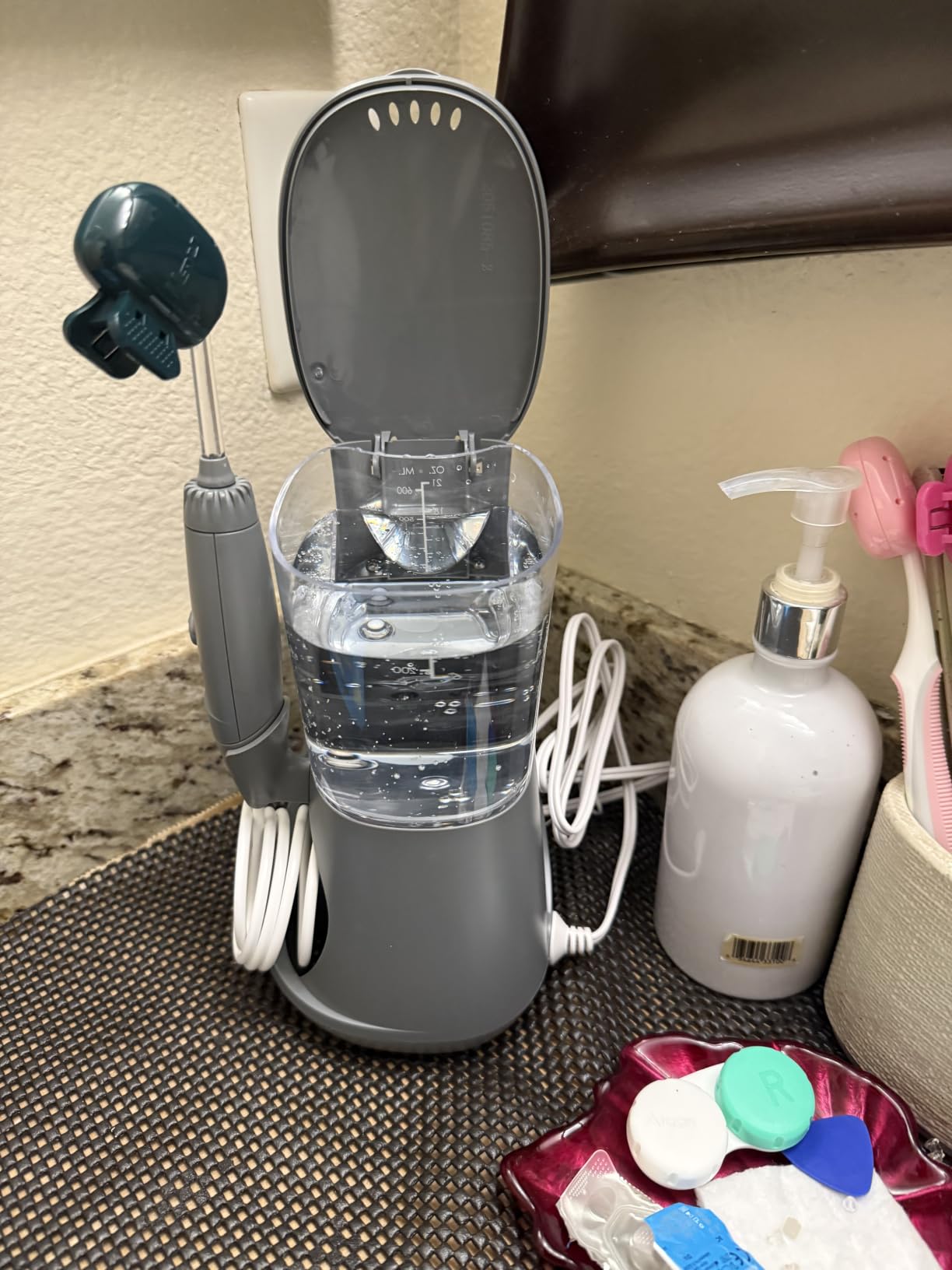
This is the one I kept coming back to. Ten stepped pressure settings is more granularity than anything else here, and granularity is exactly what implant work needs: start low around a fresh site, climb one notch at a time until the stream flushes cleanly without making your gums flinch.
The 22 oz reservoir is the other reason it wins. Ninety-plus seconds of runtime means you can do the whole mouth, every implant margin included, in one pass without the mid-session refill that makes people cut a clean short. Seven tips cover orthodontic, implant and general use, and 360-degree tip rotation makes reaching the back of the mouth far less of a wrestling match.
Pressure Range and the Massage Mode
Ten settings from gentle to strong is the widest adjustment range here, and the massage mode pulses rather than blasts, which is a reasonable setting to finish on around a tender site. Reviewers note the flow is noticeably stronger than most portable irrigators, so first-time users should start at setting one or two. Several owners report a hygienist or periodontist recommended this model to them, the same referral pattern seen in implant forums.
Tank Size and the Dishwasher-Safe Reservoir
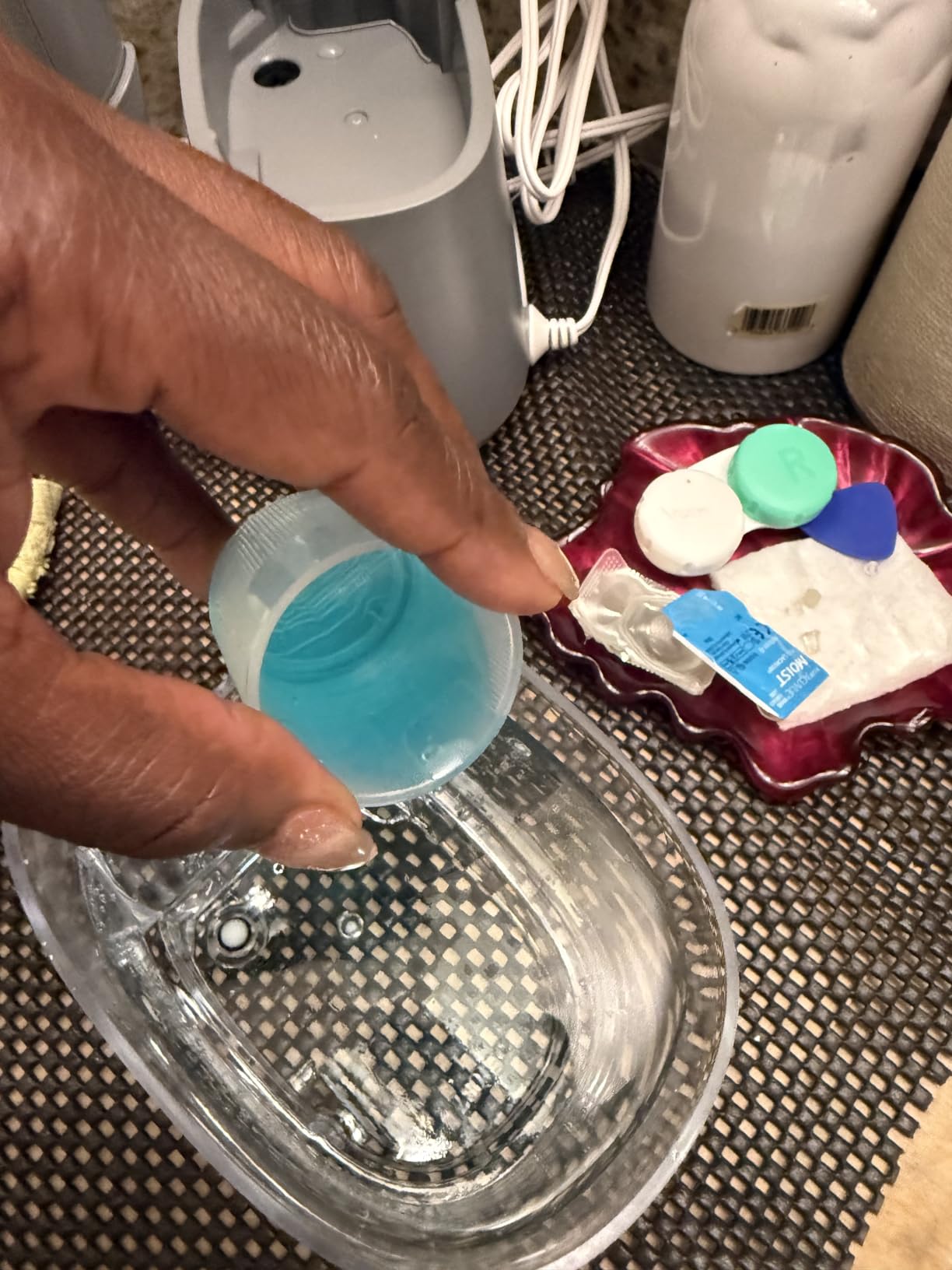
The removable top-rack dishwasher-safe 22 oz tank is the practical standout. It detaches for cleaning without fussing with the base unit. Multiple reviewers mention a dentist-office clean feeling afterward, which is the phrase people use when the irrigator reaches biofilm a toothbrush cannot.
Who Should Skip It
Skip the Aquarius if your bathroom has no counter space or you travel often. It needs an outlet, and its wand hose is stiff enough that reaching under a molar crown takes practice. The cordless models compared here suit that case better.
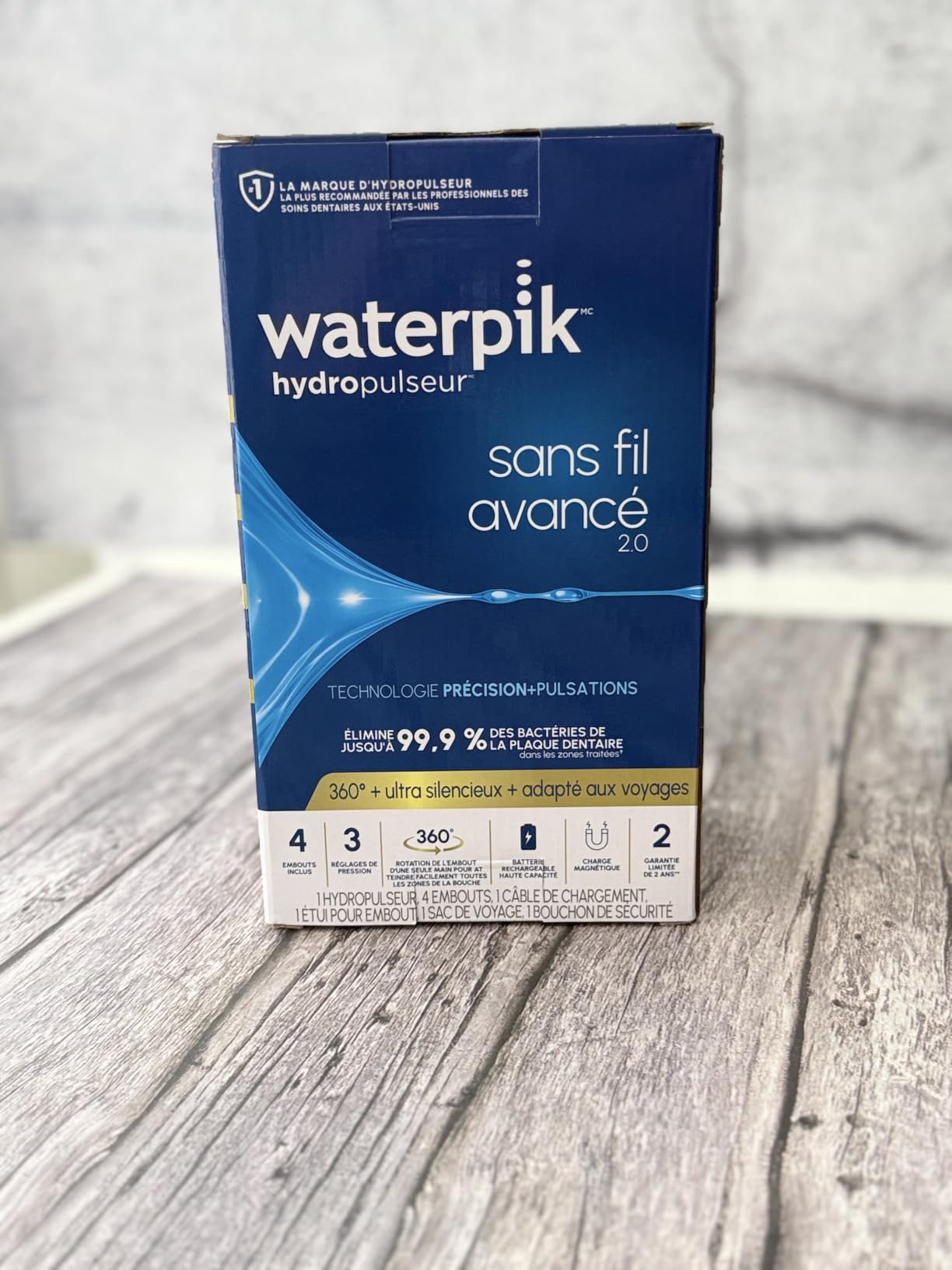
2. Waterpik Cordless Advanced – Best for Travel With an Implant
Waterpik Cordless Advanced Portable Water Flosser, Rechargeable, White
3 pressure settings
7 oz reservoir
4 weeks per charge
Waterproof
2-year warranty
Pros
- True middle pressure setting rare among cordless rivals
- Up to 4 weeks of use per charge
- Waterproof for shower use
- Travel bag and tip case included
- Low setting suits sensitive and healing gums
Cons
- 7 oz tank runs out mid-session
- Only three pressure settings
- Some owners report pump or charging failures after a year or two
- Small base drip reported
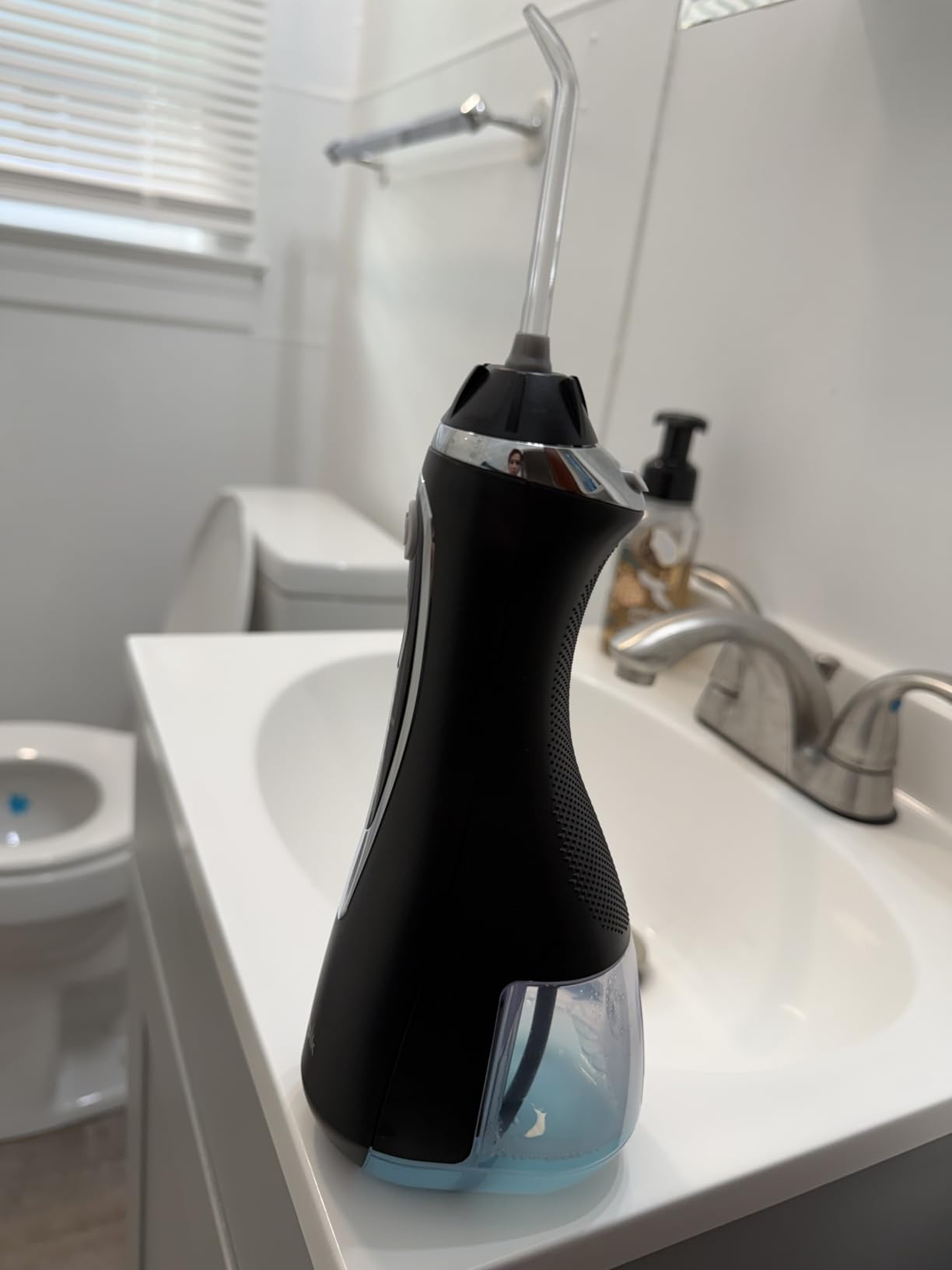
Three pressure settings is a real step down from the Aquarius, and that is the trade for freedom from the counter. In return you get the most practical travel design here: a waterproof body you can use in the shower, up to four weeks of use per charge, and a travel bag, tip case and leak-prevention plug in the box.
Reviewers praise battery life and portability above all else, and many report replacing string floss entirely. The middle setting matters more than the spec sheet suggests, because most cordless rivals jump straight from soft to strong.
Battery Life and the Magnetic Charger
Up to four weeks per charge with an LED recharge indicator and a rapid magnetic USB charger. A wall adapter is not included, and the magnetic connector is the part most likely to go missing, so give it a home.
The Tank Is the Weak Point
Seven ounces is roughly 45 seconds of floss time. For a single implant crown that is plenty. For a full-arch or All-on-4 restoration, or a household sharing one device, you will refill mid-session, and the base can drip when the tank is full. Owners also report a small but non-zero rate of pump or charging failures after a year or two.
Who Should Skip It
Skip it if you have several implants across the arch and want one fill to last, or if you need more than three pressure steps.
3. COSLUS C20 – Best Value With the Largest Tank
COSLUS ADA Accepted C20 Water Dental Flosser Pick, Professional Set Black
300 ml BPA-free tank
30-day battery
1400-1800 pulses per minute
IPX7 waterproof
5 tips
Pros
- Largest tank in this roundup at 300 ml
- ADA Scientific Council accepted
- Quiet operation with no counter pump
- 30-day battery and IPX7 waterproofing
- Number one best seller in Power Dental Flossers
Cons
- Lowest setting can still feel forceful on healing gums
- Wide body is awkward to grip
- Proprietary charger port cover is easy to lose
The C20 solves the problem that trips up nearly every cordless model, which is tank capacity. At 300 ml it holds more than double what most portable irrigators carry, and with a 30-day battery it becomes a device you leave out rather than one you charge every other week.
It is also ADA Scientific Council accepted, ranks as the number one best seller in Power Dental Flossers, and holds a 4.4 average across more than 53k reviews. A dental hygienist reviewer recommends it to patients, which is a stronger endorsement signal than a generic marketing line.
Pulse Rate and Dual-Stream Flow
The jet runs at 1400-1800 pulses per minute through a 0.3 mm plus 0.3 mm dual-thread stream, with dual-stream flow from a motor rated for three years of typical use. That pulse pattern breaks biofilm loose rather than merely rinsing it.
One caution: reviewers report even the softest mode can feel too aggressive for very sensitive or healing gums, and the jet is forceful enough to spray the room if triggered before the tip is in your mouth. The manufacturer advises first-time users start on Soft mode.
Three Modes, Five Tips and Waterproofing
Three modes, five interchangeable tips and IPX7 waterproofing for shower use. The quiet motor and hose-free design are the everyday pleasures: no counter pump, no splatter across the bathroom.
Who Should Skip It
Skip it if your gums are in active recovery and you need a truly feather-light first setting. The wide body is also awkward to grip for some hands, and countertop models deliver noticeably more pressure at a similar duty cycle.
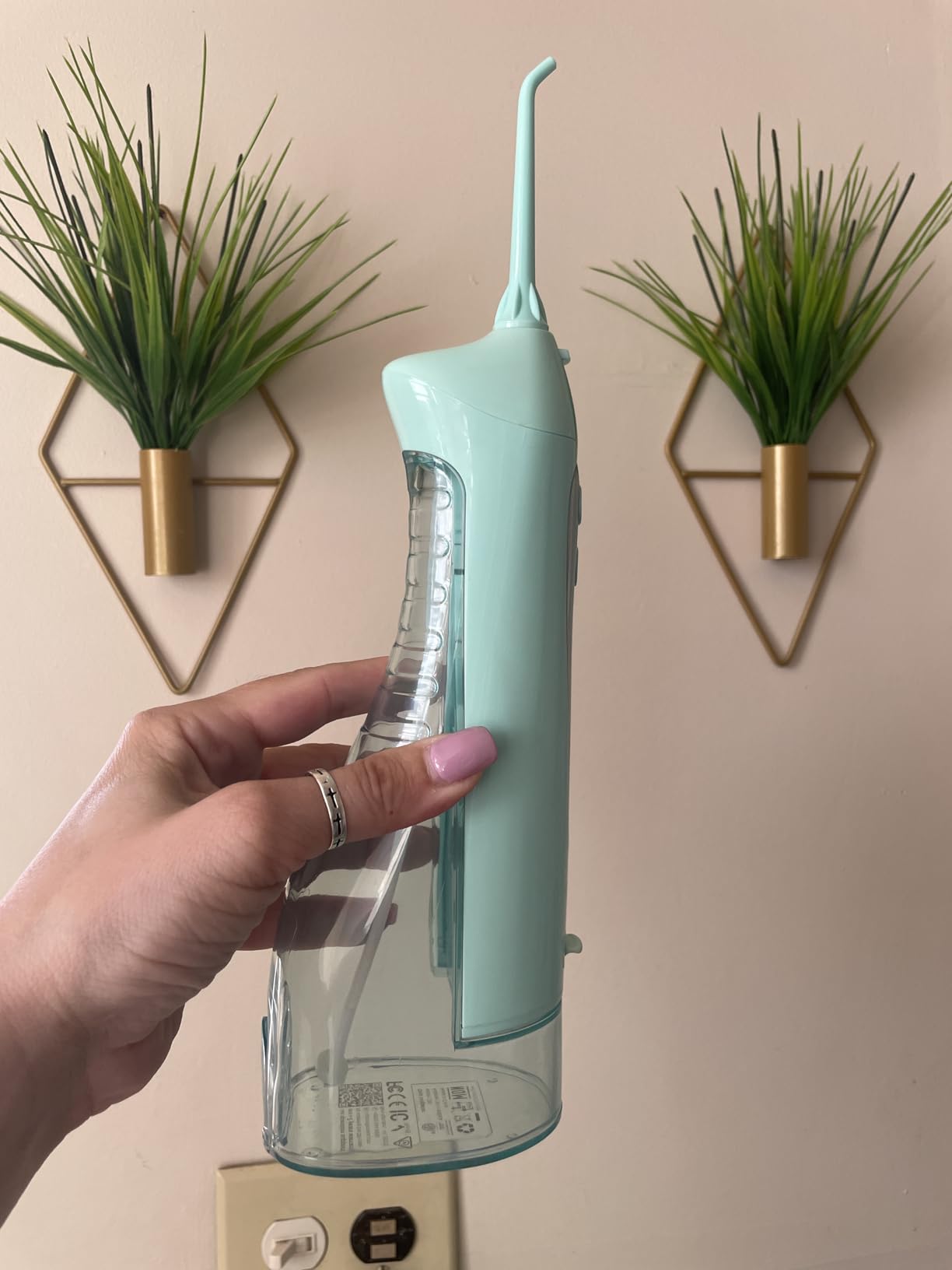
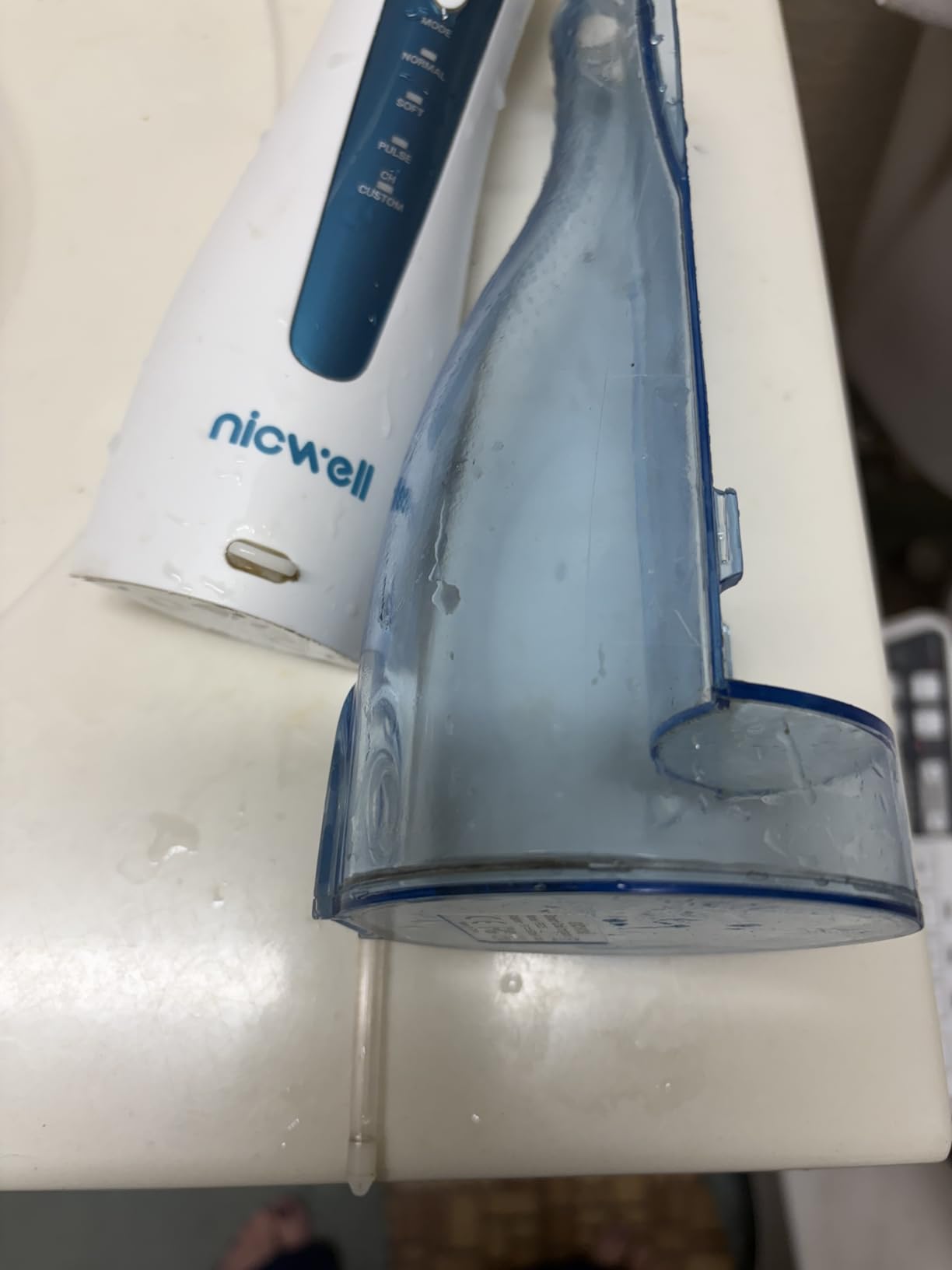
4. Nicwell F5025 – Best for the Gentlest Possible Start
Nicwell Water Dental Flosser for Teeth – 4 Modes & 11 Pressure Settings Cordless Portable Oral Irrigator, IPX7 Waterproof Rechargeable with 5 Tips for Braces Cleaning, Travel, Deep Teeth Cleaning
11 pressure levels across 4 modes
Smart memory
USB-C charging
IPX7 waterproof
5 tips
Pros
- Most pressure levels of any cordless model here
- Smart memory recalls your last setting
- Standard USB-C charging with no proprietary adapter
- Includes an orthodontic tip and tongue scraper
- Quiet and under one pound
Cons
- Jet is aggressive enough to spray if triggered early
- Small reservoir for a full-mouth clean
- Some owners report battery degradation between 18 months and 3 years
- Port cover sometimes missing from the box
Eleven pressure levels across four modes is the widest adjustment on the cordless side, and it exists for one reason: giving someone with a fresh implant site a genuinely soft starting point and a clear path upward. Level 1 exists, which is not a small thing when irrigating a healing abutment.
Smart memory is an underrated touch. Set your level once around a sensitive site and it holds there the next morning without hunting through buttons on a sore mouth. USB-C charging means no proprietary dock to lose, and the body is waterproof, quiet and under a pound.
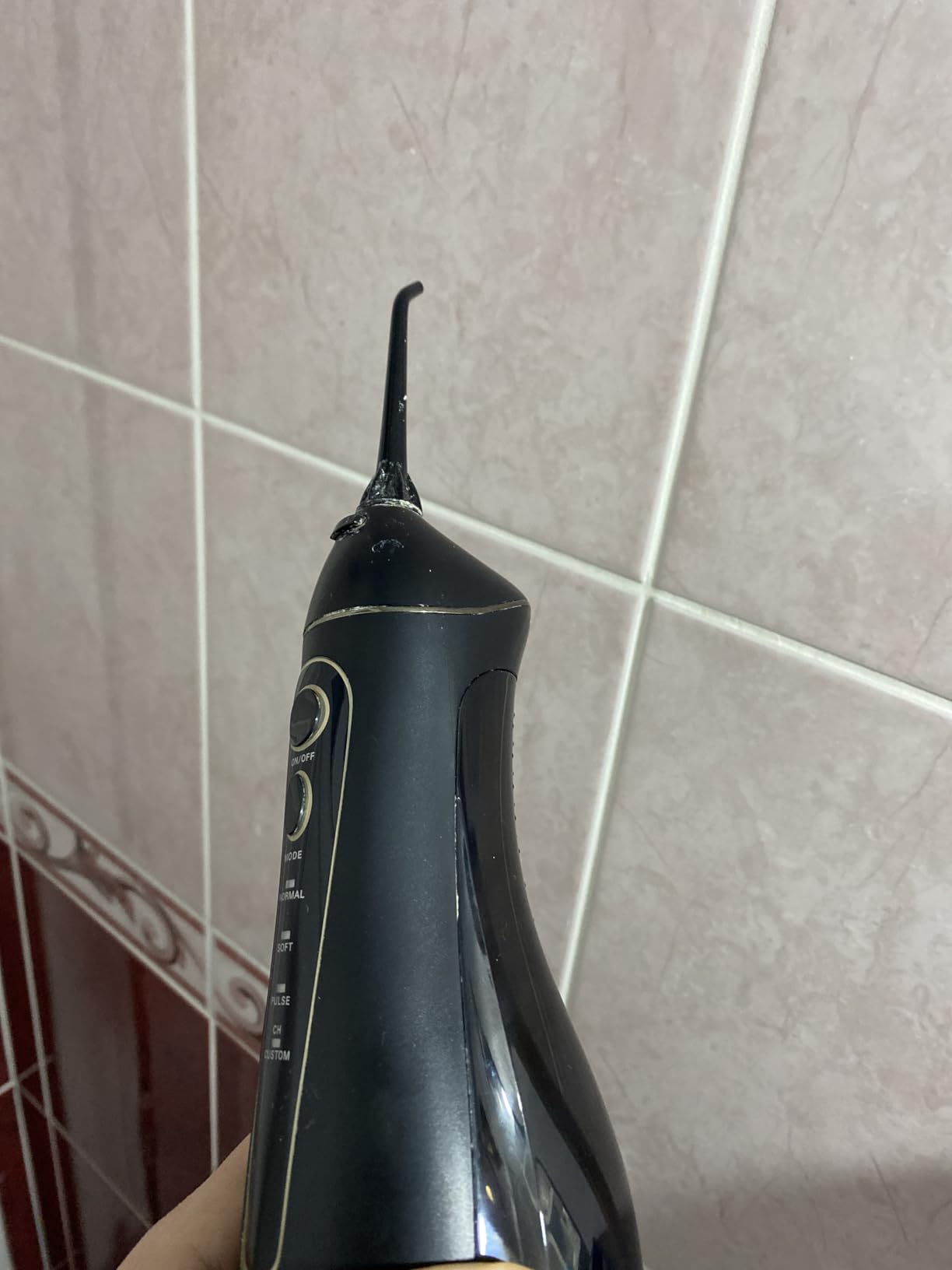
Four Modes and What Each Does
Soft, Pulse and two deeper modes across 11 levels give a genuine control range rather than three fixed settings. The pulse rate is 1400-1800 per minute through a 0.3 mm dual-thread stream, the same class of output as the larger cordless models.
Owners recommend putting the tip in your mouth before powering on and using warm water. Both pieces of advice appear repeatedly in the reviews and both solve the aggressive-spray problem directly.
Tips and Dental Work Compatibility
Five tips: classic jets, an orthodontic tip and a tongue scraper, all rotating 360 degrees. Reviewers single out the orthodontic tip working well on braces and similar work, and the device is listed as compatible with braces, retainers and bridges, which covers the crown-and-bridge implant case well.
Who Should Skip It
Skip it if you have a full-arch implant and want one fill to complete the clean. Battery longevity is the other question mark, with multiple reports of failures between 18 months and three years.
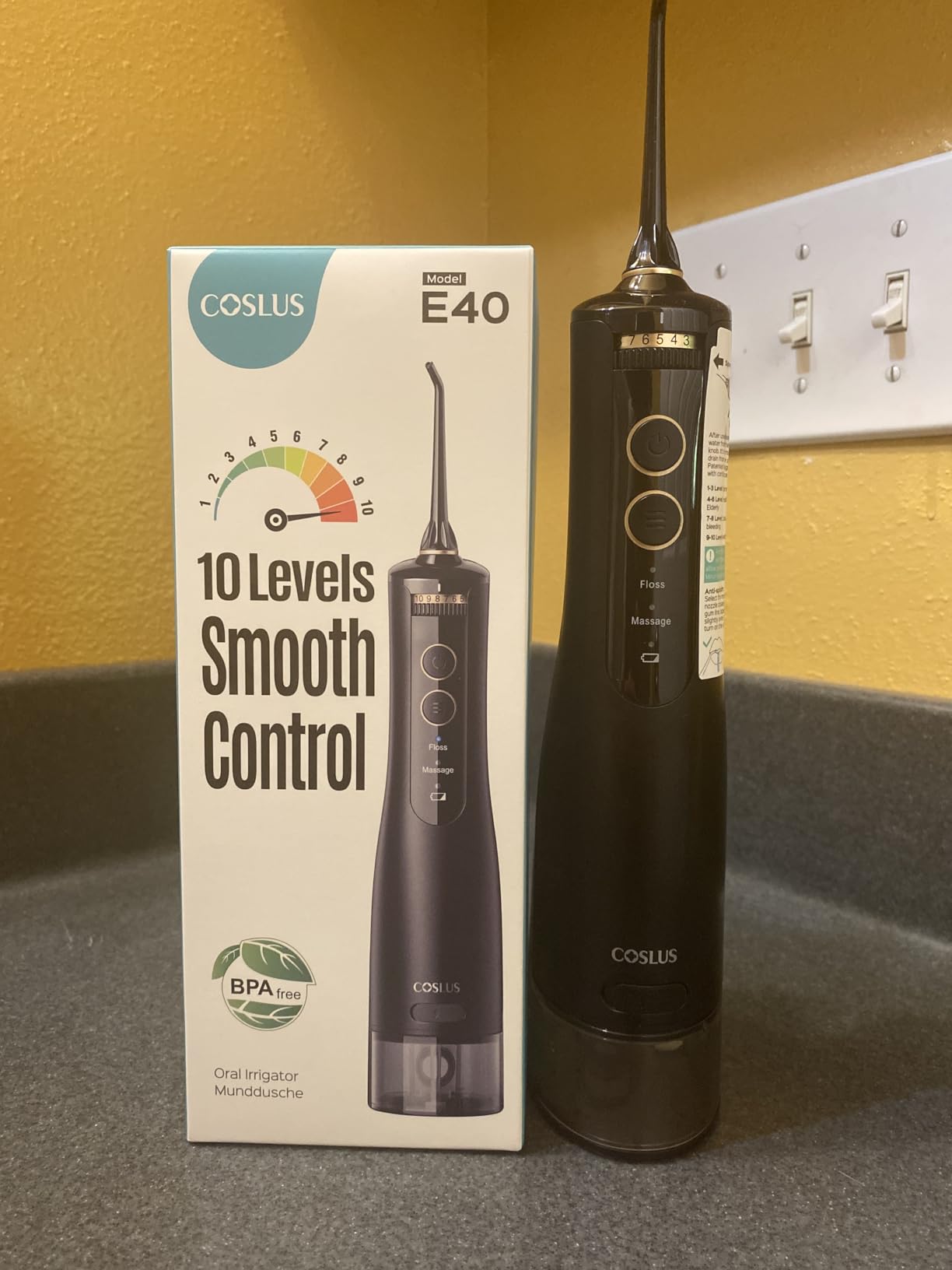
5. COSLUS E40 – Best for Precise Pressure Control
COSLUS ADA Accepted E40 Water Dental Flosser, 10 Pressure Levels, Black Pro
Stepless dial from level 1 to 10
300 ml tank
30 days per charge
Periodontal nozzle
IPX7
Pros
- Stepless dial gives incremental pressure changes with no pauses
- Periodontal and orthodontic nozzles for implant work
- 300 ml tank and 30-day battery in a compact body
- ADA accepted
- Multi-user capable
Cons
- Newer listing with a much smaller review base
- No wall adapter included
- Fewer tips than some rivals at the same level
Every other irrigator here steps pressure in fixed jumps. The E40 has a stepless dial that behaves like a volume button: you roll it and the pressure changes continuously under your finger, without pausing the flow or letting go of the wand. For implant work that matters, because the difference between too weak and just right becomes a few degrees of dial rather than an entire level.
It also ships a periodontal nozzle, the tip type most directly aimed at the sulcus around an implant collar. A 300 ml tank and 30 days per charge put it in the same practical league as the C20, and it carries ADA acceptance.
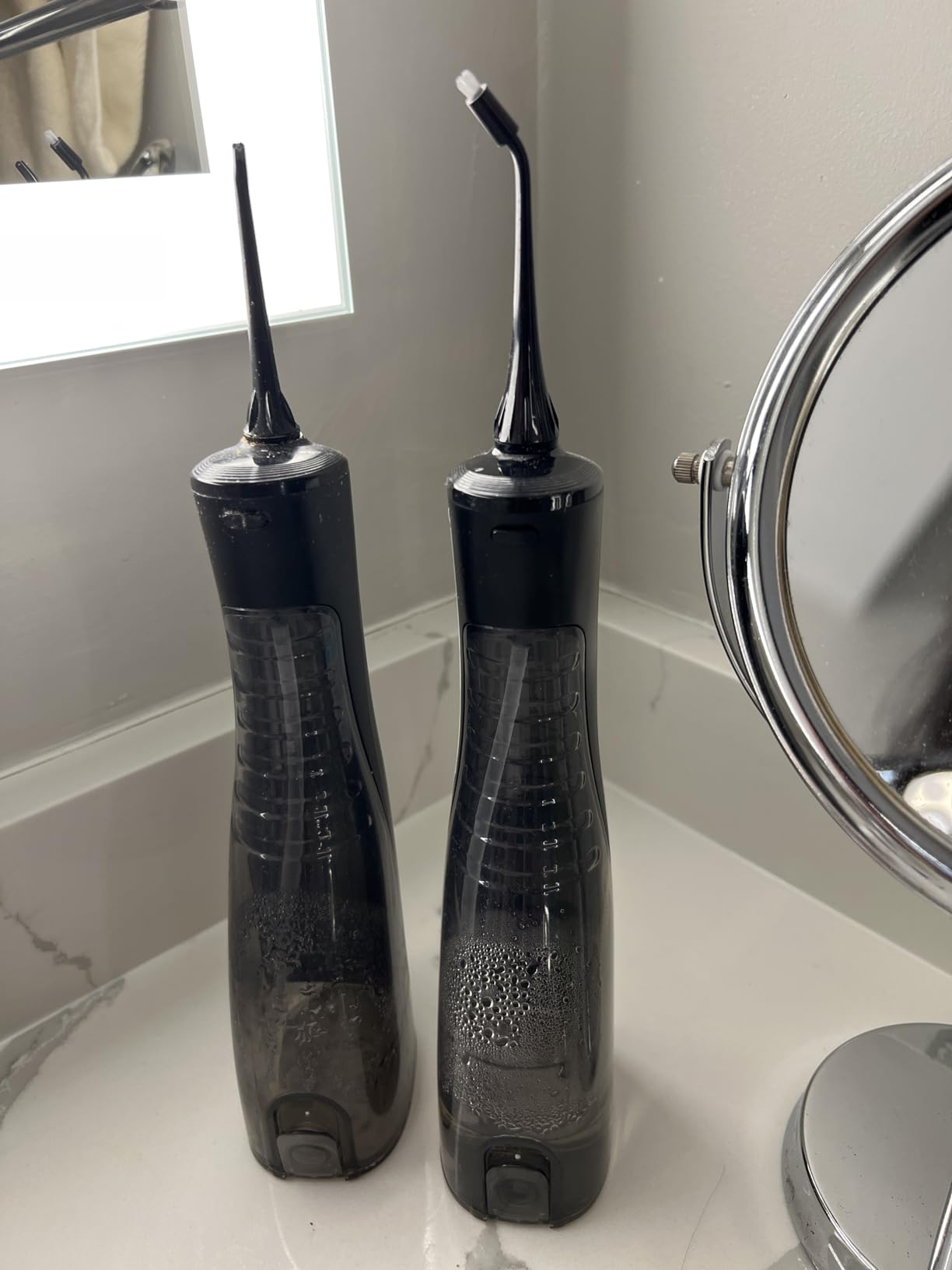
The Stepless Dial in Practice
Buyers single out the dial as the reason they chose this over a stepped-button device, describing the change as genuinely incremental rather than a jump. For a healing site, that control is worth more than an extra setting.
Periodontal and Orthodontic Nozzles
The nozzle set covers standard, orthodontic and periodontal tips. The periodontal tip is the one to use around an implant margin, where the narrow tapered stream reaches deeper into the sulcus than a standard jet.
Who Should Skip It
Skip it if you want a deep long-term durability record. This is a newer platform with a review base in the low thousands rather than the tens of thousands, so multi-year reliability feedback is thinner. No wall adapter is included.
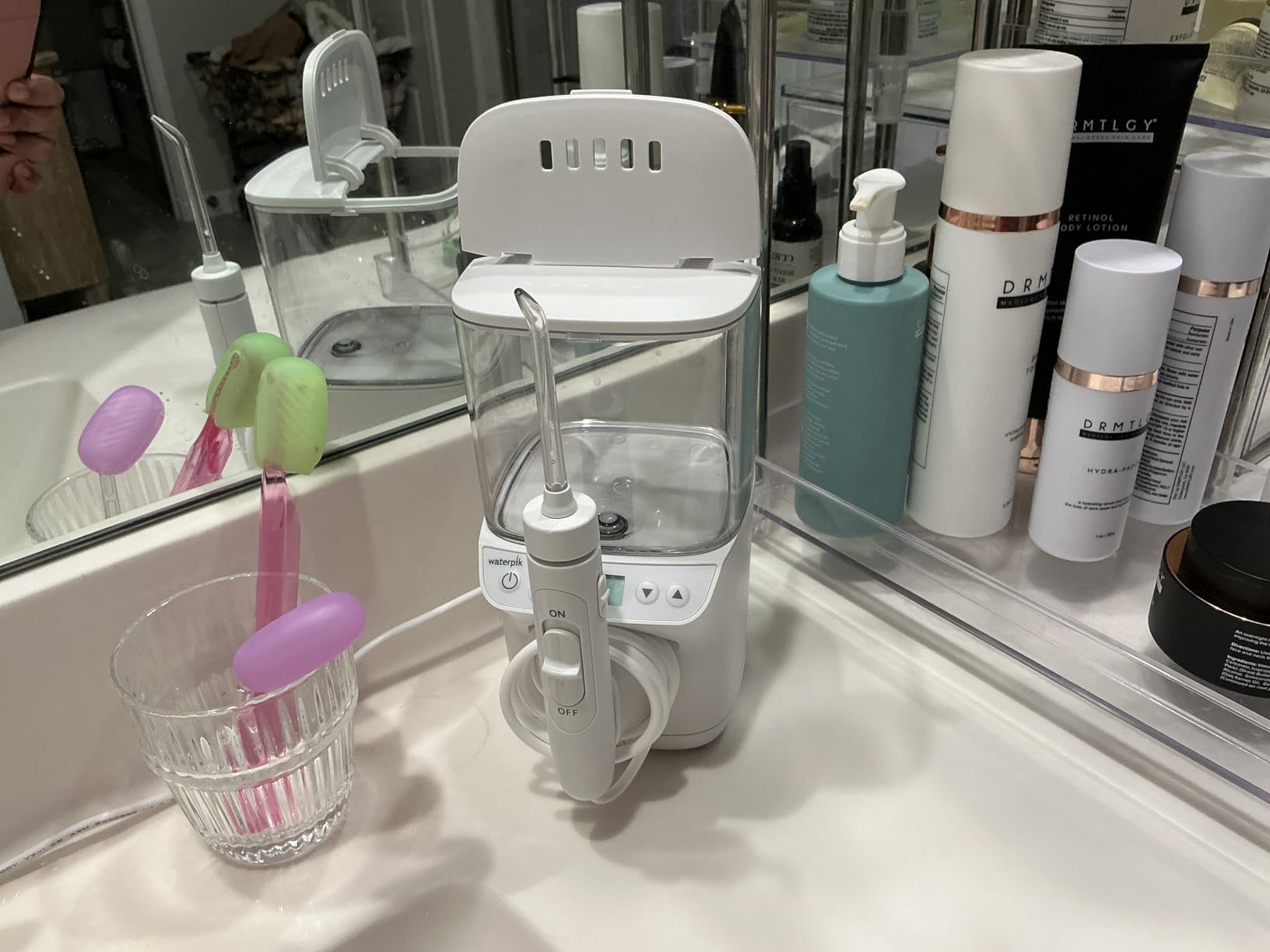
6. Waterpik Promax – Best for Brand New Irrigator Users
Waterpik Promax Countertop Water Flosser, SmartAdvance, 10 Settings, 5 Tips
SmartAdvance two-week ramp
10 intensity settings
90+ second reservoir
5 tips
3-year warranty
Pros
- SmartAdvance ramps pressure gradually over two weeks
- Strongest flow we reviewed and noticeably quiet
- Compact footprint with a magnetic wand holder
- Two pressure profiles for multiple users
- Marketed by Waterpik specifically for dental implants
Cons
- Removable tank does not latch and slides off when the unit is moved
- Reservoir smaller than the Aquarius despite the larger body
- Tank lid is harder to remove and replace
This is the model that answers the fear new implant owners actually have, which is using too much pressure on day one. SmartAdvance starts you at a conservative setting and walks the intensity up to the full deep-cleaning level over two weeks. The ramp is built into the device rather than left to your willpower.
Waterpik markets it explicitly for beginners, gingivitis, sensitive gums, braces and dental implants, and it delivers the strongest flow of anything we reviewed while running noticeably quiet. It also takes less counter space than the Aquarius and adds a magnetic wand holder.
SmartAdvance and the Two-Week Ramp
Two user profiles, 10 intensity settings and the automatic ramp. If you are nervous about starting an irrigator around a recently placed implant, this device does the cautious part for you during the window when caution matters most. Reviewers upgrading from the Aquarius call it more powerful, quieter and smaller.
Reservoir and Design Quirks
Two design issues recur: the reservoir does not latch and slides off when the unit is moved, and it is smaller than the older Aquarius despite the larger body, so you refill mid-session. A few buyers needed a replacement hose. Because this listing launched only recently, long-term durability data is limited compared with the mature Waterpik models.
Who Should Skip It
Skip it if tank capacity matters more than flow strength. The power and the automatic ramp are the reasons to buy it, not the capacity.
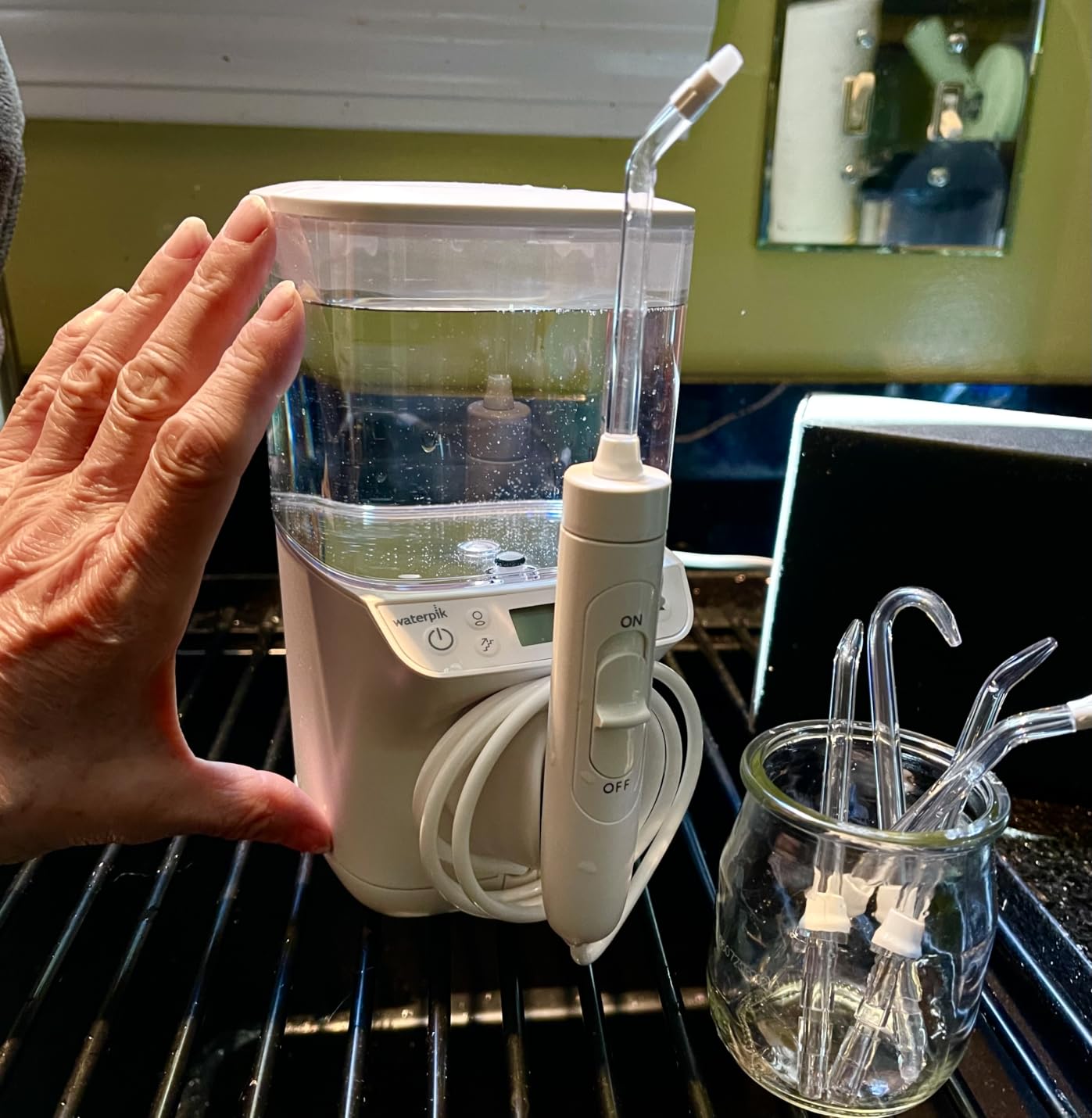
7. Aquapik Mini – Best for Small Bathrooms and Travel
Aquapik Mini Portable Water Flosser for Travel, Cordless Oral Irrigator Ideal for Braces, Implants and Gum Care, 200 mL Telescopic Tank, 4 Jet Tips, 3 Modes, 140 PSI, IPX7 Waterproof, USB-C (White)
200 ml telescopic tank
140 PSI
3 modes
IPX7 waterproof
USB-C up to 21 days
Pros
- Lightest and most compact body here at under 10 ounces
- Telescopic 200 ml tank collapses for storage
- Includes a periodontal nozzle for delicate gumline work
- Soft mode for sensitive gums
- USB-C charging with up to 21 days per charge
Cons
- Only three pressure modes and no fine adjustment
- 200 ml tank means more refills on a full-mouth clean
- Smallest review base in the group
- Lower pressure ceiling than countertop models
The travel case for this category. At under 10 ounces and 1.5 by 2.56 by 5.71 inches, with a telescoping tank that collapses for storage, it is the one to pack.
It still ships four nozzles including the periodontal tip, which matters more for implant care than most travel-focused models manage, and 140 PSI is a real working pressure rather than a token figure. Three modes including a Soft setting cover the basics.
Three Modes and the Pressure Ceiling
Soft, Normal and Pulse with one-button control. There is no continuous fine adjustment, so if you need to move gradually between intensities around a healing site, this is not the device. The 140 PSI ceiling also sits below what the countertop models deliver.
Who Should Skip It
Skip it if you want fine-grained pressure control. With the smallest review base here, expect more variance in long-term experience, and full-arch owners will refill more often than with a 300 ml tank.
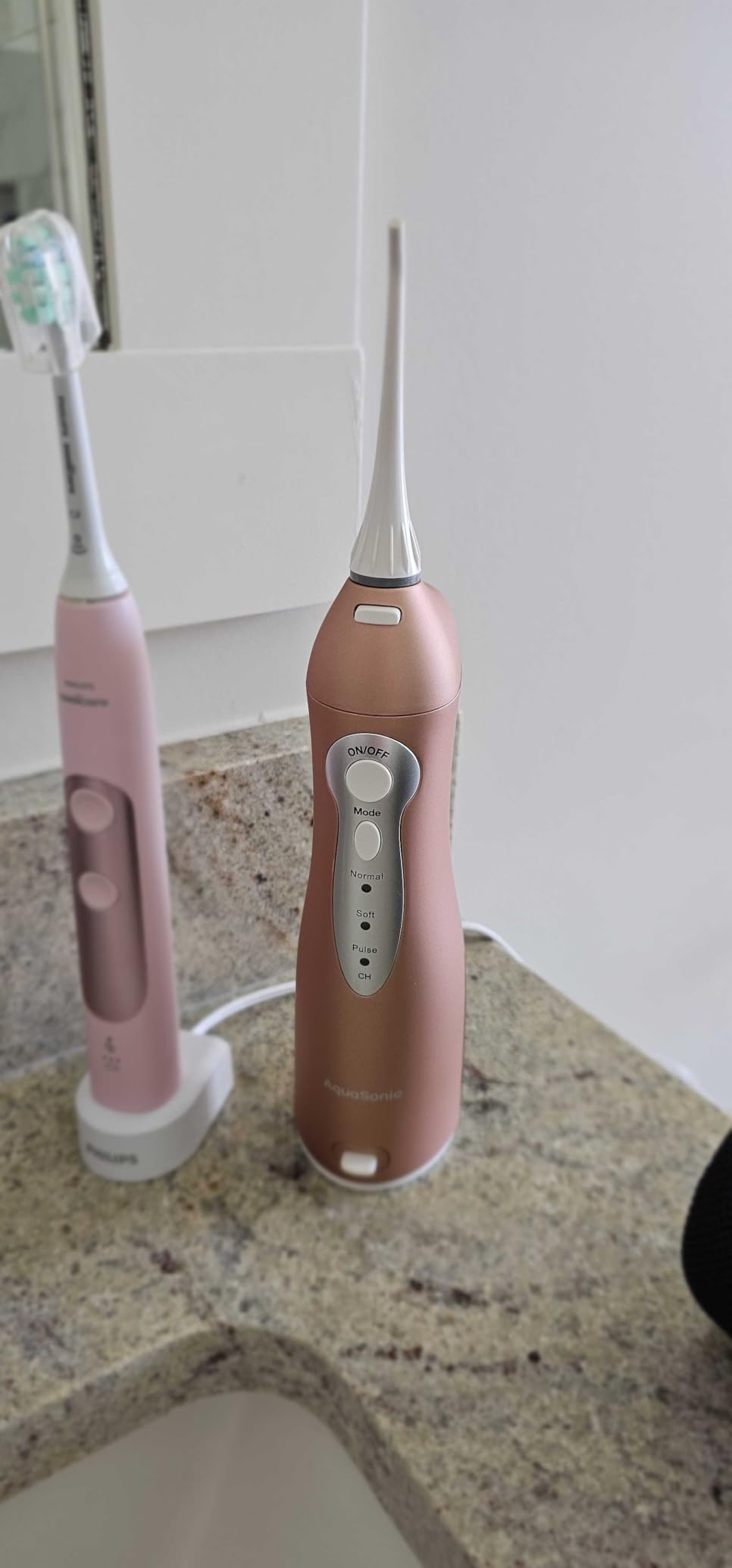
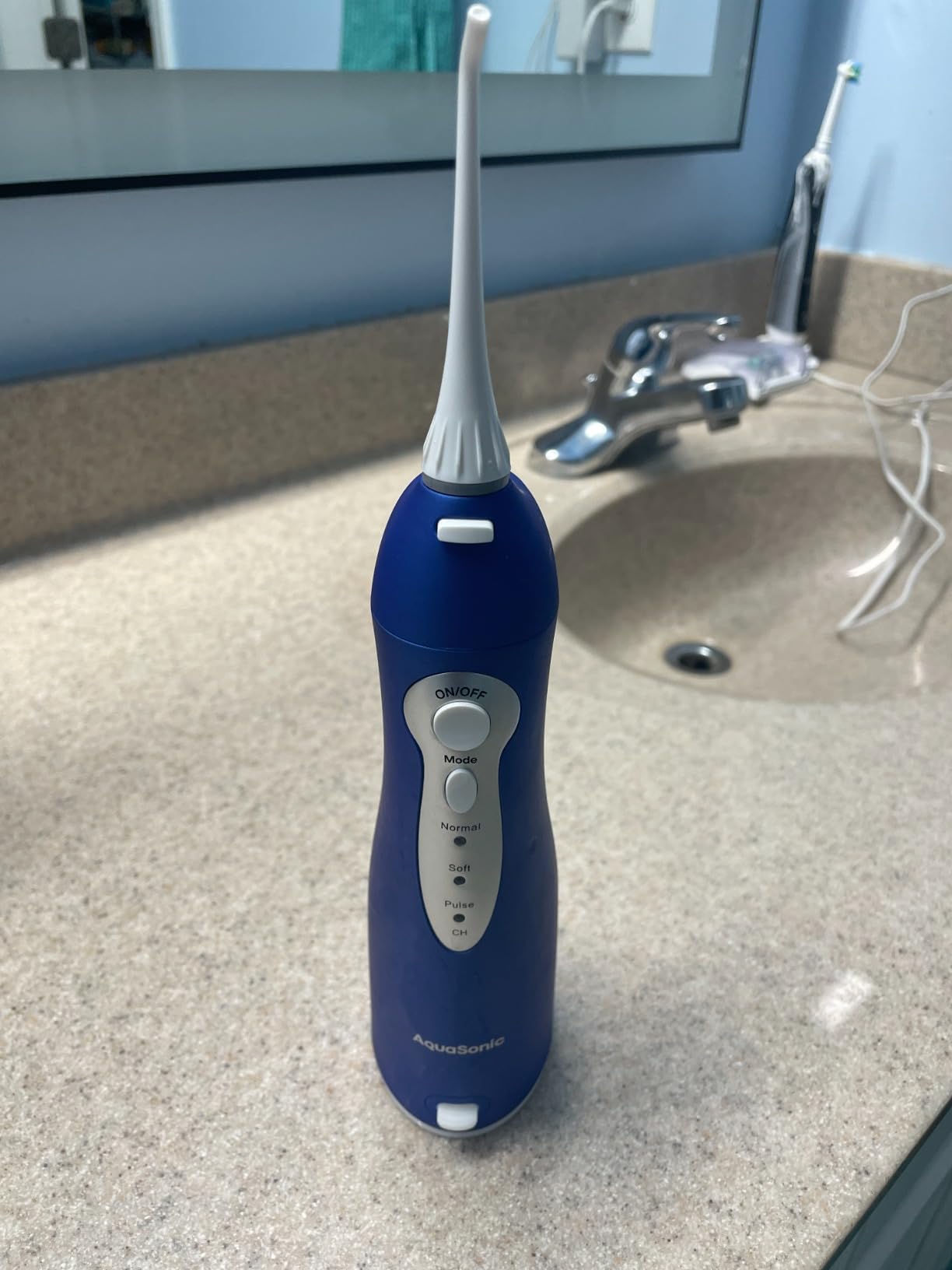
8. AquaSonic Aqua Flosser – Best for Published Clinical Evidence
AquaSonic Aqua Flosser Water Flosser, ADA Accepted, White
ADA accepted via its own 30-day study
5 rotating tips
3 modes
Waterproof cordless
3 ounces
Pros
- ADA Seal earned through its own randomized controlled clinical study
- Published plaque and gum health figures rather than marketing claims
- Five tips including orthodontic and periodontal
- Owners report a year or more of daily use
- Very light at about 3 ounces with a travel bag
Cons
- Small tank that several owners refill two or three times per session
- Mode selection is awkward because it defaults to pulse on power-up
- Some replacement tips pop off on activation
- Only preset modes with no continuous adjustment
This is the pick for anyone tired of the phrase clinically proven with no citation attached. The ADA Seal of Acceptance here was earned through the brand’s own formal clinical study, a 30-day randomized controlled trial with 30 IRB-supervised subjects, reporting up to 87.1 percent plaque reduction and up to 93.8 percent improvement in gum health. A stated design, a stated sample size, specific numbers. That is the standard the rest of the category is measured against.
Sensitive-gum users report the lowest mode is comfortable for them, and owners mention a year or more of daily use without failure. At about 3 ounces with a waterproof cordless body and a travel bag, it is also the lightest functional option here.
What the Study Actually Measured
Thirty days, randomized and controlled, with figures for both plaque reduction and gum health. The clinical study is the main reason reviewers recommend it, and it is the same evidence base dentists draw on when they suggest irrigators for implant patients. If you want the evidence rather than the endorsement, this is the entry to read.
Tank Size and the Mode Sequence
Two practical drawbacks. The tank is small, and several users refill it two or three times in a session, which on a full-arch implant case is a real interruption. The mode sequence is also awkward: the device defaults back to its pulse setting every time it is switched on, so changing modes means pressing buttons while water is already spraying. Some replacement tips also pop off on activation.
Who Should Skip It
Skip it if you have several implants and want a single fill to last, or if you want continuous pressure adjustment. A minority find the flow too strong despite the advertised gentle mode.
How to Use a Water Flosser on a Dental Implant Safely
Technique matters as much as the device. These six steps are how we used each model, and they match the low-power approach that dominates advice from periodontists in implant forums.
- Fill and warm the tank. Warm water is more comfortable against a tender site, and a water distiller is one way to get it without waiting on a kettle.
- Start on your lowest setting. Not level two. Level one, and get a feel for it around a natural tooth before going near the implant.
- Put the tip in your mouth before switching on. The most repeated piece of practical advice in the reviews, and it stops the jet spraying across the room.
- Aim along the crown margin at a shallow angle. Follow the line where crown meets gum rather than pointing at the tooth surface. You are tracing a seam, not aiming at a wall.
- Pause at each implant. Hold the tip at the margin for a couple of seconds so the pulses dislodge biofilm from the sulcus, then move on. A slow pass beats a fast one.
- Ramp up gradually. Once a few sessions pass with no bleeding or discomfort, move up one setting. If you are within the first weeks after implant surgery, confirm the timing with your dentist first.
If bleeding or tenderness persists beyond a session or two, stop and contact your dentist. Around an implant, persistent bleeding is a symptom worth reporting rather than pushing through.
Which Tip to Use on an Implant Crown
Tip confusion is one of the most common questions in implant communities. Most boxes ship five to seven nozzles and say nothing about which belongs on a crown.
The Plaque Seeker tip is the implant tip. Its slim, tapered shape reaches into the sulcus around the implant collar, which is precisely where biofilm collects. The periodontal pocket nozzle is the equivalent tip on other brands, and the COSLUS E40, the AquaSonic and the Aquapik Mini all include one.
The standard jet tip works fine for a broad rinse of the crown face, and the orthodontic tip is genuinely useful if the crown sits next to brackets or a retainer. The tongue scraper has nothing to do with implants. Replace tips on the manufacturer’s schedule, since a worn tip loses its flow characteristics.
Water Flosser vs String Floss vs Superfloss for Implants
These three are not interchangeable, and the implant thread is where that matters most. String floss is standard advice for natural teeth and the least useful tool here: around a screw-retained implant or curved abutment it tends to slide off, fray, or get wedged where you cannot see it.
Superfloss and bridge flossers are the better conventional option for a single accessible implant crown, because the stiffened end can be guided under the margin. Doing that by feel at the back of the mouth every night is genuinely difficult, though.
An oral irrigator is the only one of the three that reaches the back of the arch and the underside of a crown without a mirror. It does not physically wipe a surface the way floss does, so the sensible routine for a single implant is irrigator daily plus floss or a bridge flosser periodically. For a full-arch All-on-4 restoration, where threading floss under a fixed prosthesis is not realistic, irrigation is doing nearly all of the home work.
How to Choose a Water Flosser for Implants
Pressure settings come first
Buy the widest adjustment range you can find and start at the bottom. Ten settings on the Aquarius, eleven levels across four modes on the Nicwell and the stepless dial on the COSLUS E40 are all meaningfully better for implant work than a three-mode device. Hiding at the lowest setting forever is understandable but self-limiting, because a too-gentle stream rinses instead of flushing.
Look for an implant-appropriate tip
Check for a Plaque Seeker or periodontal pocket nozzle specifically. A seven-tip box sounds generous but often means six duplicates and a tongue cleaner. The Aquarius, the E40, the AquaSonic and the Aquapik Mini all ship the right one.
Reservoir capacity decides whether a clean gets finished
The difference between one fill and three is the difference between a complete nightly routine and one you abandon. A 22 oz countertop tank gives 90+ seconds; 300 ml cordless tanks are the portable equivalent; anything at 200 ml or 7 oz means mid-session refills, which is exactly where full-arch users lose out.
Countertop versus cordless
Countertop gives stronger flow, more settings and a bigger tank in exchange for counter space and an outlet. Cordless gives waterproofing, multi-week battery life and the ability to use it in a shower, at the cost of pressure range and usually capacity. One or two crowns in the front of the mouth are served well by either. Full-arch restorations and multi-implant households lean countertop.
What the ADA Seal actually means
The ADA Seal of Acceptance is awarded to specific products, not to water flossers as a category. The first water flosser brand to receive it was Waterpik, and the AquaSonic earned it through its own 30-day randomized controlled study. Treat the seal as one meaningful data point among several rather than a magic phrase.
Waterproofing, warranty and small parts
IPX7 waterproofing matters more than it sounds if you intend to irrigate in the shower rather than over a sink. Warranty length is a rough proxy for platform maturity: three years on the Aquarius, two on the Cordless Advanced, thinner coverage on newer models where long-term feedback is still accumulating. Check whether a wall adapter is included too, since several here ship a USB cable with no adapter and a loose port cover that is easy to lose.
Be realistic about limits. A water flosser is a home maintenance tool, not a substitute for the professional implant maintenance schedule your dentist sets, which includes debridement and probing depth measurement. If you are due for a cleaning, irrigation does not replace it.
Frequently Asked Questions
What is the best water flosser for dental implants?
The Waterpik Aquarius is the best overall pick for implants. It combines 10 pressure settings, a 22 oz reservoir giving 90+ seconds of runtime, seven tips, 360-degree tip rotation and the ADA Seal of Acceptance. The widest pressure range means you can start gentle around a healing site and increase gradually, and the large tank lets you clean every implant margin in one pass without refilling.
Is a water flosser good for implants?
Yes, when used correctly at a low-to-moderate setting. An oral irrigator is the only home method that reliably flushes biofilm from the sulcus around an implant collar, where a toothbrush cannot reach and string floss tends to slide off or fray. Start on the lowest setting, trace the crown margin at a shallow angle, and pause a couple of seconds at each implant. It complements but does not replace professional implant maintenance.
Which WATERPIK tip is best for implants?
The Plaque Seeker tip is the right choice on an implant. Its slim tapered shape reaches into the sulcus around the implant collar, which is exactly where biofilm builds. The periodontal pocket nozzle on other brands serves the same purpose, and the COSLUS E40, AquaSonic and Aquapik Mini all include one. The standard jet tip is fine for rinsing the crown face, and the tongue scraper is not relevant to implants at all.
How long after implant surgery can I use a water flosser?
Ask your dentist or periodontist for the exact timing, because it depends on the procedure and how the site healed. As a general approach, irrigate gently rather than stopping entirely, keep to the lowest pressure setting for the first couple of weeks while tissue is tender, and use warm water. If you see persistent bleeding or pain beyond a session or two, stop and contact your dentist rather than pushing through it.
Do water flossers prevent peri-implantitis?
They help, and they help a lot. Peri-implant mucositis starts as inflamed, bleeding tissue around the implant collar, and it is reversible if the biofilm is removed. An irrigator reaches the margin and sulcus where a toothbrush and floss struggle, which is the zone where that biofilm forms fastest. Water flossers are not a cure for established peri-implantitis, which involves bone loss and needs professional treatment.
The Bottom Line on Water Flossers for Implants in 2026
If you want one device and one decision made for you, the Waterpik Aquarius is the pick. It has the widest pressure range, the longest runtime, seven tips, ADA acceptance and by far the deepest review history in this group, which matters in a category where a weak pump is the most common long-term failure.
Choose differently if your situation is different. Travel constantly or irrigate in the shower and the Waterpik Cordless Advanced is the balanced option, though its 7 oz tank suits one or two implants rather than a full arch. Capacity per charge is the thing that frustrates you most and the COSLUS C20 gives you 300 ml and 30 days between charges with ADA acceptance. Healing gums and a desire for the gentlest place to begin points to the Nicwell F5025, with 11 levels and a soft mode that actually feels soft, or the COSLUS E40 if the stepless dial appeals. Brand new to irrigators and afraid of too much pressure is the Waterpik Promax, which ramps you up automatically over two weeks. The Aquapik Mini collapses into a travel bag, and the AquaSonic is the one with a randomized controlled trial behind its ADA Seal.
Whichever you choose, technique does more for your implant than the model does: warm water, lowest setting first, tip in the mouth before you power on, a slow pass along the crown margin, and a pause at every implant. Then keep your professional maintenance appointments, because no home device replaces them. Our picks and the wider category are updated for 2026, and the full portable shortlist lives in our cordless water flosser guide.
Leave a Reply