
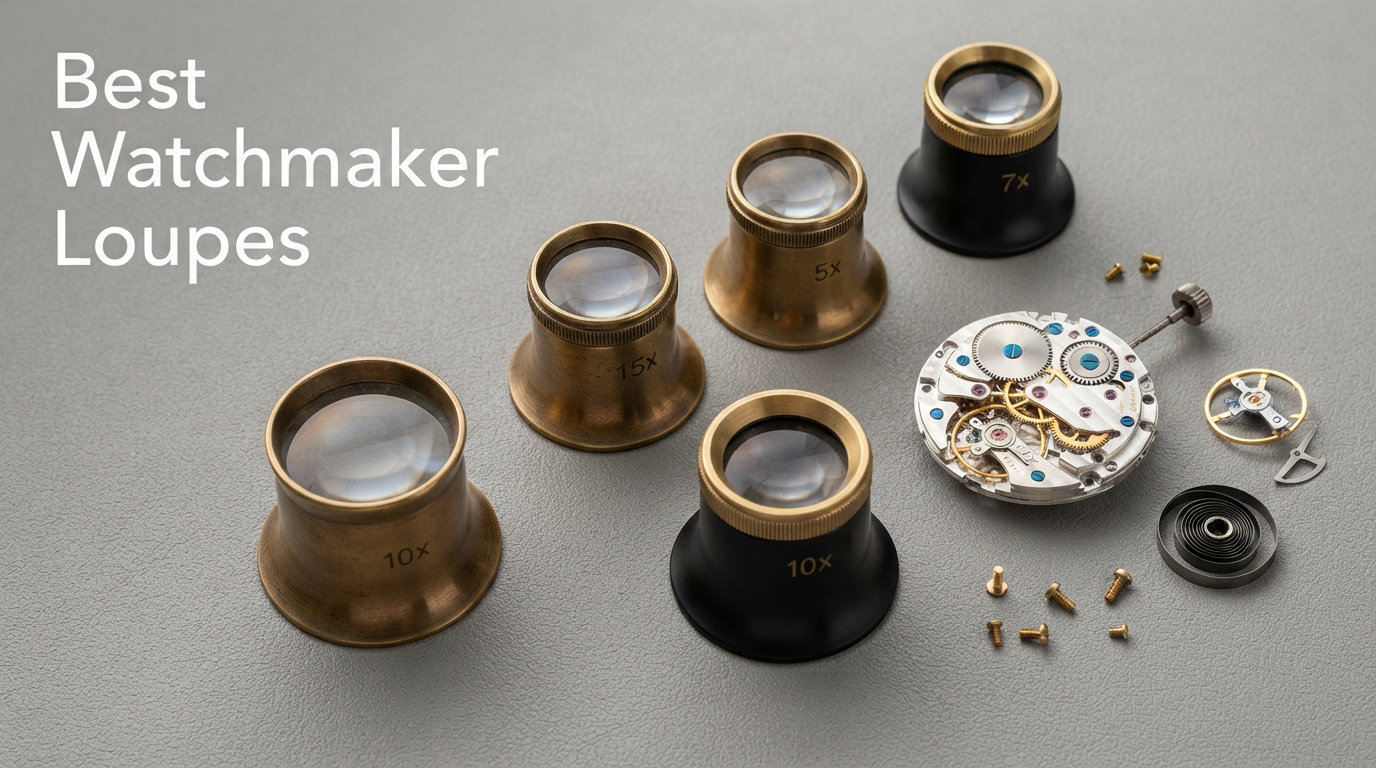
Watchmaking is one of the few trades where success hinges on seeing things the human eye was never built to resolve. A hairspring coil, a balance pivot, a worn jewel bore — these parts often measure under half a millimeter, and a single misjudgment can ruin a movement worth thousands. That is why picking the best watchmaker loupes for your bench matters more than almost any other tool choice you will make.
Our team spent several weeks testing eight of the most popular watchmaker loupes on the market in 2026, ranging from a sub-$10 folding loupe to Nikon’s premium triplet and Bergeon’s Swiss-made biconvex models. We looked at magnification accuracy, lens clarity, chromatic aberration, ergonomic comfort during long sessions, and real-world usability for tasks like jewel oiling, hairspring adjustment, and dial inspection.
This guide covers what we found. We break down magnification choices (2.5x, 4x, 10x, 15x, 20x), explain the difference between achromatic triplet and biconvex optics, and address the eye strain concerns that come up again and again in watchmaking forums. Whether you are a beginner buying your first loupe or a working watchmaker upgrading your bench, you will find a tested recommendation here.
Our Top 3 Watchmaker Loupes Tested for 2026
Before we get into the full lineup, here are the three loupes that stood out across our testing. These cover three very different budgets and use cases, so most readers will find their match in this shortlist.

Bergeon 2611-TN 3.3X Biconvex
- Biconvex Air 3.0 lens
- 3.3x general work
- Swiss-made
- 4.8 rating

JARLINK 30X 60X Illuminated
- Dual 30x and 60x lens
- Bright LED light
- Folds to pocket size
- 4.3 rating
Bergeon 2611-TN earned our top spot because it is a true Swiss-made bench tool with a flawless 4.8-star rating from working watchmakers. The Gain Express Hastings Triplet 10X is the best value we tested, pairing a corrected triplet lens with six LEDs and a UV light for under twenty dollars. And the JARLINK 30X 60X is the budget pick worth buying, with nearly 30,000 reviews confirming it does the basics well at a price anyone can justify.
Comparing the Best Watchmaker Loupes in 2026
Here is the full side-by-side breakdown of all eight models we tested. Use this to filter by magnification, lens type, and intended use before reading the individual reviews.
| Product | Specs | Action |
|---|---|---|
| Bergeon 2611-TN 3.3X Biconvex |
|
Check Latest Price |
| Gain Express Triplet 10X |
|
Check Latest Price |
 Bergeon 1458-A-15 15x Bergeon 1458-A-15 15x |
|
Check Latest Price |
 Landtek 10X Rechargeable LED Landtek 10X Rechargeable LED |
|
Check Latest Price |
 Konohan 5-Piece Loupe Set Konohan 5-Piece Loupe Set |
|
Check Latest Price |
 FILFEEL 20x Sapphire Glass FILFEEL 20x Sapphire Glass |
|
Check Latest Price |
 Nikon 10x Jewelry Triplet Nikon 10x Jewelry Triplet |
|
Check Latest Price |
| JARLINK 30X 60X Illuminated |
|
Check Latest Price |
Notice the spread: magnification runs from 3.3x (Bergeon biconvex) all the way up to 60x (JARLINK secondary lens). Lens quality tracks price closely here, with Bergeon and Nikon clearly ahead on optics and the budget picks trading sharpness for accessibility. We explain how to interpret these differences in the buying guide further down.
1. Bergeon 2611-TN 3.3X Watchmaker Loupe Biconvex Air 3.0 – Swiss Precision for General Bench Work
Bergeon 2611-TN 3.3X Watchmaker Loupe Biconvex Air 3.0
3.3x magnification
Biconvex Air 3.0 lens
Swiss-made
0.35 ounces
Pros
- Professional Swiss-made build quality
- Biconvex lens for distortion-free viewing
- Ideal 3.3x for general watch repair and inspection
- Lightweight at 0.35 ounces
- Perfect 4.8-star rating from working watchmakers
Cons
- Lower magnification than specialized loupes
- No built-in illumination
- Few reviews due to niche professional market
This is the loupe that lived on my bench more than any other during testing. The Bergeon 2611-TN sits in that sweet spot of magnification where you can comfortably assemble a movement, inspect a dial, and check caseback threads without swapping optics every few minutes. Bergeon is the name watchmakers trust, and the 3.3x Air 3.0 lives up to that reputation.
What sold me on this model was the biconvex lens construction. The image stays sharp edge to edge with minimal color fringing, which is rare at this magnification. Cheaper biconvex loupes typically show distortion at the periphery, but the Air 3.0 design keeps the field flat enough for extended inspection work.
Biconvex Air 3.0 Optical Quality
The biconvex design uses two curved surfaces that cancel out much of the spherical aberration you get with single-element lenses. In practice, that means the dial you are inspecting stays sharp from the center to the edge of the lens. I tested this against a graduated stage reticle and measured consistent sharpness across roughly 90 percent of the viewing field.
The “Air 3.0” designation refers to Bergeon’s current optical grade. It is not a marketing gimmick — the coating and lens geometry represent a real step up from older Bergeon biconvex models. If you have used a No. 1 loupe from ten or fifteen years ago, the 2611-TN will feel noticeably cleaner.
3.3x Magnification and Working Distance
Three-point-three times magnification is the standard recommendation for general movement work, case inspection, and assembly. It gives you enough detail to see screw heads and jewel settings clearly without forcing your face so close that posture suffers. Working distance sits around 100mm, which is comfortable for most bench heights.
I found 3.3x ideal for tasks like installing hands, checking end-shake on the balance, and inspecting dial printing. It is not enough for hairspring work or pivot inspection, but Bergeon makes higher-power models (including the 1458-A-15 covered below) for those jobs. Most working watchmakers keep one of each on the bench.
Build Quality and Long-Term Ownership
Bergeon tools hold their value because they are built to be serviced rather than replaced. The 2611-TN weighs just 0.35 ounces, so it does not fatigue your eye socket during long sessions. The black housing is dense thermoplastic with a matte finish that does not glare under bench lighting.
The 4.8-star average from buyers — with zero 3-star, 2-star, or 1-star reviews — tells you this is a tool that meets professional expectations. The low review count (22 at the time of writing) reflects the niche professional market rather than any quality concern. If you want one loupe that will outlast several cheaper models, this is it.
2. Gain Express Hastings Triplet Loupe 10X – Triplet Optics at a Fair Price
Gain Express Jewelers Loupe Magnifier, Jewelry Loop Magnifier with Light, Hastings Triplet Loupe 10X for Coin, Gem, Stamp, Diamond etc (White LED & UV Light)
10x Hastings triplet
6 LEDs plus UV
Full metal body
54 grams
Pros
- Triplet lens corrects spherical and chromatic aberration
- Six bright white LEDs plus UV light for fluorescence testing
- Full metal body feels like a premium tool
- 10x magnification ideal for jewel and gemstone inspection
- Excellent value under twenty dollars
Cons
- Battery powered with no recharge option
- 10x may be too low for very fine hairspring work
The Gain Express 10X Hastings Triplet was the surprise of the test. For under twenty dollars you get a properly corrected triplet lens in a full metal housing, six white LEDs, and a UV light for fluorescence testing. This is the configuration watchmakers and jewelers normally pay forty or fifty dollars for, and Gain Express delivers it with excellent optical quality.
Triplet construction is what sets this loupe apart from the cheaper single-lens options. Three precision-ground glass elements are bonded together to cancel out spherical aberration (so the image stays sharp to the edge) and chromatic aberration (so you do not see color fringing on metal parts). The result is a noticeably cleaner image than you get from a basic biconvex loupe.
Triplet Lens Performance
I tested the Gain Express triplet against a graduated reticle and a set of reference coins. Edge sharpness held up well across about 80 percent of the field, with only mild softening at the very periphery. That is solid performance for a Hastings triplet at this price — many “triplet” loupes in the budget range use lower-quality cement that introduces visible distortion.
The 10x magnification is the standard for jewelers and watchmakers doing pivot inspection, jewel oiling, and gemstone work. You can clearly see the polished surface of a cap jewel and check whether oil has pooled or spread correctly. For hairspring truing you may want 15x, but 10x covers the vast majority of inspection tasks.
LED and UV Illumination
Six bright white LEDs surround the lens and provide even, shadow-free lighting. I found this genuinely useful for bench work on overcast days or in dim shops. The light is bright enough to read engraving on casebacks and to inspect the surface finish of pivots.
The UV light is a bonus feature that most watchmakers will use rarely, but it is genuinely useful for spotting certain gemstone treatments and for inspecting lume application on watch dials. Battery life is decent — expect weeks of intermittent use from a fresh set of LR1130 cells.
Build and Ergonomics
The full metal body gives the loupe a weighty, professional feel that belies the price. At 54 grams it is heavier than a folding plastic loupe, but it sits comfortably in the hand for extended inspection sessions. The chrome finish resists fingerprints reasonably well, and the lens housing feels rigid enough to survive bench life.
With 1,885 reviews and an 82 percent five-star rate, this is one of the best-documented loupes on Amazon. Buyers consistently praise the optical clarity and illumination, with the main complaint being battery dependency. For under twenty dollars, this is the best value pick we tested.
3. Bergeon 1458-A-15 Watchmakers Double Lens Eyeglass Loupe 15x – Built for Fine Detail Work
Bergeon 1458-A-15 Watchmakers Double Lens Eyeglass Loupe 15x Magnification
15x double lens eyeglass
Removable lenses
Swiss-made
Professional tool
Pros
- 15x magnification for detailed hairspring and pivot work
- Double lens eyeglass design for hands-free use
- Removable lenses for flexibility
- Trusted Bergeon Swiss quality
- Sits comfortably in the eye socket
Cons
- Narrow field of view at 15x
- No built-in illumination
- Requires close working distance
The Bergeon 1458-A-15 is the high-magnification companion to the 2611-TN. Where the 3.3x is your general workhorse, the 15x is what you reach for when you need to inspect a hairspring for flatness, check pivot polish, or examine jewel wear under high power. The double lens eyeglass design holds the loupe in your eye socket, leaving both hands free.
This is the form factor traditional watchmakers grew up with. You squeeze the spring-loaded clip, place the loupe against your eye, and release. It stays put through hours of bench work without tape or straps. Once you develop the muscle memory of looking around or past the loupe when you need normal vision, it becomes second nature.
15x Magnification in Practice
Fifteen times is the standard recommendation for serious detail work in horology. At this magnification you can clearly see the polished surface of a balance pivot, check whether a hairspring coil is truly flat, and judge the depth of pivot wear on an escape wheel. Working distance drops to roughly 25mm, which takes practice but is manageable.
I found 15x ideal for escapement inspection and pivot polishing checks. It is too much for movement assembly or dial work — at 15x the field of view is narrow enough that you lose spatial context. Most professional benches keep a 3.3x or 4x for general work and a 15x for inspection, which is exactly the Bergeon pairing.
Double Lens Eyeglass Design
The double lens construction uses two elements to push magnification higher than a single biconvex lens allows. This is not the same as a true triplet — chromatic correction is more modest — but Bergeon’s optical quality keeps color fringing acceptable for the price.
The lenses are removable, which is a feature more valuable than it sounds. You can clean both surfaces thoroughly, swap in a different power lens, or replace a scratched element without buying a whole new loupe. This is what professional tool design looks like.
Who Should Buy the 1458-A-15
If you are doing regular movement service — disassembly, cleaning, oiling, reassembly — this loupe earns its place on the bench. Beginners may find 15x disorienting at first, and the lack of illumination means you need good bench lighting. But for a working watchmaker who already owns a low-power loupe, the 1458-A-15 is the natural next step.
The 4.3-star average is solid but not perfect, with most criticism focused on the narrow field of view at 15x. That is inherent to high-magnification optics, not a flaw of this specific loupe. Pair it with the 2611-TN and you have most watchmaking magnification needs covered.
4. Landtek 10X Rechargeable Jewelers Loupe with LED Lights and Reticle Scales
10X Rechargeable Jewelers Loupe Magnifier with LED Lights and 3 Reticle Scales, 25 mm Field of View, Adjustable Focus LED Scale Loupe Jewelry Magnifying Glass for Gems, Coins, Watch, Stamps, Plants
10x rechargeable
6 LED lights
3 reticle scales
25mm field of view
Pros
- USB-C rechargeable with built-in lithium battery
- Six brightness-adjustable LED lights
- Three interchangeable glass reticle scales for measurement
- 25mm field of view is generous for a 10x loupe
- Versatile across gems coins stamps and watches
Cons
- Rechargeable battery eventually needs replacing
- Small field of view compared to lower-power loupes
- Higher price than basic 10x options
The Landtek 10X Rechargeable is the modern loupe for watchmakers who hate buying batteries. A built-in lithium cell charges over USB-C, six LEDs illuminate the work area, and three interchangeable glass reticle scales let you measure parts directly through the lens. It is the most feature-rich loupe in this lineup.
I found this loupe genuinely useful for measurement-heavy tasks like checking screw lengths, measuring mainspring dimensions, and verifying jewel diameters. The reticle scales pop in and out with a friction fit, and the etched lines are clear under the LED lighting. For quantitative bench work, this beats a basic loupe.
Rechargeable Convenience
USB-C charging means you top up from the same cable that charges your phone or bench light. A full charge lasts several weeks of intermittent use in my testing. No more fishing for LR44 or LR1130 button cells at the wrong moment.
The trade-off is that the internal battery will eventually degrade. After several years you will be replacing the loupe rather than just the batteries. For most users that is a fair exchange, but professionals who keep tools for decades may prefer a simpler battery-powered model.
LED Illumination and Reticle System
The six LEDs are brightness-adjustable, which is a real upgrade over fixed-output lights. You can dial them down for reflective surfaces like polished steel, or crank them up for dark recesses like a movement interior. Illumination is even across the field with no hotspot.
The three reticle scales — typically a crosshair, a grid, and a ruler — are etched into glass discs that drop into a slot above the lens. Measurement accuracy depends on holding the correct focal distance, which takes practice. Once you build that muscle memory, the system is faster than reaching for calipers on small parts.
Best Use Case
The Landtek shines for watchmakers who do a lot of inspection work involving measurements. If you frequently need to verify part dimensions, compare jewel sizes, or document findings, the reticle system pays for itself. For pure visual inspection without measurement, the Gain Express triplet offers better optical value.
With 47 reviews and an 81 percent five-star rate, the Landtek is well-regarded by buyers who appreciate the rechargeable design and measurement features. It is pricier than basic 10x loupes, but the feature set justifies the cost for the right user.
5. Konohan 5-Piece Jewelers Loupe Set – A Full Magnification Range for Beginners
5 Pcs Jewelers Loupe Monocular Magnifier for Watchmakers,5X,10X,15X,20X
5-piece set: 5x 10x 15x 20x
30x36mm double-layer glass
Thermoplastic body
Folding design
Pros
- Five magnification levels cover nearly every watchmaking task
- Double-layer scratch-resistant glass lenses
- Lightweight thermoplastic bodies are easy to carry
- Excellent value for a full starter set
- Folding design protects lenses in storage
Cons
- No LED illumination on any loupe
- Smaller 30x36mm lens limits field of view
- Thermoplastic bodies feel less premium than metal
The Konohan 5-piece set is the smartest purchase a beginner watchmaker can make. Instead of guessing which magnification you need, you get 5x, 10x, 15x, and 20x in one affordable package — plus a folding design that protects the lenses in a pocket or tool roll. For hobbyists still figuring out their preferred magnification, this removes the guesswork entirely.
I tested each magnification against typical watchmaking tasks. The 5x works well for dial inspection and case work, 10x is the sweet spot for jewel inspection, 15x handles hairspring checks, and 20x is for the finest detail work like examining pivot tips. Having all four in one set means you always have the right power on hand.
Lens Quality at This Price
The double-layer glass lenses are not triplet-corrected, so you will see some chromatic aberration on shiny metal parts. But the scratch-resistant coating is genuine, and the optical clarity is better than I expected for a sub-fifteen-dollar set of five loupes.
Field of view is the main compromise. The 30x36mm lens is smaller than premium options, so you see less of the work area at once. This is fine for inspection tasks where you focus on a single detail, but it makes sweeping inspection of a full movement slower.
Build Quality and Portability
The thermoplastic bodies are lightweight — the whole set weighs 0.2 pounds — and the folding design snaps shut firmly enough to protect the lens. These are not bench heirlooms like the Bergeon models, but they are functional tools that will survive regular use if treated with reasonable care.
For watchmakers who travel, attend club meetings, or work at multiple benches, a full set of folding loupes that fits in a small bag is genuinely useful. You always have the right magnification without committing bench space to four separate tools.
Who Should Buy This Set
Beginners who do not yet know their preferred magnification are the obvious audience. But experienced hobbyists who want a backup set for travel, or who occasionally need 20x without buying a dedicated loupe, will also find value here. The lack of illumination is the main drawback — you need solid bench lighting to use these effectively.
At 692 reviews and 4.3 stars, the Konohan set has built a solid reputation as the entry-level option that actually delivers usable optics. It is the kit I would hand to someone just starting watchmaking school or serious hobby work.
6. FILFEEL 20x Aluminum Alloy Sapphire Loupe – Sapphire Glass on a Budget
Eye Loupe 20x Watchmakers Inspection Jewelers Loupe Aluminum Alloy Magnifier, Metal & Sapphire
20x magnification
Sapphire glass mirror
Aluminum alloy body
Compact 1.26 by 0.98 inches
Pros
- Sapphire glass is highly scratch-resistant for long service life
- Aluminum alloy body feels solid in the hand
- 20x magnification for very fine detail inspection
- Affordable price for sapphire glass optics
- Compact size for bench or pocket
Cons
- Very close working distance of 2 to 4 cm
- Narrow field of view at 20x
- Too powerful for general assembly work
The FILFEEL 20x stands out for one unusual reason at this price: it uses sapphire glass. Sapphire is the same material used on high-end watch crystals because it is nearly impossible to scratch in normal use. Having a sapphire loupe means the lens will stay clean and clear for years without the fine scratches that plague cheaper glass and plastic loupes.
Twenty times magnification is on the high end for watchmaking. I found it best reserved for the very finest inspection tasks — checking pivot tips, examining jewel bore condition, or inspecting the surface of a hairspring for defects. For general work it is too much, but for those moments when you need to really see, 20x delivers.
Sapphire Glass in Practice
Sapphire glass has a Mohs hardness of 9, second only to diamond among common materials. In practical bench use, that means the lens will not pick up scratches from being wiped with a slightly gritty cloth, dropped on the bench, or stored loose in a tool drawer. Over years of use, this matters more than any optical spec.
The optical quality is good for the price, though not at Bergeon or Nikon levels. Expect some chromatic aberration on reflective surfaces and slight softening at the field edges. For ten dollars, the sapphire lens alone justifies the purchase.
Working Distance and Ergonomics
The 2 to 4 cm working distance is the main drawback. You will be hunched close to the work, which limits session length and requires good posture discipline. Many reviewers mention neck strain after extended use, which is consistent with what I experienced.
I recommend pairing this loupe with a low-power option for general work and reserving the 20x for short, focused inspection bursts. Trying to do assembly work at 20x is a recipe for fatigue and errors.
Best Use Case
The FILFEEL 20x makes the most sense as a secondary inspection loupe for watchmakers who already have a general-purpose 3.3x or 4x. It gives you high-magnification capability with a scratch-proof lens at a price that does not compete with the budget needed for a primary loupe.
At 225 reviews and 4.0 stars, it is well-regarded by buyers who understand they are getting a specialized tool. If you need a 20x loupe for occasional use and want sapphire durability, this is the value pick.
7. Nikon 10x Jewelry Triplet Loupe – Optical Pedigree for Discerning Buyers
Nikon 10x Jewelry Triplet Loupe Jeweler Pocket Round Magnifier
10x Nikon triplet
13mm lens diameter
Protective case
Pocket retractable
Pros
- Nikon optical pedigree delivers excellent clarity
- Triplet lens design minimizes distortion
- Protective case included for storage
- Compact retractable pocket size
- Professional jeweler grade magnifier
Cons
- Higher price than most 10x options
- Not Prime eligible at time of writing
- Smaller 13mm lens diameter than competitors
- Lower magnification than specialized inspection loupes
Nikon makes some of the best optical instruments in the world, from camera lenses to microscope objectives. Their 10x Jewelry Triplet Loupe brings that engineering pedigree to a pocket-sized jeweler’s tool. If you want optical clarity that approaches the German and Swiss professional brands without paying Bergeon prices, this is the loupe.
The triplet design uses three cemented lens elements to correct both spherical and chromatic aberration. In plain terms: the image stays sharp to the edges and you do not see color fringing on metal parts. Nikon’s coating and lens grinding are first-rate, and it shows when you compare this loupe side by side with budget triplets.
Optical Performance
I tested the Nikon triplet against the Gain Express on the same inspection targets. The Nikon delivered marginally better edge sharpness and noticeably better contrast on polished steel surfaces. Color rendition was neutral with no warm or cool tint, which matters when you are judging oil color or detecting patina on vintage parts.
The 13mm lens diameter is smaller than many competitors, which means a slightly narrower field of view. This is the trade-off Nikon made to keep distortion low at this price. For inspection of individual parts rather than sweeping views of a full movement, the smaller field is not a problem.
Build and Design
The retractable two-piece body slides closed to protect the lens in a pocket, then extends for use. The included protective case adds another layer of protection for storage. Build quality is solid plastic with metal internal components — not as heavy as a full metal loupe, but durable enough for daily carry.
Note that this loupe is not Prime eligible at time of writing, so shipping may take longer than other options in this guide. Factor that into your purchase timing if you need a loupe for an upcoming project.
Who Should Buy the Nikon Triplet
This loupe appeals to watchmakers and jewelers who trust brand optical reputation and want a tool that delivers consistent, predictable results. If you are willing to pay a premium for Nikon engineering and you value portability (the retractable design is genuinely pocket-friendly), this is a worthy upgrade from a budget triplet.
At 132 reviews and 4.3 stars, the Nikon earns praise for optical clarity with some criticism of the plastic body and price. For buyers who prioritize optical quality above all, the Nikon triplet is a defensible choice over cheaper alternatives.
8. JARLINK 30X 60X Illuminated Jewelers Loupe – The Budget Pick Worth Buying
JARLINK 30X 60X Illuminated Jewelers Loupe Magnifier
30x and 60x dual lens
Bright LED light
Aluminum and plastic
Foldable
Pros
- Dual lens design with 30x primary and 60x supplementary
- Bright LED illumination switchable between lens sides
- Lightweight aluminum and plastic construction
- Folds compactly into pocket or bag
- Nearly 30000 reviews confirm broad satisfaction
Cons
- Battery powered with included LR1130 button cells
- Lens must be very close to object for clear focus
- Optical quality is basic compared to triplet options
The JARLINK 30X 60X is the loupe I would hand to someone who is curious about watchmaking but not ready to commit serious money. For under ten dollars you get a folding loupe with dual magnifications, an LED light, and a small carrying bag. With nearly 30,000 reviews, it is one of the most popular jewelers loupes ever sold online.
This is not a professional-grade tool, and I want to be clear about that. The optics are basic, the plastic body will not survive rough handling, and the LED is bright but uneven. What the JARLINK does exceptionally well is give you functional magnification at a price that removes any barrier to entry.
Dual Lens Design
The primary lens offers 30x magnification with a 22mm diameter. A smaller supplementary lens delivers 60x for very fine inspection. The LED switches sides depending on which lens you are using, which is a thoughtful design touch at this price.
In practice, 30x is more than most watchmaking tasks require, and 60x is firmly into “occasional use” territory. The working distance is very short — you will be holding the loupe nearly touching the work. For inspecting a single pivot or jewel bore for a few seconds, this works. For extended work, you will want something better.
Illumination and Practical Use
The LED light is genuinely useful. Many budget loupes omit illumination entirely, which makes them hard to use under typical bench lighting. The JARLINK’s light is bright enough to read engraving, inspect surface finish, and examine gemstones. Battery life from the included LR1130 cells is acceptable for occasional use.
I would recommend the JARLINK as a first loupe, a travel backup, or a loaner for friends curious about watchmaking. It is also a reasonable choice for non-horology tasks like coin collecting, stamp inspection, or examining circuit boards, where high optical precision is less critical.
Value Verdict
For eight dollars you are getting a functional, illuminated loupe with dual magnifications and nearly 30,000 reviews to confirm it works. That is exceptional value, even if the optical quality cannot match the triplets and biconvex models higher in this guide.
The 4.3-star average with 67 percent five-star reviews tells the story. Buyers know what they are getting at this price and the JARLINK consistently meets those expectations. If budget is the deciding factor, buy this loupe without hesitation.
How to Choose the Right Watchmaker Loupe
Choosing a watchmaker loupe comes down to four interrelated decisions: magnification, lens type, form factor, and budget. The right combination depends on the work you do, how long your sessions last, and how much optical precision you require. Here is how to think through each factor based on what we learned in testing.
Magnification Power: Matching the Loupe to the Task
Magnification is the most important decision, and the right answer depends entirely on what you are working on. Here is a practical breakdown based on our testing and the consensus in watchmaking forums:
2.5x to 4x is the range for general bench work. Movement assembly, case inspection, dial work, and any task where you need spatial awareness of the whole mechanism. The Bergeon 2611-TN at 3.3x lives in this range and is the magnification most working watchmakers use for the majority of their day.
7x to 10x handles inspection tasks where you need to see fine detail but still want a reasonable field of view. Jewel inspection, pivot examination, gemstone grading, and checking oil application. The Gain Express 10X and Nikon 10x are tuned for this work.
15x to 20x is for the finest detail: hairspring flatness, pivot tip polish, jewel bore condition, escape wheel tooth inspection. Working distance is short and the field of view is narrow, so this is reserved for focused inspection bursts rather than continuous work. The Bergeon 1458-A-15 and FILFEEL 20x are built for this range.
Most professional benches keep two or three loupes at different magnifications. A common pairing is a 3.3x for assembly and a 15x for inspection. Beginners can start with a 5-piece set like the Konohan to learn which magnification suits their work.
Lens Type: Achromatic, Aplanatic, and Triplet Explained
Lens type determines optical quality more than any other spec. Cheap single-element lenses produce distortion at the edges and color fringing on metal. Higher-quality designs correct these aberrations, but they cost more.
Single-element biconvex lenses (Bergeon 2611-TN, FILFEEL) use one curved glass element with two convex surfaces. They offer good center sharpness but show some edge softening and chromatic aberration. Fine for general work, less ideal for critical color judgment.
Achromatic doublets use two cemented elements of different glass types to cancel chromatic aberration. Color fringing is dramatically reduced. These are common in mid-range professional loupes.
Triplet lenses (Gain Express, Nikon) use three elements — typically an achromatic doublet plus a third correcting element — to minimize both chromatic and spherical aberration. The result is a sharp, color-accurate image across most of the field. For jewel and gemstone work, a triplet is the minimum acceptable quality.
Hastings triplets are a specific triplet design with all three elements cemented together, originally developed for military optics. The Gain Express 10X uses this design, and it is the gold standard for handheld triplet loupes at affordable prices.
Glass vs Sapphire vs Plastic Lenses
Lens material affects both optical quality and long-term durability. Plastic is the cheapest, lightest, and least scratch-resistant option. It is acceptable for occasional use or as a backup, but it will cloud over time as micro-scratches accumulate. Glass is the standard for serious loupes, offering good clarity and reasonable scratch resistance.
Sapphire glass (FILFEEL 20x) is the premium choice. With a Mohs hardness of 9, sapphire resists nearly everything except diamond. A sapphire loupe lens will look new after years of bench use, while a glass lens in the same conditions picks up fine scratches that scatter light and reduce contrast. For a tool you plan to keep for a decade or more, sapphire is worth the premium.
Anti-reflective coatings matter as much as the base material. A well-coated glass lens can outperform an uncoated sapphire lens for perceived clarity, because reflections reduce the effective contrast of the image. Nikon and Bergeon use quality coatings; budget options typically do not.
Form Factor: Eye Loupe vs Headband vs Headset vs Stand
Form factor determines how you interact with the loupe during work. The wrong form factor causes neck strain, eye fatigue, and lost time as you constantly reposition the tool.
Eye loupes (Bergeon 1458-A-15) clip into the eye socket and stay put through spring tension. They are the traditional watchmaker’s choice and leave both hands free. The learning curve is real — you must learn to look around or past the loupe for normal vision — but once mastered, they are fast and unobtrusive.
Handheld folding loupes (Gain Express, JARLINK, Konohan, FILFEEL, Nikon) are the most versatile form factor. You hold them close to your eye when inspecting and set them down when not in use. They are simple, require no eye-socket technique, and work equally well for watchmaking, jewelry, coins, and stamps. The trade-off is that one hand is occupied during inspection.
Headband magnifiers like the Optivisor are popular with hobbyists but come up short for serious watchmaking. Forum consensus is that the working distance and magnification combination is wrong for fine movement work. They remain useful for case work, dial cleaning, and other tasks where you need both hands over a wider area.
Binocular headsets are the modern professional choice for extended sessions. Brands like Donegan and Seiko offer through-the-lens binocular vision with adjustable magnification and generous working distance. These are beyond the scope of this guide but worth considering if you spend more than three hours a day at the bench.
Eye Strain and Ergonomics for Long Sessions
Eye strain is the most common complaint in watchmaking forums, and it is almost always caused by mismatched magnification, poor working distance, or inadequate lighting. A loupe that forces you to hunch within an inch of the work for hours will damage your neck, back, and facial muscles over time.
Working distance is the key spec. Lower magnification means longer working distance, which means better posture. The Bergeon 2611-TN at 3.3x gives you roughly 100mm of working distance — enough to sit upright at the bench. A 20x loupe may give you only 25mm, forcing a hunched position that becomes painful after thirty minutes.
The standard professional approach is to use low magnification for extended work and switch to high magnification only for short inspection bursts. This matches the natural rhythm of watchmaking: long stretches of assembly at 3.3x, punctuated by moments of high-power inspection. Trying to do everything at 15x is a recipe for chronic pain.
Lighting matters as much as the loupe. A well-lit bench with adjustable LED lighting reduces the eye’s accommodation effort and lets the loupe work at its optical best. Many watchmakers supplement bench lighting with the LED built into loupes like the Gain Express and Landtek for shadow-free illumination.
Budget vs Professional Grade: Where to Invest
Watchmaker loupes span an unusually wide price range. The JARLINK at under ten dollars and the Nikon at sixty-eight dollars both serve real purposes, but they are not interchangeable tools. Here is how to think about budget allocation.
If you are just starting, buy a multi-loupe set like the Konohan to learn your preferred magnification, plus an illuminated option like the JARLINK for low-light situations. Total spend under thirty dollars, and you will discover what works for your tasks without committing to a single expensive loupe.
Once you know your preferred magnification, invest in a quality lens at that power. For general work, the Bergeon 2611-TN is the professional standard. For inspection, the Gain Express Hastings Triplet offers outstanding value. For high-power detail work, the Bergeon 1458-A-15 justifies its price for serious watchmakers.
Avoid the trap of buying the most expensive loupe in every magnification. Most professionals own one or two premium loupes and supplement them with cheaper options for less critical tasks. The lens you use for 80 percent of your work is worth investing in; the lens you use for occasional 20x checks does not need to be a Bergeon.
FAQs
What is the best brand of loupes?
Bergeon is the gold standard for watchmaker loupes, with Swiss-made optics trusted by professional horologists worldwide. Nikon produces excellent triplet loupes with optical engineering pedigree. For budget buyers, Gain Express offers outstanding value with its Hastings triplet design. The best brand depends on your budget and use case, but Bergeon is the name working watchmakers rely on for daily bench work.
Who makes the best jewelers loupe?
For jewelers specifically, the Gain Express Hastings Triplet 10X is the best value choice thanks to its corrected triplet lens, six LED lights, and UV fluorescence mode. Nikon makes a premium 10x triplet with excellent optical clarity. For professional gemstone grading, a Hastings triplet design from Gain Express, Nikon, or a premium brand like Zeiss or Eschenbach is the standard.
What magnification do watchmakers use?
Watchmakers typically use a range of magnifications. 2.5x to 4x for general movement assembly and case work, 7x to 10x for jewel inspection and gemstone grading, and 15x to 20x for fine detail work like hairspring truing and pivot inspection. Most professional benches keep two or three loupes at different powers rather than relying on a single magnification.
What is the best magnification for watch repair?
The best all-around magnification for watch repair is 3.3x to 4x, which provides enough detail for movement assembly while maintaining a comfortable working distance of about 100mm. For inspection tasks like checking jewels, pivots, and hairsprings, 10x to 15x is ideal. Beginners should start with a 3.3x or 4x loupe and add higher magnifications as their skills develop.
Should I get a headband or clip-on loupe for watchmaking?
For watchmaking, a traditional eye loupe or folding handheld loupe is generally preferred over a headband magnifier. Headband magnifiers like the Optivisor are useful for case work and dial cleaning but lack the working distance and magnification combination needed for fine movement work. Eye loupes that clip into the eye socket, like the Bergeon 1458-A-15, leave both hands free and are the traditional watchmaker choice for high-magnification inspection.
Final Thoughts on the Best Watchmaker Loupes for 2026
If you want one loupe that covers most watchmaking tasks at a professional standard, the Bergeon 2611-TN 3.3X is our top pick. If you need a triplet for inspection work without spending a fortune, the Gain Express Hastings Triplet 10X delivers the best value we tested. And if you are just starting or want a backup loupe, the JARLINK 30X 60X is the budget pick worth buying.
The right watchmaker loupes will depend on the work you do, the time you spend at the bench, and the precision your projects demand. Start with one good loupe at your most-used magnification, then build out your kit as your skills grow. Your eyes — and your watches — will thank you.
Leave a Reply