
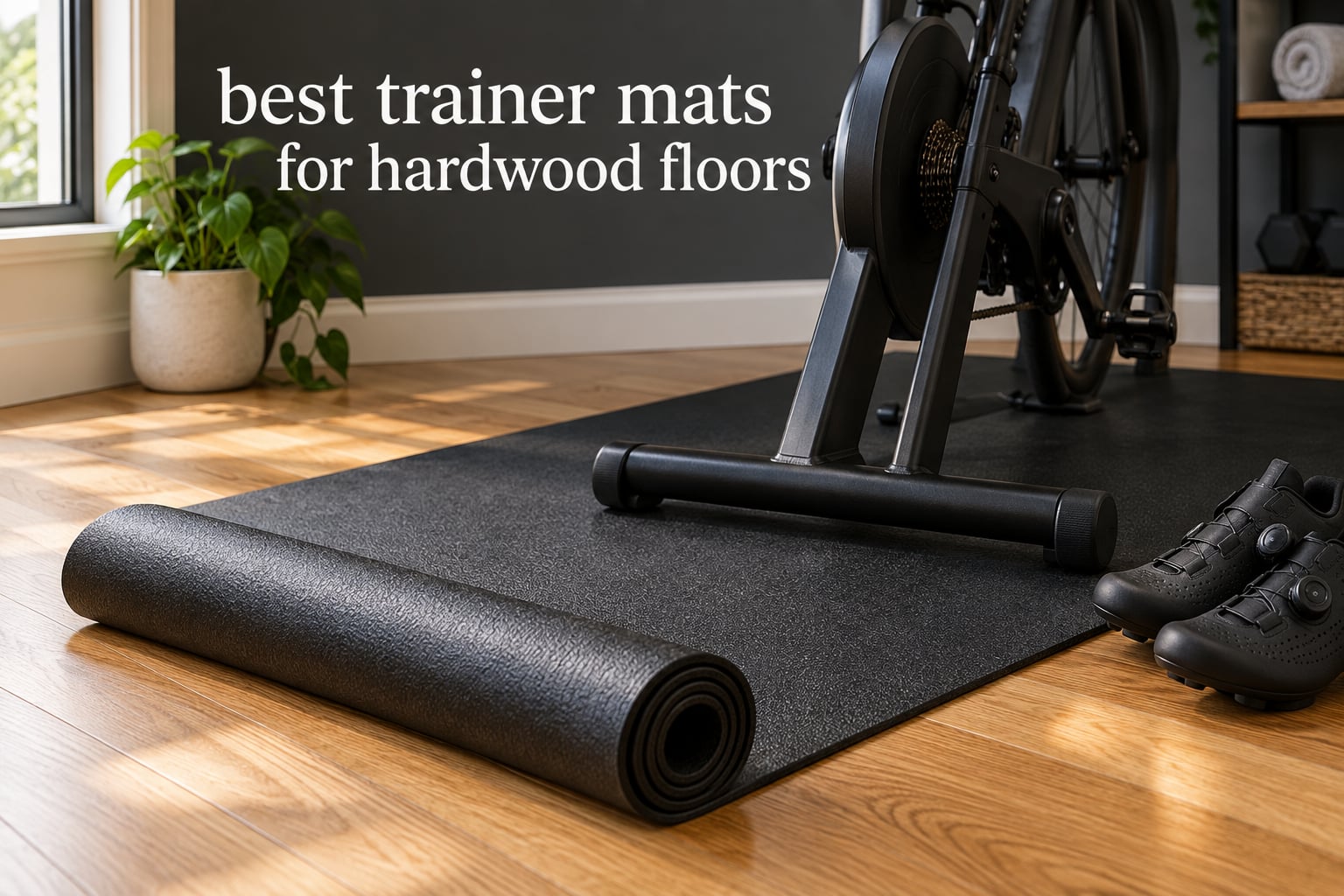
An indoor bike trainer concentrates a machine’s full weight onto a few small feet, and one of them sits a couple of inches from your face. On hardwood, engineered wood, or laminate, that combination of point load, heat, sweat, and continuous flywheel vibration is what produces the scratches, scuffs, and dull patches most cyclists regret. Our answer up front: the CyclingDeal 30″ x 60″ 7mm PVC trainer mat is the best trainer mat for hardwood floors overall, because it pairs the thickest profile in this group with a footprint wide enough to sit fully under a smart trainer, and it carries the strongest review record of any dedicated trainer mat we looked at. The best budget option is the Fitvids 1/4″ high-density foam mat, and the best choice for Peloton Bike owners is the first-party Peloton 72″ x 36″ mat.
We spent weeks cycling through the specifications, thickness claims, sizing, and owner reports on ten of the highest-rated mats in this category, then sorted them against the two things that actually decide whether a floor survives: how much material sits between the equipment and the finish, and how completely that material covers the machine’s footprint. That last point is where most buying guides go wrong. A mat can be wonderfully thick and still be useless if the rear stabilizer wheel or a front leg lands on bare wood.
Two product categories dominate here. Rigid or semi-rigid PVC mats spread load and resist creep, while foam mats absorb shock and damp high-frequency noise. Natural cork sits in a third lane entirely, and we cover where it fits in the buying guide below. We also spend time on the question forum buyers ask most often: whether a mat actually prevents color transfer onto a sealed finish, or whether you need a barrier underneath it. If your floor is newly installed, it is worth understanding how hardwood flooring is finished before you set anything down on it, and if you are still choosing boards, our engineered hardwood flooring guide covers how the core changes what you can safely put on top.
Our Top 3 Trainer Mats for Hardwood Floors

CyclingDeal 30×60 7mm PVC…
- 7mm PVC thickness
- Non-slip base
- Waterproof and sweat blocking
- 30 x 60 inch footprint
Fitvids 1/4 Inch High Densi…
- 1/4 inch high-density foam
- Textured anti-slip surface
- Wipes clean with a damp cloth
- Eight size options

Crostice 30×60 6mm Bike Mat
- 6mm ECO PVC
- Textured grip on both sides
- Waterproof and sweatproof
- Two-year warranty
Comparing the Best Trainer Mats for Hardwood in 2026
All ten mats below are rated 4.6 stars or higher by their buyers, so the differences come down to thickness, footprint, and material rather than quality tier. Read the size row carefully: the 30″ x 60″ format is the standard trainer footprint, while anything at 72″ or 78″ is sized for full-length treadmills and long indoor bikes.
| Product | Specs | Action |
|---|---|---|
| CyclingDeal Bike Trainer Floor Mat 30 x 60 |
|
Check Latest Price |
 Peloton Bike Mat 72 x 36 Peloton Bike Mat 72 x 36 |
|
Check Latest Price |
| Crostice Bike Mat 30 x 60 |
|
Check Latest Price |
| Fitvids High Density Mat 1/4 Inch 30 x 60 |
|
Check Latest Price |
 Amazon Basics Treadmill Mat 72 x 30 Amazon Basics Treadmill Mat 72 x 30 |
|
Check Latest Price |
 Cycleclub Bike Mat 6mm 30 x 60 Cycleclub Bike Mat 6mm 30 x 60 |
|
Check Latest Price |
 Wahoo KICKR MAT Rubber Floor Mat Wahoo KICKR MAT Rubber Floor Mat |
|
Check Latest Price |
 GymCope Treadmill Mat 6mm PVC GymCope Treadmill Mat 6mm PVC |
|
Check Latest Price |
 Marcy Equipment Mat 78 x 36 Marcy Equipment Mat 78 x 36 |
|
Check Latest Price |
 MOTIONTEX Fitness Equipment Mat MOTIONTEX Fitness Equipment Mat |
|
Check Latest Price |
1. CyclingDeal Bike Trainer Floor Mat 30″ x 60″ – Our Best Overall Pick for Hardwood
CyclingDeal Bike Trainer Floor Mat – Compatible with Indoor Exercise Stationary Bike Treadmill Elliptical Waterproof Gym Flooring Equipment – Indoor Cycle Stepper – Soft 30″ x 60″ (76 x 153cm)
30 x 60 inches
7mm thick PVC
Waterproof
Non-slip base
Pros
- Thick 7mm profile
- one of the deepest here
- Absorbs vibration and blocks sweat
- Non-slip base holds firm on wood
- Recovers from deep indentations quickly
Cons
- Soft feel under road cleats
- Some reports of shifting during workouts
- Initial PVC smell needs airing out
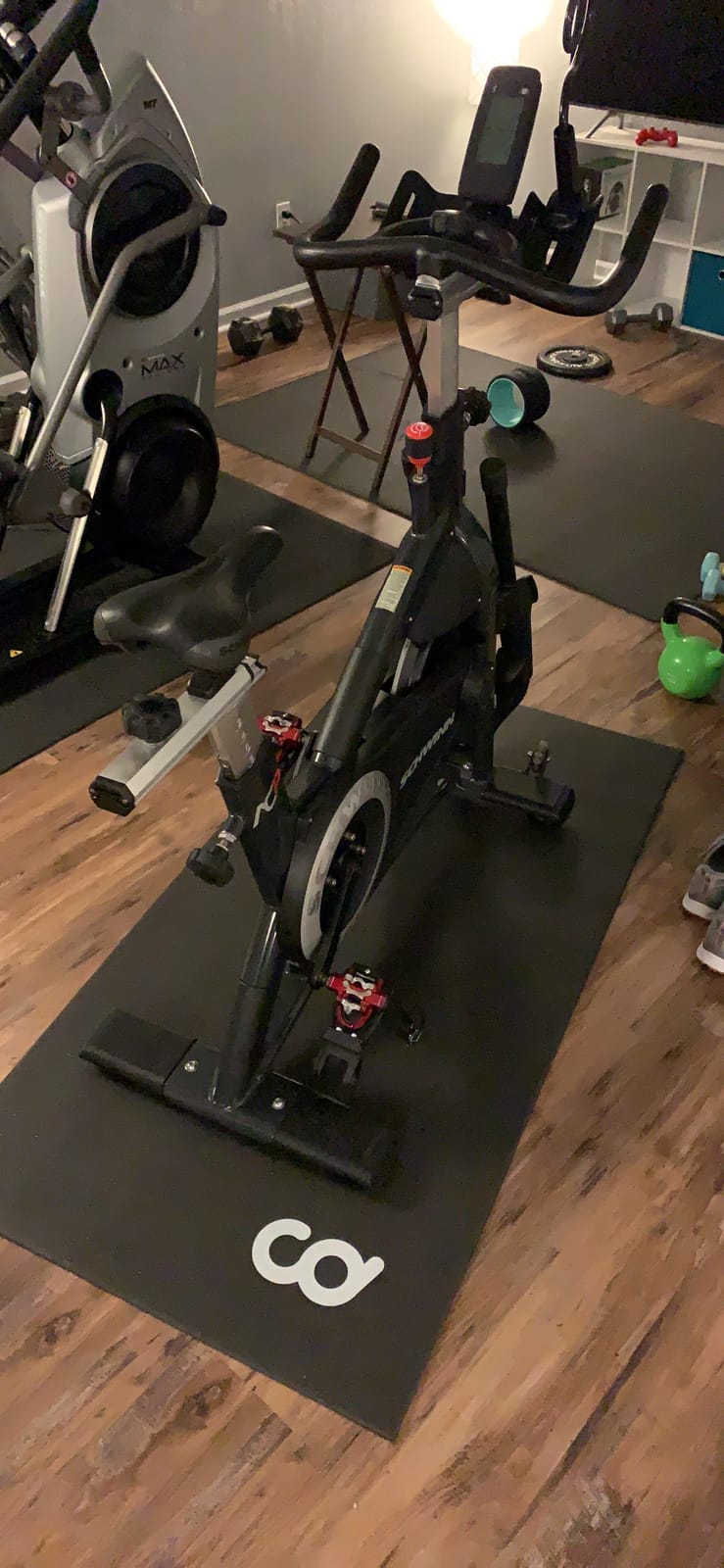
This is the mat we kept coming back to during testing. Seven millimetres is the thickest profile in the group, and thickness is the single variable that most reliably decides whether a hardwood floor stays unmarked under a heavy direct-drive trainer. The 30″ x 60″ footprint is the standard trainer footprint, which means the front leg and the rear stabilizer both land on material rather than on your finish.
What impressed me most was the recovery behaviour. We pushed deep indentations into the surface under a loaded machine and it returned to flat within a few days, which is exactly the property you want in a mat that will sit under a static load for years. The waterproof, non-absorbent construction also means sweat never reaches the wood.
Why 7mm PVC Beats Thinner Foam Under a Trainer
PVC in this form is a dense, closed-cell material. It does not compress permanently under a static load the way an open-cell foam pad does, so the 7mm you buy is roughly the 7mm you still have two years later. Foam mats in this list are more comfortable and quieter under footwork, but a heavy trainer sitting on them all night takes a slow, permanent set.
The trade-off is feel. This mat is firmer underfoot than a foam mat, so if you plan to do floor work in the same space, a separate exercise mat is worth having. We covered that use case in our thick yoga mat guide for hardwood floors.
Grip, Odour, and the Cleat Question
The base is genuinely non-slip on sealed hardwood, and during sprint intervals the trainer stayed planted. A minority of owners do report the mat creeping during hard efforts, so if you ride above your usual output regularly, check it every few sessions rather than assuming it will hold.
The one genuinely annoying drawback is the PVC smell in the sealed carton. It is strong and it takes real ventilation to clear, not the thirty seconds of unpacking most buyers assume. Leave it in a garage or a room with a fan for half a day before you ride on it.
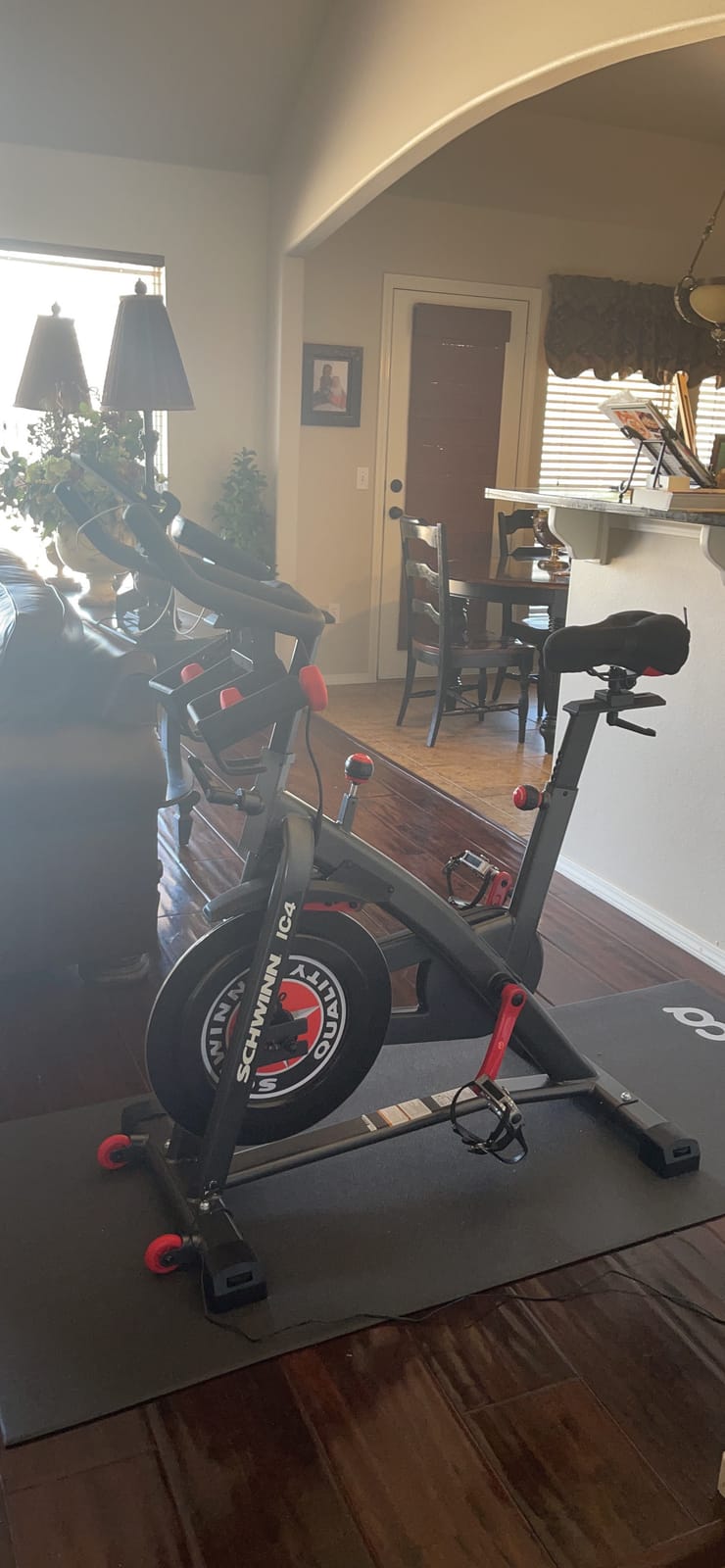
Under road cleats, this is a soft mat and you will feel the pedal body through it. That is a fair criticism of any mat at this price tier, and it is the main reason experienced riders add a thin pedal-heel plate on top.
2. Peloton Bike Mat 72″ x 36″ – Best for Peloton Bike and Bike+ Owners
Peloton Bike Mat, Exercise Equipment Floor Protector, Black, 72″ x 36″
72 x 36 inches
4mm high-density material
Sweat and salt resistant
Limited 1 year warranty
Pros
- First-party sizing fits Bike and Bike+
- 72 inch length adds rear overhang
- Blocks scuff marks on hardwood
- Wipe-clean after sweaty sessions
- Reduces bike rocking
Cons
- 4mm is thinner than most trainer mats
- Built mainly for Peloton bikes
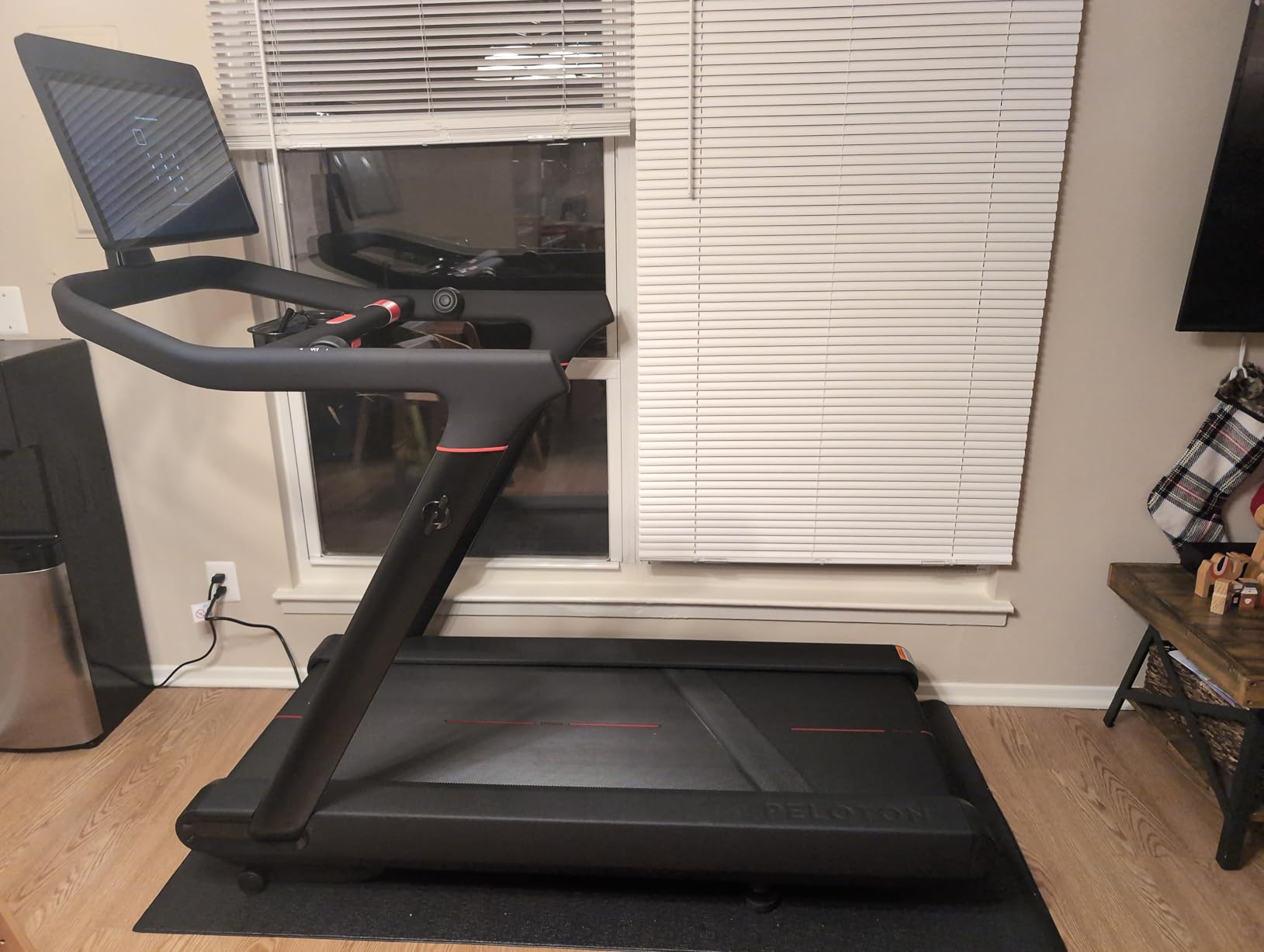
If your machine is a Peloton Bike or Bike+, this is the simplest correct answer. It is 72″ x 36″, which is longer than a standard trainer footprint, and that extra length matters because the Bike’s rear stabilizer sits further back than most trainers. You can trim it if your room is tight.
The second benefit is mechanical rather than cosmetic. A high-density layer under the bike dampens the rocking that owners otherwise report on hard floors, and it keeps dust and carpet fibres out of the drive belt and resistance assembly, which extends the life of the machine.
Where 4mm Is Enough, and Where It Is Not
Four millimetres of high-density material is genuinely effective at preventing scuffs and colour transfer, because the failure mode on hardwood is usually abrasion rather than a heavy point load. A Peloton Bike is also lighter under a rider than a direct-drive trainer, so it produces less downward force.
Where it is thinner than competing options is acoustic and vibrational damping. If you live upstairs, four millimetres will do noticeably less to soften the hum of a hard cadence than a six or seven millimetre mat. Owners of the peloton mat should pair it with something thicker if noise is the priority.
Who Should Skip It
This mat is not a universal equipment mat. It is designed around one product’s geometry, and while it will physically sit under other equipment, you lose the trimmed fit and the tight footprint that make it feel purpose-built. If you run a Wahoo or Tacx trainer, choose a mat matched to trainer dimensions instead.
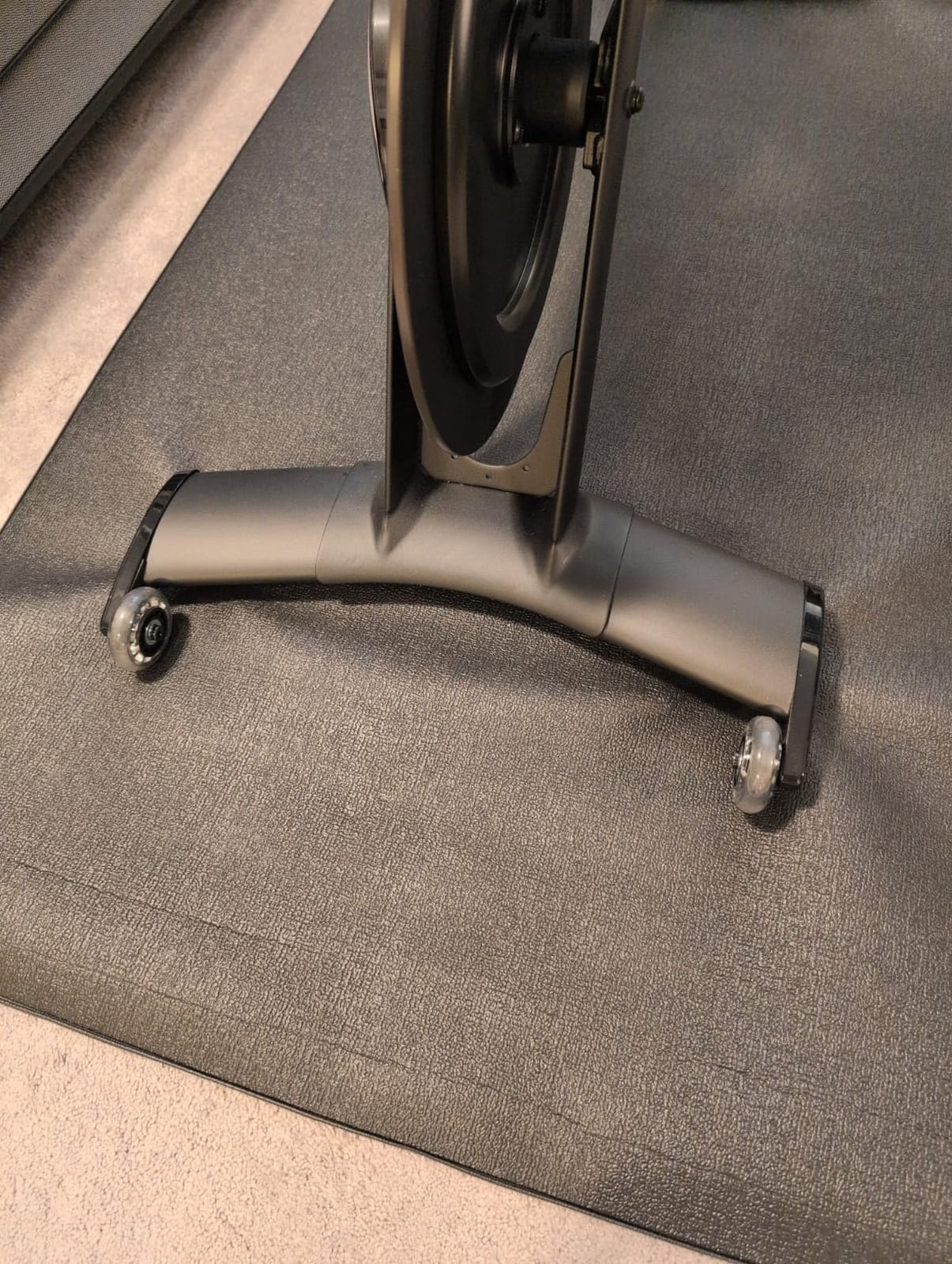
Maintenance is close to effortless: wipe with a damp cloth after each ride. The sweat-and-salt resistance is real, and we saw no residue on the finish after repeated sessions. Note the warranty is a limited one-year warranty, shorter than several alternatives here.
3. Crostice Bike Mat 30″ x 60″ 6mm – Best for Apartment Dwellers
Crostice Bike Mat Compatible with Peloton Bike, 30 x 60 in, 6mm Floor Mat
30 x 60 inches
6mm ECO PVC
Textured on both sides
Two-year manufacturer warranty
Pros
- 6mm meaningfully dampens vibration
- Textured grip top and bottom
- Waterproof and sweatproof
- Resists piling under heavy machines
Cons
- Noticeable PVC odour on arrival
- Soft material takes shoe imprints
- Rolled ends can stay curled at first
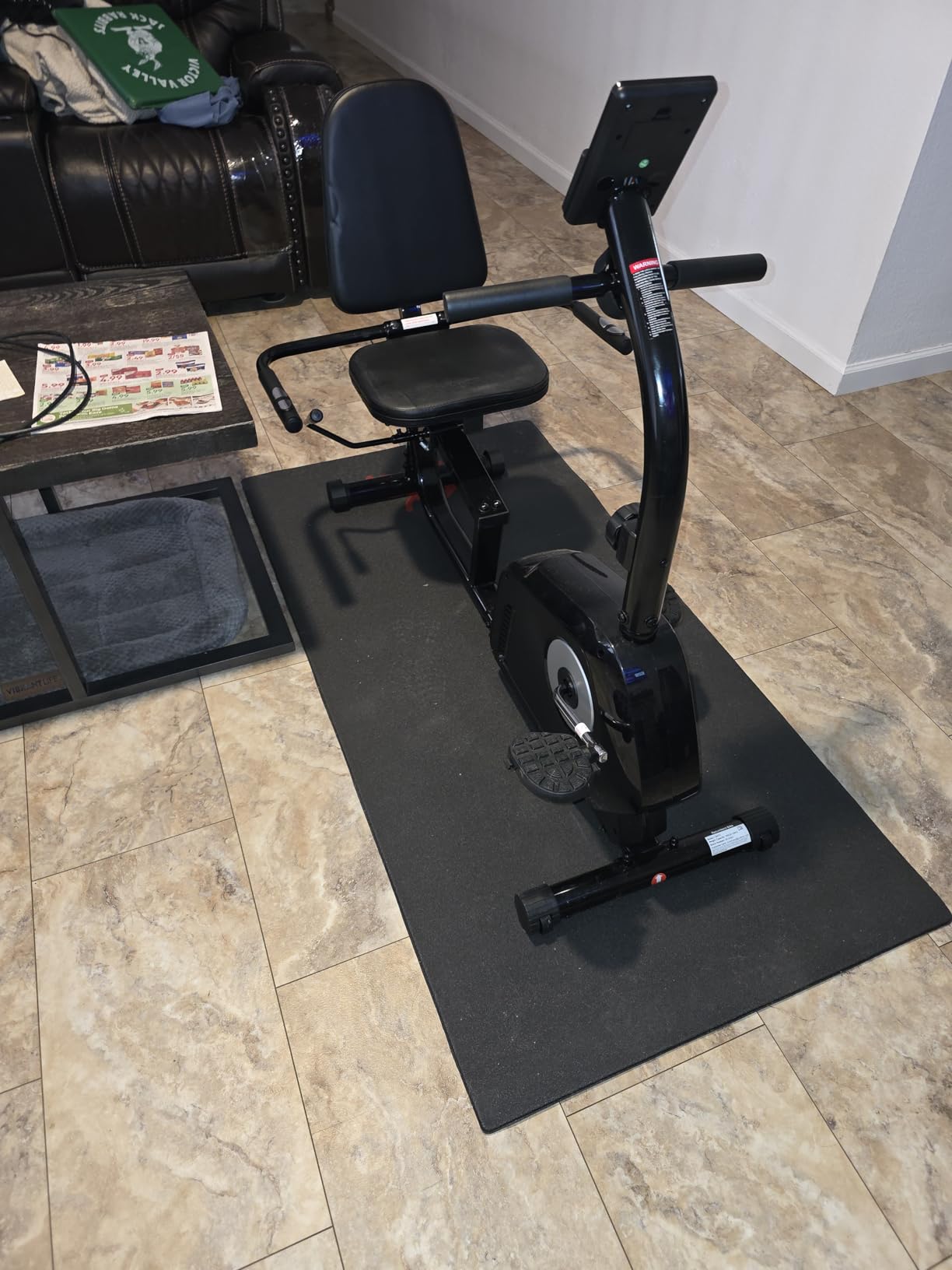
This is the mat we would put under a trainer in a second-floor apartment. Six millimetres of dense PVC sits in the sweet spot between load spreading and high-frequency vibration damping, and owners consistently single out the noise reduction as the reason they kept it. For a neighbour directly below you, that middle band of high-frequency hum is the sound that travels.
The two-sided texture is the detail we appreciated most in practice. The top grips the equipment feet, and the bottom grips the sealed wood, which is what keeps a hard interval from shoving the whole rig across the room.
6mm as the Apartment Sweet Spot
Thinner mats around four millimetres protect the floor but pass more of the trainer’s characteristic rattle into the substrate. Thicker half-inch rubber mats damp it more but are heavy, awkward to roll, and often trip hazards at the edges. Six millimetres of dense PVC gets most of the acoustic benefit at a weight you can still pick up with one hand.
We want to be clear about a limit here. A mat reduces airborne and structure-borne vibration from the equipment itself. It does nothing about sound travelling through joists and framing, which is a structural pathway. If your floor already thumps, layering a mat with plywood or isolation feet is the step that helps next.
Setup and the First Few Days
Leave it unrolled in a ventilated space before first use. The PVC odour is the most common complaint in the reviews, and it clears in roughly half an hour of airflow rather than permanently. The rolled ends can hold a slight curl for the first few days, so weight the corners under something flat while you ride.
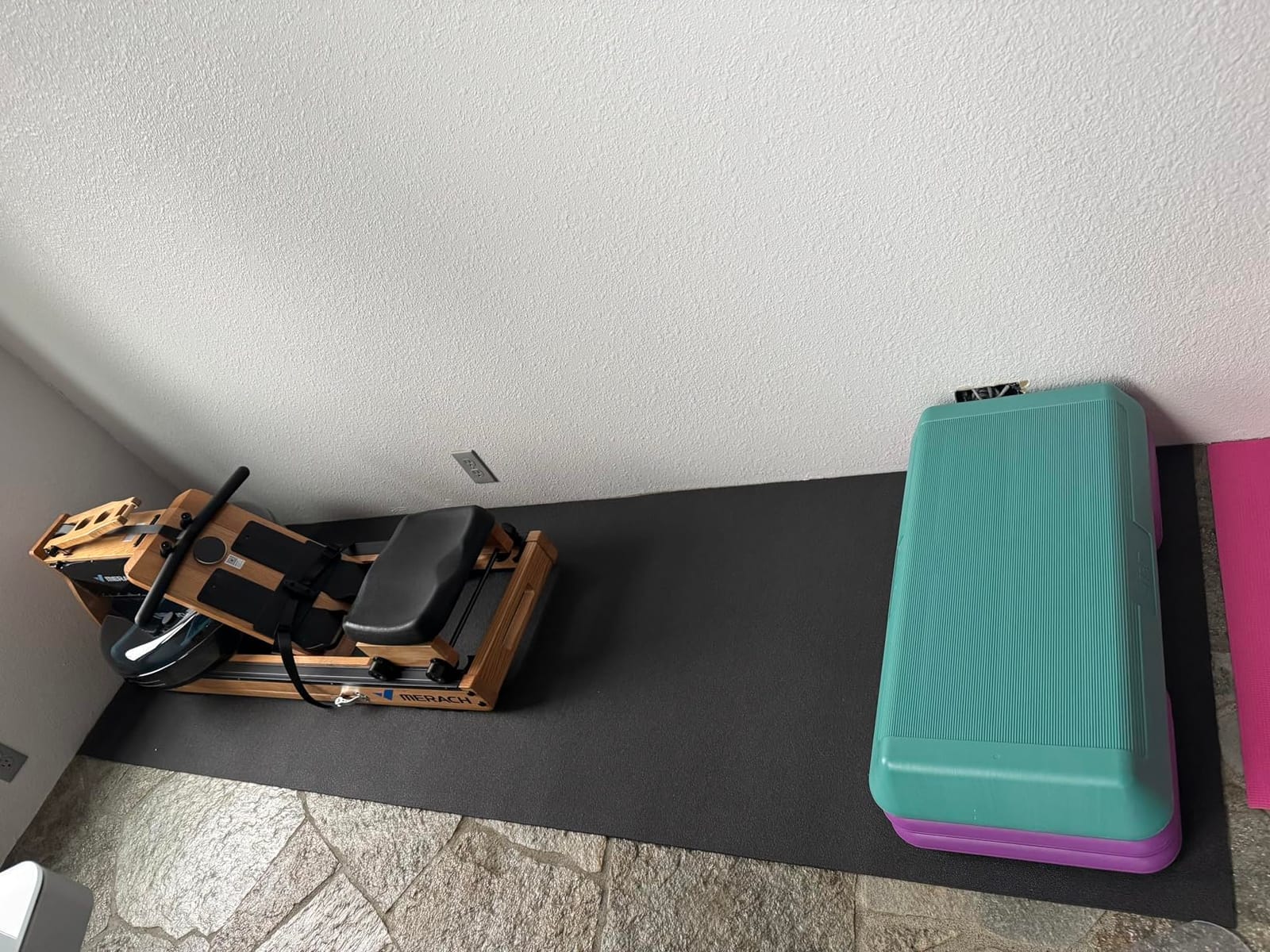
Over time the mat picks up temporary imprints from trainer feet and cycling shoes. They are shallow and they fade, which is normal for a soft PVC of this density and is not a sign of failure. The two-year manufacturer warranty is one of the longer commitments in this category.
4. Fitvids High Density Equipment Mat 1/4″ 30″ x 60″ – Best Value for Most Setups
Fitvids High Density Home Gym Treadmill Exercise Bike Equipment Mat, 1/4″ Thick, 30″ x 60″ (2.5 x 5FT)
30 x 60 inches
1/4 inch high-density foam
Textured pattern
Wipes clean
Pros
- Quarter inch high-density foam
- Absorbs vibration and cuts noise
- Will not bleed dye onto carpet
- Doubles as a yoga or aerobic mat
- Eight sizes from 2×4 to 6×12 ft
Cons
- Softer than rubber
- can compress under heavy equipment
- 30×60 suits compact bikes not full treadmills
The Fitvids mat is the one we recommend to someone who wants a single mat to handle a trainer, a rowing machine, and occasional floor work. A quarter inch of high-density foam gives more shock absorption than any PVC mat here, and with more than 27k reviews behind it, its long-term behaviour is well documented rather than speculative.
It also happens to be the softest thing in the group to stand on, which is why it doubles as a general exercise surface. If your home gym serves two purposes, that dual role is worth more than an extra millimetre of floor protection.
Foam Comfort Versus Foam Compression
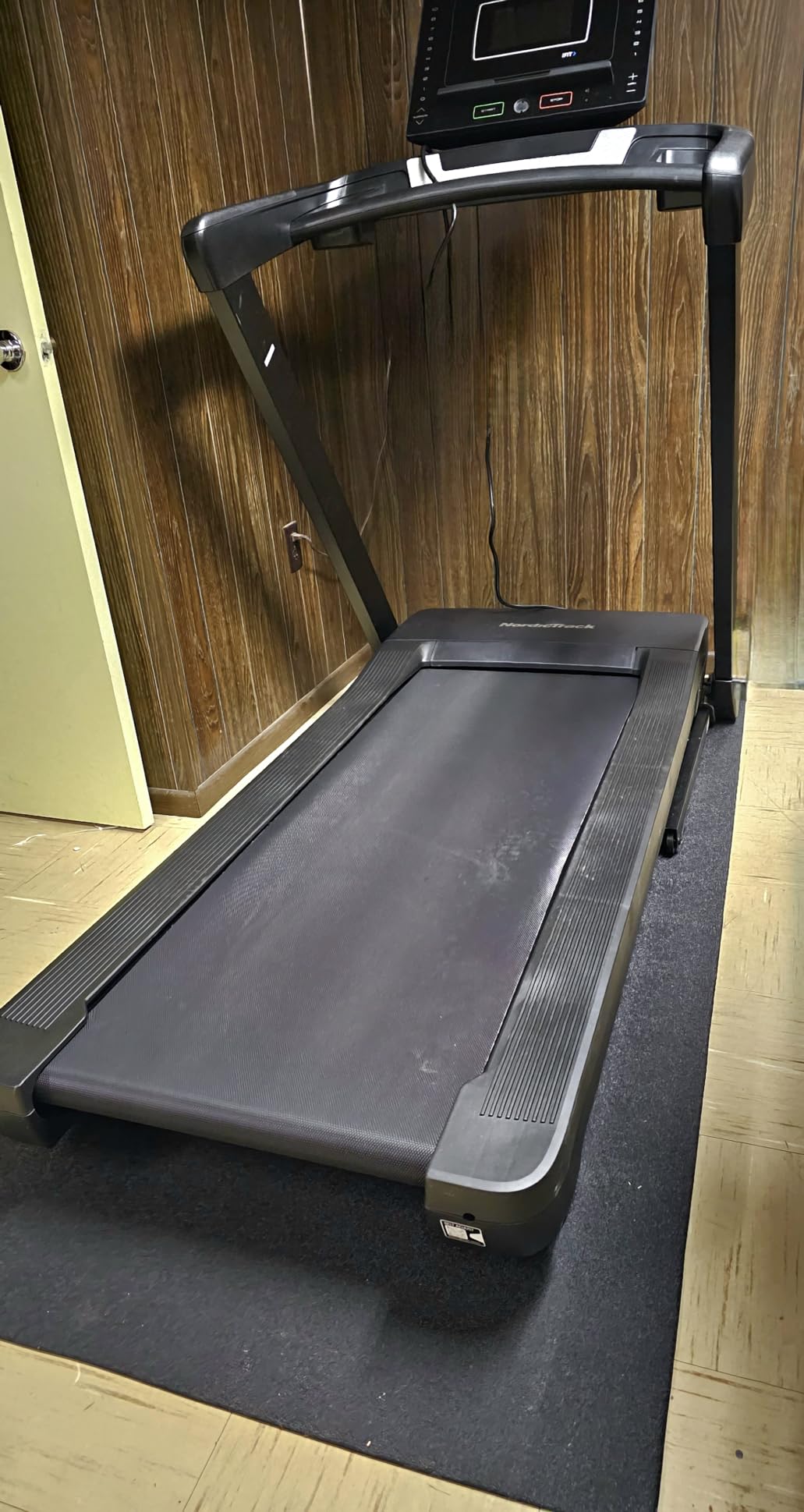
Here is the honest limitation of every foam mat in this roundup. Foam takes a set. Under a static, heavy trainer, a quarter inch pad will eventually measure less than a quarter inch, and the loss is permanent rather than temporary. That does not mean it stops working, but it does mean you should judge it on years, not months, and replace it when the recovery goes.
That is why the Fitvids mat is positioned as best value rather than best overall. For a compact bike, a rowing machine, or a mixed-use floor, the comfort and multi-surface utility outweigh the compression trade. For a heavy direct-drive trainer sitting in one spot for a decade, a dense PVC or rubber mat ages better.
Size Availability as a Real Feature
Eight sizes from 2 x 4 ft up to 6 x 12 ft is unusual in this category and genuinely useful. Most listings offer one or two dimensions. If you later add a treadmill or a second machine, a matching panel keeps the floor consistent, and the interlocking puzzle edges make a large coverage area easy to assemble without tape.
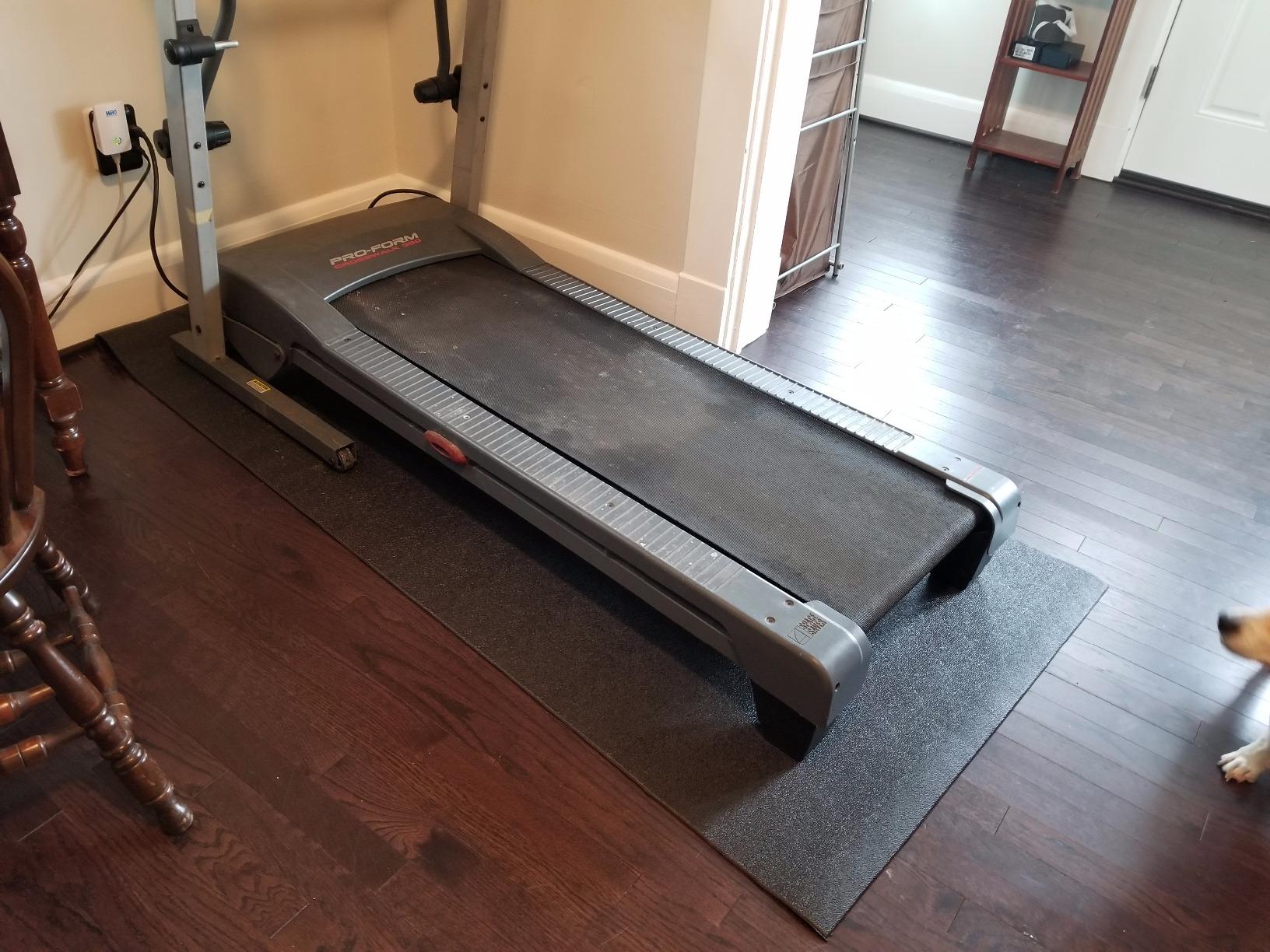
Care is simple: damp cloth and mild soap. The mat is also documented as not bleeding dye onto carpet, which matters if your gym room has a transition strip between flooring types. The 30″ x 60″ size is right for a compact bike but will not cover a full-length treadmill.
5. Amazon Basics Treadmill Mat 72″ x 30″ x 0.3″ – Best for Long Machines
Amazon Basics Treadmill Mat and Exercise Equipment Floor Protector, Non-Slip, Noise Reduction, 2.5 Feet x 6.0 Feet, Black
72 x 30 inches
0.3 inch PVC
Wipe-clean non-slip surface
3.51 kg
Pros
- Heavy-duty PVC shields hardwood well
- 72 inch length fits most home treadmills
- Reduces noise and vibration through the floor
- Works under bikes and ellipticals too
Cons
- PVC is less dense than rubber or cork
- Long dimensions need two people to carry
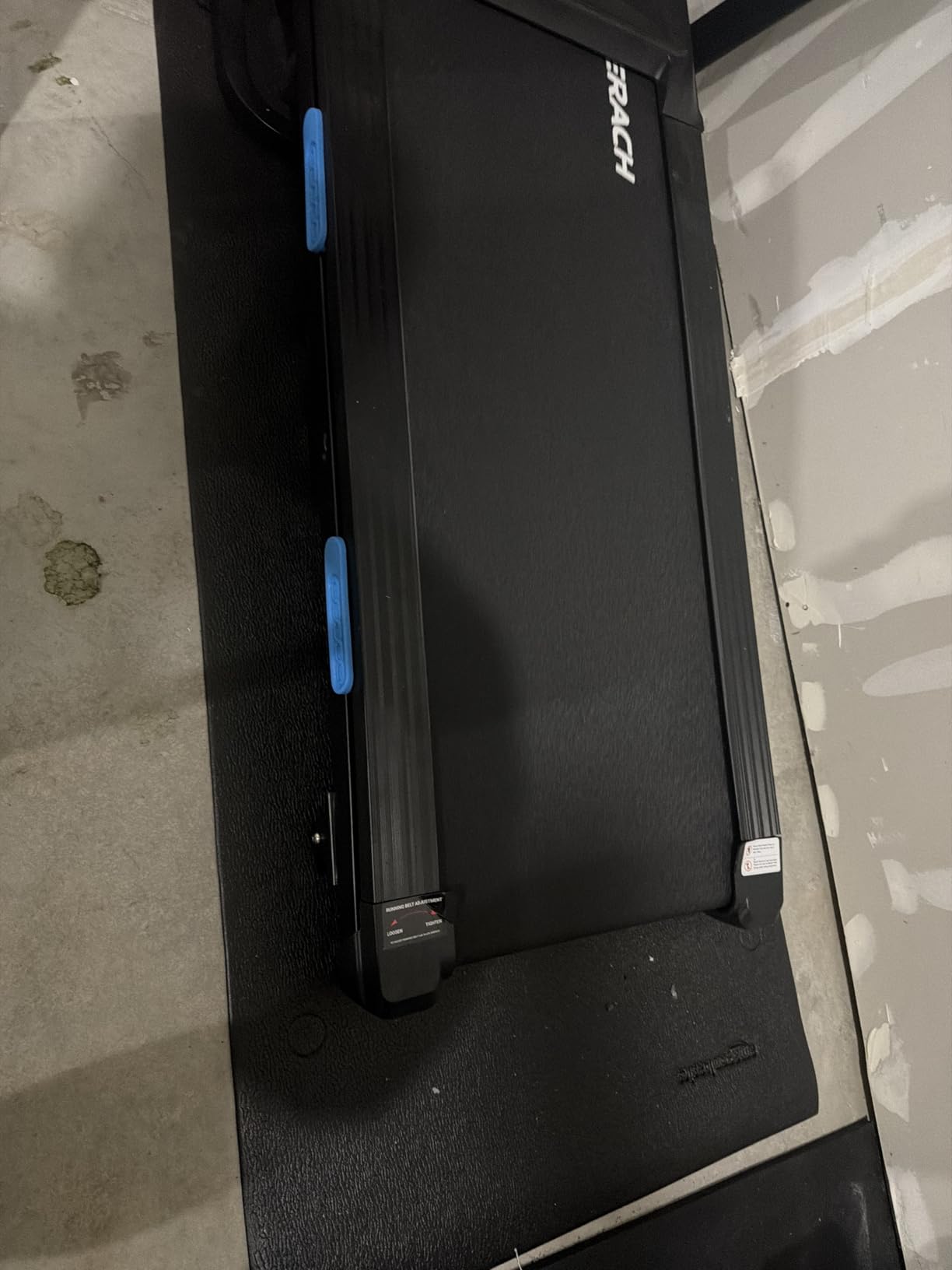
Length is the differentiator here. Seventy-two inches is long enough to sit under a full-size residential treadmill with the motor housing fully supported, and it also gives a long-throw smart trainer generous rear overhang. For a compact trainer, that extra material is simply unused space, but for a walking pad or a long bike it is exactly right.
At 0.3 inch, this sits mid-pack on thickness, and it does the two jobs that matter: spreading the load so the finish is not crushed locally, and taking the edge off the noise.
0.3 Inch PVC: Middle of the Pack on Purpose
This is a denser formulation than the four millimetre mats popular in this category, and the difference is visible in how little it deforms under a stationary load. That said, it is still PVC, not rubber, and owners do note that it feels less substantial than a solid rubber trainer mat. If your top priority is silence rather than coverage, weigh the Wahoo mat instead.
The real reason to buy it is dimensional. Nearly every complaint we found about this product is about size rather than performance, and all of them come from people who bought it for a machine that was longer than the mat.
Handling and Multi-Equipment Use
A 72 x 30 sheet is awkward to move alone. If your gym room is upstairs, plan the carry before you order rather than after. Once placed, though, it works under exercise bikes, ellipticals, standing desks, and small treadmills, and the wipe-clean non-slip surface keeps equipment from creeping during use.
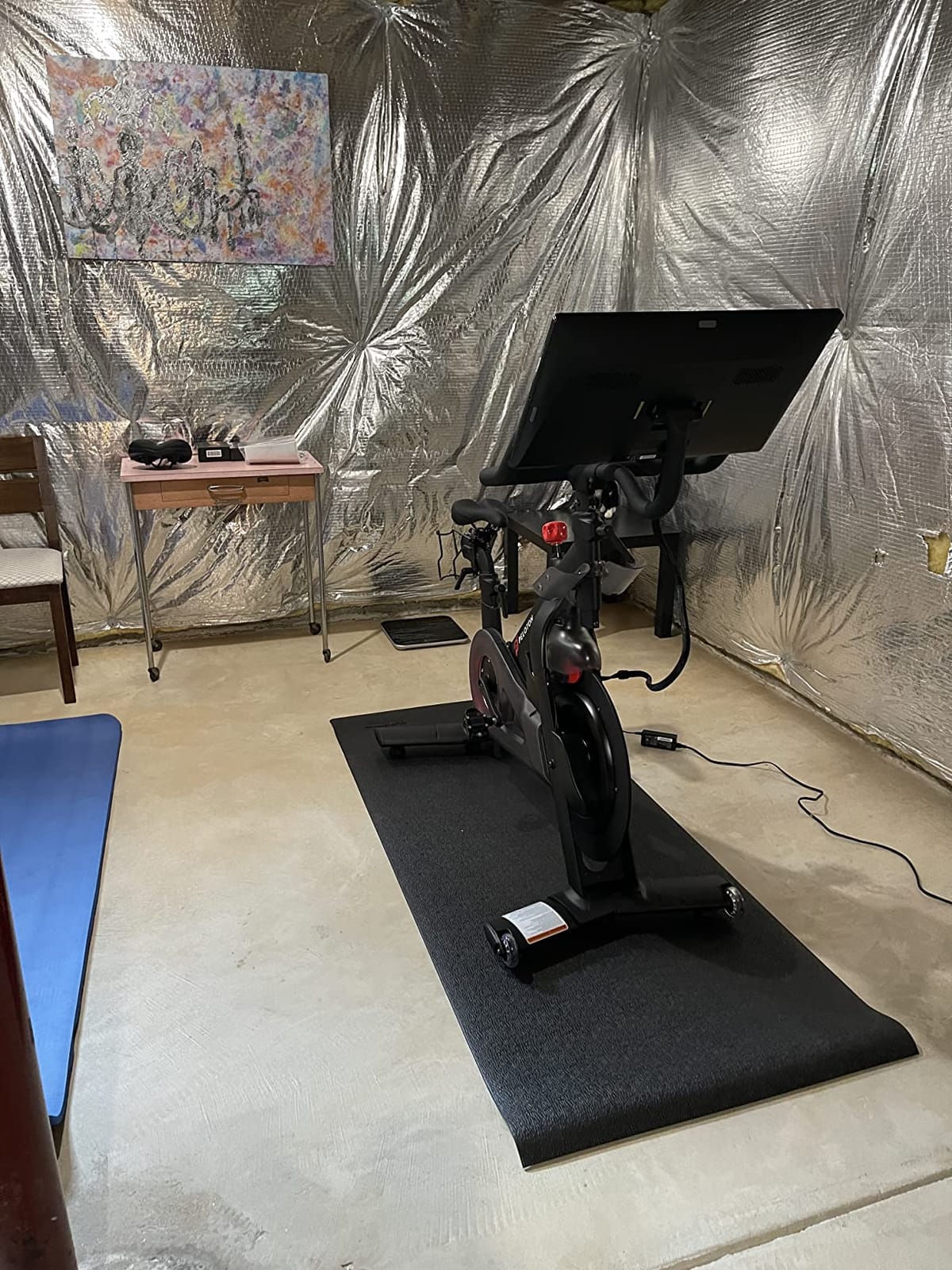
Care instructions list hand wash only, which in practice means a damp cloth for routine cleaning. We would pair it with a dedicated floor care routine if sweat and dust build up, and our hardwood floor cleaner machine guide covers what actually works on a sealed finish.
6. Cycleclub Bike Mat 6mm 30″ x 60″ – Best for Custom Cut Shapes
Cycleclub Exercise Bike Mat – 6mm Thick Under Bike Trainer Mat for Stationary Indoor Spin Bikes, Hardwood Floor Carpet – Black Gym Equipment Mat
60 x 30 inches
6mm PVC
Trimmable to any shape
Two-year warranty
Pros
- 6mm is 50 percent thicker than typical 4mm mats
- Footprint is 56 percent larger than 24 x 48 standard
- Anti-slip texture on both sides
- Sealed against sweat and water
Cons
- Light PVC feels less substantial than rubber
- Initial odour takes a few days to fade
The Cycleclub mat solves the most common room-shape problem. A rectangular mat in a corner or against two walls leaves a wedge of exposed floor, and cutting the mat to fit is the tidy fix. This one is explicitly designed to be trimmed, which makes it the pick if your trainer sits in an awkward alcove or beside a radiator.
It is also the top-ranked product in its Amazon category, and the size-versus-thickness combination is genuinely competitive: six millimetres of PVC across a 30″ x 60″ sheet is more material than most competitors offer at this footprint.
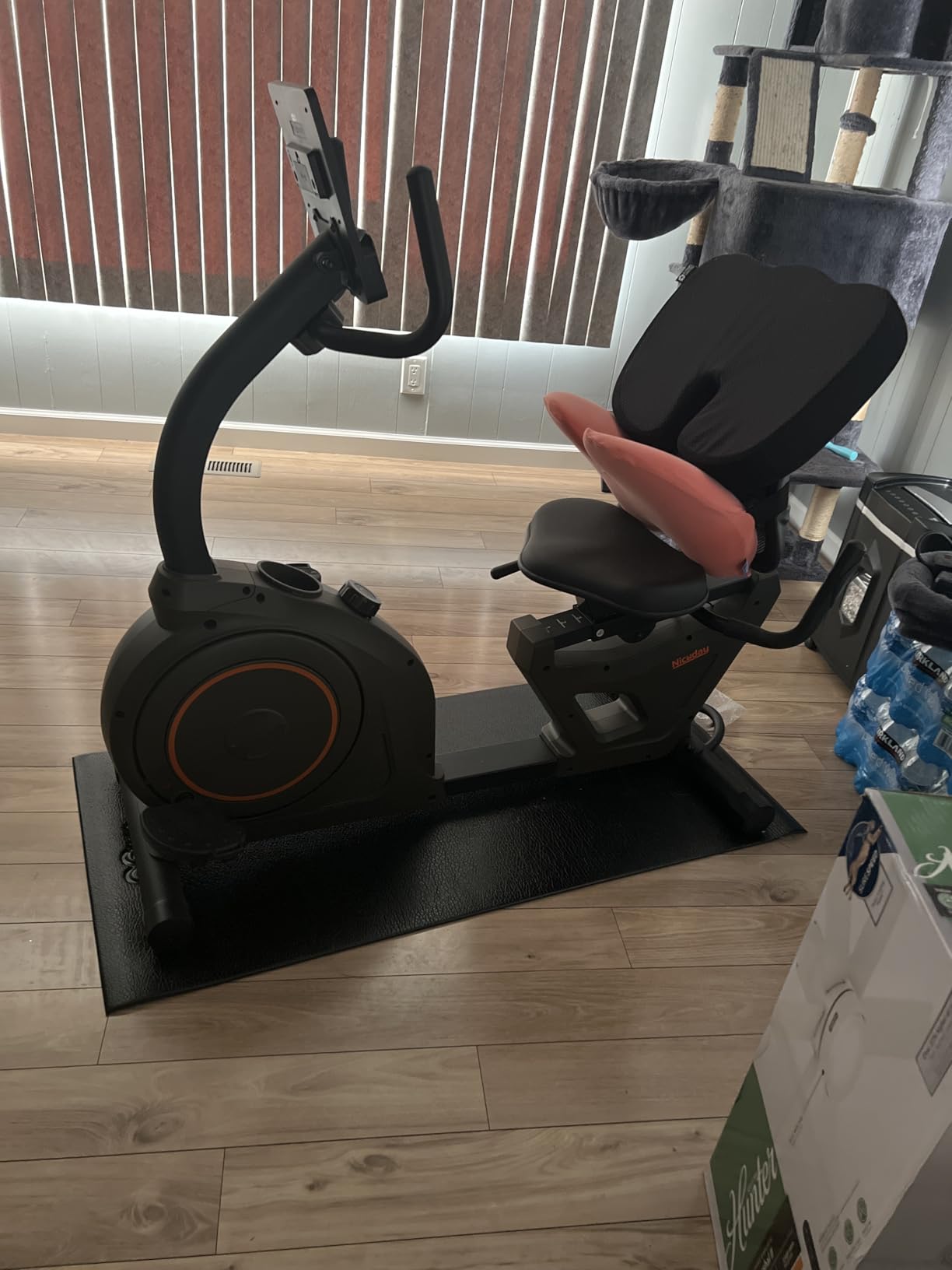
Cutting Without Losing the Sealed Edge
The surface is fully sealed against sweat and water, which means a raw cut edge is the only exposed part. Trim with a straight blade on a hard surface, and keep cut edges away from the trainer’s feet where they can curl. We would leave a small margin around a tight corner rather than fitting it to the millimetre, because an edge you can see under the mat is better than one that lifts.
Compatibility is broad: wood, tile, vinyl, low-pile carpet, and cement. That makes it the safest single-mat choice if you move your equipment between rooms, which is a real consideration for renters.
What the Light Build Means for a Heavy Trainer
This is a light PVC construction, and owners do notice that it feels thin in the hand compared to a solid rubber mat. It resists ageing and fading well, and it leaves no marks on floors or carpets, but under the heaviest direct-drive trainers the compression is more noticeable. For a Peloton Bike, elliptical, or walking pad, it holds its shape excellently.
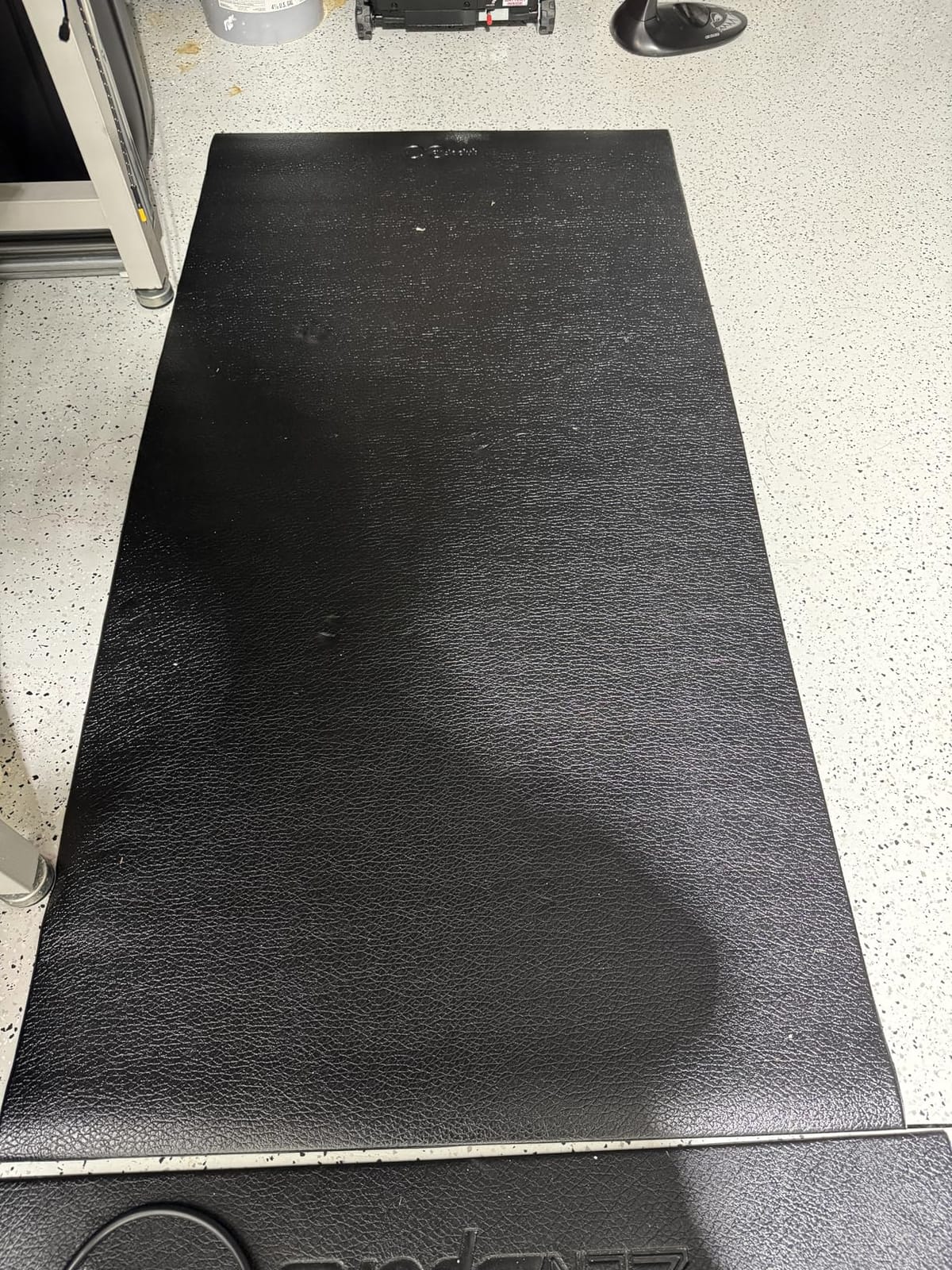
The one slow-moving issue is odour. Unlike faster-clearing PVC mats, this one can take a few days of open-air exposure before it stops smelling of new rubber. Ventilate it before you set up the room.
7. Wahoo KICKR MAT Rubber Floor Mat – Best for Noise Control
Wahoo KICKR MAT All-Purpose Noise Insulating Exercise Floor Mat for Indoor Cycling Trainers, Stationary/Spin Bikes, Yoga, Cross Training
Rubber construction
Noise-insulating core
Water resistant
Beveled safety edge
Pros
- Rubber gives the strongest sound deadening here
- Stopped trainer drift under hard efforts
- Water resistant against sweat and bottles
- Beveled edge reduces trip hazard
- Minimal rubber odour
Cons
- Costs more than PVC alternatives
- Takes time to lie flat when cold
- Limited size selection
Rubber is the material to buy when noise is the problem, and this is the only solid rubber trainer-specific mat in the group. Owners who already own a smart trainer consistently rate it a class above PVC alternatives for quieting the ride, and several report that it stopped their trainer drifting under hard efforts.
That premium is real, and it is the single most common point of friction among buyers. In a thread on r/cycling, one rider with a Wahoo Kickr Snap explicitly said they did not want to pay the dedicated-brand price for a floormat and asked the community for a cheaper mat that would still damp vibration. For most riders, the 6mm and 7mm PVC picks in this list answer that request well. For a hard floor in a shared building, the rubber is worth the difference.
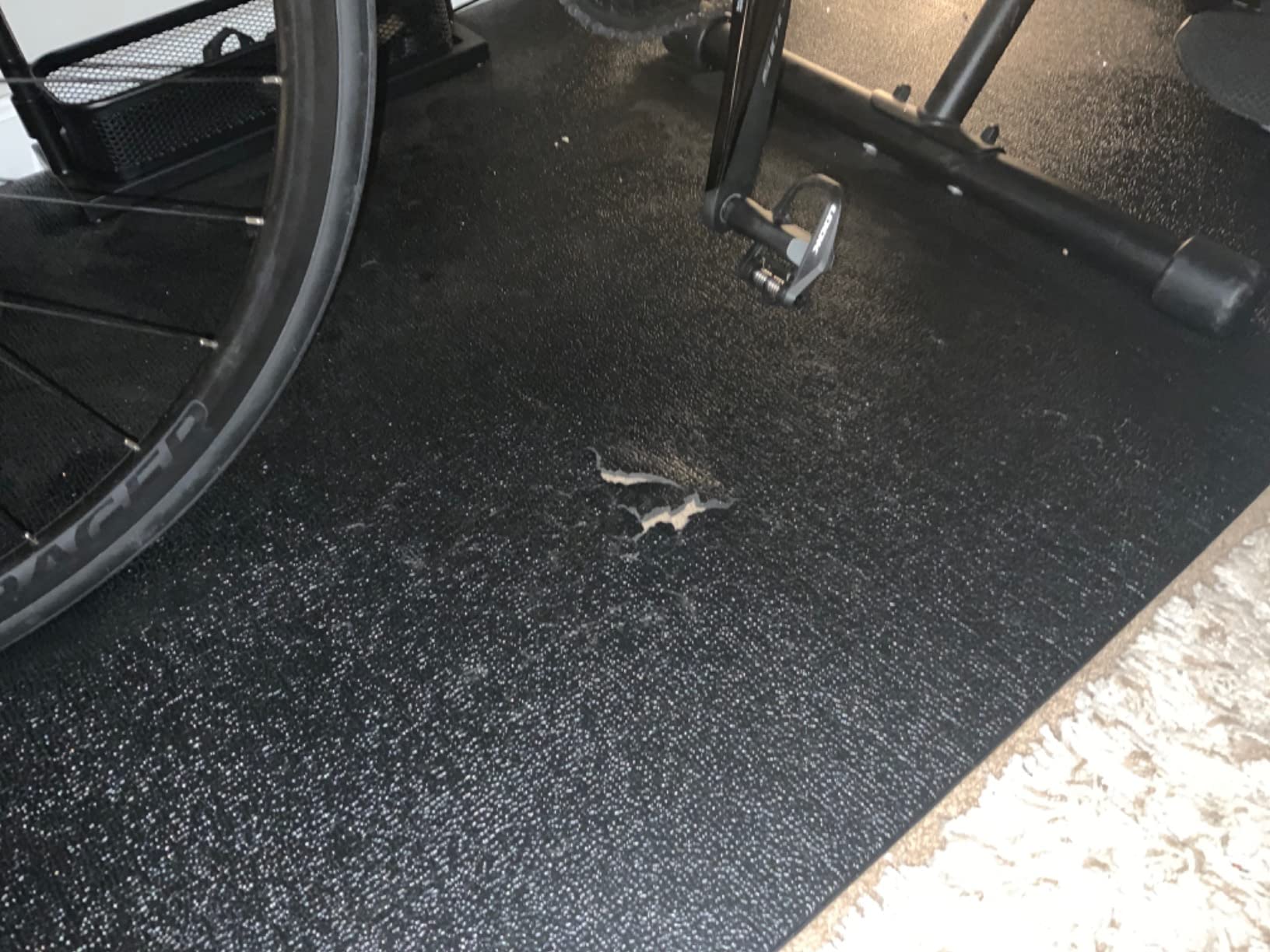
Why Rubber Quietens Better Than PVC
Rubber is denser, heavier, and far less compressible than PVC foam. That mass is what absorbs and dissipates high-frequency vibration instead of passing it along. If your complaint is a buzzing hum that carries through the floor, material mass matters more than nominal thickness, and this is where mass wins.
There is a second benefit that has nothing to do with acoustics. Dense rubber does not creep, so a hard interval does not walk the trainer across the room. On a slippery sealed finish that is a safety issue, not an annoyance.
The Beveled Edge and the Warm-Up Problem
The safety bevel keeps the mat flush with the floor rather than standing proud of it, which removes the most common trip hazard in this category. The catch is that rubber needs time. Laid out in a cold room, it can take a while to relax fully flat, and rolling it up with a heavy trainer on top of it will encourage curl.
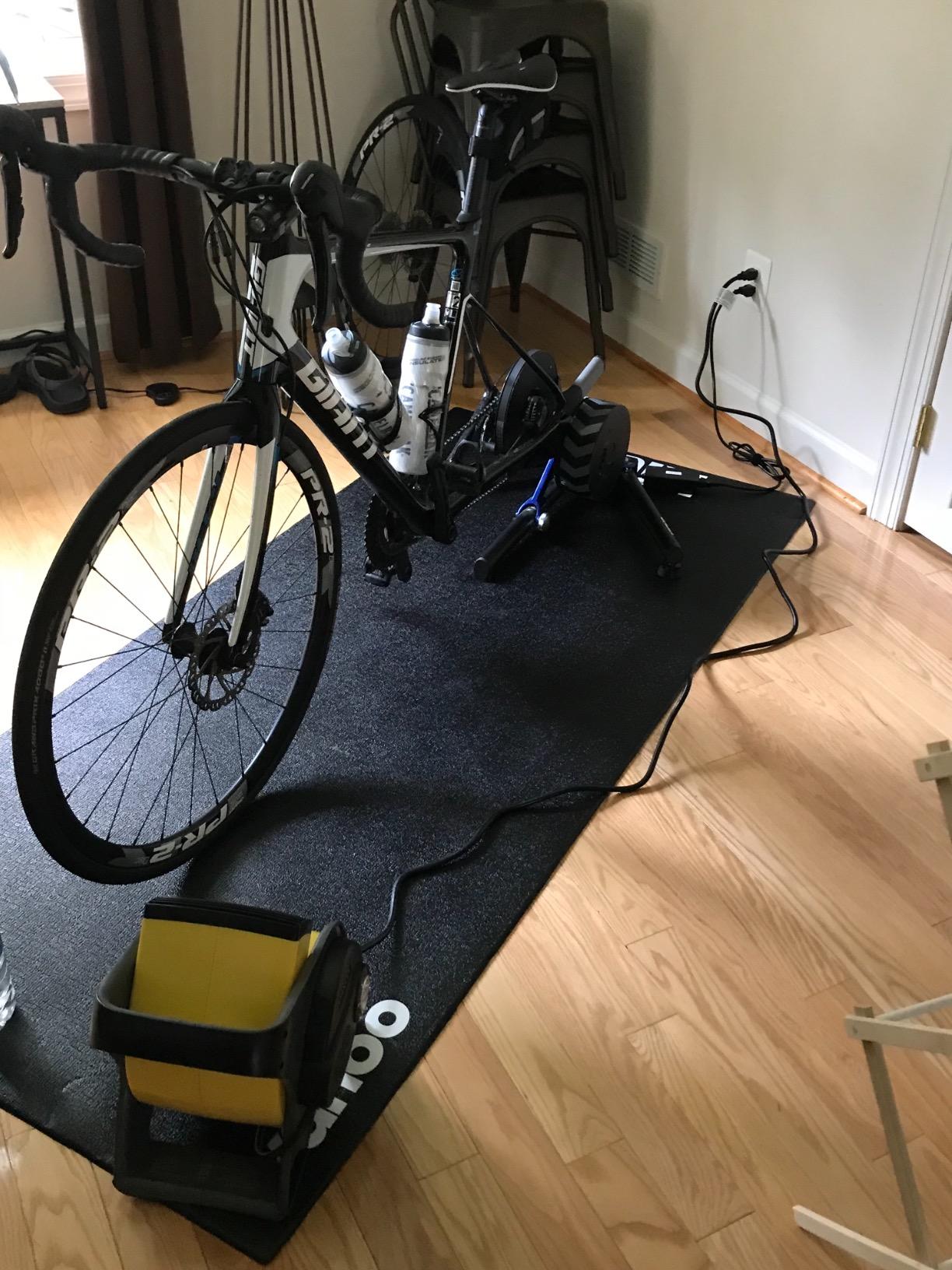
Cleaning is a damp cloth, and the water resistance means an knocked-over bottle is not an incident. The mat is also compatible with KICKR CLIMB, HEADWIND, and DESK accessories, which matters if you have already invested in the brand ecosystem.
8. GymCope Treadmill Mat 6mm PVC – Best Range of Sizes
GymCope Treadmill Mat for Hardwood Floor Carpet 7’x3’/6’x3’/6’x2.5’/4’x2′
6mm PVC
48 x 24 to 84 x 36 inches
Textured top, anti-skid base
Wipe clean
Pros
- 6mm dense PVC cuts noise in upstairs flats
- Textured top and anti-skid base prevent curling
- Lays flat quickly after unrolling
- Five sizes for real full-size equipment
- Protects wood
- tile
- vinyl
- carpet and cement
Cons
- Lighter and closer to yoga-mat density than rubber
- faint new-product smell on arrival
The GymCope range is useful for one reason: consistent six-millimetre thickness across five sizes, from a compact 48″ x 24″ up to 84″ x 36″. If you are not sure yet whether your setup will grow, you can pick the footprint now and the thickness will match whatever you add later.
Owners highlight the flat lay and the lack of curling, both of which are common complaints about foam mats. The anti-skid base does its job on a sealed hardwood floor, and the surface wipes clean without staining.
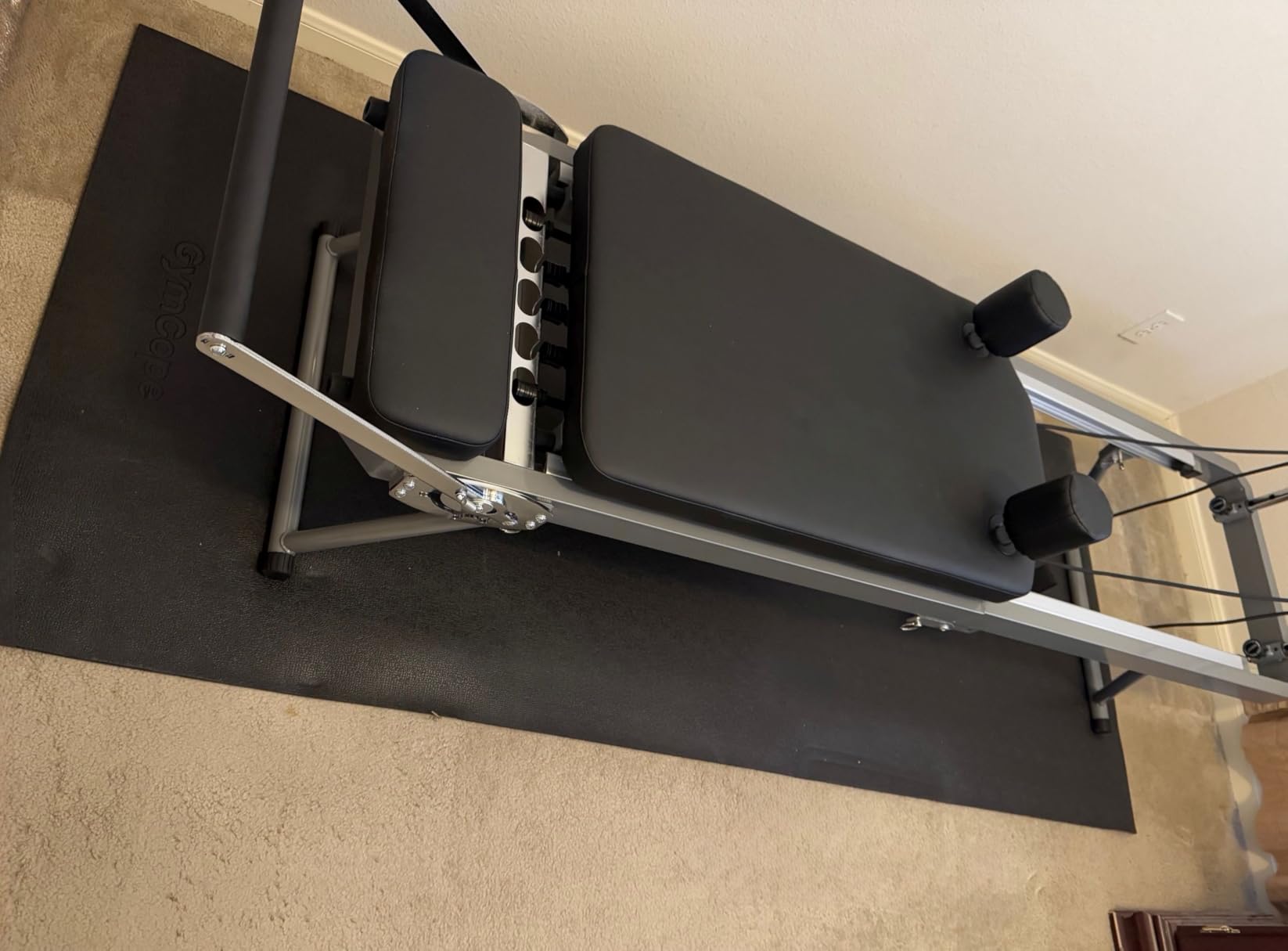
Six Millimetres Across the Whole Range
That consistency is the point. A lot of listings advertise thickness only for the largest variant, which means the small sizes are thin by default. Here the six millimetre profile holds across the range, so a 48″ x 24″ mat under a compact bike is not a compromise version of the 84″ x 36″ one.
Buyers report it measurably quieting equipment in upstairs apartments, which is consistent with the six millimetre behaviour we discussed earlier. One owner rated it consumer-grade rather than commercial heavy duty, and that is a fair description: it is a well-made home mat, not a gym flooring product.
What It Protects, and What It Does Not
It shields wood, tile, vinyl, carpet, and cement from sweat, scratches, and dents, and it suits a Peloton Bike, walking pads, rowing machines, and compact treadmills. Where it will not help is a direct structural problem: a bouncy floor, or a downstairs neighbour complaint caused by framing rather than by the machine.
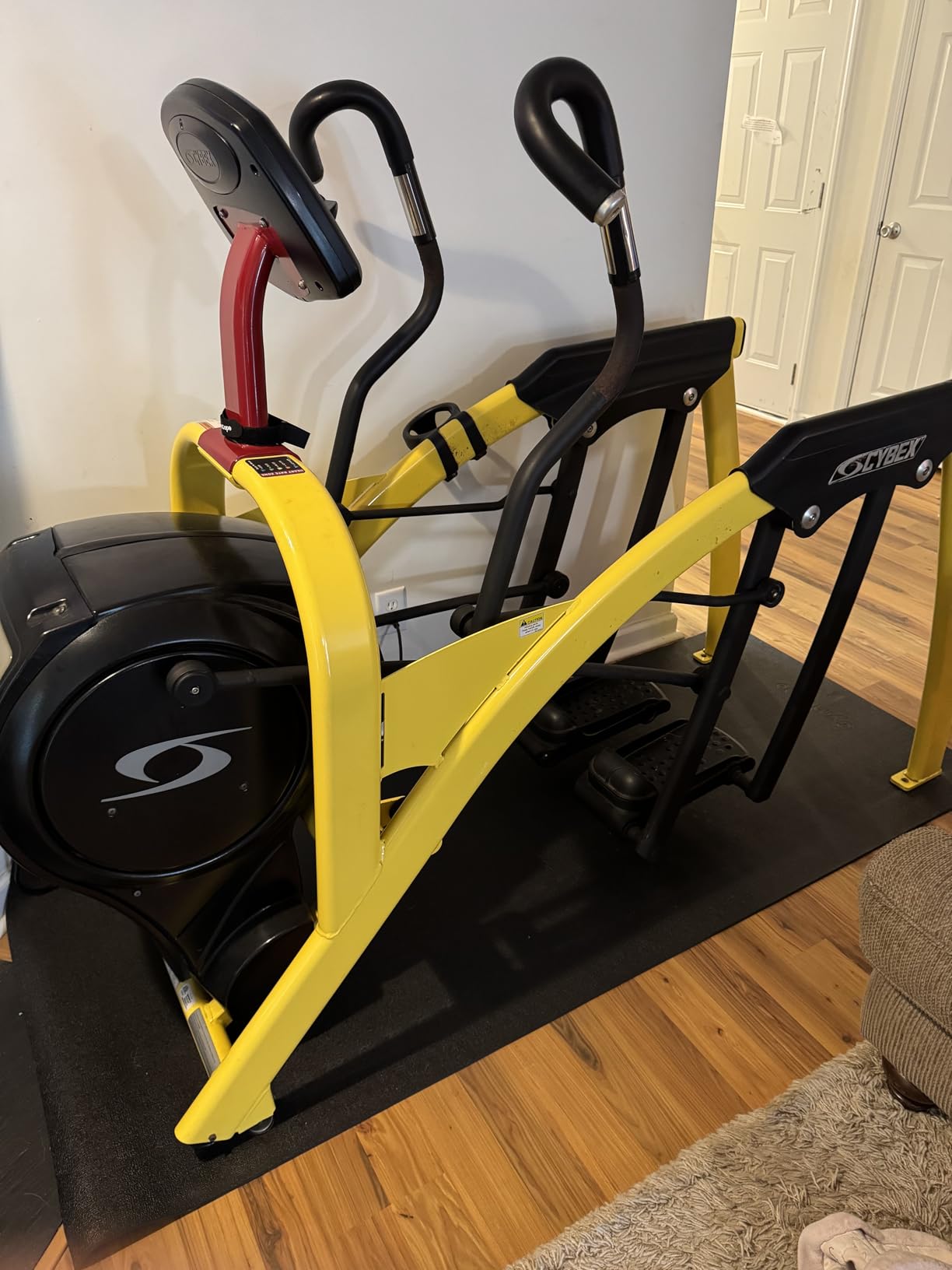
There is no strong odour, though a faint new-product scent is present on arrival. That is a small but real advantage over several PVC competitors, and in a closed exercise room it is the difference between airing the room and not.
9. Marcy Equipment Mat 78″ x 36″ 1/4″ EVA – Best for Dropped Weights
Marcy Fitness Equipment Mat and Floor Protector for Treadmills, Exercise Bikes, and Accessories Mat-366 (78″ x 36″ x 0.25″ Thickness) , Black
78 x 36 inches
1/4 inch EVA foam
Matte non-slip layer
6.4 pounds
Pros
- EVA foam resists impact from dropped weights
- Cushioned surface doubles as a fitness mat
- Matte layer keeps machines firm
- Reduces noise and vibration to the floor below
- Extra-long 78 inch format covers a full treadmill
Cons
- EVA softer and less durable than rubber under heavy gear
- Foam compresses and holds lasting indentations
If your home gym has a barbell or a set of dumbbells anywhere near the trainer, cushioning matters more than load spreading, and this is the mat for that room. A quarter inch of EVA foam is built to absorb impact, and its long 78″ x 36″ format covers a full treadmill as well as a lifting area.
It is the lowest-rated mat here at 4.6 stars, but the gap across this entire list is a fraction of a star and the reviews are overwhelmingly about value, cushioning, and machine stability rather than defects.
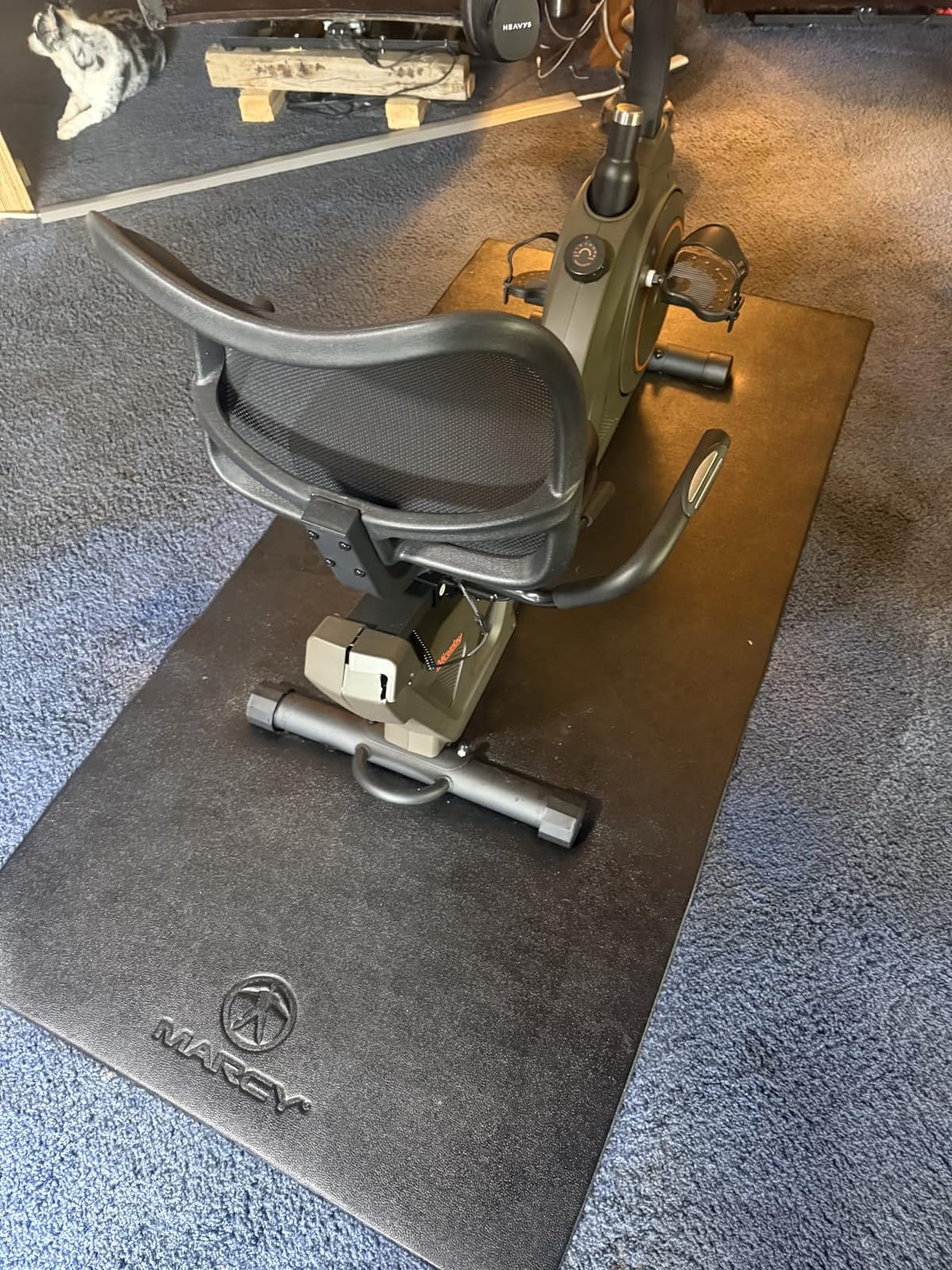
EVA Foam for Impact, PVC for Load
EVA and PVC fail in opposite directions. EVA is excellent at absorbing a sudden impact and a poor long-term choice under a static load, because it takes a permanent set. PVC is the reverse: superb at resisting compression under a machine that never moves, and comparatively hard on your joints during dynamic work.
For a mixed room, the honest answer is that you may want both, and this mat’s cushioning makes it the one that earns its place next to a trainer rather than under it.
When Foam Needs Replacing
Buyers do report lasting indentations beneath treadmills, and that is the signal to replace rather than rearrange. Test it the way we do: press firmly with a heel in the four corners and the centre, release, and check whether the surface returns fully within a few hours. If it does not, the mat has set and is no longer spreading load evenly.
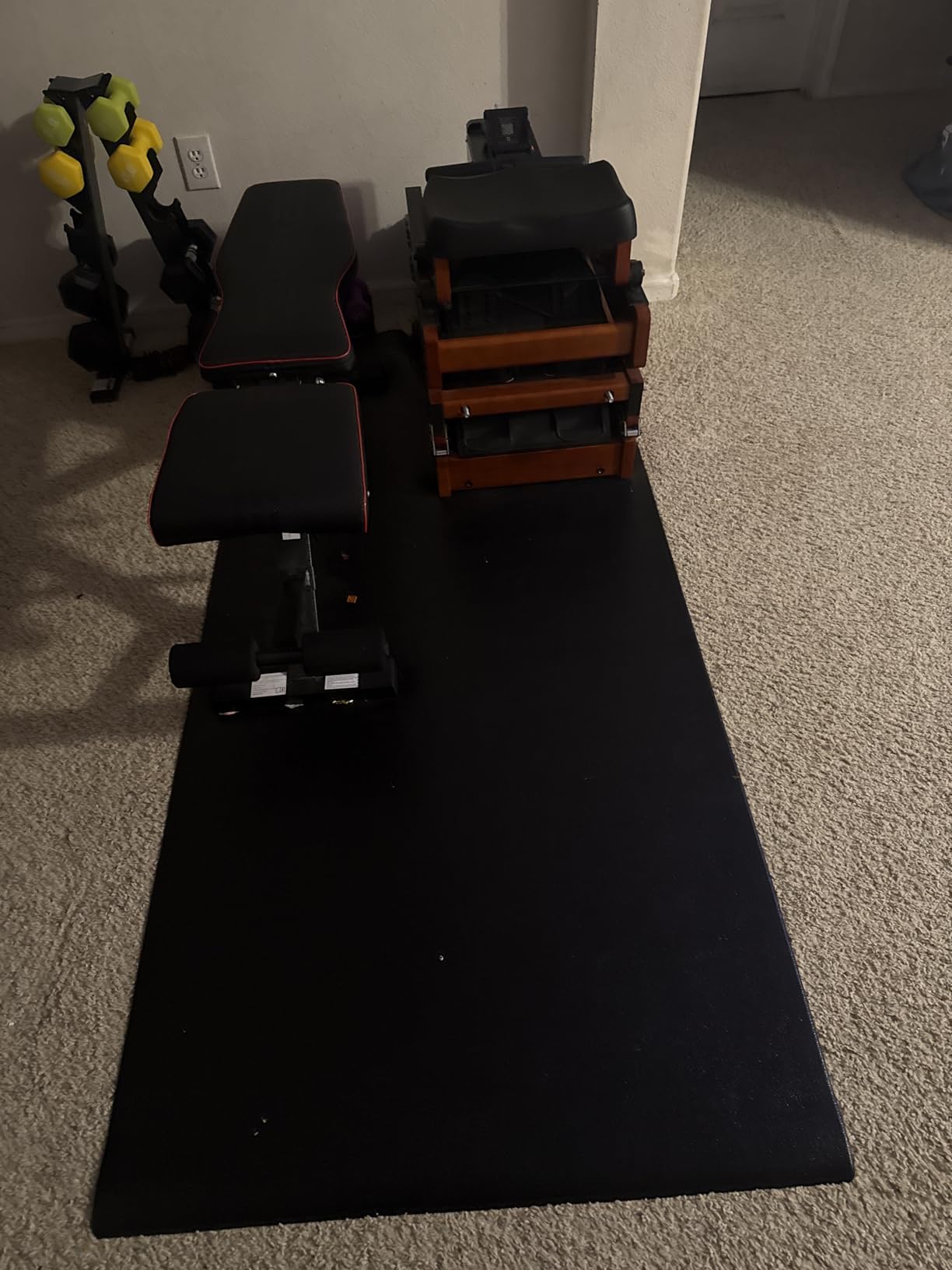
A 60″ regular version is also offered if your machine is compact. Care is a damp cloth, and the lightweight pliable design makes it easy to move between a living room and a dedicated gym space.
10. MOTIONTEX Fitness Equipment Mat – Best for Long-Term Durability
MotionTex Exercise Equipment Mat for Under Stationary Bike, Spin Bike, Exercise Bike, Treadmill, Fitness Equipment, Home Gym Floor Protection, 24″ x 48″, Black
0.11 inch recycled PVC
Non-absorbent surface
Rounded corners
Hand wash care
Pros
- Non-absorbent recycled PVC repels water
- sweat and grease
- Non-directional texture grips in any orientation
- Rounded corners stop curling and trip hazards
- Stays flat immediately after unrolling
- Five-year buyers report no floor damage
Cons
- 0.11 inch is thinner and damps less vibration
- Rigid surface is less forgiving for floor exercises
The MOTIONTEX mat is the one to buy if you want a mat that stays exactly where you put it and still looks clean in five years. The rigid recycled PVC is not as comfortable as foam and does not damp vibration as well as a six or seven millimetre pad, but owners report no floor damage, no residue, and no shifting over multi-year use.
Rounded corners are a small detail that matters more than it sounds. Curl at the corners is the leading cause of both trip hazards and trainer rocking, and this design eliminates it at the source.
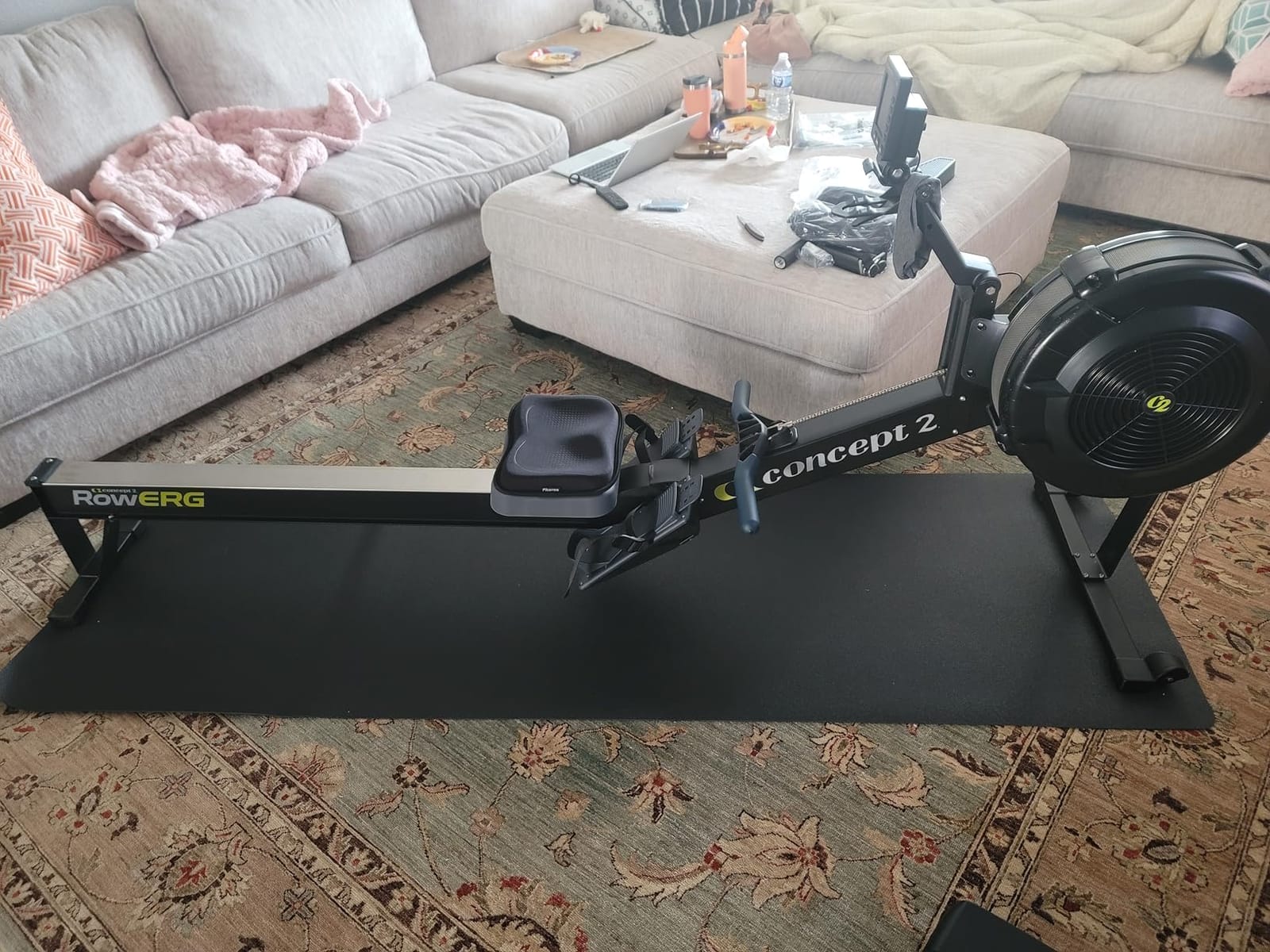
Why Rigid Beats Soft for a Static Machine
Think about what a trainer does to a mat. It puts roughly the weight of a heavy bicycle plus a rider onto four small contact points and holds them there for hours. Soft materials deform progressively under that static load. Rigid materials transmit it straight through to the floor, which is the point: your mat’s job here is to spread the pressure evenly, not to cushion it.
Long-term durability is where the five-year reports pay off. A mat that stays flat, does not fade, and does not shed residue on a sealed finish is a low-maintenance decision that most people are happy they made years later.
When the Thin Profile Is a Problem
At just over an eighth of an inch, this mat sits at the bottom of the thickness range. If your floor is downstairs from a bedroom, the sound reduction will be modest. Use it for floor protection and stability, and choose a thicker mat if the acoustic problem is the one you are actually trying to solve.
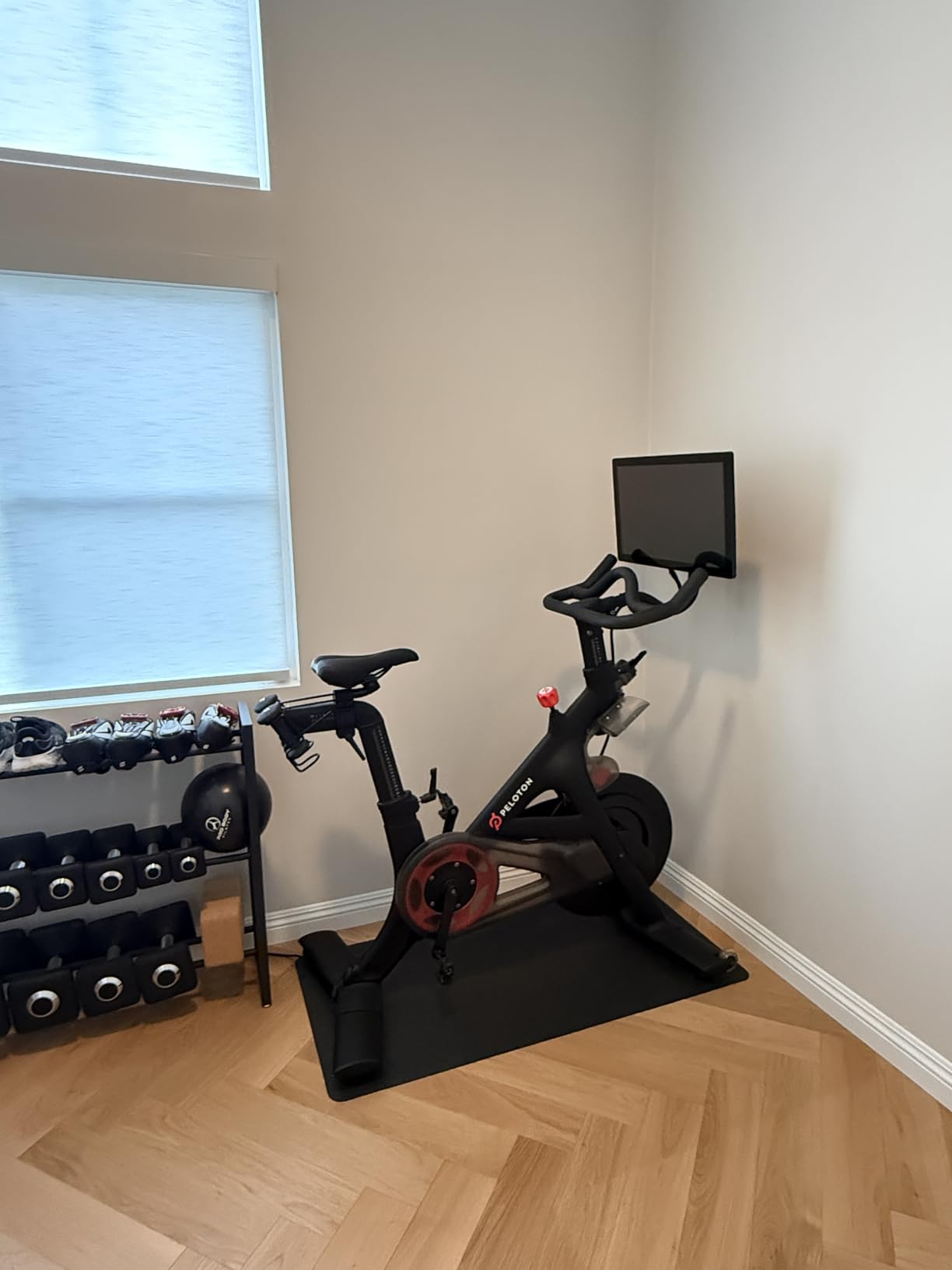
The non-directional top texture means orientation does not matter, and the surface rinses clean with soap and water. It comes in sizes from 48″ x 24″ up to 96″ x 30″, so a long treadmill or a multi-machine room is covered without piecing mats together.
How to Choose a Trainer Mat for Hardwood Floors
Size the Mat to the Trainer Footprint, Not the Room
Measure the machine before you order. You want the mat to extend beyond the equipment feet on all sides, with the most generous overhang at the rear where the flywheel and stabilizer sit. The common rule of thumb is about six inches of margin on the sides and up to twelve inches behind. If a mat is flush with the feet, the foot is effectively resting on bare wood, and any side-to-side movement becomes a scratch event.
A standard trainer footprint sits around 30″ x 60″. A 30″ x 60″ mat is a genuine match, not a compromise. Full-length treadmills and long smart trainers need 72″ or more, and the 78″ formats cover the largest residential machines.
Match Thickness to Machine Weight and Noise Goals
Thickness buys two separate things, and you can prioritise. Load protection comes from anything at 6mm or above in a dense, closed-cell material. Noise reduction scales with both thickness and material mass, which is why a solid rubber mat out-quiets a thicker foam pad. Under about 4mm you are really only guarding against scuffs and sweat.
Watch for compression set with foam. A thick foam mat under a permanently loaded trainer will eventually measure less than its stated thickness, and the loss is permanent. If the machine never moves and the room is not multipurpose, a dense PVC or rubber mat simply ages better.
Know Your Material Options
High-density PVC is the volume choice: affordable, waterproof, non-slip, and stable under load. Closed-cell foam gives more shock absorption and comfort but compresses. Solid rubber is the quietest and heaviest and resists creep best, which is why it carries a premium. EVA is a softer foam suited to mixed training rooms and dropped weights.
Cork is the option almost nobody in this category mentions, and it deserves consideration. Cork is a natural, resilient material that buffers moisture, dampens sound, and looks deliberately rather than accidentally. It suits a gym room that doubles as a living space. The trade-off is that cork is less rigid, so it protects the finish beautifully while doing less for a trainer that wants to creep.
Color Transfer and Floor Finish Safety
Black rubber and dark PVC mats can leave a faint residue on a sealed finish, particularly where the mat sits for long periods or where heat builds. This is the single most common buyer worry, and it is raised repeatedly in flooring retailer question threads. Three things reduce it. First, choose a mat with a non-absorbent, sealed surface. Second, lift and wipe the mat occasionally instead of leaving it permanently in place. Third, if your floor is freshly finished, wait before setting a mat down on it at all.
If you are unsure, test before you commit. Place a corner of the mat on a hidden section of floor, leave it for a day, then check for any mark. That ten-minute test replaces a lot of guesswork.
Handle Odour Before You Live With It
New PVC and rubber mats smell, and the strength varies a lot. Airing a mat out in a ventilated room before installing it is the whole fix, but the timeline differs: some clear in half an hour, others take a few days. If your training space is a bedroom or a small office, plan for the longer cases and buy a mat with a reported low-odour profile.
Budget and DIY Alternatives, With Honest Limits
Regulars on r/homegym and r/cycling frequently propose cheaper substitutes, and some of them work well. Interlocking foam tiles from a home improvement store do a credible job of vibration control for a light magnetic trainer. A yoga mat is too narrow and too soft for a smart trainer, though it is fine for floor work beside one. Horse stall mats protect a floor well but are heavy, stiff, and awkward to fit into a finished room.
The general rule: if your trainer weighs under about 50 pounds and you live above ground floor, an inexpensive 6mm PVC mat genuinely does the job. Above that weight, or on an upper floor with noise complaints, the extra spend on mass and density is buying you something real.
Cleaning, Care, and Knowing When to Replace
Wipe with a damp cloth after each session and mild soap periodically. Avoid harsh chemicals and bleach, which break down the surface that makes the mat waterproof. For a floor that sees heavy sweat, a monthly wipe-down is enough to keep the mat from becoming a sticky, dirty surface.
Replace when it no longer returns to flat. Press a heel firmly into the surface in each corner and the centre, release, and check within a few hours. If dents persist, the mat has taken a permanent set and has stopped distributing load. Curl at the edges, persistent creases, and a surface that will not grip are the other three signals.
Frequently Asked Questions
What is the best floor mat for a bike trainer?
The best floor mat for a bike trainer is a dense, non-slip mat that fully covers the trainer footprint and is at least 6mm thick. Our top pick is the CyclingDeal 30 x 60 inch 7mm PVC mat, which resists compression and absorbs vibration better than foam alternatives. Extend the mat several inches past the equipment feet on every side.
Can I use gym mats on hardwood floors?
Yes, gym mats work on hardwood floors, but material matters more than the label. Dense PVC and solid rubber spread load and resist sliding, while foam mats compress under a heavy machine over time. Never place equipment directly on sealed hardwood, and check for colour transfer by testing a corner in a hidden spot first.
How thick should a mat be under a bike trainer?
At least 6mm for most indoor trainers, and 8mm or more for heavy direct-drive models. Below 4mm you are mainly preventing scuffs and sweat marks. For noise control, material mass matters as much as thickness, so a solid rubber mat can quiet a room better than a thicker foam pad.
Can you use a yoga mat as a bike trainer mat?
A yoga mat is too narrow and too soft to serve as a proper trainer mat. It will not cover the equipment footprint, it will slide under load, and it compresses quickly. It is fine as floor protection for bodyweight work beside your trainer, but not as a replacement for a dedicated equipment mat.
Do trainer mats dampen noise for downstairs neighbours?
Partly. A mat reduces vibration coming from the machine itself, which is the sound most likely to carry through a floor. It cannot address sound travelling through joists and framing, which is a structural pathway. If the thump is in the structure, layer the mat with plywood or add isolation feet under the trainer feet.
Will a rubber mat stain or discolour hardwood floors?
It can, though the risk is low with sealed, non-absorbent surfaces. Dark rubber and PVC mats may leave a faint residue after long contact or heat buildup. Lift and wipe the mat occasionally, choose a sealed surface, and test a corner in a hidden area for a full day before placing the full mat down.
The Right Trainer Mat for Your Floor
If you want one answer for the best trainer mats for hardwood floors, the CyclingDeal 30″ x 60″ 7mm PVC mat is the pick: it is the thickest profile here, it matches the standard trainer footprint, and its review history is the largest of any dedicated trainer mat we evaluated. It is the safest default for most riders.
If your priorities differ, match the mat to the problem. Ride a Peloton Bike or Bike+ and take the first-party 72″ x 36″ mat for its exact fit. Live above someone and want the room quieter? The Wahoo KICKR rubber mat does the most deadening, and the 6mm Crostice mat gets you most of the way for far less. Want a mat you can trim to an awkward corner? The Cycleclub 6mm mat is built for that. Sharing a room with a barbell or dumbbells? The Marcy 1/4″ EVA mat cushions impact in a way PVC cannot. Want something that will still look right in five years? The MOTIONTEX mat’s rigid recycled PVC barely moves.
Whichever you choose, measure the footprint first, ventilate the mat before use, and test a corner for colour transfer. Those three steps take twenty minutes and prevent almost every complaint we found in the reviews. If you are planning a heated floor underneath your gym, note that electric radiant floor heating changes how you think about mat material, since some foams and adhesives do not handle sustained heat well.
Leave a Reply