
The Best Studio Subwoofers do more than make a kick drum feel bigger: they show the bottom octave that small nearfield monitors may hide. I compared the published driver, amplifier, frequency-range, connection, control, warranty, and review data for eight powered models so you can match the sub to your monitors and room rather than buy by driver diameter alone.
A studio subwoofer matters when you need to judge sub-bass, bass-guitar weight, kick-to-bass overlap, or low-frequency noise in a mix. It is not automatically necessary in every home setup, especially a very small untreated room, but a properly integrated unit can reveal problems that headphones and compact monitors miss.
My short list favors practical crossover controls and studio-ready connections, then calls out models that suit desktop rigs or higher-output work. If your monitoring routine also includes closed-back checking, see our guide to studio monitor headphones; for a more entertainment-focused desktop setup, our 5.1 PC speakers guide covers a different kind of system.
The three strongest choices cover accurate mixing, compact desks, and ADAM monitor systems
Choose the Yamaha HS8S for the deepest documented extension in this group, the compact PreSonus Eris Sub 8BT for flexible desktop connections, or the ADAM Audio T10S if you run compatible ADAM monitors and value its five-year manufacturer warranty.
The full comparison shows all eight studio-ready options at a glance
Start with extension and connections, then check the controls you need for crossover and phase alignment. A larger driver can move more air, but it is not a shortcut around room acoustics or careful calibration.
| Product | Specs | Action |
|---|---|---|
 Yamaha HS8S Yamaha HS8S |
|
View on Amazon |
 PreSonus Eris Sub 8BT PreSonus Eris Sub 8BT |
|
View on Amazon |
 KRK S10.4 KRK S10.4 |
|
View on Amazon |
 ADAM Audio T10S ADAM Audio T10S |
|
View on Amazon |
 Samson MediaOne 10S Samson MediaOne 10S |
|
View on Amazon |
 Mackie CR8SBT Mackie CR8SBT |
|
View on Amazon |
 Rockville APM10D Rockville APM10D |
|
View on Amazon |
 Mackie MRS10 Mackie MRS10 |
|
View on Amazon |
1. Yamaha HS8S is the best all-round studio subwoofer for low-end monitoring
Yamaha HS8 Studio Subwoofer,Black
8 inch bass reflex
22Hz to 150Hz
150W amplifier
Pros
- 22Hz extension
- 150W power
- XLR inputs
- adjustable cut controls
- phase switch
Cons
- Heavy 33.6 pound cabinet
- one-year warranty
The Yamaha HS8S is the clearest starting point when the goal is hearing the lowest decisions in a mix without adding a pile of extra features. Its published 22Hz to 150Hz response and 150W amplifier give it the deepest stated low-end reach among the models reviewed here, while its 4.8 rating across 365 reviews gives the recommendation meaningful customer support.
I would pair it first with a monitor setup that already has balanced XLR cabling and a real need to check sub-bass content. Community discussion repeatedly favors HS-series monitor-and-sub combinations, which makes the HS8S a sensible fit for that familiar production path rather than a random add-on.
The 22Hz extension gives bass-heavy sessions more information to judge
The HS8S is an 8-inch bass-reflex powered design rated down to 22Hz. That claimed reach matters for electronic music, hip-hop, cinematic effects, and any material where a small monitor may stop before the fundamental of the lowest part is audible.
Extension alone does not mean a mix will translate, because room modes can exaggerate or cancel bass at the listening position. Treat the 22Hz figure as additional monitoring information, then cross-check on headphones, a car system, and smaller speakers before printing a final mix.
The 80Hz to 120Hz filters make monitor handoff more controllable
The rear controls include LOW CUT and HIGH CUT settings from 80Hz to 120Hz plus a phase switch. Those are the controls I want to see on a music production subwoofer because they let the sub and main speakers share the low frequencies instead of fighting each other.
Start with the crossover near where your monitors begin to lose authority, play a bass-heavy reference track, and change only one setting at a time. If the low end becomes thinner at the seat when you add the sub, test the opposite phase position before raising level.
The XLR-only studio path suits balanced interfaces and monitor controllers
Two XLR inputs place the HS8S naturally in a balanced audio-interface chain. That is useful when cable runs are longer or when you want the connection scheme to match typical studio monitors.
The cabinet weighs 33.6 pounds, so plan its position before cabling the room. Yamaha lists a one-year manufacturer warranty, which is shorter than the T10S coverage and worth weighing if warranty duration is a deciding factor.
2. PreSonus Eris Sub 8BT is the most flexible compact choice for desktop production
PreSonus Eris Sub 8BT — 8″ Inch Powered Subwoofer, Powered Sub, Active Subwoofer, Wireless, Bluetooth, Home Audio, Bass Speaker, Home Theater, Music Production, Gaming
8 inch glass fiber
30Hz extension
100W Class AB
Pros
- Compact footprint
- Bluetooth 5.0
- TRS RCA and aux inputs
- headphone output
- adjustable filters
Cons
- 100W output
- 8 inch driver
The PreSonus Eris Sub 8BT fits a desktop-oriented studio better than a large, high-output box that overwhelms the space. Its 8-inch woven glass-fiber composite woofer reaches a stated 30Hz, and its 100W Class AB amplifier gives it a more restrained specification set than the biggest 10-inch contenders.
Its 4.6 rating from 332 reviews is strong for a compact multipurpose model. I see its appeal in a creator setup where an interface, computer, phone, and headphones may all need convenient access rather than a dedicated all-balanced monitoring chain.
The compact cabinet works better when floor area and room volume are limited
At 9.8 inches deep, 12.7 inches wide, and 11.7 inches high, the Eris Sub 8BT is materially easier to place than several larger subwoofers in this guide. A small room still needs measurement and placement work, but avoiding an oversized cabinet is a sensible first move.
Forum feedback warns that 12-inch-class output can be too much for tiny home rooms. An 8-inch driver is not a compromise by default; it can be the more controllable choice when you sit close to the monitors and cannot place the sub far from boundaries.
The TRS, RCA, aux, and Bluetooth inputs make mixed-source work easier
PreSonus includes balanced 1/4-inch TRS, unbalanced RCA, a front 1/8-inch stereo aux input, and Bluetooth 5.0 with a stated 10-meter range. That input range is unusually helpful for switching between an audio interface and casual reference playback.
Bluetooth is convenient for checking a phone reference, but I would keep critical mix decisions on the wired interface path. Wireless playback can be a useful reality check, not the reference connection for timing-sensitive work.
The filters and headphone jack support a one-seat workflow
High-pass and low-pass crossover controls support a proper handoff to the mains, and the front headphone output offers a quick personal-monitoring option. The power saver engages after 40 minutes without activity, which is helpful for a desk system left connected through a workday.
The trade-off is headroom: 100W and an 8-inch driver will not fit every medium or large control room. Choose it for modest rooms and flexible source needs, not for maximum SPL.
3. KRK S10.4 is the high-output option for producers who need more headroom
KRK S10.4 S10 Generation 4 10″ 160 Watt Powered Studio Subwoofer
10 inch glass aramid
28Hz extension
160W and 117 dB
Pros
- 117 dB maximum SPL
- 160W Class D
- 28Hz extension
- front port
- footswitch bypass
Cons
- 35 pound cabinet
- footswitch separate
The KRK S10.4 brings the biggest published output figure in this group: 117 dB maximum SPL from a 10-inch glass aramid composite woofer and 160W Class D amplification. That specification suggests more headroom for a larger space or demanding material, provided the room can support it.
A 4.6 rating from 313 reviews supports its standing as a serious studio model. I would not pick it merely because it is louder, though; low-frequency monitoring gets less accurate when a sub is run harder than the room allows.
The 28Hz extension and 117 dB rating suit sessions that need headroom
KRK lists bass extension to 28Hz and a 117 dB maximum SPL. That combination makes the S10.4 relevant for producers working with electronic bass, hip-hop, or loud playback checks where an 8-inch compact unit may run out of level first.
Keep the level low enough that the sub disappears as a separate sound source at the listening position. A big output specification is a reserve, not an instruction to fill the room with bass.
The front-firing port gives placement more options near a wall
This model has a curved cabinet and front-firing bass port, which can make physical placement less restrictive than a rear-ported design. It does not remove the need to leave breathing room or measure the result, but it can help in a room where the sub must live closer to the front wall.
Move the cabinet in small increments and listen from the mix seat rather than judging bass from beside the sub. Room gain changes dramatically from one position to another, especially near corners.
The footswitch bypass supports fast before-and-after checks
The S10.4 accepts a footswitch that turns the sub and crossover filter on or off, although the footswitch is not included. That is a practical way to hear whether a kick or bass decision still makes sense without the added low end.
Its TRS and XLR connections fit common audio-interface and monitor-controller rigs. At 35 pounds, it also deserves a stable location rather than a desk shelf or lightweight stand.
4. ADAM Audio T10S is the best match for ADAM T5V and T7V monitor owners
Pros
- Designed for ADAM T monitors
- 28Hz extension
- 80 and 120Hz crossover
- 5-year warranty
- phase switch
Cons
- Needs floor clearance
- down firing design
The ADAM Audio T10S makes the most sense when your mains are ADAM T5V or T7V speakers, because it was designed to complement those models. It combines a 10-inch down-firing woofer, 130W Class D amplifier, and a stated 28Hz to 120Hz range in a 27-pound MDF cabinet.
Its 4.5 rating across 126 reviews is respectable, while the five-year manufacturer warranty is a real differentiator in this set. I would give that warranty meaningful weight for a component that spends years working through low-frequency material.
The 80Hz and 120Hz crossover options make ADAM monitor pairing straightforward
The T10S offers 80Hz, 120Hz, and bypass crossover positions, plus XLR, 1/4-inch TRS, and RCA inputs and outputs. That allows an ADAM monitor owner to start with a documented simple configuration and then confirm the handoff by ear and measurement.
Bypass is useful if an external processor or monitor controller handles bass management. Do not stack multiple filters without knowing their crossover points, because overlapping slopes can produce a dip or hump around the handoff frequency.
The down-firing driver needs clear floor space to work as intended
The 10-inch woofer faces downward, and the cabinet needs clearance underneath it. Place it on a solid, level floor and avoid packing the base against soft material that can interfere with the intended space below the driver.
The down-firing format can support flexible placement, but no subwoofer is immune to room effects. A quick crawl test or measurement sweep will tell you more about a location than driver orientation alone.
The long warranty strengthens its case for a fixed studio system
ADAM lists a five-year manufacturer warranty, the longest stated coverage among the products in this review. That does not predict a problem-free lifetime, but it provides stronger documented support coverage than the one-year Yamaha and KRK listings.
The T10S also has a footswitch connection for subwoofer bypass, with a phase rotation switch for integration. It is a focused pick for ADAM monitor owners rather than the most feature-heavy general desktop option.
5. Samson MediaOne 10S is a simple RCA-based choice for stereo expansion
Samson MediaOne 10S Active Studio Subwoofer
10 inch copolymer
100W power
RCA and speaker level
Pros
- 10 inch driver
- variable low pass
- speaker level connections
- auto sleep
- wood enclosure
Cons
- RCA only
- limited 28-review sample
- lower 4.4 rating
The Samson MediaOne 10S is aimed at a simpler stereo-style arrangement rather than a fully balanced interface chain. Its 10-inch copolymer woofer, 100W amplifier, variable low-pass control, and speaker-level inputs and outputs make its role easy to understand.
I would approach its 4.4 rating from 28 reviews with more caution than the higher-volume ratings above. A smaller review sample does not make it a poor choice, but it gives us less customer evidence than the Yamaha, PreSonus, KRK, or Rockville models.
The speaker-level connections suit systems without a studio monitor output path
RCA connectivity and speaker-level inputs and outputs can help when a stereo component setup lacks TRS or XLR connections. This is the feature that separates the MediaOne 10S from models focused more strictly on audio-interface workflows.
For a balanced studio interface, a sub with XLR or TRS may be the cleaner connection choice. Forum users often point out that consumer-oriented subs can lack the filtered outputs that make studio monitor integration easier, so map your full signal path before choosing.
The variable low-pass control gives a basic crossover adjustment
The sub offers variable low-pass frequency control, which lets you set where it begins to hand off to your mains. There is also a down-firing tuned bass-reflex port and a bass-boost feature.
For mixing, begin with bass boost off so the reference stays less colored, then work on crossover and level first. Bass boost can be enjoyable for playback, but a monitoring system should expose imbalance rather than flatter it.
The auto-sleep mode reduces idle power draw between sessions
Selectable Auto Sleep can reduce unnecessary energy draw when the system is not playing. The wood enclosure and 27.33-pound weight indicate this is still a floor component, not a tiny desktop add-on.
Its published 300Hz upper response figure is broader than a typical monitoring handoff, so pay attention to the low-pass setting. Let your main monitors handle the midrange while the sub covers only the low-frequency range they cannot reproduce cleanly.
6. Mackie CR8SBT is the convenient remote-controlled choice for a creator desk
Mackie CR8SBT 8″ Studio Subwoofer for CR Monitors, Bluetooth + Remote
8 inch polypropylene
200W maximum
Bluetooth and desktop remote
Pros
- Desktop remote
- Bluetooth
- TRS and RCA
- 40Hz to 180Hz crossover
- polarity control
Cons
- 4.3 rating
- 63-review sample
The Mackie CR8SBT is built around everyday convenience: Bluetooth, a CRDV desktop remote, TRS and RCA input/output options, and an adjustable 40Hz to 180Hz crossover. Its 8-inch polypropylene woofer sits in an all-wood cabinet with custom-tuned ports.
The remote is the standout detail because it puts sub level close to the keyboard and monitor controls. That can make a desk workflow more pleasant, although I would mark a calibrated reference level and avoid changing it casually during critical balance decisions.
The desktop remote makes level checks fast without reaching behind the cabinet
The CRDV remote gives direct volume control from the desk. That is useful for checking a mix at the calibrated sub level, reducing level for casual listening, and returning to the marked setting without crawling around a floor cabinet.
Convenience should not replace calibration. Write down or mark your reference position after you have aligned the system, since a drifting sub level can push every later low-end decision in the wrong direction.
The 40Hz to 180Hz crossover offers wide adjustment for many monitor types
Mackie lists adjustable input level, crossover frequency from 40Hz to 180Hz, and polarity controls. That wide range can accommodate compact speakers with different low-end limits, but it also gives you more opportunities to make an unhelpful setting.
Begin near the lowest sensible handoff for your mains rather than automatically selecting the highest available point. If voices and guitars begin to sound as if they are coming from the sub location, the crossover is probably set too high.
The connection mix supports computer, interface, and casual streaming sources
Stereo 1/4-inch TRS and RCA connections cover common desk gear, while Bluetooth supports phone and tablet playback. The stated 200W maximum power does not include an RMS figure in the supplied data, so I would not compare it directly to the RMS figures listed for other models.
Its 4.3 rating from 63 reviews is lower and based on fewer reviews than several alternatives. Pick the CR8SBT when remote control and source flexibility matter more than the strongest available customer-rating record.
7. Rockville APM10D is the adjustable high-power choice with broad inputs
Rockville APM10D Dark Wood 10″ Powered Studio Subwoofer, Reference Sub
10 inch polypropylene
200W RMS Class D
50Hz to 150Hz control
Pros
- 200W RMS
- MDF enclosure
- XLR TRS and RCA
- phase adjustment
- front port
Cons
- 4.0 rating
- mono output
- 14 percent one-star reviews
The Rockville APM10D brings 200W RMS Class D amplification, a 10-inch injection-molded polypropylene cone, and a 0.7-inch-thick MDF enclosure. It also has RCA, XLR, and 1/4-inch TRS inputs and outputs, which gives it one of the broadest connection sets in the lineup.
That specification list is appealing for a producer building around an interface or mixer, but the 4.0 rating from 325 reviews needs to remain part of the decision. Its review distribution includes 14% one-star ratings, a much sharper caution flag than the top picks.
The 200W RMS amplifier offers meaningful headroom on paper
Rockville specifies 400W peak and 200W RMS output, and RMS is the more useful figure for comparing continuous amplifier capability. The front-firing port and rubber woofer surround are designed to support the sub’s low-frequency output.
More amplifier power does not correct a difficult room. If the listening position has a large bass peak, reduce the problem through placement and acoustic work before assuming a stronger amp will create clearer monitoring.
The 50Hz to 150Hz crossover and phase controls support detailed matching
The APM10D has adjustable volume, crossover frequency from 50Hz to 150Hz, phase, and treble controls. The wide crossover adjustment is useful when matching monitors with different low-end limits.
For critical monitoring, keep changes deliberate and simple: choose a crossover point, choose phase by measurement or listening test, then set level. The treble control is unusual for a subwoofer, so avoid treating it as a substitute for correcting the main-monitor response.
The thick MDF cabinet and balanced connections suit a fixed floor placement
The stated 0.7-inch MDF enclosure is a more substantial construction detail than generic particle board, and the dark-wood finish gives it a different visual presence from the usual black studio box. Its 18 by 20.5 by 21.1-inch dimensions are sizeable, so reserve floor area before ordering.
Rockville lists mono output mode, which does not prevent subwoofer operation but is worth understanding in a stereo monitor system. Confirm how your interface or monitor controller will feed the sub and return the filtered signal before committing to the wiring.
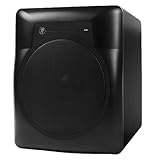
8. Mackie MRS10 is a balanced-input option that needs a careful rating check
Mackie Mr MRS10 -Channel Studio Subwoofer
10 inch glass aramid
120W Class A/B
XLR and TRS inputs
Pros
- Glass aramid woofer
- Class A/B amplifier
- XLR and TRS
- shelf port
- software included
Cons
- 3.8 rating
- 35 reviews
- 120W power
- limited stock
The Mackie MRS10 is a conventional studio-system expansion option with a 10-inch glass aramid composite woofer, 120W Class A/B amplification, and stereo XLR and TRS connections. Its shelf-ported design targets deep low-end support for a pair of monitor speakers.
It belongs in this complete comparison because its connection format and driver type fit studio use, not because its customer evidence is strongest. The 3.8 rating from 35 reviews is the lowest in this group, and 14% of the supplied review distribution is one-star.
The XLR and TRS connections fit a balanced monitoring chain
Stereo XLR and TRS inputs give the MRS10 a straightforward path from common interfaces, mixers, and monitor controllers. That is an advantage over RCA-only designs when you already work with balanced cabling.
Check whether the rest of your system needs high-pass-filtered outputs and how the routing is implemented. Good cables do not solve bass-management problems if the crossover and phase have not been set correctly.
The shelf-ported cabinet targets electronic and hip-hop low end
Mackie describes a shelf-ported design for deep low end and positions the MRS10 for electronic music and hip-hop production. The 10-inch glass aramid composite woofer is a credible physical basis for those use cases.
Still, no published lower-frequency boundary is supplied in the analyzed product data, so I would not infer an exact extension figure. Compare its documented 120W Class A/B power and connection needs against the more complete response data available for the Yamaha, KRK, and ADAM models.
The rating history makes this a narrower recommendation than the leaders
The MRS10 includes Pro Tools | First software, but software inclusion is not a reason to overlook product performance or customer feedback. With only 35 reviews, it has a smaller evidence base than most of this list.
Choose it when its XLR/TRS routing and monitor-system fit are already right for your room, then purchase from a seller with a return process you understand. For a default recommendation, the higher-rated and better-documented alternatives above are easier choices.
The right studio subwoofer starts with room size and monitor limits
A subwoofer is part of a monitoring system, not a stand-alone bass upgrade. The best decision follows a sequence: assess the room, identify your monitors’ real low-frequency limit, choose the connection path, then calibrate the completed system.
An 8-inch subwoofer is enough when the room is small and listening distance is short
An 8-inch model can be enough for a home studio when you work nearfield in a small room and need extension rather than extreme output. The Yamaha HS8S, PreSonus Eris Sub 8BT, and Mackie CR8SBT show why: all have 8-inch drivers, but their extension, amplifier, and controls differ substantially.
A 10-inch model can offer more headroom, yet it can also excite room modes more aggressively in a tight space. Community feedback consistently warns against placing a large sub in a tiny untreated room and then trying to fix boominess with the volume knob.
The crossover should hand bass to the sub without making its location obvious
Set the sub’s low-pass point near the point where your monitors stop producing clean, trustworthy low end, and engage a matching high-pass filter when your setup supports one. The Yamaha’s 80Hz to 120Hz controls, the ADAM’s 80Hz or 120Hz options, and the Mackie CR8SBT’s 40Hz to 180Hz range all provide different ways to make that handoff.
Play a familiar reference with a steady bass line, switch phase, and listen or measure at the chair rather than near the cabinet. The correct phase setting is the position that produces the smoothest transition at the listening point, not necessarily the setting that sounds biggest.
Balanced XLR or TRS routing is the better default for an audio interface
XLR and TRS connections fit the balanced outputs found on many interfaces and monitor controllers. Yamaha, KRK, ADAM, Rockville, and the MRS10 provide balanced connection options, while the PreSonus adds them alongside RCA and aux connections.
RCA and speaker-level routes can still work for a stereo-oriented system, as seen on the Samson MediaOne 10S. Before buying, sketch the signal flow from interface to sub to monitors, including whether the sub supplies filtered outputs for the mains.
Ported and down-firing designs change placement needs rather than removing them
The Yamaha uses a bass-reflex design, the KRK and Rockville have front-firing ports, the MRS10 has a shelf port, and the ADAM and Samson use down-firing arrangements. These differences affect how a cabinet interacts with nearby walls and the floor, but every design still needs placement trials.
Begin away from corners when the room permits, keep the sub on a firm surface, and take notes as you move it. If you cannot measure, play slow sine sweeps and familiar bass references; an obvious one-note boom at the seat is a placement issue worth solving before adding level.
Calibration and repeatable checks matter more than maximum output
Set a conservative sub level, check the crossover and phase, and return to the same marked positions for future sessions. The KRK and ADAM footswitch-bypass connections can help with fast A/B checks, while the Mackie CR8SBT remote makes level access convenient.
Cross-check finished work on small speakers and quality headphones, then revisit the low end if it changes character elsewhere. That habit is more useful than chasing the most powerful specification because translation is the real goal of studio monitoring.
Warranty, idle power, and cabinet size matter after the first session too
Long-term ownership is not only about driver size. ADAM lists a five-year manufacturer warranty, PreSonus lists two years, Samson lists two years parts and labor, and Yamaha and KRK list one-year coverage in the supplied data.
The PreSonus power saver activates after 40 minutes of idle time, and Samson offers selectable Auto Sleep. Those details will not change a mix, but they do matter in a workstation that stays connected daily, as do the cabinet’s weight, dimensions, and safe floor position.
These studio subwoofer FAQs answer the setup questions that matter first
What subwoofer do most studios use?
Most studios do not rely on one universal model. They choose a subwoofer that matches their monitors, room size, and routing. Yamaha, ADAM Audio, KRK, PreSonus, and Focal are repeatedly discussed studio brands; among the products reviewed here, the Yamaha HS8S is the strongest general recommendation because it combines 22Hz extension, 150W power, XLR inputs, adjustable filters, and a 4.8 rating from 365 reviews.
Is an 8-inch subwoofer enough for studio?
Yes, an 8-inch subwoofer can be enough for a small home studio. It is often easier to integrate than a large unit in a small room. Choose based on extension, crossover controls, and your monitors low-end limit; the Yamaha HS8S reaches a stated 22Hz, while the compact PreSonus Eris Sub 8BT reaches 30Hz.
What is the best studio subwoofer for small rooms?
The PreSonus Eris Sub 8BT is the most practical small-room choice in this list. Its 8-inch driver, compact 9.8 by 12.7 by 11.7-inch cabinet, 30Hz extension, high-pass and low-pass controls, and TRS/RCA inputs fit a desk-oriented setup. Keep its level modest and test placement because a small room can still create major bass peaks.
Do you really need a subwoofer in a home studio?
You need a subwoofer when your work requires reliable monitoring below your main speakers usable range. It helps reveal kick, bass, sub-bass, phase, and low-frequency noise problems. In a very small or untreated room, careful monitor placement, acoustic work, and headphones may be the better first steps before adding a subwoofer.
The Yamaha HS8S is the safest overall pick for accurate low-end decisions
For most producers choosing among the Best Studio Subwoofers, the Yamaha HS8S is the balanced recommendation because its stated 22Hz to 150Hz response, 150W amplifier, XLR connections, and adjustable crossover controls directly address the core monitoring job. Choose the PreSonus Eris Sub 8BT for a compact, mixed-source desktop, the KRK S10.4 for documented output headroom, or the ADAM T10S to complement T5V or T7V monitors.
Measure or listen carefully in your own room before trusting any subwoofer setting, then check your low end on headphones and small speakers. The right model in 2026 is the one that makes bass balance easier to judge without calling attention to itself.
Leave a Reply