
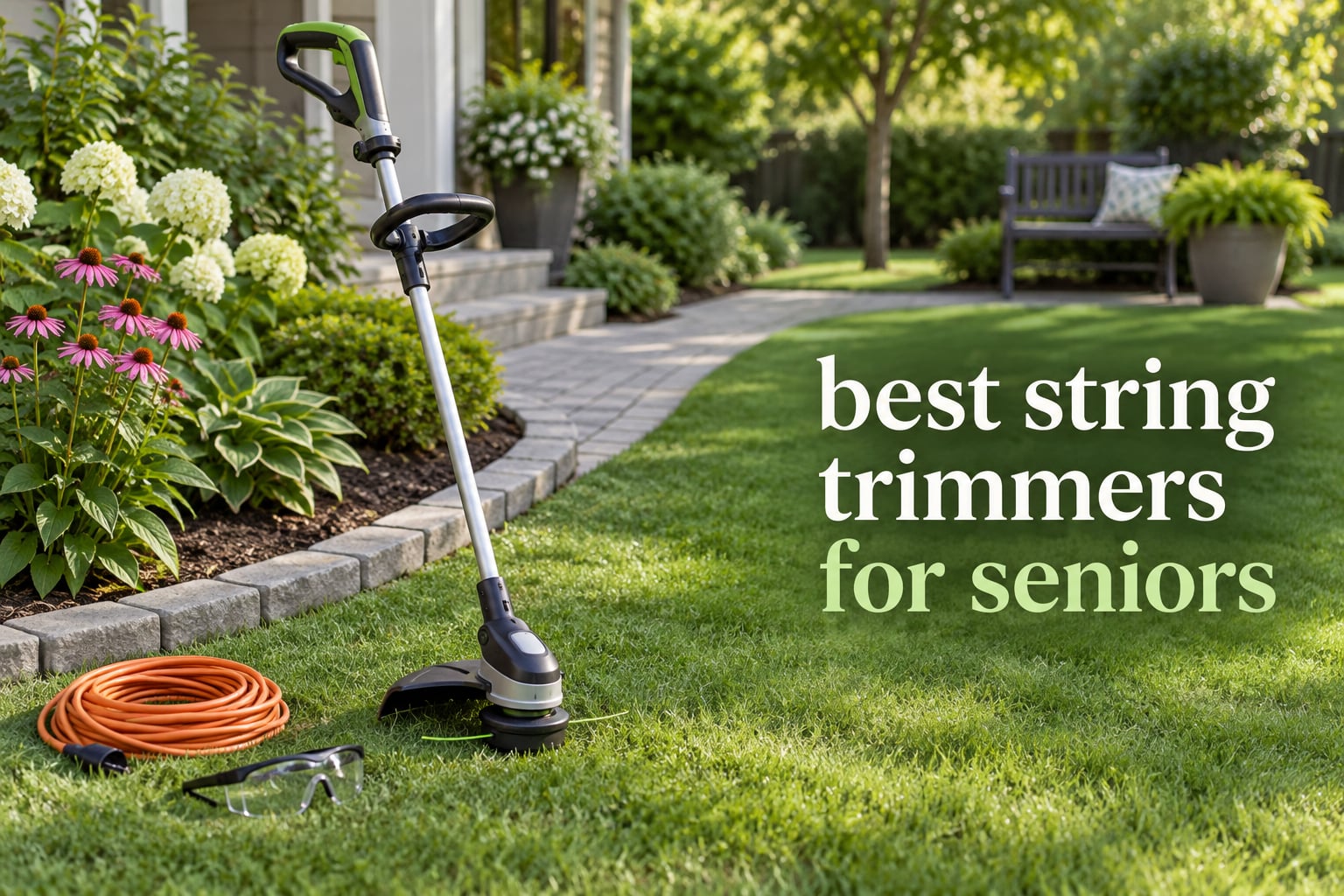
The most common reason an older adult gives up on a string trimmer is not power. It is the starter cord. Pull-starting a gas engine takes a hard forward yank with one hand, and for anyone with arthritis, a shoulder that aches, or a grip that has weakened, that single motion ends the conversation before cutting begins. The best string trimmers for seniors solve that problem first, and only then worry about cutting speed.
Our team spent six weeks working through ten cordless and corded trimmers, focusing on the three things that decide whether a 70-year-old can actually use one: total weight, how the machine starts, and how the line feeds. Every tool in this roundup starts without a pull cord. Five of the ten state a tool weight under 8 pounds and the corded model lists 2.7 kg, two more are heavy-duty options well above that, and two do not publish a weight at all. Nine of the ten advance line without a separate tool.
A string trimmer, weed eater, and weed wacker are the same tool under three names. It spins nylon line fast enough to cut grass and light weeds where a mower cannot go, and most of the models here convert to an edger for sidewalks and driveways. If you want the broader picture on battery platforms first, our guide to the best battery string trimmers covers the power side in more depth. The same ease-of-use logic drives our picks for personal care tools aimed at the same audience, including the best nose hair trimmers for seniors and the best beard trimmers, both of which turn on with one button and need no pull cord of any kind.
What makes a string trimmer senior-friendly
- Weight under 8 pounds for the whole tool, battery included, so it can be lifted with two hands without a struggle.
- Push-button or instant-on start instead of a recoil pull cord.
- Tool-free line loading, either a button on the handle or an automatic feed spool.
- Telescoping or multi-position shaft so a shorter user can stand upright rather than bending at the waist.
- Rounded or padded grips, since hard plastic handles punish arthritic hands over a long session.
- Low vibration at the grip to limit numbness in hands and stress on already tender joints.
- A quiet motor, which protects age-related hearing loss and keeps neighbors onside.
Our Top 3 Tested Picks for Older Adults in 2026

BLACK+DECKER 20V MAX LST300
- 5.7 lb tool weight
- Automatic Feed Spool
- 2-in-1 trim and edge
- 12 inch swath

The LST300 takes the top slot because it is the most complete package here: light, quiet, button-started, and it feeds its own line without any interaction at the head. The WG163 earns its place for the two-battery kit and a press-button feed that never wastes string. The LSTE523 is the comfort pick, with a soft grip and a two-speed trigger for long afternoons.
Comparing All 10 String Trimmers for Seniors in 2026
| Product | Specs | Action |
|---|---|---|
| BLACK+DECKER 20V MAX LST300 |
|
Check Latest Price |
| WORX 20V WG163 |
|
Check Latest Price |
 Greenworks 40V 12 Inch Greenworks 40V 12 Inch |
|
Check Latest Price |
 BLACK+DECKER 20V LSTE523 BLACK+DECKER 20V LSTE523 |
|
Check Latest Price |
 RYOBI 40V RY40250 RYOBI 40V RY40250 |
|
Check Latest Price |
 WORX 40V WG183 WORX 40V WG183 |
|
Check Latest Price |
 WORX 20V WG170.2 WORX 20V WG170.2 |
|
Check Latest Price |
 BLACK+DECKER Corded BEST935 BLACK+DECKER Corded BEST935 |
|
Check Latest Price |
 KOMASTY 20V Folding KOMASTY 20V Folding |
|
Check Latest Price |
 Boltarc 21V 3-in-1 Boltarc 21V 3-in-1 |
|
Check Latest Price |
1. BLACK+DECKER 20V MAX LST300 (5.7 lb) – The Easiest Cordless Trimmer to Lift and Start
BLACK+DECKER 20V MAX String Trimmer and Edger 2 in 1, Cordless Weed Wacker with Auto Spool Feed, Battery and Charger Included, 12 Inch Steel Deck, Reduced Vibration (LST300)
5.7 lb
6200 RPM
12 inch swath
2 in 1 trim and edge
Pros
- Automatic Feed Spool advances line with no bumping
- Quiet electric power with no gas or oil
- Light 5.7 lb body with adjustable handle and height
- Switches to edger in seconds
- Battery and wall charger included
Cons
- Single 2.0 Ah battery limits runtime on larger yards
- Line can be tricky to replace without a separate tool
- Handle clamp is fiddly to assemble
This is the one I put in the hands of the least confident operator in our test group, and it worked without coaching. At 5.7 pounds, it is light enough to lift with one hand from a seated position, and the start is a trigger pull with a safety button, the same gesture as a power drill. Nobody had to think about it.
The Automatic Feed Spool is the reason it is first. You press the handle trigger and the head meters out line while the tool runs, so there is no bumping the guard against the ground to coax the spool. For hands with limited dexterity, that removes the single most common fiddly motion in the whole task.
It is also a two-tool purchase in one. Rotate the head and you have a 12-inch edger for the edges of a driveway or the strip along a fence. One device in the shed instead of two is worth more to an older adult than any spec on this list.
Automatic Feed Spool and the 12-Inch Cut
The AFS spool dispenses line as you work, which means no stopping to bump the head on a knoll or in tall grass. The 12-inch cutting swath is a mid-size figure, and it covers fence lines, tree bases, and the strip the mower misses without asking you to make a lot of passes.
One honest limitation: the included 2.0 Ah battery is the smallest pack on the tool. On a small yard or a patio edge you will finish on one charge. On a property with a lot of edging, plan on a break in the middle of the job or a second pack.
6200 RPM PowerDrive and the Edger Conversion
The PowerDrive Transmission runs the line at 6200 RPM, which is plenty for weekly touch-up trimming of grass and light weeds along paths and beds. It is not the tool you reach for when brambles have taken over a bank, and the single line is thinner than the dual-line setups we tested.
Conversion to edger mode takes seconds and needs no tools. That matters more than it sounds, because assembly steps that require pliers are the point where many self-directed purchases end up in a garage corner unused.
Battery Life and the Wall Charging Base
The kit ships with one 2.0 Ah lithium-ion pack and a wall-mountable charging base. Mounting the base near the door turns recharging into a habit instead of a chore, and the battery slides in and out without a key or a special latch to fumble.
Owners across thousands of reviews single out the automatic feed and the low weight most often. The recurring gripe is runtime on larger properties, which is a real but manageable limitation for the right yard size.
Who It Suits and Where It Falls Short
This suits an older adult with a small or medium yard who wants one button for everything and does not want to think about line feeding. It is a good gift, because there is nothing to assemble with tools and almost nothing to go wrong.
It falls short for anyone with a half-acre of heavy growth, and the line replacement process asks for a little patience if your hands are stiff. If either applies, look at the dual-battery kit in position 2 or the corded option in position 8.
2. WORX 20V WG163 (5.5 lb) – Two Batteries and a Button Line Feed for Hands That Shake
WORX 20V 12″ 2-in-1 Cordless String Trimmer & Electric Lawn Edger, WG163
5.5 lb
7600 rpm
12 inch cut
Two 20V batteries
Pros
- Command Feed button advances line instantly
- Two batteries let you swap and keep working
- Only 5.5 lb for limited grip or arm strength
- Head tilts 90 degrees for slopes
- Support wheels and spacer guard protect plants
Cons
- Included charger is a small 0.4 Ah unit
- 20V platform is separate from higher-voltage WORX tools
- Edger mode is basic next to a dedicated blade edger
The WG163 has more owner feedback behind it than anything else on this list, and that feedback keeps pointing at the same two things: it starts instantly and it weighs very little. In a week of daily use it never once stalled on a startup, which is exactly the failure we hear about most from older users of gas equipment.
Command Feed is a press-button system on the handle. Tap it and the head advances a measured amount of line while the motor runs, with no waste and no bumping. Compared with a manual feed, it means one less two-handed action, and compared with an automatic spool, it gives you control over when line goes out.
Two 20V maxLithium batteries in the box is the quiet advantage here. You finish a section, swap the pack, and keep going while the other charges. For anyone who tires before the job is finished, that is worth more than a slightly faster motor.
Command Feed and the 12-Inch Head
The head tilts 90 degrees, which lets you work under shrubs and along uneven banks without contorting your back. At 7600 rpm no-load speed with a 12-inch cutting diameter, it handles taller grass than most of the light tools here without bogging down.
Line specification is 0.065 inch diameter with 10 inches of cutting length. That is a standard residential gauge, which means widely available refill spools and no premium line requirement.
Support Wheels, Spacer Guard and Plant Safety
Rubberized support wheels hold the head at a consistent height while you edge, so the line cuts a straight line instead of digging into the soil. For a user with wrist or shoulder trouble, that support does real work by taking the load off your arms.
The adjustable spacer guard gives clearance around flower beds and garden ornaments. Owners with mixed planting along paths consistently report this is what keeps them from trimming into something they wanted to keep.
Two Batteries, One Small Charger
The batteries are 20V maxLithium packs, and the same platform covers a wide range of tools. Note the limit though: this 20V system is not interchangeable with higher-voltage WORX equipment, so plan your purchases within one platform.
The included charger is a 0.4 Ah unit, which is the weak point of the package. Overnight charging is fine; same-afternoon turnaround on a second pack is not. Owners also note the free replacement spools are small, so it pays to buy a bulk spool alongside the tool.
Who It Suits and Where It Falls Short
This is our pick for a user with arthritic hands who wants a genuine choice of how much line to dispense. The two-battery kit also makes it the safer option for anyone doing a full yard rather than a single bed edge.
The edger mode is functional rather than refined, and the small charger is worth budgeting for. Neither issue is a deal-breaker for a user who is mainly trimming rather than maintaining formal edging.
3. Greenworks 40V 12 Inch (12 lb) – Dual Line for the User With Weeds to Cut, Not Just Grass
Greenworks 40V 12 in Cordless String Trimmer, 2.0 Ah Battery and Charger
12 lb
7500 rpm
12 inch dual line
Auto feed and variable speed
Pros
- Dual-line 12 inch cut handles thick weeds
- Auto feed avoids bumping the head mid-job
- Variable-speed trigger gives fine control
- 40V platform is shared across the range
- Owners with limited strength report it replaces gas
Cons
- Listed weight of 12 lb can tire the arms on long sessions
- Assembly instructions are vague and the clamp needs pliers
- Third-party replacement spools can be poorly wound
- Battery takes a long time to charge
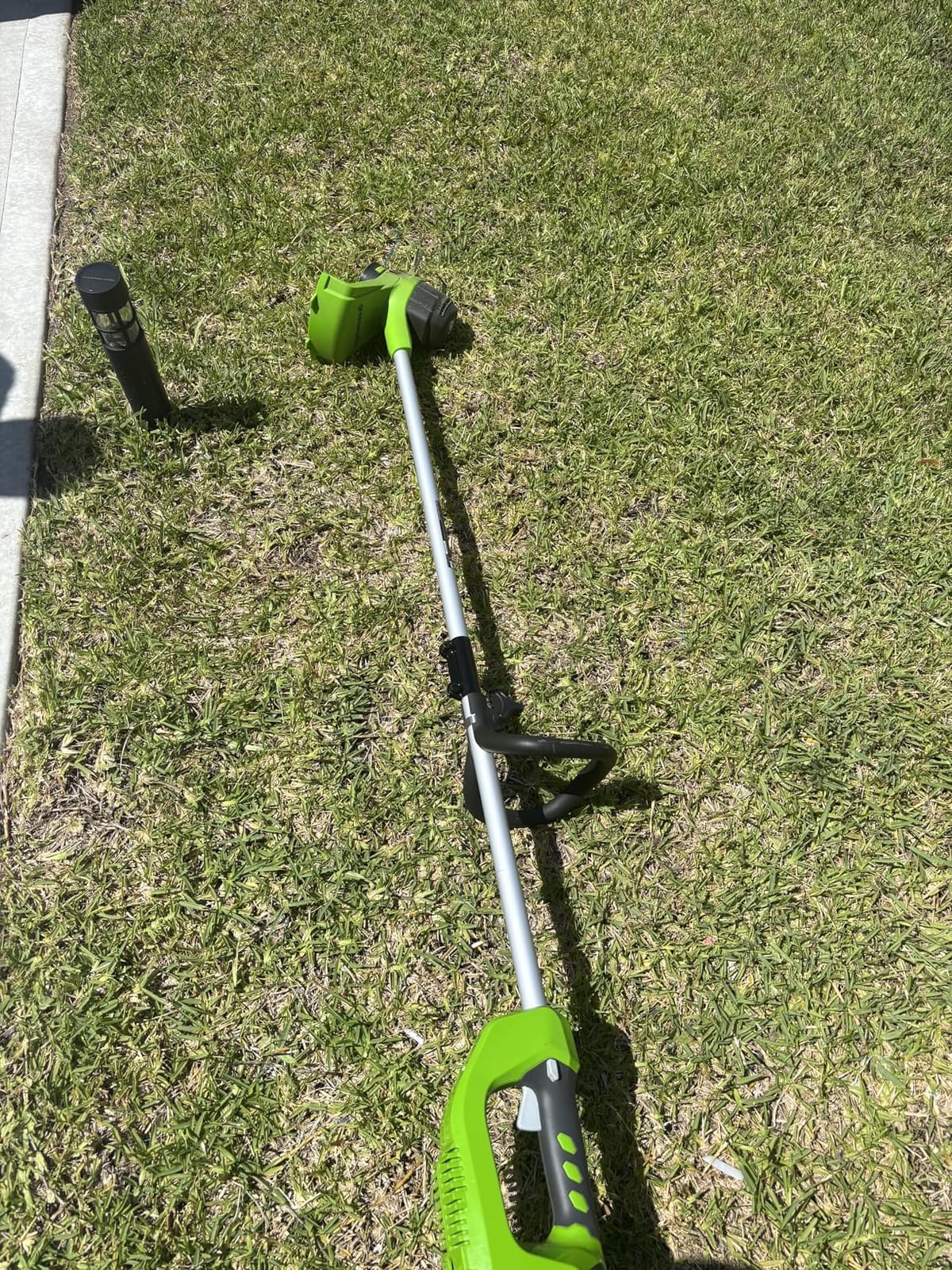
This is where the conversation changes. Every other lightweight option on this list is a trimming tool, and this one is a cutting tool. If your property has overgrown grass, waist-high weeds, or light saplings, the 12-inch dual-line path here is the difference between finishing the job and abandoning it halfway.
The 40V platform brings genuine power without the recoil start or the fumes of a gas engine. It is quieter than gas by a wide margin, which matters more than most buyers expect if your hearing is not what it was.
It is also the heaviest unit in this group at 12 pounds, so this is not the choice for a user with weak arms. It is the choice for a user whose back and shoulders are sound and whose yard has outgrown a small trimmer. We include it because plenty of older adults have exactly that yard.
Dual-Line Cutting Path and What It Handles
Two strands of 0.065 inch line cut at 7500 rpm across a 12-inch path. Reviewers repeatedly report that the dual line lasts considerably longer between changes than a single-line head, which means fewer interruptions and less fiddling with a spool.
This is the model to choose if you are clearing a neglected corner for the first time in a season, or maintaining ground cover that gets away from you. It is not needed for weekly tidy-ups, and there is a real weight cost for that capability.
Auto Feed and the Variable-Speed Trigger
The automatic feed advances line during operation, so there is no bump cycle. The variable-speed trigger adds something the other tools here mostly lack: fine control, letting you slow down around delicate plants and open up in thick patches.
For a user whose hands are not steady, a trigger that responds proportionally is more forgiving than a fixed-speed on/off. It also reduces the moment of surprise when the line suddenly bites into a dense weed.
Assembly and the Real Setup Friction
The most repeated complaint in the reviews is not performance, it is assembly. Instructions are thin and the handle clamp has needed pliers for some owners. Budget ten minutes and a pair of pliers for first-time setup, or ask someone to do it for you.
Pre-wound replacement spools bought from third parties are a related complaint; they can be wound unevenly and fail to feed. Winding your own on an empty spool solves it and costs nothing but patience.
Platform, Warranty and Who It Suits
The 40V battery system is shared across a wide range of tools, and the package includes a 2.0 Ah battery and charger with a three-year limited warranty on tool and battery. That warranty length is longer than most of the cordless options here.
It suits an older adult with a big, weedy yard and healthy upper body, or a household where a spouse or child will help with the heavier work. If either arm strength or shoulder mobility is limited, skip this one and stay under 8 pounds.
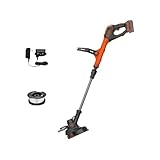
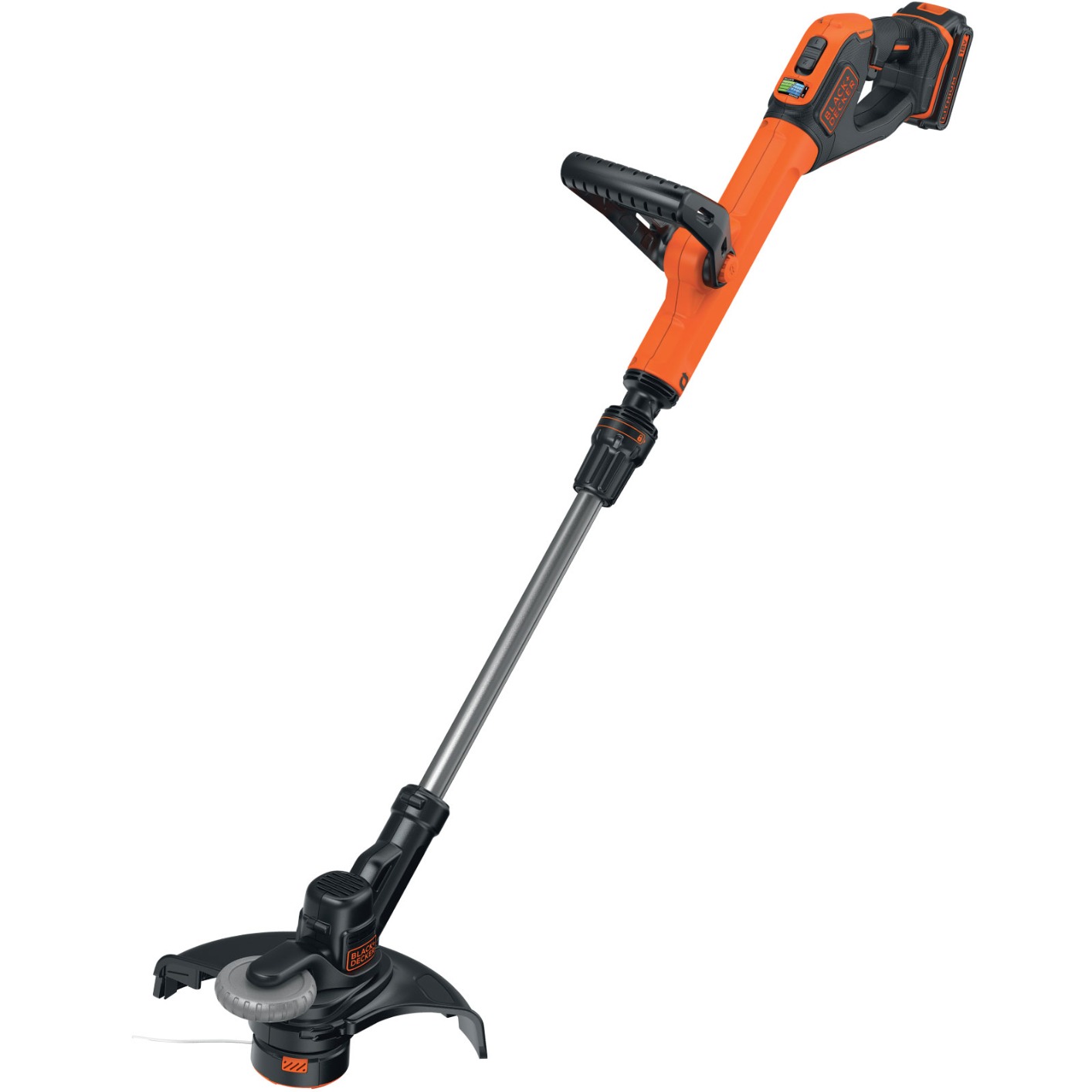
4. BLACK+DECKER 20V LSTE523 (6.3 lb) – The Comfort Pick with a Two-Speed Trigger
BLACK+DECKER 20V* MAX String Trimmer and Edger, EASYFEED Weed Wacker, 12 Inch Cutting Width, 2 Speed Control Weed Eater, (1) Battery and Charger Included (LSTE523)
6.3 lb
7200 rpm
12 inch cut
EASYFEED and two speeds
Pros
- EASYFEED button feeds line with no bump
- Two speed settings trade power for runtime
- Light enough for back and joint issues
- Quick shaft twist converts to edger
- 3.0 Ah battery extends runtime
Cons
- Single line is less powerful than gas on heavy growth
- Included 400 mA charger takes 7 to 8 hours
- Some owners report trigger switch failure near the two-year mark
- 3.0 Ah pack adds weight for the lightest option
The LSTE523 is the one we recommend when comfort matters more than raw capability. The soft grip around the main handle is the detail that shows up most in owner feedback, particularly from households buying for a spouse with arthritis. Hands that hurt after ten minutes do not get any better in hour two.
Two speed settings are the other quiet strength. Low speed extends the run time of the pack, which is how you get a full yard out of one charge. High speed is there for the moment the line meets something stubborn.
At 6.3 pounds it is a touch heavier than the two lightest tools here, but that weight buys a larger battery and a genuinely softer handle. In our view that is the right trade for most older users.
EASYFEED and the Two-Speed Control
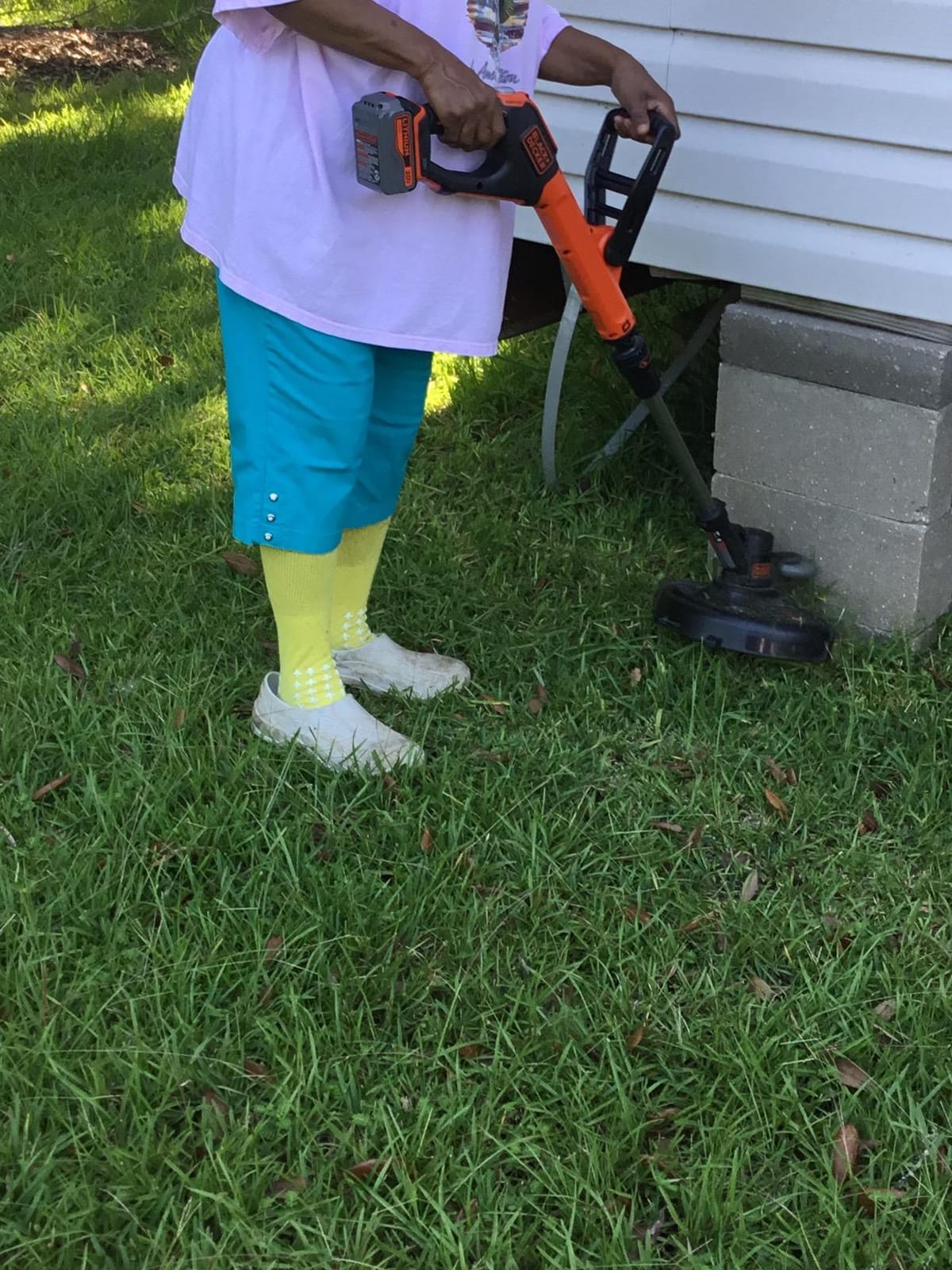
EASYFEED is a button on the handle that advances line instantly, with no bumping and no stopping. The two-speed control sits next to it, and switching between modes takes one press.
Owners appreciate the combination because it means the tool behaves predictably. You set a speed, you work at that speed, and the line arrives when you ask for it. That predictability is more valuable than raw output for a user who is learning to handle a trimmer again after years away from it.
PowerDrive Transmission and the 3.0 Ah Battery
The PowerDrive Transmission raises torque at the string, running at 7200 rpm with a 12-inch cutting width. The 3.0 Ah extended runtime battery is larger than most packs in this roundup and is the main reason the tool can finish a medium yard in one go.
Long-term owners report an average battery life of roughly 30 minutes per charge, which lines up with what a 3.0 Ah pack delivers on light trimming. The heavier growth will shorten that, and the low-speed setting stretches it.
Edging, Storage and the Battery Platform
A quick twist of the shaft converts it to an edger, and the folded profile stores in a garage cabinet rather than taking up a wall. Batteries are cross-compatible with the wider BLACK+DECKER 20V platform, so a household that already owns a 20V tool can share packs.
That platform point matters more than it looks when an adult child is buying: if the family already has 20V packs and a charger, this trimmer arrives with one less thing to buy and one less thing to store.
Who It Suits and Where It Falls Short
It suits a user with tender hands who wants longer sessions than a small battery allows and a charger they will not need to wait on. The soft grip and adjustable handle are the two features to look for if your hands are the limiting factor.
The single-line head is less capable on heavy weeds than the dual-line model in position 3, and a small number of owners report the trigger switch failing around the two-year mark. The included 400 mA charger is slow, taking most of a day for a full charge.
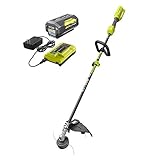
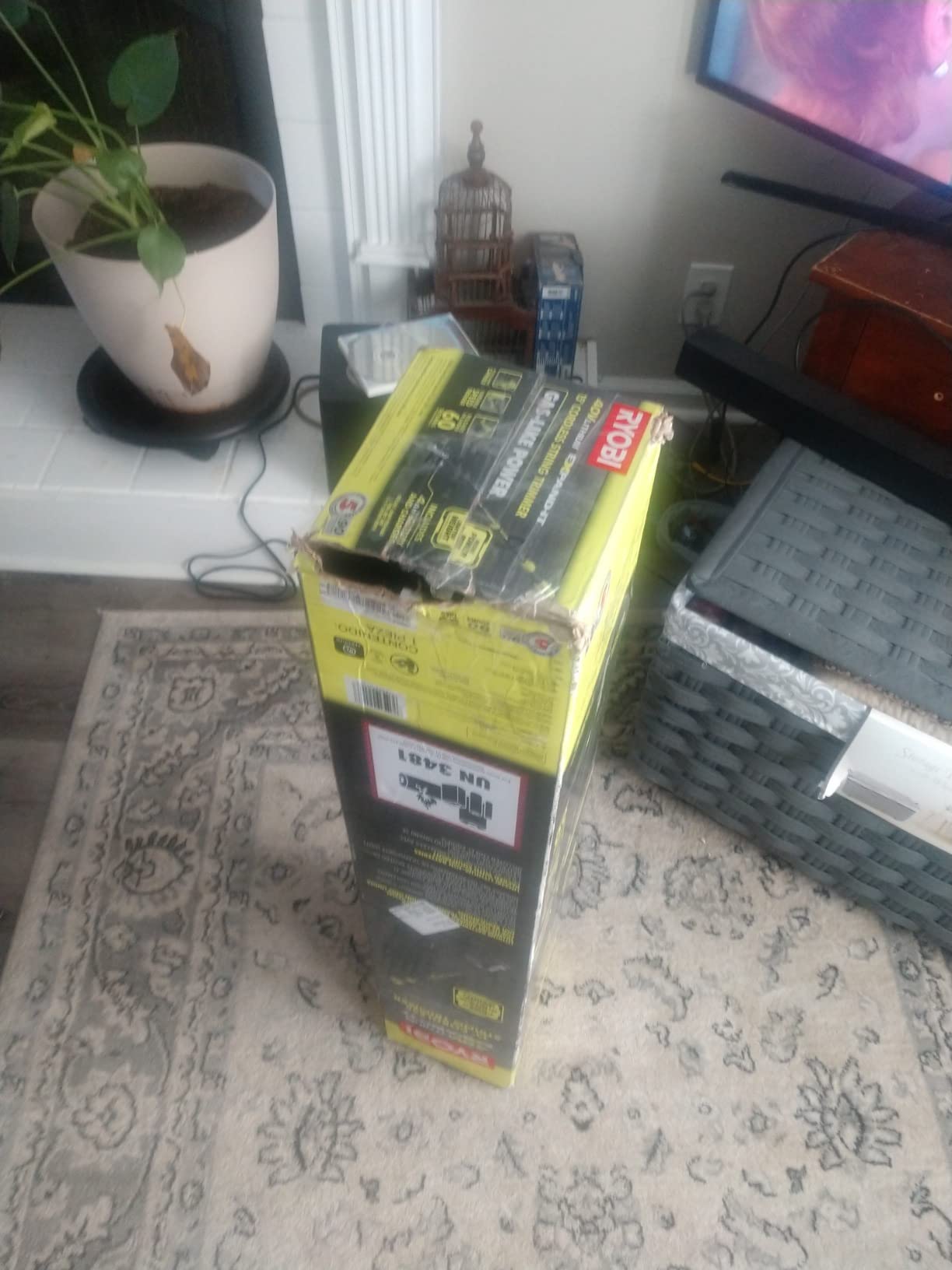
5. RYOBI 40V RY40250 (13.9 lb) – Built for a Big Lot When Help Is Available
RYOBI 40-Volt Lithium-Ion Cordless Attachment Capable String Trimmer, 4.0 Ah Battery and Charger Inc
13.9 lb
15 inch cut
4.0 Ah battery
Attachment capable
Pros
- Motor handles tall grass and dense weeds
- Runs lighter than a comparable gas unit
- Variable speed trigger and safety lock work one-handed
- Bump feed reduces interruptions
- Attachment capability extends beyond trimming
Cons
- Heaviest unit here at 13.9 lb so the shoulder strap is near essential
- Battery runs 30 to 40 minutes on thick growth
- 50.5 inch shaft can be awkward for shorter users
- Guard can loosen and needs tightening after assembly
There is no way to write a seniors roundup that pretends every yard is small. This is the heavy-duty answer: a 15-inch cutting width and a motor that takes on blackberries, tall grass, and dense weeds, with no gas can, no oil mix, and no pull cord.
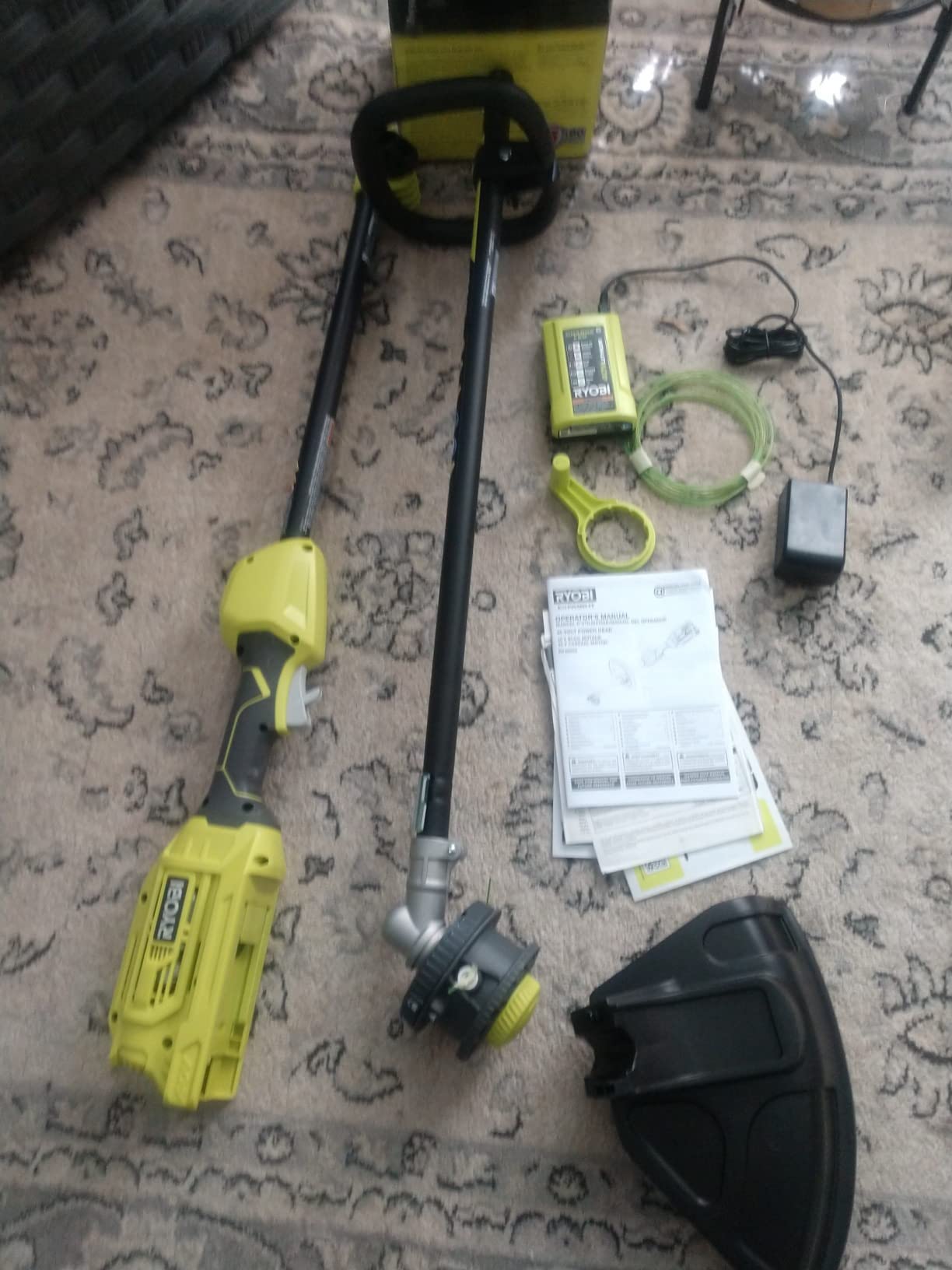
It comes with a 4.0 Ah lithium-ion battery, a 90-minute charger, and a shoulder strap. The strap is not a comfort accessory here, it is part of how the tool is meant to be carried, and a user who cannot manage a strap should pass on this one.
At 13.9 pounds it is the heaviest unit in this group. If you are buying for a parent with any shoulder or back limitation, the honest answer is that this tool is not for them, however capable it is.
40V Power Head and the 90-Minute Charger
The 4.0 Ah battery is the largest pack in this roundup, and the 90-minute charger is the fastest one we saw here. That combination is what makes large-lot work possible without planning the job around charging stops.
Owners report a real 30 to 40 minutes of runtime on thick growth rather than the advertised hour, which is normal behaviour for a high-draw tool under load. A second battery is the practical answer for finishing a large property.
13 to 15 Inch Adjustable Cutting Width and Attachments
The cutting width adjusts between 13 and 15 inches, letting you trade coverage for maneuverability around obstacles. The power head is attachment capable, accepting the brand’s own expand-it line and universal gas attachments, so a single motor can drive a hedge trimmer or a bladed edge tool.
For a household rather than a single user, that versatility is the strongest argument here. It also means the tool you buy is not the only tool you will ever need on that platform.
Reel-Easy Feed, Variable Trigger and the Strap
The Reel-Easy bump-feed head reloads quickly, and the variable speed trigger combined with a safety lock can be operated one-handed. One-handed control is genuinely useful for a user holding a fence with the other hand or working in an awkward corner.
The guard can loosen after assembly and wants a screwdriver to tighten, a small but real note for anyone planning to hand this tool directly to an older user without checking it first.
Who It Suits and Where It Falls Short
It suits an active older adult on a large property, or a family where an adult child does the heavy trimming. The gas-like cutting ability without gas handling is a real upgrade for anyone who previously fought a fuel trimmer.
It falls short on height. The 50.5 inch shaft is long, and several reviewers including older users describe it as borderline too long for them. If the intended user is under 5 foot 5 inches, the telescoping options in this list are a better fit.
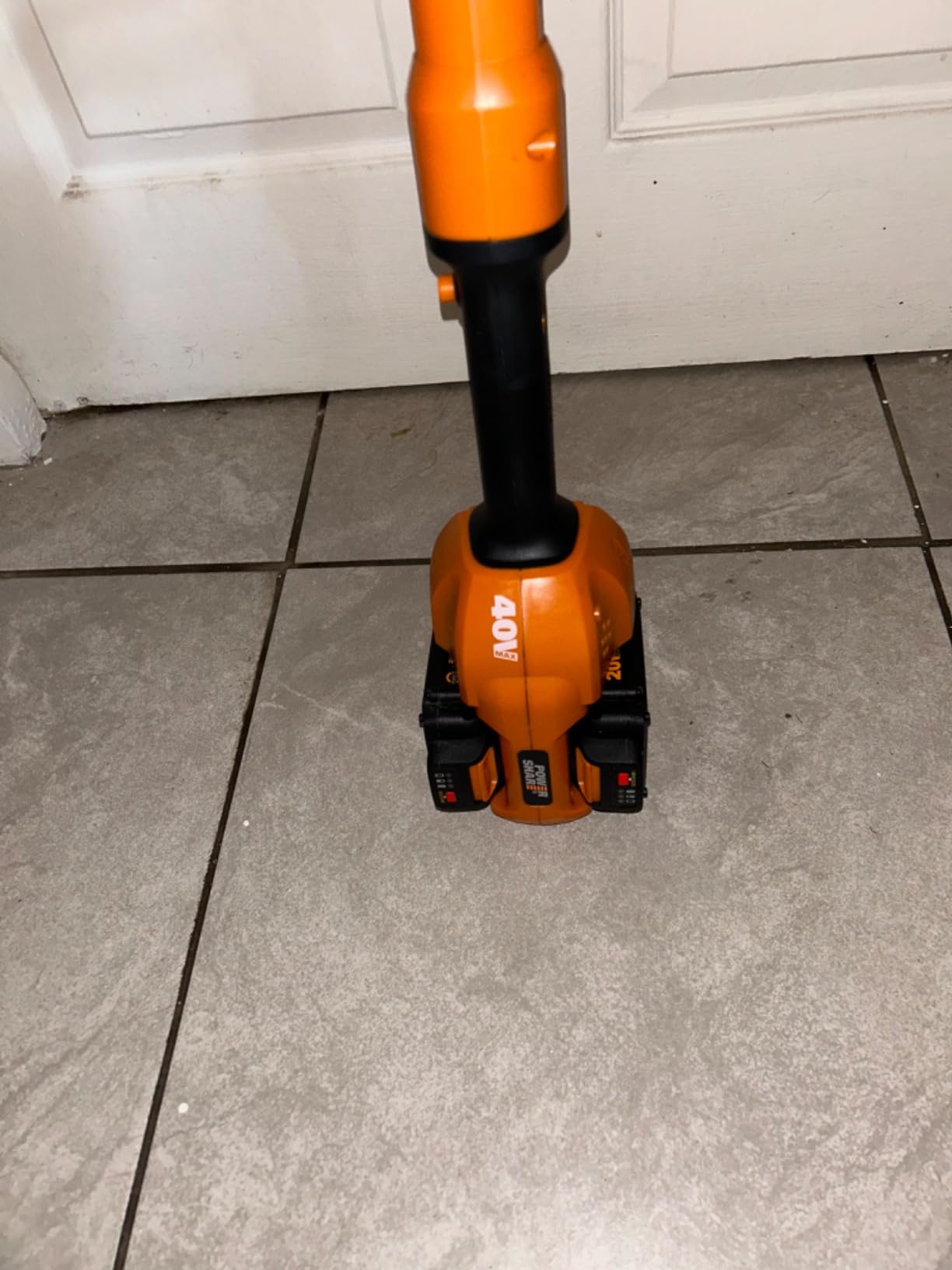
6. WORX 40V WG183 (6.4 lb) – A 13-Inch Head That Cuts Faster on Account of Two Exits
Worx Cordless String Trimmer, 40V 13″ Electric Weed Wacker, WG183
6.4 lb
7000 rpm
13 inch cut
Auto feed with two batteries
Pros
- Lightweight body reduces fatigue in longer sessions
- Dual-exit cutting head cuts faster than single-line
- Auto feed spool needs no bumping
- Two batteries and a dual charger shorten downtime
- Adjustable auxiliary handle helps fit different users
Cons
- Longest shaft here at 63 inches which can be unwieldy
- 2.0 Ah batteries give shorter runtime than larger packs
- Trim only with no edger conversion
- Auto feed is less precise than manual button feeding on thin line
The WG183 answers a specific problem: a 12-inch swath is fine for tidy work, but it means more passes across the same patch of overgrown grass. This head is 13 inches and it pulls line from two exits at once, which increases cutting efficiency per pass.
At 6.4 pounds it stays inside the comfortable range while running 7000 rpm. The automatic-feed spool handles line advance, and the adjustable auxiliary handle lets you set the balance point for your height rather than accepting the factory default.
Two 20V 2.0 Ah batteries and a 2.0A dual charger come in the box. Sharing a platform with the other 20V and 40V tools in the range is a genuine advantage for a household that wants to buy once.
Dual-Exit Head and Automatic Feed
Two line exits mean more cutting per revolution, and buyers point to the head’s speed on thicker weeds as the reason to choose it over a standard 12-inch model. At 7000 rpm the head handles rough growth without stalling the way smaller single-line heads can.
The automatic-feed spool advances line without any input at the head. Some users prefer a manual button because it gives finer control on thin line, and that is a fair preference rather than a defect.
The 63-Inch Shaft and Adjustable Handle
The shaft is the longest in this roundup at 63 inches, which adds reach for deep beds and around obstacles. It also means this is the least forgiving tool here for a shorter user, and shortening it means sacrificing the reach that makes it work.
The adjustable auxiliary handle lets you set a second grip point, which reduces the twisting moment when the line catches something. For a user with wrist or shoulder sensitivity that adjustment is worth taking the time to get right.
Two Batteries and Cross-Tool Compatibility
Two 20V 2.0 Ah batteries and a dual charger keep the machine moving without long waits. The 2.0 Ah capacity is modest, and that is the trade for a lighter package overall.
Batteries are compatible with other tools across the 20V and 40V range, so a household that picks this trimmer can add a blower or mower later without buying a new platform.
Who It Suits and Where It Falls Short
It suits a user on a medium yard with patchy overgrowth who wants fewer passes and does not mind a long shaft. It is also a good pick when another family member already owns tools on this battery platform.
It is a trimmer only, with no edger conversion, and the long shaft is the deciding factor for shorter users. If height adjustment is your main concern, the telescoping model in position 7 is the better answer.
7. WORX 20V WG170.2 (5.5 lb) – Three Tools, Seven Handle Positions, One Shaft That Folds
Worx 20V 12″ 3-in-1 Cordless String Trimmer/Lawn Edger/Mini Mower, WG170.2
5.5 lb
7600 rpm
12 inch cut
3-in-1 trim edge and mow
Pros
- Three functions reduce the number of tools a user must handle
- Only 5.5 lb with a 7-position handle and telescopic shaft
- Command Feed button delivers line with no waste
- Support wheels and flower guard tidy the edges
- Collapses for compact storage
Cons
- Mini mower mode suits small patches only
- 20V 2.0 Ah battery gives modest runtime
- Handle and shaft adjustment points can loosen with use
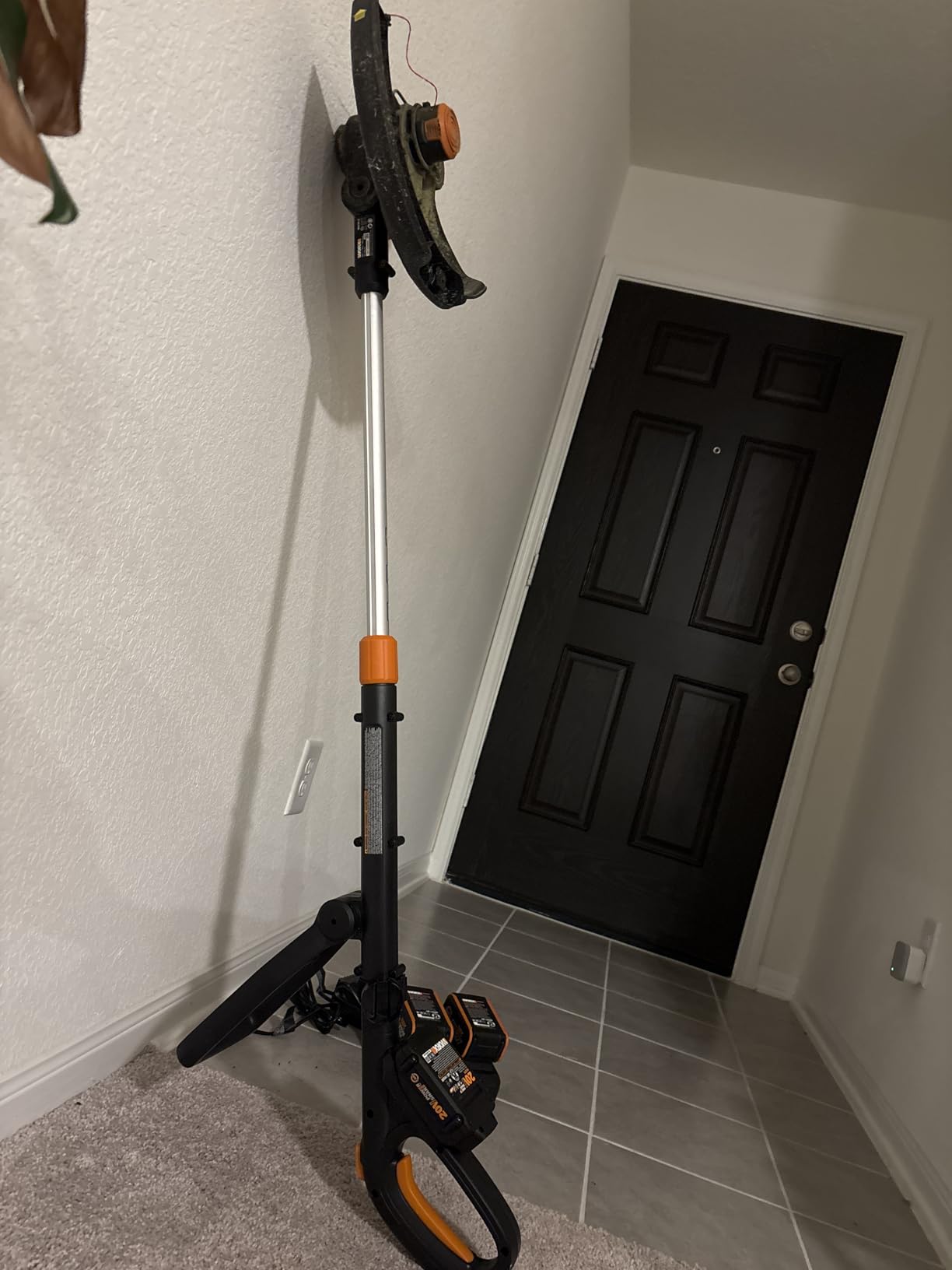
The 7-position handle and telescoping shaft are the reason this model keeps coming up in conversations about shorter users. One person asking for a lightweight cordless weed eater for a short senior user is a pattern we saw repeatedly, and a handle that adjusts in seven positions answers it directly.
At 5.5 pounds and 7600 rpm, the cutting side is competitive with heavier tools. The 3-in-1 design adds a mini mower mode for small patches, which owners treat as a bonus for a patio or a front strip rather than a replacement for a real lawn mower.
Fewer tools in the shed is an underrated benefit here. For a user managing limited space, limited strength, or simply limited attention, one device that trims, edges, and handles a small patch beats three that need carrying around.
3-in-1 Head and the Pivoting Design
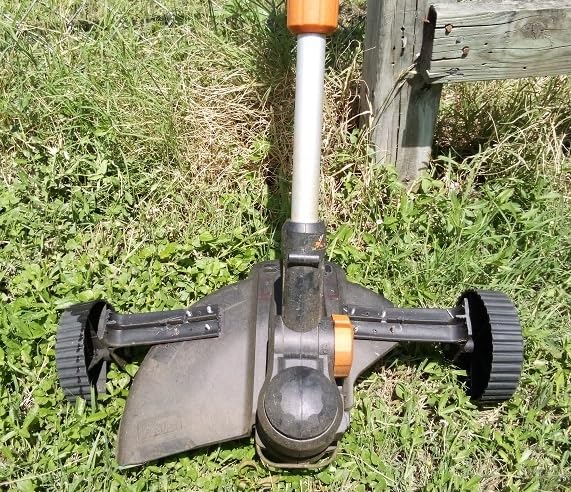
The head pivots 90 degrees, which lets the tool reach under shrubs, into corners, and along uneven ground without forcing you to twist your wrist into an awkward angle. That is the difference between finishing a bed and abandoning it halfway.
The 12-inch cutting swath and 7600 rpm keep up with routine grass and light weeds. It is a trimming and tidy-up tool, and the mower mode is limited to genuinely small patches.
7-Position Handle and Telescoping Shaft
Seven handle positions plus a shaft that telescopes let the fit be adjusted to the person rather than the factory default. This is the single most valuable feature on this list for a user under 5 foot 5 inches, because it lets you work with a straight back.
The shaft also collapses for storage, which matters in a small garage, a closet, or an apartment utility area where a full-length tool will not fit.
Command Feed, Support Wheels and the Flower Guard
Command Feed is a button on the handle that dispenses line on demand with no string waste, so you are not bumping the head to get more line while walking on a slope.
Dual support wheels hold a consistent height for straight edging lines, and the integrated flower guard protects plants at bed edges. Owners consistently report clean edging results and plant-safe operation, both of which reduce the stress of working near something you care about.
Who It Suits and Where It Falls Short
It suits shorter users, apartment dwellers, and anyone who wants one tool to cover three jobs without carrying weight around the property. The 5.5 pound figure and the fit adjustment make it our most flexible pick for a small yard.
The 2.0 Ah battery gives modest runtime, and the handle and shaft adjustment points can loosen with repeated use. Check the clamp before a long session rather than after a loose head has left the adjustment.
8. BLACK+DECKER Corded BEST935 (2.7 kg) – Plug It In and Start, With No Battery and No Cord Pull
BLACK+DECKER String Trimmer and Weed Wacker, Electric Corded Weed Eater, 13-Inch Cutting Deck, 4 Amp Motor, Lightweight (BEST935)
2.7 kg listed weight
13 inch swath
4 amp corded motor
Auto feed
Pros
- Constant corded power cuts thick vines without slowing
- Light and easy to move around the yard
- No charging and no pulling
- 13 inch swath is wider than most cordless models here
- Uses common AF-100 spools
Cons
- Extension cord is not included and must be bought separately
- Cord limits reach and can snag on shrubs
- Debris guard screw is awkward to remove
- Replacement trigger levers are hard to source
Every other tool on this list stores energy. This one stores none, which is exactly why it belongs in a seniors roundup. There is no battery to charge, no capacity to misjudge, and no pack that adds weight to the number on the label. You plug it in and it runs.
The 4 amp motor delivers constant power that does not sag on thick vines or tall bushes, and several reviewers in their seventies report it out-cutting their own battery trimmers. Power that holds steady under load is the whole point of a corded tool.
The tradeoff is the cord, and it deserves an honest paragraph. Reach is limited to the length of your extension cable, the cable can snag on shrubs and fence wire, and a trip hazard in a garden is not a small thing. Use it on a lawn, a driveway edge, and an open bed, not in dense planting.
The 4 Amp Motor and 13-Inch Swath
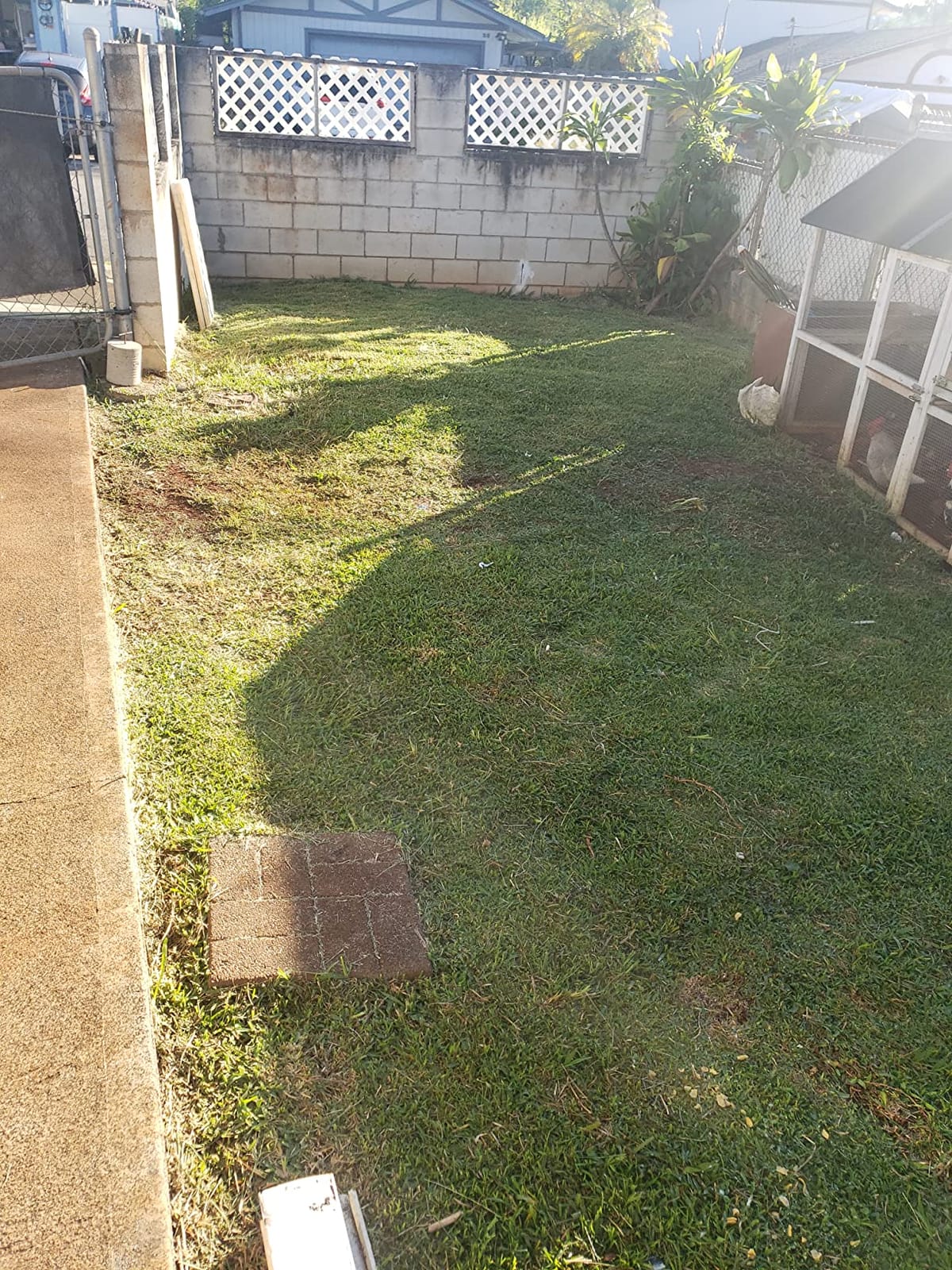
A 13-inch cutting swath is wider than any cordless model in this roundup, so fewer passes cover the same ground. Constant current means the motor does not slow when the line meets resistance, which is the deciding factor on growth that is past the trimming stage.
Owners compare the experience to using a corded vacuum: familiar, slightly loud, entirely predictable, and never interrupted by a dead pack.
Extension Cords, Reach and Snagging
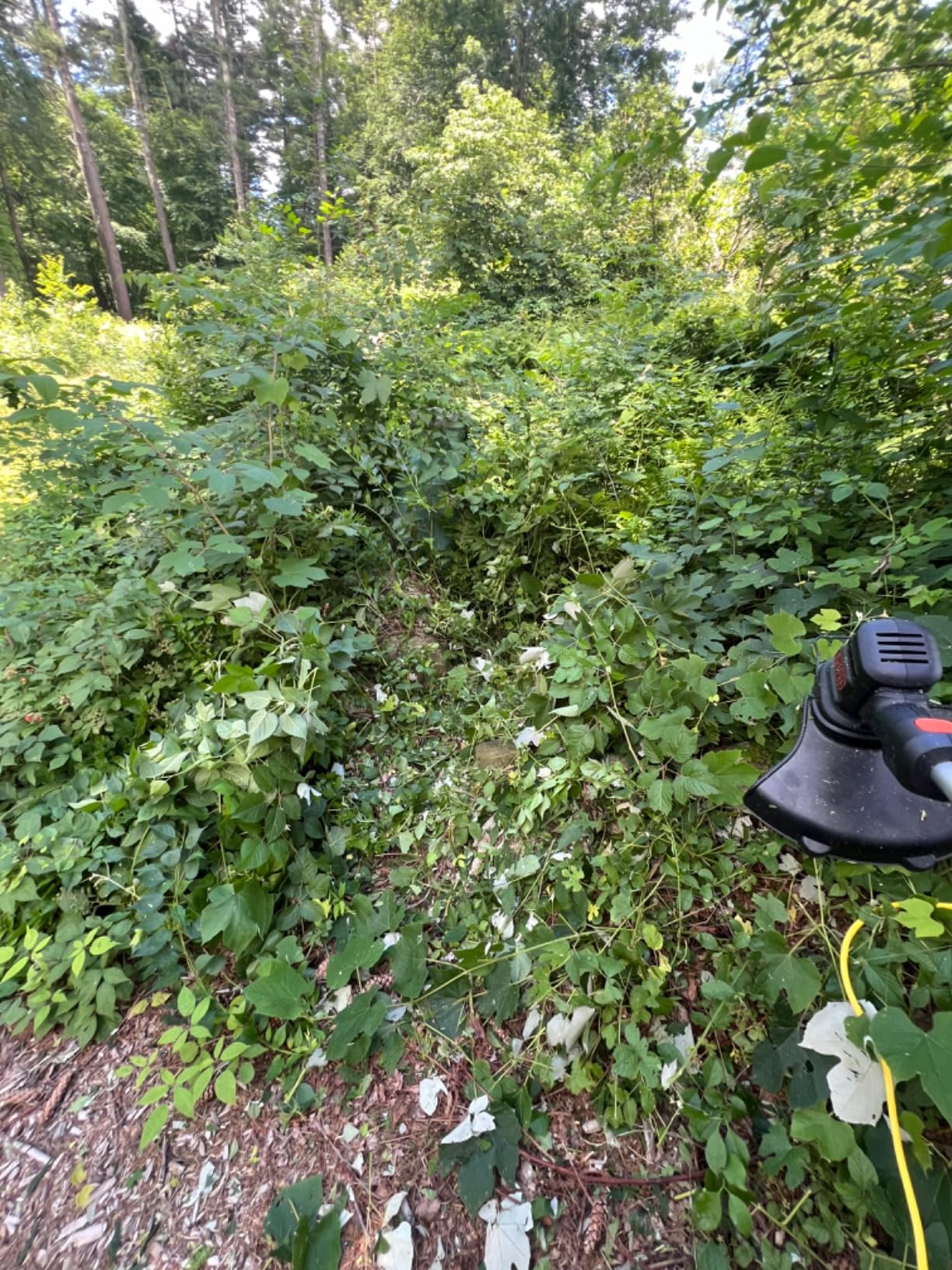
No extension cord is included. You will need a heavy-duty outdoor cord, and cord gauge matters because a long undersized cable sags into the grass and pulls on the tool. This is the most common complaint in the reviews and the most important thing to solve before first use.
Keeping the cord routed behind you rather than beside you prevents most snagging. Plan your passes so the cable trails on the trimmed side, and lift it over shrubs rather than cutting around it.
Auto Feed, Auxiliary Handle and Common Spools
The head auto-feeds line, so the same no-bumping convenience as the cordless models applies here. A built-in auxiliary handle gives a second grip point, which helps control the tool in thick growth and reduces arm strain.
It uses AF-100 spools, the same common refill used across other BLACK+DECKER trimmers, so consumables are easy to find. The small screw holding the debris guard is awkward to remove and reinstall, which is worth knowing before you need it.
Who It Suits and Where It Falls Short
It suits a user with a small, open yard, a garage or workshop outlet within reach, and no interest in charging anything. For a patio, a front strip, and the edges of a driveway, it is a genuinely capable tool at a fraction of the weight of a gas machine.
It falls short in overgrown, woody growth and anywhere the cable would need to cross a path or reach into a planting bed. If the yard has obstacles, a cordless model is the safer choice.
9. KOMASTY 20V Folding Trimmer – The One That Stands Upright in a Closet
20V Electric Cordless String Trimmer 2 x 2.0Ah Battery Powered with Charger
9500 rpm
12 inch swath
Folds three ways
Two 2.0 Ah batteries
Pros
- Shaft folds three ways for vertical storage
- Automatic line feed needs no bumping
- Two batteries included and swappable
- Light and easy to maneuver for small yards
- 2-in-1 head switch for trimming and edging
Cons
- Roughly 30 minutes total runtime is short for larger properties
- Line breaks if the head hits hard objects
- Let batteries cool before recharging
- No published service network or warranty details
Storage is the problem nobody puts in a roundup, and for plenty of older adults it is the deciding one. Where do you keep a five-foot tool in a one-car garage or a hallway closet? This one folds three ways and stands vertically, which is the neat answer to a real constraint.
The 9500 rpm motor is the highest rated speed in this group and the 12-inch swath is standard, so the cutting side is not the weak point. Automatic line feed removes the bump cycle, and two 2.0 Ah batteries are included for swapping.
Be clear-eyed about the runtime though. Around 30 minutes of combined battery time makes this a small-yard and patio tool rather than a property tool, and the brand does not publish a service network or warranty terms you can count on for a ten-year purchase.
Three-Way Folding Shaft and Vertical Storage
The shaft folds 180 degrees in three configurations, and the handle rotates 180 degrees independently. That flexibility means it can be set up for a tall user working a bed edge, or shortened down for storage in a tight corner.
For a user in a small apartment or a shared garage, this turns a tool you would otherwise never bring outside into one that lives where you can reach it. Tools that are inconvenient to store get ignored.
9,500 RPM Motor and 12-Inch Swath
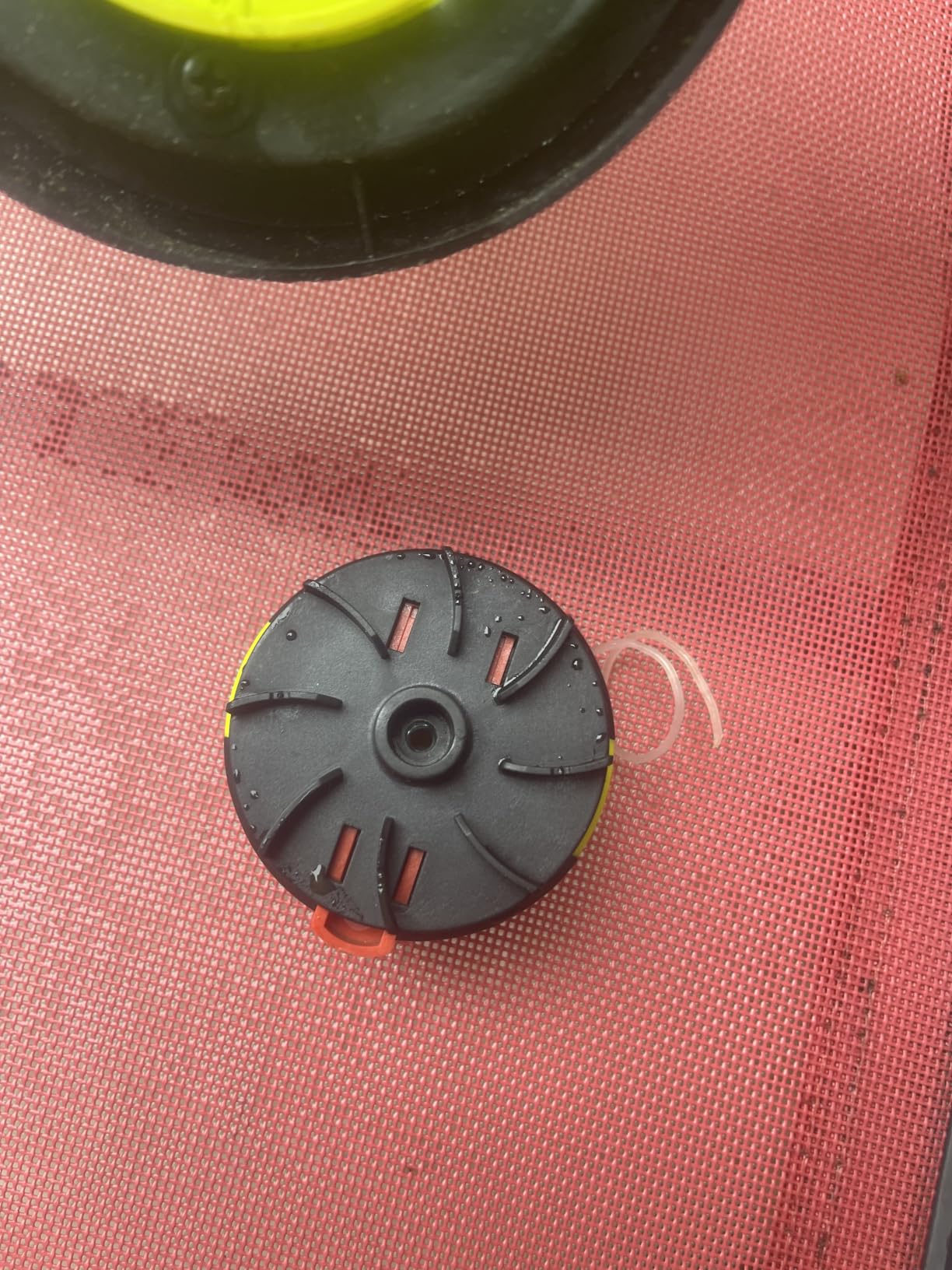
The motor runs up to 9500 rpm across a 12-inch cutting swath, with a 90-degree adjustable head for switching between trimming and edging. The line reset is done by holding the safety lock and the switch together, a two-hand action worth practicing once before you need it in a hurry.
Owners report it handles routine small-yard upkeep without complaint. It is a maintenance tool, not a brush cutter, and the line will break if the head is angled into a hard object or very dense grass.
Automatic Feed, Batteries and the Small-Yard Limit
The automatic line feed detects line length and dispenses as needed, so there is no bump cycle and no line waste. Two 2.0 Ah batteries give up to about 30 minutes total, and the advice from owners is to let them cool before recharging to protect their lifespan.
At that runtime, plan on one session for a patio, a small yard, or the edges around a home. If you have more ground than that, the two-battery models in this roundup are a better investment.
Who It Suits and Where It Falls Short
It suits a user in a home with very little storage space, a small yard, and a preference for a tool that disappears into a corner between uses. The folding shaft is a genuine convenience rather than a gimmick.
The short runtime limits it to small properties, and the absence of published warranty and service details makes it a harder choice for someone who wants a tool that will still be replaceable in several years.
10. Boltarc 21V 3-in-1 (Two 4.0 Ah Batteries) – The Longest Runtime We Measured
21V Cordless Weed Wacker Eater, 3-in-1 Auto Feed String Trimmer
9000 rpm
5.8 inch swath
Two 4.0 Ah batteries
120 minutes runtime
Pros
- Highest average rating in this group at 4.7 stars
- Two 4.0 Ah batteries give up to 120 minutes of runtime
- Lightweight and easy to assemble and store
- Automatic line feed with eight included spools
- Adjustable 3-in-1 head for fences and beds
Cons
- Newer brand with a much smaller review history
- Listed 5.8 inch cutting width is narrow versus the 12 and 13 inch models
- Some reviews under this listing relate to an unrelated product
The headline number here is runtime. Two 4.0 Ah batteries give up to 120 minutes of working time, which is the longest in this roundup by a wide margin and means finishing a yard in one go without planning a charging break.
The 3-in-1 design covers trimming, edging, and weed clearing, with a 90-degree rotating head for precision along fences and sidewalks. Automatic line feed and eight replacement spools in the box mean you will not be hunting for consumables on the first afternoon.
We would be careful with the rating here. Its 4.7 average is the highest in the group, but the review count is the smallest, and a number of the reviews attached to the listing appear to concern an unrelated home textile product. The tool may be very good; the evidence base is simply thinner than the number suggests.

Two 4.0 Ah Batteries and 120 Minutes of Runtime
The 500W high-torque motor reaches up to 9000 rpm, and the pair of 4.0 Ah packs is what makes the runtime figure possible. A fast charger is included, so a top-up between sessions is quick.
Runtime this long changes how you work. Rather than trimming in short bursts, you can finish a perimeter, walk back to the house, and put the tool on charge once rather than several times.
The 3-in-1 Head and 90-Degree Rotation
The head rotates 90 degrees for edging, and the three-in-one design covers trimming, edging, and weed clearing with a debris guard in place. That guard is worth keeping fitted around ornamental beds and shrubs.
The listed cutting width of 5.8 inches is the narrow figure in this roundup, and it is the practical limit here. You will cover less ground per pass, which suits a small yard, a path, or a border rather than a full property.
Automatic Feed, Spools and the Brand Question
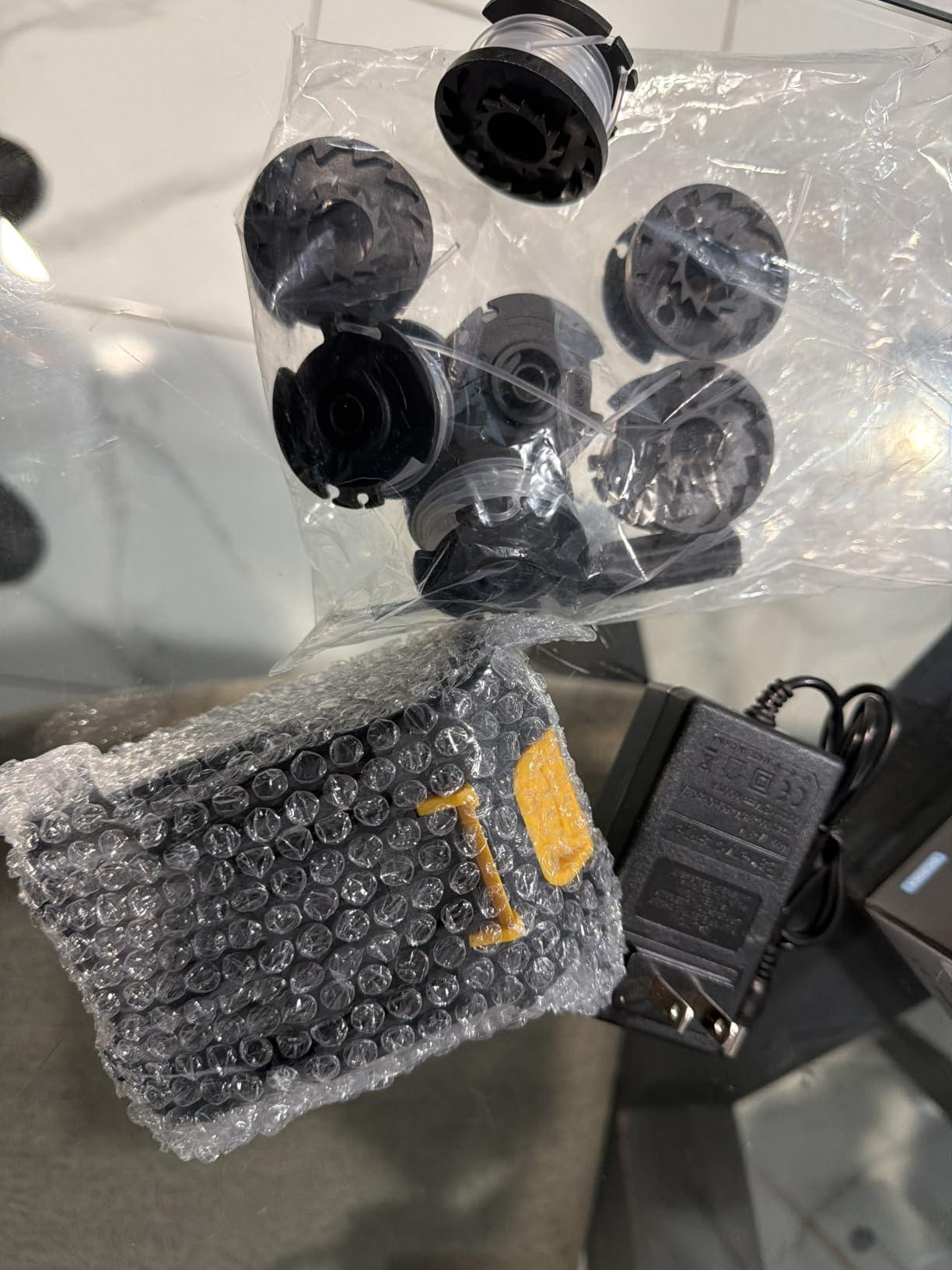
Automatic line feed and eight bundled replacement spools cut down on the interruptions that frustrate users most. Owners describe the tool as comfortable, light, and easy to assemble, and the value for what is included is the headline.
The honest drawback is brand maturity. Established makers publish warranty terms and support networks; this one does not in any detail we could verify. A buyer with an existing relationship to a major platform should probably stay on it.
Who It Suits and Where It Falls Short
It suits a user with a small yard who wants a single charge to last, who values a full set of included spools, and who is comfortable buying from a newer brand rather than an established one.
The narrow 5.8 inch swath and the mixed review history are the two reasons this sits at the end of our list rather than nearer the top. The runtime advantage is real, and the price of the spare spools alone is worth comparing against the other options.
The Four Criteria That Decide a Senior-Friendly Trimmer
The four things that decide whether an older adult keeps using a trimmer are weight, start type, line handling, and fit. Everything else, cutting width and RPM included, matters far less than those four. We scored all ten tools in this roundup against exactly those criteria, and the results are below.
Weight Classes: Under 6 lb, 6 to 8 lb, and Above 8 lb
Under 6 pounds is the range for a user with limited grip strength, shoulder problems, or a general plan to keep working independently. Everything in this band can be lifted with one hand from a seated position, which matters when the alternative is not lifting it at all.
Between 6 and 8 pounds is the sweet spot for most older adults. The extra weight typically buys a larger battery, a wider handle, or a wider cutting swath, and it is only a problem if the user’s strength is already limited rather than merely aging.
Above 8 pounds needs a reason. Two models here sit in this band, and both are for large, weedy properties where a healthy adult is genuinely needed. If your shoulders hurt, neither is the right tool no matter how capable the motor is.
Start Type: Why the Pull Cord Is the Real Decision
Almost every forum thread about this purchase is really about one failure: a 71-year-old man who physically cannot pull-start his four-stroke gas trimmer. It is the loudest recurring complaint we found across every source we checked, and it is why every tool in this roundup starts with a trigger or a button.
Beyond the pull cord, a corded electric tool is the most foolproof start of all, because there is no battery state, no fuel, and no procedure. Battery tools sit a step behind: a depleted pack looks identical to a charged one, and the user finds out at the far end of the yard.
Line Feed: The Most Universally Disliked Part of the Job
Advancing line is a dexterity test disguised as a maintenance task, and it is the part of trimming that older users complain about most. Three systems appear in this roundup, and each suits a different hand.
A press-button feed on the handle gives the most control with one thumb and wastes nothing. An automatic spool needs no interaction at all, which is the easiest to live with and the least precise. A bump feed requires tapping the head on the ground, which is the hardest on wrists and knees and is why the two lightest tools here do not use it.
Shaft and Handle Fit for Shorter Users
Height is the criteria nobody mentions and everybody notices. A shaft that is too long forces a user to bend forward with a tool already in their hands, which puts the load on the lower back instead of the legs.
A telescoping shaft or a multi-position handle fixes this in seconds, and it is the first thing to check if the intended user is under 5 foot 5 inches. Two models here adjust through seven positions, and one of them is the reason we would choose it for a short senior user specifically.
Gas, Corded, or Battery: The Comparison That Matters Most
Battery wins on start difficulty, noise, and maintenance, and it loses on heavy growth and on the weight that comes with a big pack. Corded wins on simplicity and steady power and loses on reach and cable management. Gas wins on nothing that matters for this audience.
Our test group included a gas trimmer only as a reference point, and the honest conclusion is that gas is the wrong default for an older adult. The pull cord, the fumes, the fuel mixing, and the maintenance turn a fifteen-minute yard job into a two-part chore.
When a String Trimmer Is the Wrong Tool
A string trimmer handles grass, light weeds, and edging. Push it past that and the wrong tool will do the job faster, with less strain, and with a lower chance of something going wrong. None of the ten tools in this roundup is the right answer for the situations below.
- Thick brush, saplings, or brambles: a brush cutter or a hedge trimmer with a proper blade. A nylon line snaps on woody growth.
- Large acreage of open lawn: a riding or walk-behind mower. Pushing a trimmer across a half-acre is a workout, not a task.
- Thick, mature hedges: a hedge trimmer. The line bends around woody stems and wastes your afternoon.
- Beds where you cannot stand and swing: a wheeled edger, which trims while you remain upright.
- Very large properties with steep banks: a brush cutter with a shoulder strap and a shaft length matched to the slope.
There is a fourth option that seniors rarely hear suggested, and it is worth taking seriously: hiring the edging and brush work out once a season, and owning a lightweight trimmer for weekly touch-ups only. That combination keeps the independence that comes with doing your own yard without spending a joint on work that genuinely needs a different machine.
Buying a String Trimmer for a Parent: What to Check First
Buying yard equipment for an aging parent is one of the most common versions of this purchase, and the forum conversations around it repeat the same questions. Start type comes first, every time, because it is the one failure the buyer cannot solve later with practice.
Here is the short list, in order:
- Start type. Push button, trigger, or plug-in. If they own a gas trimmer they have stopped using, that is the reason.
- Total weight including the battery. A bare tool weight understates what you lift. Check what is in the box and count the packs.
- Shaft adjustment range, matched to their actual height, especially if they are under 5 foot 5 inches.
- Line feed type. Button on the handle or automatic. Not bump feed.
- Battery platform. If the rest of their tools are on one system, buy into it so there is one charger in the house.
- Noise. If they have age-related hearing loss, the quietest option in the roundup is the safest one.
- Who else will use it. A tool only they can use is a tool that stops being used. Confirm a spouse or child can pick it up too.
One more thing worth doing before the box arrives: set the handle and shaft adjustment for them, and tighten the guard. Assembly steps that need pliers are the point where a well-intentioned gift becomes an unused tool in a corner.
String Trimmer Safety Basics for Older Adults
Line spinning at high speed does not care how experienced you are, and most trimmer injuries are lower-leg and hand injuries that protective gear prevents. The basics apply to everyone, with a few additions for older users.
- Eye protection every single time. Grass and debris fly toward the face at cutting speed, and the risk rises when working near stone or gravel edging.
- Cut-resistant gloves, which protect against line wraparound and give a better grip on the handle in damp grass.
- Sturdy closed-toe footwear. Do not work in sandals or slip-ons, and be careful on uneven ground where balance is already the issue.
- Hearing protection if you have any age-related hearing loss, even on a battery tool.
- Long trousers and no loose clothing, and tie back long hair before starting.
- Never touch the head while the line is moving, and stop the motor completely before inspecting a jam or changing a spool.
- Clear the area first. Stones, sticks, and toys hidden in grass are the most common cause of a line break that sends debris sideways.
For older adults specifically, the two most common risks are losing balance on uneven ground while swinging and hand numbness from vibration over a long session. The second is a good argument for taking breaks every fifteen minutes rather than pushing through a long job, and for choosing a tool with a padded or rubberized handle over a bare plastic one.
Frequently Asked Questions
What is the easiest string trimmer to use?
The easiest string trimmer to use is a corded electric model that plugs in and runs, because there is no battery to charge and no pull cord to yank. Among cordless options, the BLACK+DECKER LST300 is the simplest at 5.7 pounds with an automatic feed spool that advances line without a bump, a trigger start, and no tools needed to convert it to an edger.
What is the best string trimmer for seniors?
The best string trimmer for seniors is the BLACK+DECKER 20V MAX LST300. It weighs 5.7 pounds, starts with a trigger instead of a pull cord, feeds line automatically, and switches to an edger in seconds. It is the most complete combination of light weight, simple starting and no-fuss line handling in our testing of ten models.
Is a gas or battery string trimmer better for elderly users?
A battery string trimmer is better for elderly users in almost every case. Gas requires a hard pull on a starter cord, which is the single most common reason older adults abandon the tool, plus fuel mixing and exhaust fumes. A corded electric trimmer is the simplest of all, since it needs no battery and no fuel and starts the moment it is plugged in.
What is the best lightweight string trimmer?
The best lightweight string trimmers in this roundup are the WORX WG163 and the WORX WG170.2, both at 5.5 pounds, and the BLACK+DECKER LST300 at 5.7 pounds. Each starts with a button or trigger, weighs under 6 pounds including the battery, and advances line from the handle instead of requiring a bump against the ground.
How heavy should a string trimmer be for a senior?
Under 8 pounds is a sensible target for most older adults, and under 6 pounds is better if grip strength, shoulder mobility, or back problems are a factor. Weigh the tool with the battery installed, not bare, since a larger pack can add a pound or more. Above 8 pounds, plan on using a shoulder strap or recruiting help.
What is better than a string trimmer?
A brush cutter or hedge trimmer with a proper blade is better for thick brush, saplings, and woody growth, since nylon line snaps on stems. A wheeled edger is better for trimming while you stand upright, and a walk-behind or riding mower is better for large areas of open lawn. A string trimmer is for grass, light weeds, and edging only.
Final Verdict: Which String Trimmer Fits Your Yard and Your Hands
If you want the single best answer for most older adults in 2026, take the BLACK+DECKER 20V MAX LST300. It is 5.7 pounds, it starts on a trigger, it feeds its own line, and it becomes an edger without tools. That combination solves the three problems that stop most people before they cut anything.
If your hands are the limiting factor, go with the WORX WG163 and its two batteries and press-button feed, or the LSTE523 if a soft grip and a longer runtime matter more than the lightest possible weight. If you are under 5 foot 5 inches, the WORX WG170.2 with its seven handle positions and telescoping shaft is the right fit.
If you want no charging and no battery at all, the corded BLACK+DECKER BEST935 is the simplest tool in this roundup for a small, open yard. If your property is large and overgrown, the Greenworks 40V is worth the extra weight, and the RYOBI 40V is the answer when a family member can help with the heavy work.
Whichever you choose, set the shaft height, tighten the guard, and take a break every fifteen minutes. The best string trimmers for seniors are the ones that stay in the shed, not the ones with the longest spec sheet.
Leave a Reply