
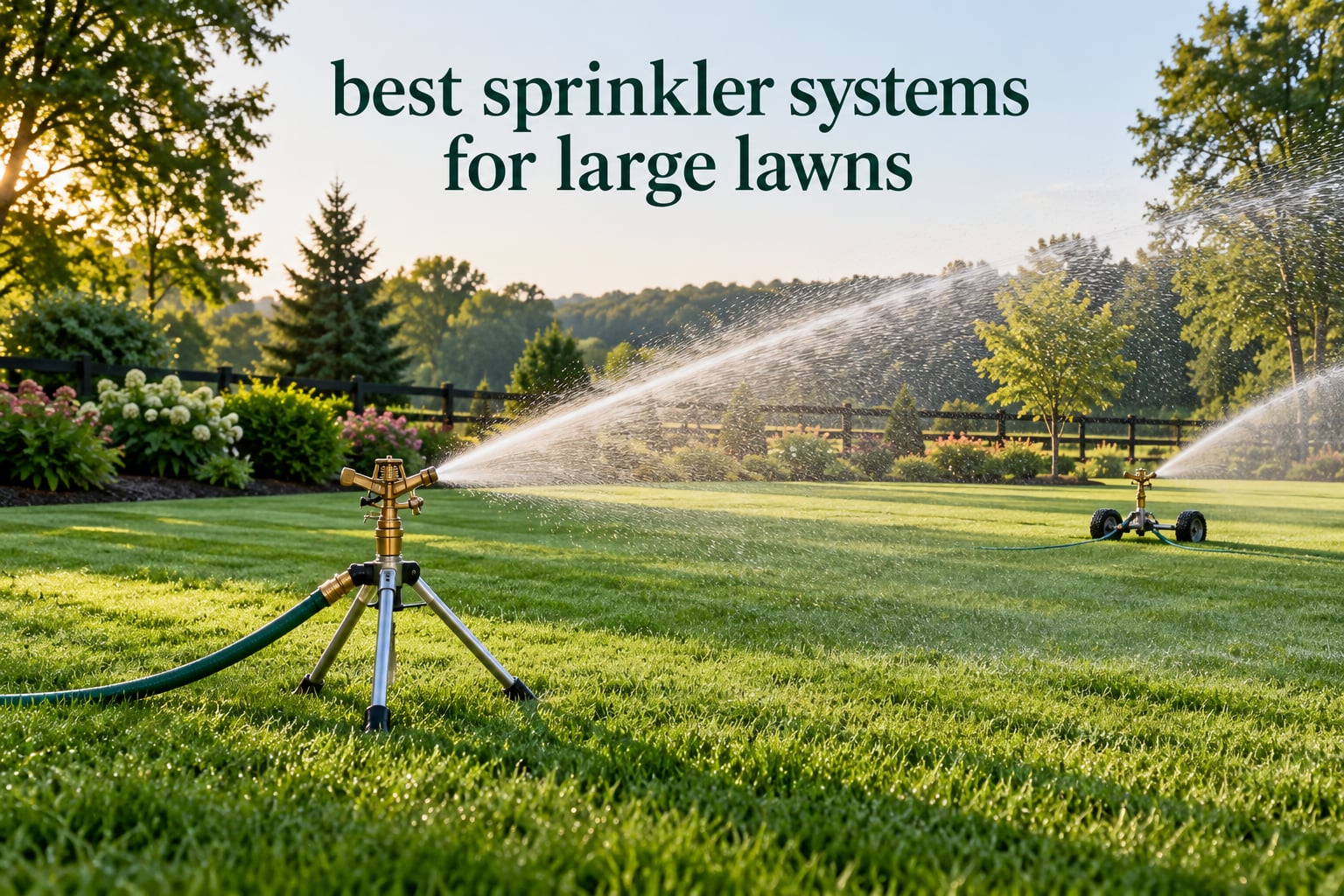
For a large lawn, the right answer is a heavy-duty impact or rotary sprinkler head on a stable tripod, spike or wheeled base, covering 5,000 square feet or more per head. Above-ground systems like these are the fastest way to water a big yard; permanent in-ground kits only make sense once you want unattended, scheduled coverage. Everything below reflects what we found after comparing ten systems on reach, pressure tolerance and stability.
My property is a little over half an acre with a long, narrow front yard that a single circular pattern has never covered properly. Over the past two summers I moved spike sprinklers, borrowed impact heads and finally ran a two-zone setup, and the difference between head types was obvious within the first week.
The biggest surprise was how little the advertised coverage number matters. A head that throws a 40-foot circle on a clean municipal line may manage half that once two more sprinklers are chained onto the same hose, which is the single most common complaint in lawn forums. Sizing to your flow rate matters more than sizing to the number printed on the box.
That is why this roundup breaks the category into the five sub-types that actually appear in the shopping results: spike-base gear-drive heads, brass impact heads on tripods, travelling tractors, oscillating units, and permanent in-ground kits. Each section below covers who it suits, what the real-world coverage looks like, and where it falls short.
If your problem is scheduling rather than reach, start with our sprinkler timer comparison and our smart sprinkler controller picks, then come back to the heads here.
Our Top 3 Picks for Acres and Half-Acre Lots

Orbit H2O-Six Gear-Drive Spike Head
- Six spray patterns
- Four-position flow control
- Metal T-spike base
- 65 psi maximum

Orbit Brass Impact Tripod Sprinkler
- Adjustable 22-48 inch height
- Brass impact head
- 80 psi maximum
- 25 gpm maximum

Orbit Traveling Tractor Sprinkler
- Self-propelled along hose path
- Cast-iron body
- Automatic shut-off
- Three speed settings
We picked these three because each solves a different shape of problem. The gear-drive spike head is the workhorse you can chain into a zone, the brass impact tripod reaches furthest from a single head, and the travelling tractor covers ground while you are not standing next to it.
Comparing Every Sprinkler System in This Roundup for 2026
| Product | Specs | Action |
|---|---|---|
| Orbit H2O-Six Gear-Drive Sprinkler |
|
Check Latest Price |
| Orbit Brass Impact Tripod Sprinkler |
|
Check Latest Price |
| Orbit Traveling Tractor Sprinkler |
|
Check Latest Price |
 Hourleey Impact Sprinkler Tripod 2 Pack Hourleey Impact Sprinkler Tripod 2 Pack |
|
Check Latest Price |
 Biswing Impact Sprinkler Tripod 2 Pack Biswing Impact Sprinkler Tripod 2 Pack |
|
Check Latest Price |
 Melnor XT Oscillating Sprinkler Melnor XT Oscillating Sprinkler |
|
Check Latest Price |
 Rain Bird 32ETI In-Ground Kit Rain Bird 32ETI In-Ground Kit |
|
Check Latest Price |
 Triumpeek Impact Sprinkler Tripod 2 Pack Triumpeek Impact Sprinkler Tripod 2 Pack |
|
Check Latest Price |
 Aiper IrriSense 2 Smart System Aiper IrriSense 2 Smart System |
|
Check Latest Price |
 STYDDI Pulsating Sprinkler on Wheels STYDDI Pulsating Sprinkler on Wheels |
|
Check Latest Price |
One column deserves an explanation before the reviews. The square-footage figures in this table are manufacturer or listing claims, and reviewers repeatedly report that real coverage lands lower whenever more than one head shares a faucet. Treat the numbers as a ceiling rather than a promise.
1. Orbit H2O-Six Gear-Drive Sprinkler – The Head We Chained Into a Working Zone
Orbit H2O-Six Gear-Drive Sprinkler on Metal T-Spike – Customizable Lawn Watering Coverage – Multi-Pattern Rotating Head with Adjustable Spray Range – Durable Outdoor Yard Irrigation Sprinkler – 58573
Metal T-spike base
Six spray patterns
Four-position flow control
65 psi maximum
Pros
- Six selectable spray patterns let you target one patch or a full 360 degree circle
- Four-position flow control fine-tunes output for even coverage
- Quick spike-and-hose setup
- Metal T-spike feels sturdier than plastic spike designs
- Quieter than impact heads
Cons
- Gear-driven rotation can stall when several heads share one zone
- Throw drops well short of the advertised 40 ft when heads are chained
- Diffuser settings tend to dribble at the base
This is the unit I have running at the head of my zone, and it earned the top spot for one reason: adjustability. Six spray patterns plus a four-position flow collar mean I can dial one head back to a narrow jet for the dry strip along the driveway while a second head runs a full circle on the open turf.
Because it is a spike rather than a tripod, repositioning takes seconds. When a storm knocks the pattern out of place or a head gets bumped, I pull it up and move it in under a minute, which matters when you are managing several zones across a big yard.
The metal T-spike also survived a season of being dragged over seeded ground without tipping, which is where cheaper plastic spike heads tend to lean and stop covering.
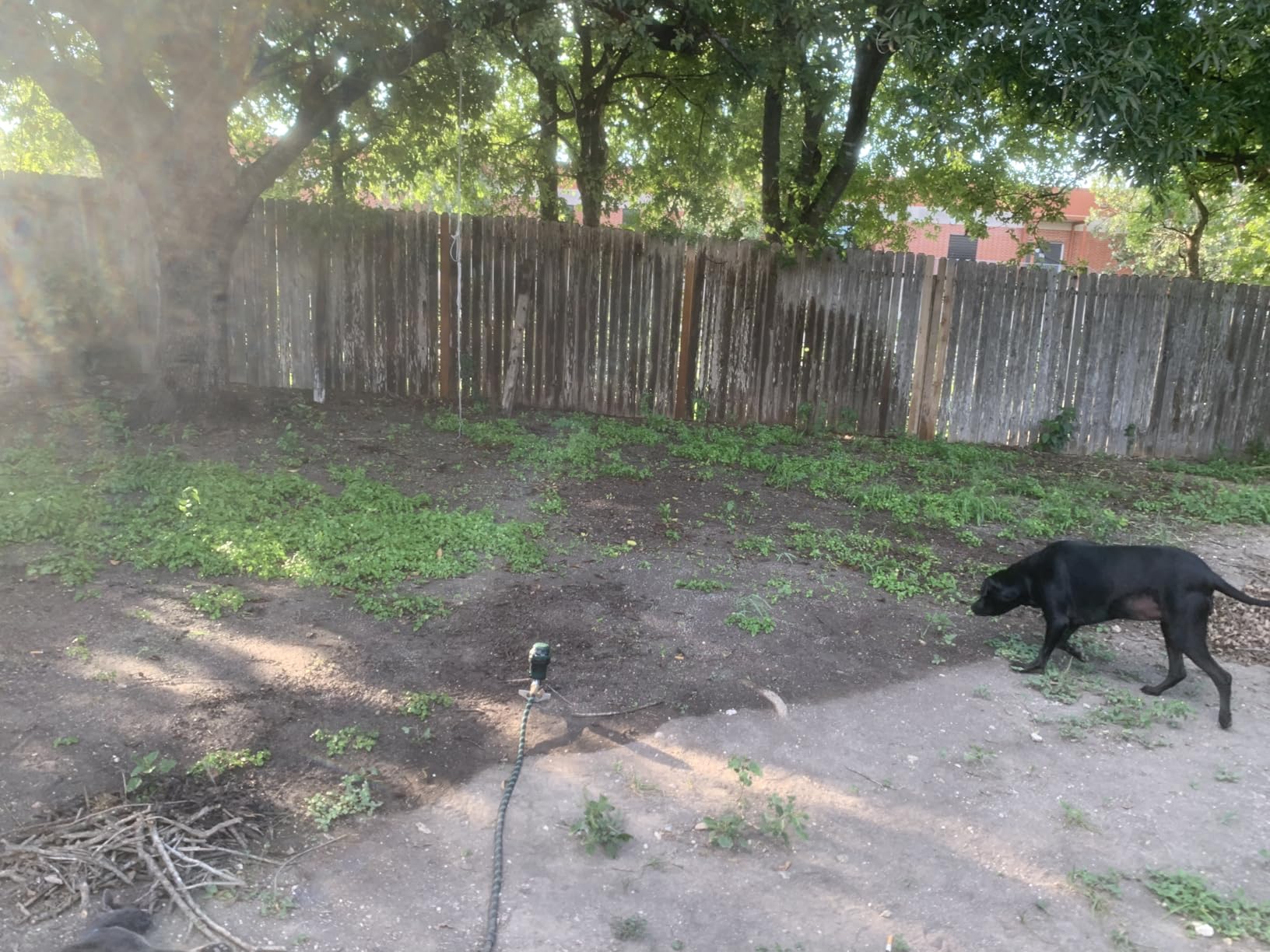
Six spray patterns and the four-position flow collar
Most single-pattern heads waste water on pavement. This one lets you select the pattern from the collar tabs, concentrating output on a narrow area or widening to a full circle when you move to open grass. I have used the narrow setting to soak a strip of new seed without touching the adjacent driveway.
The four-position spray control is a separate adjustment from the pattern itself. It governs flow output, which is how you stop a head on a high-pressure line from blasting one wedge of lawn while the rest stays dry.
65 psi ceiling and what happens in a chain
The listed maximum pressure is 65 psi, and it handles the low-to-mid residential range without trouble. The catch is chaining, where owners report the head sometimes stops advancing and sprays from a fixed position instead of rotating through the pattern.
Throw distance is the other reported shortfall. Buyers describe a marked drop in reach once three heads share a single supply, with real-world radius closer to the mid-20s in feet rather than the advertised figure. If you plan to chain units, budget for fewer heads per zone than the box suggests.
Gear-drive noise versus impact-head durability
A gear-driven rotor is quieter than a brass impact head, which matters if the system runs at five in the morning near a bedroom wall. The trade is that the gear train is the part that can stall under multi-head load, whereas an impact head keeps knocking even with lower pressure.
Reviewers also note a small weeping leak at the head connection and a spike that can slowly work loose over a long cycle, particularly on bare or newly seeded soil. Push the spike in firmly and check it between cycles.
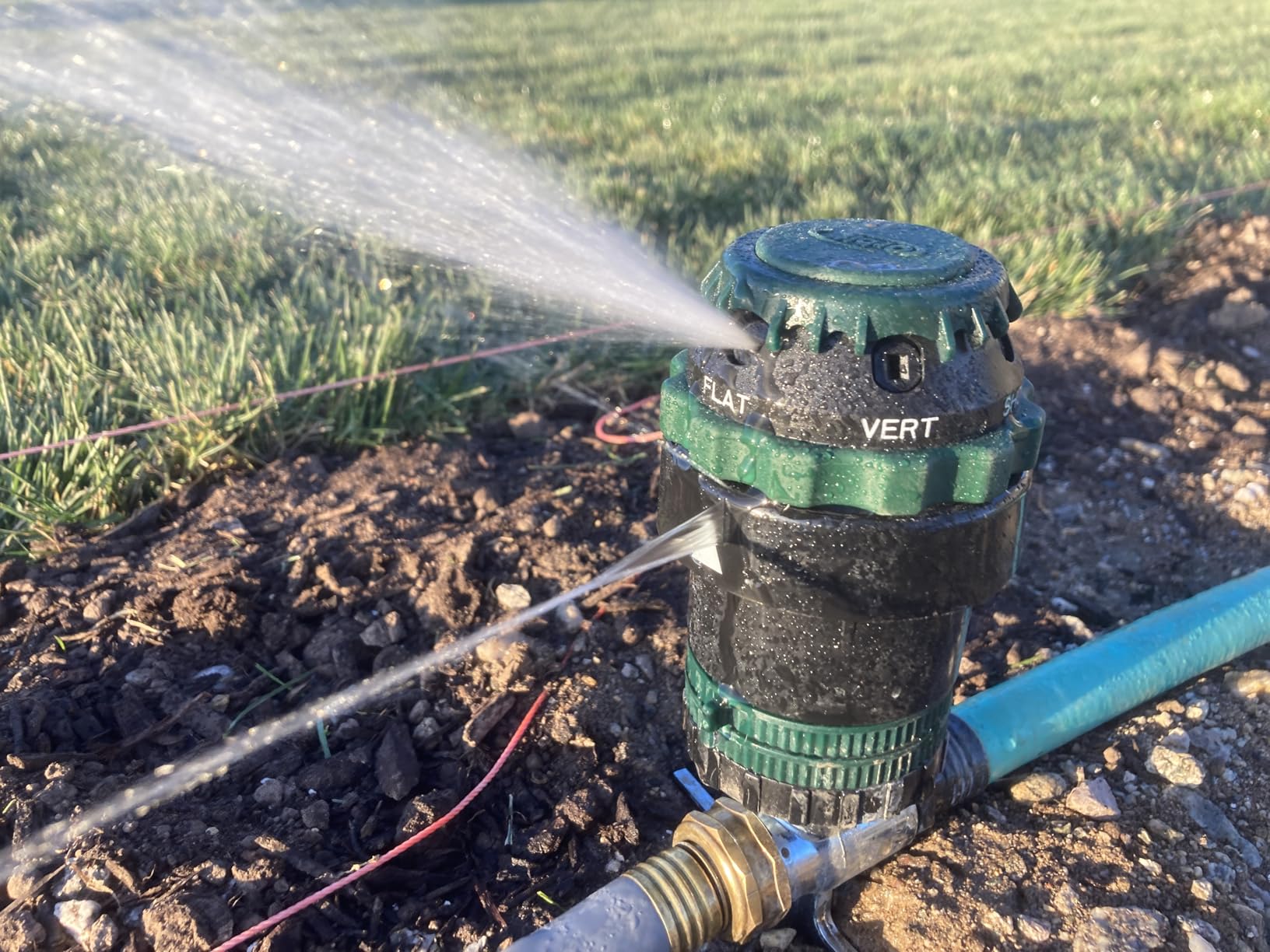
Who this head suits
It suits anyone building a modest multi-head zone on hose or above-ground pipe who needs per-head control over pattern and flow. Buyers commonly purchase several and treat them as a low-cost zone rather than a single coverage solution.
It suits you less if you need one head to blanket a quarter acre on its own, since the reach shrinks once it shares a line. In that case the brass impact tripods below throw further per head.
2. Orbit Brass Impact Tripod Sprinkler – Longest Throw From a Single Head
Orbit Tripod Brass Impact Sprinkler, Adjustable Height – 58308
Adjustable 22-48 inch height
Brass impact head
Aluminum construction
80 psi max
Pros
- Tripod height adjusts from 22 to 48 inches to extend throw and even out coverage
- Brass impact head and aluminum frame are built for long outdoor service
- Precision high-pressure nozzle supports long-distance reach
- Customizable full or partial circle pattern
- Six-year parts warranty
Cons
- Tripod legs can shift on uneven or sloped ground without staking
- Half-inch inlet is smaller than a standard three-quarter-inch garden hose
- Coverage shrinks noticeably on lower water pressure
When the goal is raw reach from one head, the impact tripod is the tool. Raising the head from its low setting to full 48 inches lets the stream travel further before it drops, which is exactly the behaviour you want on a long, open yard with a municipal supply.
The impact mechanism is also the most forgiving if your household pressure sags when other appliances run. Rather than stalling the way a gear-driven rotor can, a brass impact head keeps knocking and keeps laying down water at reduced reach.
My only real complaint came from the fitting, not the head. The half-inch inlet is smaller than the three-quarter-inch hose most people have coiled by the spigot, so plan on an adapter before you start.
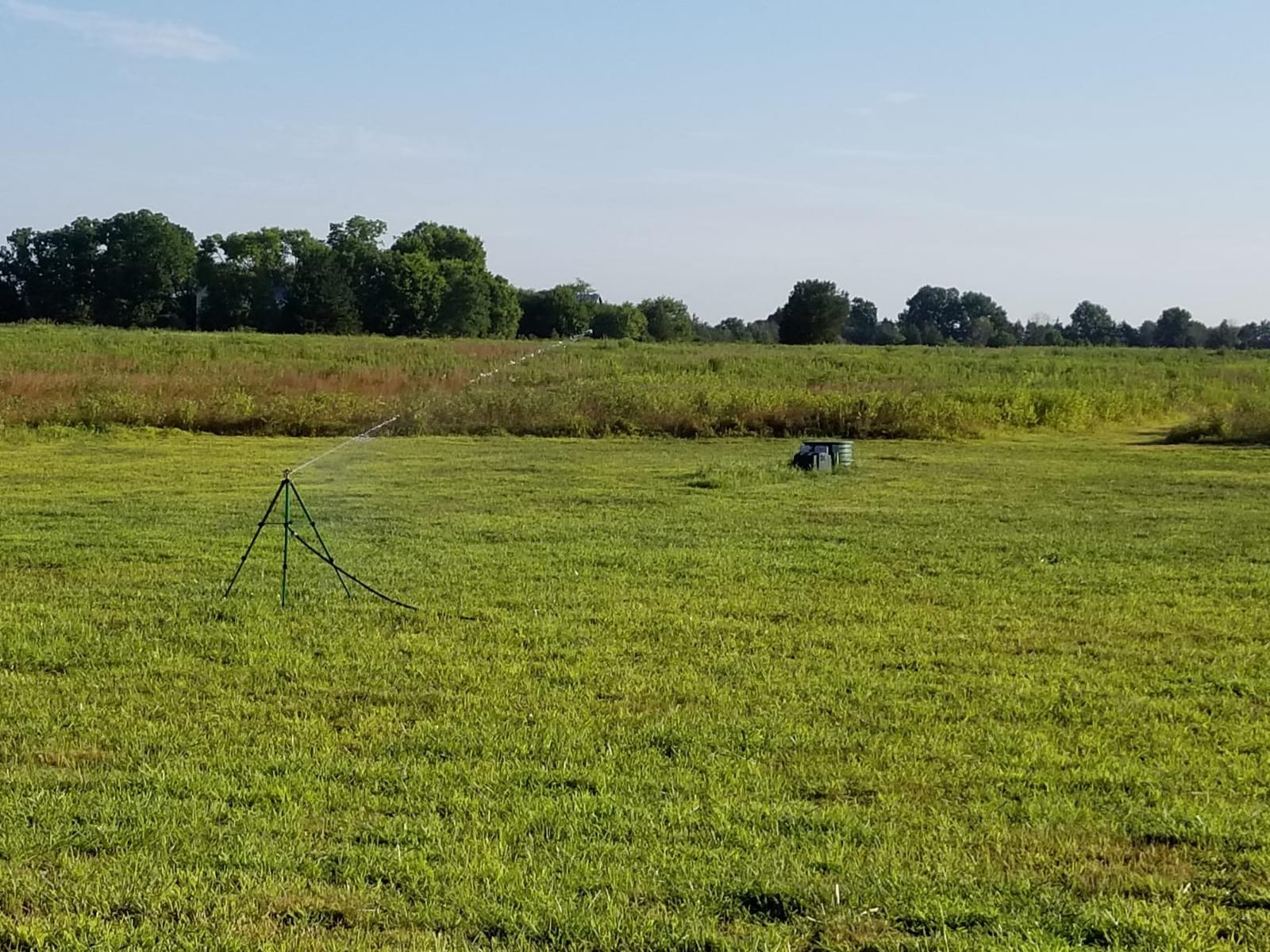
Why height adjustment changes coverage shape
Spray height determines how far water travels before gravity takes over, and a taller head produces a flatter, wider arc. Reviewers report the most even results at the upper part of the 22 to 48 inch range, where the stream stays up longer and reaches past the spray body itself.
Height also changes the footprint underneath the unit. A head set high tends to leave a drier ring right at the base, which is the same complaint the diffuser-equipped models generate for a different reason. Walk the perimeter and check for a dry band after the first full cycle.
Brass head, 80 psi ceiling and a 25 gpm ceiling
The listed maximums are 80 psi and 25 gallons per minute, comfortably above typical residential supply. The practical limit is rarely the sprinkler, though, since it is usually the service line or a splitter feeding two heads at once.
That said, buyers note that coverage shrinks noticeably at lower pressures. If your property runs on a well or a long hose run, treat the head’s range as a maximum rather than a typical result.
Stability on slopes and the adapter question
The tripod legs settle or shift on uneven and sloped ground if you do not anchor them. On my property I weigh the low leg side with a paver, and that stopped the head from creeping across a gentle slope mid-cycle.
The half-inch inlet is the other recurring detail. Standard three-quarter-inch garden hoses need an adapter, and a slightly undersized connection can also starve the head of flow, which looks like a coverage problem rather than a fitting problem.
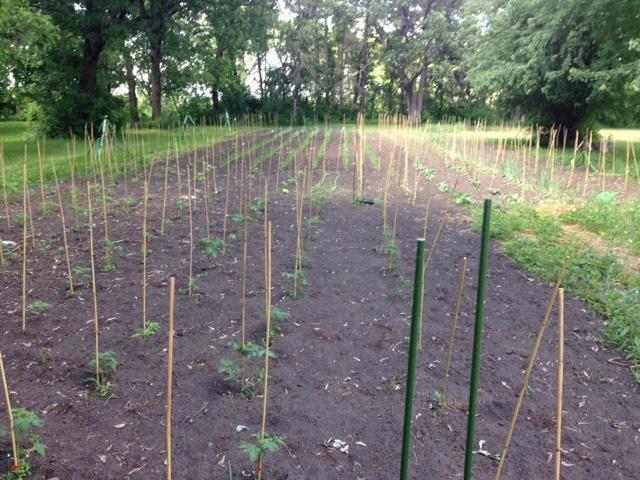
Who this sprinkler suits
It suits owners of half-acre and larger lots with a decent water supply who want maximum reach per head and can tolerate a brass-and-aluminum component that stays out on the lawn all season.
It suits you less if you have very low household flow, or if you plan to place the unit on a pronounced slope and do not want to stake or weight it. The gear-drive spike handles slopes without a tripod at all.
3. Orbit Traveling Tractor Sprinkler – Hands-Free Coverage Along a Straight Hose Path
Orbit Traveling Tractor Water Sprinkler – Self-Propelled Traveling Sprinkler for Wide Lawn Coverage – Cast-Iron Body with Adjustable Coverage – Three-Speed – Automatic Shut Off – 58322
Self-propelled water-powered drive
Cast-iron body
Automatic shut-off at stop ramp
Three speed settings
Pros
- Self-propelled design waters a whole path without you moving it
- Cast-iron body shrugs off knocks and lasts years
- Automatic shut-off stops water at the end ramp
- Three speeds and adjustable arms let you tune throw to lawn size
- Spiked traction wheels roll over uneven ground
Cons
- Derails on sharp turns or with more than about 50 ft of hose drag
- Spray arms can pop out of the plastic T-coupler during use
- Wheels and coupler are plastic even though the body is cast iron
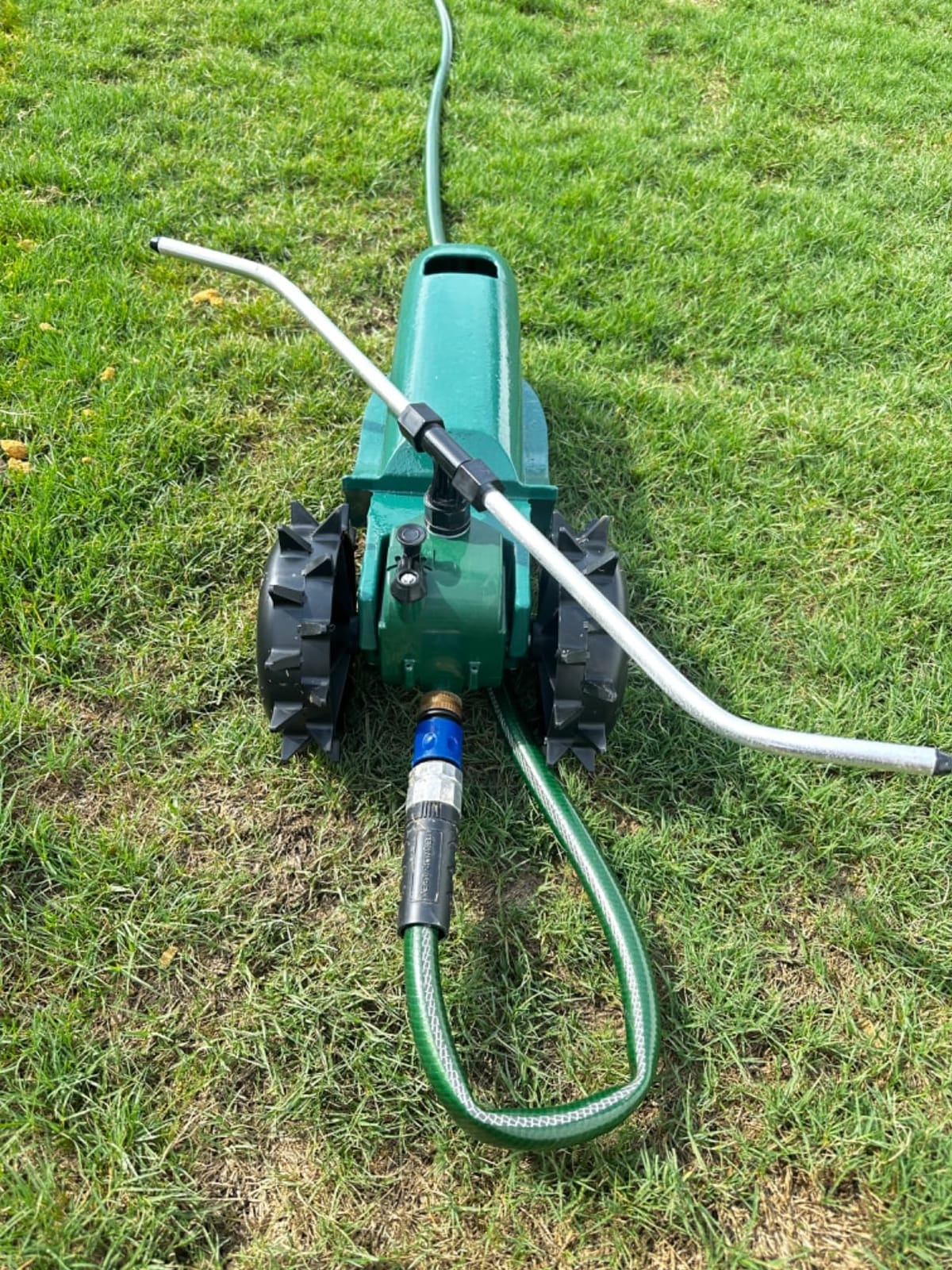
This is the closest thing to an unattended above-ground system you can set up in an afternoon. Lay a hose in a straight line across the yard, set the speed, and the water-powered drive pulls the unit along the path while you go inside.
That makes it a genuinely different answer for a long rectangular lawn, which is a shape a circular head covers poorly. If your big yard has a straight edge to follow, the tractor can cover it without you walking back and forth.
My condition for recommending it is a straight path. The moment you add corners, the geometry works against the wheels and the unit leaves the line.
Straight paths, gentle curves and derailment
Owners who lay out a straight run of 100 feet or less report excellent results. Beyond that, or on any sharp turn, the unit tips off course and waters the wrong area, so the practical limit is how much hose drag it can handle.
Reviewers also warn that grass kept at 2.5 to 3 inches can prevent the stop ramp from disengaging. The unit then runs past the endpoint of your path, which is worth checking on the first cycle before you trust it overnight.
Automatic shut-off and speed settings
The automatic shut-off at the stop ramp is the feature that makes this viable for large lawns, because a cycle ends without wasted water. It depends on the ramp engaging properly, so give it a supervised first run.
Three speed settings and adjustable spray arms let you trade travel rate against reach. Slower speeds with longer arms give a wider band along the path, which is how you approach the width of a long strip of grass.
Cast iron body, plastic running gear
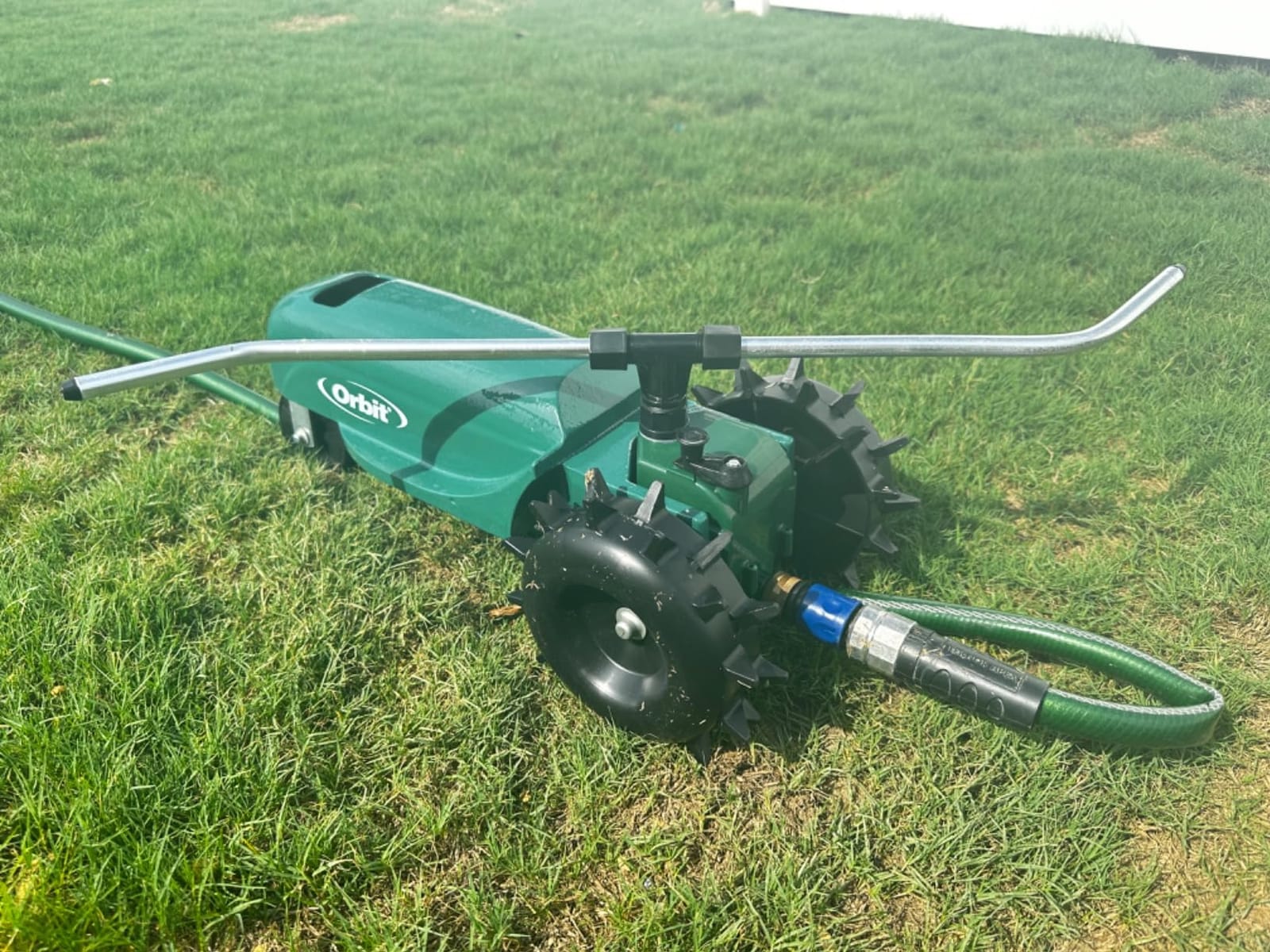
The cast-iron body is the part that feels indestructible and shrugs off the knocks that destroy lighter units. The running gear is not: the wheels, the stop valve, the coupler and the motor assembly are all plastic, and those are the components owners report needing to keep an eye on.
Some buyers also report spray arms popping out of the plastic T-coupler mid-run, dumping water locally until you notice. Check the couplers after the first few cycles while the hoses are still new and pliable.
Who this system suits
It suits owners with a long, straight run of turf who want full coverage without returning to move a head, and who can lay hose before they water. The cast-iron body and six-year parts warranty suit owners planning to keep it for seasons.
It suits you less if your lawn is oddly shaped or full of obstacles. Reviewers with complex yards report the most frustration, and the cost of re-laying a hose path mid-week is higher than simply moving a spike head.
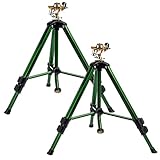
4. Hourleey Impact Sprinkler Tripod 2 Pack – The Two-Zone Value Pick
Hourleey Impact Sprinkler on Tripod Base, 2 Pack Heavy Duty Sprinklers for Lawn Yard Garden, 0-360 Degree Large Area Coverage, 3/4 Inch Connector Extension Legs Flip Locks with Brass Head
Two brass impact heads
Adjustable 16-27 inch legs
80 psi maximum
20-35 ft radius
Pros
- Adjustable legs extend from 16 to 27 inches and hold on uneven ground
- Brass heads and alloy tripod bodies resist corrosion
- Four head adjustments tune spray distance and angle
- Two units let you run two areas at once
Cons
- Tripod tips over if the hose pulls or the head is bumped
- Flow adjustment screw is sometimes bonded shut
- Minor joint leaks and some zinc parts despite brass labeling
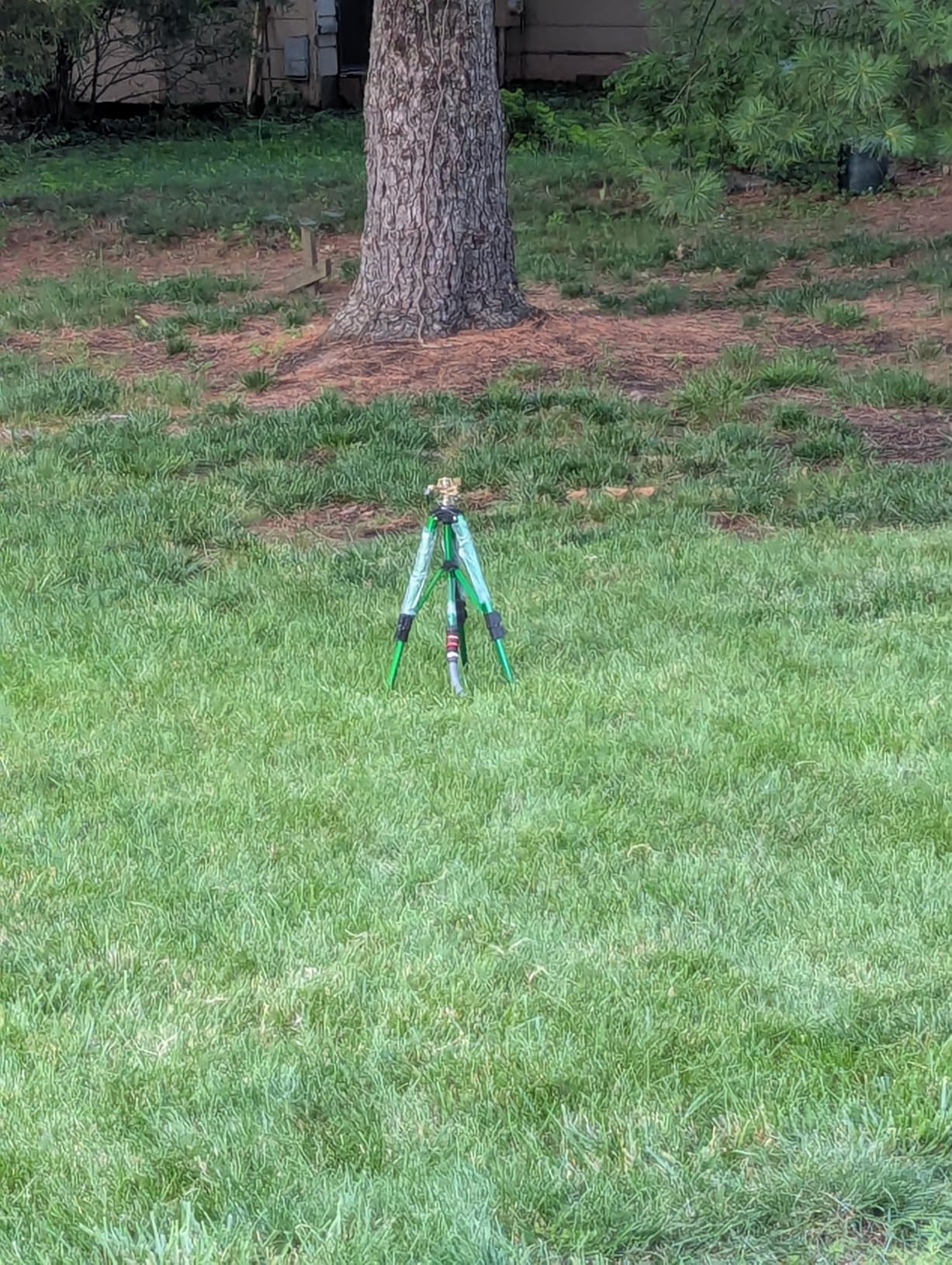
Selling a two-pack changes the math on a large lawn, because two heads on separate hoses is the cheapest way to cover more than one area without splitting a single line’s flow. This set ships with two brass impact heads and two tripod bases with flip-lock legs.
Owners commonly report steady daily use without major failures over a season. The four adjustments per head let you set one for a full circle and the other for a partial arc aimed at a corner, which is helpful on an irregular lot.
The reason this sits fourth rather than higher is stability. The tripod tips when the hose pulls against it, and that knocks the head out of rotation as well as off position.
Two heads versus one head
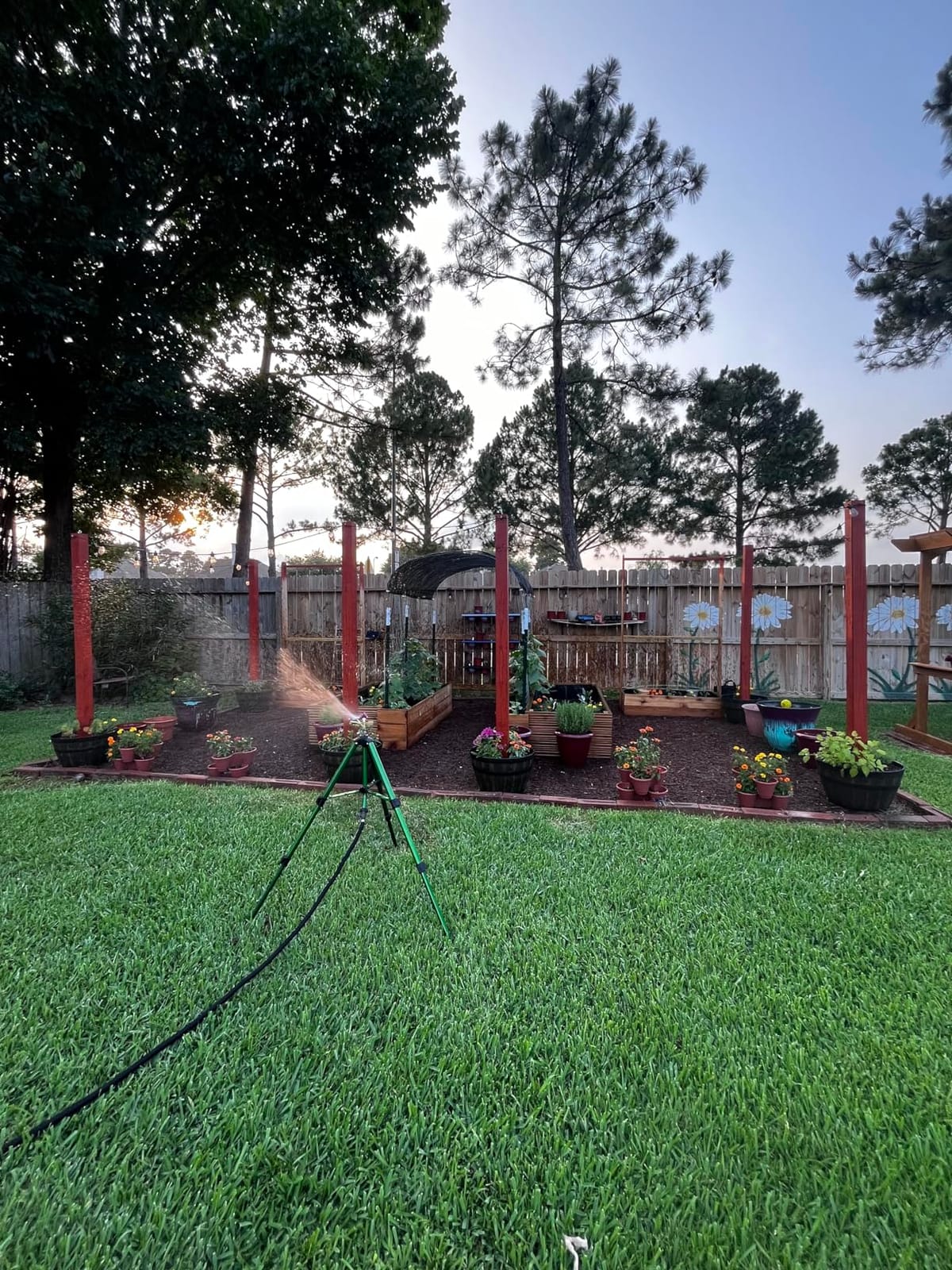
Coverage area scales with how many heads your supply can carry, and a two-pack is the simplest way to increase that number without buying a splitter that splits your flow. Two units on separate hoses is the arrangement most owners settle on.
The trade is that each tripod is individually vulnerable. Stake them, or weight the leg on the hose side, and the tipping problem largely disappears.
Pressure, radius and the 80 psi figure
Listed coverage is about 20 to 35 feet in radius at up to 80 psi. That range reflects the honest truth about impact heads: reach depends heavily on the pressure you actually deliver rather than the maximum the head tolerates.
If your supply is soft, expect the lower end of that figure. Household pressure dropping while other fixtures run is the most common reason owners see smaller circles than expected.
Build quality and the mixed-metal question
The heads are brass and the tripod bodies are alloy, which is a good combination for outdoor corrosion resistance. Some buyers report zinc components mixed into assemblies labeled as brass, so inspect what arrives before you rely on the label.
A second complaint is a flow adjustment screw that arrives bonded with glue and cannot be turned. It is a small inconvenience rather than a failure, but budget for it if you want fine control over output.
Who this two-pack suits
It suits owners who want two brass impact heads without paying for two separate purchases, and who can position each on a straight run. Many owners use one in the open and one aimed at a corner or a garden bed edge.
It suits you less if your terrain is steep. The legs extend to 27 inches, which is lower than some competitors, and reviewers on sloped ground report more frequent tipping.
5. Biswing Impact Sprinkler Tripod 2 Pack – The Tallest and Steadiest Alloy Legs
Biswing Impact Sprinkler Head on Tripod Base, Heavy Duty Lawn Sprinklers, 360 Degree Large Area Irrigation, Metal Sprinkler Nozzle & Solid Alloy Metal Extension Legs Flip Locks, 2 Pack
Two solid alloy tripods
Quick-release legs 16-37 inches
20-60 PSI recommended
20-35 ft radius
Pros
- Quick-release leg clips make height changes and leveling fast
- Solid alloy tripod and heavy head resist rust
- Goose-neck connector with a filter O-ring screens out grit
- Two units cover separate areas of a big yard
Cons
- Tripod topples at higher flow unless staked or weighted
- Spray pattern adjusts poorly with little water landing near the head
- Baffle that changes reach can be pushed open by pressure
The distinguishing feature here is leg range. Quick-release clips take the tripods from 16 to 37 inches, which is the tallest adjustment in this group and gives you more room to set a head above a shrub line or on a slope.
Owners often compare the alloy build favourably against costlier branded heads at the same reach. The goose-neck hose connector with a rubber filter O-ring is a small detail that matters on a property where sand and grit blow across the lawn.
The frustrating part is spray adjustment. Reviewers report a gap in coverage between the head itself and the far reach of the stream, so the near ring stays drier than the middle.
16 to 37 inches of leg travel
Taller legs mean a flatter arc and longer throw, but they also mean a higher centre of gravity. On level ground the alloy frame handles that fine; on a slope, use the included clips to level before you open the valve.
The quick-release design is genuinely faster than bolt-locked legs, which matters when you are repositioning a head every few days during a dry spell.
Coverage quality and the near-head dry gap
Recommended operating pressure is 20 to 60 psi with coverage of roughly 20 to 35 feet in radius, and real results cluster at the lower half of that unless your supply is strong. The pattern is wider than it is uniform.
Several owners report a baffle that controls reach being pushed open by water pressure, which locks the setting and leaves you with a fixed pattern. Check the pattern after a few minutes of running, not just at startup.
Stability, inlet parts and durability
This tripod topples at higher flow rates unless it is staked or weighted, and bumping the head stops rotation entirely. That is a recurring theme across this category, so treat anchoring as part of setup rather than an optional extra.
Some buyers report the inlet gasket and mesh filter falling out when the hose is disconnected, and a minority report heads arriving bent, cracked or already stopped rotating. Inspect both units on arrival.
Who this two-pack suits
It suits owners with uneven or gently sloped ground who need more leg adjustment than a 27-inch tripod offers. The two-pack also suits owners who want one head per zone from separate spigots.
It suits you less if your water pressure is marginal and you need the extra reach from a 60 psi ceiling. Under those conditions the near-head dry gap becomes the bigger problem.
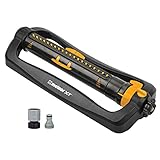
6. Melnor XT Oscillating Sprinkler – Even Rectangular Coverage for Oddly Shaped Lawns
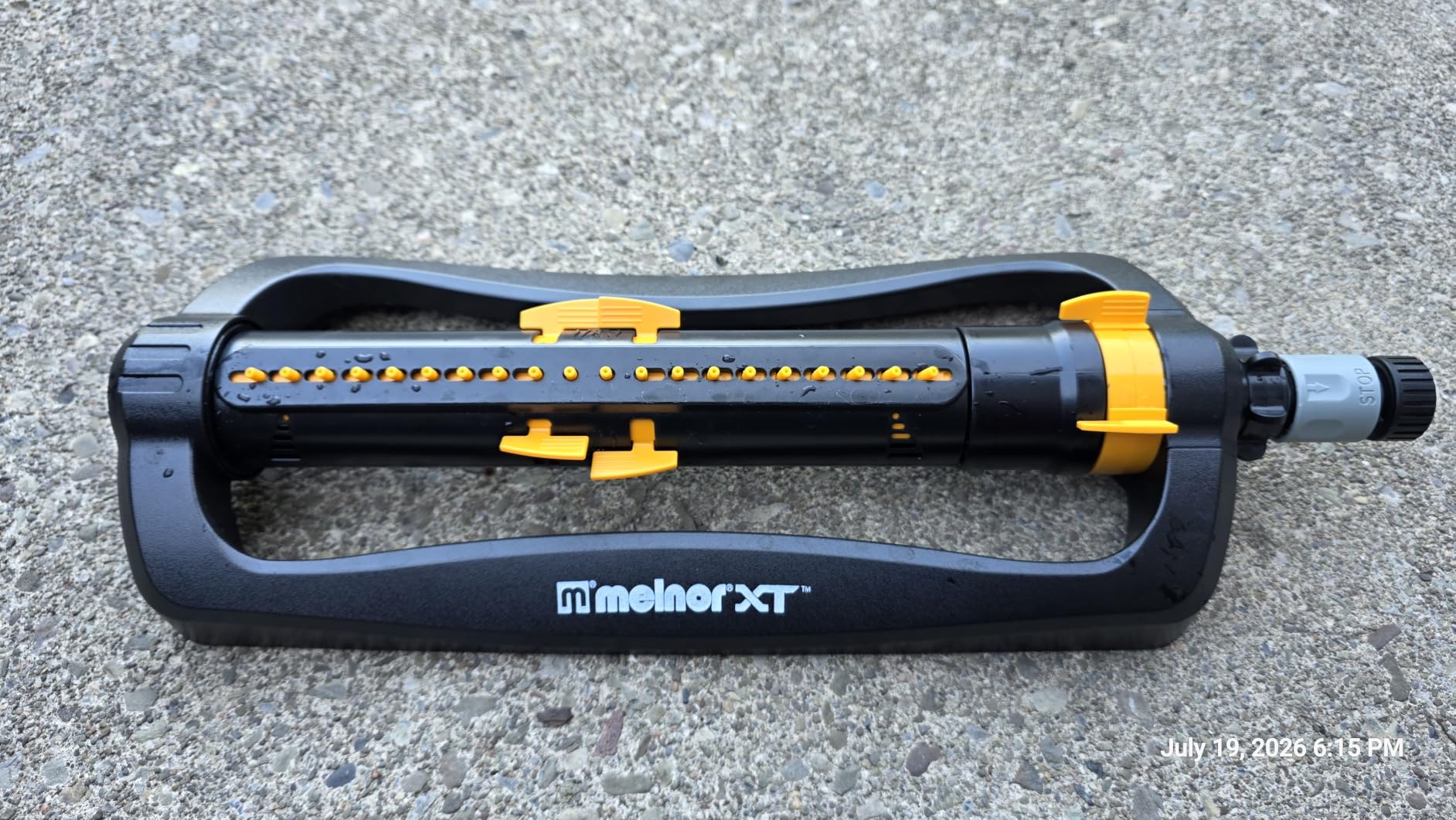
Melnor XT Oscillating Sprinkler, 4500 Sq Ft: Flow, Width & Range Adjust
Coverage up to 4500 sq ft
TwinTouch width and range controls
Zoom Control overall area
20 precision nozzles
Pros
- Oscillating pattern with 20 nozzles covers up to 4500 sq ft
- TwinTouch controls adjust width and range independently
- Zoom Control scales the area from a seeded patch to a full yard section
- Watering width indicators let you record your settings
- Limited lifetime manufacturer warranty
Cons
- Oscillating arm knocks out of alignment and breaks the even pattern
- Coverage falls short of 4500 sq ft at low household pressure
- Width indicators are hard to read once the unit is on the ground
This is the only rectangular-pattern unit in the group, and on a long narrow lawn that matters more than raw square footage. An oscillating head lays down a wide, even band rather than a circle, which is the shape most large side yards actually are.
Three separate adjustments mean the same head can serve a newly seeded patch in April and a full section of lawn in July. That versatility is the reason owners keep it in rotation rather than retire it once the season turns.
Coverage is listed at up to 4,500 square feet, and on a strong supply the rectangular pattern is genuinely even. At low pressure the rectangle shrinks, and the arm alignment becomes the thing to watch.
TwinTouch and Zoom Control explained
TwinTouch sets width and range independently, which controls how wide the band is and how far the water reaches down the lawn. Zoom Control scales the whole pattern up or down, so the same unit can water a small bed or a large section.
The width indicators are a practical detail. They let you note the setting that worked last summer, which matters on a large property where you will not be re-tuning the unit every week.
Why oscillation beats impact on rectangles
An impact head wastes a large share of its circle on driveways, fences and beds. An oscillating rectangle can be aligned to a lawn with far less overspray, which on a large lot translates into a meaningful reduction in wasted water.
The trade is wind. A rectangular pattern of finer streams is more vulnerable to drift than the heavy droplets from an impact head, so exposed open lawns get less from oscillation than sheltered ones.
Alignment, breakage and low pressure
The most common complaint is the oscillating arm being knocked out of alignment, which distorts the rectangle and leaves a dead strip. It happens when a foot, a mower or a dog moves the unit.
Owners also report that coverage falls well short of 4,500 square feet when household pressure is low, and that the lighter plastic base is less stable on a slope than a metal tripod model.
Who this sprinkler suits
It suits owners with rectangular or irregular lawns who want even distribution and minimal overspray, especially anyone sharing one head between a small seeded area and a large turf section.
It suits you less on a wide, exposed, windy property where drift is the limiting factor, or on a pronounced slope. An impact head on a metal tripod handles both cases better.
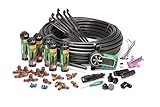
7. Rain Bird 32ETI In-Ground Kit – The First Permanent System Worth Installing
Rain Bird 32ETI DIY Install In-Ground Automatic Sprinkler Kit
Covers 1000-3000 sq ft
125 ft of 1/2 inch tubing
6 pop-up rotary heads
70 psi and 12 gpm maximum
Pros
- Waters automatically all season without moving hoses
- Installs in a single afternoon on an ordinary outside faucet
- Pop-up rotary heads retract flush for clean mowing
- Includes a pro-grade hose-end timer and automatic drain valves
Cons
- Requires digging and laying 125 ft of tubing over a weekend
- Must be drained or blown out in freezing climates
- Multiple zones cannot run at once within the kit flow limits
This is the only kit in the group that is a permanent system, and it is the right first step for a lawn in the 1,000 to 3,000 square foot range. The heads pop up, water, and retract flush, so the lawn mows cleanly and nobody moves a hose.
What convinced me is what it removes. The in-ground approach means the watering happens on a timer whether or not anyone remembers, which is exactly the problem on a big property where two portable heads never quite cover everything.
The scope is the limitation. This kit covers a medium lawn, not an acre, and the trenching is a real weekend of work before the first cycle runs.
What is included in the box
The kit includes a faucet connection kit, a pro-grade hose-end timer, 125 feet of half-inch tubing, six pop-up rotary sprinklers, fittings, automatic drain valves, compression couplers, stakes, cable ties, Teflon tape, a rotor adjustment tool, twelve extra nozzles and a manual.
Automatic drain valves are the underappreciated part. They let you slope the lines and clear them at the end of a cycle, which matters more in a freeze climate than most buyers expect at purchase time.
Coverage, PSI and how many heads you can run
Coverage is 1,000 to 3,000 square feet at 45 to 75 psi, with listed maximums of 70 psi and 12 gallons per minute. That 12 gpm ceiling is the real constraint on how the system is laid out.
Owners report that several zones cannot run simultaneously within the kit’s flow limits, which is expected. You are dividing an available flow rate among the heads, and the twelve extra nozzles let you tune rather than add.
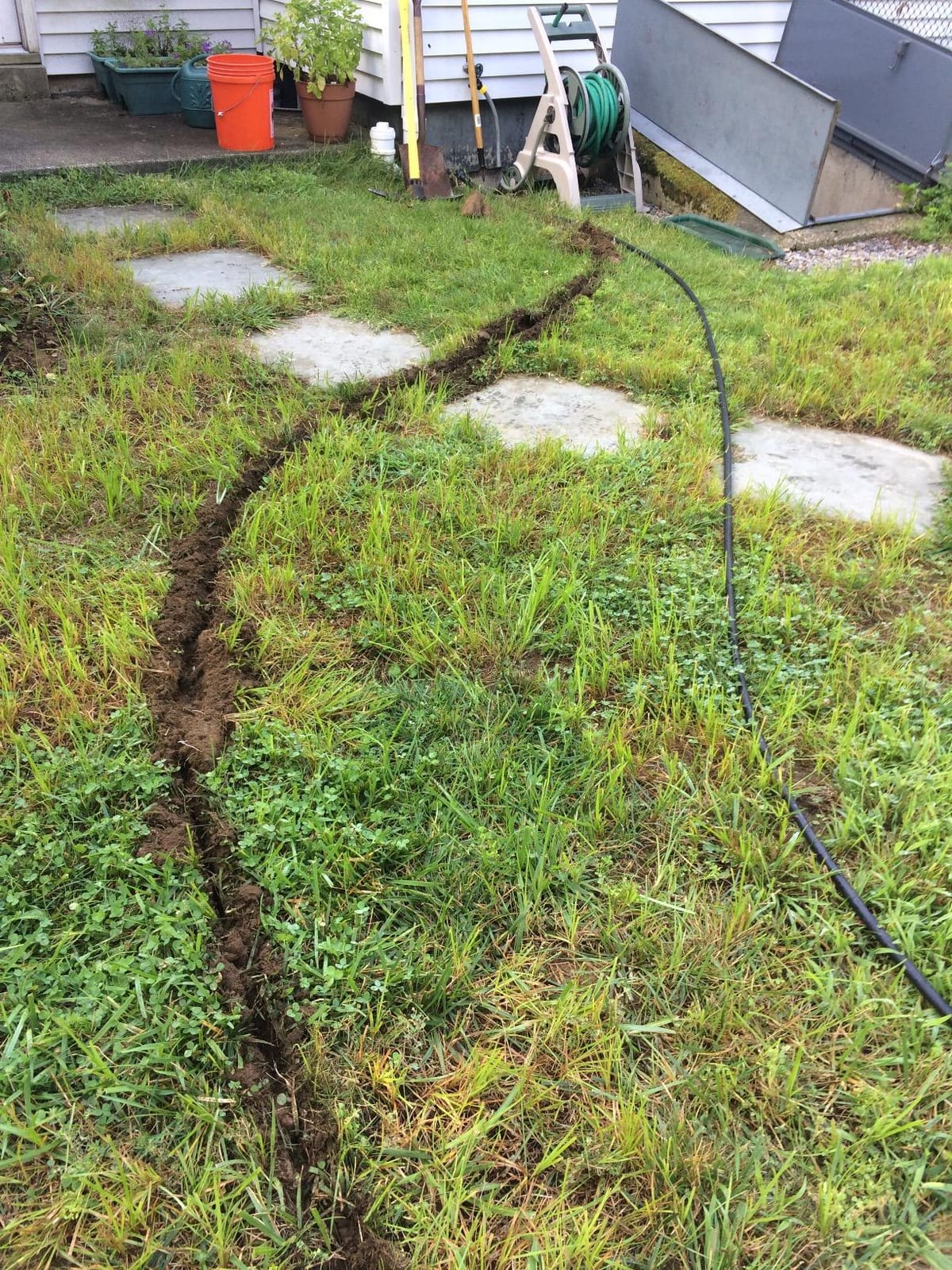
Installation reality and dry patches
Laying 125 feet of tubing is a genuine weekend project, and the reviews are clear that this is the main barrier. Coordinating the dig with seeding or landscaping avoids re-damaging the lawn later.
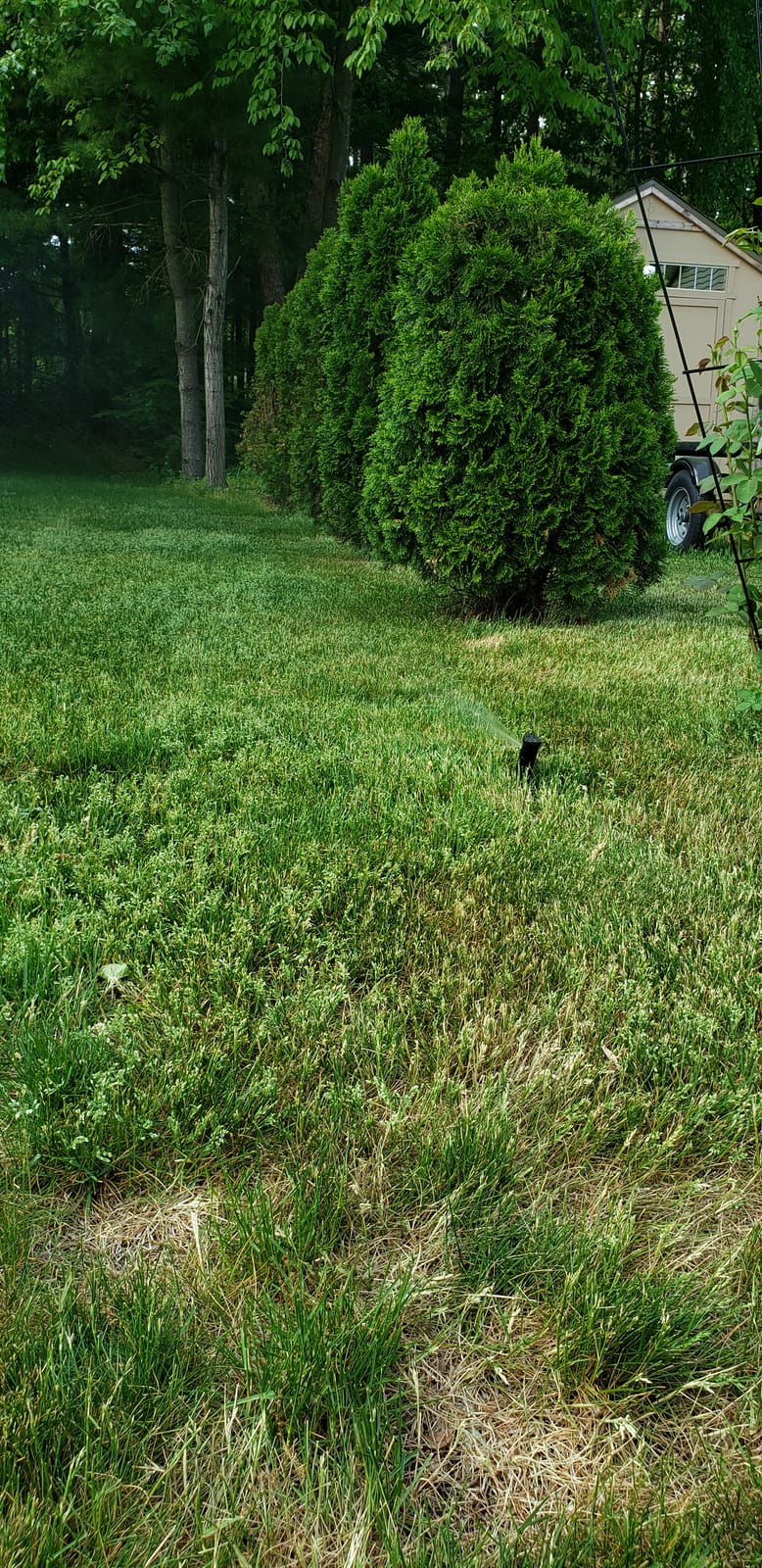
On irregular lawns, some owners need extra heads or fittings beyond what the kit includes to avoid dry patches. Plan the layout before you dig rather than after.
Who this kit suits
It suits owners of a medium lawn who want scheduled, unattended watering and can commit a weekend to the install. The retractable heads and included timer are what make it feel finished rather than temporary.
It suits you less if you are renting, if the lawn is under roughly 1,000 square feet, or if you are on an acre-plus property. For acreage you will want professionally designed zoning, not a hose-end kit.
8. Triumpeek Impact Sprinkler Tripod 2 Pack – Stable Tripods With Stakes Included
Triumpeek 2 Pack Impact Sprinkler on Tripod Base with Stakes
Two brass heads and tripod bases
Six ground stakes included
Three height settings
20-80 PSI operating range
Pros
- Includes six ground stakes that add real stability
- Three tripod height settings from 19.7 to 37 inches
- Assembles in a few minutes with basic connections
- Filter screen at the inlet helps prevent nozzle clogging
Cons
- Auto-reset step mechanism can stick and needs a manual nudge each cycle
- Claimed throw distance is optimistic compared with real radius
- Quality is inconsistent across units
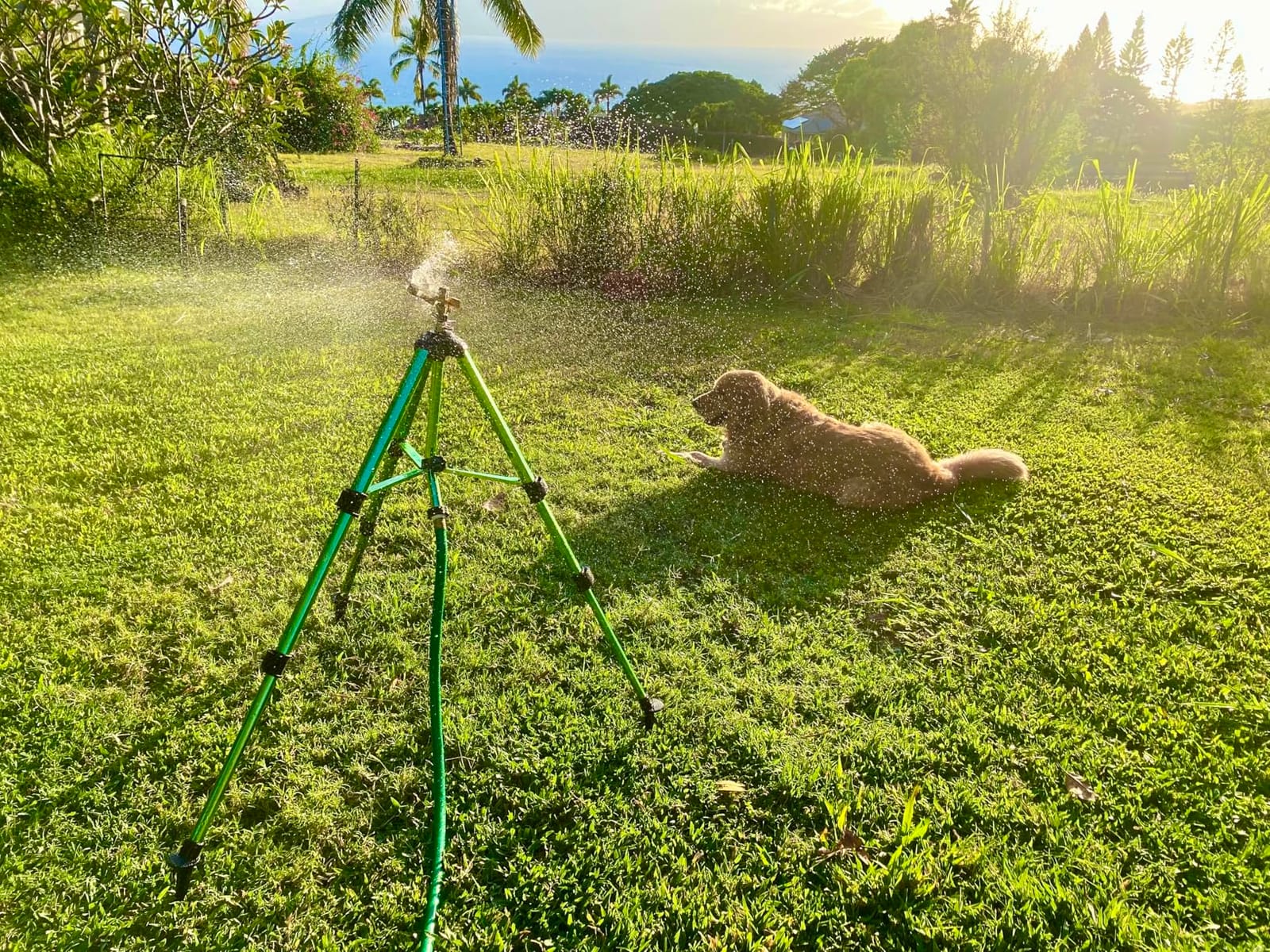
The included stakes are the reason this two-pack solves the tripping problem that plagues cheaper tripods. Six stakes go into the ground and the base stops wandering when the hose pulls or a head gets bumped.
Three height settings between roughly 20 and 37 inches give enough adjustment for most lawns, and the brass heads hold up well in daily service. Many owners describe it as the best sprinkler they own for what it costs.
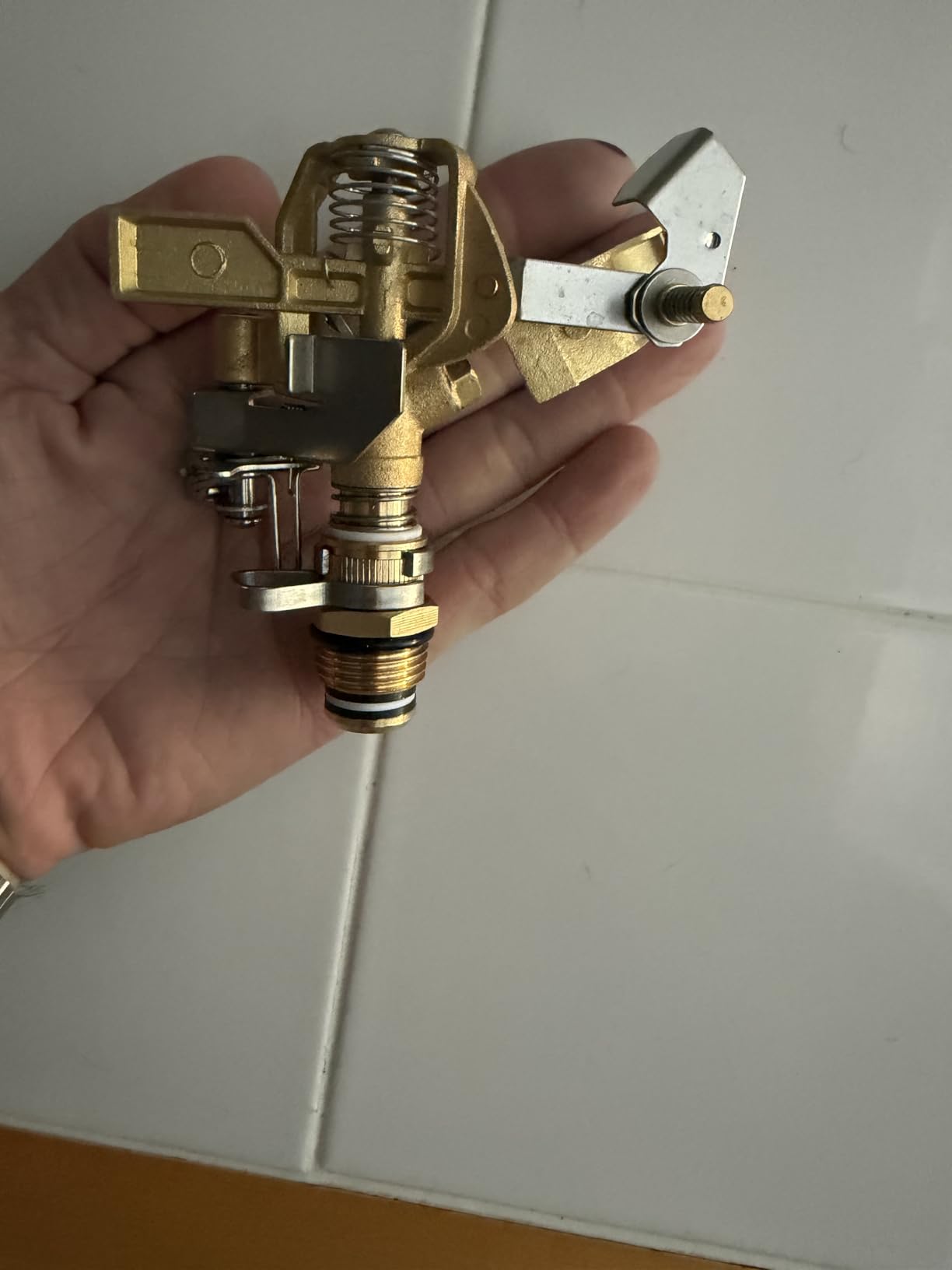
The specific flaw is the auto-reset mechanism. The tab that should return the head to its start position can stick, leaving the head spraying one spot until you walk over and nudge it, and some units need the reset pieces removed entirely.
Why the stakes matter more than the head
Almost every stability complaint in this category traces back to a tripod reacting to hose tension. Supplying six stakes removes that failure mode at the source rather than asking the owner to improvise a fix.
That single change is why this budget pick behaves like a higher-tier product in daily use on uneven ground.
Stated distance versus measured radius
Listed throwing distance is 40 to 86 feet at 20 to 80 psi, and owners regularly report real radius closer to 30 feet on flat ground at typical household pressure. Treat the upper figure as a lab number.
The stated operating range of 20 to 80 psi is wide, and a good working point for most properties sits in the middle of it. Check the pattern on the first run and dial the arc in.
Build consistency and the reset tab
Quality is inconsistent across units, with reports of heads that stopped rotating on first use, cracked parts and heavy leaking on arrival. Inspect both units before you set them out.
The auto-reset step is the recurring mechanical complaint. When it sticks, a quick check at the start of each cycle fixes it, but on a large lawn that check is a habit you have to keep.
Who this two-pack suits
It suits owners who want brass impact heads on stable tripods and would rather not buy separate anchors. The multi-height settings suit lawns that need the head raised over a low bed edge.
It suits you less if you leave the system running unattended for a full day, since the reset mechanism needs attention more often than the spring-loaded tripods in this group.
9. Aiper IrriSense 2 Smart System – App Scheduling With a Built-In Rain Sensor
Aiper IrriSense 2 Smart Sprinklers for Yard, Multi-Zone Plant-Specific Watering, Smart Scheduling, Weather-Adaptive Irrigation with Rain Sensor, Irrigation System for Large Lawns up to 4800 sq.ft.
Covers up to 4800 sq ft
Controller, valve and sprinkler in one unit
Built-in rain sensor
Up to 40 percent water savings
Pros
- Combines controller
- sprinkler
- electric valve and feeder in one unit
- Roughly 15-minute setup per the manufacturer
- Multi-zone plant-specific watering with up to 10 irrigation maps
- Built-in rain sensor pauses watering during rainfall
- Up to 40 percent water savings with EvenRain delivery
Cons
- Scheduling depends on an app and account setup
- Requires in-ground placement and line access rather than a stake-in head
- Far fewer owner reviews than established sprinkler brands
This is the highest-rated unit in the group and the newest, and the reason is consolidation. A controller, electric valve, sprinkler and nutrient feeder sit in one body, so the hardware count for a scheduled system drops sharply.
Rain detection is built in rather than added on. When rain falls, the unit pauses, and the app flags incoming weather, which is the behaviour that reduces water use on properties under drought restrictions.
The trade is dependence. Without a phone and an account, the scheduling does not happen, and the system needs fixed placement with line access rather than being something you spike in and move on Saturday.
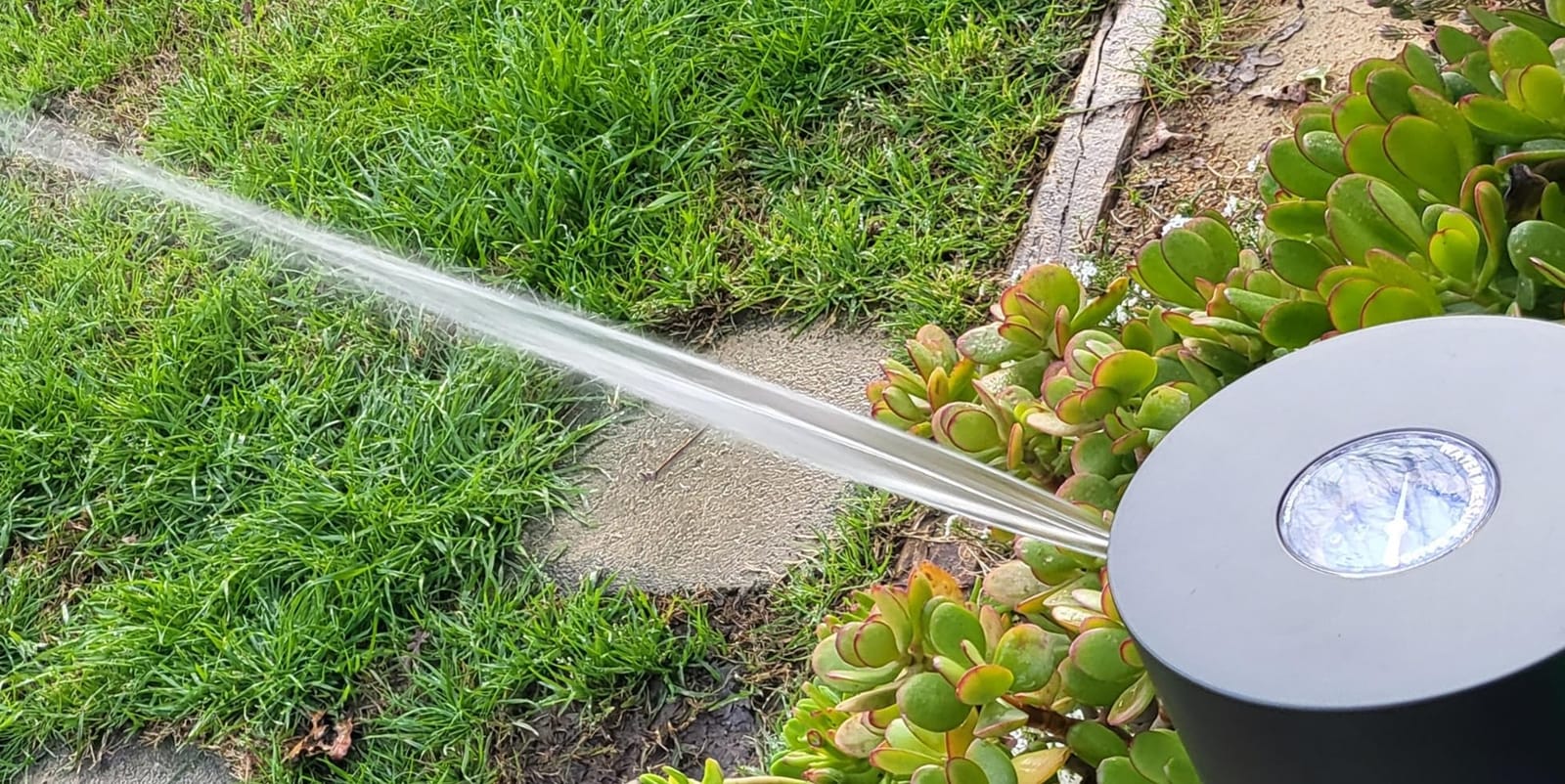
What the 4-in-1 design actually removes
Most above-ground scheduling stacks need a timer, a valve, a manifold and heads. Folding those into one unit means fewer fittings to leak and less to winterize at the end of the season, which is a real saving on a cold-climate property.
Manufacturer-stated setup is around 15 minutes, and owners confirm the physical placement is straightforward once the line connection is sorted.
Multi-zone maps and water savings
Up to 10 custom irrigation maps let you schedule differently for turf, beds and plantings rather than watering everything the same way. EvenRain delivery is described as gentler and more uniform, improving absorption and reducing erosion on sandy soil.
Claimed water savings reach up to 40 percent, which is the highest figure in this roundup. Treat it as a manufacturer claim tied to proper scheduling rather than a guaranteed outcome, since actual savings depend on how the zones are configured.
Placement and durability evidence
This needs in-ground placement and hose or line access, so it is not a substitute for a spike head you move around the yard. Plan the location before you buy rather than after.
With 189 owner reviews, the long-term durability picture is thinner than for the established brands here. Owners rate the design and app highly, but most commentary covers setup rather than years of service.
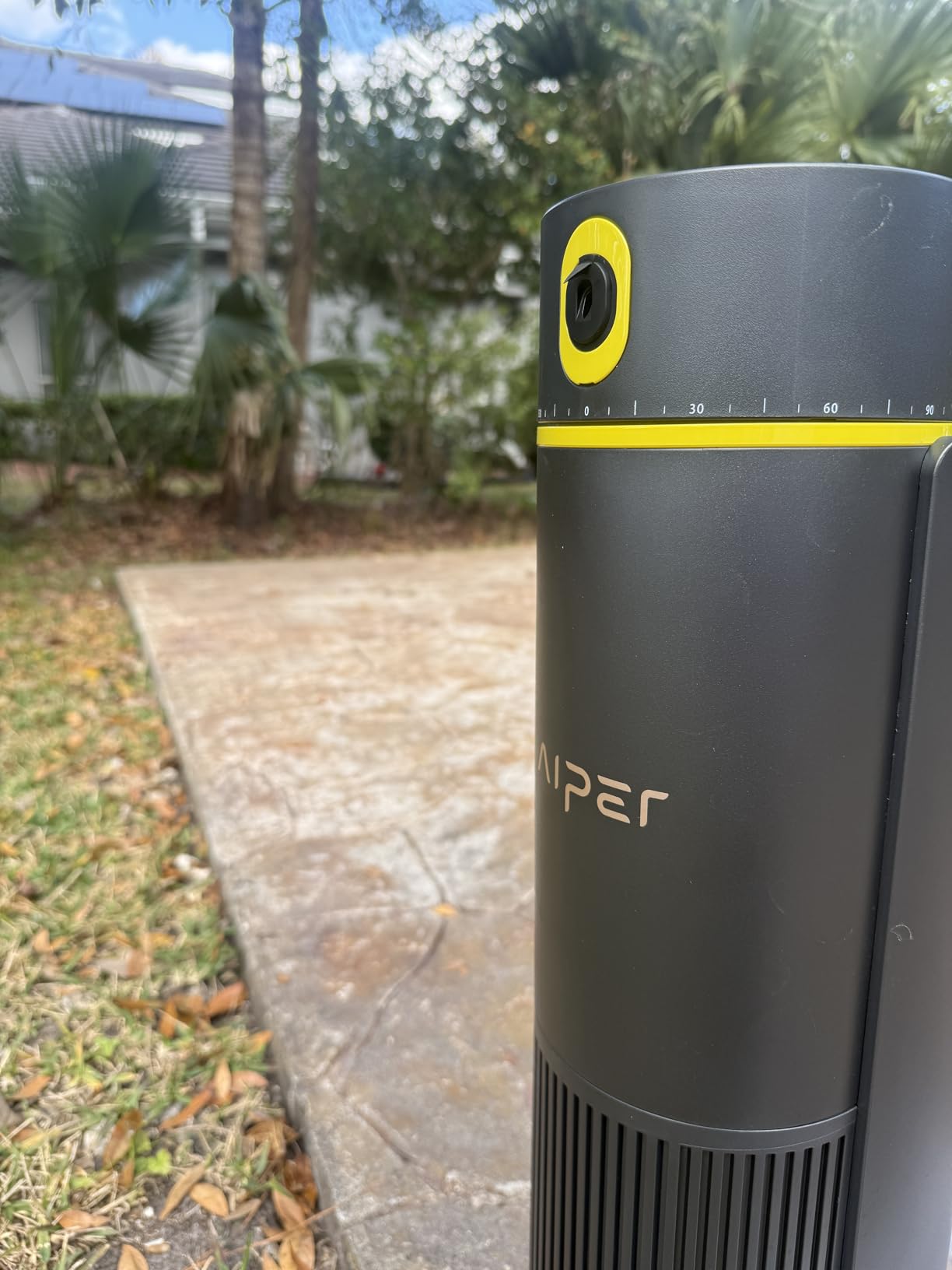
Who this system suits
It suits owners up to about 4,800 square feet who want scheduled watering and multi-zone control without assembling a timer and valve stack. Built-in rain detection suits anyone under drought restrictions.
It suits you less if you want a movable head, if you have no reliable line access at the intended location, or if you prefer to avoid app-based control entirely.
10. STYDDI Pulsating Sprinkler on Wheels – Metal Stability You Can Roll Around
STYDDI Metal Pulsating Sprinkler on in-Series Metal Wheeled Base, Adjustable Circular Water Sprinkler for Medium to Large Circular Lawn, Yard, Garden and Large Areas, Coverage up to 6,360 Sq. ft
Two-wheel metal base
Coverage up to 6360 sq ft
4 gpm flow
100 psi maximum
Pros
- Two-wheel metal base stays upright where tripods tip over
- All-metal body resists rollover under high pressure
- Adjustable pattern from partial circle to full 360 degrees
- In-series flow-through design links several units to one faucet
- Swivel coupling attaches a hose without twisting
Cons
- Fixed 4 gpm flow means real coverage falls short of the stated figure on smaller supply lines
- Wheels are hard plastic and can degrade with long exposure
- Weighted base is heavier to reposition than a spike head
The wheeled base solves the single most common complaint in this category. Tripods tip when the hose pulls or a head is bumped, and this all-metal unit stays upright and can simply be dragged to a new position.
On a large lawn where you reposition constantly, dragging a weighted metal base is faster and steadier than unsticking a spiked tripod from damp soil. Reviewers consistently call the base the standout feature.
Coverage is listed at up to 6,360 square feet, which is the largest claim in the group, but the fixed 4 gpm flow rate is what actually determines how much lawn it can wet on a given supply line.
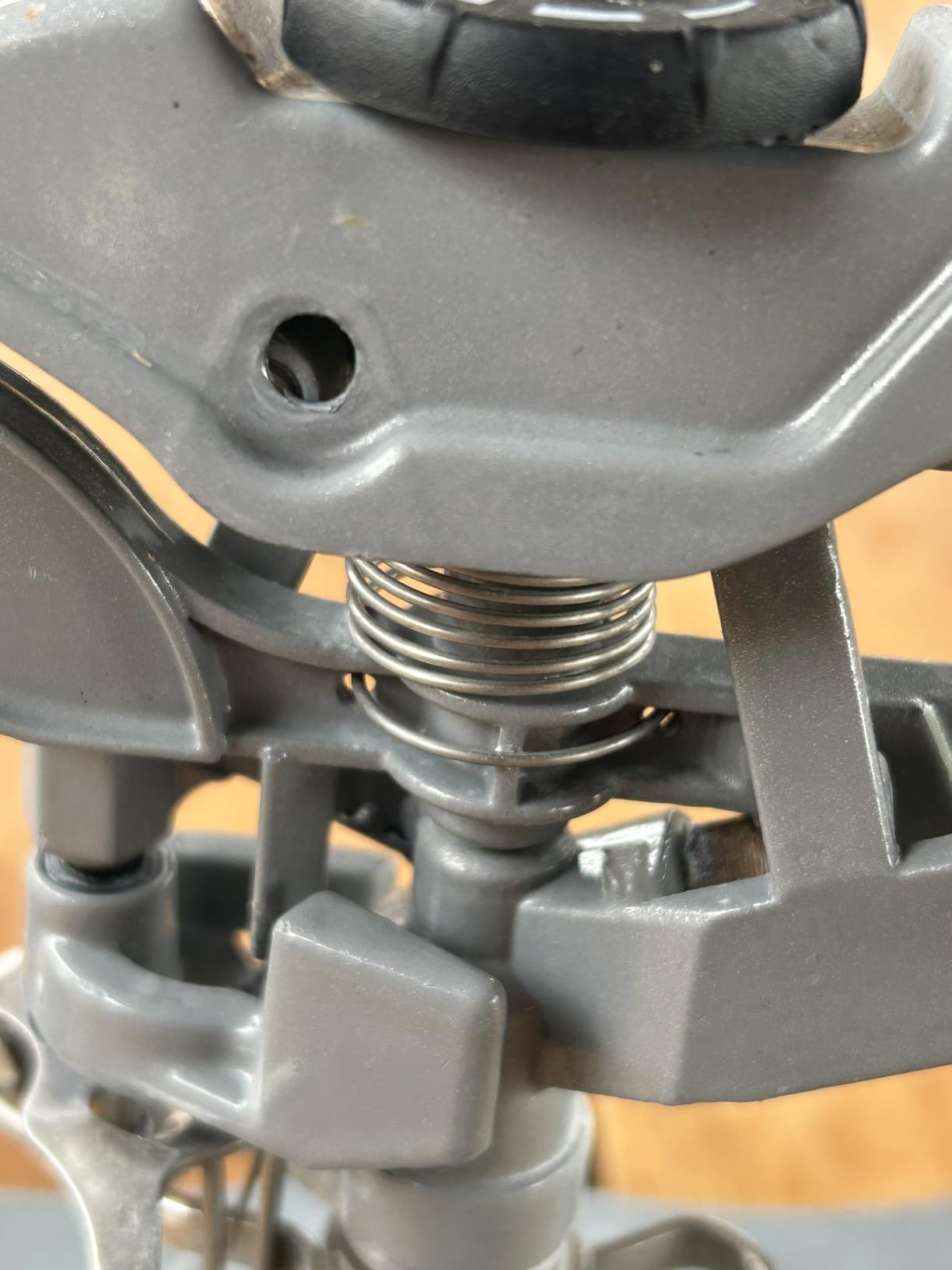
Why a wheeled base beats a tripod on big yards
A metal base with two wheels removes the tipping failure entirely, which matters most on uneven ground and during long unattended cycles. There is no leg to settle and no spike to work loose.
The cost is weight. Dragging the unit across turf takes effort, and on soft or newly seeded ground you can scar a track, so a wheeled base is a repositioning tool rather than a permanent spot.
Coverage claim versus the 4 gpm ceiling
The stated coverage of up to 6,360 square feet is the largest figure here, and it is achievable only with strong supply. With a fixed 4 gpm flow, real coverage on a smaller line falls noticeably short, which owners report directly.
If you want the full circle, confirm the flow available at that tap before you buy. Otherwise treat the coverage number as a ceiling.
Chaining several units from one faucet
The flow-through brass inlet and capped outlet allow multiple sprinklers to be connected in series, which is how you build a multi-head zone without a splitter that throttles every head at once.
That makes it the most practical unit here for owners who want a fixed zone layout. Chaining does still divide your available flow, so keep the head count within what your supply can carry.
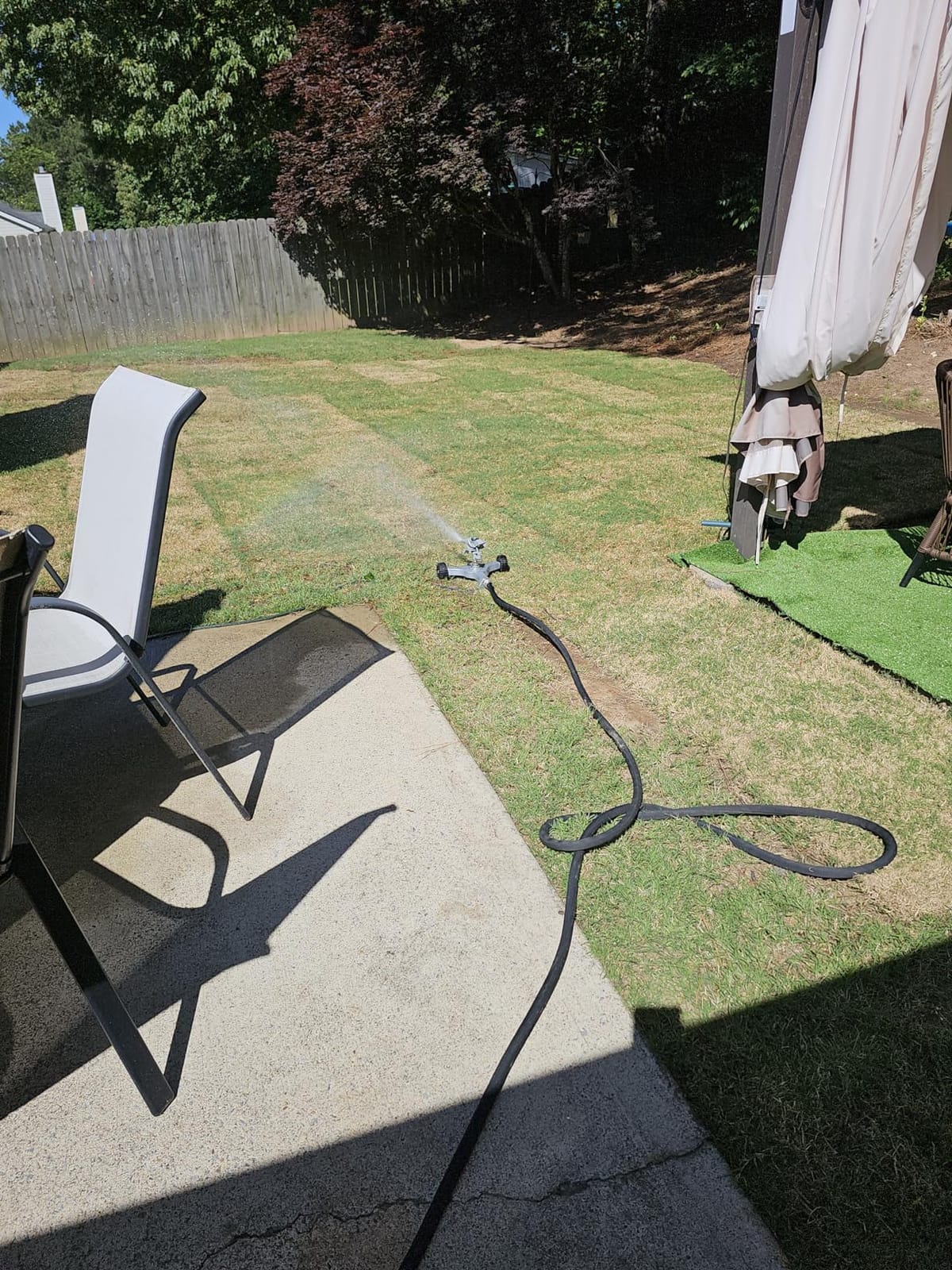
Who this sprinkler suits
It suits owners who reposition often, water on uneven ground, or want a stable metal unit that stays upright without staking. The in-series inlet suits anyone building a chained zone from a single tap.
It suits you less if you need to move it long distances on soft ground, or if the hard plastic wheels are a concern for you in a harsh sun exposure. It is also a poor match for very low-flow supplies given the 4 gpm ceiling.
How to Choose a Sprinkler System for a Large Lawn
After working through ten systems, the choice comes down to four decisions in order: head type, total square footage, available flow rate, and whether you will be around to move things. Get the first two right and the rest follows.
Pick the head type first: impact, rotary, spray or oscillating
Impact heads produce large, heavy droplets that resist wind drift and evaporation, which makes them the standard choice for open, exposed, large lawns. Rotary and gear-drive heads deliver a tighter stream and run more quietly, but they need steadier pressure to keep rotating.
Spray heads cover small, irregular areas such as beds and corners, and they are the wrong tool for a large lawn. Oscillating heads trade a circle for a rectangle, which suits long narrow lawns and wastes less water on paving.
For a large open property, impact or rotary wins. For a long rectangular side yard, oscillation wins. For a lawn that must run unattended, an in-ground kit with a timer wins.
Match the system to your square footage
Under about 5,000 square feet, one strong head repositioned across two or three positions is usually enough. Between 5,000 and 20,000 square feet, you are looking at multi-head zones with a splitter or a chained series.
Past 20,000 square feet, portable setups become a scheduling problem rather than a coverage problem. The forums make the same point repeatedly: owners size their setups to flow rate, not preference, with one commenter running 10 sprinklers per zone and 20 heads across two zones on a 1,250 square foot planting area.
Above roughly an acre, professional design for zoning and pressure is worth the money, mostly because of layout complexity rather than head cost.
PSI, GPM and the heads-per-zone math
PSI is pressure and GPM is flow, and you need both. Too little pressure and a head cannot reach or maintain rotation. Too much pressure and nozzles distort, mist and waste water, and a gear-driven head can stall entirely.
To size a zone, add up the flow of every head you plan to run at once and compare it with what your supply delivers. A household service line commonly supports a limited total flow, and splitting it across too many heads is the reason zones lose pressure in the middle of a cycle.
Fifty psi is generally enough for a residential zone, though impact heads run happily higher, with listed maxima in this group ranging from 60 to 100 psi. Match the head to your actual pressure rather than the other way around.
Coverage and spacing: the 3x rule explained
The 3x rule means spacing sprinklers no more than three times the distance of their throw. A head with a 25-foot radius sits about 75 feet from its neighbour, and that is what produces even head-to-head coverage instead of alternating dry and soaked patches.
For portable setups this explains a familiar frustration: almost every available head throws a circle larger than the lawn segment you need to water, so you end up watering the driveway to get the grass. Narrowing the arc, lowering the flow collar, or raising the head all reduce wasted throw.
Square heads in the corners of a rectangle and half-circle heads along a straight edge are the standard fix for odd-shaped lots, and they are the reason professionals design a zone rather than dotting heads around a property.
How long to run each zone and when to start
Most turf needs about 1 to 1.5 inches of water per week, split across two or three sessions rather than one long run. Deep, infrequent watering builds deeper roots than daily sprinkling, and it reduces the water lost to evaporation.
Start early in the morning. Cooler air and lower wind cut evaporation losses, and water applied overnight has hours to soak in before the sun hits it.
On clay soil or slopes, use cycle and soak. Running a zone in several shorter cycles with pauses between them lets the ground absorb what it can before the next application, which prevents runoff and erosion.
Installation, spring startup and fall winterization
In-ground installs need a backflow preventer, which is both a code requirement on municipal water and the thing that protects your drinking supply. It is the first component to plan, not an afterthought.
Spring startup is short: run each zone one cycle at a time, replace any nozzles that were lost to freeze, and check that every head pops up fully and retracts cleanly. A monthly walk while the system runs catches a broken head long before a brown patch does.
Fall winterization in a freeze climate means blowing out the lines with an air compressor or draining them fully. This scales with system size, and on an acreage property the professional blow-out is usually worth the money, because a single split lateral can be expensive to find and repair under a lawn.
Coordinate any trenching with seeding or landscaping so the lawn is not dug up twice in one season.
Who should not install in-ground yet
Renters, and anyone on a lot under about 1,000 square feet, should start with a portable head. An in-ground system on that scale costs more than the watering problem it solves.
If you have only one spigot and a very long hose run, solve the plumbing before you buy heads. Long runs split flow and drop pressure, and no head performs well at the far end of a starving line.
If you are still deciding between portable and in-ground, start portable. Forum discussion on this question is consistent: owners do not regret beginning with a portable setup and moving up once the lawn outgrew it.
Once you do outgrow it, our guide to smart sprinkler controllers covers the scheduling side, and WiFi sprinkler timers cover the simpler upgrade from a mechanical timer.
Whatever head type you choose, keeping the lawn on a feeding schedule matters alongside irrigation. Our picks for tow behind spreaders for large lawns pair well with a zone layout, since the same square footage has to be walked for both jobs.
Frequently Asked Questions
What is the 3x rule for sprinklers?
The 3x rule says to space sprinklers no more than three times their throw distance apart. A head with a 25-foot radius sits about 75 feet from the next head, which is what produces even head-to-head coverage. Spacing heads closer than that wastes water on the overlap, while spacing them further apart leaves alternating dry and soaked strips.
What is the best way to water a large lawn?
Use heavy-duty impact or rotary heads on stable tripods, spike or wheeled bases, and divide the property into zones so only the heads your water supply can support run at once. Deliver about 1 to 1.5 inches per week across two or three sessions rather than one long run, and start early in the morning to cut evaporation. On slopes or clay soil, use cycle and soak with pauses between short cycles.
Are rotary sprinklers better than impact sprinklers?
Impact sprinklers throw large, heavy droplets that resist wind drift and keep working when pressure drops, making them the usual choice for large open lawns. Rotary and gear-drive heads run more quietly and distribute water more evenly, but they need steadier pressure to keep turning and can stall if several heads share one supply. For an exposed property, impact is usually the more forgiving choice.
Why is my sprinkler zone not getting enough pressure?
The usual causes are too many heads running on one supply, a long or undersized hose run, a partly closed valve, clogged nozzles or a filter screen, and a leak somewhere in the line. Test by running one head alone and comparing its reach to the full zone. Dividing the heads across more zones is the standard fix, since it reduces the flow each zone demands at once.
How long should each zone run on a sprinkler system?
Run time depends on the head’s precipitation rate rather than a fixed number, because a rotor and a spray head deliver very different inches per hour. Target roughly 1 to 1.5 inches of water per week for turf, split across two or three sessions. On clay or sloped ground, replace one long run with several short cycles and pauses so the soil absorbs water between applications instead of running off.
Which Sprinkler System Fits Your Lawn Best
If you want a single dependable head you can dial in and chain into a zone, the Orbit H2O-Six gear-drive spike is our pick. Its six spray patterns and four-position flow collar give you more control per head than anything else in this roundup, which is why it earned our top ranking.
If your priority is reaching the far corners of a half-acre from as few heads as possible, choose the Orbit brass impact tripod. Raising it toward 48 inches flattens the arc and extends throw, and impact heads keep working when pressure drops.
If you would rather not move anything at all and your lawn has a straight run of turf, the Orbit travelling tractor covers a full path unattended and shuts off at the end. If your lawn is rectangular, the Melnor XT oscillating unit gives an even band instead of a circle.
If you want scheduled watering without a timer stack, the Aiper IrriSense 2 handles up to 4,800 square feet with a rain sensor built in, and the Rain Bird 32ETI kit is the simpler route to a permanent in-ground system on a medium lawn. For stability you do not have to stake, the STYDDI wheeled unit stays upright and rolls to the next spot.
Whichever you pick, size the zone to your flow rate rather than to the coverage number on the box. That single decision prevents more dry rings than any head choice will.
We keep this roundup current as new models land, and you can check the latest specifications for every pick on the listings below.
Leave a Reply