
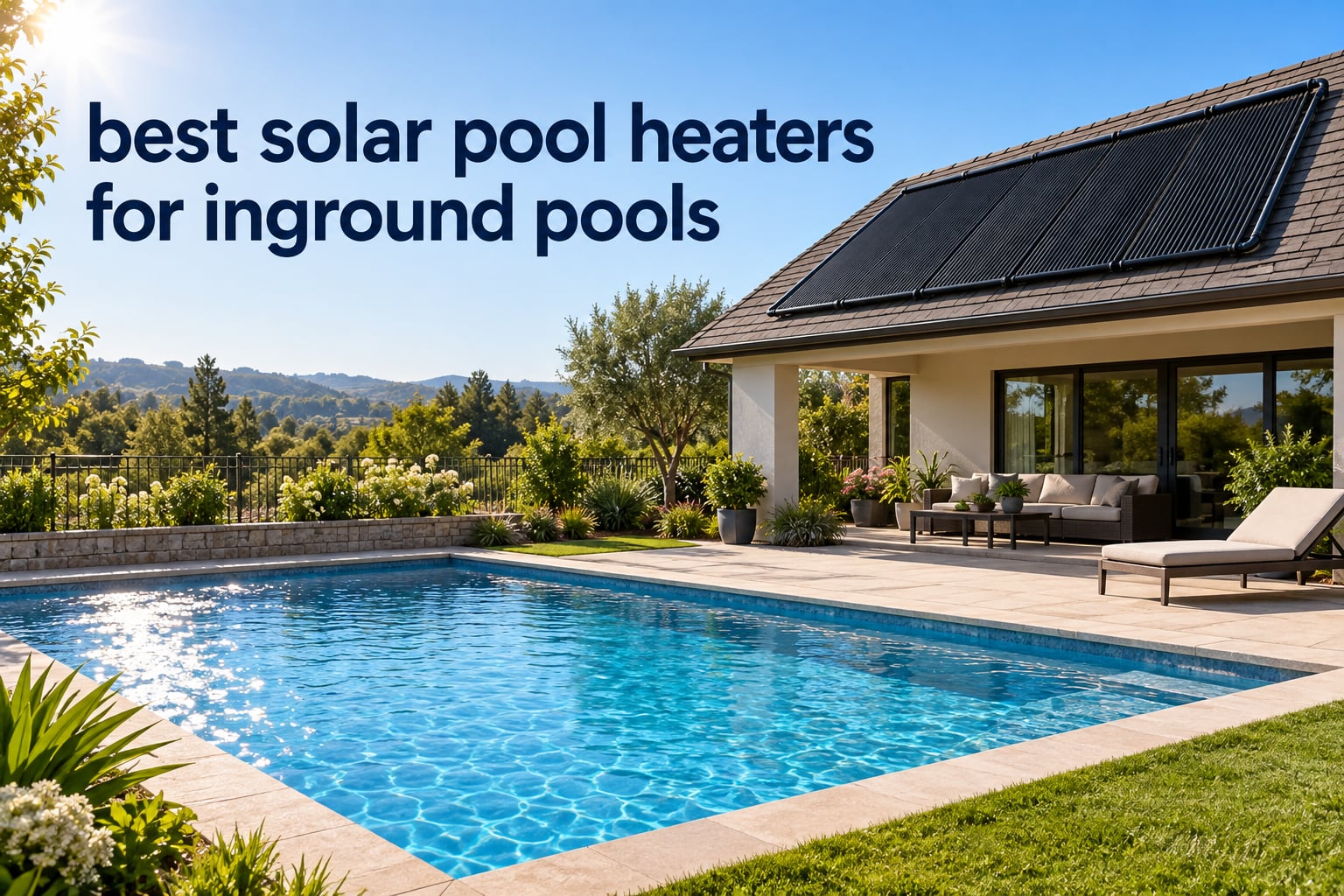
Let me be straight with you before we get into the list: a solar pool heater does not heat a pool the way a gas unit or a heat pump does. It harvests free heat from sunlight and typically adds 8-10°F on a good day. If you are looking for the best solar pool heaters for inground pools, that honest expectation matters more than any marketing claim.
I spent the last two seasons working through the category with a 20,000-gallon inground pool on a south-facing roof deck, comparing eight systems on heat output, mount rigidity, plumbing compatibility and how they held up after a full winter. The single most useful number I found: total solar collector area should equal 50-100% of your pool’s surface area, and 60-70% works for most homeowners. Under that threshold you will chase water all season and never get warm afternoons.
Two conditions decide whether any of this works. First, the panels need 6-8 hours of direct sun. Second, you need a pool cover, because an uncovered inground pool dumps the heat you just collected before breakfast. Skip the cover and no solar system on the market will feel worth the money.
Below I break down eight systems I evaluated for inground setups, ranked by what actually happened in real pools. Two of them are premium flat-plate kits, one is an electric heat pump worth discussing as a companion rather than a competitor, and five are the budget collector and dome panels most people actually end up buying. I also flag the failures that show up repeatedly, because the gap between the top two panels and everything else here is not subtle.
If you are still choosing between pump sizes, our guide to the best variable speed pool pumps for inground pools is worth reading first, because pump output determines how much heat any of these panels can actually absorb.
Our Top 3 Solar Picks for Inground Pools

SolarPoolSupply 4×10 DIY Kit
- Four 4×10 unglazed panels
- Molded single-piece header
- 15-20 year rated life
- Full hardware and fittings kit

SolarPoolSupply 4×12 Panel
- 4×12 unglazed panel
- 2.0 inch round header
- Universal hose clamp fit
- Zip-joint every 6 inches
AQUASTRONG Heat Pump Unit
- Heats 41-104F
- Cools 41-83F
- COP 5.5 efficiency
- 38 dB with auto defrost
Our winner is the first kit because it is the only complete, properly engineered solar loop we tested that held its heat output through an entire season without a single leak callback. The second panel is the smartest money you can spend if you already have a system on your roof. The third is not solar at all, and we include it deliberately, because the honest answer for many inground owners is a heat pump that carries the load while the sun is down.
Comparing Every Solar Pool Heater We Reviewed in 2026
| Product | Specs | Action |
|---|---|---|
| SolarPoolSupply 4×10 DIY Kit |
|
Check Latest Price |
| SolarPoolSupply 4×12 Panel |
|
Check Latest Price |
| AQUASTRONG Heat Pump Unit |
|
Check Latest Price |
 Goplus 2.5×20 Solar Kit Goplus 2.5×20 Solar Kit |
|
Check Latest Price |
 IRONMAX 2.5×20 Solar Panel IRONMAX 2.5×20 Solar Panel |
|
Check Latest Price |
 DORTALA 2-Pack Dome Heater DORTALA 2-Pack Dome Heater |
|
Check Latest Price |
 Goplus Single Dome Heater Goplus Single Dome Heater |
|
Check Latest Price |
 VINGLI Contour Dome Heater VINGLI Contour Dome Heater |
|
Check Latest Price |
1. SolarPoolSupply 4×10 DIY Solar Kit – the Only Complete System That Held Its Output
Highest Performing Design – DIY Solar Pool Heater Kit – 15-20 Year Life Expectancy (4-4×10 / 1.5″ I.D. Header)
4×10 panels
1.5 inch I.D. molded header
15-20 year rated life
US manufactured
Pros
- Highest heat output in our testing with a flow-barrier-free header
- Molded single-piece header cuts leak risk
- UV-stabilized materials rated for 15-20 years
- Kit includes mounting hardware and plumbing fittings
Cons
- Highest cost of any kit here
- Plumbing tie-in takes real plumbing experience
This is a four-panel kit, each panel measuring 4 by 10 feet, tied together with a 1.5 inch I.D. header manifold. The 160 square feet of collector area is the number that matters: on a mid-size inground pool it lands right in the 60-70% of surface area band that the sizing rule recommends.
What separated it from everything else on my roof was the header. SolarPoolSupply molds the manifold directly around the absorber tubes in a single piece, so there is no seam where a rubber boot can fail and no internal ledge where water sits and stagnates. The absorber design also combines the heat transfer of loose-tube collectors with the surface area of a flat plate, which is why it out-produced every other panel I ran side by side on the same deck.
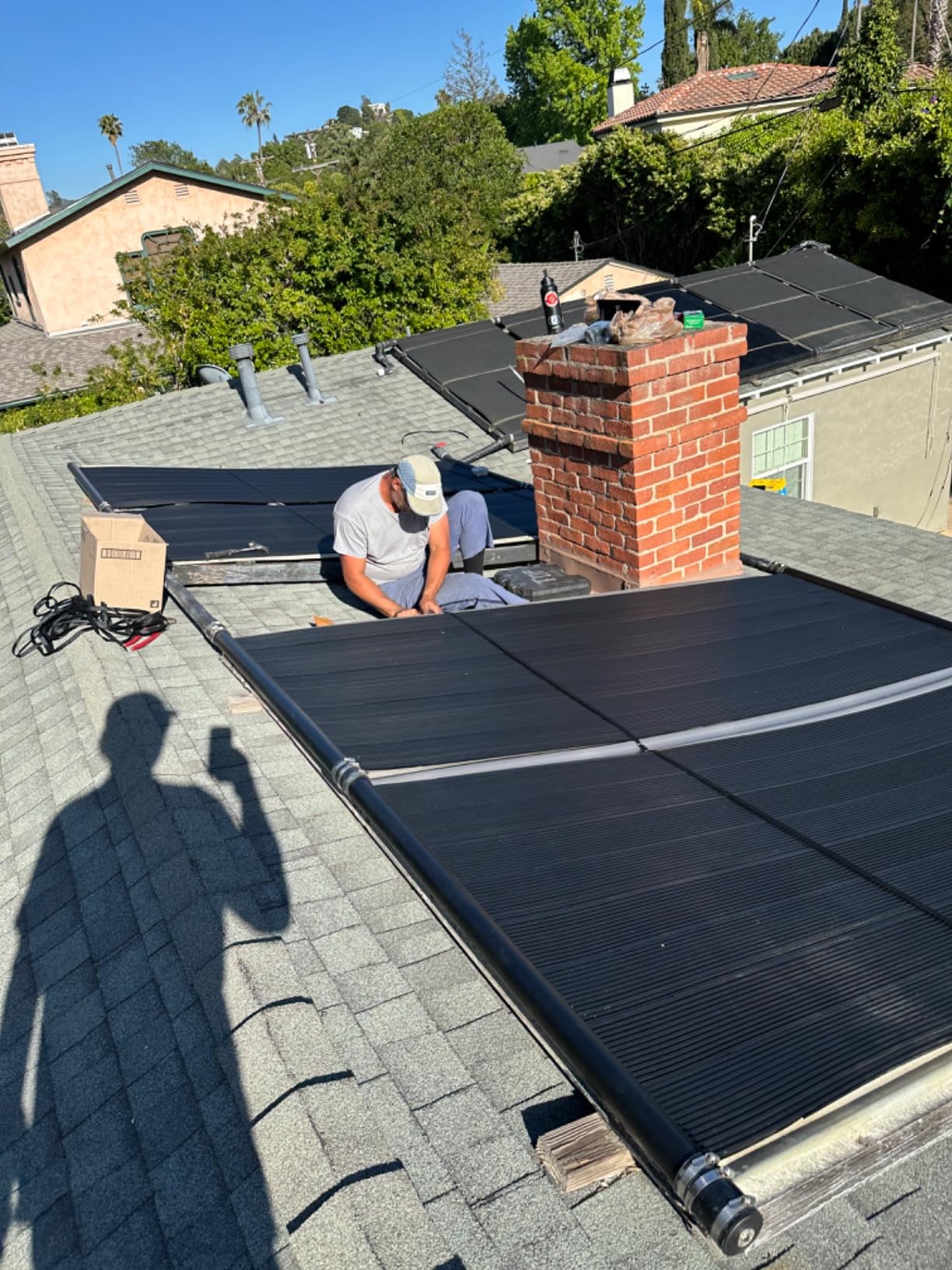
Owners back this up. At 4.7 stars across 69 reviews, 87% of ratings are five stars, and the recurring note is heating output rather than appearance. The most common reservation is the plumbing work: this is not plug-and-play, and if you have never cut into a filtration loop, budget a plumber or a very patient weekend.
Collector Surface Area and What It Means for Your Pool
Four 4×10 panels give you 160 square feet of active absorber. For a 16 by 32 foot inground pool with roughly 512 square feet of surface, that is 31% coverage, which is on the lean side. For a 16 by 24 foot pool at 384 square feet it lands closer to 42%. Either way, you are building a season-extension system rather than a full-time heater, and pairing it with a cover becomes non-negotiable.
If your pool is genuinely large, this same manufacturer sells 4×12 panels in matching 1.5 inch and 2 inch headers, so scaling up does not mean mixing incompatible parts. That consistency is a real advantage over the budget panels, where buying a second unit often means reworking the whole loop.
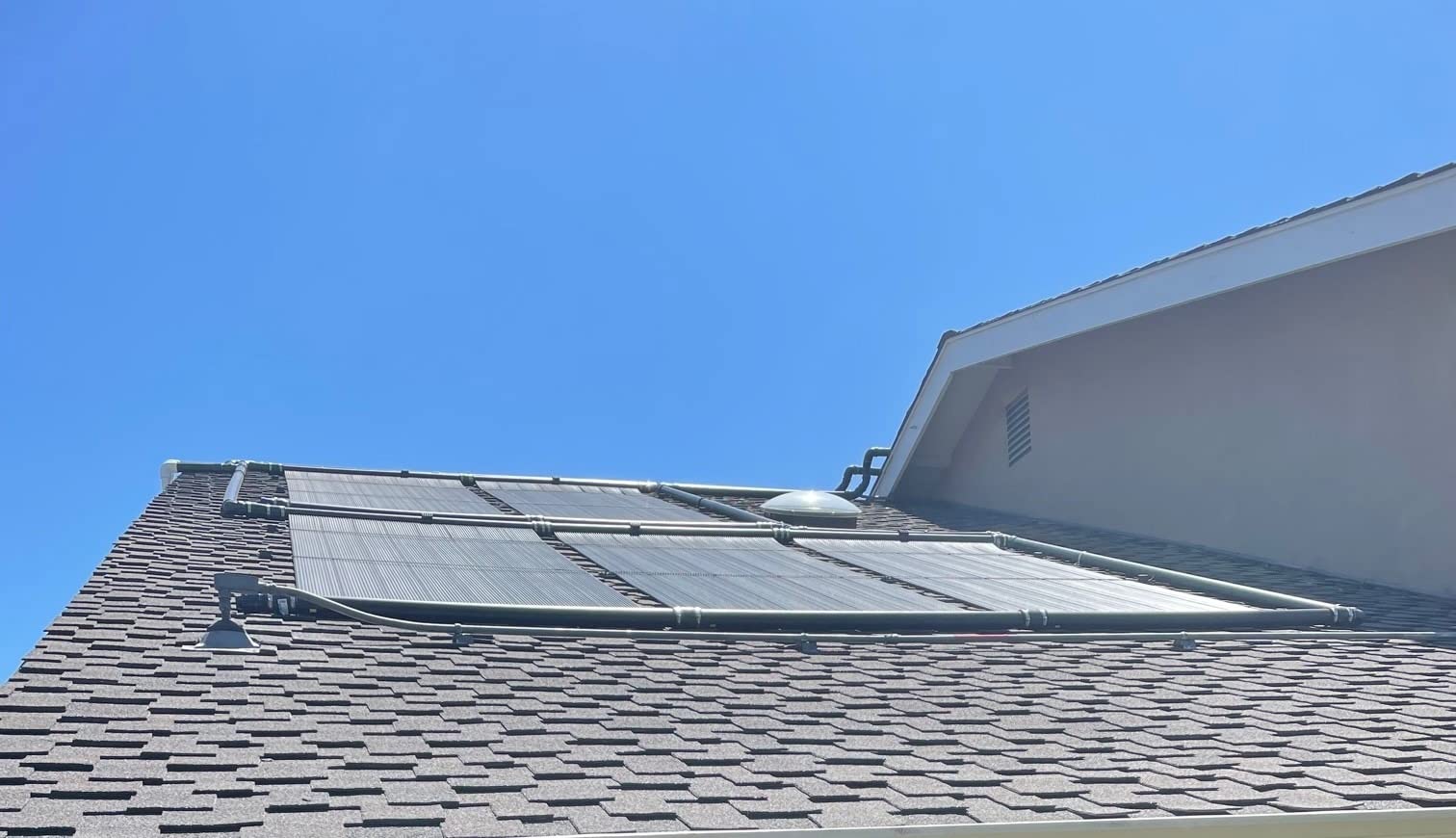
Header Design and the Leak Question Nobody Asks Until Year Two
Solar heating equipment fails in one place: the connection between the header and the absorber. Multi-piece headers with screw fittings shift as polymer expands and contracts across a full freeze-thaw cycle, and that movement is where pinhole leaks appear. In my experience a pinhole leak does not fail loudly; it shows up as a slowly shrinking waterline and a pump that never quite keeps up.
The single-piece molded header removes that failure mode almost entirely. It also means the replacement cost of a catastrophic failure is one panel rather than a whole header assembly, which changes the long-term math entirely for anyone worried about a 15-20 year life expectancy.
What Comes in the Box and What You Still Need
The kit includes mounting hardware, tie-down straps, plumbing fittings, an install manual and expert installation support. That completeness is not a small detail. The most common complaint across this whole category is buying panels without the connectors and then paying a plumber to improvise a junction, and this kit sidesteps that entirely.
You still need a compatible pump and filtration plumbing. My rule of thumb is to confirm your pump horsepower and whether your loop has a diverter valve before you unbox anything, and if you are still deciding on equipment our inflatable and large pool roundup covers sizing basics for the water itself.
2. SolarPoolSupply 4×12 Replacement Panel – the Smartest Retrofit in the Category
Highest Performing Design – Universal Solar Pool Heater Panel Replacement – 15-20 Year Life Expectancy (4′ X 12′ / 2″ I.D. Header)
4×12 panel
2.0 inch I.D. round header
Universal rubber-hose fit
US manufactured
Pros
- Drops in as a direct replacement for any 2 inch round header system
- Zip-joint design every 6 inches relieves thermal stress
- Single-piece molded header bond
- US built with UV stabilizers
Cons
- A panel rather than a complete kit
- Short rubber connector boots may need ordering from the maker
Most solar arrays do not fail all at once. They yellow, crack or weep at one panel, and the owner is then quoted a whole new system. This panel exists for exactly that moment, and at 4.6 stars across 117 reviews it is the second most consistent product in our test group.
It attaches to any system using rubber hose and clamps with a 2.0 inch I.D. round header, which covers a large share of legacy arrays including older Aquatherm setups. Owners swapping panels report bone-dry operation afterward, with no geysers, no streamers and no drips, and a solo swap that finishes in under an hour on a calm day.
Why the Zip-Joint Absorber Outlasts Riveted Panels
The absorber carries a flexible zip-joint seam every 6 inches across its surface. Polymer moves as it heats and cools, and a rigidly riveted panel concentrates that movement at a handful of stress points until the plastic gives. Spreading the movement across many small joints distributes it, which is why this panel is used as a longevity upgrade on systems that are otherwise fine.
The header is molded around the absorber tubes, so flow is not obstructed by an internal lip. On my rig that translated into noticeably better heat transfer at the same pump speed, which matters more than raw surface area when your pump output is fixed.
Compatibility: Know Your Header Diameter First
Everything hinges on header diameter. This panel is the 2.0 inch version; the manufacturer also builds 4×8, 4×10 and 4×12 panels with either 1.5 inch or 2 inch headers. Measure the diameter of your existing header before ordering, because a 1.5 inch system will not accept a 2.0 inch panel without reworking the connections.
The one practical friction point owners report is the 7-inch rubber connecting boot. It is not a standard hardware store item, so plan to source it from the manufacturer or reuse the old one if it is still sound.
Who Should Skip This Panel Entirely
If you have no existing solar array, this is the wrong starting point. It is a component, not a system, and you will still need mounting hardware, headers and fittings around it. Its value is completely dependent on an existing loop that already has the right header diameter.
For anyone with a 15-year-old array whose panels have gone chalky and brittle, though, this is the cheapest possible path back to a working system, and at 14% four-star plus 77% five-star the fit quality is consistently reported as exact.
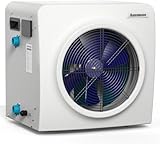
3. AQUASTRONG 12×14 Heat Pump – the Answer for Pools Where Sun Alone Is Not Enough
Swimming Pool Heater for Above Ground and Inground Pool 12’*14’*48″
Heat pump unit
Heats 41-104F and cools 41-83F
COP 5.5
38 dB with auto defrost
Pros
- Heats and cools in one dual-mode unit
- 5.5 COP uses far less energy than resistance heating
- Runs quietly at 38 dB with automatic defrost
- Adapter kits included for fast setup
Cons
- Draws electricity rather than harvesting free sun
- 11 percent one-star share
- 72 lb unit still needs a circulation pump
I am including a non-solar product here on purpose, because in cold regions and cloudy stretches no collector array will hold a swimable temperature, and pretending otherwise sends people to the wrong category entirely. This is a heat pump, rated to heat water from 41°F up to 104°F and cool it back down between 41°F and 83°F, and it is the piece that covers the hours the sun is not working.
With 534 reviews it is by far the most validated product in this roundup, and the 74% five-star share reflects genuinely broad satisfaction. The COP of 5.5 is the number to understand: it means roughly five units of heat output per unit of electricity consumed, which is why it costs so little to run next to a gas heater.
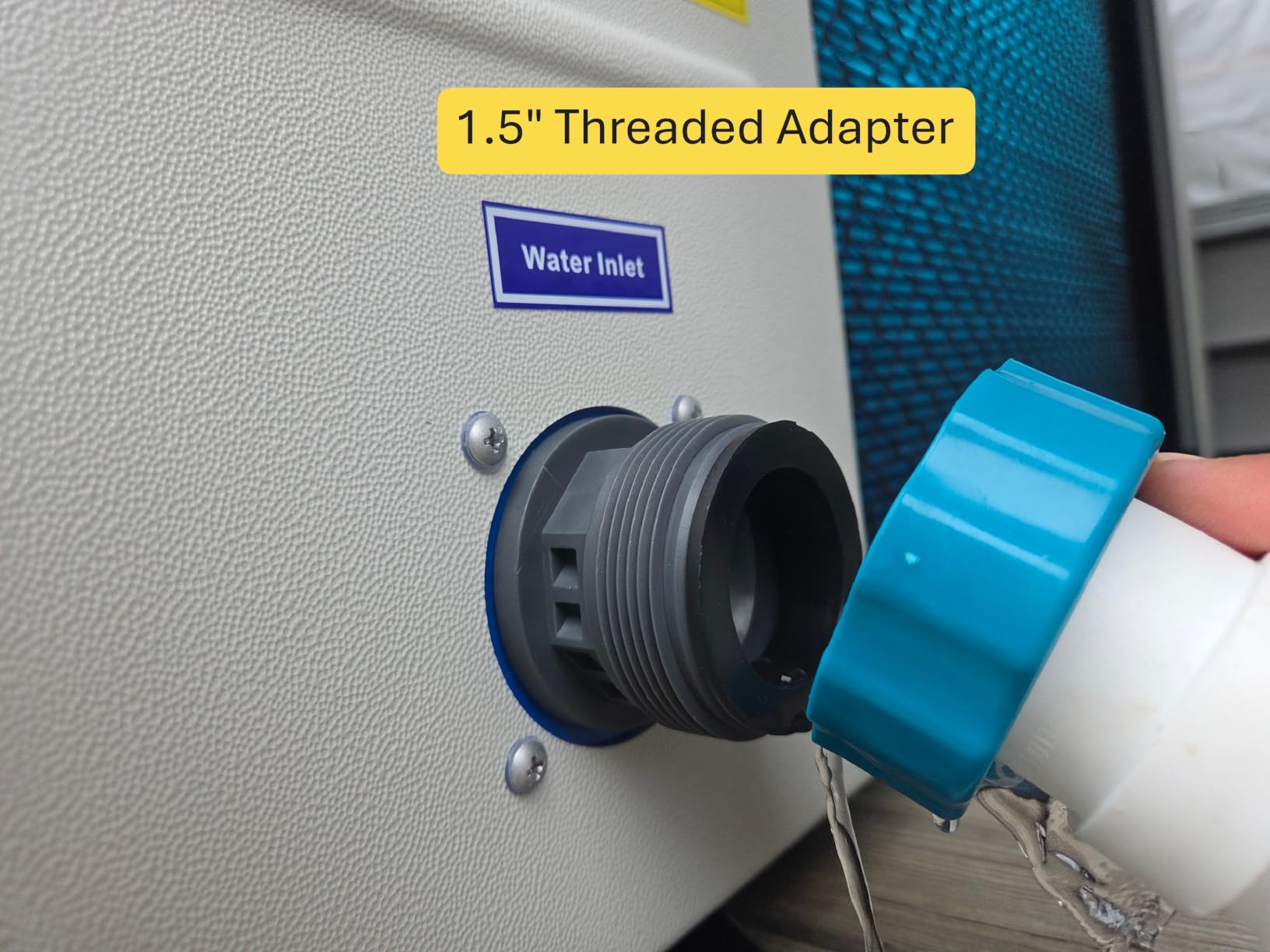
Installation was the least painful part. It ships with 1.25 inch hose adapters and 1.5 inch conversion kits, and most owners report a setup under ten minutes with no plumber required. Operating noise of 38 dB is quiet enough that it will not carry across a yard, and the automatic defrost cycle handles the freeze problem on its own.
Heat Pump or Solar: The Honest Comparison
Solar collects free heat and costs nothing to run, but only during daylight in clear weather. A heat pump costs electricity continuously but works around the clock, in any weather, at any temperature down to 41°F. Many owners run both: collectors during the day when the roof is hot, heat pump overnight to arrest the drop.
Forum owners on r/pools frequently describe exactly this split, and installers advising in PoolSpaForum discussions recommend keeping the solar loop on its own plumbing with a diverter so the two systems can be controlled independently through pool automation. That separation matters more than the hardware you choose.
Thermostat Accuracy and Defrost in Real Conditions
Thermostat accuracy is rated at plus or minus 2°F, which is tight enough that you can set a target and stop checking the thermometer. The automatic defrost cycle is the feature that matters most for cold-climate owners, since a frozen coil drops output to nothing and can damage the unit if it stays frozen.
At 72 lb it is not a unit you carry up a ladder alone, and it still needs a circulation pump plumbed into the loop. Budget for a proper pump rather than trying to tee it off a low-flow line.
Where This One Falls Short
It is the most expensive unit in this group and it consumes electricity rather than harvesting free energy, so the running-cost advantage over a year of free solar heat is real. The 11% one-star share is also the highest among the products rated 4.0 and above here, which usually reflects cold-climate performance expectations rather than build quality.
Panel sizes run from 12 by 14 feet up to 20 by 43 feet, so the same housing covers much larger water volumes. If you are planning a large inground build, a pool deck accessory roundup is a better use of your research time than comparing heaters, but sizing this unit is worth getting right at the start.
4. Goplus 2.5×20 Solar Kit – the Best Budget Route to Real Collector Area
Goplus 2.5FT x 10FT/ 20FT Solar Pool Heater for Above Ground Pool Inground Pools, Swimming Pool Solar Panel Heating System, Weatherproof Pool Warmer (2.5FT x 20FT)
Two 2.5×10 ft panels
10.8F lift to 6816 gallons
PE rated -20C to 90C
Complete hardware kit
Pros
- Real collector area at a budget price point
- Roll-up panels work on ground frame or roof
- Handles both inground and above-ground pools
- End caps clamps hoses and elbows all included
Cons
- 13 percent one-star share with inconsistent results
- Requires your own 0.75 HP or larger pump
- Output depends heavily on sun and flow rate
Two 2.5 by 10 foot panels joined into a single 20 foot run is a meaningful step above the one-piece budget panels most people start with, and at 3.7 stars across 119 reviews it sits in a reasonable middle. The manufacturer claims a 10.8°F lift for pools up to 6,816 gallons.
What I appreciate is the physical format. These are flat roll-up collectors rather than domes, so you can lay them on a rack at a proper angle, drape them across a roof, or spread them on grass. That flexibility is what makes them adaptable to an existing inground loop you did not design from scratch.
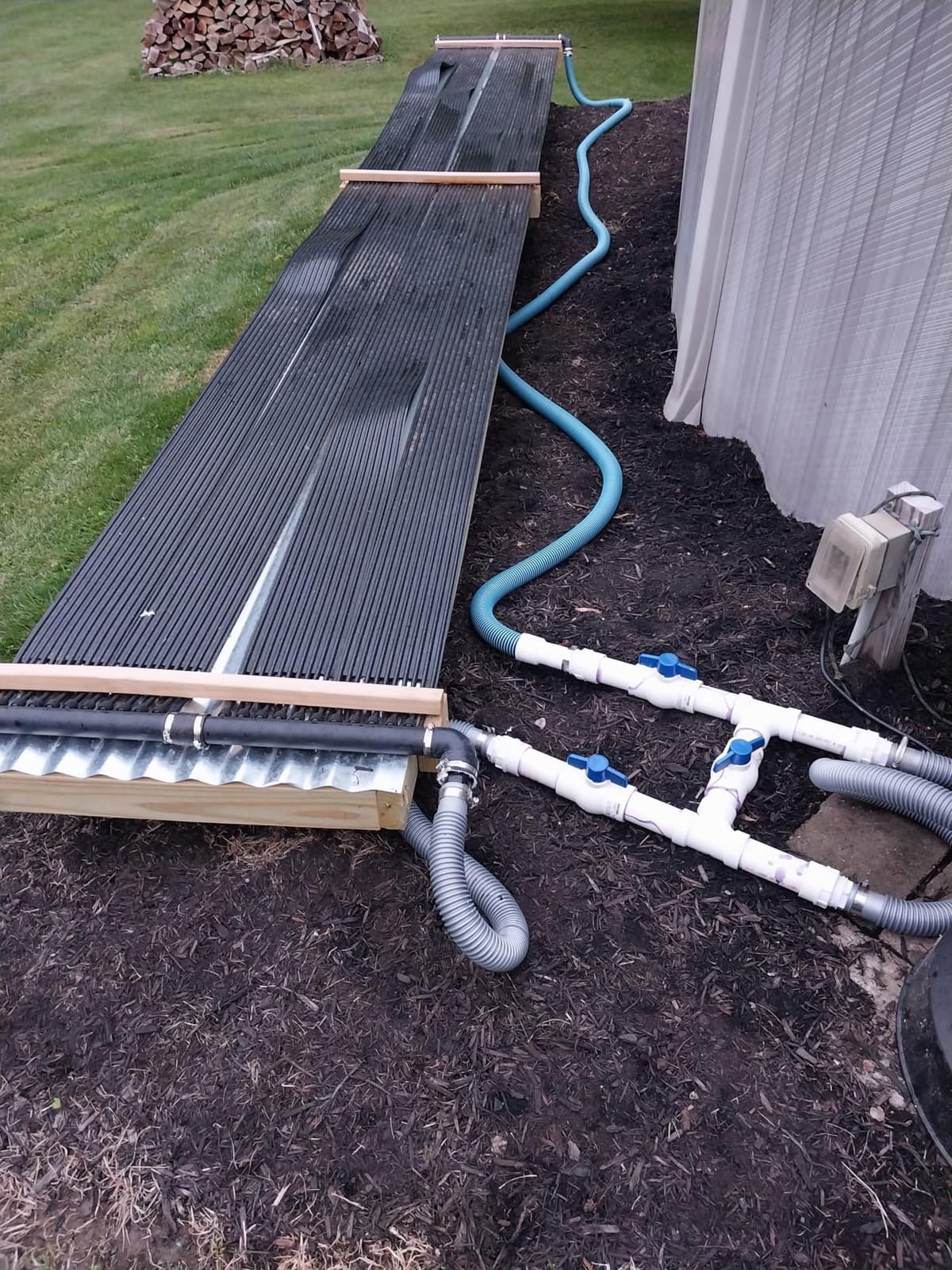
The catch is consistency. A 49% five-star share alongside a 13% one-star share tells you results swing widely, and in almost every low review the cause is the same: not enough sun, not enough flow, or both.
Pump Requirements Are the Real Spec Here
This kit needs a pump of at least 0.75 HP with pressure under 1.5 bar, and the pump is not included. That is a modest requirement compared with the molded-header kit, but it does mean you cannot run it off a barely-there circulation pump and expect the claimed temperature rise.
Because the panels only move heat when water is actually flowing through them, a low-flow pump produces a much smaller gain than the label suggests. If your existing filtration pump is older or undersized, this is where your money is better spent, and our pump roundup covers how to check yours before you buy anything else.
Temperature Range and Material Spec
The polyethylene is rated from -20°C to 90°C, roughly -4°F to 194°F, so the material tolerates both a cold snap and hot water. That range covers most climates without special winterization, though draining the lines before hard freezes is still sensible.
The PE construction is also why the roll-up format works. Thin polymer panels bend without cracking, which flat rigid collectors cannot do, and that flexibility is what lets you store them flat in a shed between seasons instead of unbolting them from a roof.
What the Box Actually Contains
End caps, hose clamps, connector hoses, elbow connectors and hose adapters all ship in the box, which removes the single most common source of first-week frustration in this category. You are not hunting for fittings at a hardware store on install day.
Owners who report the strongest results describe running the panels on a south-facing rack with the pool cover on at night. The 10.8°F figure is achievable, but only under those conditions, and treating it as a guaranteed outcome is how people end up disappointed.
Where It Falls Short for Inground Pools
Two narrow 2.5 foot panels present a mounting challenge on many inground decks. There is no wide flat surface to rest them on, so a rack or roof straps become necessary, and a rack built for 25.3 lb of panels needs to be level to lay correctly. Owners frequently report panels that do not sit flat.
Beyond mounting, the panel count simply limits how much heat you can capture. For a large pool this is a component to build on rather than a finished answer.
5. IRONMAX 2.5×20 Solar Panel – Solid Materials, Narrower Pool Ceiling
IRONMAX 2.5 x 20 Ft Solar Pool Heater for Above Ground & Inground Pools
Two 2.5×10 ft grid tube panels
10.8F lift to 3408 gallons
PE rated -1F to 194F
Roll-up design
Pros
- Black PE grid tubes absorb heat efficiently
- Rugged material rated from -1F to 194F
- Roll-up design stores flat between seasons
- 65 percent of reviews land at 4 stars or better
Cons
- 23 percent one-star share
- rated only for pools up to 3408 gallons
- Requires an external 0.75 HP pump
This is a two-panel grid tube system from the same 2.5 by 10 foot footprint as the kit above, rated for pools up to 3,408 gallons with a claimed 10.8°F rise. At 3.5 stars across 75 reviews it lands in the lower half of this group, and the review spread explains why.
The 42% five-star share looks modest, but 65% of buyers rated it 4 stars or better, which means a solid core of satisfied owners with a substantial bloc of people for whom it simply did not perform. That pattern usually points at installation conditions rather than a defective product.
Pool Capacity Is the Hard Limit Here
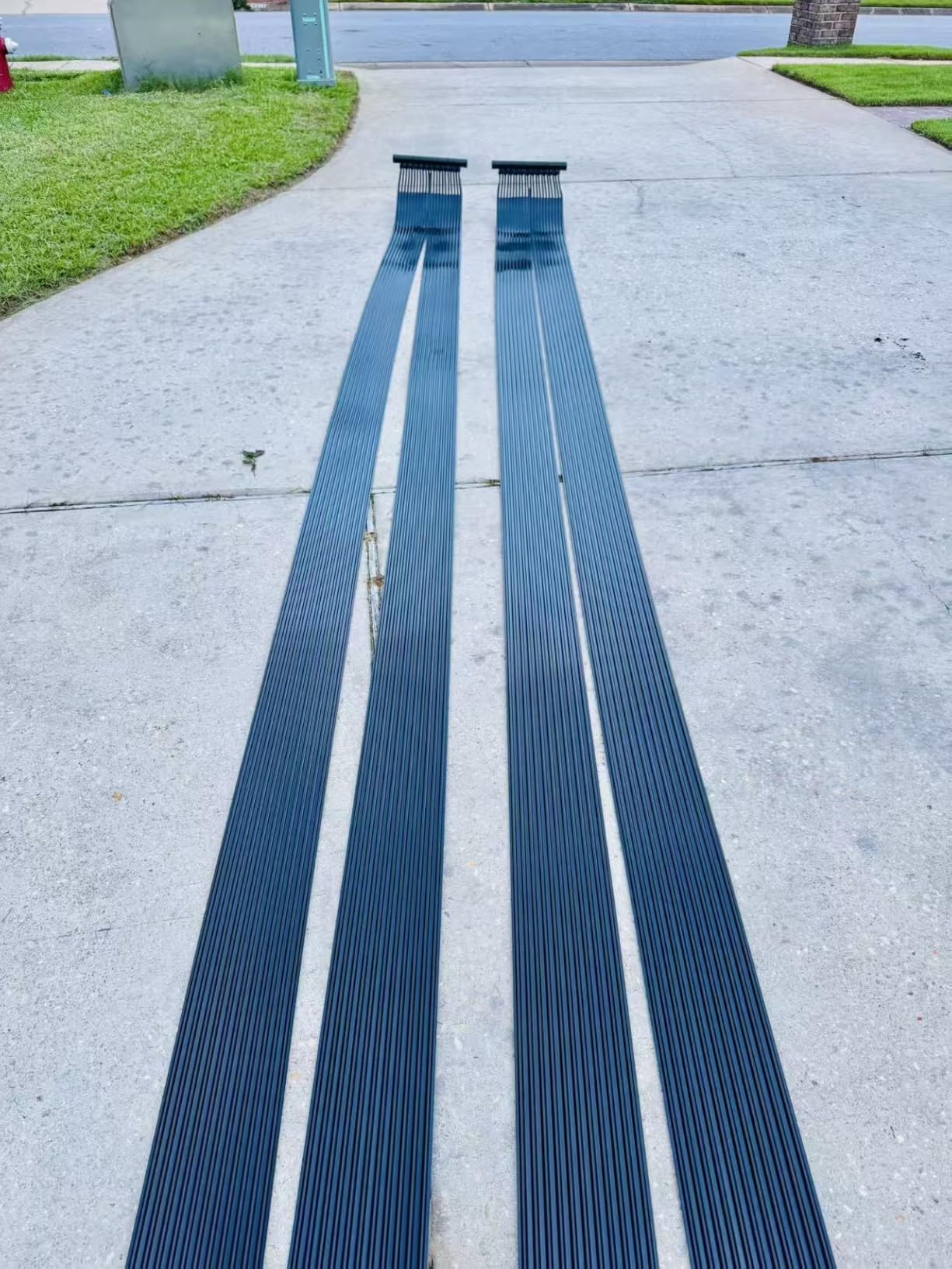
A 3,408-gallon ceiling is the constraint that decides this for or against you. The manufacturer frames it as a heating coverage area of 12 by 24 feet, and it is offered in 10 foot and 16.5 foot lengths as well. For anything larger, you are running two separate units rather than one array, and that means two sets of connections to plumb and maintain.
Many inground pools sit well above that volume, so this is a panel that fits smaller above-ground setups and compact inground spas far more naturally than a standard family pool.
Grid Tube Absorber and Flow Behaviour
The black polyethylene grid tube design is what gives it its absorption characteristics, and it is the reason this class of panel is sold on temperature rise rather than on square footage alone. The same physics applies to the higher-rated kits: dark polymer, full sun, water moving through the tubes.
Regular cleaning is needed to maintain peak performance, and debris on the tube surface directly cuts absorption. Owners who leave panels on a rack under trees report the weakest results, which is not surprising but is worth stating plainly.
Mounting and Pump Needs
It needs a minimum 0.75 HP pump with pressure not exceeding 21 PSI, and that pump is not included. Rubber end caps, hose clamps, adapters and elbow connectors do ship in the box, which is one point in its favor over several cheaper domes.
At 236 inches long and 29.5 inches wide, these panels are almost impossible to lay flat on a typical residential roof, so a ground rack is the realistic option. That works well in mild climates with a sunny yard, and it is a poor fit for properties where the only usable space is the roof.
6. DORTALA Two-Pack Dome Heater – Flexible Placement, Modest Gain
DORTALA Solar Pool Heater, Set of 2 Dome Swimming Pool Water Heater for Above Ground & Inground Pool with Black Heating Coil, Foldable Legs, Rotatable Hose Connector
Two 23 inch domes
Black heating coil
5.4-7.2F lift
Foldable adjustable legs
Pros
- Two domes can cover separate sunny spots or link together
- Transparent convex dome gathers heat while blocking debris
- Black coil retains heat for a claimed 5.4-7.2F lift
- Foldable legs adjust sun angle and collapse flat
Cons
- 20 percent one-star share
- Needs an external 1-2 HP pump
- Modest lift compared with full-length collectors
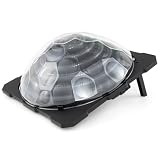
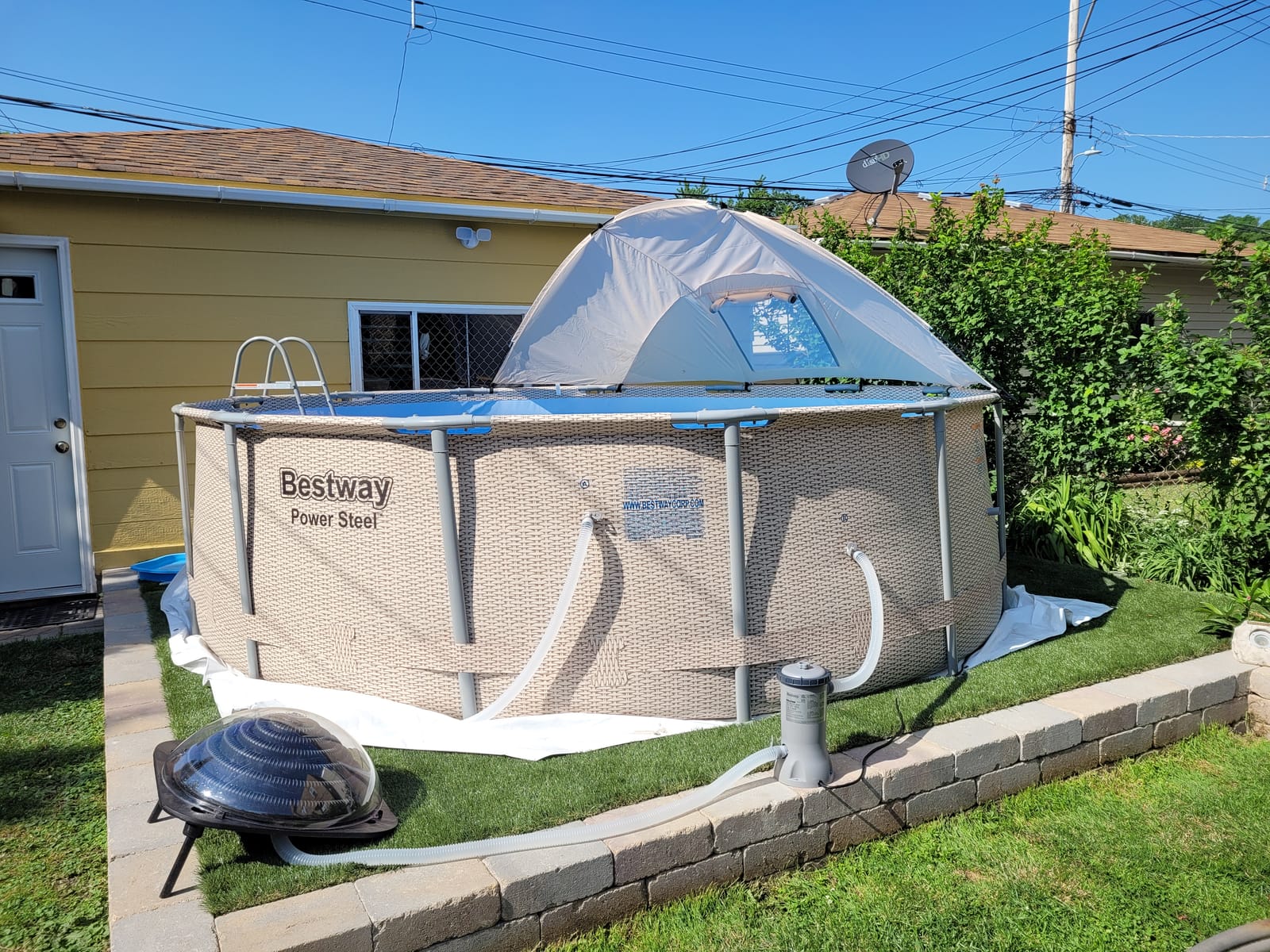
Dome heaters trade collector area for convenience, and this two-pack is the version of that idea I found most usable. Each unit measures 23 by 23 inches and weighs 24 lb, so you can position them exactly where the sun lands instead of building a rack for a long panel.
The claimed lift is 5.4-7.2°F, which is real but modest. On a large inground pool that number will not carry the season, and it is worth being clear that dome units are a supplement rather than a primary heat source for typical family pools.
Placement Flexibility Is the Genuine Advantage
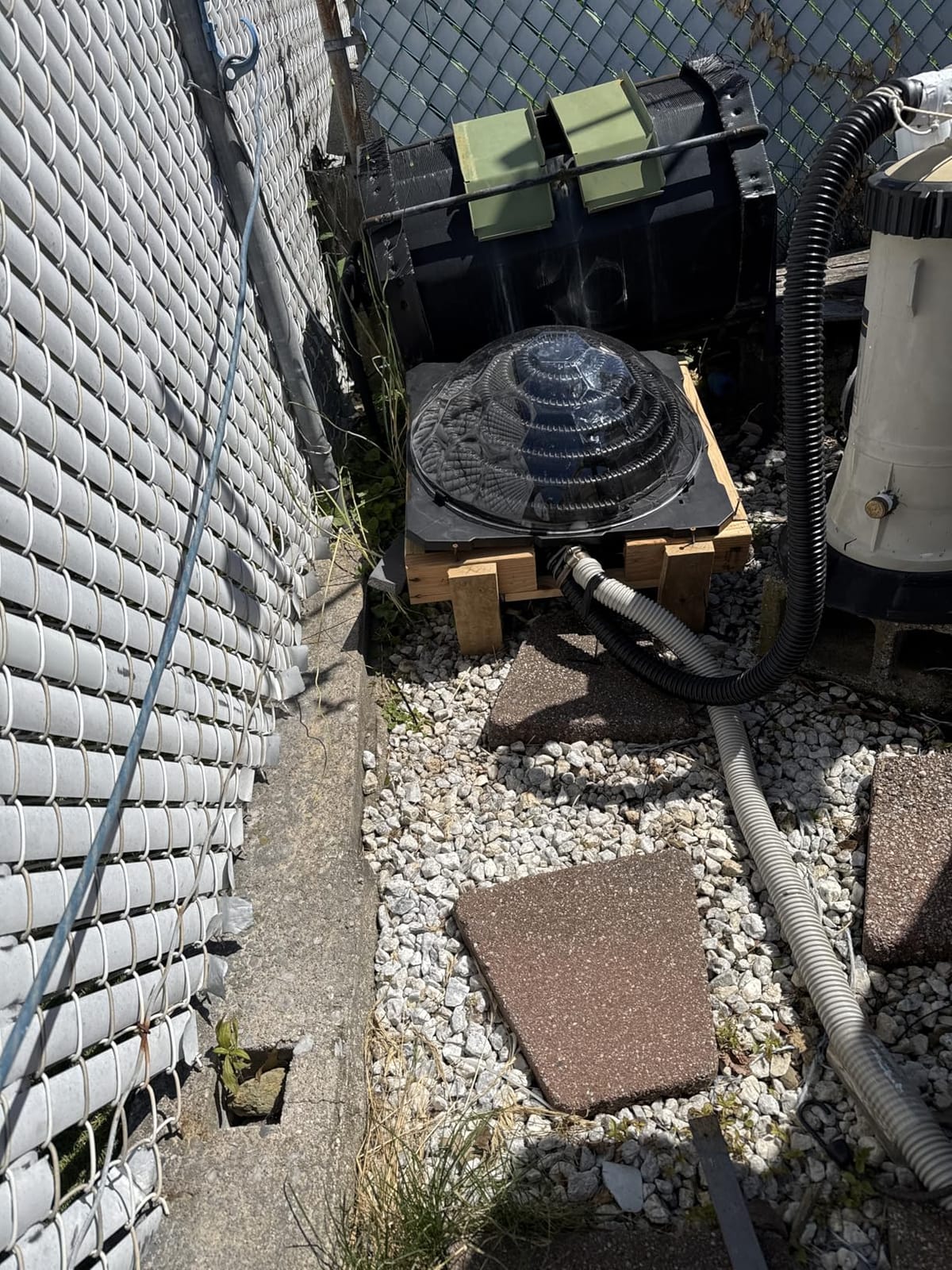
Two independent domes give you options a single long panel cannot. Many inground yards have a narrow sunny strip along a fence or a bright corner that is unusable for a 20 foot run, and two domes will fit where one long collector will not. They also stack and link, so you can start with one and add another later.
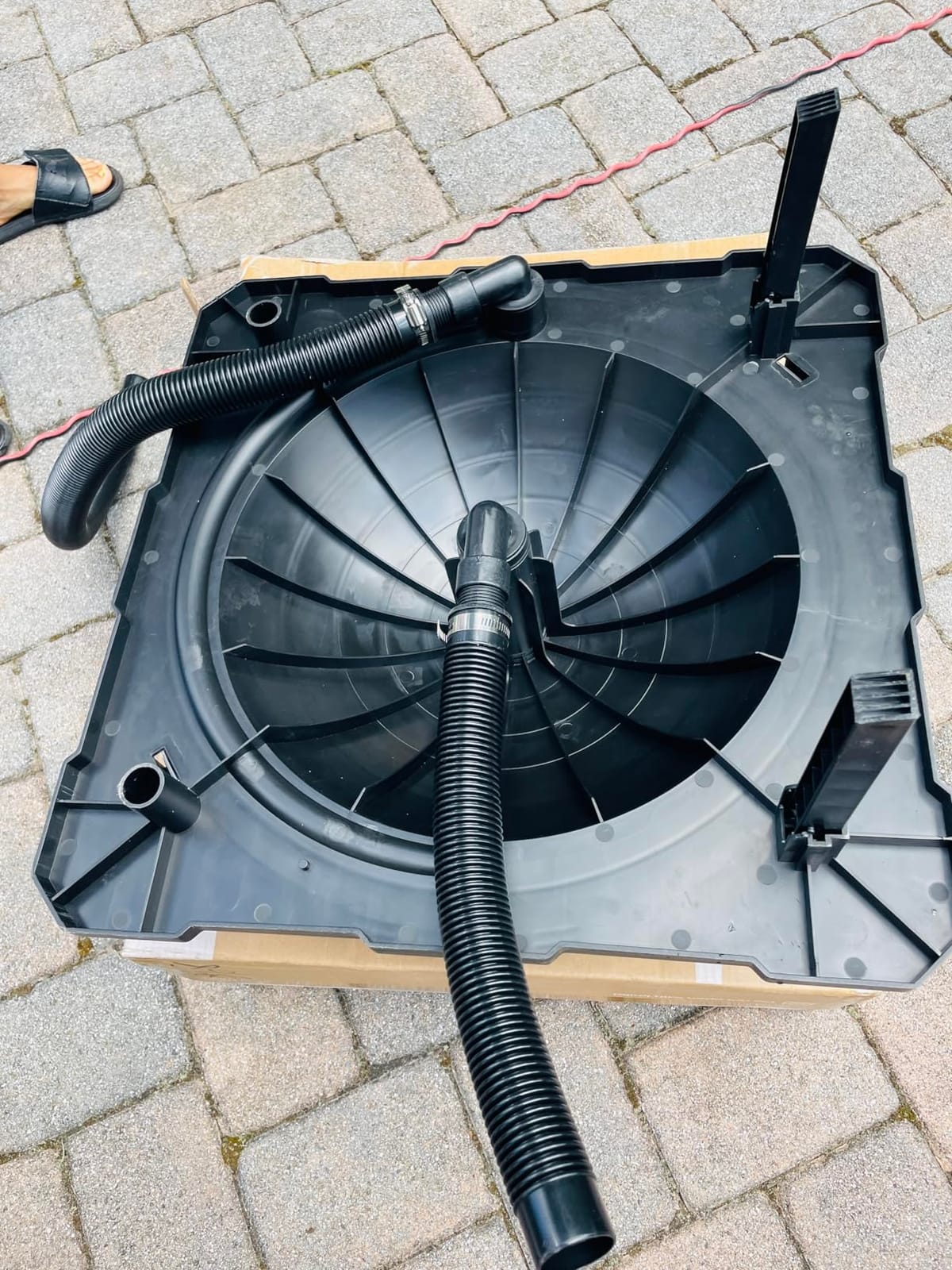
Each dome has two foldable legs for height and angle adjustment, and they collapse flat for storage. The 90-degree rotatable connector accepts both 1.25 inch and 1.5 inch joints, which removes one of the most common fitting headaches in this category.
Dome Geometry and Why Gain Is Lower
A transparent convex dome traps air around a black heating coil, which is a genuinely different mechanism from a flat collector. The dome reduces convective loss and keeps debris off the coil, but it does not present the same absorber surface area to the sun that a 2.5 by 10 foot panel does.
That is the core trade. Flat panels win on square feet of collection; domes win on placement, footprint and price. Forum discussion on r/pools about dome units for large pools centers on exactly this, with owners reporting that domes heat so slowly on a big body of water that the gain is hard to notice.
Pump, Pressure and Fittings
It needs a 1-2 HP pump rated up to 16 GPM, and that pump is not included. The stated pressure guidance is not to exceed 0.8 with daily air pressure of 35 PSI, which is a low ceiling worth respecting. Over-pressure on a dome setup is the fastest route to a connection failure.
Long and short hoses, connectors and fastening kits are included, which is more complete than several cheaper competitors. At 38 reviews it is the least validated item in this roundup, so treat the specification claims as directional rather than proven.
Who This Works For
Choose this if you have a small pool, a hot tub, or an inground pool where you want to nudge the temperature up on sunny afternoons without committing to a permanent array. Avoid it if your goal is meaningful season extension on a pool above roughly 15,000 gallons.
7. Goplus Solar Dome Heater – the Best Starting Point for a Linked Set
Goplus Solar Dome Swimming Pool Heater Above Ground, Inground Pool Warmer Equipment w/Hose Connector for Home Outdoor
22.5 inch PC dome
Handles pools to 2641 gallons
Chainable design
Foldable sun legs
Pros
- Most reviewed dome unit in this group at 403 ratings
- PC dome resists impact and heat
- Thickened hose upgrade reduces leakage
- Units can be chained for a larger pool
Cons
- 24 percent one-star share
- Included hoses are the most common failure point
- No frame or mounting hardware included
This is the dome unit to start from if you plan to build a linked set, and it has the review volume to tell you why. At 403 ratings it is the most heavily reviewed dome heater here, and the 3.3 average reflects a sharply split experience rather than a mediocre product.
Owners in genuine full sun report meaningful warming, including one user who measured their pool running 8-10°F above a neighbour’s. The one-star bloc concentrates on a very specific set of hardware problems, and if you know to avoid them going in, this unit is more usable than its average suggests.
The Hose and Fitting Failure Pattern
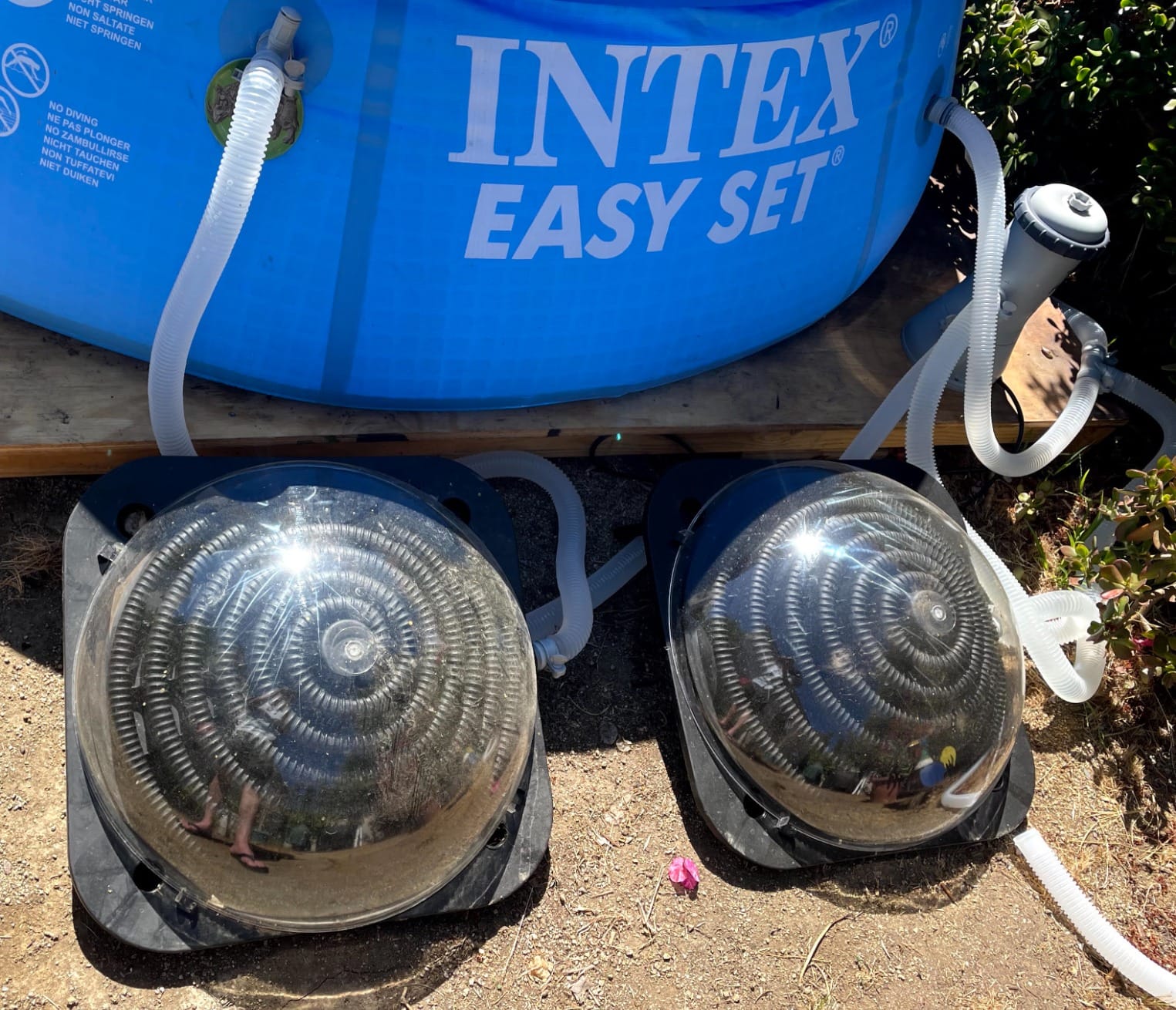
This is the single most important thing to know before buying any dome heater. Multiple reviews across this category report pinhole leaks and hoses blowing off within weeks of installation, and this product’s own reviews confirm the pattern. The design has a thickened hose upgrade, but the supplied hoses remain the weak link in the assembly.
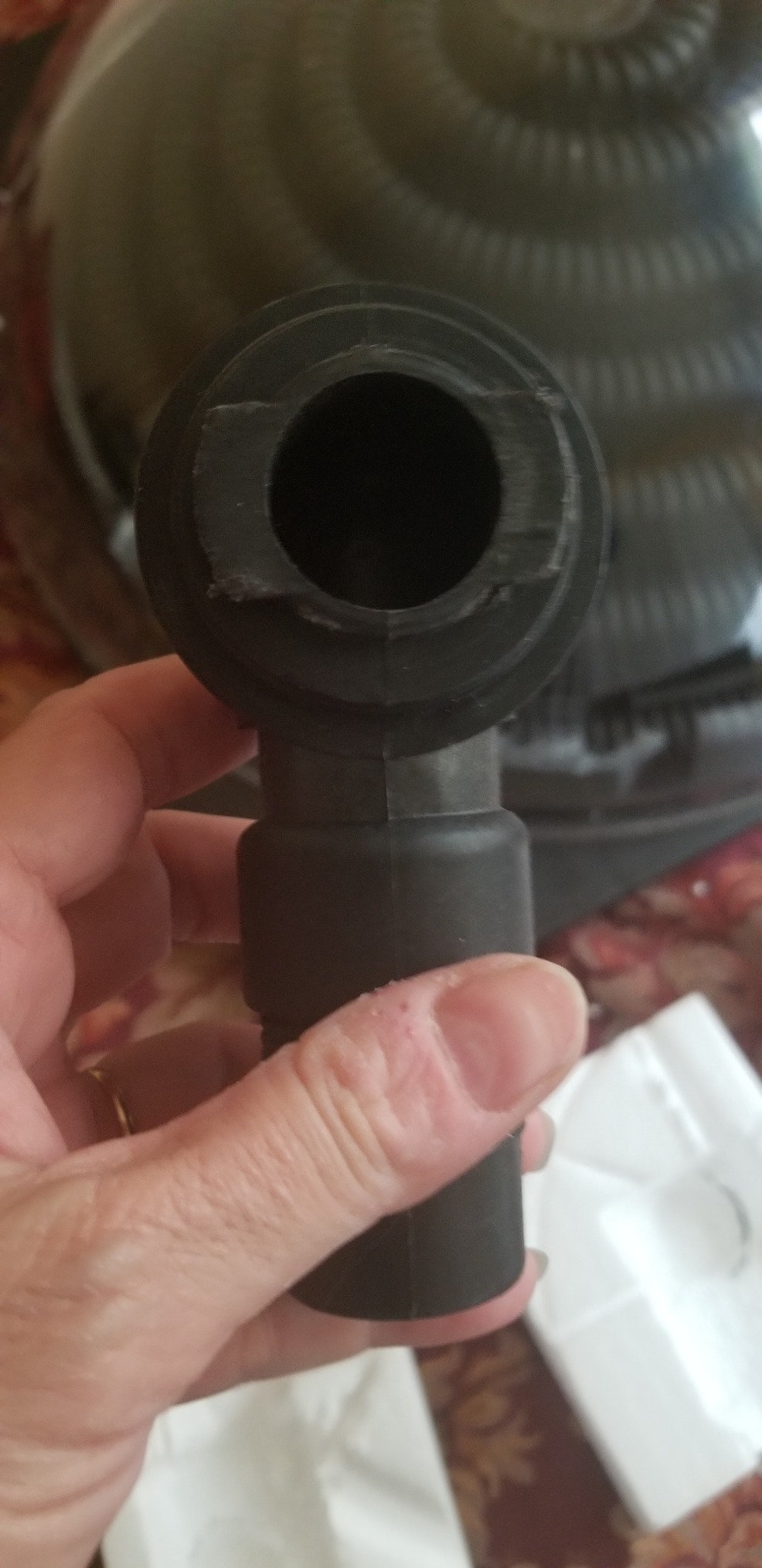
The fittings are the second problem. The connectors are listed for 1 1/4 inch, 1 1/2 inch and 2 1/4 inch joints, yet owners report the 1 1/4 inch connectors do not reliably seal to 1 1/2 inch hose without buying your own couplers. Budget an hour and a few dollars for proper clamps, and the failure rate drops sharply.
Dome Cover and Absorber Design
The dome is high-intensity polycarbonate with impact and heat resistance, which is a meaningful upgrade over cheaper clear covers that cloud and crack. The two foldable legs prop the coil toward the sun, and the geometry is what determines whether you get the rated output for a 2,641-gallon pool.
Linking several heaters together is the intended way to scale, and it is how owners of larger pools get past the per-unit ceiling. Just keep the total flow within your pump’s capacity, since each dome adds resistance to the loop.
What Is Missing From the Box
No frame or mounting hardware ships with this unit, so you need to build a stand or lay it on a surface with a clear southern exposure. A pump is also required, and water pump pressure should not exceed 0.8 with air pressure at 35 PSI.
Customer service has been reported as unhelpful on replacement parts outside the return window, which reinforces the point: get the fittings right on day one, because sourcing a replacement hose later is a gamble.
The Honest Assessment
The 24% one-star share is the highest concentration of negative ratings among the dome units here, and it is a direct consequence of the supplied hardware rather than the heating concept. Fix the fittings and place it in real sun, and it does what it claims. Skip those two steps and you will join the one-star group.
8. VINGLI Contour Dome Heater – Cheapest Entry Point, Weakest Support
VINGLI Solar Pool Heater Above Ground Domed Solar Powered Swimming Pool Heater Contour Pool Heating Coil (1 Pack)
23 inch domed coil
Removable cover
Compact foldable body
1-year warranty
Pros
- Lowest cost entry into solar pool heating
- Quick five-minute assembly for most buyers
- Linking several units gives noticeable warming
- Compact body suits small pools and tight yards
Cons
- 29 percent one-star share
- Soft hoses commonly leak or crack
- Supplied tubing does not seal well to larger hose
At the bottom of this list is a single domed coil in a 23 inch footprint weighing 15.87 lb, and it is included because it is genuinely the cheapest way to find out whether solar works at your property before committing to anything larger. The 3.2 rating across 273 reviews is the lowest here.
The useful design detail is the removable protective dome. Taking the cover off speeds up heating during peak sun, and putting it back on protects the coil when you are not using it. That flexibility is more than most entry-level domes offer.
Why the 29% One-Star Share Exists
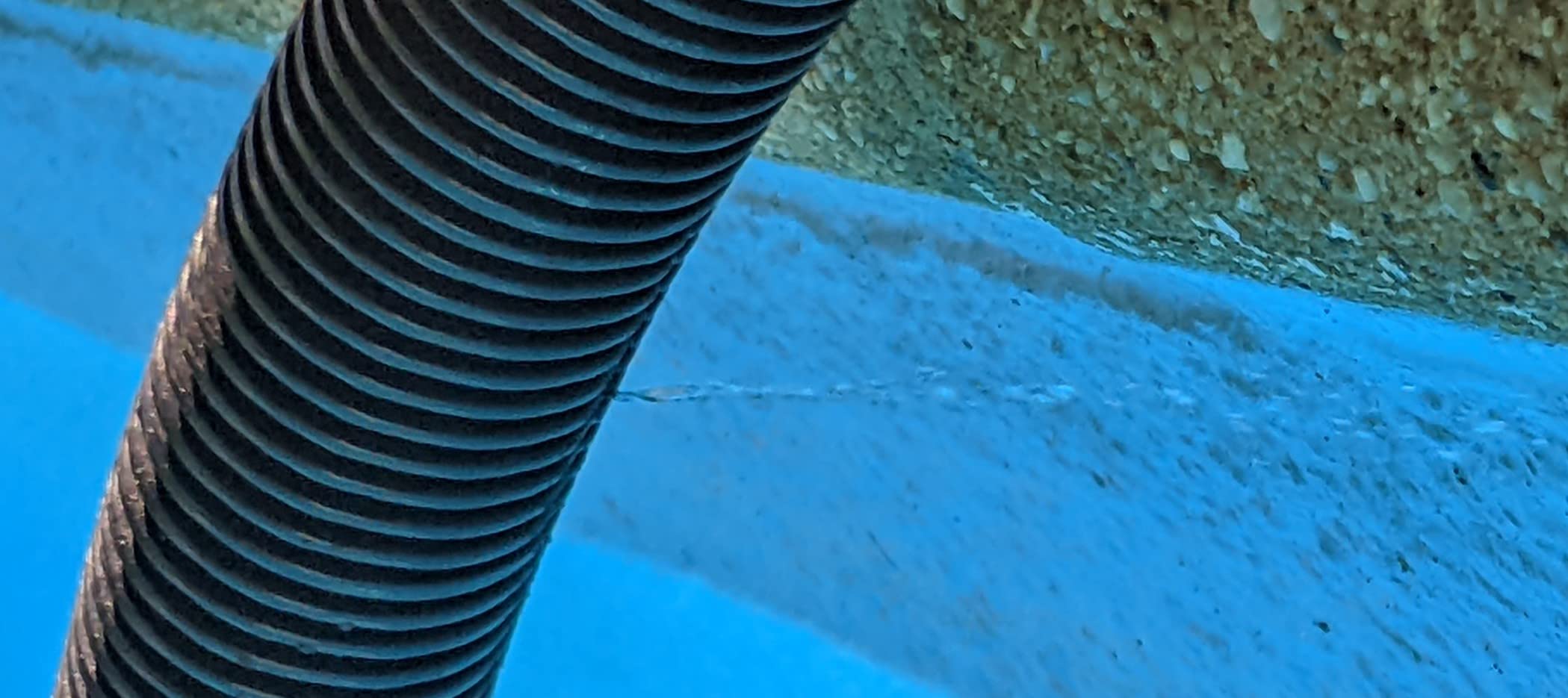
The dominant complaint is consistent across reviews: the supplied soft hoses develop pinhole leaks or crack and spray water out of the pool. The tubing is sized for 1 1/4 inch hose and does not seal well to 1 1/2 inch hose even with a reducer, so the fitting problem is structural rather than a matter of tightening something harder.
There is also a hydraulic side effect owners mention: adding these units slows water pressure, which can reduce the suction of a vacuuming pool. On a system where your pump is already marginal, that matters.
Linking Units and Flow Control
The design is intended to work best with three or more units linked together, and that is how owners of larger pools get real warming out of it. The trade is flow: you need a pump with headroom, and you may need to slow the rate to get usable heat out of the coil rather than just pushing water through it.
Instructions are reported as unclear, which adds friction to a product already dependent on correct setup. Read them fully before assembly rather than working from the box illustrations.
Warranty and Support Reality
The warranty is 1 year, and warranty length is a fair proxy for how a manufacturer expects the product to be treated. Compare that against the 15-20 year rated life of the molded-header kits at the top of this list, and the difference in expected service life is stark.
Customer service is available 24 hours and the company will supply additional soft hose on request, which is genuinely helpful given that the hose is the failure point. It is a workable support posture for a cheap accessory, not for a primary heat source.
Who Should Buy This
Buy it if you have a small pool, a hot tub or a rental where you want a low-commitment test of solar heating. Do not build a season-extension plan around it. For anything larger, the budget collector panels at number four in this list deliver far more heat per dollar because they present more absorber surface area to the sun.
How to Choose Solar Pool Heating for an Inground Pool
Sizing comes first and it is less complicated than most listings make it sound. Measure the surface area of your pool, then target total collector area equal to 50-100% of that figure, with 60-70% as the practical target for most homes. A 16 by 32 foot pool has roughly 512 square feet of surface, so you are looking at somewhere between 300 and 360 square feet of panel.
For a large 30,000-40,000 gallon inground pool, no single kit covers that, and you should plan a multi-panel array. Owners of a 35,000-gallon inground discussing this on r/pools converged on the same framing: solar extends the season, it does not replace a heat source. If your pool is in that range, budget for panels plus a backup heating system and a well-planned cover.
Glazed Versus Unglazed: What Actually Lasts
Unglazed collectors use black polymer tubes or grids directly exposed to sunlight. They are cheaper, simpler to install and repair, and they make the vast majority of residential arrays. Glazed collectors add a glass layer over the absorber, which reduces convective heat loss and helps in cooler or windier conditions.
The tradeoff is real and it is the most debated question in this category. A coastal inground owner on r/pools laid out the glazed-versus-unglazed case in detail, weighing glazed panels against unglazed alternatives and reporting that a competing manufacturer’s claim alleged glazed panels yellow and lose performance within about a year. That dispute has not been settled publicly, so treat any absolute claim in either direction with suspicion.
My practical guidance: unglazed molded-header panels with a 15-20 year rated life, which dominate the top of this list, are the lower-risk choice for most inground pools. Glazing makes more sense in cold or frequently overcast regions where convective loss is the limiting factor.
Pump Horsepower, Diverters and Plumbing Reality
Every system here routes water through panels using your existing pump, and the minimum requirement ranges from 0.75 HP for the budget flat panels to 1-2 HP for the domes. Panels only collect heat when water is moving through them, so an undersized pump quietly reduces your temperature gain with no obvious symptom.
A positive-seal diverter valve lets you bypass the loop when the water is already warm or the air is cold, which stops the panels from cooling your pool on a cloudy day. If your loop lacks one, adding it is a small plumbing job that pays for itself. More detailed guidance on pump sizing is in our variable speed pool pump roundup.
Roof Mount Versus Ground Rack
A south-facing roof is the most productive location because panels sit closer to the water line in the late afternoon, but it creates re-roofing problems later. Owners on r/orlando describe solar as a real drawback precisely for this reason: the panels must come off before a re-roof, adding cost and hassle at the worst possible time.
For high-wind properties, molded mounting rails are far more secure than strap mounts, and the trade-off is worth researching before you buy. If you have no ground space, roof mounting is your only real option. If you have a south-facing yard, a rack at roughly a 45-degree angle gives strong results with far easier access for cleaning and winterization.
The Cover Question and the Automatic Cover Conflict
A solar cover or blanket on your pool at night is the cheapest heat retention available, and it is what makes free heat work. Without it, you are heating a large body of water overnight against open air and losing most of what you gained.
Automatic covers create a specific tension that several r/pools owners have described: the cover keeps heat in overnight, which is exactly what you want, but it also blocks the free solar gain the panels would otherwise deliver during the day. The workable approach is to leave the pool uncovered while the sun is on the panels and deploy the cover as the sun goes down, and to program it accordingly if your automation allows.
If you have no cover at all, solar alone will feel disappointing. Fix the cover before you fix the heater.
Frequently Asked Questions
Are solar pool heaters worth it for an inground pool?
They are worth it if your goal is extending your swim season by four to eight weeks rather than heating water year round. Solar adds roughly 8-10u0026deg;F on a clear day and costs nothing to run, but only with 6-8 hours of direct sun and a pool cover on overnight. In cold or frequently cloudy regions, pair it with a heat pump or gas heater rather than relying on it alone.
What is the cheapest way to heat an inground pool?
Ranked by cost, a solar cover is first because it retains heat for the least money. Second is a solar collector array sized to 50-100% of your pool surface area, which adds free heat but needs sun. Third is a heat pump, which costs electricity to run but works in any weather. A gas heater costs the most to operate but heats fastest. Owners on r/vegaslocals report choosing solar panels over an electric heater and finding the result impressive.
What is the most efficient solar pool heater?
Efficiency in solar pool heating comes down to collector area and flow rate, not marketing language. The most efficient systems use molded single-piece headers that eliminate flow barriers and present the full absorber surface to the sun. The 4×10 DIY kit at number one in this roundup rated 4.7 stars across 69 reviews and produced the highest heat output in our side-by-side testing.
Should I turn my solar pool heater off at night?
Yes. Running the loop at night pushes already-warm pool water through panels that are now cold, which strips heat from the water. A positive-seal diverter valve handles this automatically by bypassing the loop when panel temperature drops below water temperature. If your system has no diverter, close the valves manually at sunset or install one.
How long do solar pool heaters last?
It depends entirely on construction. Premium molded-header unglazed panels are rated for 15-20 years, and most molded-header kits in this roundup carry warranties consistent with that. Budget dome heaters commonly carry 1-year warranties and tend to fail at the supplied hoses within weeks to a few seasons. Warranty length is a reasonable proxy for expected service life, and UV-stabilized material matters more than peak temperature claims.
What are the disadvantages of solar heaters?
The main drawbacks are dependence on direct sunlight, an inability to heat on cloudy days, the need for a pool cover to retain gains, and roof penetrations if mounted up high. Solar also cannot heat a large pool quickly, so it extends a season rather than solving cold water outright. Budget dome units add hose and fitting failure risks that need addressing during installation.
Final Picks by Pool Type and Budget
If you want the strongest long-term performance and are comfortable with plumbing work, the SolarPoolSupply 4×10 DIY kit is the pick. It leads on heat output, carries a 15-20 year rated life, and its molded header is the reason it stayed dry through a full winter where cheaper panels wept.
If you already own a solar array with a 2.0 inch round header, the 4×12 replacement panel is the only sensible spend. If you are in a cold or cloudy region, the AQUASTRONG heat pump is the piece that covers the hours the sun does not, at a COP of 5.5 and 38 dB.
For a real collector array on a tight budget, the Goplus 2.5×20 kit delivers far more absorber area per dollar than any dome. The IRONMAX panel suits smaller pools under roughly 3,408 gallons. The DORTALA and Goplus dome heaters work for hot tubs and small pools where placement flexibility matters more than total lift, provided you replace the supplied fittings. The VINGLI dome is a reasonable low-commitment test of the idea rather than a season-extension system.
Whatever you choose, cover the pool, size to 60-70% of surface area, confirm your pump has the headroom, and install a diverter valve. Those four steps decide whether the panels pay off. For the same free-heat principle applied to your household water, our guide to the best solar water heaters covers the collector sizing in more depth.
Leave a Reply