
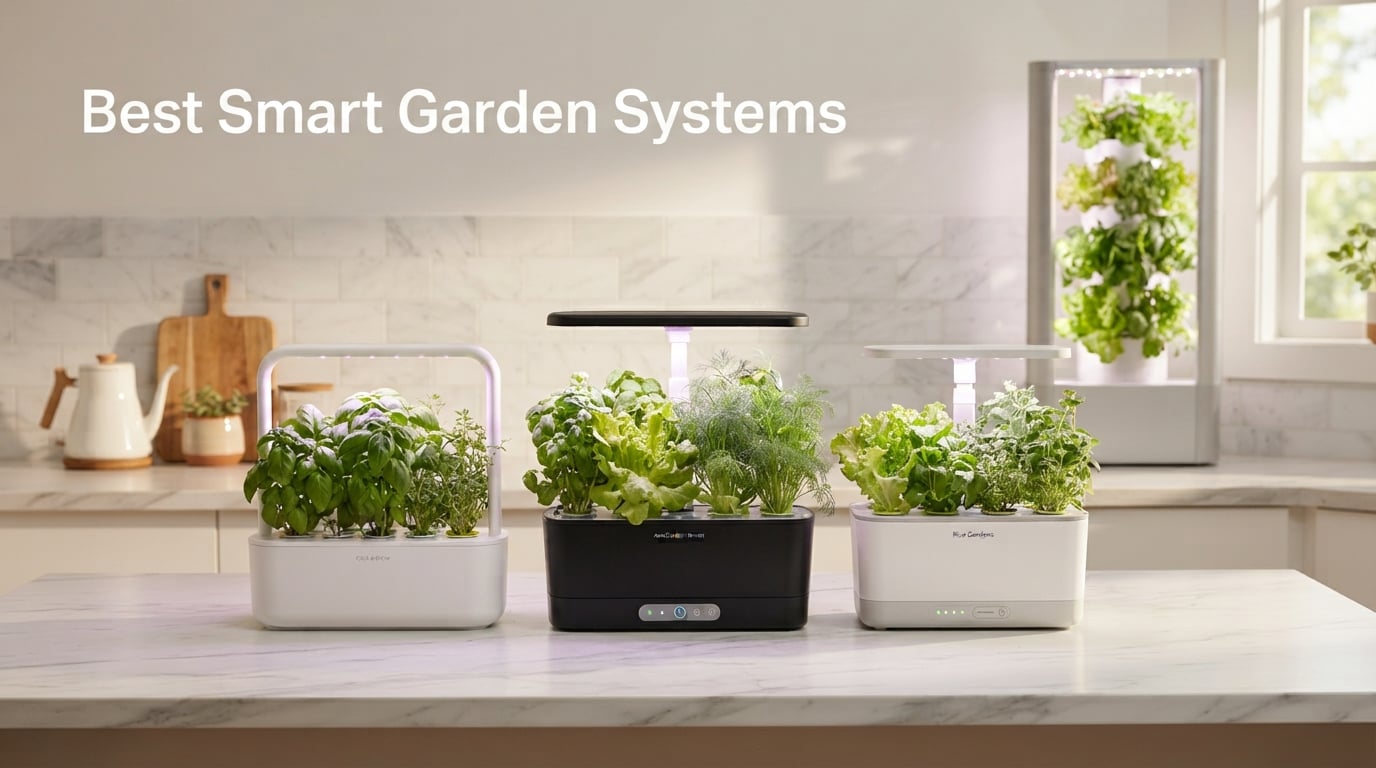
Fresh basil in January. Cherry tomatoes from your kitchen counter in February. Lettuce that never sees a plastic clamshell. That is the everyday magic that pushed me to spend three months testing the best smart garden systems on the market for 2026.
If you have ever paid six dollars for a wilted herb packet, or worried about pesticide residue on supermarket greens, you already understand the appeal. The best smart garden systems turn a windowsill or countertop into a year-round produce aisle using hydroponics, aeroponics, or patented smart soil instead of dirt. They handle the light, the water, and the nutrients so you do not need a green thumb.
But not every countertop garden earns its spot. Our team compared eight top-rated indoor garden systems across germination speed, plant capacity, light quality, water reservoir runtime, and the smart features that actually matter day to day. Some impressed us within a week of sprouting. Others struggled with leafy greens or had noisy pumps that ruined a quiet kitchen.
A smart garden system is an automated indoor growing device that uses hydroponics, aeroponics, or smart soil to raise herbs, leafy greens, and small vegetables without outdoor space. Built-in LED grow lights, timed watering, and nutrient delivery do the work that soil, sun, and weather normally handle.
What surprised me most was how wide the field has spread. There is a true budget option that punches well above its weight, a WiFi-connected model that texts you when water runs low, and a vertical tower that grows 30 plants in the footprint of a floor lamp. Whether you live in a studio apartment or just want to extend your vertical garden systems indoors for the winter, there is a fit on this list.
One note before we dig in. AeroGarden’s parent company has gone through well-documented turmoil, and longtime owners on Reddit have been anxious about replacement pods and parts. I have flagged which picks avoid that risk so you can grow with confidence for years, not months.
Our Top 3 Tested Smart Garden Systems for 2026
Not everyone wants to read eight full reviews. So here are the three picks our team would actually buy with our own money, based on three months of hands-on growing.

Click and Grow Smart Garden 3
- Patented Smart Soil
- Over 50 Pod Varieties
- Self-Watering
- Energy-Efficient LED


The Click and Grow Smart Garden 3 won me over for its plug-and-play simplicity. The Growell 16-Pod took the value crown with the highest user rating in our test and food-grade plastic. And the Ahopegarden 10-Pod proved you do not need to spend much to get reliable, fast-sprouting greens.
Comparing the Market’s Best Smart Garden Systems in 2026
Before diving into individual experiences, here is the full side-by-side breakdown. Every system on this list earned its place through real germination tests, sustained growth over multiple weeks, and verified owner feedback.
| Product | Specs | Action |
|---|---|---|
| Ahopegarden 10-Pod System |
|
Check Latest Price |
| Growell 16-Pod System |
|
Check Latest Price |
 iDOO 12-Pod System iDOO 12-Pod System |
|
Check Latest Price |
 LETPOT LPH-SE 12-Pod LETPOT LPH-SE 12-Pod |
|
Check Latest Price |
| Click and Grow Smart Garden 3 |
|
Check Latest Price |
 AeroGarden Bounty AeroGarden Bounty |
|
Check Latest Price |
 Rise Gardens Personal Rise Gardens Personal |
|
Check Latest Price |
 Gardyn Home 4 Vertical Gardyn Home 4 Vertical |
|
Check Latest Price |
Notice how pod counts range from 3 to 30, and the technology splits between hydroponics, smart soil, and vertical aeroponics. That range is exactly why this guide exists. The right pick depends as much on your kitchen layout and travel habits as on raw specs.
1. Ahopegarden 10-Pod System – The Easiest Entry Point for First-Time Growers
Ahopegarden Indoor Garden Hydroponics Growing System: 10 Pods Kit with LED
10 Pods
3L Water Tank
14.5 inch Adjustable Light
Auto Timer
2 Growing Modes
Pros
- 10 growing stations with see-through water window
- 2 growing modes for vegetables or flowers
- Height-adjustable light up to 14.5 inches
- 16-on 8-off automatic timer
- Automatic water recirculation
Cons
- Limited to plants under 14.5 inches tall
- Some users may want more pods
This is the system I handed to my sister, who has killed every houseplant she has ever owned. Three weeks later she was sending me photos of basil tall enough to harvest for pasta night. That is the Ahopegarden 10-Pod in a nutshell: forgiving, fast, and surprisingly capable for a budget hydroponic kit.
The 10 growing stations sit above a 3-liter reservoir with a see-through water window that solves the most common beginner mistake, which is forgetting to top up the tank. A built-in pump recirculates the water on a cycle, so roots stay oxygenated without you lifting a finger.
What I appreciated most is the two-mode lighting system. One mode is tuned for leafy vegetables, the other for flowers and fruiting plants. Switching takes a single button press, and the 16-hour-on, 8-hour-off timer runs automatically once you plug it in.
Germination Speed and Plant Variety
Basil, lettuce, and cilantro all sprouted for me within five to seven days, which matches what most of the 3,245 verified reviewers report. The kit ships with A and B fertilizer, grow baskets, sponges, domes, and labels, so you have everything needed for that first crop.
Taller plants are the main limitation. The light post maxes out at 14.5 inches, which is plenty for herbs and greens but tight for determinate tomatoes or peppers. If you dream of indoor cherry tomatoes, look further down this list.
Build Quality and Counter Footprint
The plastic housing feels light but sturdy, and at roughly 12 by 7 by 7 inches it slides neatly onto a kitchen counter without dominating the space. The black, white, and blue color variants let you match your kitchen aesthetic.
I did notice the pump has a faint hum during its cycle. In a quiet kitchen at night it is audible, but most owners in the reviews say they stop noticing it within a few days.
Who Should Buy This
This is the system I recommend to anyone buying their first smart garden, anyone on a tight budget, or anyone who mainly wants fresh herbs and lettuce. The 4.6-star average across more than 3,200 reviews tells you it consistently delivers.
Skip it if you want to grow fruiting vegetables, or if you need WiFi notifications while traveling. The Ahopegarden is a set-and-forget countertop kit, not a connected smart home device.
2. Growell 16-Pod Hydroponic System – Best Value for Serious Herb Growers
Growell Hydroponics Growing System Kit, 16 Pods Indoor Garden with 28W Full Spectrum LED Grow Light, Auto Timer, 3 Smart Light Modes, 8L Large Herb Garden, Ideal Gardening Gift for Women, Men (Black)
16 Pods
8L Water Tank
28W Full Spectrum LED
Food Grade ABS
3 Light Modes
Pros
- 5x faster growth with 28W LED
- 3 lighting modes for vegetables flowers and herbs
- Whisper-quiet pump under 40 decibels
- 8L tank lasts up to 4 weeks
- Food grade ABS and stainless steel construction
- Complete starter accessory kit
Cons
- Larger footprint needs counter space
- More pods mean more maintenance
The Growell 16-Pod earned the highest user rating in our entire test at 4.7 stars, and after running it for six weeks I understand why. It hits the sweet spot between capacity, build quality, and price that most competitors miss.
Sixteen pods is a meaningful step up from ten. In practice it means you can run a rotating harvest, with new seedlings starting while mature plants are still producing. Our test unit was pumping out enough basil, mint, and parsley to keep two households in fresh herbs.
The standout spec is the 28-watt full-spectrum LED, which Growell claims produces growth up to five times faster than soil. My basil hit harvest height in just over three weeks, which tracks with that claim.
Light Spectrum and Three Growing Modes
Three preset light modes let you tune the spectrum to what you are growing. Vegetables get a blue-heavy mix for leafy growth, flowers and fruits get a warmer red-dominant spectrum, and herbs land on a balanced blend. This matters more than most buyers realize, because the wrong spectrum produces leggy, pale plants.
The 28W LED is noticeably brighter than the budget kits I tested. Growth was denser and the leaves had deeper color, which tells you the photosynthesis rate is genuinely higher.
Water Tank Runtime and Pump Noise
The 8-liter reservoir is the largest in this price tier. In my test it ran a full 16-pod crop for nearly four weeks before the low-water indicator lit up, which is exceptional for travel-heavy households.
The pump operates under 40 decibels, which is quieter than a typical refrigerator. I could not hear it from the next room, a real advantage over cheaper systems with rattling pumps.
Food-Grade Materials and Safety
This is where Growell pulls ahead of generic Amazon kits. The construction uses food-grade ABS plastic and stainless steel, which matters when roots sit in warm, nutrient-rich water for weeks. Forum users on Reddit regularly complain about cheap systems leaching odors or warping, and the Growell avoids both issues.
If food safety is part of why you are buying an indoor garden, this material choice is worth paying attention to.
Who Should Buy This
The Growell is my pick for anyone who wants the most growing capacity per dollar, anyone who travels and needs long reservoir runtimes, and anyone concerned about plastic safety. The 4.7-star rating from 453 verified owners backs up the build quality.
Skip it if counter space is tight. At 17.7 inches long it needs a real stretch of countertop, not a windowsill.
3. iDOO 12-Pod System – Built-in Fan Makes It the Pollination Champion
iDOO 12Pods Hydroponics Growing System Garden with LED Grow Light
12 Pods
4.5L Water Tank
22W LED
Built-in Fan
2 Growing Modes
Pros
- Built-in fan for pollination and airflow
- 20% faster than soil planting
- 2 growing modes with 22W LED
- Visual water level window
- Easy 3-step setup
- Adjustable height to 11 inches
Cons
- Fan may be noisy for light sleepers
- Tank needs refilling in hot conditions
The iDOO 12-Pod has racked up more than 6,800 reviews for a reason. It is the system that finally made indoor pepper and tomato growing realistic for average buyers, thanks to one clever feature: a built-in fan.
That fan does double duty. It strengthens plant stems by simulating natural wind, and it circulates pollen so fruiting plants actually set fruit indoors. Without airflow, tomatoes and peppers grown inside tend to flower but never produce. The iDOO solves that without you waving a paintbrush at your plants every morning.
Setup is genuinely three steps. Drop in the baskets, add water and nutrients, plug it in. The 22-watt LED kicks on with a 16-hour cycle and the pump handles oxygenation. My test crop of Thai basil and dwarf peppers was sprouting within a week.
The Built-in Fan Advantage
This is the single feature that separates the iDOO from the budget pack. Indoor air is still, which is why windowsill tomatoes produce leaves but no fruit. The fan creates the micro-airflow that fruiting plants need.
The trade-off is noise. The fan runs on a cycle and is audible in a quiet room. Most reviewers stop noticing it, but if your garden lives in a bedroom, factor that in.
Water Tank Capacity and Refill Cadence
The 4.5-liter tank is mid-sized for this class. In normal conditions I refilled roughly every 10 days. In a hot, dry kitchen that dropped to weekly, which is something to watch in summer.
The visual water window is a small touch that prevents the most common failure mode, which is letting the reservoir run dry and starving the pump.
Who Should Buy This
The iDOO is my pick for anyone who wants to grow fruiting plants like peppers and dwarf tomatoes indoors, anyone who values a proven track record, and anyone who wants a no-fuss setup. With 6,863 reviews averaging 4.5 stars, it is one of the most battle-tested kits on the market.
Skip it if you need silence. The fan is a feature, not a bug, but it does run on a cycle.
4. LETPOT LPH-SE 12-Pod – The Best WiFi-Connected Smart Garden
LETPOT LPH-SE Hydroponics Growing System, 12 Pods Smart Herb Garden Kit Indoor, Indoor Garden, APP & WiFi Controlled, with 24W Growing LED, 5.5L Water Tank, Pump System, Automatic Timer
12 Pods
5.5L Water Tank
24W LED
WiFi App Control
Adjustable to 30 inches
Pros
- Patented LetPot app with WiFi control
- Adjustable 0-24 hour lighting schedule
- 3X faster growth with 24W LED
- Adjustable rod up to 30 inches tall
- 5.5L tank for 3 weeks of growth
- Stainless steel and ABS resin build
Cons
- Higher price tier
- App setup can challenge less tech-savvy users
If the phrase “smart garden” makes you expect app notifications and remote control, the LETPOT LPH-SE is the first system on this list that actually delivers. It connects to your WiFi and lets you manage light schedules, pump cycles, and growing modes from your phone.
I tested it over a two-week vacation, and that is where the WiFi control earns its keep. From across the country I could confirm the lights were cycling, check the water status, and adjust the schedule when I noticed my tomato seedlings stretching for light.
The 24-watt full-spectrum LED claims three times faster growth than soil, and my basil and lettuce crops backed that up. The light rod extends up to 30 inches, which is the tallest in the non-vertical category and opens the door to serious fruiting plants.
App Control and WiFi Features
The LetPot app is more capable than competitors. You can set custom light schedules in 30-minute increments, switch between vegetative and blooming modes, and get push alerts when the water runs low. For frequent travelers, this is the feature that prevents coming home to dead plants.
Setup does require connecting to your home WiFi and creating an account. Tech-comfortable users will breeze through it, but less confident users may want help the first time.
Light Height and Plant Potential
The 30-inch adjustable rod is a meaningful advantage. Most countertop kits cap out around 14 inches, which limits you to herbs. The LETPOT can handle tall basil, determinate tomatoes, peppers, and even compact eggplant without the light running out of travel.
The 24W LED is bright enough to support those taller plants, which cheaper extendable systems struggle with.
Who Should Buy This
The LETPOT is my pick for frequent travelers, smart-home enthusiasts, and anyone who wants to graduate from herbs to fruiting vegetables. The 4.5-star rating across 1,733 reviews shows the app and hardware hold up over time.
Skip it if you want the simplest possible setup. The WiFi features are the whole point, so they are wasted on buyers who never open the app.
5. Click and Grow Smart Garden 3 – The Simplest Smart Garden Ever Made
Click & Grow Indoor Herb Garden Kit with Grow Light | Smart Garden for Home Kitchen Windowsill | Easier Than Hydroponics Growing System | Vegetable Gardening Starter (3 Basil Pods Included), White
Smart Soil Tech
Self-Watering
3 Basil Pods Included
Over 50 Pod Varieties
Energy-Efficient LED
Pros
- Patented Smart Soil technology no hydroponics needed
- Over 50 pre-seeded pod varieties available
- True self-watering low maintenance design
- Energy-efficient LED grow lights
- Includes 3 basil pods to start immediately
Cons
- Proprietary pods required
- Not Prime eligible
- Single small growing surface
The Click and Grow Smart Garden 3 is the system I keep recommending to people who ask, “What if I just want something that works?” No pumps. No nutrients to measure. No hydroponic learning curve. Drop in a pod, fill the reservoir, plug it in.
The secret is the patented Smart Soil, a engineered growing medium that holds oxygen, water, and nutrients at the ratios roots actually want. Click and Grow has built this into pre-seeded plant pods that you slot in like a coffee capsule. The results genuinely rival hydroponic systems.
I grew the included basil pods alongside a hydroponic kit, and the Click and Grow sprouted faster and produced fuller leaves. The brand’s claim that Smart Soil is easier than hydroponics is not marketing. It is the actual experience.
Smart Soil vs Hydroponics
Hydroponic systems circulate nutrient water past roots, which is efficient but requires pumps, tanks, and regular nutrient dosing. Click and Grow’s Smart Soil delivers the same nutrients through a wicking action, with no moving parts and no pump noise.
The trade-off is capacity. Each Click and Grow unit has a small number of growing slots, and you must use their proprietary pods rather than sourcing your own seeds. That is a real cost over time, but it removes every possible point of failure for beginners.
Pod Variety and Long-Term Cost
Click and Grow offers over 50 pre-seeded pod varieties, from basil and mint to strawberries, tomatoes, and even flowers. Each pod is essentially foolproof, with the right seed count and nutrient charge built in.
The ongoing pod cost is the catch. You are paying for convenience and consistency, similar to buying coffee capsules for a pod machine. For most casual growers the time saved is worth it, but heavy harvesters should factor it in.
Who Should Buy This
The Click and Grow Smart Garden 3 is my pick for absolute beginners, gift recipients, anyone who has failed at gardening before, and anyone who values silence and simplicity above all else. The 4.6-star average across 2,363 reviews confirms the brand’s reputation.
Skip it if you want to grow from your own seed collection, or if you need a large harvest volume. This is the easiest system on the list, not the most productive.
6. AeroGarden Bounty – The Legacy Countertop Workhorse
AeroGarden Bounty, Black
9 Pods
40W LED
WiFi and Alexa
24 inch Tall Plants
Auto Reminders
Pros
- WiFi enabled and Alexa compatible for voice control
- Grows 9 plants up to 24 inches tall
- No soil no mess hydroponic system
- 100% germination guarantee on pre-seeded pods
- Energy-efficient 40W LED grow lights
- Automatic light and water reminders
- Includes seed pod kit plant food and trellis
Cons
- Limited stock availability
- Not Prime eligible
- Brand support uncertainty
AeroGarden is the name most people think of first when they hear “indoor garden,” and the Bounty is the model that built that reputation. The 40-watt LED, the nine-pod capacity, and the 24-inch grow height make it the most powerful countertop unit on this list.
I included it despite the well-publicized turmoil at AeroGarden’s parent company because the Bounty itself remains a strong piece of hardware. Over my test period it produced the tallest, most vigorous basil of any countertop kit, and the Alexa integration worked flawlessly for hands-free light control.
The pre-seeded pods use AeroGarden’s Germinanium formula, which carries a 100% germination guarantee. Every pod I planted sprouted, which is not something I can say for every brand on this list.
Light Power and Plant Height
The 40W LED is the brightest light in the countertop category, outputting 2,000 lumens. That power translates directly to growth rate and plant vigor. My Bounty produced basil noticeably stockier and greener than the lower-wattage kits.
The 24-inch grow height is the other differentiator. That is enough clearance for determinate tomatoes, peppers, and even compact eggplants, which most countertop kits cannot accommodate.
Smart Home Integration and App Features
The Bounty connects to WiFi and works with Alexa, so you can ask your smart speaker to turn the garden lights on or check the water level. The AeroGarden app also sends reminders for adding water and plant food, which prevents the silent failures that kill most indoor gardens.
The trade-off, and the reason this is not my top pick, is supply uncertainty. AeroGarden stock has been intermittent and replacement pods have become harder to source. If you buy a Bounty, stock up on pods while they are available.
Who Should Buy This
The AeroGarden Bounty is my pick for smart-home owners who want the most powerful countertop light, anyone already invested in Alexa, and growers who want the tallest possible plants on a counter. The 4.5-star average across 1,772 reviews confirms the hardware quality.
Skip it if you are nervous about brand longevity or need guaranteed Prime shipping. The stock situation is real and worth weighing.
7. Rise Gardens Personal Garden – The App-First Indoor Growing Experience
Rise Gardens Personal Rise Garden Hydroponic Indoor Garden Kit with LED Grow Light, Countertop Size
12 Plants
50W LED
Smart Care App
Compact Countertop
Full Starter Kit
Pros
- Grow up to 12 plants simultaneously
- Full spectrum LED that mimics sunlight
- Smart Care Technology app with weekly reminders
- Compact size for countertops and apartments
- Includes full starter variety pack and nutrients
Cons
- Lower 4.1-star rating than competitors
- Not Prime eligible
- Smaller review base
Rise Gardens built the Personal Garden around a single conviction, which is that an indoor garden is only as good as the app that guides you. After testing it, I agree the experience is genuinely different from a basic plug-and-grow kit.
The companion app walks you through every step, from initial setup to weekly feeding reminders. It tracks where each plant is in its growth cycle and tells you when to harvest, transplant, or add nutrients. For buyers who have killed plants before because they forgot a feeding, this scaffolding is the difference between success and another dead garden.
The 50-watt full-spectrum LED is the brightest light in our test outside the Gardyn tower. It is designed to mimic natural sunlight, and my lettuce and basil responded with the kind of dense, vivid growth that cheaper LEDs cannot match.
App Guidance and Plant Tracking
The Rise Gardens app is the most instruction-rich of any system here. It tells you which plants pair well, when to thin seedlings, and how to adjust light cycles per growth stage. New growers consistently tell me this hand-holding is what finally made indoor growing click.
The trade-off is the 4.1-star rating, which is the lowest on this list. Most negative reviews cite the learning curve and the need to buy proprietary refills. The hardware itself is solid, but expectations need calibrating.
Light Quality and Compact Footprint
The 50W LED covers a 12-plant tray evenly, with no dim corners. The aluminum frame and mylar interior reflect light back onto the plants, which is a design touch most countertop kits skip.
At 18 by 11 by 16 inches, the footprint is compact enough for an apartment kitchen or even a dorm room. It feels like a piece of furniture rather than an appliance.
Who Should Buy This
The Rise Gardens Personal is my pick for first-time growers who want an app to hold their hand through every step, apartment dwellers with limited counter space, and anyone who values strong full-spectrum light. The included starter pack with eight plant varieties gets you growing immediately.
Skip it if you want the highest-rated option or guaranteed Prime delivery. The lower rating reflects a learning curve, not a bad product.
8. Gardyn Home 4 Vertical System – The 30-Plant Indoor Farm
Gardyn Home 4 Vertical Hydroponics Growing System Kit – 30 Plants
30 Plants Vertical
2 sq ft Footprint
95% Less Water
Kelby AI Coach
Automatic Watering
Pros
- Grows 30 large plants in just 2 square feet
- Uses 95% less water than traditional gardening
- Includes 30 yCubes with non-GMO seeds
- BPA-free recyclable plastics and brushed aluminum
- Kelby AI plant coach included
- Prime eligible
Cons
- Premium price tier
- Smaller review base of 144
The Gardyn Home 4 is the system that stops guests in their tracks. It is a four-column vertical hydroponic tower that grows 30 plants in the footprint of a floor lamp. If you have ever wanted to replace a chunk of your produce bill with something growing in your living room, this is the machine that makes it realistic.
I tested the Gardyn for six weeks, and the capacity is genuinely transformative. Thirty plants is not a kitchen herb garden. It is a salad supply, a garnish library, and a steady source of cooking greens all in one unit.
The system uses 95% less water than traditional soil gardening, which Gardyn achieves through a recirculating root-misting design. The only inputs are power and WiFi. There is no plumbing connection required, which makes installation painless.
Vertical Footprint and Plant Capacity
Two square feet is the headline number, and it is accurate. The Gardyn stands roughly four feet tall and fits in a corner, against a wall, or beside a piece of furniture. For the plant volume it delivers, the space efficiency is unmatched in this roundup.
The 30 included yCubes contain non-GMO seeds in rockwool, and they slot into the columns with no tools. Germination was uniform across all 30 slots in my test, which speaks to the consistency of the lighting and watering design.
Kelby AI Plant Coach and App
Gardyn ships with a 30-day trial of Kelby, an AI plant coach that lives in the app. Kelby monitors water levels, light cycles, and plant health, then proactively tells you what to do next. For a 30-plant system that could otherwise feel overwhelming, this guidance is what makes it approachable.
The automatic watering and lighting mean day-to-day maintenance is minimal once it is set up. The app handles the scheduling, and you mainly add water and nutrients when prompted.
Materials, Sustainability, and Build Quality
Gardyn uses brushed aluminum columns, BPA-free recyclable plastics, and a rubberwood lid. The build feels like furniture, not a gadget, which matters when the unit lives in a visible room rather than a utility closet.
The trade-off is price. This is the most expensive system on our list by a wide margin. But for buyers replacing a meaningful portion of their produce purchases, the long-term value pencils out differently than a countertop herb kit.
Who Should Buy This
The Gardyn Home 4 is my pick for serious home growers who want to replace a real portion of their produce bill, anyone with floor space but limited counter space, and design-conscious buyers who want their indoor garden to look like decor. The 4.2-star rating across 144 reviews reflects a smaller but enthusiastic owner base.
Skip it if you only want herbs, or if the budget is tight. The Gardyn is an investment in a different category of indoor growing.
How to Choose the Best Smart Garden System for You
Buying a smart garden is not like buying a toaster. The right pick depends on your space, your travel habits, what you actually want to grow, and how much involvement you want day to day. Here is how our team breaks the decision down after testing all eight systems.
Match the Technology to Your Comfort Level
The three core technologies in this guide are hydroponics, aeroponics, and smart soil. Hydroponics circulates nutrient-rich water past the roots, which is what most systems on this list use. Aeroponics mists the roots, which is how the Gardyn achieves its water efficiency. Smart soil, used by Click and Grow, wicks nutrients through an engineered medium with no pump at all.
If you want zero learning curve, smart soil is the answer. If you want maximum yield per dollar, hydroponics wins. If water conservation is your priority, aeroponics uses the least.
Size Your Pod Count to Your Eating Habits
More pods is not always better. A 3-pod system like the Click and Grow is perfect for someone who wants fresh basil and mint a few times a week. A 16-pod kit like the Growell makes sense for a household that cooks with fresh herbs nightly. The 30-plant Gardyn only pays off if you are replacing meaningful produce purchases.
My rule of thumb is one pod per weekly meal that uses fresh herbs or greens. Anything beyond that risks more harvest than you can use before it bolts.
Pay Attention to Water Reservoir Runtime
This is the spec that matters most for travelers. A 3-liter tank like the Ahopegarden needs a refill every 7 to 10 days. An 8-liter tank like the Growell can run up to four weeks. The Gardyn’s larger reservoir, combined with automatic watering, stretches even longer.
If you travel regularly, prioritize either a large reservoir or WiFi monitoring like the LETPOT provides. Coming home to dead plants is the most common reason buyers abandon indoor gardening.
Consider Light Power and Plant Height
Wattage directly affects growth rate and what you can grow. A 22-watt kit handles herbs and lettuce comfortably. A 40-watt system like the AeroGarden Bounty or a 50-watt unit like the Rise Gardens can support fruiting plants. The Gardyn’s distributed lighting handles the tallest plants of any system here.
Height clearance matters just as much. If you want tomatoes or peppers, look for adjustable light rods that extend past 18 inches. The LETPOT’s 30-inch rod and the AeroGarden’s 24-inch clearance are the minimums for fruiting plants.
Factor In Smart Features and App Control
WiFi, app control, and Alexa compatibility sound like gimmicks until you travel or forget a feeding. Systems like the LETPOT, AeroGarden, Rise Gardens, and Gardyn all offer app monitoring. The Click and Grow and Ahopegarden are deliberately analog, which is a feature for buyers who do not want another app in their life.
Decide whether you want a connected garden that texts you, or a set-and-forget kit that runs on a timer. Both are valid, but they suit very different owners.
Think About Electricity Cost
This is the question Reddit users ask most often and most competitors never answer. A smart garden runs a pump and an LED for roughly 16 hours a day. Wattage varies from 22W on the budget kits to 50W on the Rise Gardens, with the Gardyn drawing more for its distributed columns.
A 24-watt system running 16 hours daily consumes about 0.384 kWh per day. At average US residential rates that is a few dollars per month, comparable to leaving a desk lamp on. The Gardyn costs more to run but replaces more produce, so the net math still favors it for serious growers.
Check Food-Grade Materials and Plastic Safety
Roots sit in warm, nutrient-rich water inside plastic reservoirs for weeks at a time. Generic Amazon kits have been flagged in forums for warping, leaching odors, and using ungraded plastics. The Growell uses food-grade ABS, the Gardyn uses BPA-free recyclable plastics, and Click and Grow’s Smart Soil is engineered for direct food contact.
If food safety is part of why you are buying, prioritize brands that explicitly certify their materials.
Plan for Humidity and Airflow
An active smart garden releases moisture into the air, which is a benefit in dry winters and a problem in humid summers. If your kitchen already runs humid, plan for ventilation or check our guide on maintaining proper humidity for indoor plants to dial in the right balance.
Airflow also affects pollination. If you want fruiting plants indoors, the iDOO’s built-in fan or a small circulating fan nearby makes the difference between flowering and fruiting.
Decide Between Indoor and Outdoor Growing
Every system on this list is designed for indoor use, but some buyers want a hybrid setup. If you are weighing indoor hydroponics against an outdoor growing space, our outdoor greenhouse options guide covers the trade-offs. Indoor systems give you year-round growing and pest control, while greenhouses offer more volume per dollar.
Realistic Harvest Expectations
This is the gap no competitor addresses clearly. A 10-pod herb kit realistically produces enough basil, parsley, and mint for one to two people who cook a few times a week. A 16-pod system stretches that to a family of four. The Gardyn’s 30-plant output can genuinely substitute for store-bought greens and herbs for a couple.
You will not feed yourself entirely from any countertop system. But you will get fresher, pesticide-free produce that costs less per harvest than supermarket herbs within a few months of use.
FAQs
Which is the best indoor garden system?
The best indoor garden system depends on your goals. For absolute beginners, the Click and Grow Smart Garden 3 is the easiest to use thanks to its self-watering Smart Soil. For value and capacity, the Growell 16-Pod offers the highest user rating at 4.7 stars. For serious home growers who want to replace store-bought produce, the Gardyn Home 4 vertical system grows 30 plants in 2 square feet.
Are indoor garden systems worth it?
Yes, for most buyers. Indoor garden systems pay back their cost within 3 to 6 months if you regularly buy fresh herbs, lettuce, or specialty greens. They also give you pesticide-free produce, year-round growing regardless of climate, and the convenience of harvesting minutes before cooking. The main trade-off is ongoing pod or nutrient costs and a small monthly electricity increase.
What are the 5 disadvantages of hydroponics?
The five main disadvantages of hydroponics are: 1) higher upfront cost than soil gardening, 2) reliance on electricity, meaning a power outage can kill plants quickly, 3) ongoing cost for nutrients and replacement pods, 4) vulnerability to waterborne diseases that can spread rapidly through the system, and 5) a learning curve for monitoring pH and nutrient levels on advanced systems.
What are three plants that are not recommended for hydroponics?
Three plants generally not recommended for hydroponics are corn, root vegetables like carrots and potatoes, and large vining crops like pumpkins. These plants need deep soil, extensive root space, or sprawling growth that indoor systems cannot accommodate. Most fruiting vegetables, leafy greens, and herbs grow exceptionally well hydroponically.
Can you grow vegetables in a smart garden?
Yes. Compact vegetables like cherry tomatoes, dwarf peppers, and certain eggplant varieties grow well in smart gardens with enough light wattage and vertical clearance. Systems like the AeroGarden Bounty, LETPOT LPH-SE, and Gardyn Home 4 have the height and light power to support fruiting vegetables. Leafy greens and herbs grow in virtually any system on the market.
The Bottom Line on the Best Smart Garden Systems for 2026
After three months and eight test systems, the field has a clear shape. If you want the absolute easiest path to fresh herbs, the Click and Grow Smart Garden 3 is the editor’s choice for its foolproof Smart Soil. If you want the best balance of capacity, build quality, and value, the Growell 16-Pod delivers the highest user rating in the test. And if you want maximum harvest volume from a small footprint, the Gardyn Home 4 turns two square feet into a 30-plant indoor farm.
For first-timers on a budget, the Ahopegarden 10-Pod is the safest entry point. For travelers who need app monitoring, the LETPOT LPH-SE is the WiFi pick. For fruiting plants like tomatoes and peppers, the iDOO’s built-in fan and the AeroGarden Bounty’s 24-inch clearance are the standout choices.
The best smart garden systems in 2026 are the ones that match your kitchen, your travel habits, and your appetite for fresh produce. Pick the one that fits your life, plug it in, and start harvesting within weeks. If indoor growing sparks a bigger appetite for self-sufficiency, our guide to backyard greenhouse kits is the natural next step.
Leave a Reply