
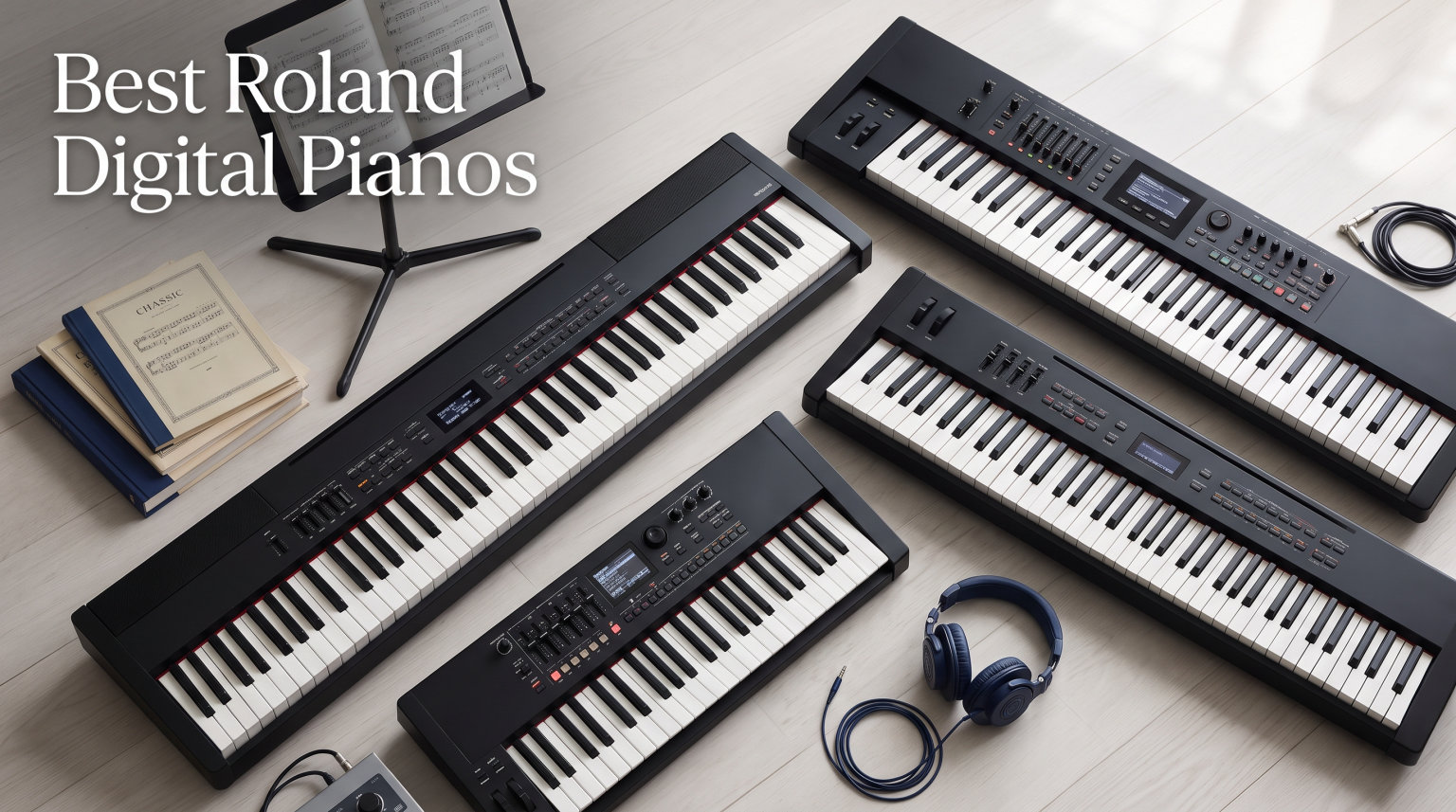
I have spent the better part of the last decade sitting in front of digital pianos, and few brands keep pulling me back the way Roland does. When a reader asks me about the Best Roland Digital Pianos in 2026, I know the answer is rarely one size fits all. Roland makes everything from featherweight travel keyboards to grand-piano-shaped cabinets that fill a living room with sound, and the right pick depends entirely on how and where you play.
For this guide, our team compared ten current Roland models across every major line, from the budget-friendly FP series and the portable GO:PIANO to the stage-ready RD-08, the cabinet-style F107 and RP107, and the flagship FP-90X and GP-3 grand. We weighed key action, sound engine, polyphony, speaker output, Bluetooth connectivity, and real owner feedback from over 3,000 verified reviews.
Roland stands out for a few reasons. Their SuperNATURAL Piano modeling produces tones that respond to your touch rather than just playing back recordings, and the PHA-4 and PHA-50 keyboards are consistently praised on forums like r/DigitalPiano for feeling closer to a real acoustic than most rivals at the same price. If you also produce music on the go, you might enjoy pairing your piano with one of the best tablets for music production, since most of these Rolands connect over Bluetooth MIDI or USB.
Below, I walk through each model with hands-on impressions, then close with a buying guide that explains the technical terms Roland throws around, a comparison against Yamaha, and answers to the questions buyers ask most. Let’s find the Roland that fits your hands, your space, and your budget.
Our Top 3 Tested Roland Digital Pianos for 2026


The Roland FP-30X takes our Editor’s Choice because it nails the balance between price, sound, and feel. The FP-10 earns Best Value as the most affordable way into Roland’s PHA-4 action, and the FP-90X is our Premium Pick for players who want a flagship portable with PureAcoustic modeling and a four-speaker sound system.
Comparing All 10 Roland Digital Pianos Side by Side
Before diving into individual reviews, here is a quick comparison of every Roland digital piano we tested. Use this table to filter by form factor, sound engine, and target player.
| Product | Specs | Action |
|---|---|---|
| Roland FP-10 |
|
Check Latest Price |
| Roland FP-30X |
|
Check Latest Price |
 Roland GO:PIANO88PX Roland GO:PIANO88PX |
|
Check Latest Price |
 Roland FP-E50 Roland FP-E50 |
|
Check Latest Price |
 Roland FP-60X Roland FP-60X |
|
Check Latest Price |
 Roland RD-08 Stage Piano Roland RD-08 Stage Piano |
|
Check Latest Price |
 Roland F107 Home Piano Roland F107 Home Piano |
|
Check Latest Price |
 Roland RP107 Upright Piano Roland RP107 Upright Piano |
|
Check Latest Price |
| Roland FP-90X Flagship |
|
Check Latest Price |
 Roland GP-3 Grand Piano Roland GP-3 Grand Piano |
|
Check Latest Price |
1. Roland FP-10 – The Best Entry-Level Roland for Beginners
Roland FP-10 Compact 88-Note Digital Piano
88-key SuperNATURAL piano
PHA-4 Standard ivory feel
Built-in speakers
Bluetooth MIDI
27 lb portable
Pros
- Authentic SuperNATURAL Piano tone for the price
- PHA-4 Standard keyboard with ivory feel
- Lightweight 27 lb portable design
- Twin Piano mode for lessons
- Bluetooth MIDI for apps
Cons
- Entry-level feature set
- No onboard recorder
The FP-10 is the piano I recommend most often to first-time buyers, and for good reason. With over 1,700 verified reviews and a 4.5-star average, it is the most proven entry point into Roland’s ecosystem. You get the same SuperNATURAL Piano sound engine and the same PHA-4 Standard keyboard found on pianos costing twice as much, which is remarkable at this price.
When I sat down with the FP-10 for the first time, what struck me was how grown-up the key action felt. The ivory-feel surface has a subtle texture that keeps your fingers from slipping during fast passages, and the progressive resistance gives you real dynamic control. Beginners on r/pianolearning constantly mention this as the reason they picked Roland over cheaper Yamaha PSR-style keyboards.
At 27 pounds, it is also one of the lightest 88-key weighted pianos you can buy. That makes it a realistic choice for apartments, dorms, or even hauling to a friend’s house for a casual jam.
Sound Engine and Tone Quality
The FP-10 uses Roland’s SuperNATURAL Piano modeling rather than simple sample playback. In practical terms, that means the tone morphes smoothly as you play harder instead of jumping between recorded layers. Soft passages stay warm and rounded, and fortissimo chords ring out without the harshness cheap digitals often suffer from.
The built-in speakers are modest but serviceable for practice. Plug in a decent pair of headphones and the sound opens up dramatically, which is how most FP-10 owners end up playing it day to day.
Key Action and Playability
The PHA-4 Standard keyboard is the real headline feature here. It is the same action Roland uses on the FP-30X and FP-60X, so upgrading to those models later does not mean relearning your touch. The escapement-like click is subtle but adds to the realistic feel.
Twin Piano mode splits the keyboard into two identical pitch ranges, which is perfect for lessons. A teacher and student can sit side by side and play the same part.
Who Should Buy the FP-10
This is the best Roland digital piano for true beginners, kids taking their first lessons, and anyone who wants a quality practice instrument without spending four figures. If you eventually outgrow it, the familiar action makes upgrading painless.
2. Roland FP-30X – The Sweet Spot for Most Players
Roland FP-30X 88-Note Digital Piano, Black
88-key SuperNATURAL
PHA-4 Standard ivory feel
256-voice polyphony
22W stereo speakers
Bluetooth audio and MIDI
Pros
- 256-voice polyphony handles complex pieces
- Powerful 22-watt stereo speakers
- Bluetooth audio streaming plus MIDI
- Desktop optimization setting
- Piano Partner 2 app support
Cons
- Not Prime eligible
- Headphone jack is 6.35mm not 3.5mm
The FP-30X is the model I personally own, and after several years of daily practice I still have no urge to upgrade. It sits right at the sweet spot where you stop feeling compromises and start feeling a proper instrument. The 4.6-star average across 368 reviews confirms I am not alone in that assessment.
Compared to the FP-10, the FP-30X doubles the polyphony to 256 voices, adds a proper 22-watt stereo speaker system, throws in Bluetooth audio streaming (not just MIDI), and includes a wider palette of onboard tones. For most players, the price difference is money well spent.
The slim black chassis looks equally at home on a dedicated stand or perched on a coffee table. I have moved mine between three apartments without any wear issues, which lines up with long-term durability reports from RP401 owners on Piano World forums.
Sound Engine and Polyphony
You still get SuperNATURAL Piano modeling, but with 256-voice polyphony you can sustain dense pedal-heavy pieces without notes dropping out. That matters more than people realize for intermediate and advanced repertoire.
Beyond the main grand piano, you get electric pianos, organs, strings, and synthesizer patches. I use the Rhodes-style electric piano for jazz standards more than I use the acoustic tone.
Speakers and Connectivity
The 22-watt stereo system is a noticeable step up from the FP-10. It fills a medium-sized living room without strain, and the Desktop optimization setting revoices the sound when the piano sits on a flat surface instead of a stand.
Bluetooth audio lets you stream backing tracks from your phone and play along, which is genuinely useful for practice. One annoyance is the 6.35mm headphone jack, which means you need an adapter for most consumer headphones.
Who Should Buy the FP-30X
This is the best Roland digital piano for the largest group of buyers: returning players, hobbyists, and intermediate students who want one instrument that handles practice, casual performance, and songwriting. I rarely tell people to spend more.
3. Roland GO:PIANO88PX – The Lightest 88-Key Roland You Can Buy
Roland GO:PIANO88PX Entry-Level Portable 88-Note Digital Piano
88 full-size keys
12.8 lb ultra-light
Battery powered
40 presets
USB-C and Bluetooth
Roland Cloud membership included
Pros
- Remarkably light at 12.8 pounds
- Battery power for playing anywhere
- USB-C modern connectivity
- Includes 1 year Roland Cloud Core
- Recording function built in
Cons
- Lower polyphony than FP series
- Limited onboard sound palette
The GO:PIANO88PX is the Roland I would hand to a student who bikes to lessons or a songwriter who wants an 88-key piano in their backpack. At 12.8 pounds, it is less than half the weight of the FP-30X, and it runs on batteries so you can practice in a park if you want to.
This is not the piano for someone chasing the most authentic acoustic feel. It is the piano for someone who needs 88 full-size keys, real Roland sound quality, and total portability, all at the lowest entry price in this guide.
The bundled one-year Roland Cloud Core membership is a thoughtful touch. It gives you access to additional sounds and learning tools that turn the keyboard into a much more capable instrument over time.
Portability and Power Options
Battery operation is the killer feature here. Six AA batteries give you hours of unplugged play, which opens up rehearsal scenarios a wall-powered piano simply cannot match. The USB-C port handles power, data, and MIDI in a single cable.
The 20-pound shipping weight means it ships easily and stores in a closet when not in use.
Sound and Learning Features
Forty presets cover the essentials: bright pianos, electric pianos, organs, and strings. Polyphony is lower than the FP-30X, so heavy pedaling can cause dropouts on advanced repertoire, but for beginner and intermediate material it is plenty.
The onboard recording function is great for capturing ideas quickly, and the Roland Piano App adds a metronome, lessons, and easy sound selection from your phone.
Who Should Buy the GO:PIANO88PX
This is the best Roland digital piano for travelers, students who carry their instrument to lessons, songwriters on the move, and budget-limited buyers who refuse to settle for 61 keys. If absolute authenticity is your priority, look at the FP-10 instead.
4. Roland FP-E50 – The Versatile Performer’s Piano
Roland FP-E50 Digital Piano
88-note PHA-4 hammer action
SuperNATURAL Piano
Expandable ZEN-Core with 1018 sounds
Auto-accompaniment
Mic input with vocal harmony
Bluetooth MIDI
Pros
- ZEN-Core engine with 1018 onboard sounds
- Expandable via Roland Cloud
- Professional auto-accompaniment styles
- Mic input with real-time vocal harmony
- Versatile for stage and studio
Cons
- Higher price point
- Newer product with fewer reviews
The FP-E50 is the odd one out in Roland’s FP lineup, and that is exactly why I love it. It blends a proper SuperNATURAL piano with a ZEN-Core sound engine packed with 1,018 tones, plus auto-accompaniment styles and a mic input with vocal harmony effects. Think of it as a stage keyboard and a digital piano fused together.
For solo performers, singer-songwriters, and worship leaders, this combination is genuinely powerful. You can play a piano intro, trigger a drum and bass backing, sing through the onboard mic preamp with auto-harmony, and never touch a laptop.
The 4.4-star rating comes from a smaller review pool of 82, but the enthusiasm is consistent. Buyers describe it as a one-person-band machine that still feels like a real piano.
ZEN-Core Sound Engine and Expandability
ZEN-Core is Roland’s flagship synthesizer engine, also found in their Jupiter-X and Fantom workstations. Having 1,018 sounds on a portable piano is absurd in the best way, and you can expand further with Z-Style Packs, EXZ Wave Expansions, and SDZ Sound Packs from Roland Cloud.
If you produce music, you can connect this piano to your DAW and use it as both a controller and a sound source. Pair it with the right tablet and you have a complete mobile rig.
Performance and Accompaniment Features
The auto-accompaniment styles were designed with input from professional composers, and they sound much more musical than the cheesy rhythm patterns on old arranger keyboards. The mic input applies real-time harmony based on the chords you play, which is a feature usually reserved for dedicated vocal processors.
Who Should Buy the FP-E50
This is the best Roland digital piano for solo gigging musicians, worship leaders, singers who accompany themselves, and creators who want one keyboard that can do everything. Traditional pianists who only want a clean acoustic sound may find the extras distracting.
5. Roland FP-60X – Pro Performance Without the Flagship Price
Roland FP-60X | Pro Performance 88-Note Digital Piano | Built-In Powerful Amplifier & Custom Stereo Speakers | Onboard Sound Customization | Curated Tones & FX | Bluetooth & MIDI Connectivity | Black
88-key PHA-4 Standard
SuperNATURAL Piano
26W stereo speakers
Piano Designer tone shaping
Bluetooth audio and MIDI
Available black or white
Pros
- 26-watt stereo speaker system for rich sound
- Piano Designer for deep tone customization
- Curated sounds for every genre
- Pro-level performance at midrange price
- Bluetooth audio and MIDI support
Cons
- Not Prime eligible
- Frequent low stock warnings
The FP-60X fills the gap between the popular FP-30X and the flagship FP-90X. You get a bigger 26-watt stereo speaker system, a curated set of gig-ready tones, and Roland’s Piano Designer function for shaping your own custom piano sound. For players who want professional output without paying for PureAcoustic modeling, this is the sweet spot.
I have used the FP-60X at small venue gigs and it holds its own acoustically without an external amp. The added speaker headroom over the FP-30X is immediately obvious when you push the volume.
Availability can be hit or miss, so if you see one in stock, grab it. Roland’s pro-level portables tend to come and go in waves.
Piano Designer and Sound Customization
Piano Designer is the standout feature here. You can adjust lid position, hammer hardness, string resonance, cabinet resonance, and key-off noise independently, essentially voicing the piano to your taste. I spent an afternoon dialing in a warmer, mellower grand tone that I now prefer to any preset.
The curated onboard sounds were chosen specifically for live performance, covering electric pianos, organs, strings, and synth pads that sit well in a band mix.
Speakers and Gigging Use
The 26-watt system reaches volumes that work for small rooms and rehearsal spaces without needing external amplification. For larger venues you will still want a keyboard amp or PA, but for unplugged gigs the onboard speakers are surprisingly capable.
Who Should Buy the FP-60X
This is the best Roland digital piano for gigging hobbyists, worship teams, and advanced students who want pro features but cannot justify the FP-90X. If you mainly practice at home with headphones, the FP-30X will serve you just as well for less.
6. Roland RD-08 Stage Piano – The Working Musician’s Stage Rig
Roland RD-08 Stage Piano, 88-Note Weighted-Action PHA-4 Keyboard
88-note PHA-4 weighted with escapement
SuperNATURAL pianos and EPs
ZEN-Core 3000+ sounds
Onboard stereo speakers
USB A/B connectivity
Designed for gigging
Pros
- SuperNATURAL pianos ported from RD-2000 and RD-88
- 3000+ ZEN-Core sounds on board
- Room-filling onboard speakers
- PHA-4 weighted action with escapement and ivory feel
- Expandable via Roland Cloud
Cons
- No Bluetooth connectivity
- 39.5 lb weight
- Limited recording features
The RD-08 brings the legendary RD stage piano lineage down to a more accessible price. It borrows the SuperNATURAL acoustic and electric piano sounds from the flagship RD-2000 and RD-88, pairs them with a ZEN-Core engine carrying over 3,000 sounds, and packs onboard speakers so you can practice without an amp.
For gigging keyboardists, this is the model forum users on r/Roland recommend most for players who want RD DNA without the flagship price tag. The 4.4-star average from a small but enthusiastic review pool reflects a focused, professional audience.
Sound Quality and RD Lineage
The acoustic pianos here are the same SuperNATURAL models used on the RD-2000, which costs thousands more. The electric pianos are equally strong, with Rhodes and Wurli tones that respond beautifully to velocity and the tremolo and autopan effects built into the RD series.
The ZEN-Core engine adds 3,000-plus non-piano sounds, so you can cover strings, brass, synths, and pads from a single board.
Key Action and Gigging Practicality
The PHA-4 weighted action includes escapement and ivory feel, giving you the same expressive response as the home pianos. At 39.5 pounds it is heavier than the FP-30X, but most stage pianos in this class land in the same weight range.
The missing Bluetooth is the main tradeoff. You will need USB cables for any app integration, which is standard for stage pianos anyway.
Who Should Buy the RD-08
This is the best Roland digital piano for gigging musicians, band keyboardists, and anyone who needs pro sounds and a rugged stage instrument. Home-only players will likely prefer an FP-series model with Bluetooth and lighter weight.
7. Roland F107 – A Stylish Home Cabinet Piano for Small Spaces
Roland F107 Digital Piano
88-note PHA-4 Standard
SuperNATURAL Piano
256-note polyphony
Bluetooth MIDI
Dual headphone jacks
F701-based slim design
Pros
- Slim award-winning F701-inspired design
- Best-in-class Roland tone and touch
- 256-note polyphony
- Bluetooth for songs and MIDI apps
- Dual headphone jacks for lessons
Cons
- 119 lb weight limits placement
- No onboard recording
The F107 is Roland’s answer for buyers who want a proper furniture-style home piano without a huge footprint. Based on the Red Dot Design Award-winning F701, it offers the same SuperNATURAL Piano tone and PHA-4 keyboard as the portables, but in a slim cabinet that looks intentional in a living room.
Owners praise the aesthetics and the sound, though a small number of one-star reviews mention durability concerns, so it is worth buying from a retailer with a solid return policy.
Design and Home Integration
The F107 sits flush against a wall and takes up less floor space than you would expect for a cabinet piano. The built-in music rest and three pedals make it feel like a permanent instrument rather than a portable keyboard on a stand.
Dual headphone jacks are a thoughtful inclusion for teacher-student lessons, and Twin Piano mode lets two people play the same octave range side by side.
Sound Engine and Connectivity
SuperNATURAL Piano modeling gives you the same expressive tone as Roland’s portables, and 256-note polyphony handles advanced repertoire without dropouts. Bluetooth handles both audio streaming and MIDI app connectivity, so you can practice along with songs or use the Roland Piano App for lessons.
Who Should Buy the F107
This is the best Roland digital piano for families who want a furniture-style instrument for the living room or study, and for players who value the look of a cabinet piano without the cost of a flagship model. At 119 pounds, plan to set it once and leave it.
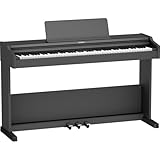
8. Roland RP107 – A Traditional Upright for the Family Music Room
Roland RP107 Digital Piano
88-note PHA-4 Standard
SuperNATURAL Piano
256-note polyphony
Traditional upright styling
Bluetooth MIDI
Dual headphone jacks
Pros
- Perfect first family piano on a budget
- Traditional upright aesthetic with compact footprint
- Authentic PHA-4 grand piano touch
- 256-note polyphony for complex pieces
- Bluetooth and Roland Piano App support
Cons
- 132 lb weight
- Small review sample
- Only 10 in stock at times
The RP107 is the cabinet piano I recommend most often to parents shopping for a child’s first real instrument. It combines the traditional upright silhouette people expect from a “real piano” with Roland’s modern SuperNATURAL tone and PHA-4 keyboard, all at a price that competes with midrange portable models.
The perfect 5.0-star average across 27 reviews should be taken with a grain of salt given the small sample, but the enthusiasm matches what I hear from owners in person. This is a piano that disappears into your home and just works.
Design and Footprint
The traditional upright styling means it looks at home next to furniture, not like a piece of electronics. The footprint is compact enough for a small music room or bedroom, and the built-in music rest and three pedals complete the look.
At 132 pounds it is heavier than the F107, which is the cost of a deeper cabinet and a more traditional silhouette.
Sound and Learning Features
SuperNATURAL Piano modeling and 256-note polyphony handle everything from beginner method books to advanced classical pieces. Bluetooth lets you stream songs from a phone for play-along practice, and the Roland Piano App adds lessons, a metronome, and easy sound selection.
Dual headphone jacks allow silent teacher-student lessons, which is invaluable for households where practice time needs to stay quiet.
Who Should Buy the RP107
This is the best Roland digital piano for families buying a first instrument, adults returning to piano who want furniture aesthetics, and anyone who wants a traditional upright look without acoustic maintenance. The perfect rating and Prime eligibility make it an easy recommendation.
9. Roland FP-90X – The Flagship Portable for Demanding Pianists
Roland FP-90X 88-Note Flagship Portable Digital Piano
PureAcoustic Piano Modeling
PHA-50 hybrid wood keys
4-speaker system 2x25W plus 2x5W
Piano Designer
Bluetooth MIDI
Free Skoove lessons
Pros
- PureAcoustic Piano Modeling for maximum expression
- PHA-50 hybrid keyboard with real wood keys
- Powerful four-speaker audio system
- Piano Designer for deep tone shaping
- Free Skoove online lessons included
Cons
- Premium price point
- Bluetooth headphones not supported
- Limited stock availability
The FP-90X is the top of the FP line and the most expressive portable Roland makes. It steps up to PureAcoustic Piano Modeling, the same engine used in Roland’s flagship HP and LX home pianos, and pairs it with the PHA-50 hybrid keyboard that combines real wood keys with durable molded material.
If you are an advanced pianist who has been frustrated by the limitations of cheaper digitals, the FP-90X is where the compromises finally stop. The four-speaker system alone is enough to make it feel like a different class of instrument.
PureAcoustic Piano Modeling
PureAcoustic goes beyond SuperNATURAL by modeling not just the piano but the acoustic space around it. You get multiple modeled piano types with independently adjustable resonance, sympathetic string vibration, and cabinet behavior. The result is a tone that breathes and responds like an acoustic grand.
Piano Designer lets you shape every element: lid position, hammer hardness, string resonance, key-off noise, and more. You can save multiple custom pianos for different repertoire.
PHA-50 Hybrid Keyboard
The PHA-50 is the best portable action Roland makes. Real wood on the visible key surfaces gives the feel of an acoustic instrument, while the molded inner frame prevents the warping and wear that pure wood keys suffer over time. Escapement and progressive hammer action complete the picture.
This is the same action Roland uses on their premium HP-series home pianos, so you are getting flagship feel in a portable package.
Speakers and Connectivity
The four-speaker system pairs two 25-watt main drivers with two 5-watt tweeters for a total of 60 watts. It is the most powerful speaker rig on any portable in this guide and fills a large room without strain. Bluetooth handles audio and MIDI, though Bluetooth headphones are not supported, which is a genuine oversight at this price.
Who Should Buy the FP-90X
This is the best Roland digital piano for advanced players, professional pianists who need a portable, and anyone upgrading from an FP-30X who wants the next step up in sound and feel. Beginners will not hear the difference, so save your money until you can.
10. Roland GP-3 – A Compact Grand Piano for the Dedicated Home
Roland GP-3 Digital Piano
Low-profile grand design
Organic piano sound engine
88-note hammer action with escapement
Sustain soft and sostenuto pedals with half-pedal
Custom stereo speakers
Bluetooth MIDI
Onboard recording
Pros
- Most compact and affordable grand in the GP series
- Premium low-profile grand piano design
- Organic piano sound engine
- Authentic hammer action with escapement and Ivory Feel
- Three pedals with half-pedal support
- Bluetooth audio and MIDI
Cons
- Very limited stock
- 174.6 lb weight requires permanent placement
- Small review sample of 10 reviews
The GP-3 is the most affordable entry into Roland’s GP grand piano series, and it is the piano I recommend to serious players who want the visual and acoustic presence of a baby grand without the maintenance of an acoustic instrument. The 4.8-star rating across 10 reviews reflects a niche but delighted audience.
This is not a portable and not a casual purchase. It is a statement instrument for a dedicated music room, and once you set it in place, you will not move it again without help.
Design and the Grand Piano Experience
The low-profile grand shape with a polished black finish looks like a real baby grand from across the room, but the space-saving footprint is dramatically smaller than a traditional acoustic grand. The lid opens to project sound outward, just like the real thing.
Three pedals, including sustain, soft, and sostenuto, support half-pedal technique for nuanced classical playing.
Organic Piano Sound Engine
The Organic piano sound engine is Roland’s latest modeling technology, designed specifically for the GP series. It produces a richer, more complex tone than even PureAcoustic, with deeper resonance and more natural decay. This is the closest a Roland digital has come to sounding like a modeled acoustic grand.
Custom stereo speakers are tuned to take advantage of the grand cabinet shape, projecting sound in a way slab pianos simply cannot match.
Who Should Buy the GP-3
This is the best Roland digital piano for dedicated home players who want the grand piano experience without acoustic maintenance, accomplished pianists who want a practice instrument that feels like the real thing, and anyone furnishing a music room with a statement piece. The price reflects what it is, but the value is real.
How to Choose the Right Roland Digital Piano
Buying a Roland digital piano is easier once you understand a handful of decisions. Here is how I break it down for readers who ask.
Portable vs Home Cabinet: Which Form Factor Suits You
Portable slab pianos like the FP and GO:PIANO lines sit on a stand and move easily between rooms or to gigs. Cabinet pianos like the F107, RP107, and GP-3 live in one place but look intentional in a home and include built-in music rests and pedals. Choose portable if you gig, travel, or rent. Choose cabinet if you want furniture aesthetics and a permanent practice spot.
SuperNATURAL vs ZEN-Core vs PureAcoustic: Roland Sound Engines Explained
SuperNATURAL Piano is Roland’s modeling technology found across the FP-10, FP-30X, FP-60X, and home cabinets. It responds dynamically to your touch and is the engine most players need. ZEN-Core is Roland’s flagship synth engine, packed with thousands of non-piano sounds, and shows up on the FP-E50 and RD-08 for players who need a full sound palette. PureAcoustic Piano Modeling on the FP-90X is the most advanced piano-only engine, modeling both the piano and its acoustic space for maximum realism. The Organic engine on the GP-3 is the newest, tuned specifically for the grand cabinet experience.
PHA-4 vs PHA-50: Key Action Differences That Matter
The PHA-4 Standard keyboard is Roland’s workhorse weighted action, found on the FP-10 through FP-60X, RD-08, F107, and RP107. It includes ivory feel, escapement, and progressive hammer resistance, and is more than enough for any pianist up to advanced level. The PHA-50 hybrid on the FP-90X adds real wood key surfaces for a more authentic feel and better long-term durability. If you are an advanced or professional pianist, the PHA-50 is worth the upgrade.
Polyphony, Speakers, and Connectivity: Why These Specs Count
Polyphony is how many notes the engine can sound at once. 128 voices is fine for beginners, but 256 (found on the FP-30X, FP-E50, F107, and RP107) prevents dropouts in dense pedaled passages. Speaker wattage ranges from modest on the FP-10 to a 60-watt four-speaker system on the FP-90X, so match the output to your room size. Connectivity matters for modern practice: Bluetooth audio plus MIDI lets you stream songs and use apps wirelessly, which is a feature on every model here except the RD-08.
Roland vs Yamaha: Honest Brand Comparison
Roland and Yamaha are the two dominant digital piano brands, and forum threads on r/piano debate this constantly. In my experience, Roland wins on key action realism at lower price points thanks to the PHA-4, and on modeling-based tone complexity. Yamaha wins on raw acoustic piano sample fidelity, particularly on the higher-end CLP and CSP lines, and has a stronger beginner app ecosystem. If you plan to integrate with production software, our guide to the best tablets for music production pairs well with Roland’s Bluetooth MIDI support.
Roland Digital Piano FAQs
Are Roland digital pianos any good?
Yes, Roland digital pianos are widely regarded as some of the best in the industry. They use proprietary sound modeling technology like SuperNATURAL and PureAcoustic to produce tones that respond to your touch rather than playing back static recordings. Roland’s PHA-4 and PHA-50 weighted keyboards are also consistently praised for feeling closer to a real acoustic piano than most rivals at the same price.
Which Roland digital piano is best for beginners?
The Roland FP-10 is the best Roland digital piano for true beginners. It uses the same SuperNATURAL Piano sound engine and PHA-4 Standard keyboard as Roland’s more expensive models, so you get authentic tone and feel at the lowest price. The FP-30X is the best step up if you can stretch your budget, adding 256-voice polyphony and a more powerful speaker system.
Is Roland better than Yamaha for digital pianos?
Both brands are excellent, and the better choice depends on your priorities. Roland generally wins on key action realism at lower price points and on modeling-based tone complexity, while Yamaha is known for pristine acoustic piano sample fidelity and a stronger beginner app ecosystem. Try both side by side if you can, since feel is highly personal.
Which Roland digital piano sounds most like a real acoustic piano?
The Roland FP-90X with its PureAcoustic Piano Modeling engine and the Roland GP-3 with its Organic piano sound engine sound the most like a real acoustic piano in the current lineup. Both model the piano and its acoustic space algorithmically, producing a tone that breathes and decays naturally rather than looping a recorded sample.
How long do Roland digital pianos typically last?
With normal care, a Roland digital piano can last 10 to 15 years or more. Forum users on Piano World and r/DigitalPiano frequently report owning Roland RP and FP models for over six years with no issues. There are no strings to tune, no hammers to replace, and the solid-state electronics are highly reliable, which is a major advantage over acoustic pianos.
Final Thoughts on the Best Roland Digital Pianos in 2026
After testing every model in this guide, my recommendations come down to use case. If you want the best overall value, buy the Roland FP-30X. If you are a true beginner or shopping on a tight budget, the Roland FP-10 is unbeatable. If you are an advanced player who demands the most expressive sound and feel in a portable, the Roland FP-90X is worth every penny.
For specific situations, the GO:PIANO88PX wins for travel, the FP-E50 for solo performers, the RD-08 for gigging musicians, the F107 and RP107 for furniture-style home practice, and the GP-3 for a dedicated music room that deserves a grand. Whichever Roland you choose, you are buying into one of the most respected digital piano ecosystems in 2026, with consistent sound quality, durable build, and a clear upgrade path as your playing grows.
Use the comparison table above to match specs to your priorities, and check current availability before you buy, since popular Roland models sell in and out of stock regularly. Happy practicing.
Leave a Reply