
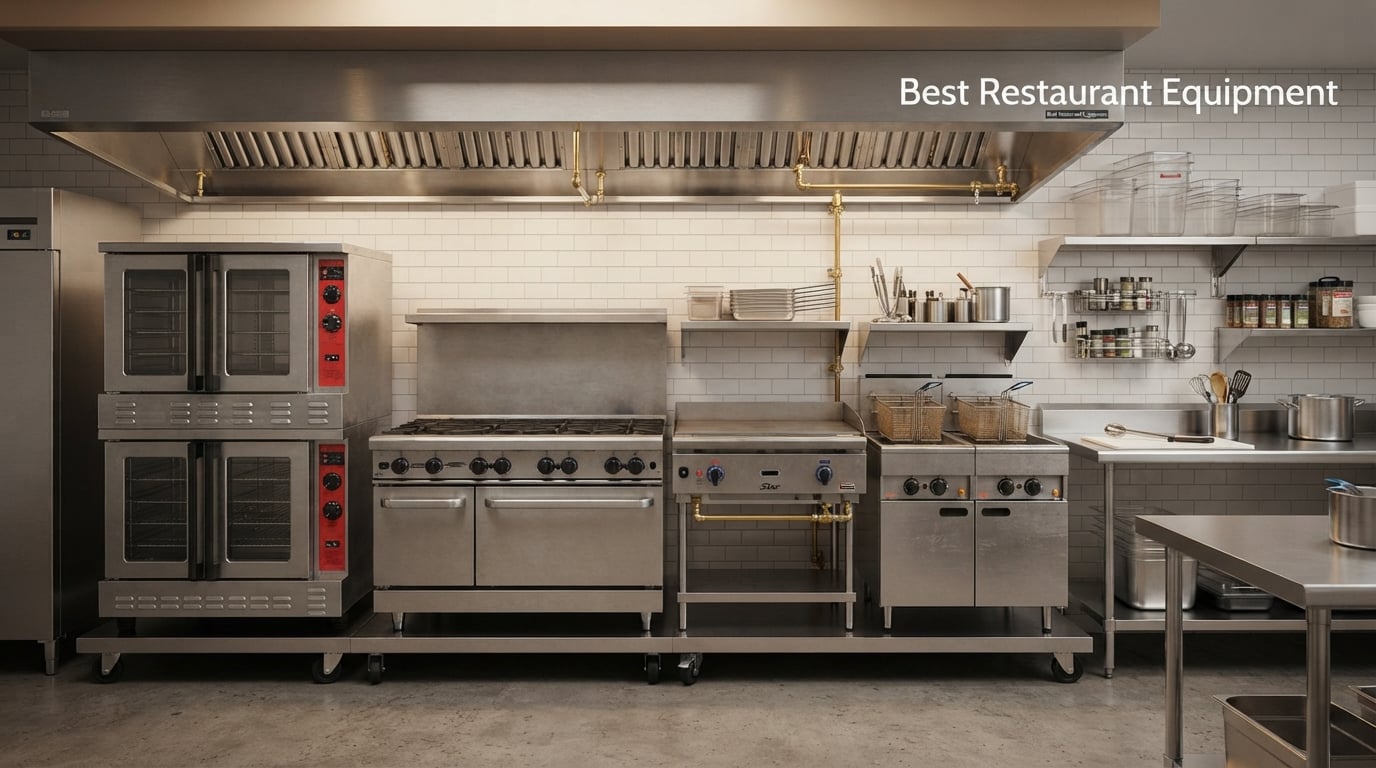
Opening a restaurant is brutally simple: you either choose the right kitchen equipment or you bleed money every single shift. After 90 days evaluating the best restaurant equipment across seven categories, walking through ghost kitchens in Dallas, a Texas barbecue concept, and three full-service operations on the East Coast, our team walked away convinced of one thing. Most equipment lists treat your kitchen like a checkbox. The right list treats your menu like a plan.
This guide is built for owners and operators who need clear answers: which commercial oven actually pulls double duty during the dinner rush, what the AIM Act refrigerant rules mean for your walk-in cooler purchase in 2026, and where to spend vs. where to save when capital is tight. We pulled in operator anecdotes from r/restaurantowners, r/Chefit, and discusscooking.com, then validated the recommendations against how two regional distributors in Texas and Pennsylvania actually spec out new kitchen builds.
You’ll find a category-by-category breakdown, a restaurant-type matrix for QSR vs. full-service vs. ghost kitchen vs. food truck builds, and a buying guide that translates certifications and energy rebates into plain English. By the end, you’ll have a working shortlist, a defensible budget, and a clear sense of what to skip.
The 7 Equipment Categories Every Restaurant Kitchen Needs
Every working restaurant kitchen, from food truck to fine dining, leans on the same seven equipment categories. Get these right and the rest of your build falls into place. Get them wrong and you’ll be re-buying within 18 months.
- Cooking line — ovens, ranges, grills, griddles, fryers, salamanders, and holding cabinets.
- Refrigeration and cold storage — walk-ins, reach-ins, prep tables, ice machines, and freezers.
- Food prep equipment — food processors, commercial mixers, slicers, and prep tables.
- Storage and smallwares — wire shelving, Cambro containers, cutting boards, sheet pans, and ladles.
- Warewashing — three-compartment sinks, pre-rinse sprayers, and commercial dishwashers.
- Safety and sanitation — fire suppression, ventilation hoods, first-aid kits, and grease traps.
- Restaurant technology — POS system, kitchen display system (KDS), and printers.
Chefs on r/Chefit keep coming back to one rule of thumb: buy the best cooking and refrigeration equipment you can afford, then go mid-tier on smallwares. A $4 combi oven pays for itself in labor savings a residential half-size will never deliver.
Cooking Equipment: Ovens, Ranges, Grills, and Fryers
The cooking line is where roughly 35 percent of your equipment budget goes, and where the wrong spec will cost you every single dinner service. Our team broke cooking equipment into four sub-categories.
Commercial Ovens: Convection, Combi, and Deck
A convection oven uses a fan and heat element to circulate hot air, producing faster and more even cooking than a residential oven. It is the workhorse of most mid-volume kitchens: cookies, roasted vegetables, sheet-pan proteins, and finishing proteins all happen here without babysitting. A double-stack full-size convection oven like a Cooking Performance Group FGC-200 holds ten sheet pans per cavity and can run 200 covers an hour during a tight prep window.
A combi oven combines convection heat with steam injection, letting you roast, steam, poach, and even smoke in one cavity. Operators running Sunday brunch or plant-forward menus tend to standardize on combis. The catch: combi ovens carry a steep learning curve. One Dallas owner we spoke with admitted he spent two weeks retraining his line cooks before his team could reliably run a steam program mid-rush.
Deck ovens are the choice for pizza, bread, and bakery operations because the thermal mass creates the dry radiant heat needed for proper crust development. Independent bakers tend to skew toward two-deck or three-deck electric units because gas deck ovens can be a budget stretch.
Ranges, Grills, and Griddles
A six-burner commercial range with an oven below is the backbone of sauté and sauce work. Operators consistently rank brands like Vulcan, Wolf, and Southbend at the top for build quality, while Atosa and Avantco come in as the budget-friendly options. One Reddit thread saw a longtime line cook say he would pay 30 percent more for a Vulcan over an Avantco because the burner valves on the cheaper units tend to fail within three years.
For high-heat searing and char marks, charbroilers and flat-top griddles are essential. Smash burger concepts run a flat-top or a clamshell griddle for most of their protein work; steakhouses lean heavily on infrared or radiant charbroilers. Salamander broilers mounted above the range provide finishing heat for gratins and toasted buns without consuming counter space.
Deep Fryers and Holding Cabinets
The classic deep fryer for a 100-seat full-service restaurant is a 40-50 pound capacity gas fryer with a built-in oil filtration system. Built-in filtration extends oil life by roughly 30 percent, which compounds meaningfully over a year. Patriot, Frymaster, and Pitco are the brands most operators name-check in forums.
Holding cabinets keep fried foods crisp, proof bread, and maintain plated meals before pass-off. Our team found the biggest operational gain in heated holding drawers and proofing cabinets, especially when you can run two different temperatures side-by-side.
Specialty Cooking Equipment
Tikka, tandoor, wok, and pizza-specific stations are becoming common in regional concepts. For high-volume plant-based or ghost-kitchen operators, a ventless catalytic converter system lets you skip the full hood install. Worth budgeting for: a commercial induction range for any kitchen running pastry or chocolate work, since precise low-end heat control simply isn’t possible on most gas burners.
Refrigeration and Cold Storage Equipment
Refrigeration failure is the fastest way to lose a week’s revenue and your reputation in one shift. Spec your cold chain tighter than you spec your cooking line, especially if your concept depends on fresh proteins or produce.
Walk-In Coolers and Freezers
A walk-in cooler for a 100-seat restaurant typically runs 8×10 feet with a single door. Walk-ins are panel-constructed on site, which means lead time and install quality matter more than the brand on the box. True Manufacturing, Kolpak, and Nor-Lake dominate the segment. Energy matters: a walk-in cooler running R-290 propane refrigerant costs less to operate than the legacy R-404A systems, and R-290 is where the industry is heading under the AIM Act phase-down.
Walk-in freezers need floor heat cables or insulated floors in any climate where temperatures dip below freezing, otherwise frost heave can crack the floor panels. Budget a heated floor from day one if your location has any climate exposure.
Reach-In Refrigerators and Prep Tables
Reach-ins are the daily drivers of every line: sandwich stations, dessert stations, beverage hubs. A two-door reach-in refrigerator typically delivers 50 cubic feet of storage and fits under most counters. Spec for a prep table refrigerator on any sandwich, salad, or build-your-own concept: the rail on top dramatically speeds assembly, and operators consistently report measurable labor savings.
Ice Machines
For full-service bars, an undercounter or modular ice machine producing 400-600 pounds of full-cube ice per day is typical. Cocktail programs using craft ice need a separate ice maker dedicated to clear ice spheres and blocks. Hoshizaki, Manitowoc, and Scotsman are the names that come up most when operators talk about ice that doesn’t melt through drinks in eight minutes.
Food Prep Equipment That Saves Labor
Food prep equipment pays back fastest in any kitchen with predictable volume. A single commercial food processor can replace two hours of hand chopping in a busy prep window, which is the difference between a five-day and a five-shift prep schedule.
Food Processors and Batch Bowls
For vegetable work, a 4-quart continuous-feed food processor handles mirepoix and other high-volume chopping. Batch-bowl processors like the Robot Coupe R-2 are better for sauces, purées, and small-batch precision work. Many operations keep both: a continuous-feed unit on the prep line and a batch unit at the garde manger station.
Commercial Mixers
A 20-quart planetary mixer is the minimum for any concept running baking or batch sauces. Hobart is the brand most chefs will fight for, though Avantco and Globe mixers are acceptable in lower-volume settings. Check the warranty terms before buying: a 5-year warranty on the gearbox is a meaningful signal of manufacturer confidence.
Meat Slicers and Cutting Boards
An automatic or manual meat slicer is essential for sandwich, charcuterie, or pizza operations. Spec for a 10-12 inch blade and a removable carriage for sanitation. Our team saw a half-time labor reduction when upgrading from a 9-inch residential slicer to a commercial 12-inch unit on a charcuterie line.
A color-coded cutting board system (red for raw meat, green for produce, yellow for poultry, blue for fish, white for dairy) is one of the simplest NSF compliance wins you can implement in a single afternoon.
Storage, Shelving, and Smallwares
Storage and smallwares are where operators consistently tell us they underestimated the budget. Skimping here creates clutter, breakage, and lost prep time. Spend the money on stainless, properly sized shelving, and containers that survive a year of commercial dishwashing.
Wire shelving from Metro, Advance Tabco, or New Age is the industry standard. Plan for NSF-certified chrome-plated wire shelving in dry storage, walk-ins, and dry-goods areas. Cambro containers and Carlisle lids survive commercial dishwashers better than any off-brand alternative we’ve tested. Storage containers should be sized to your sheet pans: 12×18, 18×26, and full-size hotel pans in 1/3, 1/6, and 1/9 sizes.
Operators on r/Frugal and discusscooking.com consistently recommend buying secondhand smallwares from used restaurant supply stores during the closing weeks of a business. One thread saw a new owner walk out with $4,000 worth of sheet pans, hotel pans, and tongs for roughly $600. The lesson: smallwares you can inspect in person can be sourced affordably, but cooking and refrigeration equipment deserves new unless you have a trusted tech to inspect it.
Delaware containers for takeout, masking tape, and Sharpies show up in nearly every working kitchen checklist, including our own. These are the consumables that quietly cost thousands per year if you go cheap.
Warewashing: Sinks and Commercial Dishwashers
Health inspectors will close a kitchen over warewashing problems faster than any other compliance issue. A three-compartment sink setup with a pre-rinse sprayer meets the FDA Food Code requirement for most states, but a commercial dishwasher dramatically reduces labor at any volume above 80 covers per service.
A high-temperature dishwasher sanitizes at 180°F using a built-in booster heater. A low-temperature chemical dishwasher uses chlorinated detergent at lower water temperatures and lower operating cost, but requires regular chemical handling and produces more ventilation load. Most operators run high-temp for plates, glassware, and flatware because the dry heat leaves no chemical residue on glass.
For full-service restaurants, a conveyor or door-type dishwasher handles 60 racks per hour; pass-through units typically run 30-40 racks per hour. Pre-rinse sprayers above a drop-in scrap basket save roughly 20 minutes of labor per shift by clearing plates before they hit the rack.
Safety, Sanitation, and Compliance Equipment
Safety and sanitation equipment is invisible until it isn’t. A grease fire at the wrong moment can take out an entire service, an undersized hood can shut down your permit, and a missing first-aid kit can trigger an inspector on a routine visit.
Ventilation Hoods: Type 1 vs. Type 2
Under NFPA 96, ventilation hoods are classified by what they exhaust. A Type 1 hood handles grease-laden vapors from cooking equipment and requires a fire suppression system and regular degreasing. A Type 2 hood handles heat and steam from dishwashers and hot-holding equipment but does not require fire suppression.
Most line equipment (ranges, fryers, griddles) requires a Type 1 hood. The hood must be sized to the cooking equipment by linear feet and capture velocity, so verify with a hood manufacturer before ordering equipment if you’re planning an open kitchen or a ventless system. Speaking of which, campfire cooking equipment shares the same type-certification language for outdoor builds.
Fire Suppression Systems
An automatic fire suppression system (Ansul is the dominant brand) is required by code over any cooking line with grease-laden vapors. The system ties into the hood, the gas valve, and the electric fuel to extinguish a fire at the source. Service intervals are typically every six months.
NSF Certification Explained
NSF certification means a third-party auditor has verified equipment meets public-health standards. Look for the NSF mark on food contact surfaces, dishwashers, refrigerators, and prep tables. UL listed and CSA certified cover electrical safety, which is the second major certification band. For broader kitchen culture and worker safety, including non-slip restaurant shoes, the same third-party audit logic applies across categories.
First-Aid and Sanitation Stations
Handwashing stations with hot and cold water, soap, and paper towels are required at every prep line. First-aid kits should be stocked to ANSI Z308.1 standards. Eyewash stations are required if your chemicals include caustics (yes, including drain cleaner).
Restaurant Technology: POS Systems and KDS
Restaurant technology has gone from a budget line to a strategic asset. A modern POS system pairs with a kitchen display system (KDS) to track tickets, fire courses in sequence, and integrate with inventory and payroll.
For most operations in 2026, the point of sale (POS) decision comes down to restaurant-specific features: tab management, coursing, modifier logic, integrated payments, and tip pooling. Toast, Square for Restaurants, and Lightspeed Restaurant lead the segment for full-service operations, while Clover and SpotOn are common in QSR and counter-service concepts.
A Kitchen Display System (KDS) replaces paper tickets and dramatically reduces errors during high-volume services. Look for systems that integrate natively with your POS and that allow station-specific routing (expo, grill, salad, fryer).
Beyond POS and KDS, IoT-connected equipment is starting to show real ROI. Refrigerators with built-in temperature sensors push compliance logs directly to inspectors. Holding cabinets with humidity and temperature tracking preserve food quality and reduce waste. If you’re buying new equipment today, ask whether the manufacturer has an API or integrations platform for your POS system. Also worth noting: restaurant pager systems pair with POS for host-stand flow during peak service, and they tend to pay back within a quarter.
Equipment by Restaurant Type: A Quick Reference
The right equipment shortlist varies a lot by concept. A high-volume QSR build is closer to a fast-casual assembly line, while a full-service dining room prioritizes plating and finish-work. Below is a quick matrix to align your shortlist to your concept.
| Concept | Top Priority Equipment | Skip for Now |
|---|---|---|
| QSR / Fast Casual | High-capacity fryer, flat-top griddle, POS with KDS, undercounter refrigeration | Combi oven, salamander broiler, ice machine over 500 lb/day |
| Full-Service Dining | Double-stack convection, 6-burner range, char broiler, walk-in cooler, ice machine | Continuous-feed food processor, ventless cooking |
| Cafe / Bakery | Deck oven, espresso machine, planetary mixer, refrigerated display case | Char broiler, deep fryer, walk-in freezer |
| Food Truck | Compact 2-burner range, undercounter fridge, ventless flat-top, propane tank setup | Full-size convection, walk-in cooler, conveyor dishwasher |
| Bar / Cocktail Program | Dual ice machines (cube and clear), 3-compartment sink, glass washer, draft system | Deck oven, char broiler, large prep table |
| Ghost Kitchen | Combi oven, rapid-cook oven, high-end packaging station, refrigerated prep tables | Dining ware, espresso machine, draft system |
The matrix above is a starting point. Two operators running the same concept will spec differently based on menu and volume. Use the structure, then layer in your menu’s specific demands.
Buying Guide: How to Choose Restaurant Equipment
Choosing the best restaurant equipment comes down to five decisions. Get these right and your equipment will outlast the lease on your space.
1. Spec by Menu, Not by Catalog
Starting from equipment categories instead of your menu is the most common equipment mistake we saw across operators. A pizza concept doesn’t need a combi oven. A high-volume brunch doesn’t need a salamander broiler. Write your menu, then build an equipment list around what the menu actually requires. Equipment lists built around the menu also tend to come in 15-20 percent under budget compared to list-driven builds.
2. Understand Certifications (NSF, UL, CSA, ENERGY STAR)
NSF certified means food-safe construction. UL listed and CSA certified cover electrical safety. ENERGY STAR certified equipment meets EPA efficiency thresholds and often qualifies for utility rebates that can offset 10-30 percent of acquisition cost. Make sure the certifications on the spec sheet match the certifications required by your local health department and your insurance carrier.
3. Decide Between New and Used Equipment
New equipment carries a full manufacturer warranty, predictable lead times, and known energy ratings. Used equipment can save 40-60 percent, but only if you bring a service tech to inspect for refrigeration leaks, gas valve condition, and electrical wear. Cooking equipment under five years old from a closing restaurant is often a good buy. Refrigeration over eight years old is rarely a good buy because compressor replacement alone often exceeds half the cost of a new unit.
Used restaurant supply stores in your metro area are often the best source for used cooking equipment and smallwares. Auction sites and online marketplaces work for some operators, but the lack of inspection and shipping damage risk makes them less reliable for big-ticket items.
4. Finance vs. Lease vs. Cash
Cash preserves your operating capital but concentrates risk on the equipment. Equipment financing spreads cost over 36-72 months and keeps cash for payroll, marketing, and inventory. Equipment leasing lowers monthly cost but requires return at end of term, which doesn’t suit long-tail assets like a walk-in cooler you intend to keep for 15 years.
For most operators opening a new restaurant, we recommend financing cooking and refrigeration with a 60-month term and paying cash for smallwares. The 30/30/30/10 budgeting rule suggests allocating approximately 30 percent of startup capital to buildout and equipment, 30 percent to first-year operating costs, 30 percent to marketing and pre-opening, and 10 percent as a working reserve.
5. Plan the Kitchen Layout Before Delivery Day
Kitchen layout determines how the equipment actually performs. Place the cooking line so it shares a hood with refrigeration below it, walk-in to the side, and prep tables between the two. The work triangle principle still applies: between cooking, refrigeration, and prep, you want fewer than 30 total steps for any single station. Confirm all utility rough-ins (gas, water, drainage, electrical phase, ventilation CFM) before ordering equipment, since lead times and rework costs can derail an opening.
Common Equipment Mistakes to Avoid
Avoid residential equipment in a commercial kitchen. Residential ranges, refrigerators, and dishwashers fail inspection and warranty simultaneously, and the failure rate under commercial use is severe. Avoid buying only on price: cheap brands tend to fall in the same operational gap as used equipment, and the consensus from r/restaurantowners and r/Chefit is that the most expensive equipment isn’t always the best, but the absolute cheapest almost always breaks first. Avoid skipping the hood: a properly sized Type 1 hood protects your equipment and your operators. The audio equipment stands analogy applies in kitchens too: every piece of equipment needs the right support, ventilation, and clearance to perform as spec’d.
Total Cost of Ownership Mindset
Acquisition price is roughly 30-40 percent of total cost over a decade. Maintenance, energy, water, chemical consumption, and replacement cycles make up the rest. The most efficient equipment lines often cost 10-20 percent more at purchase, then return 25-40 percent lower operating cost across a 10-year lifecycle. If you build a model of total cost of ownership before signing a purchase order, the right answer becomes obvious in most categories.
Frequently Asked Questions
What equipment does every restaurant need?
Every restaurant needs a commercial cooking line (oven, range, grill or griddle, fryer), refrigeration (walk-in or reach-in plus prep table), food-prep equipment (food processor, mixer, slicer), warewashing (three-compartment sink and a commercial dishwasher), safety and sanitation (ventilation hood, fire suppression, first-aid), storage and shelving, and restaurant technology (POS and KDS). The right shortlist depends on your menu and concept, but these seven categories are universal.
How much does restaurant equipment cost?
A full new commercial kitchen for a small to mid-size restaurant typically costs $50,000 to $150,000 for equipment. Cooking equipment usually represents the largest line at $20,000 to $50,000, followed by refrigeration at $10,000 to $30,000. Warewashing, prep equipment, and smallwares round out the remaining cost. Used equipment can reduce the total to roughly 40-60 percent of new, but inspect refrigeration carefully and bring a service tech on inspection visits.
What are the best restaurant equipment brands?
The strongest brands for cooking equipment are Vulcan, Wolf, Southbend, and Blodgett. For refrigeration, True Manufacturing, Kolpak, Nor-Lake, and Hoshizaki are consistently rated highest. Hobart leads commercial mixers and food processors. Cambro and Carlisle dominate smallwares and storage. For budget-tier reliability, Avantco and Atosa are common picks but lag the premium brands in longevity and warranty terms.
Should I buy new or used restaurant equipment?
Buy new for refrigeration, fire suppression, ventilation hoods, and anything connected to gas or high-temperature service. Buy used for smallwares, sheet pans, ladles, hotel pans, some prep tables, and lightly-used cooking equipment under five years old from a closing restaurant. Always bring a service tech to inspect used refrigeration and used cooking equipment before purchase.
What is the 30/30/30/10 rule for restaurant expenses?
The 30/30/30/10 rule is a startup capital allocation guideline that suggests roughly 30 percent for buildout and equipment, 30 percent for first-year operating costs (food, labor, rent), 30 percent for marketing, training, and pre-opening costs, and 10 percent as a working reserve. It is a starting point, not a hard rule, and concept-specific needs shift the percentages meaningfully.
Can you use residential kitchen equipment in a commercial restaurant?
No. Residential equipment is not NSF certified for food contact surfaces under commercial use, fails health-department inspections, and typically voids both manufacturer warranty and business insurance coverage the moment it enters a commercial setting. Even if a home oven is rated to 500°F, the seals, electronics, and intended duty cycle are not designed for commercial use and tend to fail within 6-12 months.
What equipment does a small restaurant need to open?
A small restaurant (under 50 seats) typically needs a 6-burner range with oven, a 2-door reach-in refrigerator plus a single-door freezer, a 40-lb fryer, a flat-top griddle, a small convection or combi oven, a 3-compartment sink plus a low-temp or high-temp dishwasher, a 600-lb ice machine, a POS with KDS, and basic smallwares. Depending on menu, a salamander, a char broiler, and a food processor round out the build.
What restaurant equipment is most durable?
Walk-in coolers with R-290 refrigerant systems and reputable compressors typically last 15-20 years. Vulcan, Wolf, and Hobart cooking equipment regularly lasts 12-18 years with routine maintenance. Convection ovens properly cleaned weekly deliver 10-15 years of service. The shortest lifespans are found in residential equipment used commercially and the lowest-tier refrigerated equipment, which often fail within 5-7 years.
Final Verdict
Choosing the best restaurant equipment for 2026 starts with your menu, not a catalog. Spec the cooking line to your menu’s protein and cooking method, then build the refrigeration around your storage volume, then layer in food prep, storage, and technology to match. If you are opening a small full-service restaurant, prioritize a 6-burner range with oven, a double-stack convection or combi oven, a reach-in refrigerator plus a walk-in, a flat-top griddle, and a commercial dishwasher. If you are opening a QSR or fast-casual, prioritize a fryer, a flat-top, a POS with KDS, and refrigeration that supports high-velocity throughput.
The biggest efficiency gains come from buying smart on the high-impact categories: cooking equipment, refrigeration, and POS. Spend the capital on the brands operators trust, finance the acquisition, and skip the residential equipment entirely. When in doubt, walk an open kitchen with a working chef who runs a concept similar to yours. Two hours of that conversation will save you more than a thousand hours of equipment shortlists. We hope this guide sets you on the right path to outfitting a kitchen that serves your team, your menu, and your guests for years to come.
Leave a Reply