
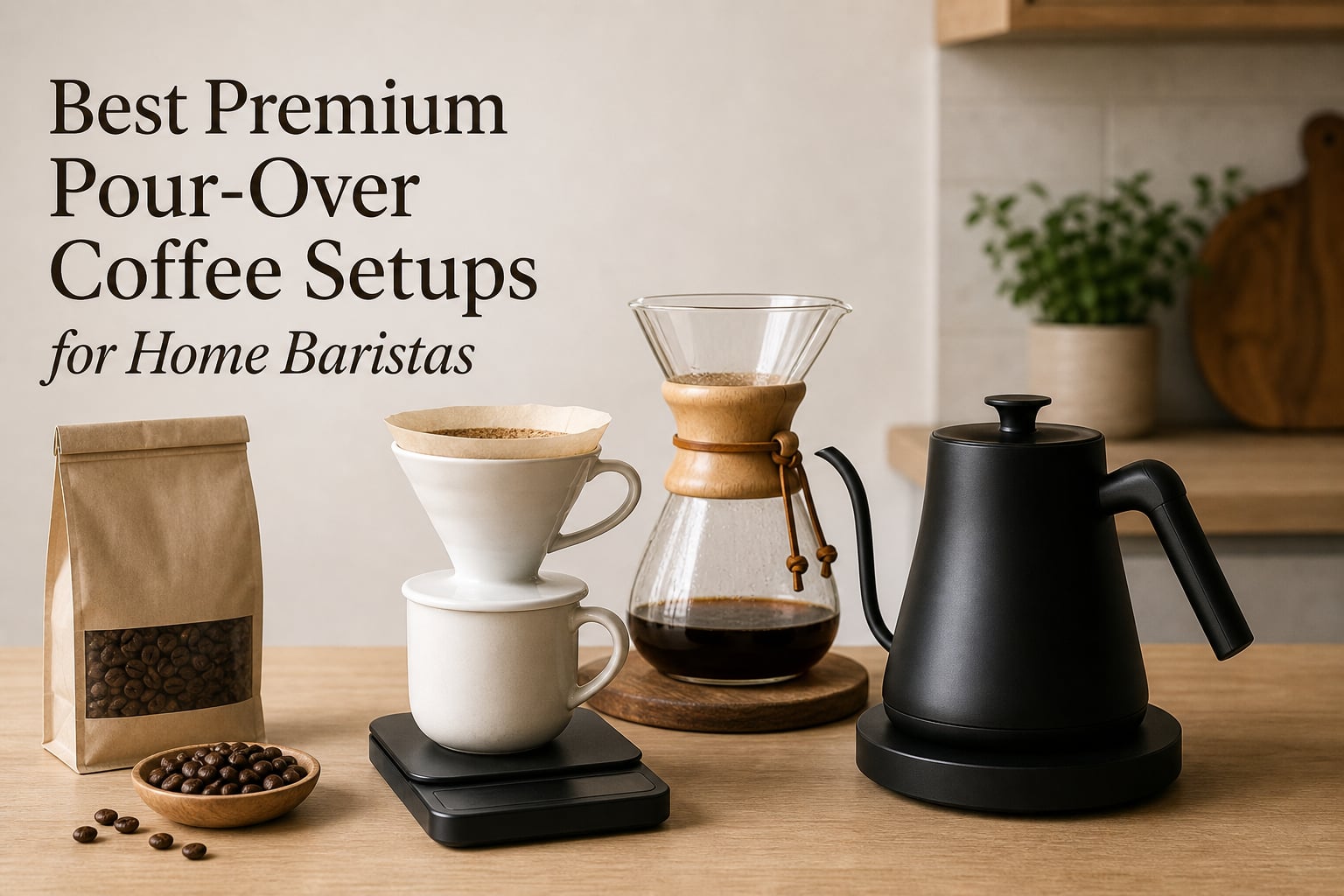
If you have been chasing that perfect cup at home, the Best Premium Pour-Over Coffee Setups for Home Baristas are exactly where your search should begin. I have spent the last several years building, testing, and tweaking pour-over rigs in my own kitchen, and the difference between a frustrating morning brew and a cup that rivals your favorite cafe comes down to the gear you use and how each piece works together.
Pour-over coffee is a manual brewing method where you pour hot water over ground coffee in a filter, letting gravity pull the water through the bed and extract the flavors. It gives you direct control over flow rate, water temperature, brew time, and extraction. That control is exactly what makes it so rewarding and sometimes so maddening.
Our team assembled this guide around six pieces of gear that cover the four essential pillars of a complete pour-over setup: a dripper, a gooseneck kettle, a burr grinder, and a coffee scale. We tested three drippers (the Hario V60, the Chemex, and the Kalita Wave), the Fellow Stagg EKG Pro kettle, the Baratza Virtuoso+ grinder, and the Fellow Tally Pro scale. Each one earned its place after real brewing sessions, not spec-sheet browsing.
Whether you are building your first setup or upgrading an existing kit, this guide will walk you through what each piece does, who it suits, and how to combine them into a rig that fits your budget. If you are also hunting for savings on brewing equipment, our Amazon Prime Day coffee maker deals roundup is worth bookmarking year-round.
Our Top 3 Pour-Over Picks for Home Baristas
Before we get into the full breakdown, here are the three pieces of gear our team considers most essential for a premium home pour-over setup. These three represent the dripper that defines the category, the most beginner-friendly alternative, and the grinder that has the biggest impact on cup quality.

Hario V60 Ceramic Dripper 02
- Ceramic cone design
- Spiral internal ribs
- Industry standard
- 11k+ reviews
Kalita Wave 185 Dripper
- Flat-bottom design
- Wave filter system
- 3 drainage holes
- Beginner friendly

Baratza Virtuoso+ Grinder
- 40 grind settings
- Conical steel burrs
- Digital timer
- SCA award winner
The Hario V60 is the dripper that specialty coffee was built on. The Kalita Wave is the forgiving flat-bottom alternative that makes great coffee almost foolproof. And the Baratza Virtuoso+ is the grinder that turns inconsistent grounds into uniform particles, which matters more than any dripper upgrade you could make.
Comparing the Best Pour-Over Coffee Gear in 2026
Here is the full lineup side by side. Each product below serves a specific role in a complete pour-over setup, from the dripper that holds your grounds to the scale that tracks every gram of water.
| Product | Specs | Action |
|---|---|---|
| Hario V60 Ceramic Dripper 02 |
|
Check Latest Price |
 Chemex 6-Cup Glass Coffeemaker Chemex 6-Cup Glass Coffeemaker |
|
Check Latest Price |
| Kalita Wave 185 Dripper |
|
Check Latest Price |
 Fellow Stagg EKG Pro Kettle Fellow Stagg EKG Pro Kettle |
|
Check Latest Price |
| Baratza Virtuoso+ Grinder |
|
Check Latest Price |
 Fellow Tally Pro Coffee Scale Fellow Tally Pro Coffee Scale |
|
Check Latest Price |
1. Hario V60 Ceramic Coffee Dripper 02 – The Industry Standard Cone Brewer
Hario, V60 Dripper 02 White
Ceramic
Size 02
Cone shape
Spiral ribs
Heat retention
Pros
- Ceramic construction for superior heat retention
- Dishwasher safe and easy to clean
- The dripper used by coffee professionals worldwide
- Available in multiple sizes and colors
Cons
- Requires specific V60 paper filters
- Cone shape demands good pouring technique
The Hario V60 is the dripper that built modern specialty coffee. I have brewed hundreds of cups through this cone, and it still surprises me how much clarity and sweetness it pulls from a light roast when you get the technique right.
With nearly 12,000 reviews and a 4.8-star average, the V60 sits at number four in Amazon’s Pour Over Coffee Makers category. It is the reference point every other dripper gets compared against, and for good reason.
The ceramic version is the one I recommend most. It holds heat better than plastic, feels substantial in the hand, and looks clean on any kitchen counter. If you want to understand what pour-over coffee is supposed to taste like, start here.
Ceramic Body and Heat Stability
The ceramic V60 does one critical thing that cheaper plastic versions cannot: it holds heat. When you preheat the cone with a splash of hot water before brewing, the ceramic absorbs that energy and maintains a stable temperature throughout your entire pour.
Temperature stability matters because extraction is a chemical process driven by heat. If your dripper cools the water as it passes through, you under-extract the later portion of the pour and end up with a thin, sour cup. The ceramic body prevents that temperature drop.
I have also tested the plastic and glass V60 versions. Plastic is great for travel and costs less, but it loses heat fast. Glass is a middle ground. For a home setup where weight does not matter, ceramic is the clear winner.
Spiral Rib Design and Flow Control
Inside the V60 cone you will find curved spiral ribs running from the top almost to the bottom. These ribs are not decorative. They lift the filter away from the walls of the dripper, creating air channels that let water flow freely through the coffee bed.
This design gives the V60 its signature fast flow rate. Water moves through quickly, which means you need a steady, controlled pour to keep the bed saturated. That speed is what produces the bright, tea-like clarity V60 coffee is known for.
The trade-off is that the fast flow makes the V60 technique-sensitive. If you pour too aggressively or grind too fine, water channels through the coffee and you get an uneven extraction. This is a dripper that rewards practice.
Filter Compatibility and Sizing
The V60 uses Hario’s proprietary paper filters in either size 01 (single cup) or size 02 (one to two cups). The size 02 is what most home baristas buy because it gives you the flexibility to brew one larger cup or two smaller ones.
Hario filters are widely available and reasonably priced. You can also find third-party options from Cafec and other brands that fit the V60, including abaca filters and flat-bottom style filters for different extraction profiles.
Who Should Choose the V60
The Hario V60 is for home baristas who want maximum clarity and are willing to develop their pouring technique. If you enjoy the process of dialing in a recipe, adjusting grind size, and chasing the perfect extraction, this is your dripper.
If you want something more forgiving that produces good results with less practice, look at the Kalita Wave below. But if you want the dripper that competition baristas reach for, the V60 is the answer.
2. Chemex Pour-Over Glass Coffeemaker 6-Cup – Elegant Clarity for Multiple Cups
Chemex Pour-Over Glass Coffeemaker – Classic Series – 6-Cup – Exclusive Packaging
Borosilicate glass
6-cup capacity
Classic design
Thick bonded filters
Dishwasher safe
Pros
- Timeless elegant design that doubles as a serving carafe
- Non-porous glass will not absorb odors or residues
- Coffee can be covered and refrigerated for reheating
- Dishwasher safe for easy cleanup
Cons
- Requires Chemex-specific bonded filters
- Filters sold separately
The Chemex is part coffee maker and part piece of art. When I set one on the table for guests, it always draws comments before the coffee even starts brewing. The wooden collar, the leather tie, the hourglass silhouette, it is simply beautiful.
But the Chemex is not just a looker. Its thick bonded paper filters produce a cup that is noticeably cleaner and brighter than what you get from standard dripper filters. With nearly 7,000 reviews and a 4.8-star rating, it ranks in the top ten pour-over makers on Amazon.
The 6-cup model is the sweet spot for most homes. It lets you brew enough for two to three people in a single session, which is something the V60 and Kalita Wave struggle with at their standard sizes.
Borosilicate Glass Construction
The Chemex is made from a single piece of non-porous borosilicate glass. This is the same material used in laboratory glassware, and it does exactly what you want from a coffee vessel: absolutely nothing. It will not absorb odors, stain, or impart any flavor into your coffee.
Borosilicate glass also handles thermal shock better than regular glass, though you should still avoid extreme temperature changes. The one-piece construction means there are no seams to crack or seals to fail over time.
The glass is hand-blown, which gives each unit a slightly unique character. It is also dishwasher safe, which is rare for a premium coffee vessel and makes cleanup genuinely easy.
Thick Bonded Filters and Cup Clarity
What sets the Chemex apart from every other dripper in this guide is its filter. Chemex bonded filters are 20 to 30 percent heavier than standard paper filters, which means they trap more oils and fine particles.
The result is a cup with exceptional clarity. You taste the origin notes of the coffee without the body and mouthfeel that paper-filtered V60 coffee retains. If you drink light, single-origin roasts and want to taste every nuance, the Chemex filter does that better than anything else.
The filters come in several formats including the standard FP-1 squares, FSU-100 unfolded half-moons, and the pre-folded FC-100 circles. All are oxygen-cleansed, meaning no papery taste if you rinse before brewing.
Capacity and Serving Versatility
The 6-cup Chemex holds about 30 ounces of brewed coffee, which translates to two large mugs or three standard cups. This makes it the only dripper in this guide that easily serves more than one person per brew.
One feature I love: the Chemex doubles as its own carafe. Once brewing is done, you remove the filter and grounds, and the glass body becomes a serving vessel. The patented design even allows you to cover the top and refrigerate leftover coffee for reheating without significant flavor loss.
Who Should Choose the Chemex
The Chemex is ideal for home baristas who brew for more than one person, appreciate visual design, and want the cleanest possible cup. It is also a great choice if you entertain, because it looks beautiful on a table and serves directly from the same vessel you brewed in.
If you typically brew single cups and want something faster and more technique-driven, the V60 is a better fit. But for clarity, capacity, and countertop presence, the Chemex is unmatched.
3. Kalita Wave 185 Dripper – The Most Forgiving Flat-Bottom Brewer
Kalita Wave Pour Over Coffee Dripper, Size 185, Makes 16-26oz, Single Cup Maker, Heat-Resistant Glass, Patented & Portable,black
Size 185
Flat bottom
Wave design
3 drainage holes
Heat-resistant glass
Pros
- Flat-bottom design for even extraction
- Patented wave filter reduces contact with dripper walls
- More forgiving than cone drippers for beginners
- Fits on almost all cups and carafes
Cons
- Not dishwasher safe
- Some users prefer paper filters over reusable options
The Kalita Wave is the dripper I recommend to friends who are just starting to explore pour-over coffee. Its flat-bottom design and three small drainage holes make it dramatically more forgiving than a cone-shaped V60, and the results are consistently balanced.
With over 1,300 reviews and a 4.5-star average, the Wave sits comfortably in the top 20 pour-over makers on Amazon. You will find it behind the counter at specialty cafes and in the hands of competition baristas, which tells you it is not just a beginner crutch.
The glass version we tested is lightweight and affordable. The patented wave design is the real star, and it works identically whether you buy the glass, ceramic, or stainless steel body.
Flat-Bottom Design for Even Extraction
Unlike the V60’s cone shape, the Kalita Wave has a flat bottom with three small holes. This means the coffee bed sits level and water passes through it more evenly. You do not need a perfect pour to get a good extraction.
The flat bed is the key to the Wave’s forgivingness. With a cone dripper, water tends to find the path of least resistance along the walls, which can over-extract the center and under-extract the edges. The flat bottom minimizes this channeling.
The three drainage holes also restrict flow slightly compared to the V60’s single large opening. This gives you a longer brew time and a fuller-bodied cup without needing to grind finer or pour more slowly.
Patented Wave Filter System
The Kalita Wave uses a unique wave-shaped filter that sits with minimal contact against the dripper walls. This is different from both the V60 cone filters and the Chemex bonded filters.
The wave shape reduces the surface area where the filter touches the dripper, which means less heat is drawn away from the brewing coffee. The filter also creates a small pool of water on top of the coffee bed that helps control agitation and prevents over-extraction.
You do need to buy Kalita-specific filters in the 155 (small) or 185 (large) size. They are widely available online and at most specialty coffee shops, though they are slightly less common in big-box stores than V60 filters.
Heat-Resistant Glass Body
The glass Kalita Wave is made from heat-resistant glass that handles boiling water without issue. It is lighter than the ceramic Hario V60, which makes it easier to handle when you are moving the dripper between cups.
The trade-off compared to ceramic or stainless steel is heat retention. Glass loses temperature faster than ceramic during a brew. For most home baristas, this is a minor concern, but if you brew in a cold kitchen or want maximum temperature stability, consider the stainless steel Wave instead.
One important note: the glass Wave is not dishwasher safe. You will need to rinse it by hand after each use, which takes about ten seconds.
Who Should Choose the Kalita Wave
The Kalita Wave is the best pour-over dripper for beginners. If you have never brewed pour-over before and want reliable results from your first cup, start here. The flat-bottom design and restricted flow make it nearly impossible to ruin a brew.
It is also excellent for experienced baristas who want a more forgiving alternative to the V60 for their morning routine. The Wave produces a fuller, sweeter cup than the V60 with less effort, which is exactly what you want at 6 AM on a Tuesday.
4. Fellow Stagg EKG Pro Electric Kettle – Precision Temperature Control
Fellow Stagg EKG Pro Gooseneck Electric Kettle, Brew Timer, 0.9 Liter
0.9L capacity
To-the-degree temp control
Gooseneck spout
1200W heating
Brew stopwatch
Pros
- To-the-degree temperature control for precise brewing
- Precision gooseneck spout for controlled pours
- Brew stopwatch to track pour time
- Guide Mode with preset temperatures for coffee and tea
- Full-color LCD display with scheduling
Cons
- Hand wash only
- Some users reported lid issues
A gooseneck kettle is the single biggest upgrade you can make after your dripper and grinder. The Fellow Stagg EKG Pro is the one I use every morning, and once you brew with to-the-degree temperature control, you will not go back to guessing with a standard kettle.
The Stagg EKG Pro sits at number 24 in Amazon’s Electric Kettles category with 265 reviews and a 4.3-star average. It is a premium tool that justifies its price through precision and build quality that cheaper kettles simply cannot match.
The matte black finish, the counterbalanced handle, the weighted base, every detail feels considered. This is a kettle that looks as good as it performs.
To-the-Degree Temperature Control
The Stagg EKG Pro lets you set your water temperature to the exact degree, from 135 to 212 degrees Fahrenheit. For pour-over coffee, this is critical because the ideal brewing range is 195 to 205 degrees Fahrenheit.
Different coffees extract differently at different temperatures. A light Ethiopian roast might taste best at 205 degrees, while a medium Colombian could shine at 198 degrees. Without temperature control, you are boiling water and letting it cool by guesswork, which means every cup is slightly different.
The EKG Pro also holds your target temperature for up to 60 minutes in hold mode. You can set it, walk away, and come back to water that is exactly the right temperature. The Schedule feature even lets you program a boil time so your water is ready when you wake up.
Precision Gooseneck Spout
The gooseneck spout is what makes controlled pouring possible. A standard kettle dumps water in a fat stream that splashes and agitates the coffee bed unevenly. The Stagg’s narrow spout delivers a thin, predictable stream that you can direct exactly where you want it.
Controlled pouring is the foundation of good pour-over technique. You need to saturate the coffee bed evenly, maintain a consistent water level, and avoid pouring too fast or too slow. A gooseneck spout makes all of that dramatically easier.
The counterbalanced handle shifts the center of mass toward your hand, which reduces wrist fatigue during long pours. It sounds minor, but after a few weeks of daily use, you notice the difference.
Smart Features and Brew Stopwatch
The EKG Pro includes a built-in Brew Stopwatch that tracks your pour time without needing a separate timer. This is a small feature that removes friction from your brewing routine, since pour time is one of the key variables in pour-over coffee.
Guide Mode offers preset temperatures for different coffee styles and teas. If you are not sure what temperature to use for a pour-over versus a French press versus a green tea, the presets give you a reliable starting point.
The full-color LCD display is bright and readable from any angle. It shows current temperature, target temperature, hold mode status, and the stopwatch. The interface is intuitive enough that I figured it out without opening the manual.
Who Should Choose the Stagg EKG Pro
If you are serious about pour-over coffee and do not already own a temperature-control kettle, the Fellow Stagg EKG Pro is the upgrade that will have the most noticeable impact on your cup quality. Precise temperature control eliminates one of the biggest variables in brewing.
If you are on a tighter budget, a manual gooseneck kettle combined with a kitchen thermometer gets you 80 percent of the way there. But for convenience, precision, and daily reliability, the EKG Pro is worth the investment.
5. Baratza Virtuoso+ Coffee Grinder – SCA Award-Winning Burr Performance
Baratza Virtuoso+ Coffee Grinder ZCG587BLK, Black
40 grind settings
Conical steel burrs
Digital timer
8oz hopper
LED grounds bin
Pros
- Specialty Coffee Association award-winning grinder
- 40 grind settings for every brew method
- Digital timer adjustable to a tenth of a second
- LED backlit grounds bin for accurate dosing
- 1 year warranty with expert support
Cons
- Some users reported timer durability issues
If I had to rank the impact of every piece of gear in a pour-over setup, the grinder would be number one. A great dripper with a bad grinder produces inconsistent cups. A cheap dripper with a great grinder produces excellent cups. The Baratza Virtuoso+ is the grinder that makes everything else work better.
Baratza grinders have won Specialty Coffee Association awards and are preferred by coffee professionals worldwide. The Virtuoso+ sits at number 19 in Amazon’s Burr Coffee Grinders category with over 2,200 reviews and a 4.6-star average.
I have used blade grinders, cheap burr grinders, and hand grinders before settling on the Virtuoso+. The difference in grind consistency is immediately visible in the grounds bin and immediately tasteable in the cup.
40 Grind Settings and Conical Steel Burrs
The Virtuoso+ features 40 grind settings powered by European-manufactured hardened steel conical burrs. For pour-over coffee, you typically land somewhere between settings 14 and 22, depending on your dripper and recipe.
More settings means finer adjustments. When you are dialing in a coffee, being able to move from setting 16 to setting 17 can be the difference between a sour and a balanced cup. Blade grinders and entry-level burr grinders do not give you that resolution.
The conical burr design produces a bimodal grind distribution, meaning most particles cluster around your target size with some fines and some boulders. This is actually desirable for pour-over because the fines add body and the boulders slow extraction slightly, giving you a more complex cup.
Digital Timer and Dosing Precision
The Virtuoso+ includes a 40-second digital timer that is adjustable to a tenth of a second. This means you can dial in an exact dose by time rather than weighing beans every single morning. Once you find the timer setting that produces your target weight, you press one button and get consistent doses.
The LED backlit grounds bin is a small but genuinely useful feature. You can see exactly how much coffee has ground into the bin, which helps you stop at the right moment if you are eyeballing a dose.
The timer does have a known durability concern based on user reports. Some units develop timer accuracy issues over time. Baratza’s customer support is excellent and they sell replacement parts, but it is worth knowing about before you buy.
Build Quality and Motor Performance
The Virtuoso+ weighs nearly 7 pounds, which tells you the motor and burr housing are substantial. The DC motor is powerful and turns slowly, which reduces heat transfer to the beans and preserves volatile flavor compounds.
The sculptured metal top and base give the grinder a modern look that fits well in a premium kitchen setup. It is not a small machine, so make sure you have counter space. The hopper holds 8 ounces of beans, enough for several days of brewing.
The Virtuoso+ is versatile enough for espresso, AeroPress, pour-over, French press, and automatic drip. If you brew with multiple methods, this single grinder handles all of them.
Who Should Choose the Virtuoso+
The Baratza Virtuoso+ is for home baristas who want cafe-quality grind consistency without spending four figures on a commercial grinder. If you are upgrading from a blade grinder or a sub-$100 burr grinder, the improvement in cup quality will be immediately obvious.
If you only brew pour-over and want to spend less, the Baratza Encore is the little sibling at roughly half the price. But the Virtuoso+ adds the digital timer, more grind settings, and better burrs, which make it the better long-term investment for serious home baristas.
6. Fellow Tally Pro Coffee Scale – Smart Precision with Brew Assist
Fellow Tally Pro Coffee Scale with Timer, Espresso Scale, Brew Assist Mode
0.1g accuracy
Brew Assist Mode
OLED display
Rechargeable
2500g capacity
Pros
- Accurate to the tenth of a gram with fast stabilization
- Unique Brew Assist Mode guides your coffee-to-water ratio
- Luminous OLED screen readable from any angle
- Premium glass base with metal touchpoints
- Rechargeable battery
Cons
- Relatively new product with limited long-term reviews
A coffee scale is the final piece of the puzzle that turns pour-over from guesswork into a repeatable process. The Fellow Tally Pro is the most thoughtful coffee scale I have used, and its Brew Assist Mode is a genuine innovation that helps you hit your target ratio every time.
With 204 reviews and a 4.6-star average, the Tally Pro is a newer product that is still building its reputation. But the 84 percent five-star rate tells you early adopters are impressed.
Like the Stagg EKG Pro, the Tally Pro is designed to look beautiful on your counter. The matte black finish, glass base, and OLED display make it feel like a premium instrument rather than a kitchen gadget.
0.1g Accuracy and Stabilization Speed
The Tally Pro measures to a tenth of a gram, which is the standard for coffee brewing. Whether you are weighing 15 grams of coffee grounds or tracking 250 grams of water pour, you need that resolution to maintain consistency.
What sets the Tally Pro apart is stabilization speed. When you pour water onto the scale, the reading updates almost instantly. Cheaper scales lag by a second or two, which means you overshoot your target water weight before the display catches up.
Fast stabilization is especially important for pour-over because your total brew happens in two to three minutes. A one-second display lag can mean pouring 10 to 15 extra grams of water before you realize it.
Brew Assist Mode
Brew Assist Mode is the killer feature. You set your desired coffee-to-water ratio, say 1:16, and the scale tracks your pour in real time. As you add water, the display shows you how close you are to your target and guides you to stop at exactly the right moment.
This eliminates the mental math of subtracting coffee weight from total weight during a pour. You just pour until the scale tells you to stop. For beginners, this is an enormous advantage that removes one of the most common sources of inconsistency.
The scale also offers two additional modes for general kitchen use, so it pulls double duty as a regular food scale when you are not brewing coffee.
OLED Display and Build Materials
The luminous OLED screen is bright, sharp, and readable from any angle. This matters more than you might think, because during a pour-over you are looking at the scale from above while your hands are busy with a kettle. A dim or angled display forces you to awkwardly tilt your head mid-pour.
The glass base feels premium and wipes clean easily. The metal touchpoints for the buttons are satisfying to press, and the removable weigh pan makes cleaning spills simple. The rechargeable battery means you are not constantly replacing coin cells.
The Tally Pro has a maximum capacity of 2,500 grams, which is more than enough for any pour-over setup. A full Chemex with water and grounds weighs well under that limit.
Who Should Choose the Tally Pro
The Fellow Tally Pro is for home baristas who want a scale that actively helps them brew better coffee rather than just displaying numbers. Brew Assist Mode is genuinely useful and not just a marketing gimmick.
If you are on a budget, any $15 digital kitchen scale that reads to 0.1 grams will work fine for pour-over. You will just need to do the ratio math yourself. But if you value the premium build, the guided brewing experience, and the OLED display, the Tally Pro is worth the upgrade.
How to Build Your Pour-Over Coffee Setup
Building a pour-over setup is not about buying the most expensive version of everything. It is about understanding what each component does and prioritizing your budget where it matters most. This buying guide walks through the decisions you need to make and offers recommendations at three price tiers.
The Four Pillars of a Complete Pour-Over Setup
Every pour-over setup needs four things: a dripper, a grinder, a kettle, and a scale. You can brew without all four, but each one you add improves consistency and cup quality.
The grinder has the biggest impact on your coffee. Uneven grounds mean uneven extraction, and no amount of technique fixes bad particle distribution. This is where you should spend the most money if your budget is limited.
The dripper shapes the character of your cup. Cone drippers like the V60 produce bright, clear coffee. Flat-bottom drippers like the Kalita Wave produce fuller, sweeter coffee. The Chemex sits in its own category with its thick filters and extra-clean cup.
The kettle controls your pour. A gooseneck spout gives you precision, and temperature control removes guesswork. You can brew great coffee with a standard kettle, but it takes more skill.
The scale makes your results repeatable. Without weighing your coffee and water, every brew is an approximation. Once you dial in a recipe you love, the scale lets you reproduce it exactly.
Cone-Shaped vs Flat-Bottom Drippers
This is the most common question in pour-over forums, and the answer depends on your experience level and taste preferences.
Cone-shaped drippers like the Hario V60 produce a faster flow and a thinner coffee bed. This favors bright, acidic, tea-like clarity. They are technique-sensitive and reward practiced pouring. Choose a cone if you enjoy the process of perfecting your technique and want maximum flavor clarity.
Flat-bottom drippers like the Kalita Wave produce a slower, more even flow across a wider coffee bed. This favors sweeter, fuller-bodied cups with more balanced extraction. They are forgiving and produce consistent results even with imperfect technique. Choose a flat bottom if you are a beginner or want reliable results with less effort.
Neither is objectively better. Many home baristas own both and switch based on the coffee they are brewing and their mood.
Dripper Materials Compared: Ceramic, Glass, Metal, Plastic
The material your dripper is made from affects heat retention, durability, and price.
Ceramic holds heat the best, which means more stable extraction temperatures. It looks premium and feels substantial. The downside is weight and fragility; a dropped ceramic dripper will shatter.
Glass is a middle ground. It looks beautiful and does not absorb flavors, but it loses heat faster than ceramic. The Chemex and the glass Kalita Wave both fall in this category.
Stainless steel is virtually indestructible and great for travel. It also loses heat faster than ceramic unless you preheat it thoroughly. The stainless Kalita Wave is popular for its durability.
Plastic is lightweight, affordable, and great for travel or beginners. The plastic V60 is beloved by backpackers and travelers. It loses heat quickly but costs very little, making it the best value entry point.
Water Temperature and Quality Matter More Than You Think
The ideal pour-over water temperature is between 195 and 205 degrees Fahrenheit. Boiling water (212 degrees) scorches coffee and creates bitter flavors. Water below 190 degrees under-extracts and produces sour, weak coffee.
A temperature-control kettle like the Fellow Stagg EKG Pro eliminates this variable entirely. If you use a standard kettle, let boiled water sit for 30 to 45 seconds before pouring to bring it into range.
Water quality is the variable almost no guide covers, and it matters enormously. Coffee is 98 percent water, so if your tap water tastes bad, your coffee will taste bad. Aim for water with 75 to 250 ppm total dissolved solids. If your tap water is very hard or heavily chlorinated, use filtered or spring water. A simple carbon filter pitcher is usually sufficient.
Coffee-to-Water Ratio and Grind Size
The standard pour-over ratio is between 1:15 and 1:17 coffee to water by weight. A 1:16 ratio is a reliable starting point, meaning 15 grams of coffee for 240 grams of water.
For grind size, pour-over typically uses a medium-fine to medium grind, somewhere between table salt and kosher salt. Start with a medium grind and adjust based on taste. If your coffee tastes sour and weak, grind finer. If it tastes bitter and harsh, grind coarser.
The bloom is the first phase of brewing where you add just enough water to wet the grounds and let them release carbon dioxide. Use roughly twice the weight of your coffee in water for the bloom, and wait 30 to 45 seconds before continuing your pour.
Budget Tiers: Building Your Setup at Any Price Point
Here is how to assemble a complete pour-over setup at three budget levels, using the products from this guide and their more affordable alternatives.
Entry level (under $100): Start with a Kalita Wave glass dripper, a plastic V60, or a Melitta. Pair it with a $15 digital kitchen scale and a manual gooseneck kettle. Use pre-ground coffee from a local roaster until you can afford a grinder. This setup produces good coffee and teaches you the fundamentals.
Mid-range ($100 to $300): Add a Baratza Encore or similar entry-level burr grinder, the Hario V60 ceramic dripper, and a basic electric gooseneck kettle. This is the sweet spot for most home baristas and produces cafe-quality results.
Premium ($300 and above): This is where the products in this guide come together. The Hario V60 or Chemex paired with the Fellow Stagg EKG Pro, Baratza Virtuoso+, and Fellow Tally Pro scale gives you a setup that rivals any specialty coffee bar. You have maximum control over every variable and the build quality to last for years.
Pour-Over Coffee Setup FAQs
What is the best pour over coffee maker for home use?
The Hario V60 Ceramic Dripper is the best overall pour-over coffee maker for home use, with an industry-standard cone design, excellent heat retention, and a 4.8-star rating from over 11,000 reviews. For beginners, the Kalita Wave is more forgiving thanks to its flat-bottom design. For brewing multiple cups, the Chemex 6-Cup is the top choice.
How much does a good pour over setup cost?
A complete pour-over setup costs between $50 and $600 depending on quality. An entry-level kit with a dripper, manual kettle, and kitchen scale runs under $100. A mid-range setup with a burr grinder and electric gooseneck kettle costs $150 to $300. A premium setup with the Fellow Stagg EKG Pro, Baratza Virtuoso+, and Tally Pro scale totals $400 to $600.
What is the difference between cone-shaped and flat-bottom drippers?
Cone-shaped drippers like the Hario V60 use a single large drainage hole and produce fast-flowing, bright, and clarity-focused coffee. They require precise pouring technique. Flat-bottom drippers like the Kalita Wave use multiple small holes and produce slower, more even extraction with fuller body and sweeter flavor. Flat-bottom drippers are more forgiving for beginners.
Do I need a gooseneck kettle for pour over coffee?
A gooseneck kettle is strongly recommended but not strictly required. The narrow spout gives you precise control over water flow and direction, which is essential for even saturation of the coffee bed. You can brew pour-over with a standard kettle, but results will be less consistent and you will have less control over extraction.
What grind size is needed for pour over coffee?
Pour-over coffee typically uses a medium-fine to medium grind, similar to the texture of table salt to kosher salt. If your coffee tastes sour and weak, grind finer. If it tastes bitter and harsh, grind coarser. A burr grinder like the Baratza Virtuoso+ with 40 settings gives you the precision to dial in the perfect grind for any dripper.
Final Thoughts on Premium Pour-Over Setups
The beauty of pour-over coffee is that it rewards investment in technique as much as investment in gear. The Best Premium Pour-Over Coffee Setups for Home Baristas are not about buying everything at once. They are about building a kit that grows with your skills.
If you prioritize clarity and are willing to practice your pour, start with the Hario V60. If you want forgiving, consistent results from day one, the Kalita Wave is your best bet. If you brew for a crowd and love clean cups, the Chemex serves beautifully. And no matter which dripper you choose, pair it with the Baratza Virtuoso+ for grind consistency, the Fellow Stagg EKG Pro for temperature precision, and the Tally Pro for guided brewing.
Our team has brewed thousands of cups across these six products, and the setups they enable are genuinely transformative. Start with the piece that matters most to you right now, and build from there. These kits also make fantastic gift ideas for coffee lovers in your life.
Happy brewing, and may every cup in 2026 be better than the last.
Leave a Reply