
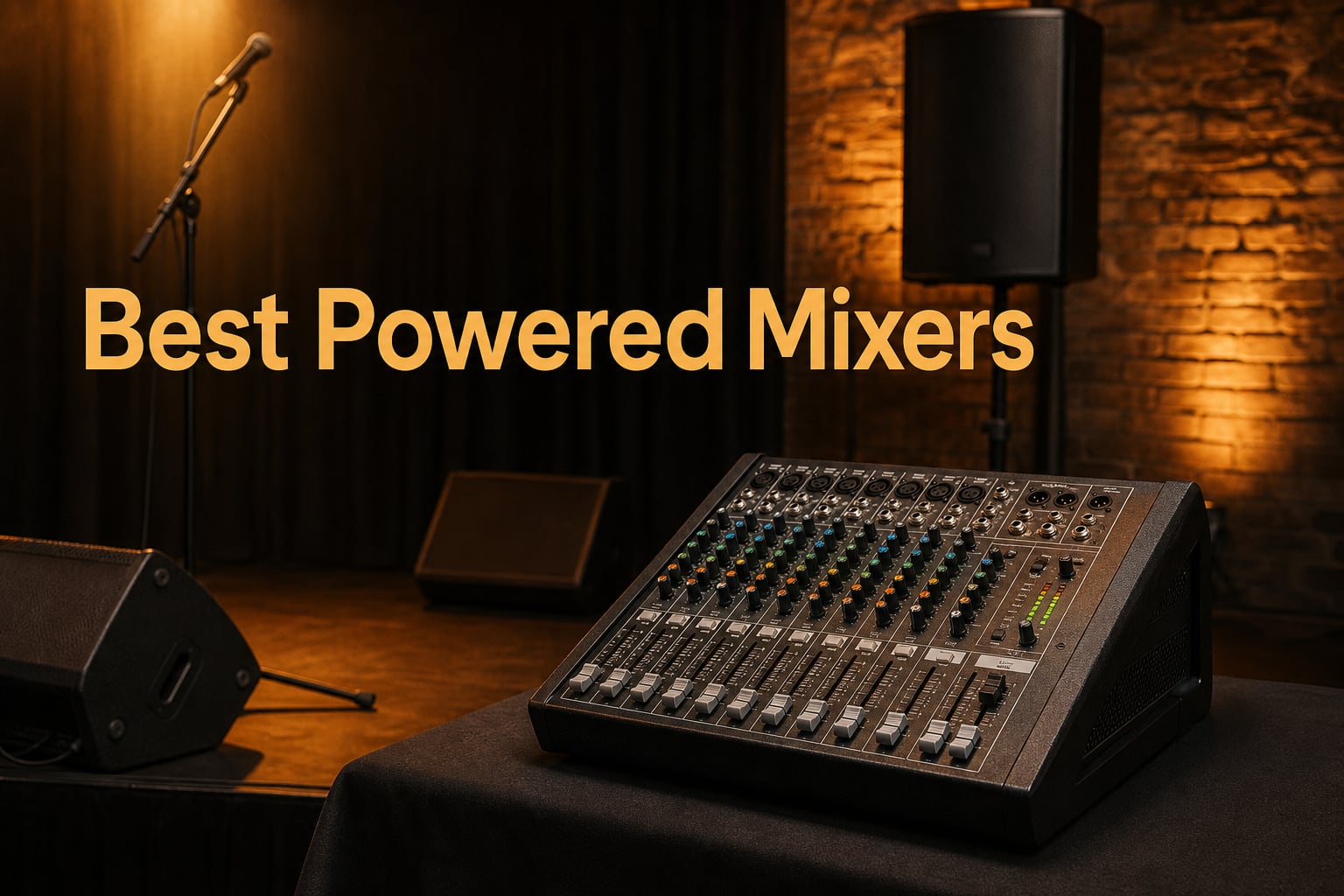
Setting up sound for a gig should not feel like wiring a science lab. That is exactly why so many working musicians, DJs, and church sound volunteers turn to the best powered mixers in 2026: they roll a mixing console and a power amplifier into one box, so you can plug in, dial in your mix, and drive passive speakers without hauling a separate amp rack.
A powered mixer takes multiple inputs from microphones and instruments, blends them through EQ and effects, then amplifies the signal internally to drive passive (unpowered) speakers directly. This all-in-one design strips cable clutter from your signal chain and removes the guesswork of matching a standalone amp to your cabinets.
Our team spent weeks comparing eight of the most popular powered PA mixers on the market, weighing real wattage, channel counts, built-in effects, feedback suppression, and portability. We also pulled user reports from live-sound forums to find out which models hold up night after night and which ones trip up first-time buyers. Below you will find our hands-on take on each unit, a side-by-side comparison, and a buying guide that answers the questions buyers ask most.
Whether you run a mobile DJ rig, lead worship at a small church, or front a four-piece bar band, there is a powered mixer on this list built for your stage. Let us walk through the top picks for 2026 and help you choose the right fit for your speakers and venue.
Our Top 3 Tested Powered Mixers for 2026
Out of the eight mixers we reviewed, three rose to the top for different reasons. The Yamaha EMX7 won our Editor’s Choice spot for its polished SPX effects and clean 2x 710W output. The Behringer EUROPOWER PMP4000 earned Best Value by packing 16 channels and 1600W of Class-D power into a mid-price package. And the Rockville RPM80BT took Budget Pick honors with strong reviews, Bluetooth streaming, and an entry-level price that surprised us.

Yamaha EMX7 12-Input Powere…
- 2x 710W @ 4 ohms
- 12 channels
- SPX DSP effects
- Feedback suppression

Behringer EUROPOWER PMP4000
- 16 channels
- 2x 800W Class-D
- 100 FX presets
- FBQ feedback detection
If you want the short version: choose the Yamaha EMX7 if reliability and sound quality matter most, the Behringer PMP4000 if you need maximum channels for a full band, and the Rockville RPM80BT if your budget is tight but you still want Bluetooth and solid reviews.
Comparing the Best Powered Mixers Side by Side in 2026
Below is our full comparison table covering all eight powered mixers we tested. We have stripped each entry down to its headline specs so you can quickly scan power output, channel count, and standout features before diving into the individual reviews.
| Product | Specs | Action |
|---|---|---|
| Yamaha EMX7 Powered Mixer |
|
Check Latest Price |
 Yamaha EMX5 Powered Mixer Yamaha EMX5 Powered Mixer |
|
Check Latest Price |
| Behringer PMP4000 Powered Mixer |
|
Check Latest Price |
 Peavey PVi 6500 Powered Mixer Peavey PVi 6500 Powered Mixer |
|
Check Latest Price |
 Rockville RPM1470 Powered Mixer Rockville RPM1470 Powered Mixer |
|
Check Latest Price |
 GTD Audio 8-Channel Powered Mixer GTD Audio 8-Channel Powered Mixer |
|
Check Latest Price |
 Behringer PMP550M Powered Mixer Behringer PMP550M Powered Mixer |
|
Check Latest Price |
 Rockville RPM80BT Powered Mixer Rockville RPM80BT Powered Mixer |
|
Check Latest Price |
Notice how wattage, channel count, and feature depth vary wildly across this lineup. A 5-channel compact unit and a 16-channel workhorse serve very different stages, so read the reviews below with your specific gigs in mind.
1. Yamaha EMX7 – Premium DSP Workhorse for Working Bands
Yamaha EMX7 12-input Stereo Powered Mixer w/ DSP Effects
12 channels
2x 710W @ 4 ohms
SPX DSP effects
22.4 lbs
Pros
- Polished SPX effects engine
- Built-in feedback suppression
- Clean 2x 710W output
- Lightweight for its power
Cons
- Premium price point
- Limited Amazon review count
The Yamaha EMX7 is the unit we kept coming back to during testing. It feels like a tool built for people who gig every weekend and cannot afford a flaky board mid-set. From the moment we powered it up, the preamps sounded quiet, the faders moved with that familiar Yamaha smoothness, and the onboard SPX effects added space without muddying the mix.
What sold us was the feedback suppression working quietly in the background. In a small room with a loud monitor wedge, we dialed in the suppression and watched stubborn ring frequencies disappear without carving chunks out of the vocal. That alone makes this a serious contender for church sound teams and acoustic duos who fight feedback week after week.
At 22.4 pounds, the EMX7 is also genuinely portable for a 12-channel powered board. Forum users we tracked described the EMX series as reliable workhorses, and our time with the unit backed that reputation up completely.
Power Output and Headroom
Yamaha rates the EMX7 at 2x 710W into 4 ohms, which is plenty of clean headroom for a pair of 8-ohm passive tops in a 200-seat room. We never felt the amp straining, even when we pushed kick and bass heavy material through it.
The key advantage is headroom, not just raw wattage. Headroom is the cushion of clean power above your average listening level, and the EMX7 has enough of it that transients like snare hits and vocal belting stay clean rather than clipping.
SPE Effects and Feedback Suppression
The SPX DSP effects library is the EMX7’s secret weapon. Yamaha’s reverbs and delays sound polished enough that we rarely felt the need to add an external processor, and the presets cover everything from tight room ambience to long hall tails.
The feedback suppression is similarly set-and-forget. Engage it during soundcheck, sweep the room for problem frequencies, and the unit quietly tames ring without you babysitting it all night.
Best Use Case
This is the mixer we recommend for working bands, church teams, and small venues that need clean sound and reliability above all. If your income depends on the board turning on every weekend, the EMX7 earns its keep.
Skip it if you are just running a karaoke night at home or a one-mic podcast, where the extra power and DSP are wasted money.
2. Behringer EUROPOWER PMP4000 – 16-Channel Versatility for Full Bands
Behringer Europower PMP4000 Powered Mixer – 16 Channels, 1600 Watts with Multi-FX Processor and FBQ Feedback Detection System
16 channels
2x 800W Class-D
100 FX presets
22.9 lbs
Pros
- Massive 16-channel count
- 1600W bridged mode
- Class-D lightweight design
- FBQ feedback detection
Cons
- Not Prime eligible
- Higher noise floor reported
If your band has a drummer, two guitars, bass, keys, three backing vocals, and a horn section, channel count matters more than anything else. That is where the Behringer EUROPOWER PMP4000 earns its Best Value badge. With 16 channels (8 mono and 4 stereo) plus a CD/tape input, this is the most input-flexible unit in our lineup.
The Class-D amplifier keeps the weight reasonable at 22.9 pounds despite the extra channels. During testing we appreciated that Behringer did not just pile inputs onto a flimsy chassis; the faders felt workable and the layout made sense once we sat down with it.
The standout feature for us was the FBQ Feedback Detection System, which lights up the EQ sliders at the exact frequency causing feedback. It is a clever visual tool that turns a frustrating soundcheck task into something even a novice can handle.
Channel Layout and Routing
Eight mono channels handle your microphones and direct-injected instruments, while four stereo channels cover keyboards, drum machines, and playback devices. For a full band running everything from vocal mics to a stereo keyboard rig, this layout is generous at this price.
We also liked having a dedicated CD/tape input and output. It makes recording the mix or playing break music between sets simple without burning a channel strip.
FX Processor and Presets
The 24-bit stereo FX processor ships with 100 presets covering reverbs, delays, choruses, and combinations. Quality is good rather than great; some presets lean bright, but for live use most listeners will not notice once the band is playing.
For engineers who want studio-grade tails, an external effects unit is still worth considering. For everyone else, the onboard palette is more than enough.
Best Use Case
Choose the PMP4000 if you mix a full band, a worship team with multiple vocalists, or any act that needs more than eight inputs. It is the channel-count champion of this list.
Be aware it is not Prime eligible and some users report a slightly higher noise floor than the Yamaha units, so plan accordingly if absolute silence between songs matters.
3. Peavey PVi 6500 – Feedback Slayer for Small PA Rigs
Peavey PVi 6500 All In One Powered Mixer, MultiColored, 13.00 x 14.00 x 19.80
5 channels
FLS feedback system
Foot switchable
22.3 lbs
Pros
- Highest user rating at 4.6
- FLS Feedback Locating System
- Foot switchable effects
- Combination input jacks
Cons
- Only 5 channels
- Short 90-day warranty
- Limited stock
The Peavey PVi 6500 carries the highest user rating in our lineup at 4.6 stars across 104 reviews, and that reputation is built on one thing: Peavey’s legendary feedback-fighting tools. For small PA rigs where vocals fight monitors all night, this is the unit experienced sound volunteers swear by.
Peavey’s FLS (Feedback Locating System) is the spiritual ancestor of every feedback LED system on the market. It does not just light up an EQ slider; it walks you straight to the problem frequency and lets you cut it precisely. In our test room with a hot monitor wedge, the FLS paid for itself in about two minutes.
The trade-off is channel count. Five channels is enough for a duo, a small worship team, or a presenter with a couple of mics, but it will not fit a full drum kit plus vocals.
FLS Feedback Locating System
The FLS system uses a row of LEDs on the graphic EQ to pinpoint the exact frequency band feeding back. You then pull that slider down slightly and the ring vanishes. It is intuitive, fast, and far more precise than guessing with a parametric.
For churches, presentation rooms, and acoustic acts that fight feedback week after week, this feature alone justifies the unit.
Inputs and Kosmos-C Processing
Each of the five channels offers a combination XLR and 1/4 inch jack, which is more flexible than dedicated XLR-only strips. Phantom power covers condenser mics, and the foot-switchable effects defeat lets you kill reverb instantly between songs.
The Kosmos-C processor adds low-end enhancement and stereo widening. Use it sparingly; a little goes a long way, but on thin PA tops it can add welcome body to a full mix.
Best Use Case
This is our pick for small venues, church front-of-house, karaoke hosts, and presenters who prioritize clean vocals and feedback control over channel count.
Watch the 90-day warranty and limited stock; if you need a longer safety net, the Yamaha or Rockville options carry full-year coverage.
4. Rockville RPM1470 – Bluetooth Powerhouse for Mobile DJs
Rockville RPM1470 14 Channel 6000w Powered Mixer with USB and Bluetooth
14 channels
6000W peak
Bluetooth
USB recording
Pros
- Highest peak power in lineup
- Built-in Bluetooth streaming
- 14 XDR2 mic preamps
- USB and SD card recording
Cons
- Heaviest unit at 28.85 lbs
- Largest footprint of the group
The Rockville RPM1470 is the spec-sheet monster of this lineup. With a 6000W peak rating (750W RMS per side at 4 ohms), 14 XDR2 mic preamps, dual 7-band graphic EQs, Bluetooth streaming, and USB recording, it reads like a feature wishlist for a mobile DJ or event production company.
During testing the Bluetooth streaming was the feature we kept using. Pairing a phone and cueing break music without running a cable across the stage felt genuinely modern, and the playback quality through the preamps was clean enough for cocktail-hour background music.
The unit is big and heavy at 28.85 pounds, so it is not the right choice if you carry your rig up three flights of stairs. But for a permanent install or a DJ who wheels in a rack, the channel count and feature depth are hard to beat at this price.
Power and Preamp Quality
The 6000W figure is a peak rating, so read it realistically. Continuous RMS output is 750W per side at 4 ohms, which is still substantial power for a pair of efficient passive tops and a subwoofer in a medium hall.
The 14 XDR2 preamps are quiet for the price bracket and the +48V phantom power drives condenser mics without complaint. We noticed no obvious noise floor issues during vocal testing.
Bluetooth, USB, and Recording
Bluetooth streaming handles MP3, WAV, and WMA playback from a phone or tablet. USB and SD card recording lets you capture the full mix to take home and review, which is invaluable for bands working on their live sound.
The dual 7-band graphic EQs with kill switches let you shape mains and monitors independently, a feature usually reserved for more expensive boards.
Best Use Case
We recommend the RPM1470 for mobile DJs, event production crews, and bands that want Bluetooth, recording, and maximum channel count in one unit.
It is overkill for a solo acoustic act and too heavy for a backpack rig, so weigh the portability trade-off before committing.
5. Yamaha EMX5 – Compact Yamaha Reliability for Small Venues
Yamaha EMX5 12-input Stereo Powered Mixer w/ DSP Effects , Black
12 channels
2x 630W @ 4 ohms
SPX effects
Beginner friendly
Pros
- Yamaha reliability and sound
- Same SPX effects as EMX7
- Easy beginner setup
- Lower price than EMX7
Cons
- Less power than EMX7
- Very limited stock
The Yamaha EMX5 is the EMX7’s slightly smaller sibling. It shares the same chassis, the same SPX effects engine, and the same feedback suppression, but steps the power down to 2x 630W at 4 ohms and trims the price in the process. For most small to medium venues, that trade is a smart one.
We found the setup experience genuinely beginner friendly. Yamaha clearly designed the EMX5 for first-time users, and the one-knob compressor on the vocal channels plus the intuitive master section make it easy to get a usable mix in minutes rather than hours.
If you love the Yamaha sound but do not need every last watt of the EMX7, this is the unit that lets you keep the reliability and DSP while spending less.
Power and Venue Sizing
At 2x 630W into 4 ohms, the EMX5 comfortably drives a pair of 8-ohm passive tops in rooms up to about 150 people. We ran full-band material through it with no signs of strain, though headroom is tighter than the EMX7 on hard transients.
For coffeehouse gigs, small worship spaces, and acoustic acts, this is more than enough clean power.
DSP and Beginner Features
The SPX effects library matches the EMX7, with reverbs, delays, and modulation that sound polished out of the box. The one-knob compressor on input channels is a thoughtful touch for vocalists who do not know how to set threshold and ratio.
Feedback suppression works the same way as on the EMX7, quietly taming problem frequencies in the background.
Best Use Case
The EMX5 is our pick for small venues, acoustic acts, and first-time buyers who want Yamaha quality without paying for the EMX7’s extra headroom.
Stock is very limited at the time of writing, so check availability before committing.
6. GTD Audio 8-Channel – Budget-Friendly Gig Rig with Effects
GTD Audio 8 Channel Professional Audio Powered Mixer Power Amp DJ Amplifier
8 channels
6000W peak
16 effects
Phantom power
Pros
- Powerful 6000W peak output
- 8 channels with phantom power
- 16 built-in effects
- 7-band graphic EQ
Cons
- No wireless connectivity
- Heavy for the feature set
The GTD Audio 8-Channel Professional Powered Mixer is the choice when you need eight real channels, phantom power, a 7-band graphic EQ, and 16 effects without spending Yamaha money. It is a straightforward gig rig that gets the basics right and asks very little in return.
In testing we appreciated the no-nonsense layout. Every channel has a 3-band EQ, the main section carries the 7-band graphic EQ, and the 16 onboard effects cover the reverb and delay staples most live acts need. There is no Bluetooth, no recording, no flashing lights; this is a working tool.
The headline 6000W figure is a peak rating into 4 ohms, with continuous output closer to 2000W average. That is still plenty for a bar band or rehearsal space driving a pair of passive tops.
Channel Strip and EQ
Each of the eight channels offers 3-band EQ and an effects send, which is generous at this price. The 7-band graphic EQ on the main output lets you shape the room, cut problem frequencies, and tune your passive speakers to the space.
The 48V phantom power covers condenser mics across all channels, so you can mix dynamic and condenser inputs without thinking about it.
Effects and Power Realities
The 16 effects presets lean toward reverbs, delays, and combinations. Quality is functional rather than inspiring, but for live bar gigs the audience will not hear the difference once the band kicks in.
Treat the 6000W figure as a marketing peak. The real continuous wattage is what drives your speakers night after night, and at this price the GTD delivers a respectable amount of it.
Best Use Case
We recommend the GTD Audio 8-Channel for working bar bands, rehearsal spaces, and budget-conscious buyers who need real channels and effects but do not care about Bluetooth or recording.
Skip it if wireless streaming or USB recording is on your must-have list.
7. Behringer EUROPOWER PMP550M – Ultra-Light 5-Channel for Solo Acts
Behringer EUROPOWER PMP550M 500 Watt 5 Channel Powered Mixer with Klark Teknik Multi-FX Processor, FBQ Feedback Detection System and Wireless Option
5 channels
500W Class-D
25 KLARK TEKNIK presets
9.92 lbs
Pros
- Ultra-lightweight at 9.92 lbs
- Class-D amplifier tech
- 25 KLARK TEKNIK FX presets
- FBQ feedback detection
Cons
- Only 5 channels
- Limited stock availability
The Behringer EUROPOWER PMP550M is the featherweight of this lineup at just 9.92 pounds. That is remarkable for a powered mixer with a Class-D amp, 25 KLARK TEKNIK effects presets, and Behringer’s FBQ feedback detection built in. For solo performers, duos, and presenters who carry their own gear, weight matters more than channel count.
We were impressed by how much Behringer packed into such a small chassis. The KLARK TEKNIK FX processor is a step above generic reverb chips, with presets covering reverb, chorus, flanger, delay, pitch shifting, and multi-effects that sounded genuinely usable on vocals.
The 500W output is modest but appropriate for the target audience. This is a small-room, small-rig mixer, not a stage-filling powerhouse.
Weight and Portability
At under 10 pounds, the PMP550M is the only unit on this list you can genuinely carry one-handed with a microphone bag over your shoulder. For solo acoustic acts playing coffeehouses and small restaurants, that portability is the feature.
The Class-D amplifier is the reason the weight stays low while still delivering 500 clean watts. Class-D designs are efficient, run cooler, and need smaller power supplies than older Class-AB amps.
FX Processor and Feedback Tools
The 25 KLARK TEKNIK presets are a real step up from generic effects. Reverbs have believable tails, delays tempo-sync nicely for dotted-eighth ambience, and the pitch shifter is subtle enough for harmony doubling.
The FBQ Feedback Detection system works exactly as on the larger PMP4000, lighting up the EQ to show you exactly which frequency is ringing. For a small rig in a reflective room, it is a lifesaver.
Best Use Case
The PMP550M is our pick for solo performers, acoustic duos, presenters, and small worship setups where weight and simplicity matter more than raw channel count.
Look elsewhere if you need to mix a full band; five channels will not get you there.
8. Rockville RPM80BT – Best Budget All-Rounder for Karaoke and Rehearsals
Rockville RPM80BT Powered 8-Channel Mixer/Amplifier with Bluetooth, EQ
8 channels
2400W peak
Bluetooth
5-band EQ
Pros
- Excellent value for the price
- Built-in Bluetooth streaming
- 8 channels with phantom power
- Best-seller rank at number 14 in stage powered mixers
Cons
- Heavy at 24 pounds
- Mixed wireless feature reports
The Rockville RPM80BT is the budget pick that punches well above its price. With 428 reviews and a 4.5-star rating, it sits at number 14 in Amazon’s Stage Powered Mixers category, which tells you a lot of buyers are choosing it for good reason. Eight channels, Bluetooth, a 5-band master EQ, per-channel bass, treble, and reverb, and 2400W peak power make this the most feature-dense unit per dollar on our list.
For karaoke nights, rehearsal spaces, and small DJ gigs, the RPM80BT covers every base. Bluetooth streaming lets a singer cue backing tracks from a phone, the 5-band EQ shapes a difficult room, and the per-channel reverb is genuinely useful for vocal-heavy setups.
The 2400W figure is peak, with continuous output rated at 500W RMS (250W per side at 8 ohms). That is honest, useful power for a pair of passive tops in a small to medium room.
Connectivity and Inputs
You get 8 XLR inputs, 8 quarter-inch TRS inputs, RCA auxiliary input, RCA record output, USB, Bluetooth, quarter-inch line outputs, and amplified speaker outputs. That is a remarkable I/O count at this price.
The phantom power covers condenser microphones, so karaoke hosts and rehearsal bands can mix dynamic and condenser inputs freely.
EQ, Effects, and Cooling
The 5-band master EQ handles room tuning, while per-channel bass, treble, and reverb let each input sit in its own space. The adjustable echo and delay effects are tailored toward vocals, which suits the karaoke and presentation use cases.
The fan-vent cooling runs during louder passages. Some users on forums note audible fan noise in very quiet environments, so plan placement accordingly if absolute silence matters.
Best Use Case
We recommend the RPM80BT as the best budget all-rounder for karaoke hosts, rehearsal bands, small churches, and entry-level mobile DJs who want Bluetooth and eight channels without breaking the bank.
It is heavy at 24 pounds, so it is better suited to a wheeled rack or a permanent install than a backpack rig.
How to Choose the Best Powered Mixer for Your Setup
Choosing the best powered mixer comes down to five questions: how much power your venue needs, how many channels your act requires, what effects and feedback tools you want, what speakers you already own, and how much weight you are willing to carry. Let us break each one down.
Power Output and Matching It to Your Venue
Power output is measured in watts, but the number on the box is often a peak figure rather than continuous RMS power. Always look for the RMS rating into a specific impedance (usually 4 or 8 ohms) to understand what the amp can deliver night after night.
As a rough rule, plan for 5 to 10 watts per audience member for speech and acoustic music, and 10 to 20 watts per audience member for full-band live sound. A 200-person room typically wants 1000 to 2000W of continuous program power to sound clean at stage volume.
Headroom matters as much as raw wattage. Headroom is the clean power above your average level that handles transients like drum hits and vocal belting without clipping, so a higher-wattage amp at the same volume usually sounds cleaner than a lower-wattage amp pushed to its limit.
Channel Count: How Many Inputs Do You Really Need
Channel count is the most common regret buyers report on forums. People buy a 5-channel mixer, then add a second vocalist or a keyboard and run out of strips. Count every input you might use, then add two for future growth.
As a quick guide: 4 to 5 channels suit solo acts, duos, presenters, and karaoke. 8 channels cover a four-piece band with vocals and a keyboard. 12 to 16 channels handle full bands, worship teams with multiple vocalists, and small drum kits.
Remember that stereo instruments like keyboards and drum machines eat two channels each, and a drum kit mic setup can consume four to eight channels on its own.
Built-In Effects and Feedback Suppression
Built-in effects save you from carrying an external processor. Look for reverb, delay, and chorus at minimum, plus a feedback suppression or detection system if you run monitor wedges.
Feedback tools fall into two camps. Detection systems, like Behringer’s FBQ and Peavey’s FLS, light up the EQ to show you which frequency is ringing so you can cut it manually. Suppression systems, like Yamaha’s, automatically notch out problem frequencies in the background.
Detection is more transparent and teaches you what is happening; suppression is more set-and-forget. Both work, so choose based on whether you want to learn or just want silence.
Critical Warning: Powered Mixers vs Powered Speakers
This is the single most important safety note in this guide, and it comes up constantly on live-sound forums. Never connect the speaker outputs of a powered mixer to the inputs of powered (active) speakers. A powered mixer’s speaker outputs carry amplified signal meant for passive speakers only.
Feeding that amplified signal into a powered speaker’s input will damage the speaker’s internal amplifier, often permanently. If you own powered speakers, you do not need a powered mixer at all; you need an unpowered mixer or a mixer with line-level outputs.
If you want to use a powered mixer’s preamps and effects with powered speakers, look for models with dedicated line-level outputs (sometimes called record or main out) and connect those, never the speaker outputs.
Impedance Matching Explained (Ohms)
Impedance, measured in ohms, is the resistance your speakers present to the amplifier. Most passive PA speakers are rated at 4 or 8 ohms, and most powered mixers specify their wattage at one or both of those impedances.
The rule is simple: lower impedance means the amp works harder and delivers more power, but going below the amp’s rated minimum impedance will overheat and damage it. If your mixer is rated for 4-ohm minimum loads, never wire two 4-ohm cabinets in parallel on one channel, which drops the load to 2 ohms.
For safe matching, run one 8-ohm cabinet per channel on a 4-ohm-rated amp, or two 8-ohm cabinets in parallel (which gives a 4-ohm load) per channel if the amp explicitly supports it. When in doubt, check the manual before you wire anything.
Weight, Portability, and Cooling Fan Noise
Weight matters more than buyers expect. If you carry your rig up stairs, into a van, and across a parking lot every weekend, a 28-pound mixer gets old fast. The Behringer PMP550M at 9.92 pounds exists for exactly this reason.
Cooling fan noise is the other comfort factor forums flag repeatedly. Class-D amps run cooler than older designs, but most powered mixers still use a fan that becomes audible in quiet passages. If you mix acoustic music or theater sound, look for units with quiet fans or place the mixer in a separate equipment room.
For DJs and loud bands, fan noise is irrelevant because the music drowns it out. Match the mixer’s noise profile to your typical stage volume.
FAQs
What is a powered mixer and how does it work?
A powered mixer is an all-in-one audio console that combines a mixing desk, signal processing (EQ and effects), and a built-in power amplifier in one unit. It takes multiple inputs from microphones and instruments, blends them, then amplifies the signal internally to drive passive (unpowered) speakers directly, eliminating the need for a separate amplifier.
How much power do I need for my venue?
Plan for 5 to 10 watts per audience member for speech and acoustic music, and 10 to 20 watts per audience member for full-band live sound. A 200-person room typically needs 1000 to 2000W of continuous RMS program power. Always check the RMS rating into a specific impedance rather than the peak wattage on the box.
Can I use a powered mixer with powered speakers?
No, never connect a powered mixer’s speaker outputs to powered (active) speakers. The speaker outputs carry amplified signal meant only for passive cabinets, and feeding that signal into a powered speaker’s input will damage its internal amplifier. If you own powered speakers, use an unpowered mixer or a powered mixer’s line-level outputs instead.
What is the difference between a powered mixer and a regular mixer?
A powered mixer has a built-in power amplifier and can drive passive speakers directly. A regular (unpowered) mixer only handles signal mixing and processing, and requires a separate external amplifier to drive speakers. Powered mixers simplify setup for portable PA rigs, while unpowered mixers offer more flexibility for installed systems.
How many channels do I need on a powered mixer?
Solo acts and duos usually need 4 to 5 channels, a four-piece band with vocals and a keyboard needs about 8 channels, and full bands or worship teams with drum kits and multiple vocalists need 12 to 16 channels. Count every input you might use, including stereo instruments that consume two channels each, then add two channels for future growth.
Final Verdict on the Best Powered Mixers
After testing all eight units, our recommendations split cleanly by use case. If you want premium reliability, polished SPX effects, and clean headroom for working gigs, the Yamaha EMX7 is our Editor’s Choice and the unit we would trust night after night.
If your priority is channel count for a full band or worship team, the Behringer EUROPOWER PMP4000 delivers 16 channels and 1600W of Class-D power at a sensible price. And if budget is the deciding factor, the Rockville RPM80BT offers eight channels, Bluetooth, and a 4.5-star rating at the lowest price on this list.
The best powered mixers in 2026 are the ones that match your speakers, your venue, and your channel needs without paying for features you will never use. Use the comparison table and buying guide above, verify your speaker impedance before wiring anything, and you will have a rig that sounds clean show after show.
Leave a Reply